2019 Shikoku Pilgrimage: Kochi

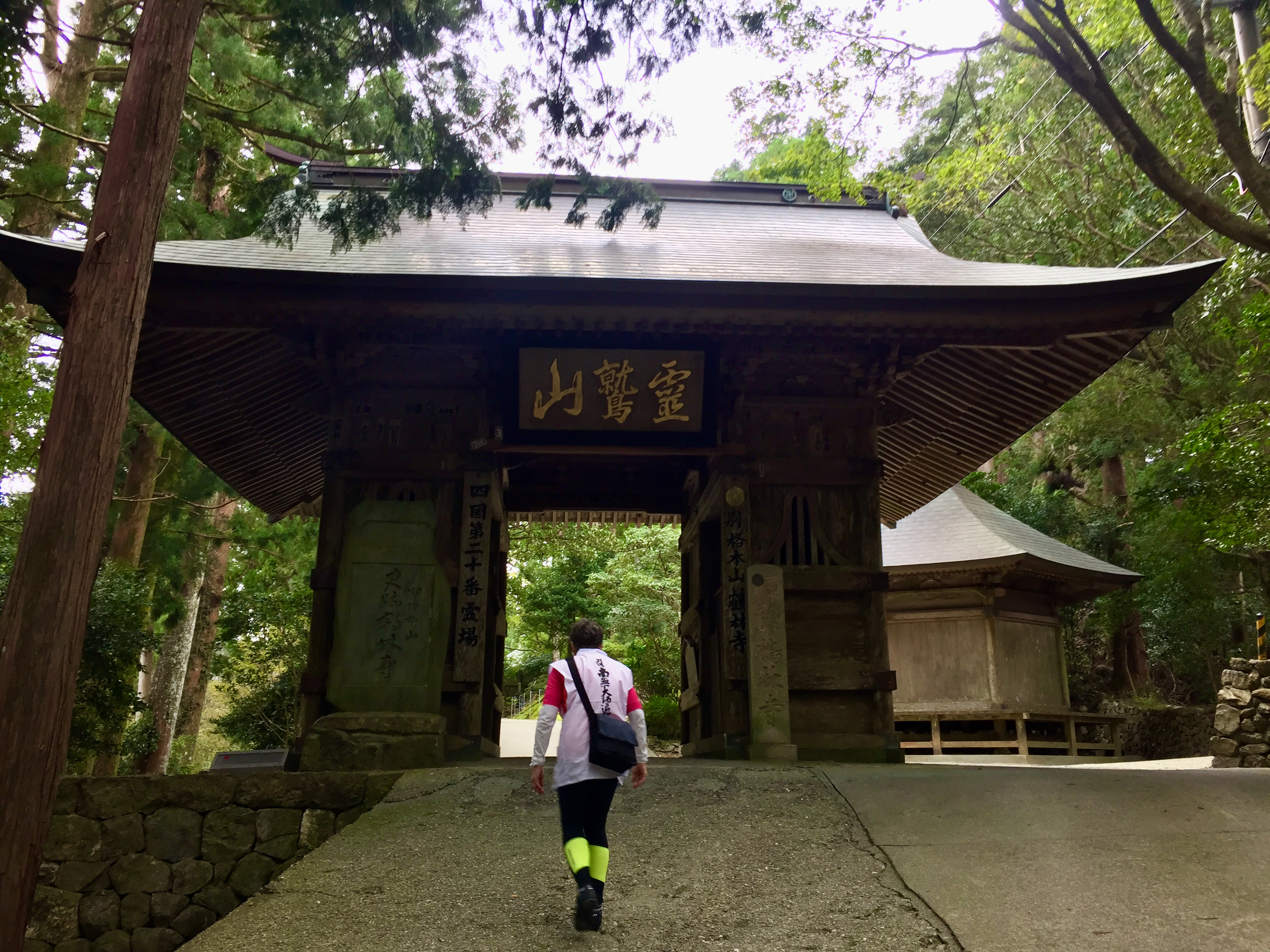
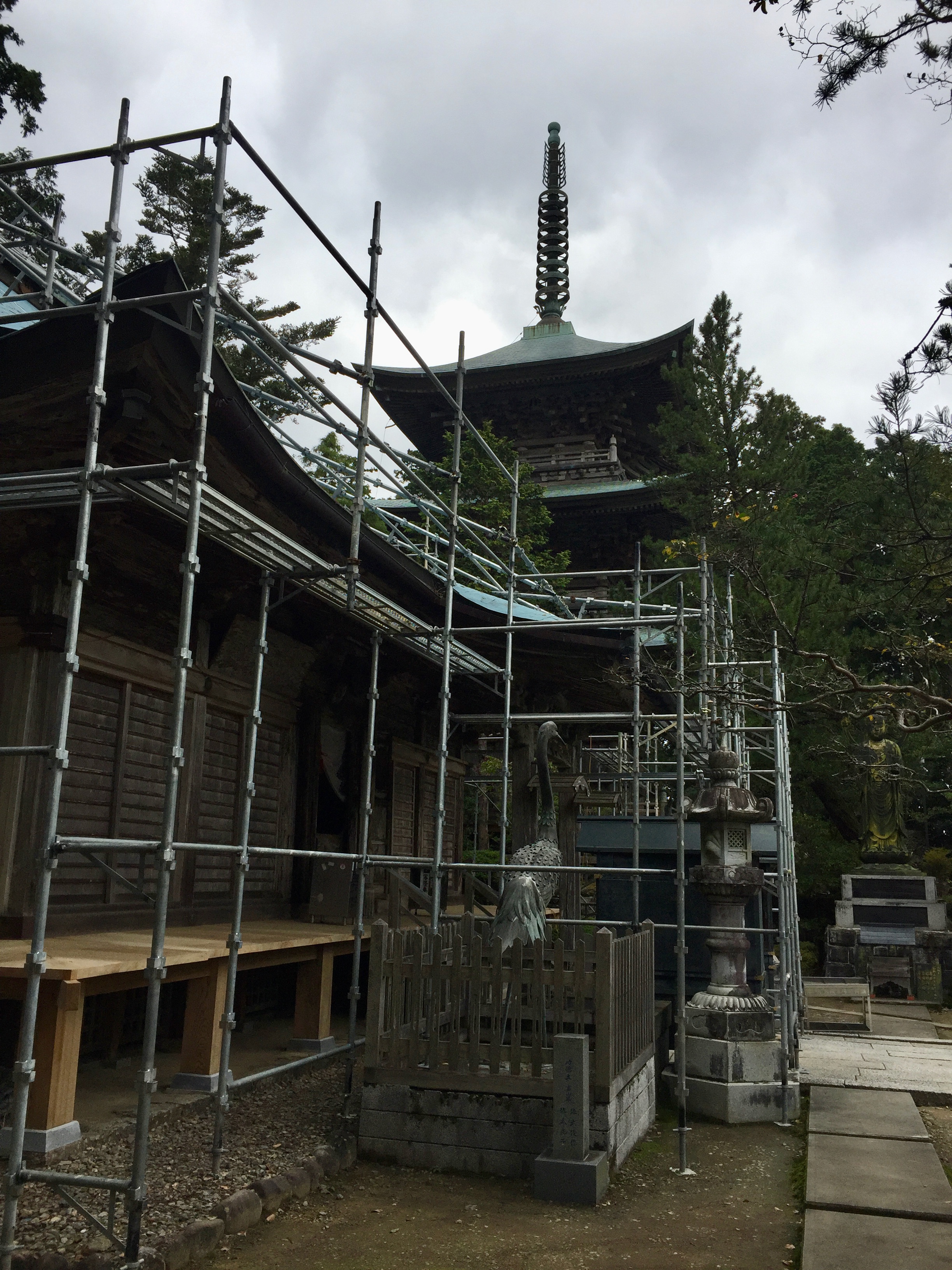
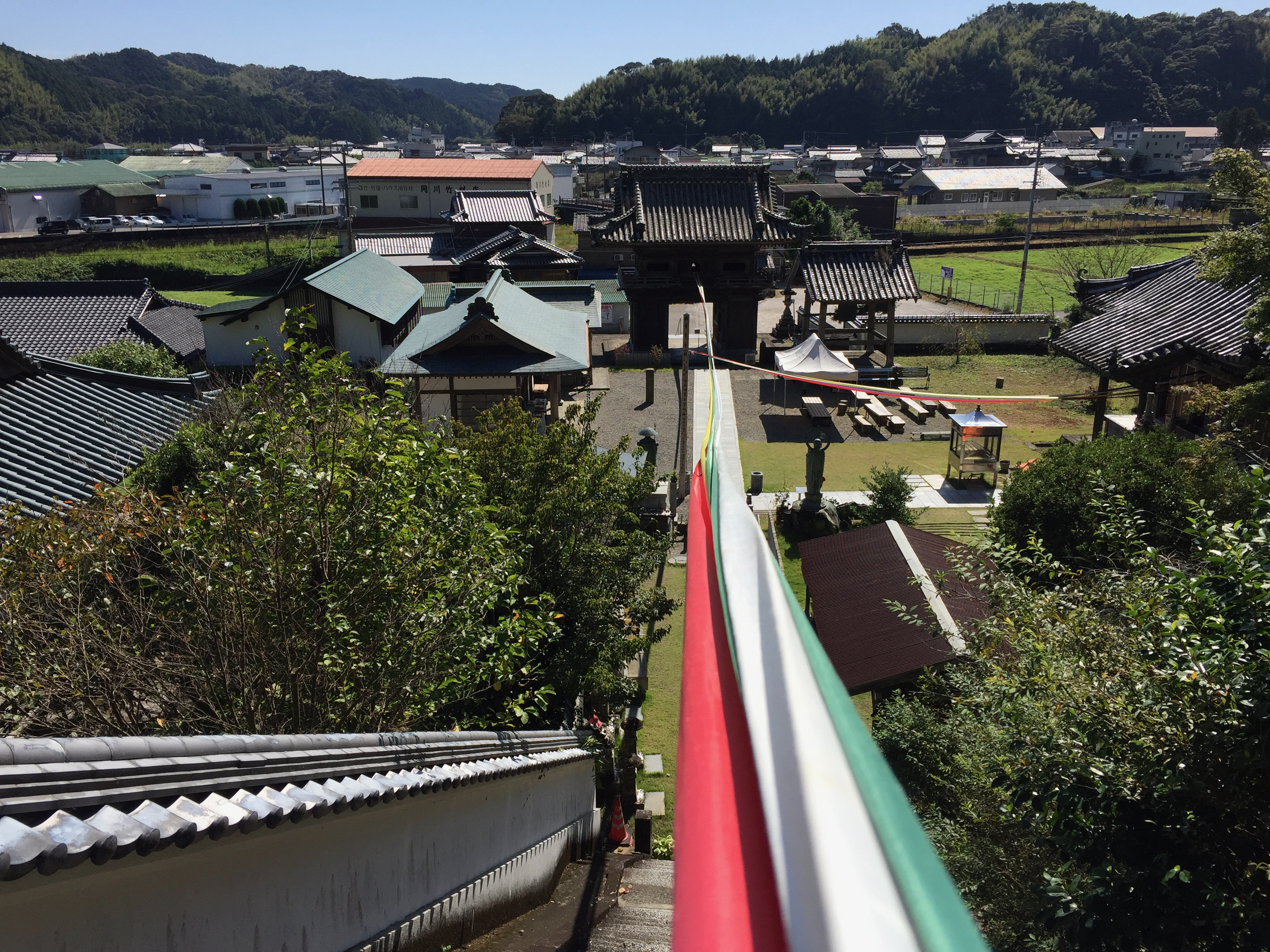
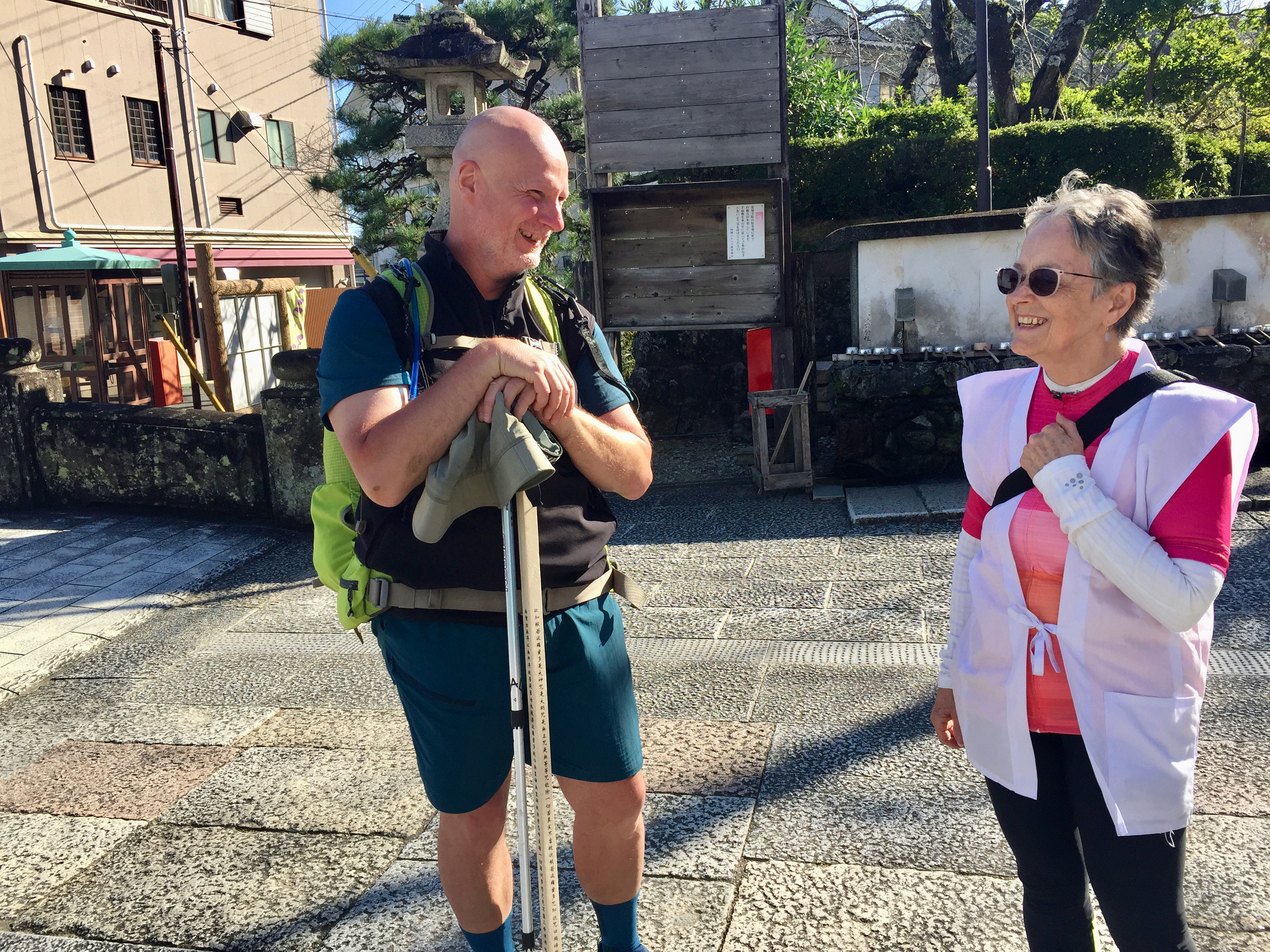
The second leg of our pilgrimage took us through the Kochi Prefecture. Not a bright lights/ big city experience, as befits the pilgrimage stretch traditionally known for teaching the value of Austerity & Discipline, or Ascetic Practice.
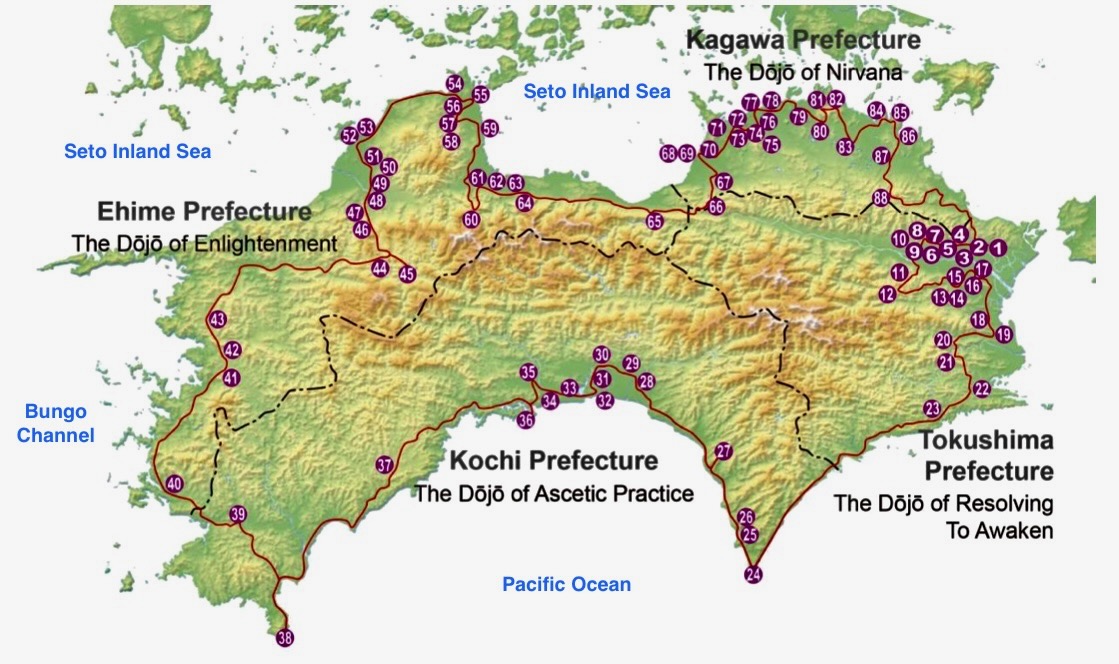
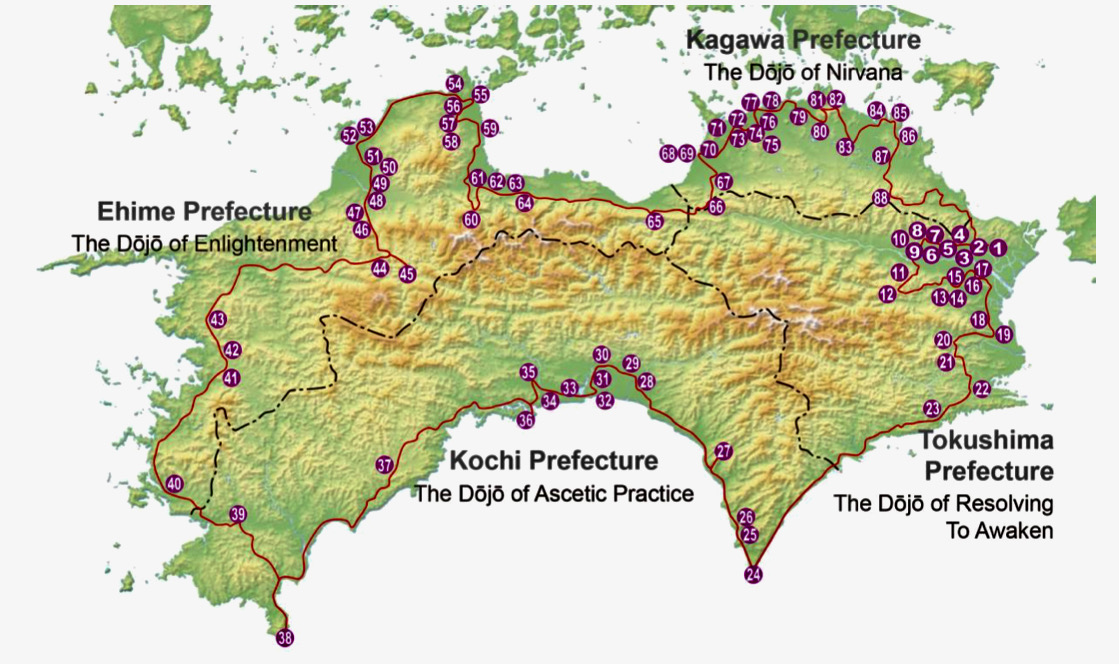
Shikoku Pilgrimage Route with Temples. Kochi, numbers 24- 39

We liked Kochi. Not everyone does. 

Long stretches of road with nothing but ocean on one side and mountains on the other. Locals in Kochi have the reputation for being blunt and no nonsense. Worked for us.

Not a tourist destination. No through traffic, famous places or big cities. By and large, hard-working rural coastal folks. 

Curiously I felt right at home in this landscape. Crashing Pacific waves. Rock cliffs to the ocean. 

We could have been on the Northern California Coast. Which accounting for continental drift we kind of were.

We would spend 8 days in Kochi. We would ride west and south along the Pacific Ocean in two sweeping arcs. The first ending at Cape Murato and Temple 24. And the second ending at Cape Ashizuri and Temple 38, the southernmost tip of Shikoku Island.

From there we would head north cutting inland to Temple 39 and emerging once again on the ocean. Not the Pacific but the Bungo Channel leading to the Uwa Sea between Shikoku and the Japanese island of Kyushu.

No longer newbies, we had settled down. We pushed through as best we could. Ascetic training, if you will. Ate our share of humble pie.

The temples were fantastic, but just as important were the roads from one to the next. And that experience, for better or worse.

Lao Tzu put it another way,

A good traveler has no fixed plan, and is not intent on arriving”

So hard to accept.

We kept to our schedule in the big picture, but only through the kindness of strangers and a bit of blind luck. Kobo Daishi’s specialty.

Day 11 October 18 Friday; Minami Town to Minshuku Tokumasu. No Temples.  

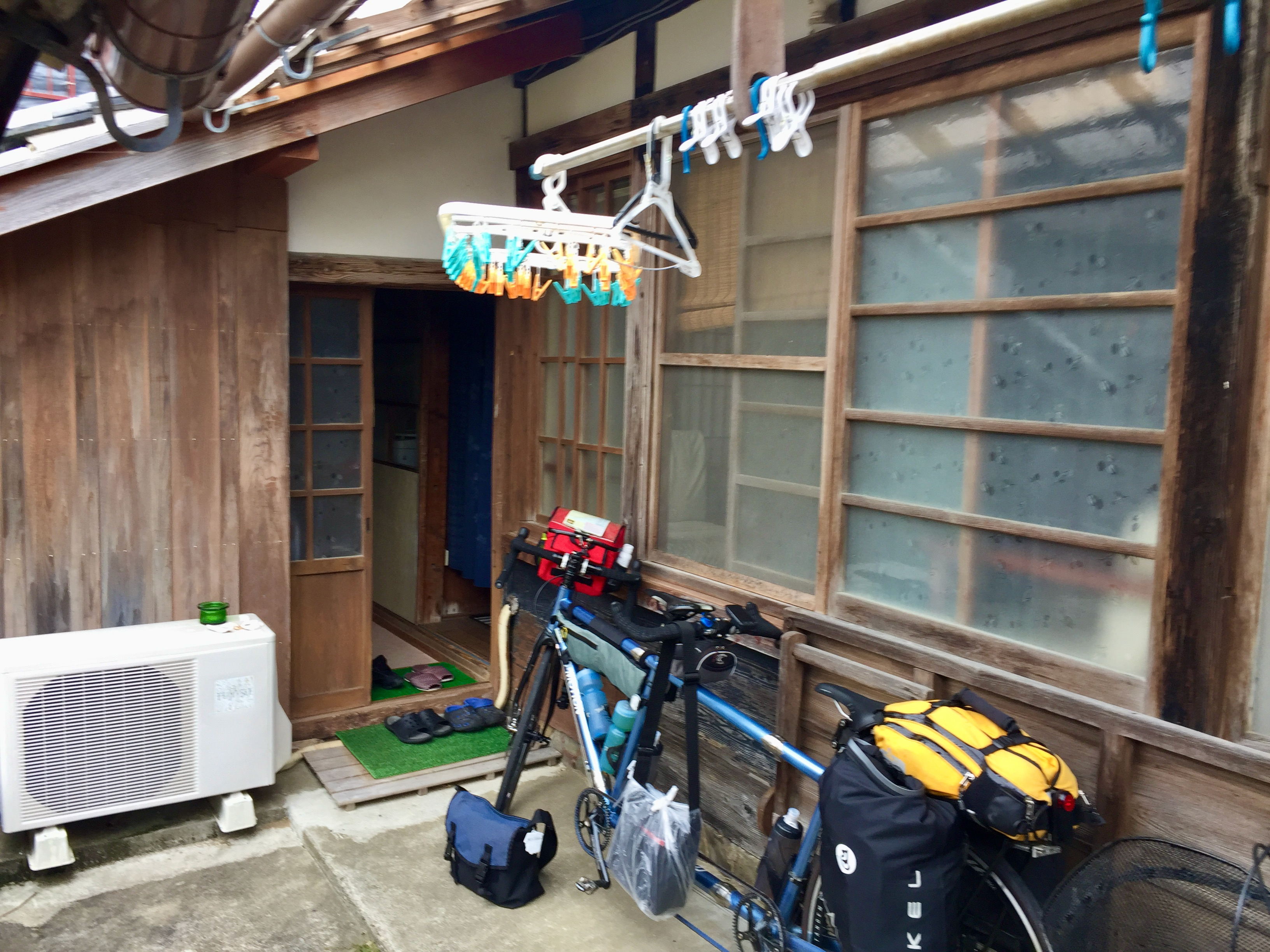
After an early breakfast we loaded the bike in our rear garden. 
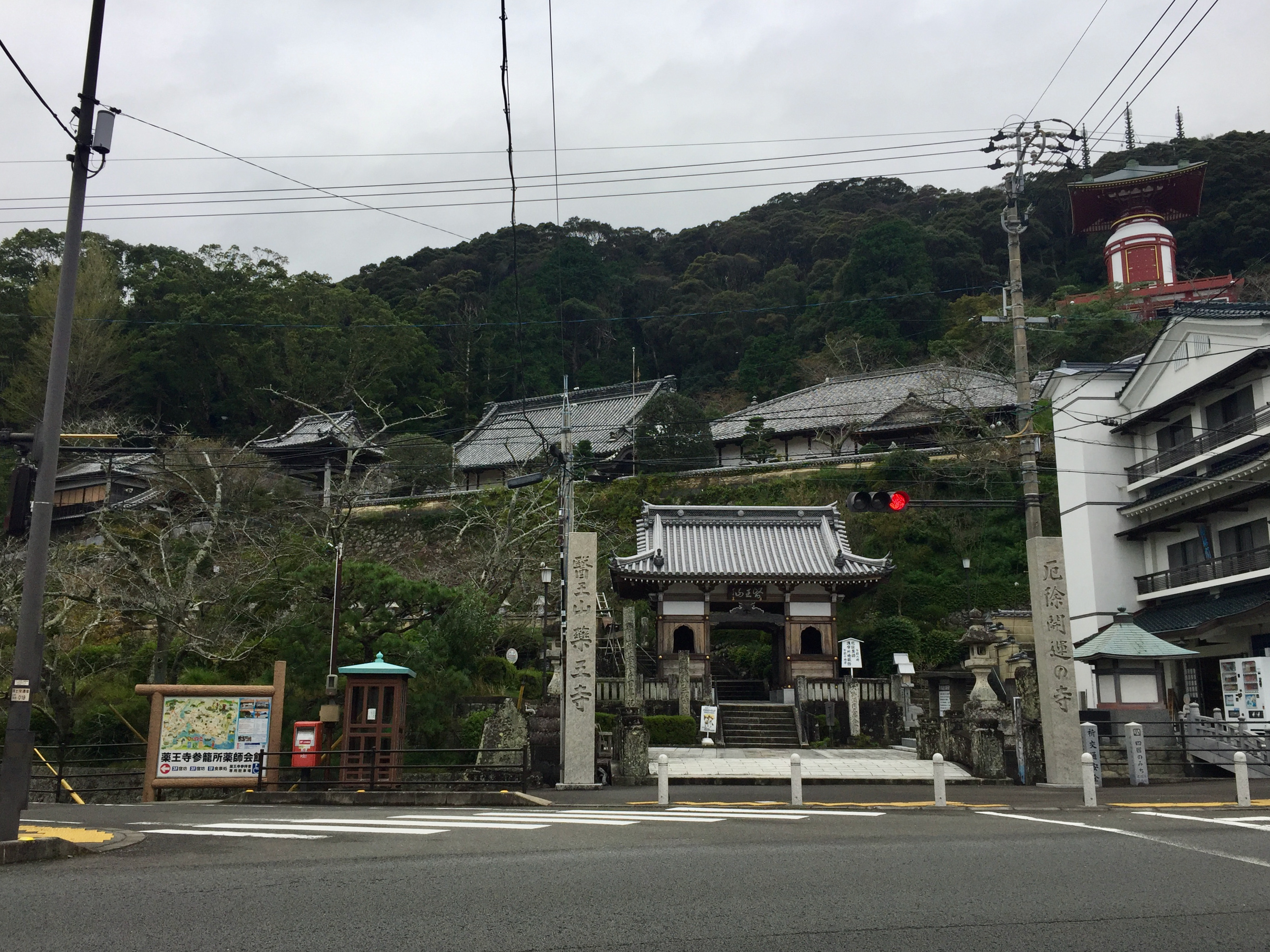
We wound our way back through Minami town to highway 55 and turned left at Yakuoji, Temple 23. 
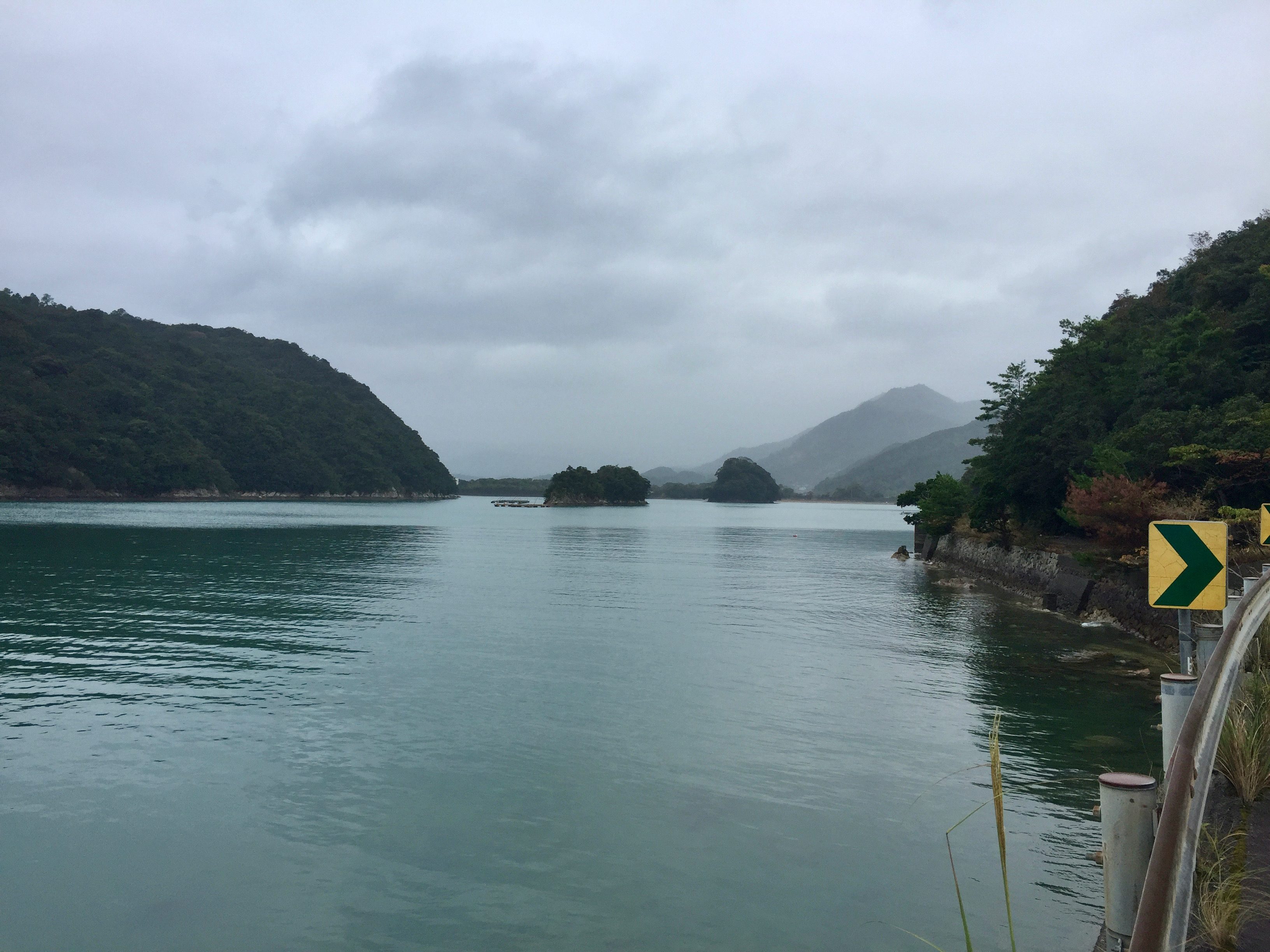
Wayfinding would be easy for a few days at least. Stay on 55. Ocean to the left. Mountains to the right.

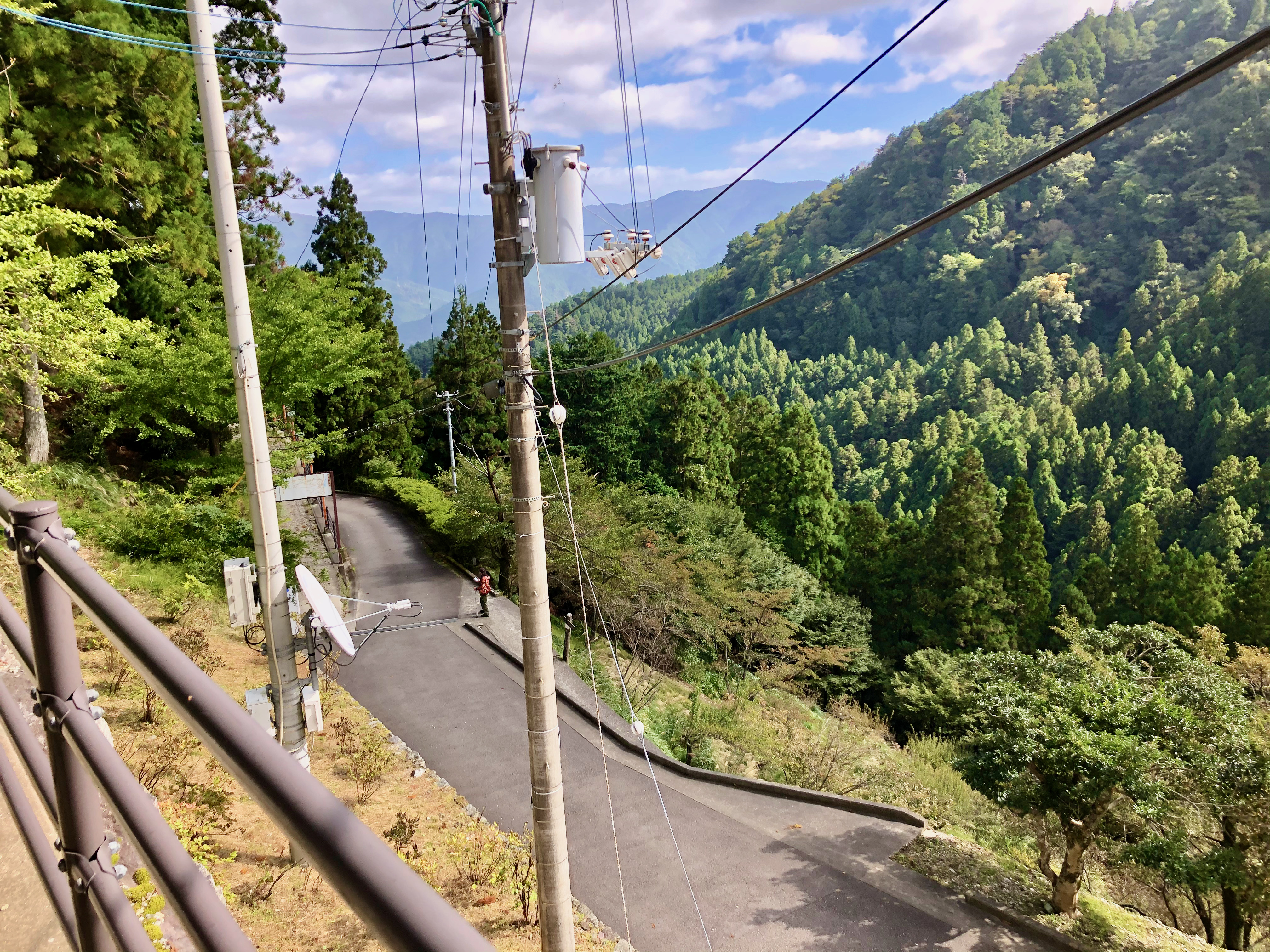
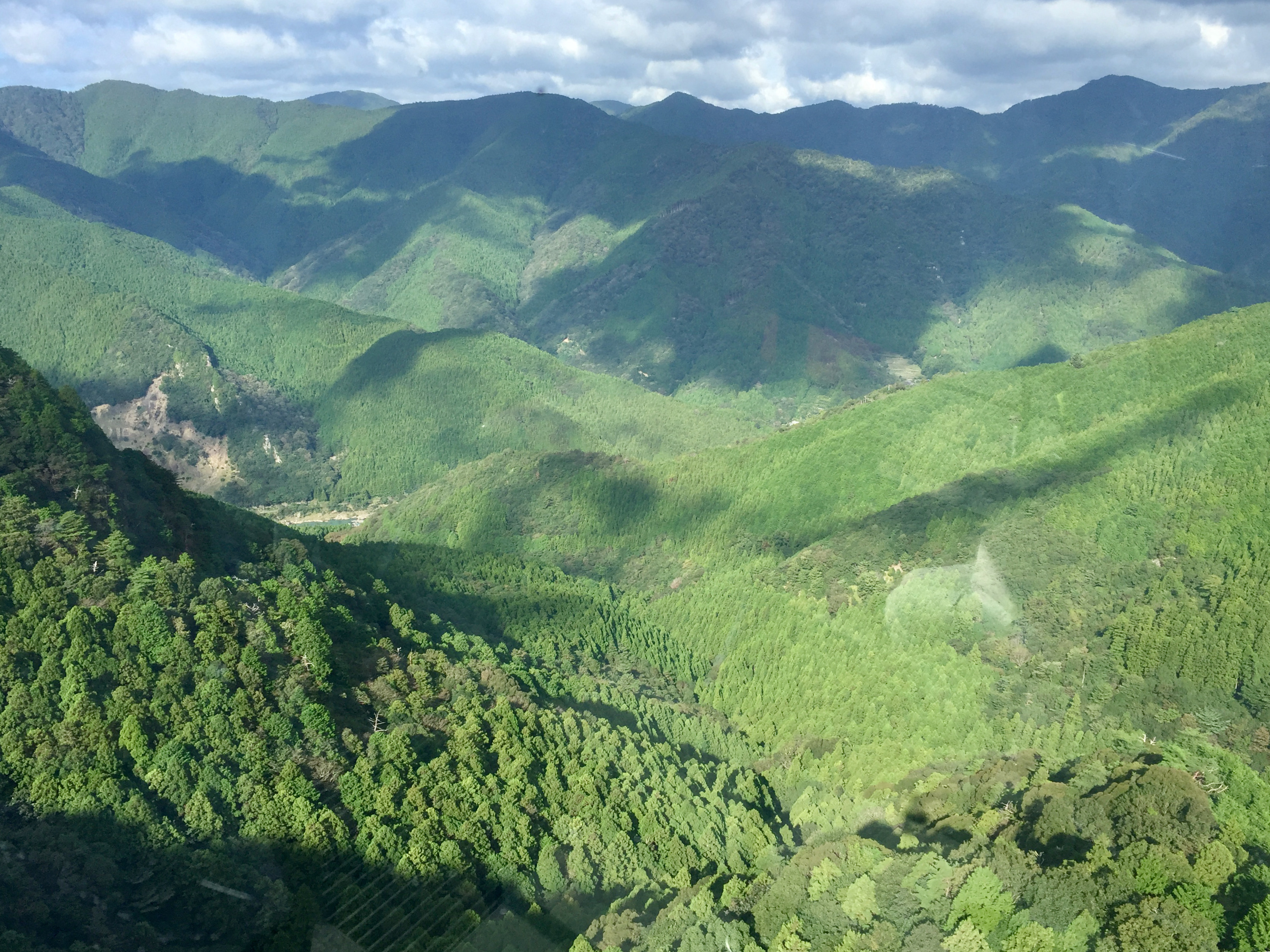
Some pretty remarkable scenery
Below is a well-cared for shrine perhaps 10 feet off the road. Main guy is Avolokiteshvara, the embodiment of compassion and mercy. 

We were riding through a Tsunami Inundation area. Which meant, if the big waves are on their way, you better run- Uphill ASAP – or kiss your ass goodbye.
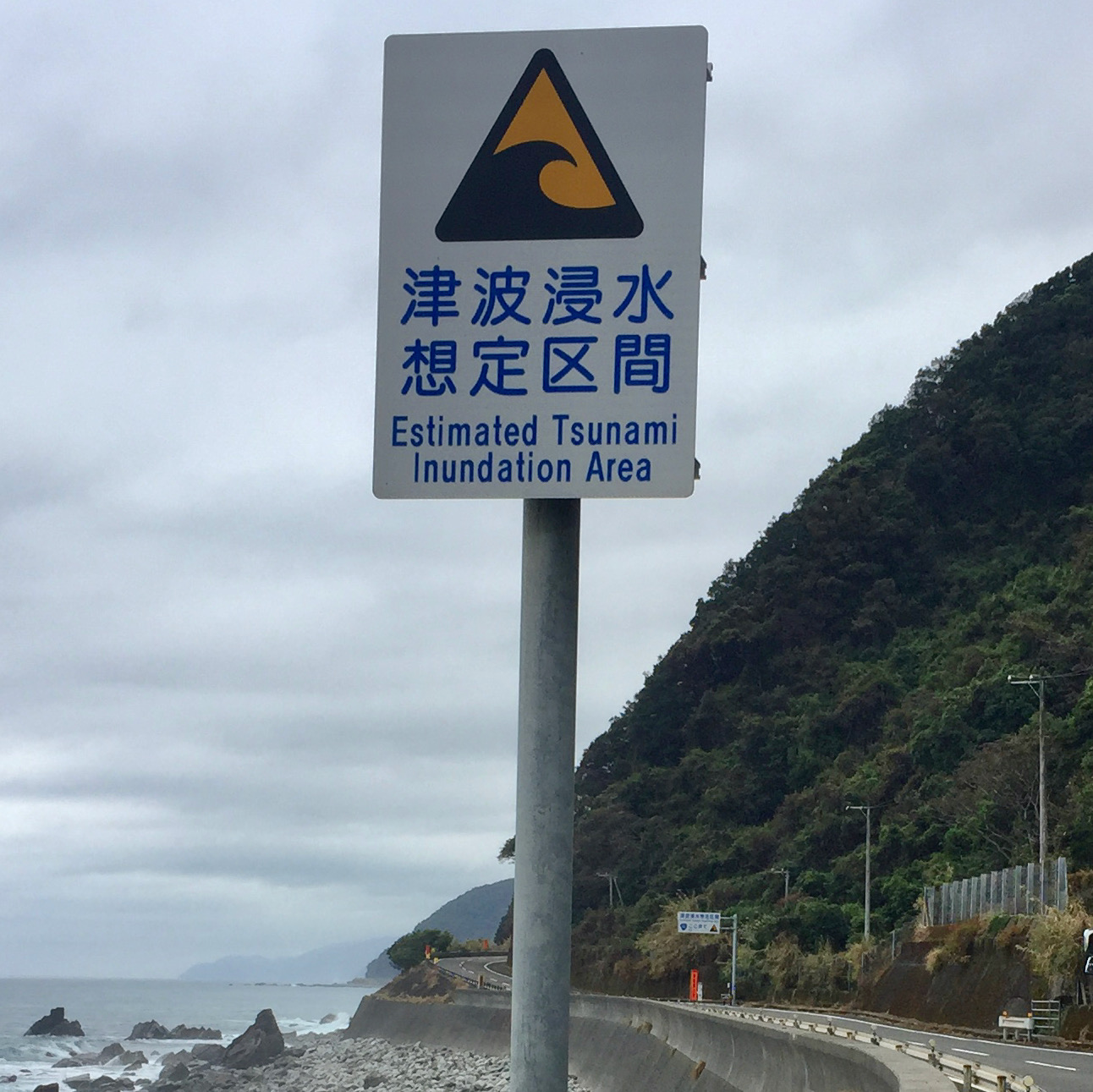
Weather had been threatening, but we were spared, at least for today. Tomorrow and the next day, we weren’t so lucky. Another typhoon was on the way. 
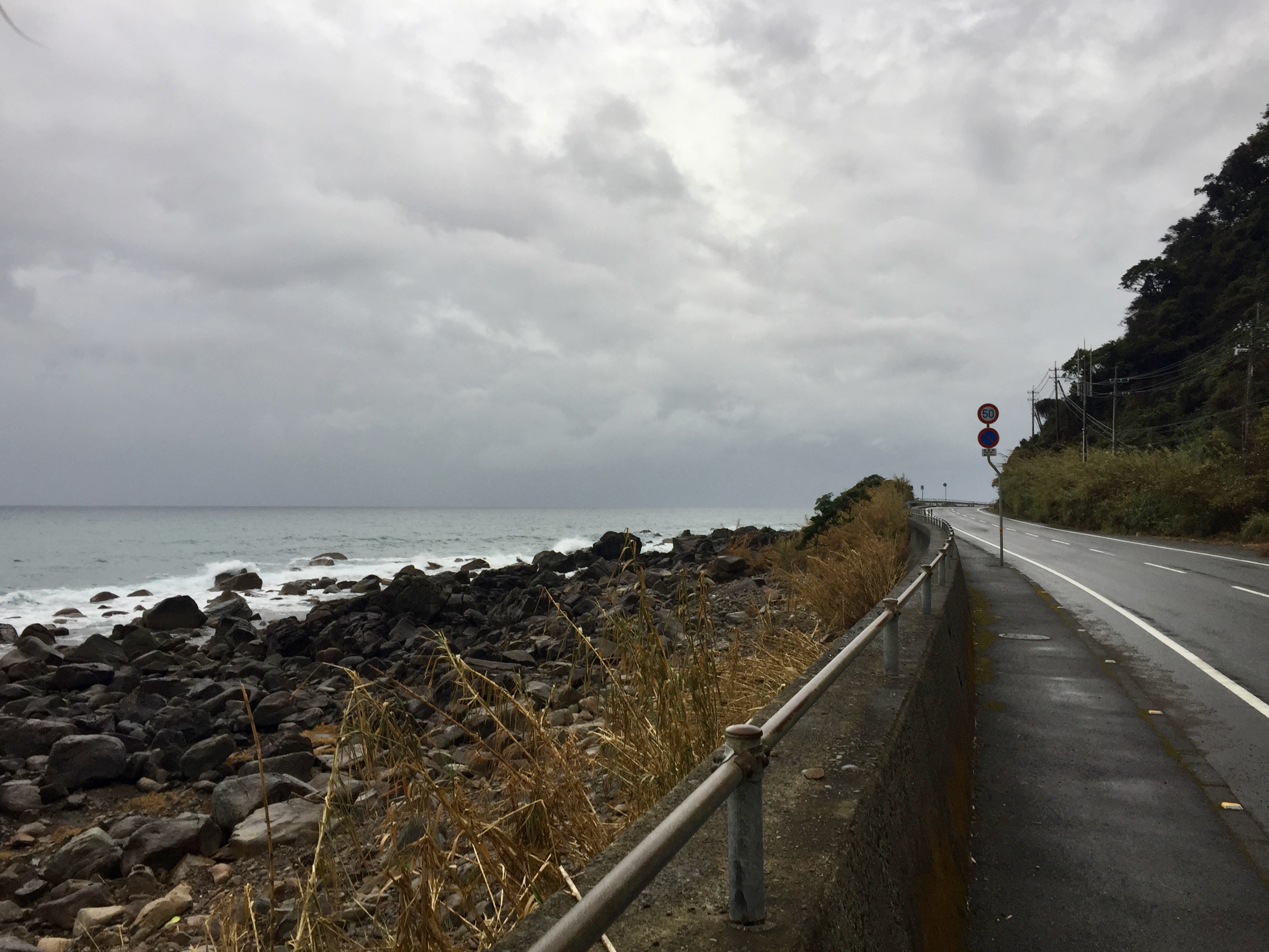
We pulled into our inn for the night, Minshuku Tokumasu, on schedule, late afternoon. 

Great place. Great folks. The 98 year old great-grandmother was special. She kept the veggie garden, worked the laundry and still used her bicycle to get around. 

Her grandson was a surfer and all-round good guy.

His wife, Chisato had been doing the pilgrimage and they fell in love and married.

Previously she had been working for JP Morgan in Tokyo. Good English. Charming.

Family Foto below

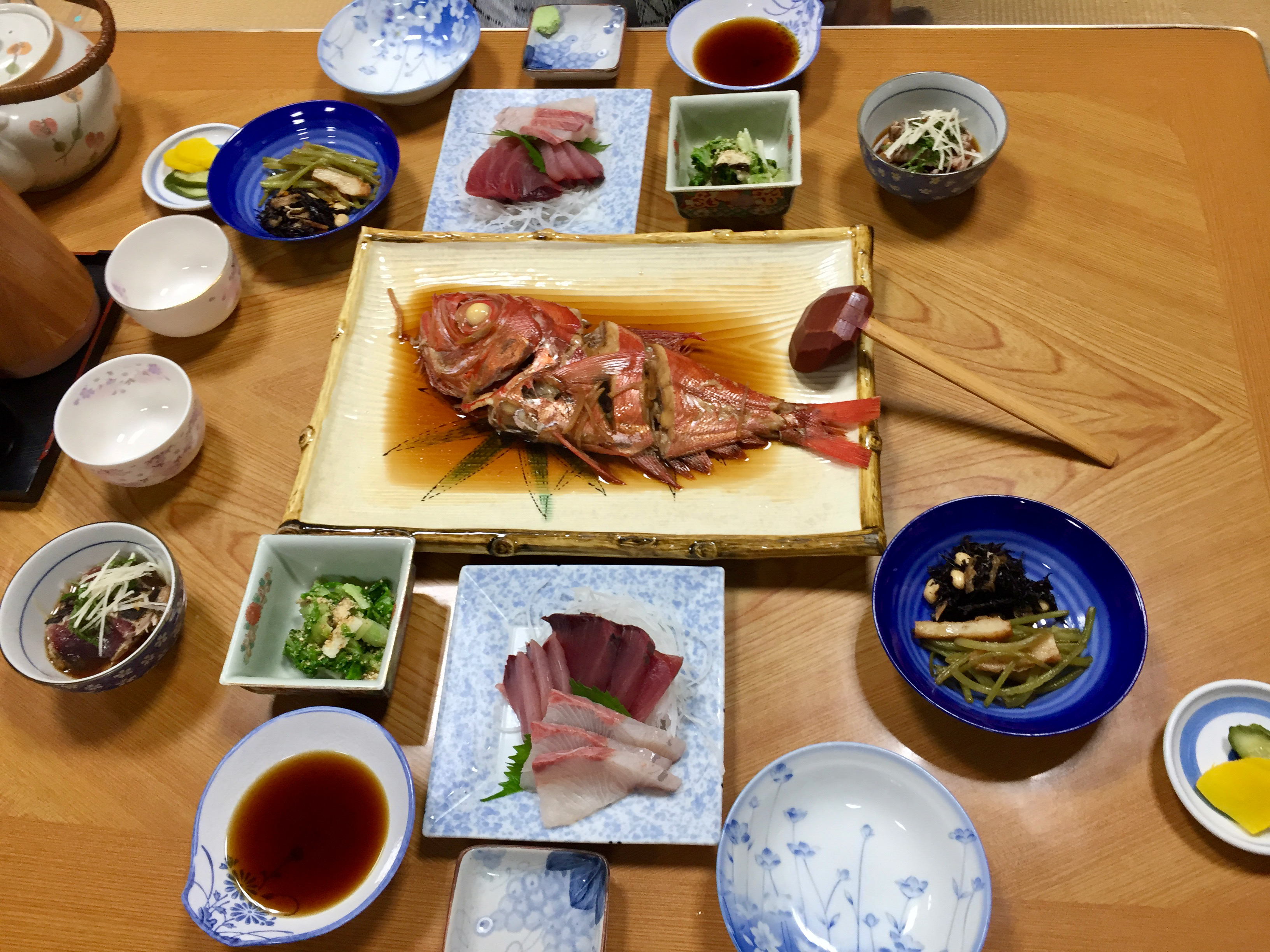
It was Red Snapper for us for dinner. From that day’s catch. They hoped we would like it. Sheesh. Best I’ve ever had. Veggies from Great Grandma’s garden.
Day 12 October 19 Saturday; Minshuku Tokumasu to the Tonohama area. 3 temples.

24 Hotsumisakiji 最御崎寺 Muroto, Kōchi
25 Shinshōji 津照寺 Muroto, Kōchi
26 Kongōchōji 金剛頂寺 Muroto, Kōchi

Sharon says it rained all night. I wouldn’t know I was out. At dawn the rain had let up and the sky seemed to be clearing. 
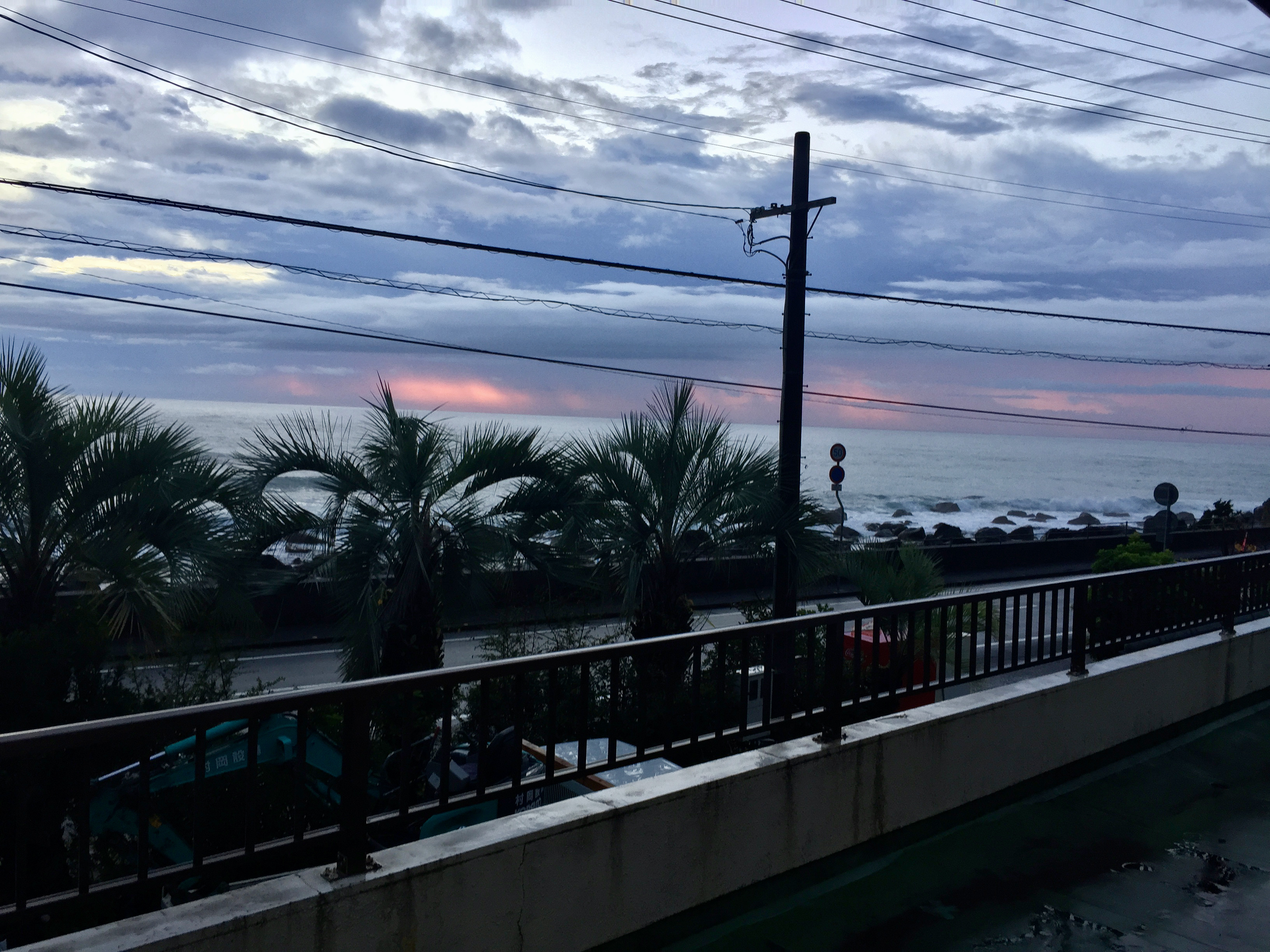
That didn’t last long and by breakfast it was pouring once again.

Chisato tried to talk us out of riding, but we knew our schedule was tight. We loaded up the bike, put on our rain gear and headed out the door. 

We took a long pause under the overhang at the front door, waiting for a break in the downpour. 
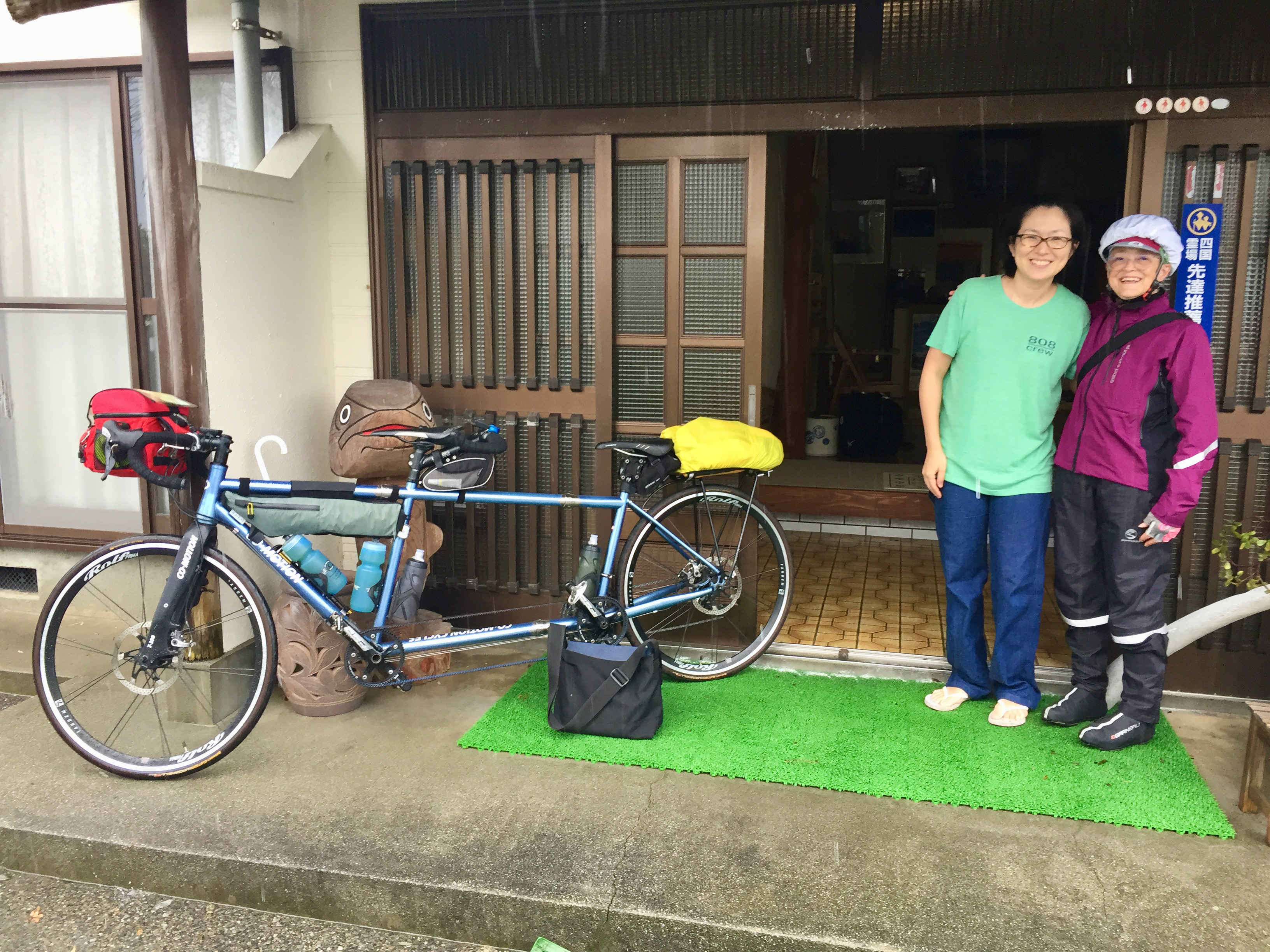
When we got to drizzle, we waved goodbye and were off. 

Our first stop was Meoto Rock, or Couples Rock. Judging by the debris, the relationship hadn’t been smooth sailing. 
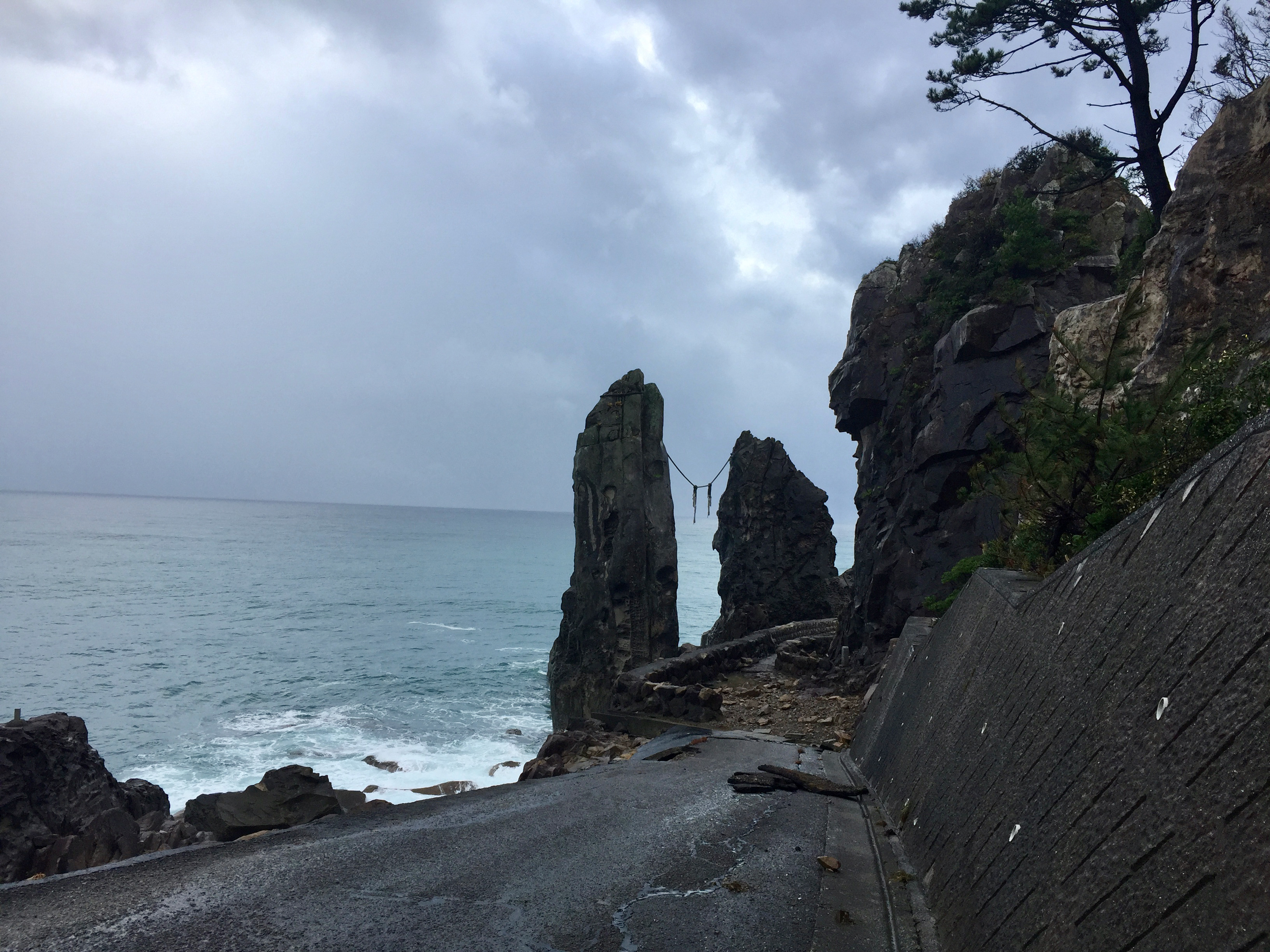
Our first Typhoon had hit this area hard. Chisato had told us that waves were washing across the highway. Great Grandmother had said she had never seen that in her lifetime.

We had some shots of blue sky as the storm seemed to pull back.

Jean Phillipe back in Minami Town, had told us to keep an eye out for a graveyard dedicated to men lost at sea. One of his memorable places and not marked on maps. We found it, stopped and spent some time. 

The guys below are looking out over the water. Quite soulful.
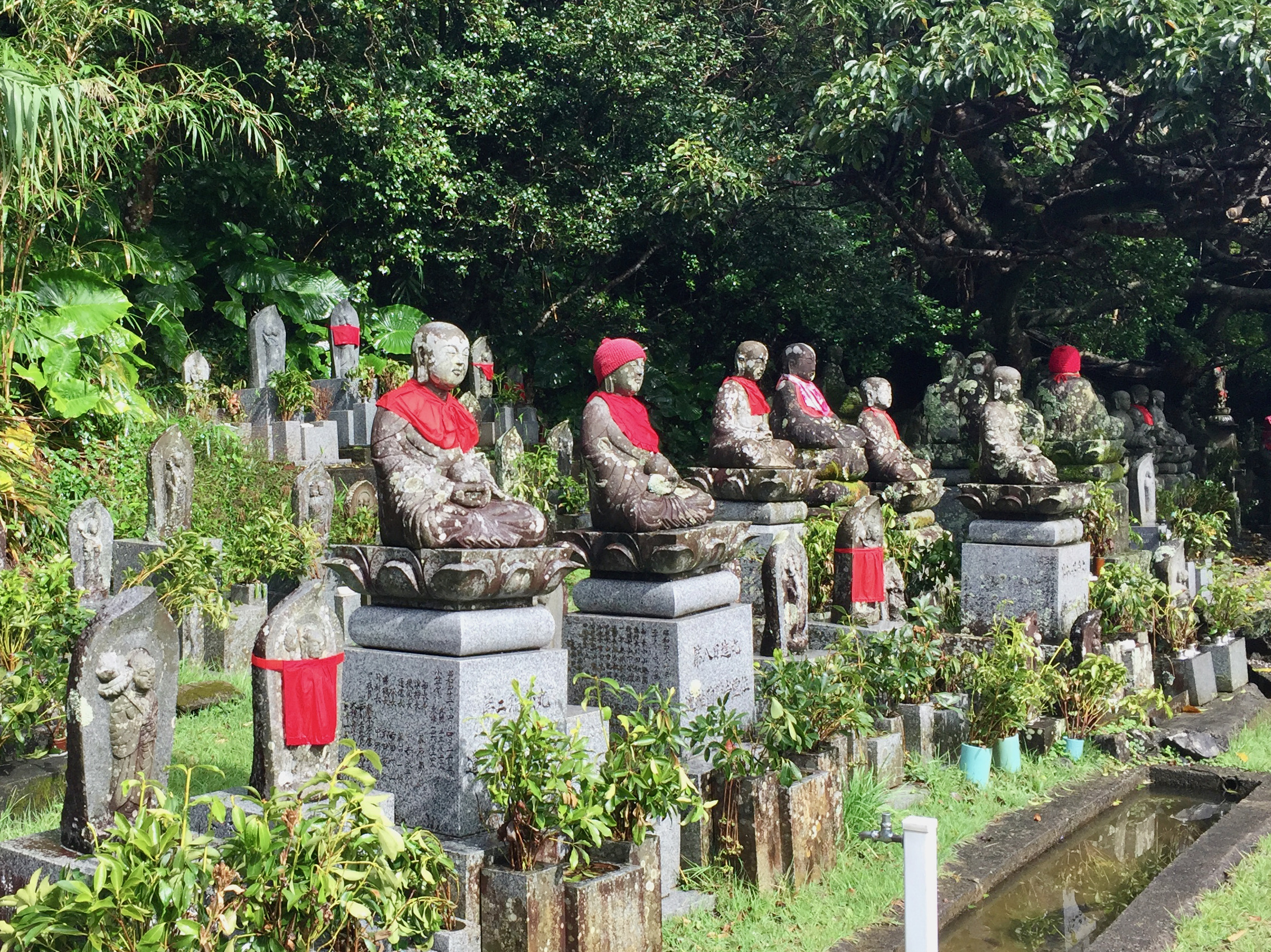
After Sharon passed along snacks to the stray cats hanging out, we were on our way.

Skies were clearing by late morning. Roads were smooth and traffic was light as we approached Cape Muroto and Temple 24, Hotsumisakiji, at the tip. 

Cape Muroto is known for its high winds, big waves, tropical plants and geology – uplifted marine terraces and active thrust faults. It’s also known for the place that Kukai reached enlightenment and took the name Kukai. The temple was founded in 805.

The road up to Temple 24 was switchbacked steep, perhaps a 1000 ft above the highway. We were expecting the climb, the road was in good shape and the views were spectacular.

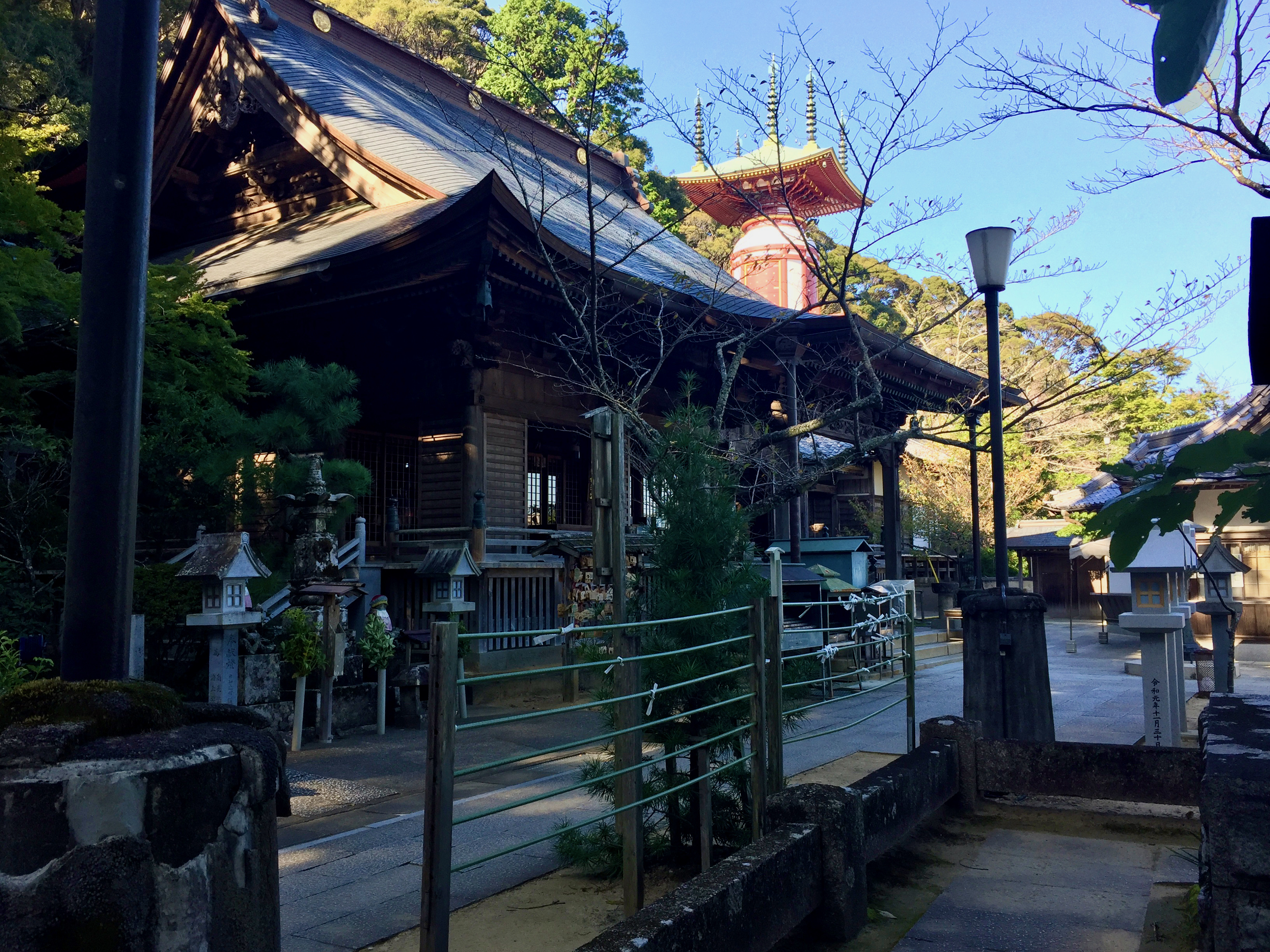
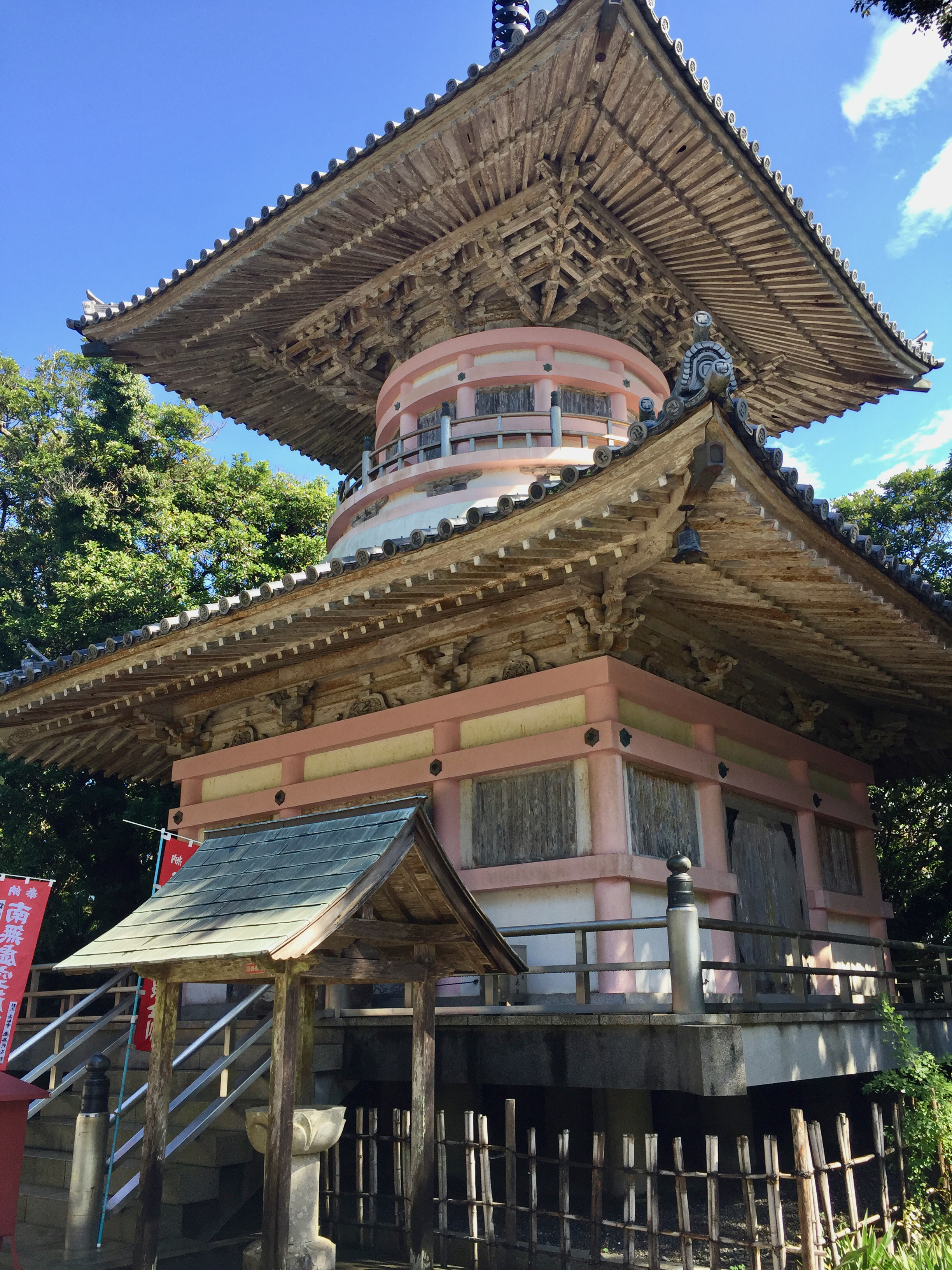
The Temple itself was pretty great, but we didn’t linger. We paid our respects at the halls, admired the pagoda below, banged on the ringing rock and headed for the temple office.
It was a quiet morning. The guys were kicked back and enjoying themselves. Our books taken care of, they admired Sharon’s shoulder bag water proofing. 

“Nice tight plastic bags. Well done”

After tightening up our brakes we descended back to highway 55. Next stop Temple 25, Shinshoji.

First though we had a bit of riding up the coast. This was an ocean-oriented world.
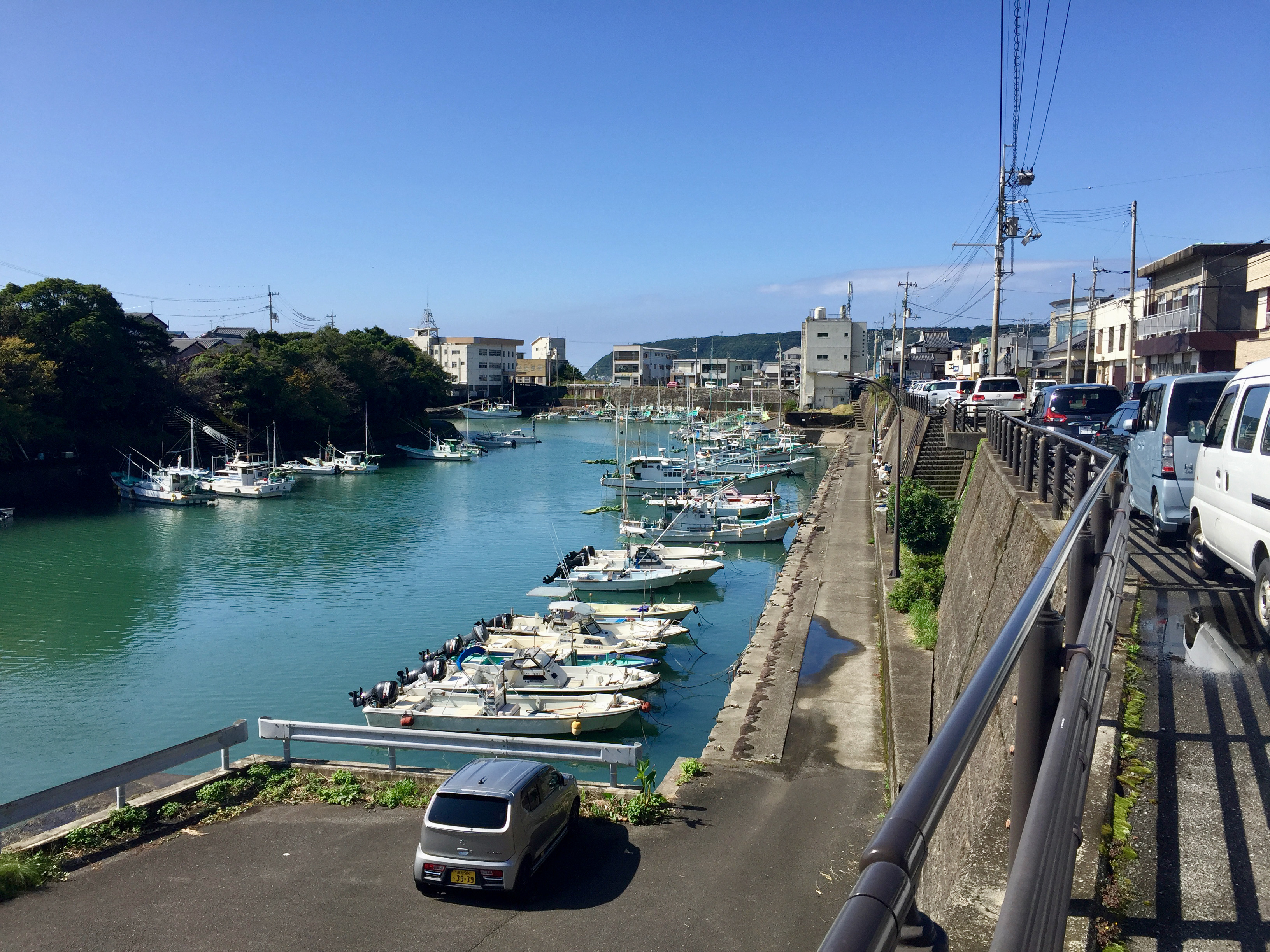
Temple 25 was an easy approach. No 1000+ foot climbs. We just rode right up. 

After passing through the main gate, and washing purification at the wash basin, we looked for the bell to mark our arrival. But it was nowhere to be seen. 

On the way back down from the main hall, we found the bell. It was upstairs in that red gate behind Sharon in the photo above.

Here’s the view from up there.

Back on highway 55, we headed to Temple 26, Kongoshoji, not far up the road. Another steep switchbacked climb.

Late afternoon we rolled into our inn for the night, Minshuku Tonohama, the least elegant of our inns. As Jean Phillipe said when he made our reservation, there aren’t any good choices in Tonohama. 

Minshuku Tonohama had its own charmless charm. A most helpful host making the best of an inn recently inserted underneath what had been a un-inspired generic wedding hall. 
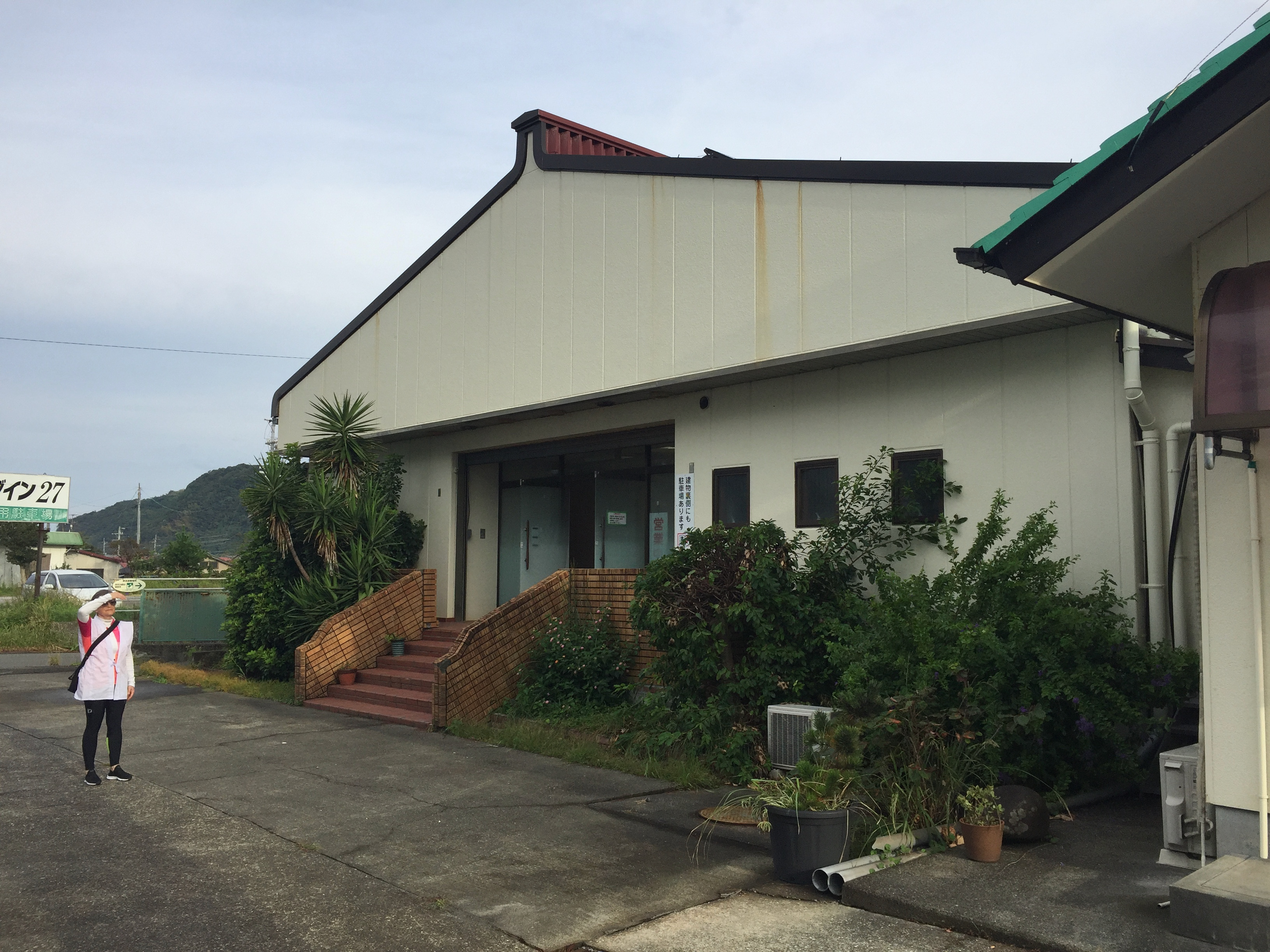
Complete with traditional Japanese floor toilets.

Traditional floor toilet in far alcove

We were comfortable enough, not being particularly proud or picky, but I was worried about the next day. Not only were we facing the tough climb to Temple 27 right off, but then we had another 5 temples and 50+ miles on top of that. 

No way we were going to make it. Not a chance. A failure of planning – on my part.

The solution- a Taxi. Up to Temple 27, Konomineji, and back. And then we would ride. 

Even so the next day would be an adventure. 

Day 13. October 20 Sunday; Tonohama to T33. 6 temples.

27 Kōnomineji 神峰寺
28 Dainichiji 大日寺 Konan , Kōchi
29 Kokubunji 土佐国分寺 Nankoku, Kōchi
30 Zenrakuji 善楽寺 Kōchi, Kōchi
31 Chikurinji 竹林寺 Kōchi, Kōchi
32 Zenjibuji 禅師峰寺 Nankoku, Kōchi

We were up early and after breakfast, our innkeeper arranged for a taxi. The taxi driver was a good guy and most entertaining. All started off well. He jumped out and held the door for Sharon.
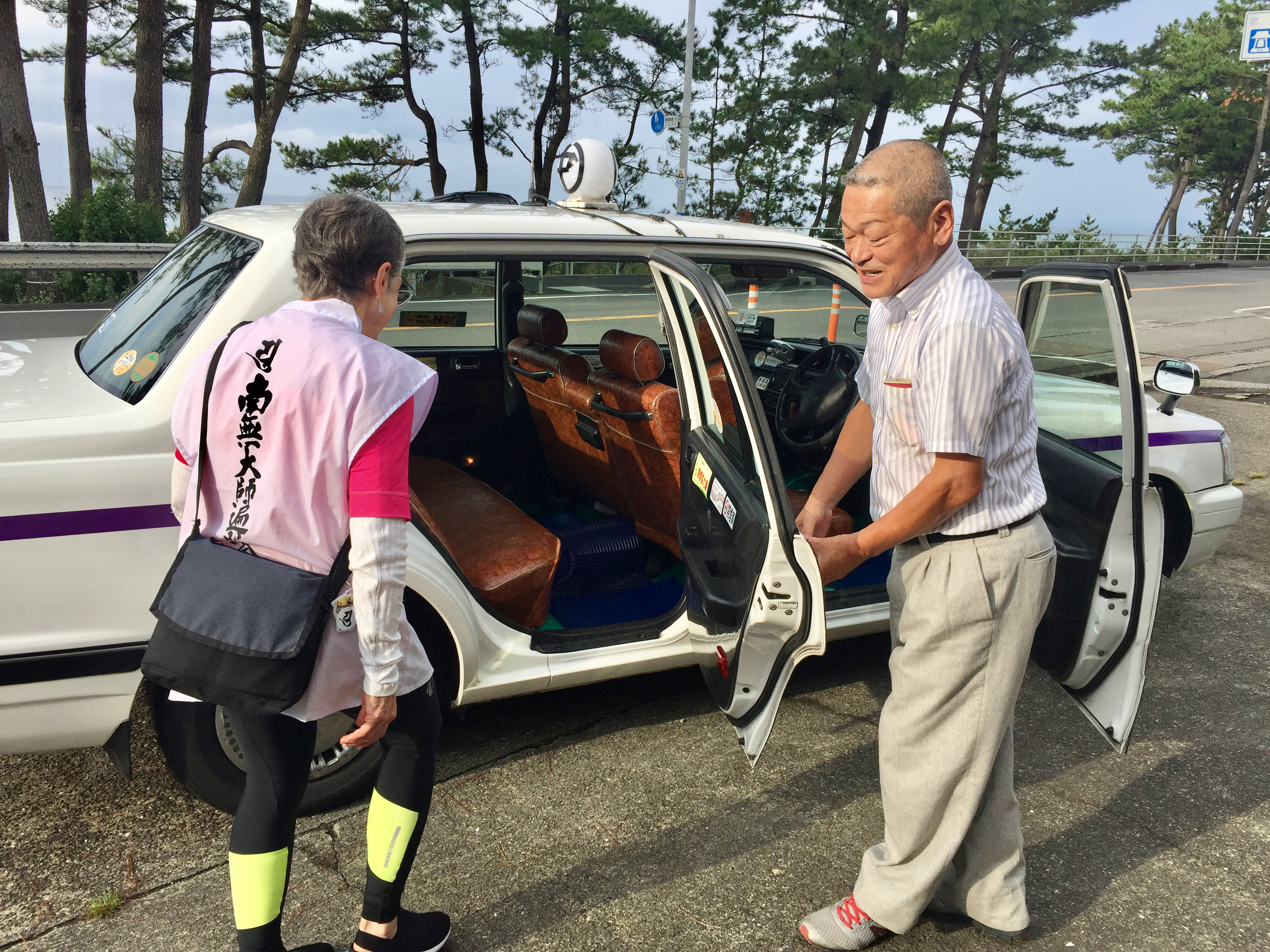
And up we went.
Our taxi driver agreed to wait in the parking lot. We headed in. Here’s Sharon getting ready to wash her hands.

After purification rituals, we headed up again.

The Temple was well cared for. We paid our respects. 
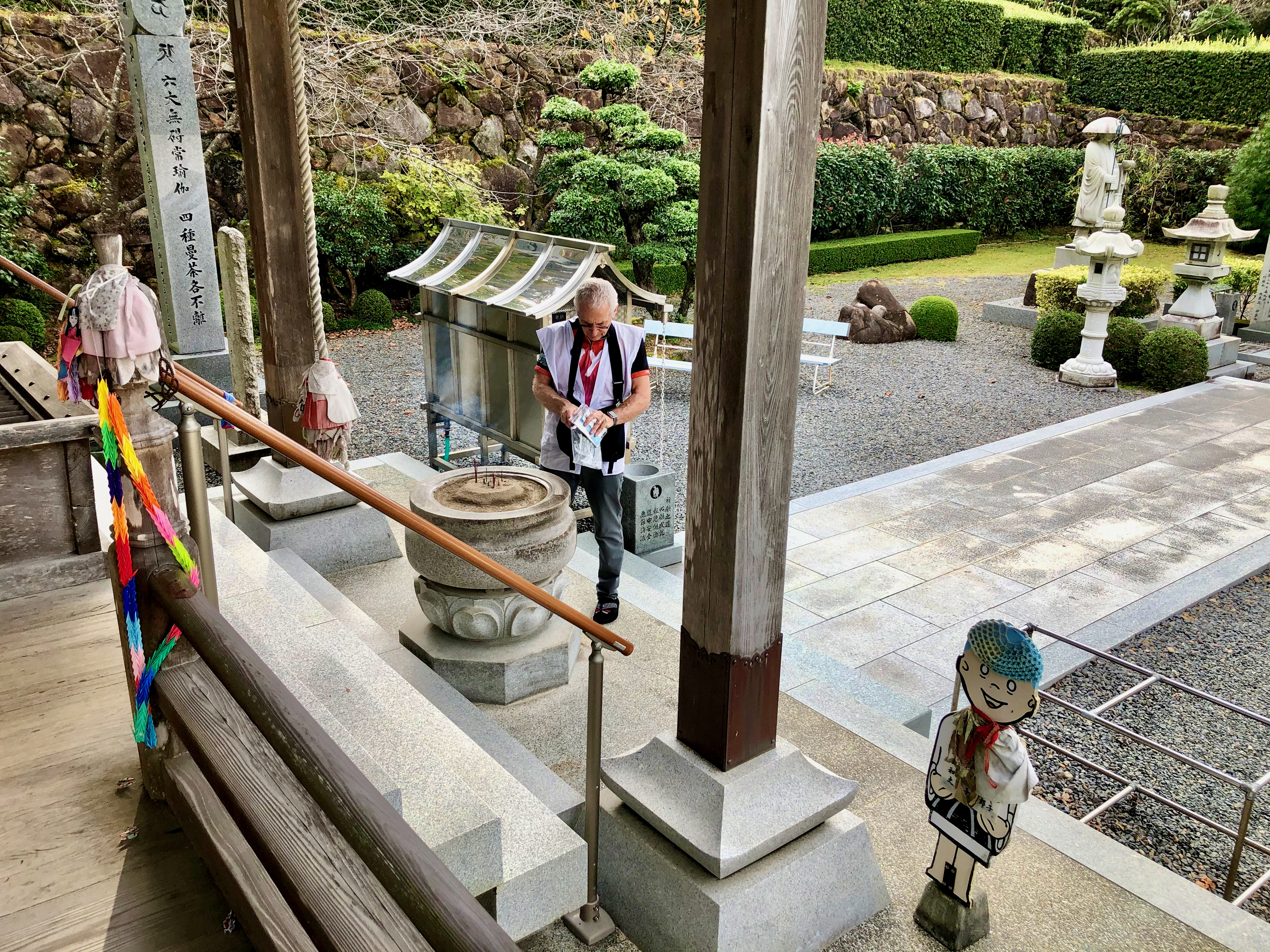
and headed back down.
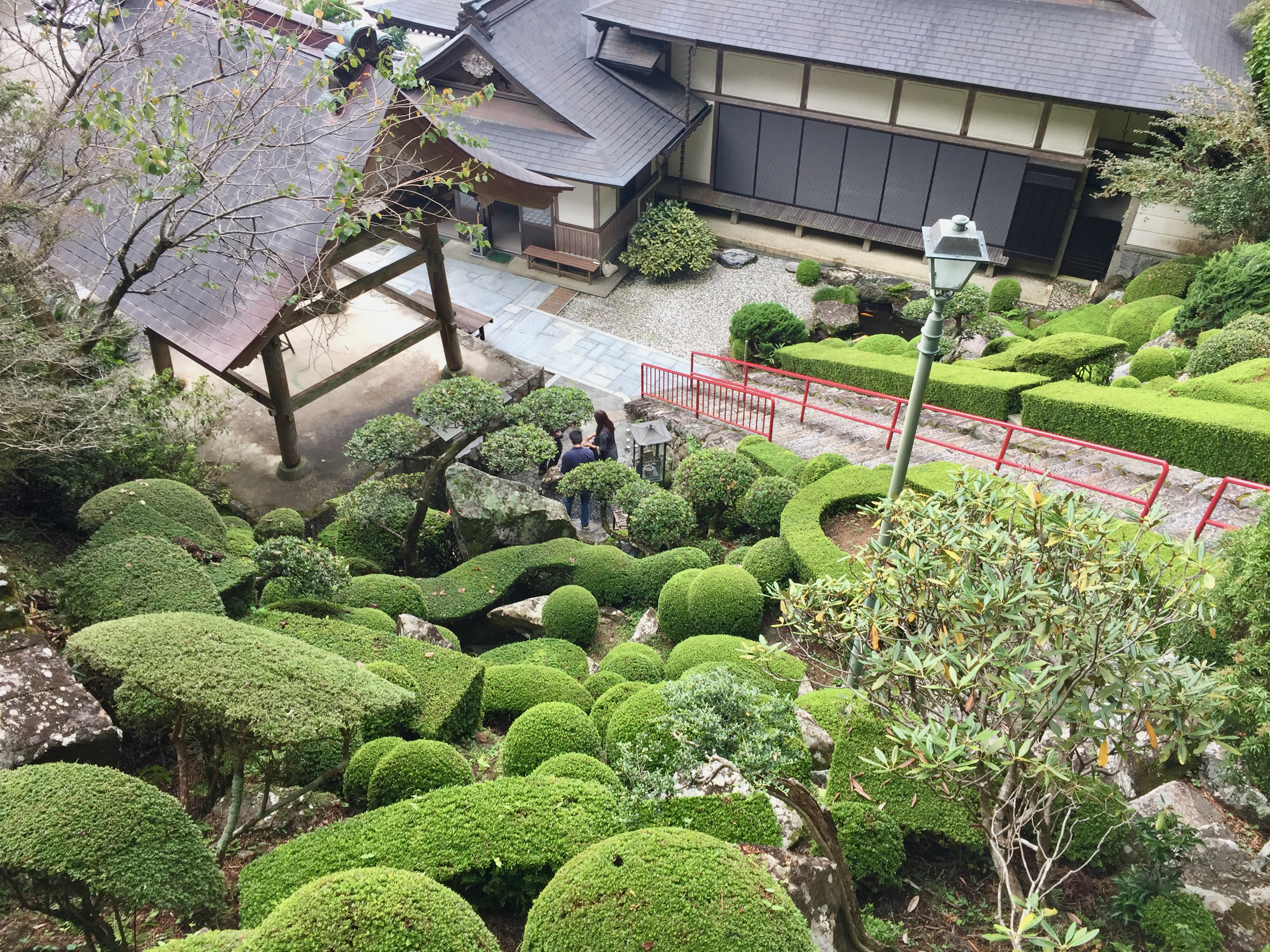
Back in the taxi, we descended.  We had to wait for this van to three-point the turn. Too steep, too tight.
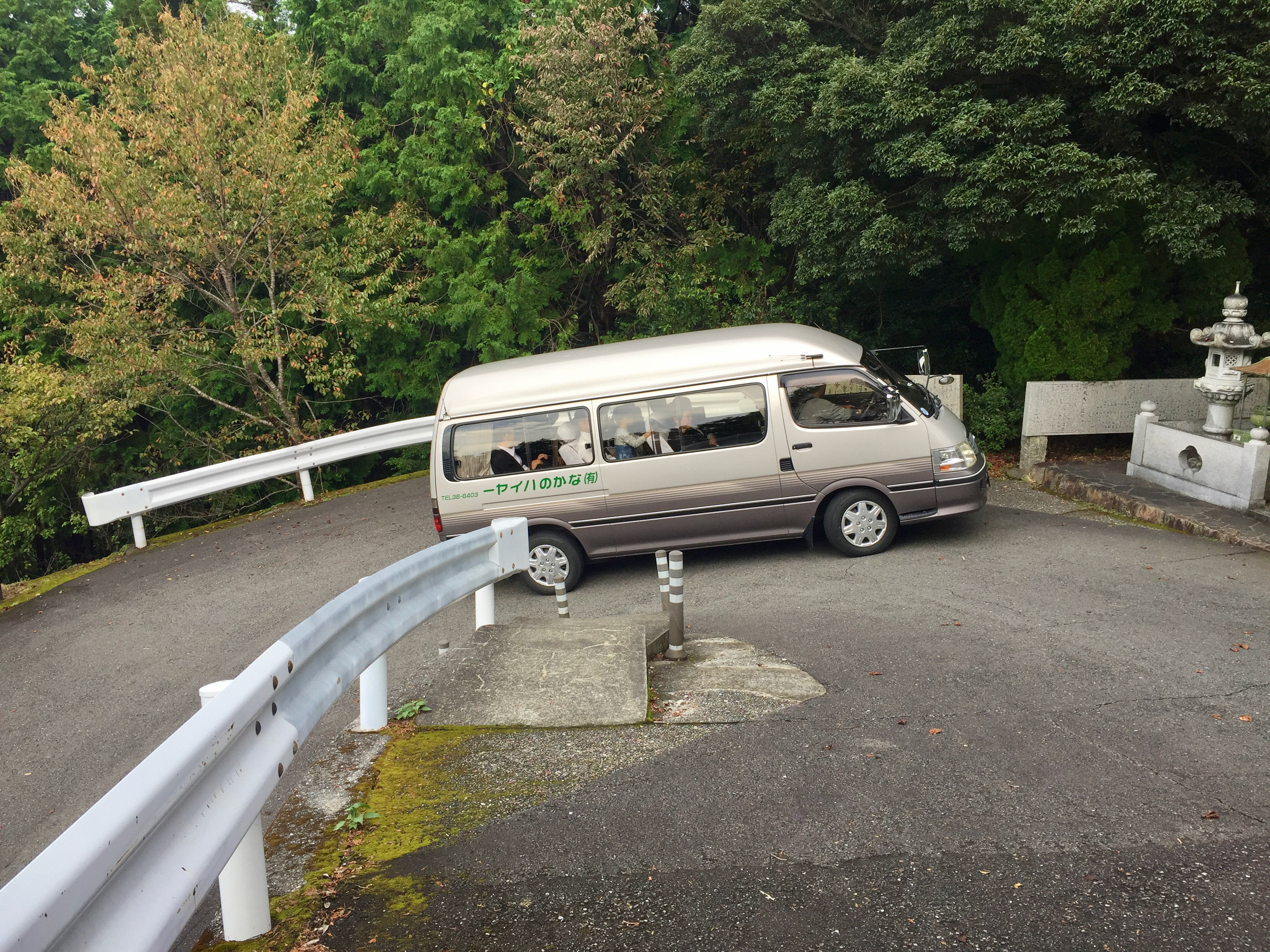
Perhaps this was the section that Jean Phillipe back in Minami Town said the front wheels of his camper came off the ground. His advice was spot on, no need to try this one on your tandem.

Back at Minshuku Tonohama, we loaded our bike and headed up the coast. Soon we were passing Tsunami Evacuation Towers like this one.
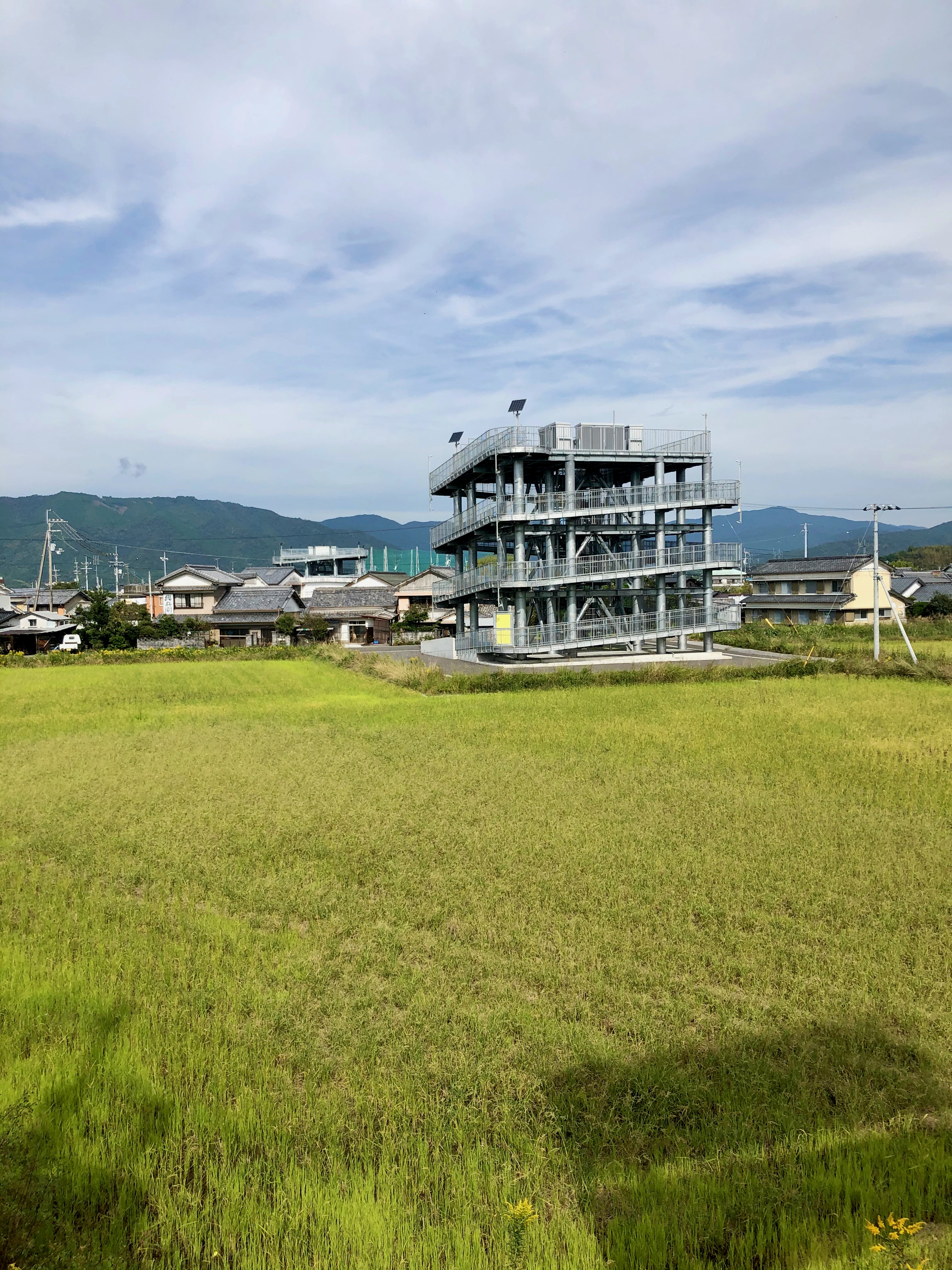
After the Great East Japan earthquake in 2011, the Kochi government constructed many. Kind of sobering to imagine the waves washing over the town, while those who made it to the top deck watch their world wash away. 

That said, better than the alternative. 

And this could happen at any time. Not lost on us.

As we rode up the Coast we had sections of smaller roads off highway 55. Good stuff. The photo below is two way. FWIW, our experience was that Japanese drivers were courteous and careful negotiating such. 

Taxis were another matter altogether. They just blasted through. Best to just pull off. 

Mid-morning in Aki City we hit the Cycling Road along the Tosa Bay to Konan. Great ride. A Japanese rail trail. Sharon found Prickly Pear Cactus fruit, which pleased her no end.

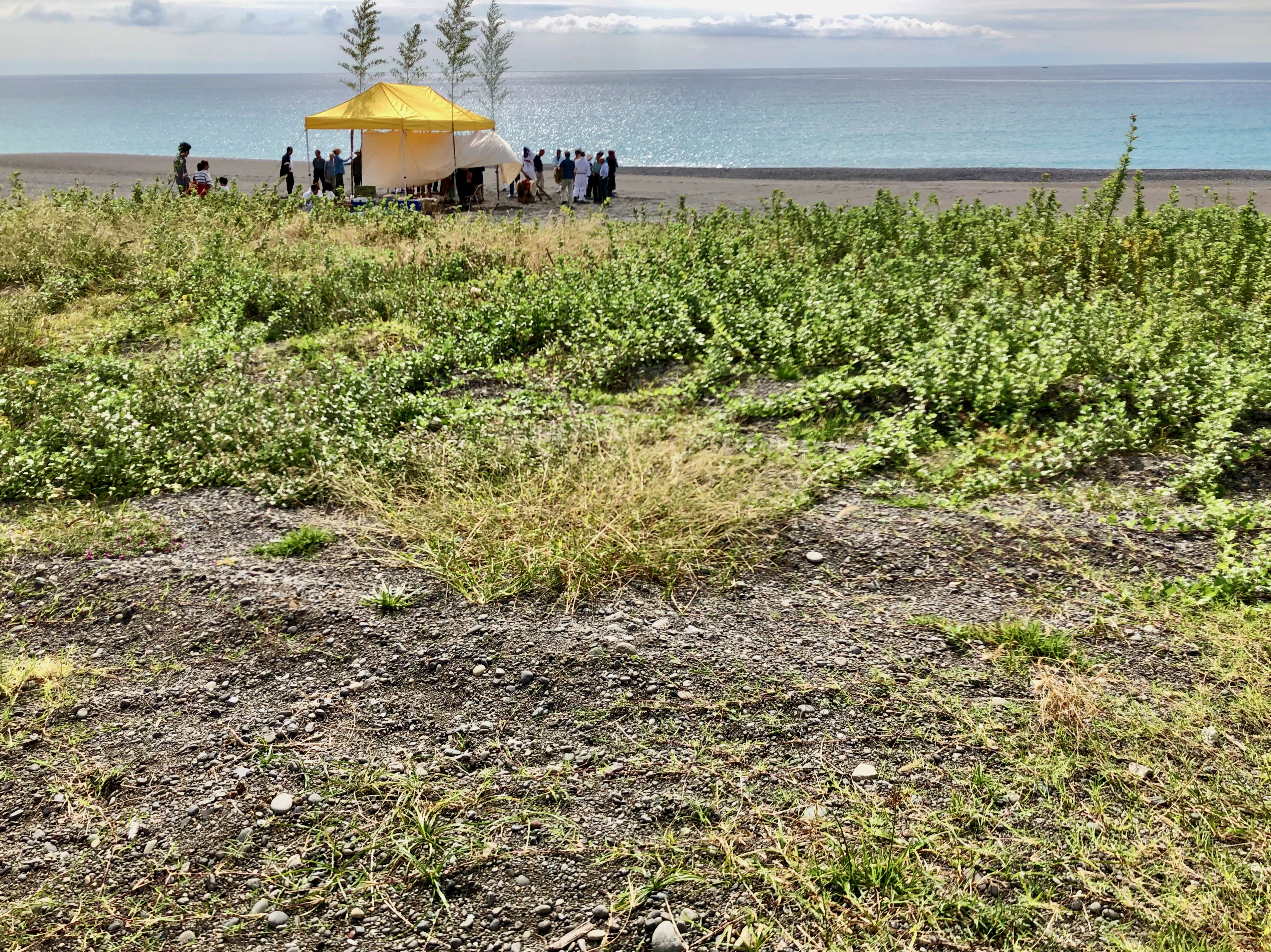
Wide open beaches.
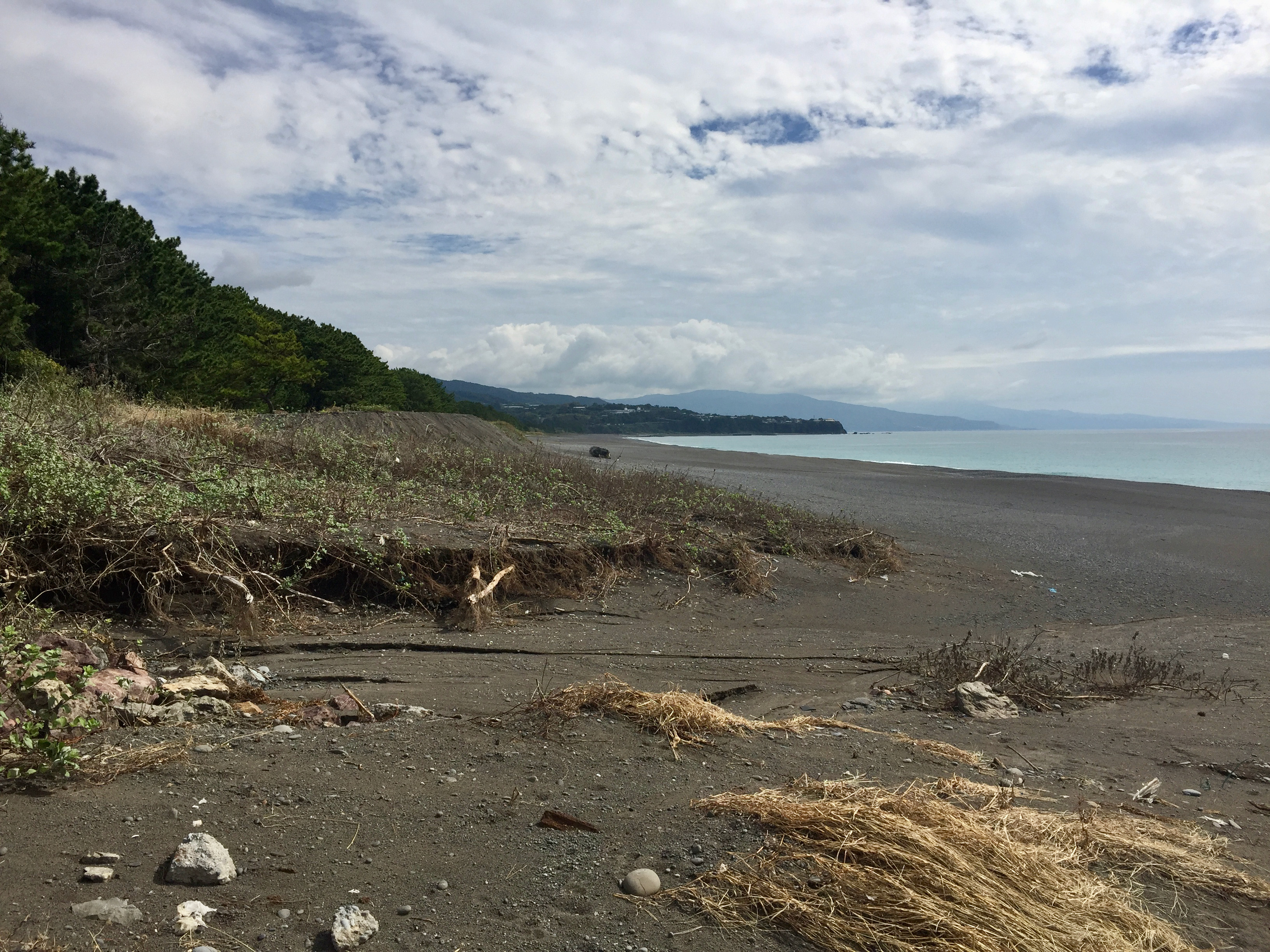
Complete with what we think was a Shinto event.
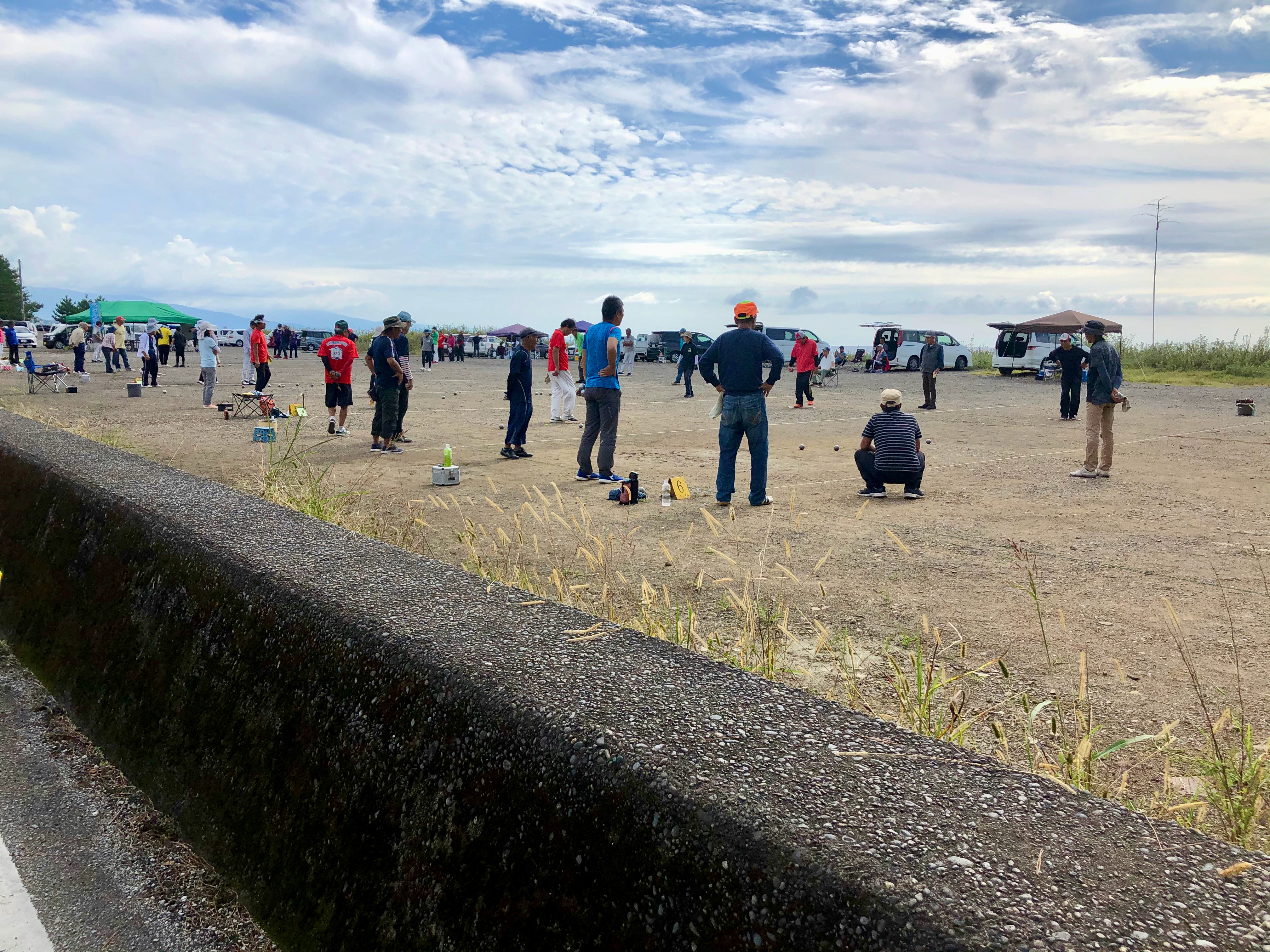
And what looked like a Japanese variant of Bocci Ball.
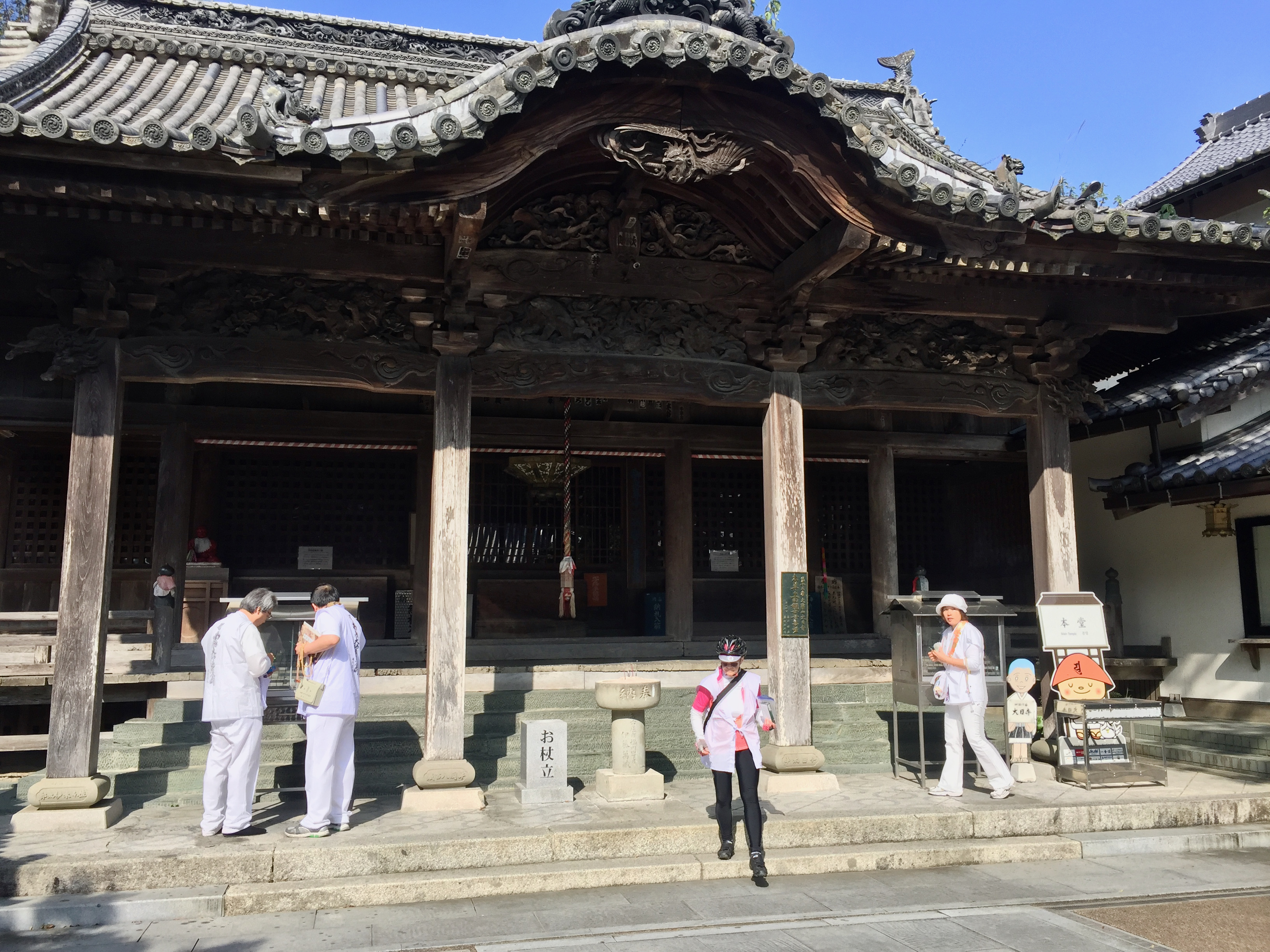
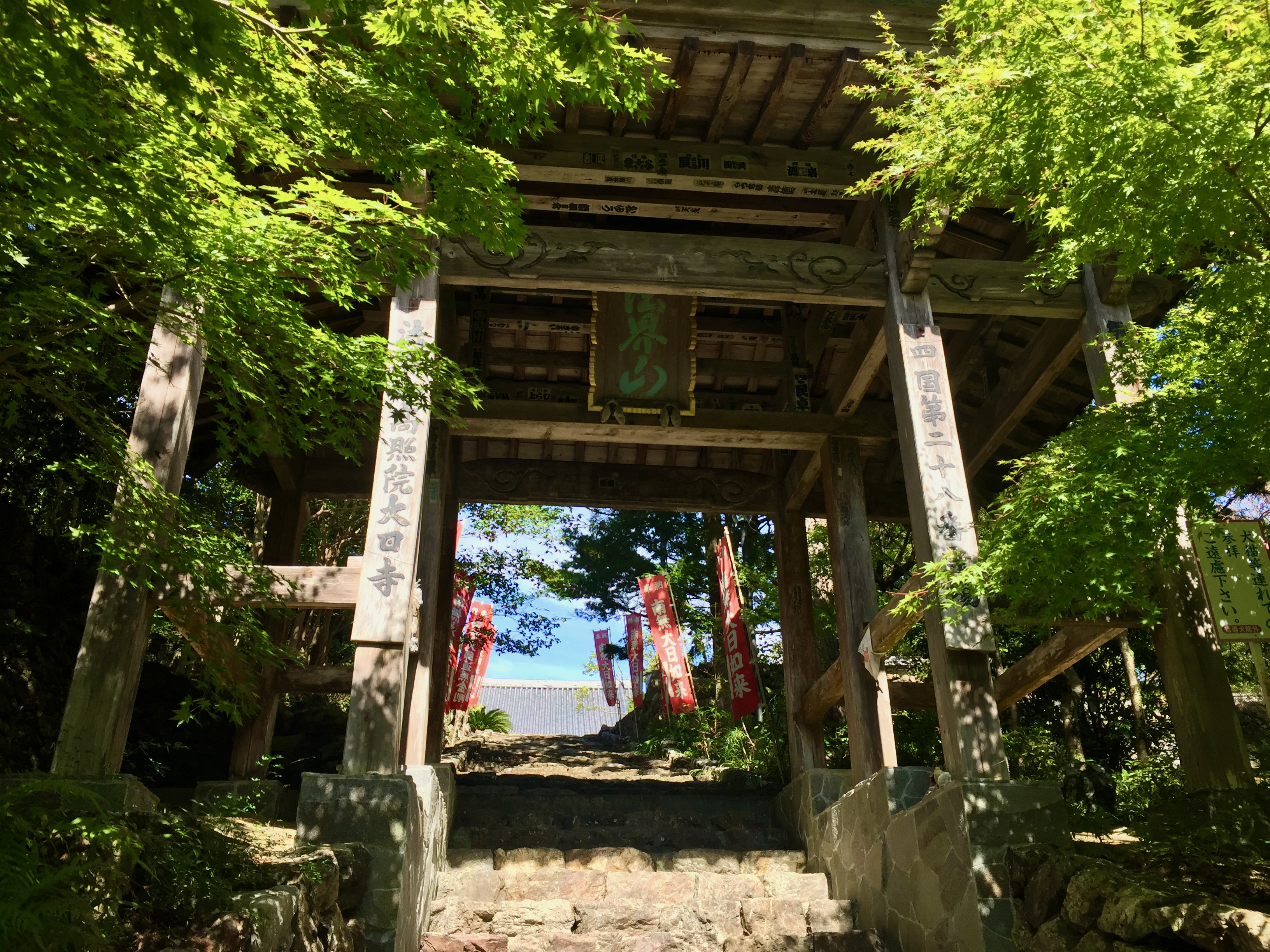
Around noon we were at Temple 28, Dainichiji.
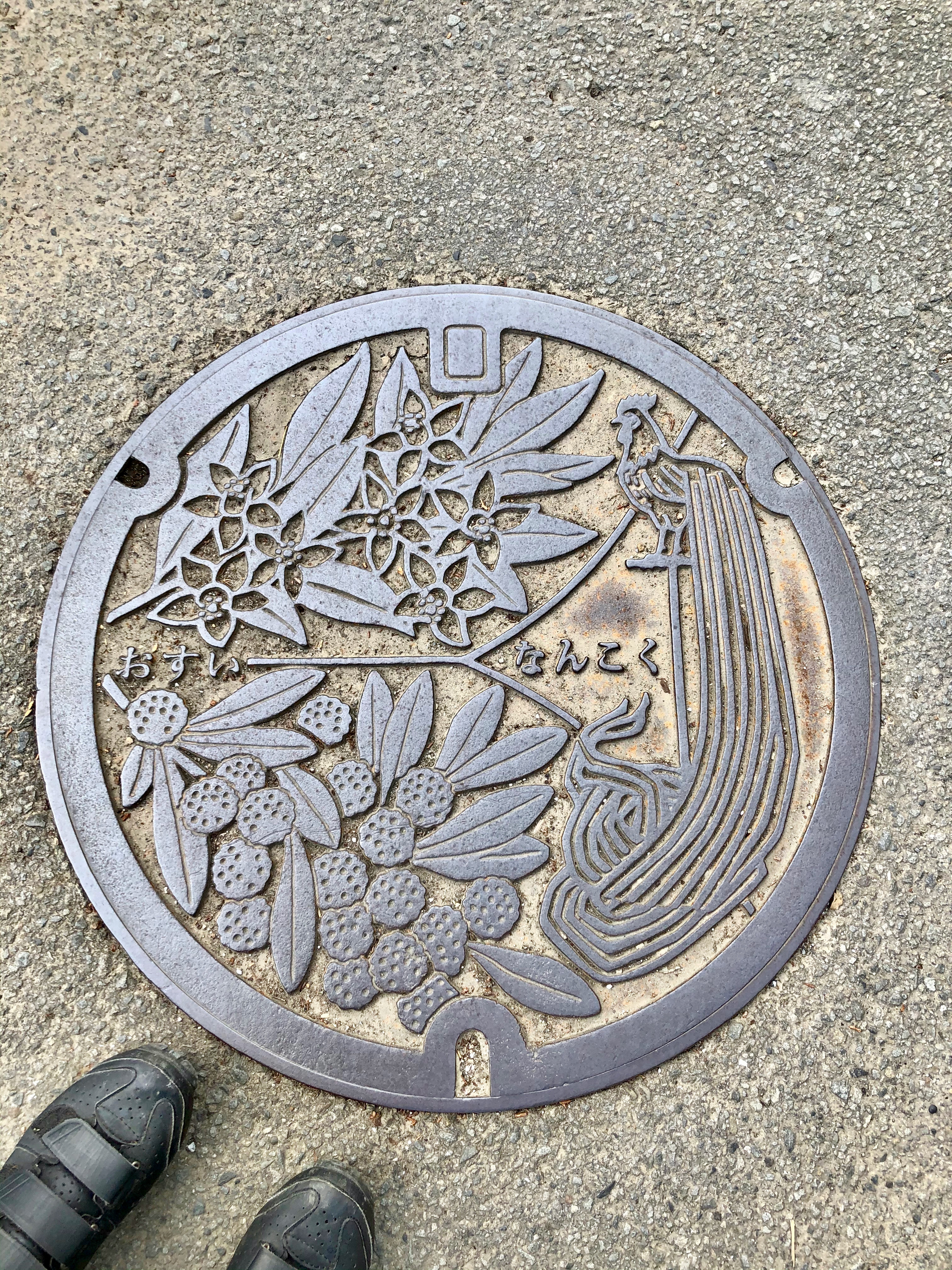
Now this is a manhole cover.
Next up was Temple 29, Kokubunji.

And then Temple 30 Zenrakuji. Altho the photo below is of the Shinto shrine, Tosajinga, next door.

We don’t have any photos of Temple 31 Chikurinji. Time was slipping away and we still had another Temple to go before 5 PM when the temple offices close.

We raced for Temple 32 and made it with just 5 minutes to spare. On the way out we turned on our headlight. It was getting dark.

In my frazzle, I had forgotten about our ferry crossing. We swept up next to Urado Bay. Sharon started shouting, “Turn right, Turn right.”

Couldn’t be right, right was just water.

Well actually, it could be “Right”, if you were on a ferry.

We looped back and waited for the ferry with a charming young couple with dilated eyes. Perhaps 16 or 17. He lived on the other side of the Bay. She was seeing him off. They held hands.

The ferry, no cars-allowed, eventually arrived and we headed across. Remarkable transition from twilight to night.  
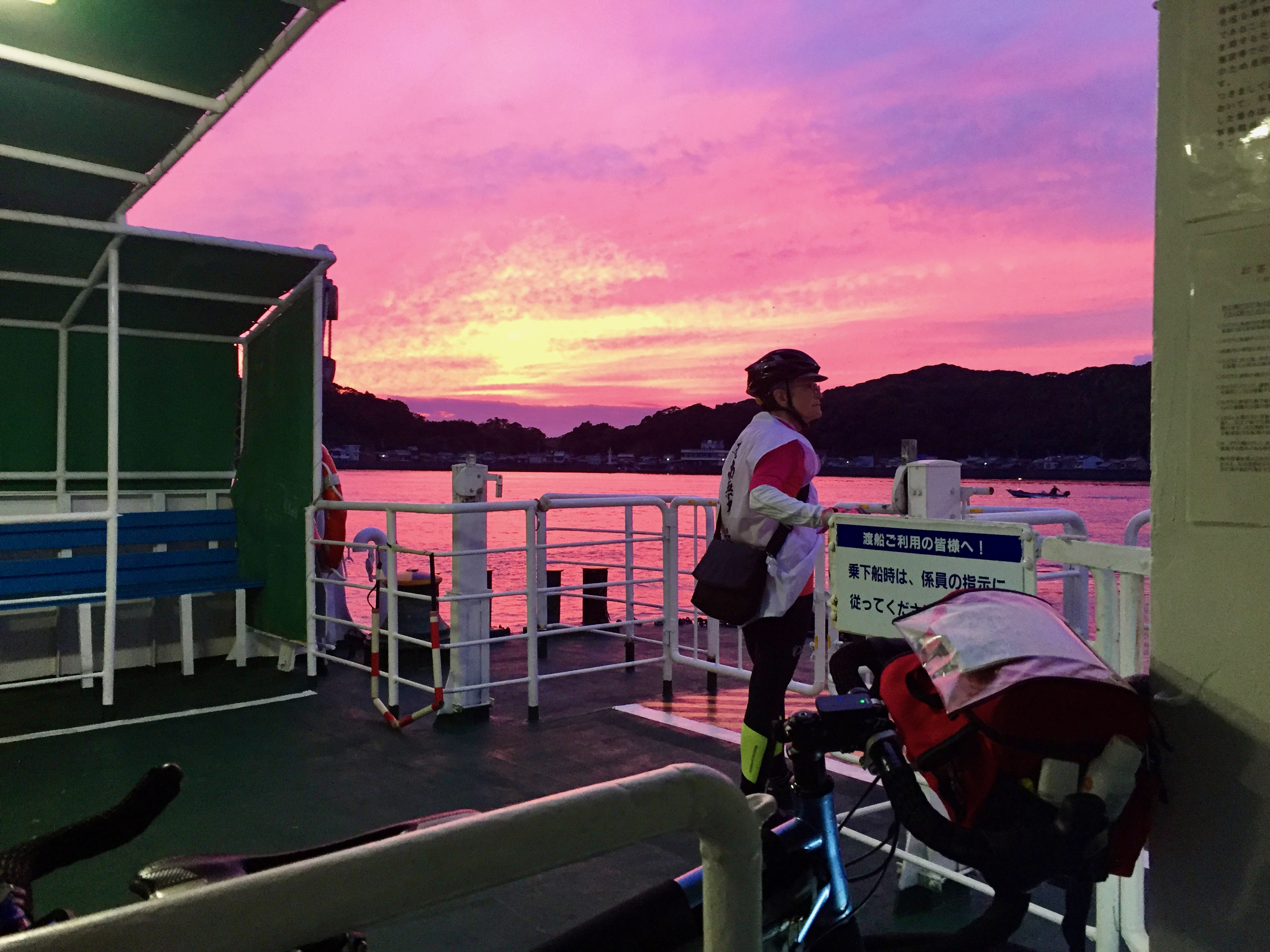
It was night when we reached the other side.

A mile or so later we were at our inn, Kochi-ya, directly opposite from Temple 33, Sekkeiji.

When we checked in, the question was bath or food, first? Dinner was in full swing. 

Food trumps presentability.

So we sit down and start in on yet another great meal. We start chatting with another pilgrim, a European woman sitting next to us. 

It soon became clear that we had crossed some indefinite line and now had pilgrimage cred.

“So where did you start?” 

“Tokushima?”

“When?” 

“ Eight days ago”

“On a bicycle?”

The rest of the table looked up.

“Yep”

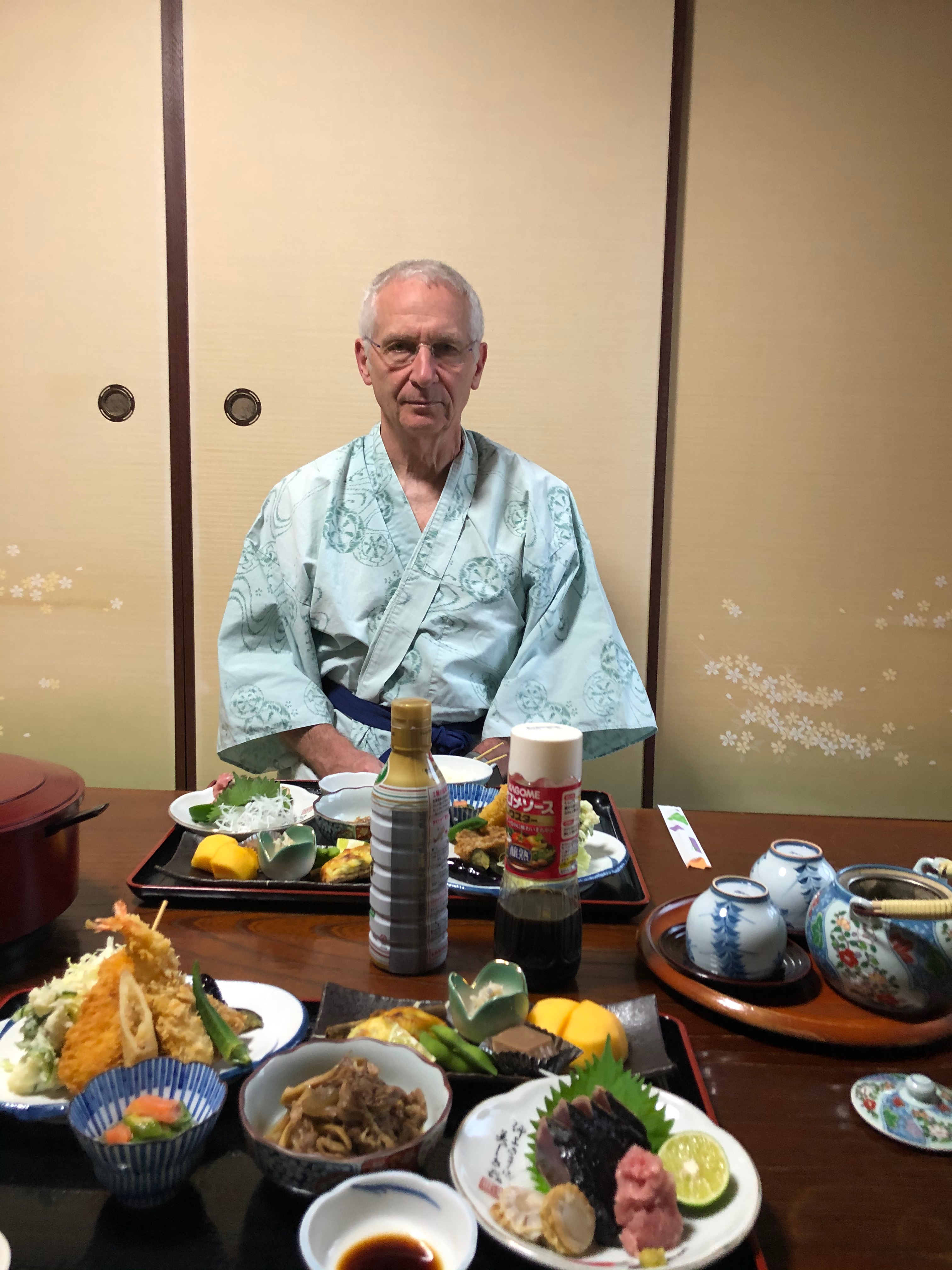
After dinner, after our bath, Sharon was pleased with her Yukata and warming vest. Weather was turning colder. After all, it was October 20. 

Day 14. October 21 Monday; Temple 33 to Susaki City. 4 temples.

33 Sekkeiji 雪蹊寺 Kōchi, Kōchi
34 Tanemaji 種間寺 Haruno, Kōchi
35 Kiyotakiji 清滝寺 Tosa, Kōchi
36 Shōryūji 青竜寺 Tosa, Kōchi

This was the day of the Cat Lady’s Inn, though we had 4 temples to visit, before arriving.

First we visited Temple 33, Sekkeiji, across the street. Photo below from outside our door on the second floor of our inn. 
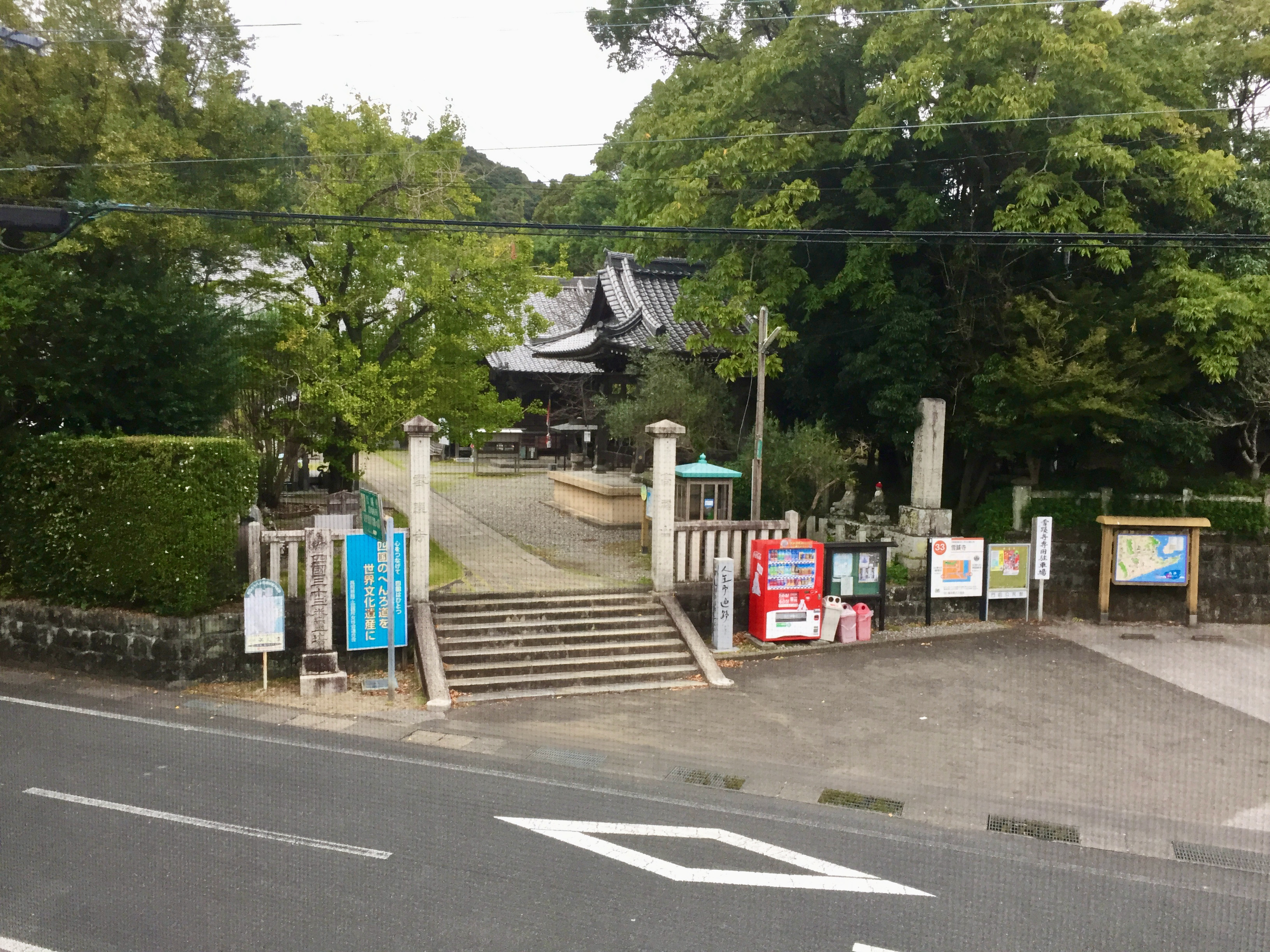
Next up was Temple 34, Tanemaji a bit before 10 AM.

Along the way to Temple 35, we passed this front yard extravaganza.

Pretty amusing and lots going on. There was a real dog just behind the turntable. He was barking to us. Sharon really wanted to walk across the yard and make friends. I knew from experience that this would involve petting and scratching. I always imagine the worst.

I’m sorry now I lobbied against the move, and that she listened to me. Mr Dog probably was mostly harmless and friendly.

It was another narrow, steep, switchbacked climb to Temple 35, Kiyotakiji. 

We arrived a shade before noon. The Temple was great. Lots of character.

But the big hit was the antique fully operational Fire Truck. Temples are mostly wood. Lots of open flames about such as candles. Fires are an ongoing problem.
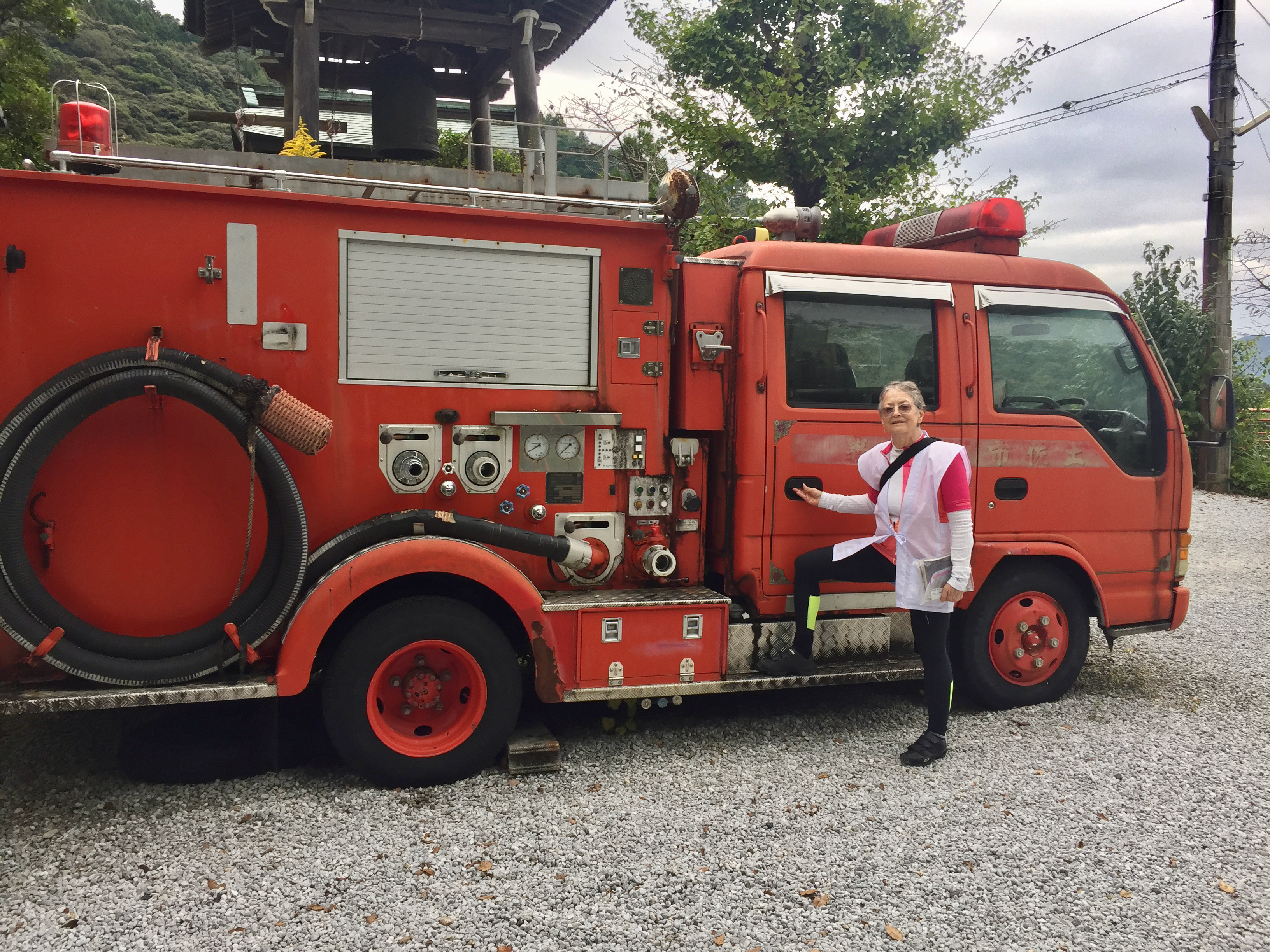
We chatted some with a Japanese Pilgrim, we had gotten to know on the road over the last few days. A good guy. He was fast, but ultimately we were faster, even with our day off.
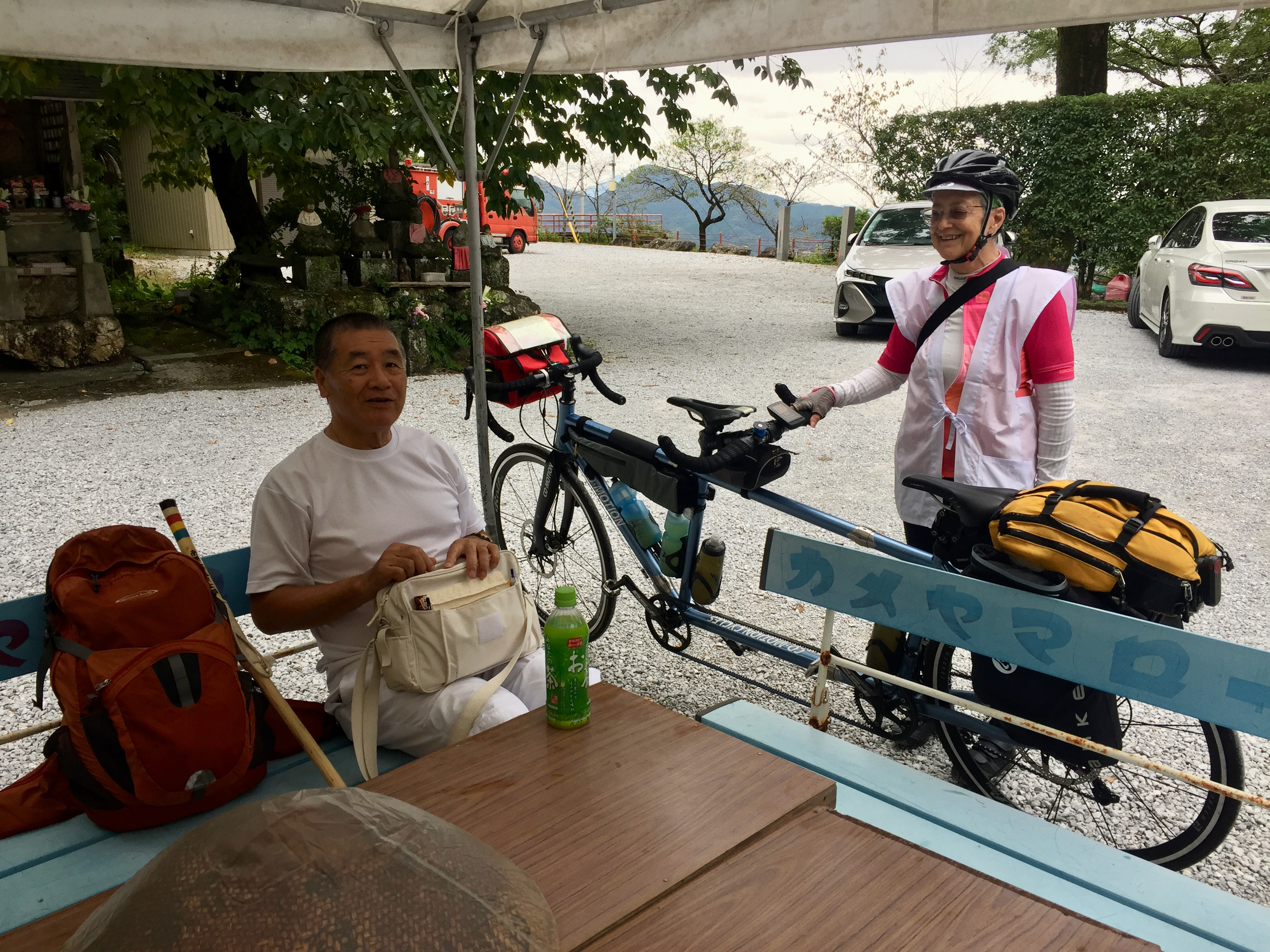
We descended and rode along the coast towards Temple 36, Shoryuji. A pretty Temple,

With a long stair.

The photo below was taken around 4 PM on our way into Susaki City and our inn for the night. Weather had been spitting, but all was well. We were going to make it with time to spare.

We crossed the Sakura River and turned left. Our bike computer had decided to send us into the heart of the main port proper and I never corrected that. So we had an up close ride along really really big ships and really really big cranes, and mountains of logs, literally.

A right turn and a couple of blocks later we knew we were close to our inn, but couldn’t get oriented. 

Sharon asked a gas delivery guy, who indicated we should just follow him. So we drafted up tight as he roared off, and a few turns and a few blocks later arrived at Guest House Doubutso Sudomari, home of the Cat Lady.

We weren’t entirely sure though that we were there. Neighbors were about so we asked them. Yep, we were in the right place.  

Mom and her 20’s/ 30’s son in a wheelchair. They were clearly bored, and we were a welcome diversion. They knew all about the pilgrimage and were into it and into our journey. Offered us cash osettai. We accepted, bowed and Sharon gave the proper response in Japanese. Good Folks. 

Jean Phillipe back in Minami Town had made our reservations for this night. He had given us the heads up that our hostess might not be home when we arrived, and that we should just go on in and make ourselves at home.

So we did.

First step was to introduce ourselves to the cat on the first floor. 
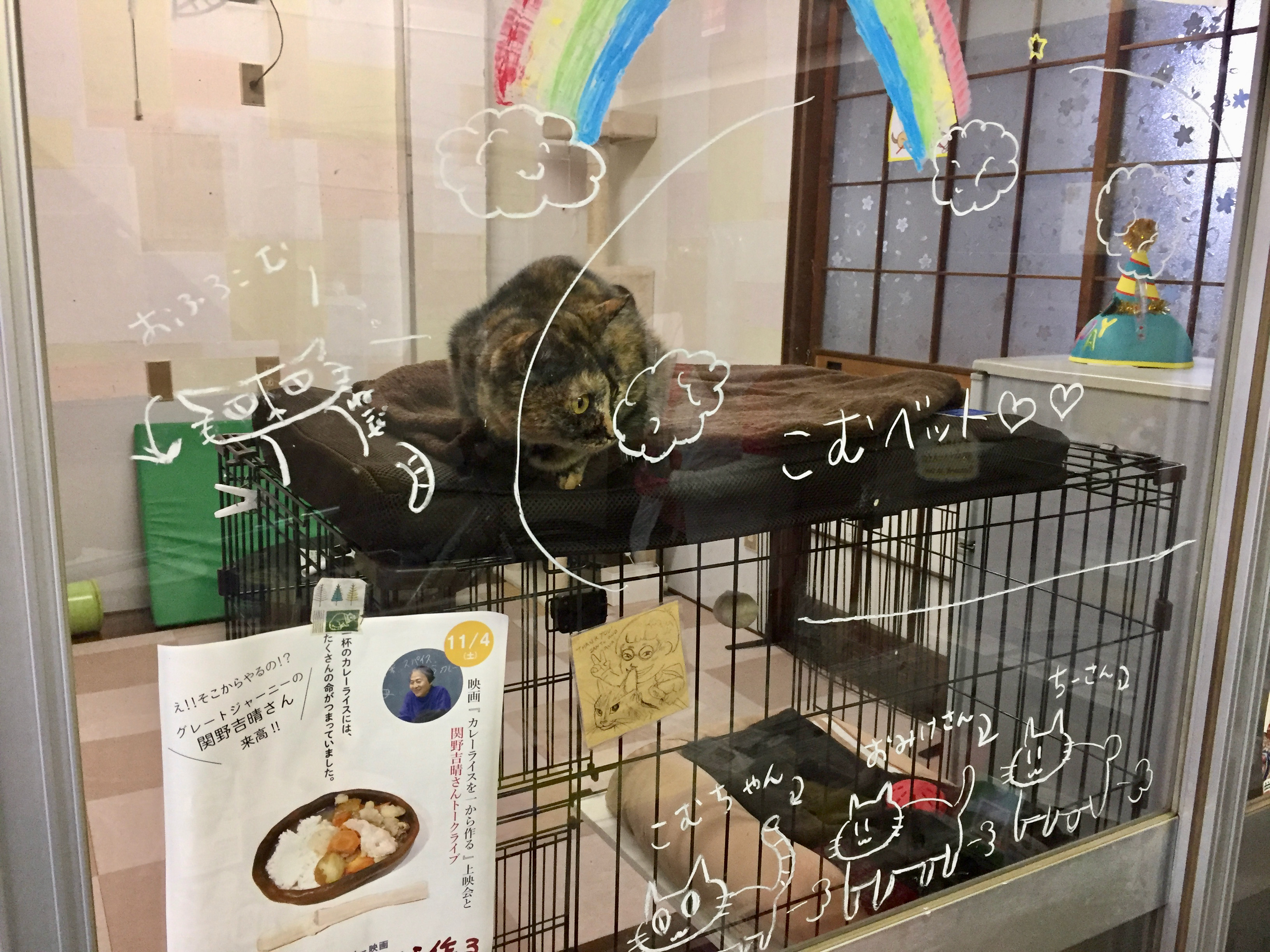
We found our room and settled in. 

It wasn’t long thereafter that the Cat Lady, Mayuyu, arrived home from work. 
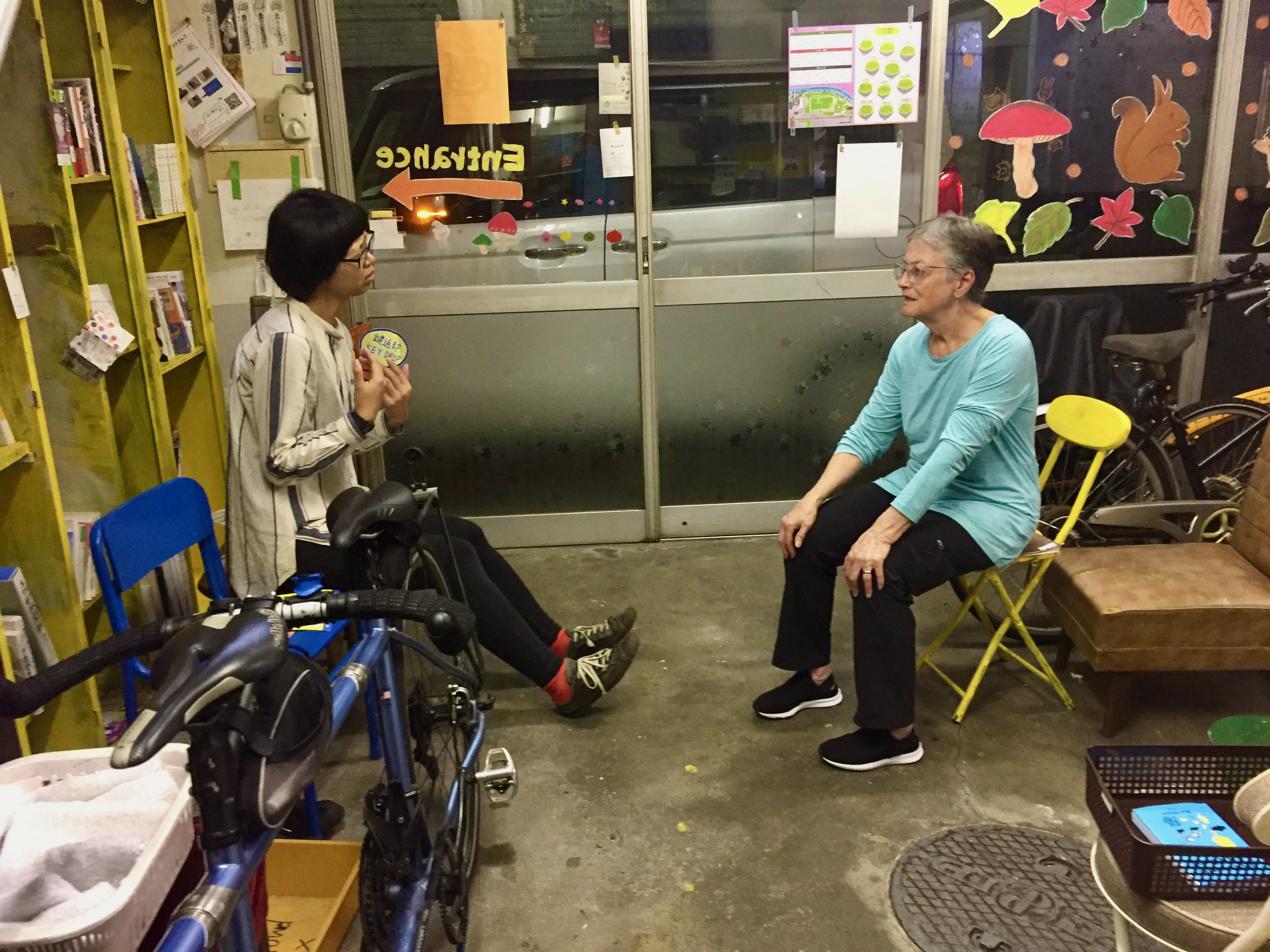
Mayuyu was great. Shortly thereafter she and Sharon headed off for the grocery store. We had the first floor guest kitchen to ourselves and Sharon put together a great dinner.

And we ate off of Cat Plates and drank from Cat Mugs.

We were especially impressed with her Tiny Cat reading Sutras.

Mayuyu explained that she had received Ms Cat and her Sutras, as a gift from a pilgrim who had stayed at her inn, and then asked if we would like her. 

Of course!!! Great stuff. 

Today Tiny Cat reads her Sutras on our kitchen vitamin carousel between the Carnitine and Boswellia. An example for us all.

Day 15. October 22 Tuesday; Susaki City to Kuroshio. 1 temple.

37 Iwamotoji 岩本寺 Shimanto, Kōchi

On our way out the next morning, Mayuyu told us that one pilgrim had left their Sedge hat and never returned for it. So Sharon tried it on. 
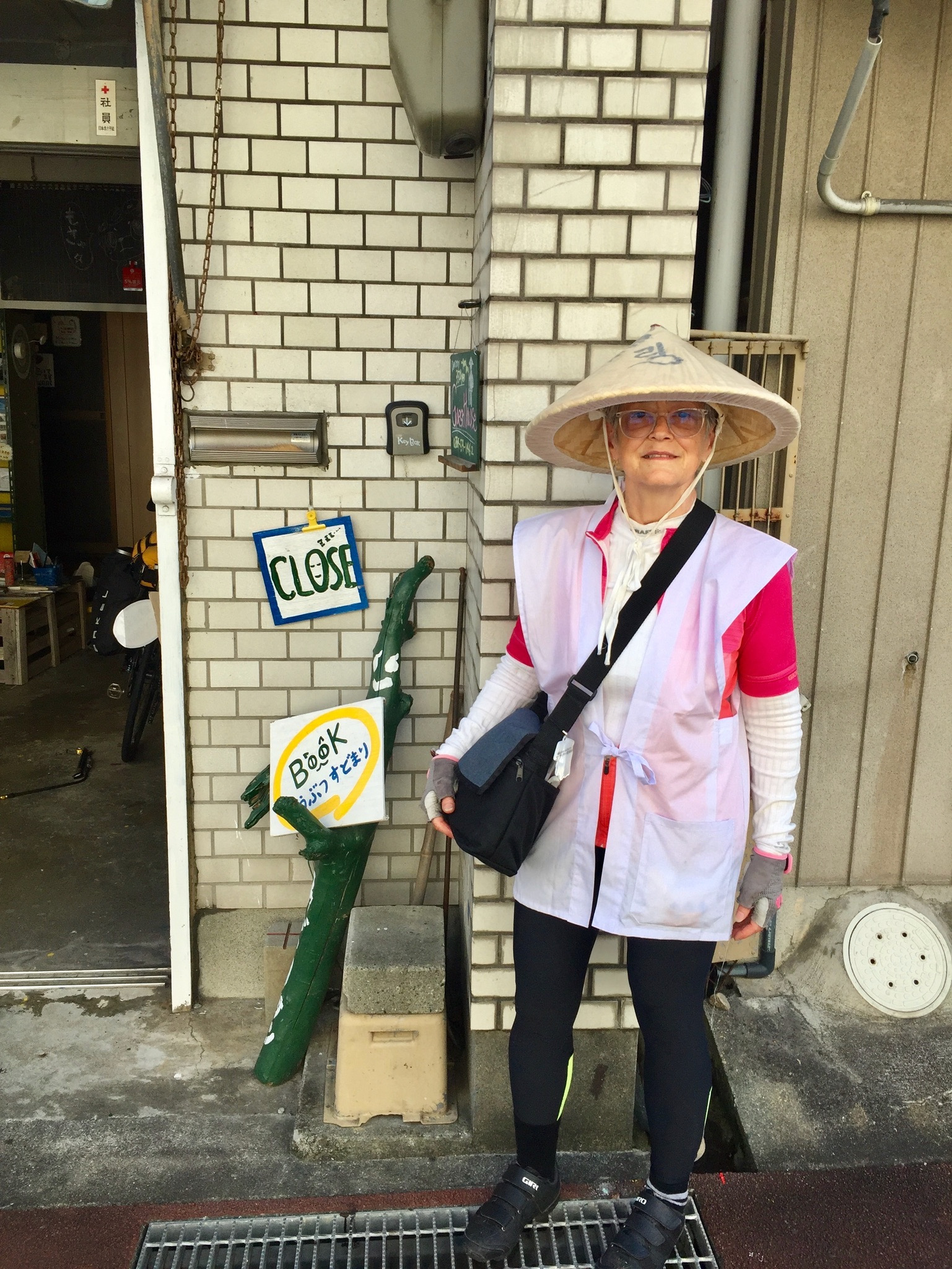
And I got to confirm, that yes, my initial idea of somehow bicycling with a sedge hat over a bicycle helmet was indeed goofball all the way down. 

Mayuyu brought a favorite cat out to see us off. It has taken me a while to warm up to the photo below, but today I find it hilarious. 

Mayuyu is into it. Sharon is smiling, though resigned, I’m worried about Nanako Pass, and the tunnels ahead, and Ms Cat is seriously not happy about any of it.

Our ride for the day would take us inland up over Nanako Pass, along a high-ish plateau to Temple 37, followed by a descent back to the Pacific Ocean.

It would also be our first day of serious tunnels. Not a problem that day or any day.

All up, I am guessing we must have passed through well over 25 tunnels on this trip.

As it turned out these tunnels were great blessings. I had been worried, but I was wrong. Tunnels truly were our friends. 

Tunnels took us through the mountains, we otherwise would have had to climb over. 

It felt almost like cheating. Our bike computer didn’t do tunnels, it just said big climb ahead as we approached. As we rode, or walked, through the tunnel, Mr. Computer would show the profile of the mountain above. What’s not to like?

That’s not to say there weren’t dodgy moments. But we were careful and prepared. We had lights, front and back , and extra frame lights as insurance for the really dark, long, tight tunnels. 

First up was Kadoya Tunnel just out of Susaki City. We just rode through this one. Only a 1/4 mile or so. Traffic was relatively light. 
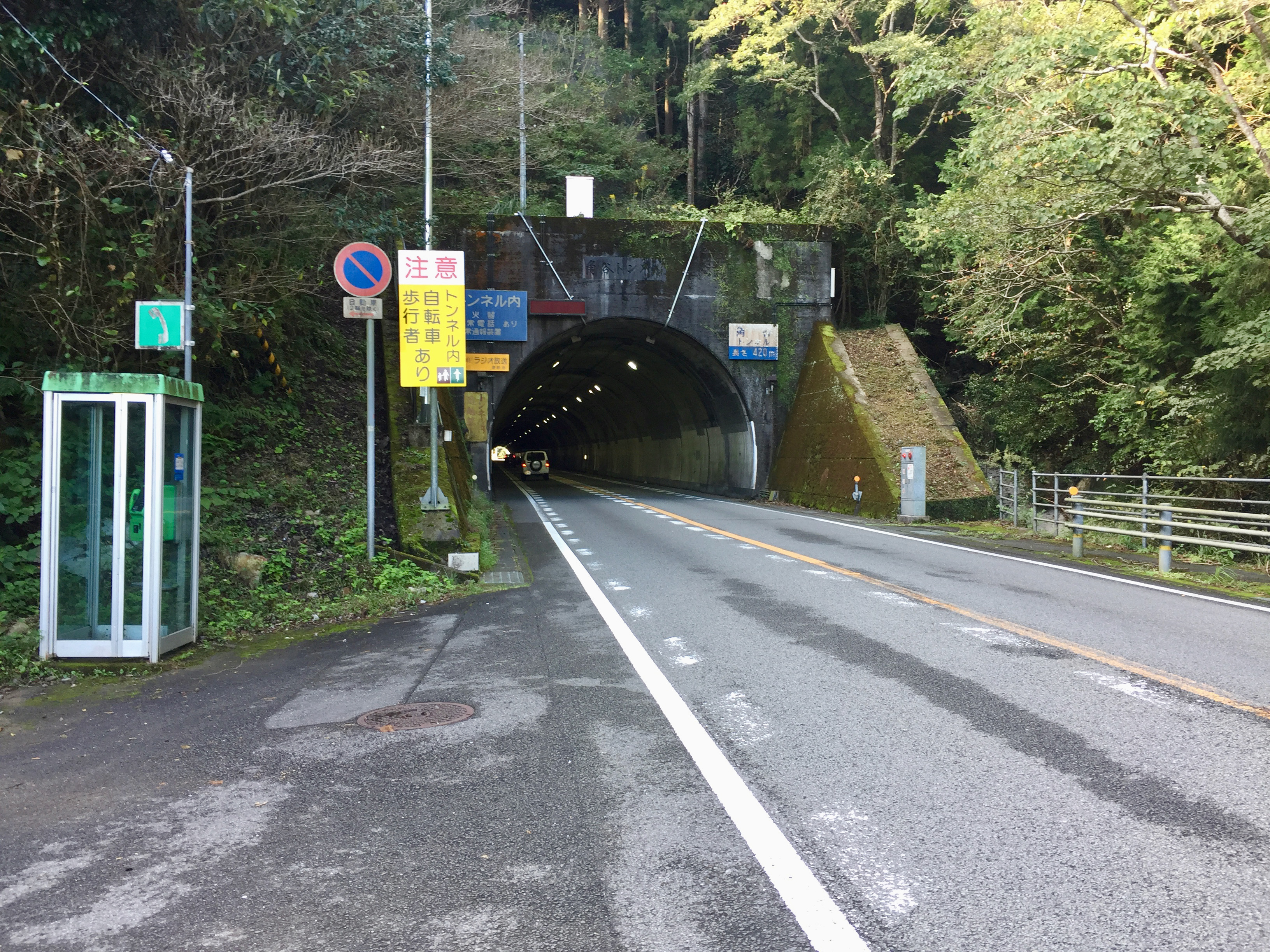
Next up was Yakezaka Tunnel, about a 1/2 mile in length. As I recall it was really dark, there was a rail and to be safe we walked most of it. 

We also wore the reflective vests provided in the box at the tunnel entrance. An honor system. Take one out on one side. Hang it back up in the box provided on the other side.

Nanako Pass was manageable. We were riding on Highway 56, and the grades were Highway grades, not crazy steep Mountain Temple grades.

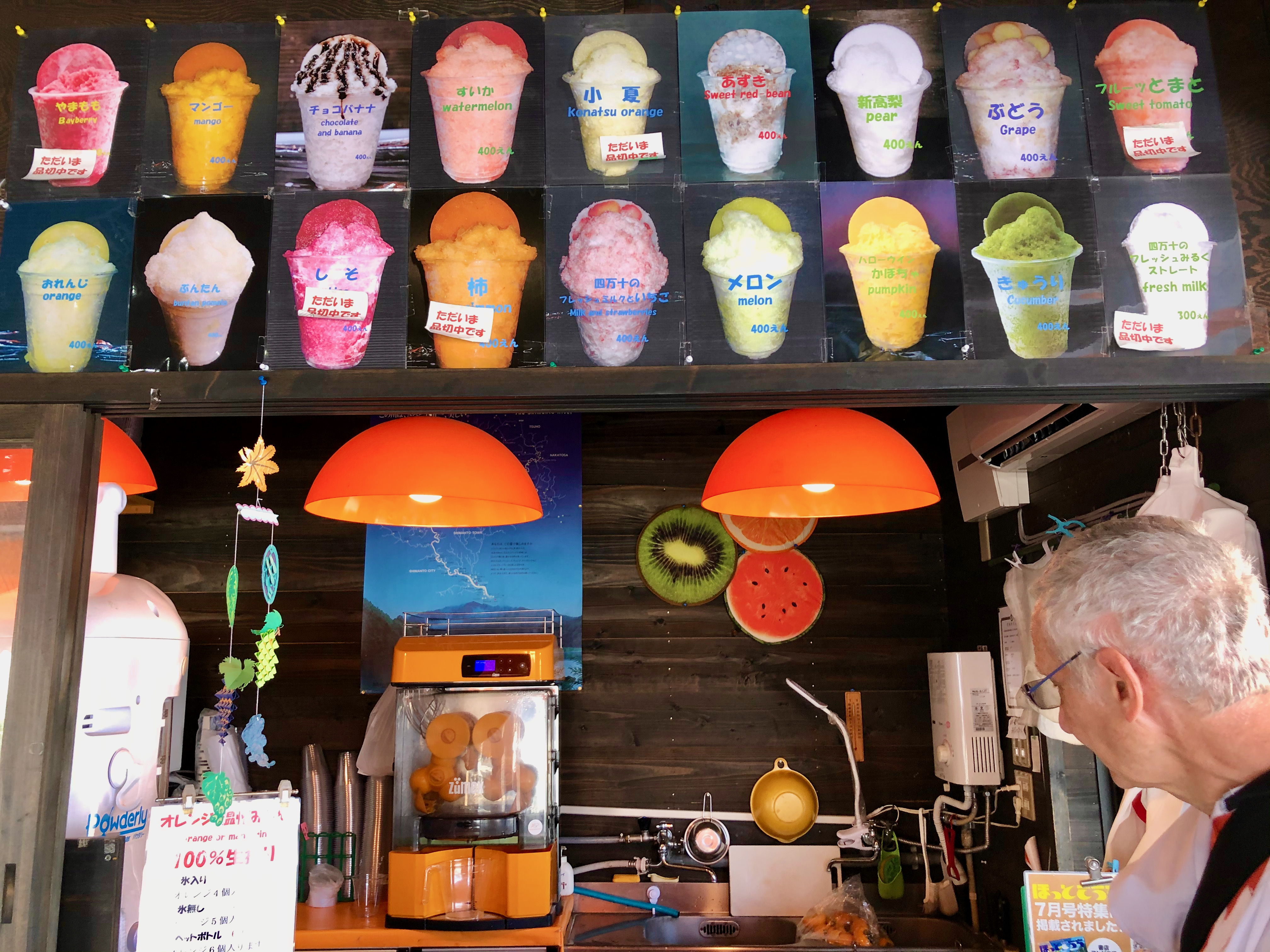
We arrived at Temple 37, Iwamotoji early afternoon. Before heading in, we stopped for treats.
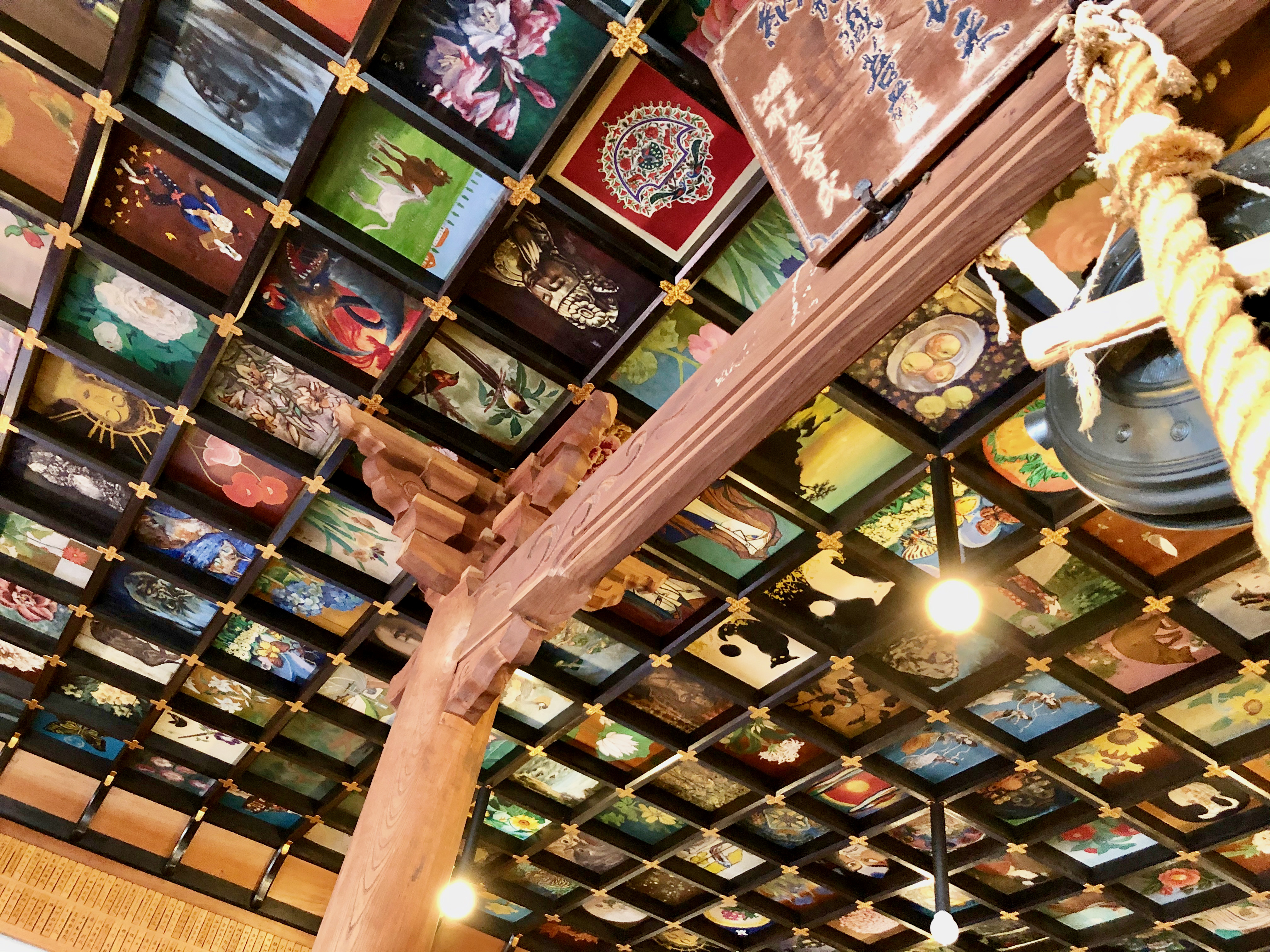
Temple 37 was an interesting collection of buildings – all shapes and sizes.

The Main Hall has 575 pictures on the ceiling.
Shortly after Temple 37, we stopped for lunch at a convenience store.

Once again, I was a bit worse for wear. We had parked Mr. Bike, and I was sitting on a curb when this pick-up pulls up. A middle-aged Japanese guy jumps out, hustles around to his cooler in the back, pulls out a couple of beers, strolls up, and offers them to me.

It took me a moment to realize what was going on. I was stunned, like pulling the arm of a slot machine and watching the wheels spin.

Then I got it. 

Osettai!

Very 21st century, and very appreciated. 

I could tell he wasn’t so sure about me. But when I bowed and mumbled, “Namu Daishi Henjo Kongo” three times. He nodded and laughed, hopped back in his pick-up and was off.
“Namu Daishi Henjo Kongo” translates roughly as “Homage to the great Teacher brilliant shining Diamond.” Or Homage to Kobu Daishi. And is the proper response on accepting Osettai.

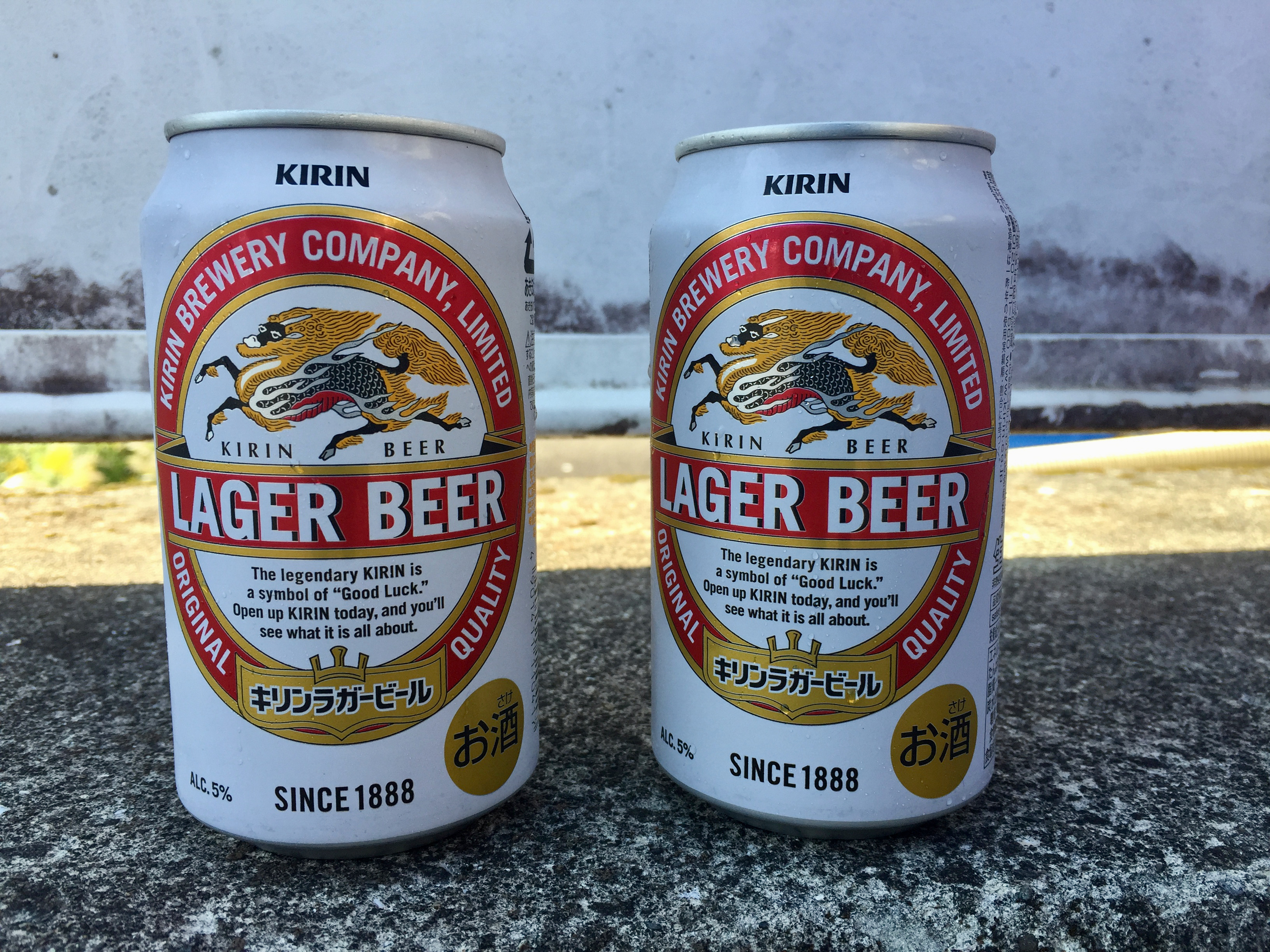
We received many gifts as Osettai. Candies, meals, fruit, money, handwoven gloves and so forth. These beers were my favorite. 

It was clear we were pilgrims, as we were wearing the traditional white vests. Hence the Osettai.

Two things are going on with Osettai from the givers point of view. First, Ossettai gifts are kind of like giving alms. Helping the needy. 

Secondly, and most importantly, such gifts are symbolic gifts to Kobo Daishi, who symbolically, would bless the giver and give them a virtual third seat on our bike, now a triple. Or maybe it’s a quad, as Kobo Daishi has a seat too.

Our pilgrimage would become their pilgrimage with Kobo Daishi’s blessing. Great tradition, with the magic, living on into the 21st century. 

Even Kirin Beer works as Osettai.

Best not consumed while riding though. Appropriate though for sipping and watching the afternoon siip away and sun set into the Pacific Ocean, which is how it went at the end of the day at Hotel Umibozu, after the Yokohama and Inomisaki Tunnels.

We weren’t alone, Mr. Pick-up guy and Kobo Daishi seemed to be enjoying it too.

As was often the case, we had remotes for both our AC and lights.

Perfectly clear. Right?

“Hey Sharon. Can you get these to work?”

A grumble later, the AC and the lights were on.

Day 16. October 23 Wednesday; Bicycling Day 11; Kuroshio to Oki.  0 temples.

By now we knew our way around the Japanese Inn breakfast. A key move, immediately after retrieving the steaming rice, break the raw egg on top and stir it in. Don’t dawdle or it won’t cook.

We loaded up the bike and were on our way.

No Temples today, just a relatively level ride along the Pacific towards Cape Ashizuri. 

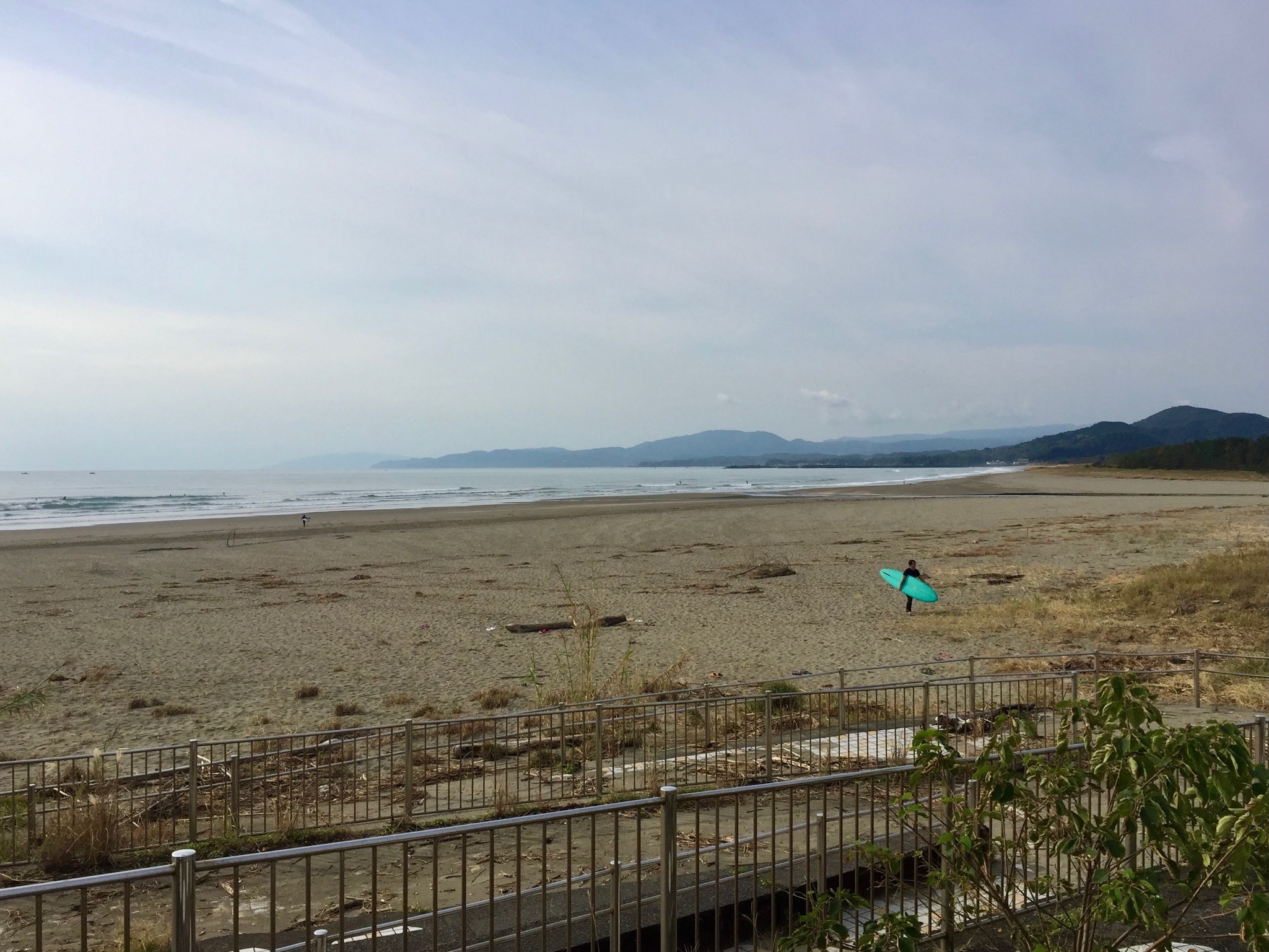
First we rode along a scenic stretch of beach with surf shops and surfers. Hello California.
We stopped for snacks mid-morning: Ice cream, potato chips, nuts & raisons, ice coffee and juice. 

Next up was the Shimanto River, the longest river in Shikoku and also the last undammed river in Japan. The river was wide and quiet when we crossed just before noon.

We met Lee Han Kok, a pilgrim from Singapore, at another convenience store on our early afternoon lunch break. He was about to head home. He could only get away for a short time.

A good guy. Sad story. Disabled brother. Parents with cancer. He was taking care of everyone, and exhausted on many fronts.

Lee said he was doing his pilgrimage for his family. We suspected he also desperately needed to get away for his own sanity. 

He had fallen on a trail, his phone was dead and he was lost. We did what we could to help.

We were making good time. Mid-afternoon we arrived at our inn for the evening, Minshuku Iburi Bar. 

Basically Iburi Bar, was a first floor spare room. And it came with a sprightly cat, Sophia, if you cared to host her, which of course, we did. Sophia had a sidekick Blackie, but he wasn’t interested in us.
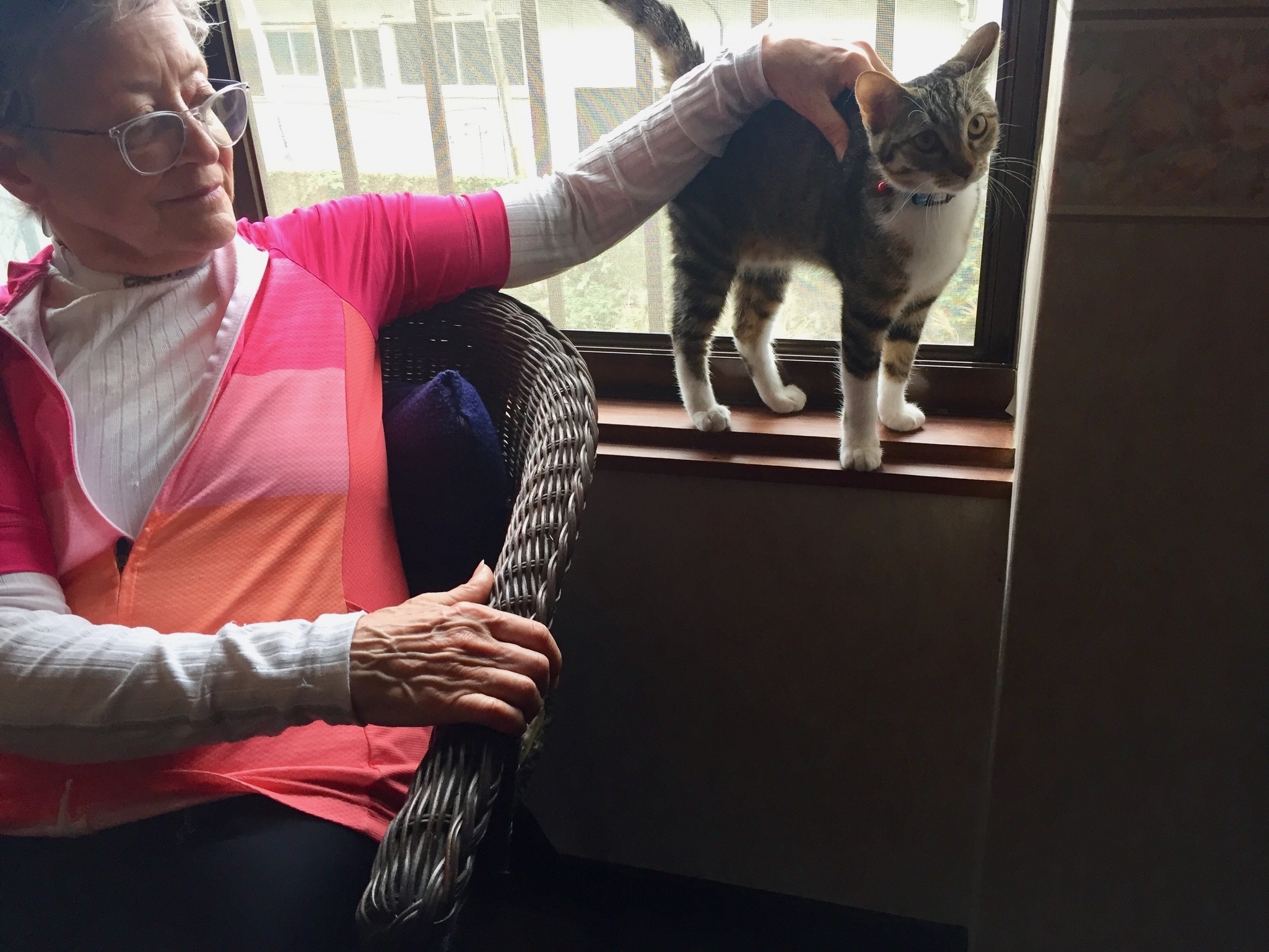
Another Typhoon was bearing down on us. Perhaps it would miss us.

Perhaps not.

Day 17. October 24 Thursday; Bicycling Day 12 Oki to Tatsukushi. 1 temple.

38 Kongōfukuji 金剛福寺 Tosashimizu, Kōchi

We ate breakfast and lingered, hoping that the Typhoon would let up.

No such luck. This was a Florida+ rain. Florida rains are the heaviest I’ve ever seen. A Japanese typhoon rain is the next level up.

I didn’t see any alternative to just riding. Torrential rain and all.

Our hosts were appalled. And had a better idea. They knew a guy, who for a modest sum would drive our bike ahead to our next hotel in his pickup.

While our host would take us and our luggage. But first he would take us out to Temple 38, Kongofukuji. 

Thus our sorry asses were saved on Cape Ashizuri.

Temple 38 was pretty great. The rain only added atmosphere. 
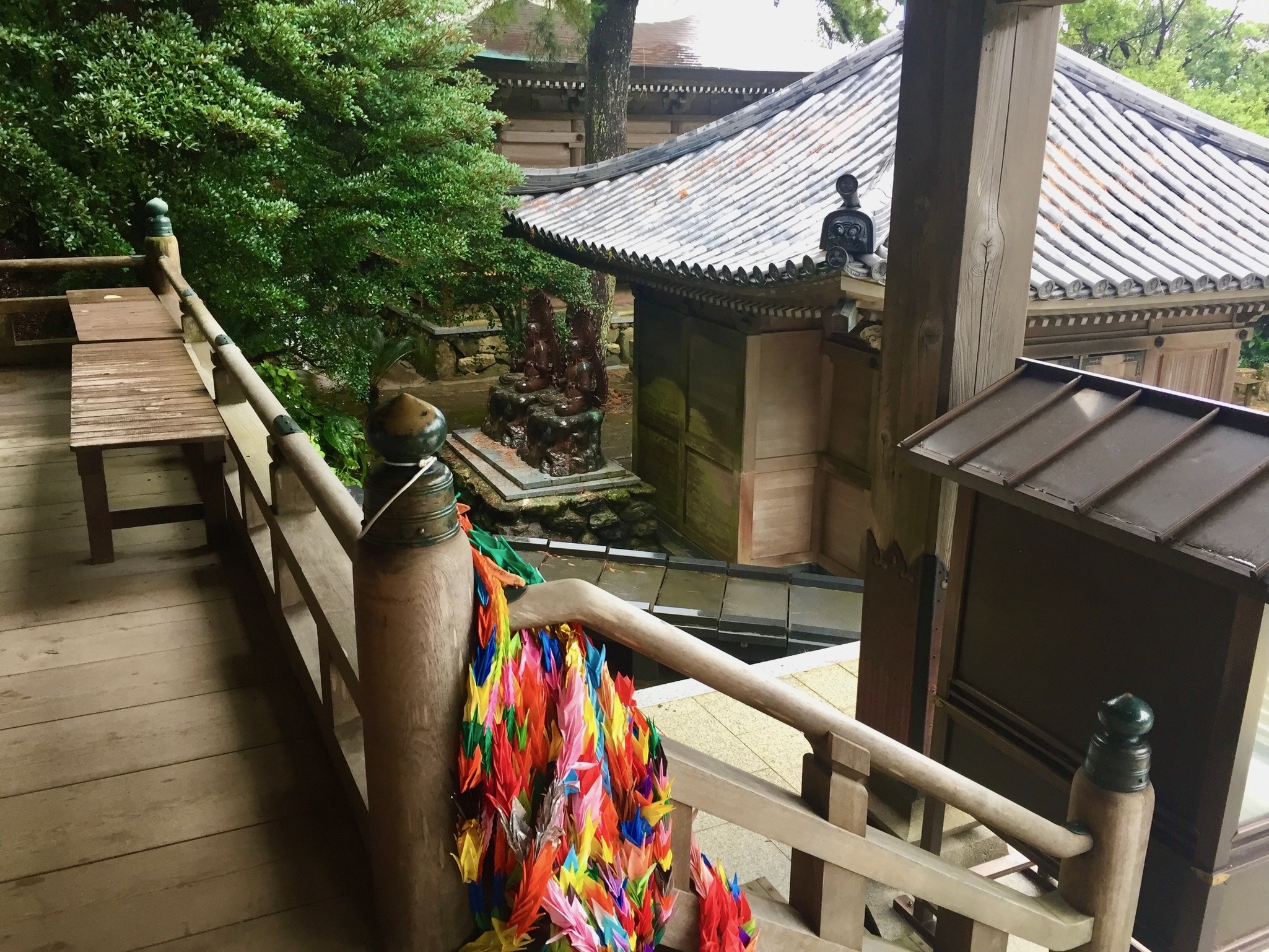
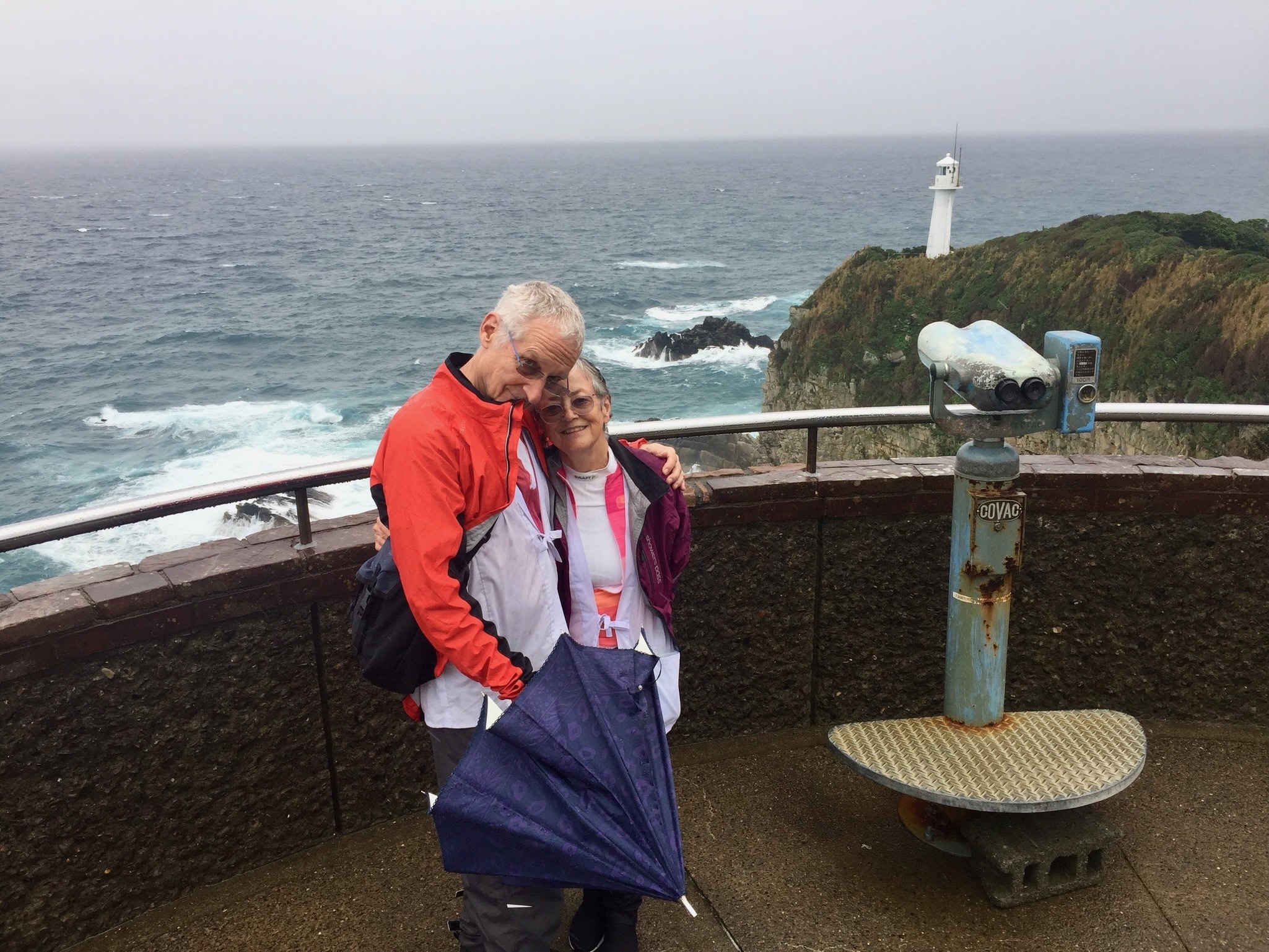
We also visited the observation platform on the point of the Cape itself.
 And a local bike shop in the town of Tosa-Shimizu, just in case they might have our brake pads. No luck there. The owner was really old.

Our host told us the town was dying. Every year there are thirty people ± fewer.  

We were dropped off at our next hotel, Nangoku, early afternoon. I spent the afternoon snacking, sipping beer, watching the rain fall, contemplating the kindness of strangers, and wondering about what I had gotten us into.

And did I mention that the Nangoku Hotel was haunted?

We were the only guests and had been given a very nice room on the top floor. When I was ready for another beer, I’d wander downwards, stepping over extension cords which went who knows where. 

Pictures on the walls were faded and never quite level. Piles of this and that had been set down on tables or chairs in passing perhaps years ago and never moved again. 

The stair landed in the front lobby. Each time I came down, there were one or two elderly folks dead asleep in chairs. At least I think they were asleep. 

I’d head to the dining area and linger. Eventually a most elderly Japanese woman with sparkling eyes would appear soundlessly. 

I’d whisper the magic word, “Beeru”. She’d disappear and then re-apparate with a Kirin and a knowing smile. I’d make my way back past the dead asleep, and then up through the empty haunted halls and stairs to our room. 

The rain fell relentlessly. Light was dim.

Day 18. October 25 Friday; Bicycling Day 13 Tatsukushi to Sukumo. 1 Temple

39 Enkōji 延光寺 Sukumo, Kōchi

We woke the next morning to a bright new day. The storm had passed. View from our room below.
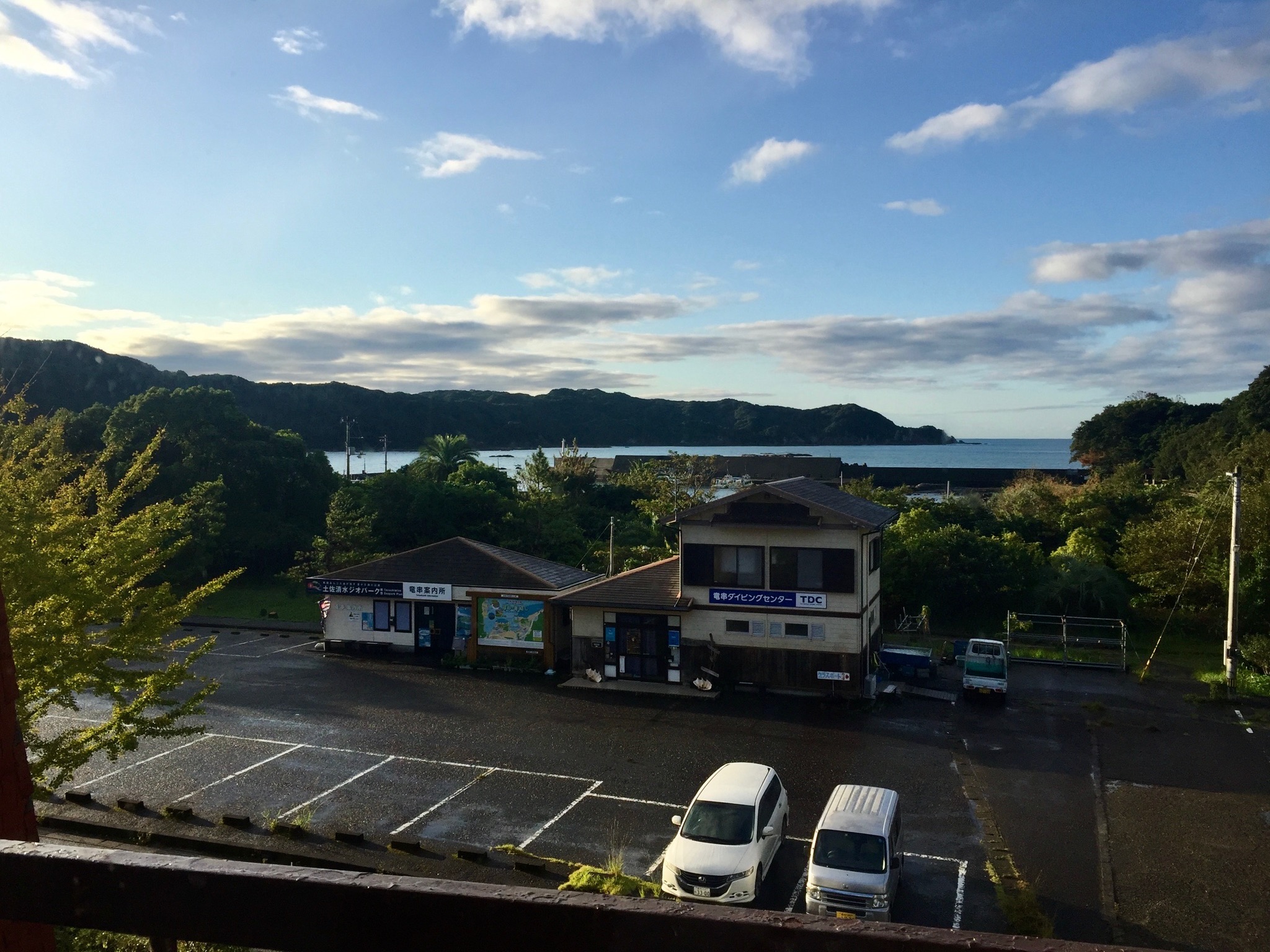
We headed downstairs for yet again another great breakfast. No bodies in the entry. 

We loaded Mr. Bike and headed out. Stopping for a pic of Hotel Nangoku in the sunshine. No ghosts in sight. Our room had been top right. 

We would be heading inland with climbs and roads off the coastal pilgrim route to Temple 39, Enkoji in Sukumo City. 

First we rode up along the Soro River. 

And then headed up through forests of tall conifers.
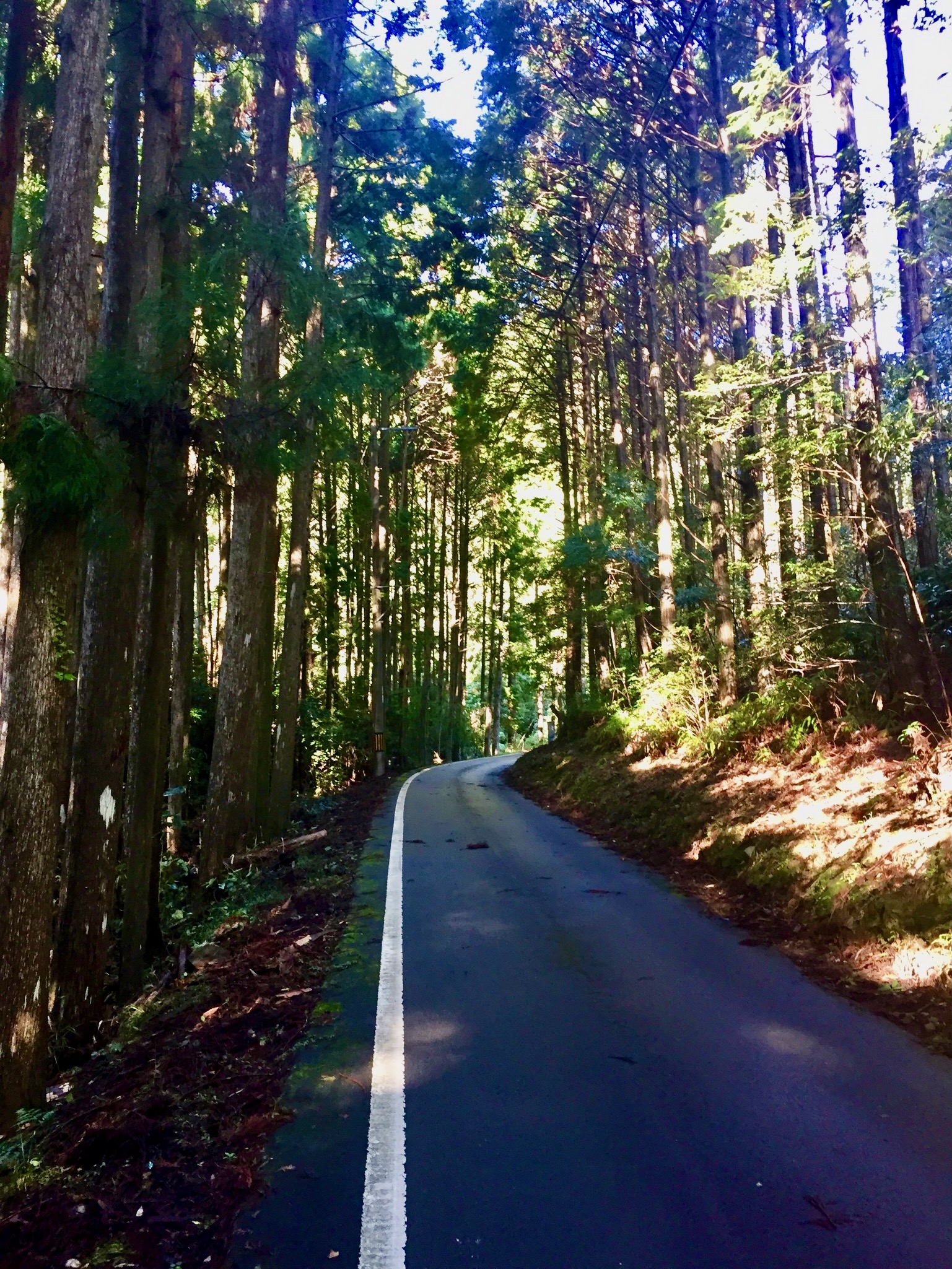
We had to wait at checkpoints before riding forward. There had been landslides and construction of new retaining structures was underway. My fear was that we would be told the roads were closed. 

But at each checkpoint we were waved through, eventually. 

As we continued climbing, we found ourselves alone in the forest. We were probably the first through here since the last typhoon. This road didn’t see a lot of traffic.
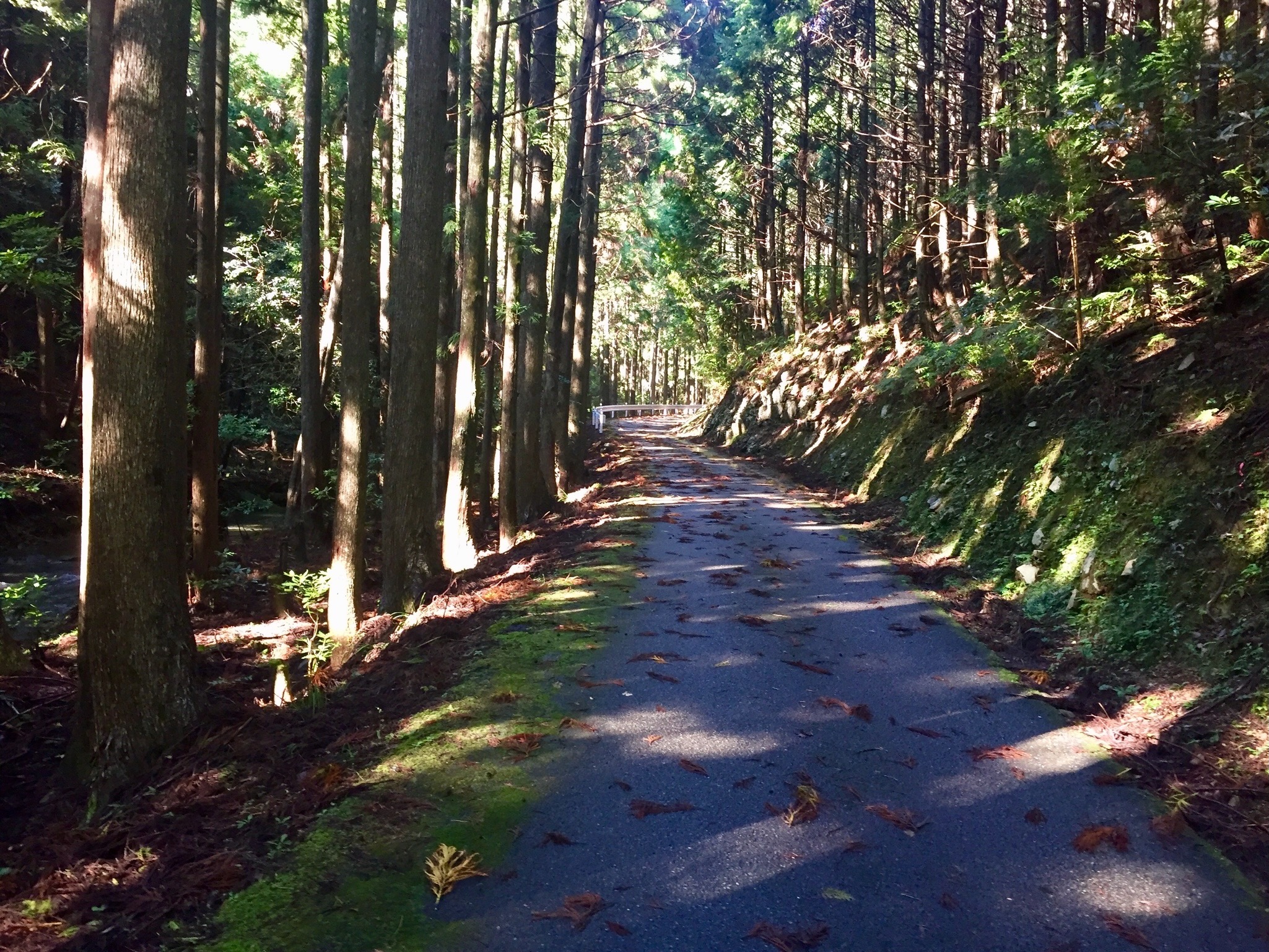
Eventually we crested and left the forest behind, as we descended back to civilization. Not much traffic though.
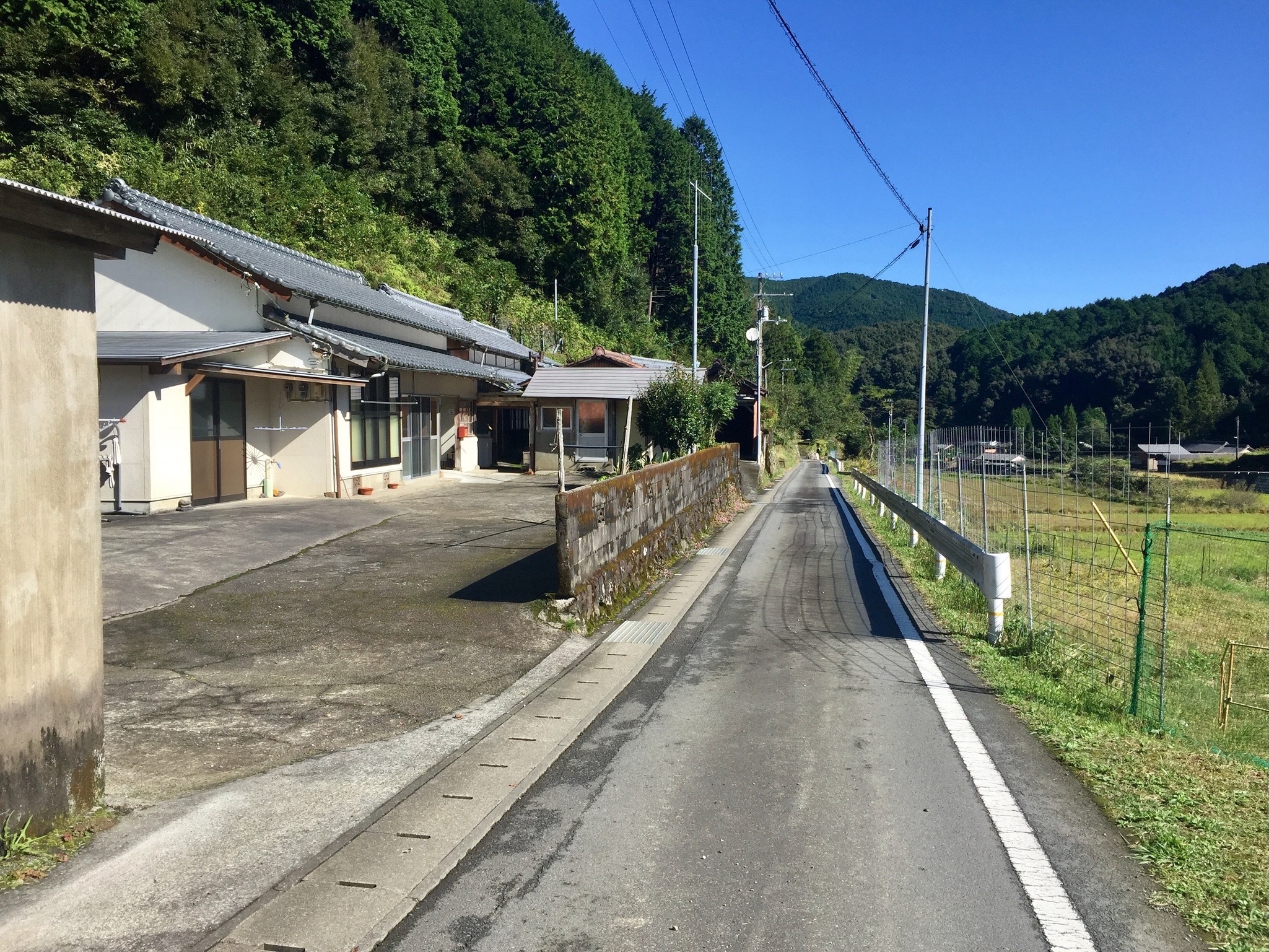
That would change once we took our left on highway 21.

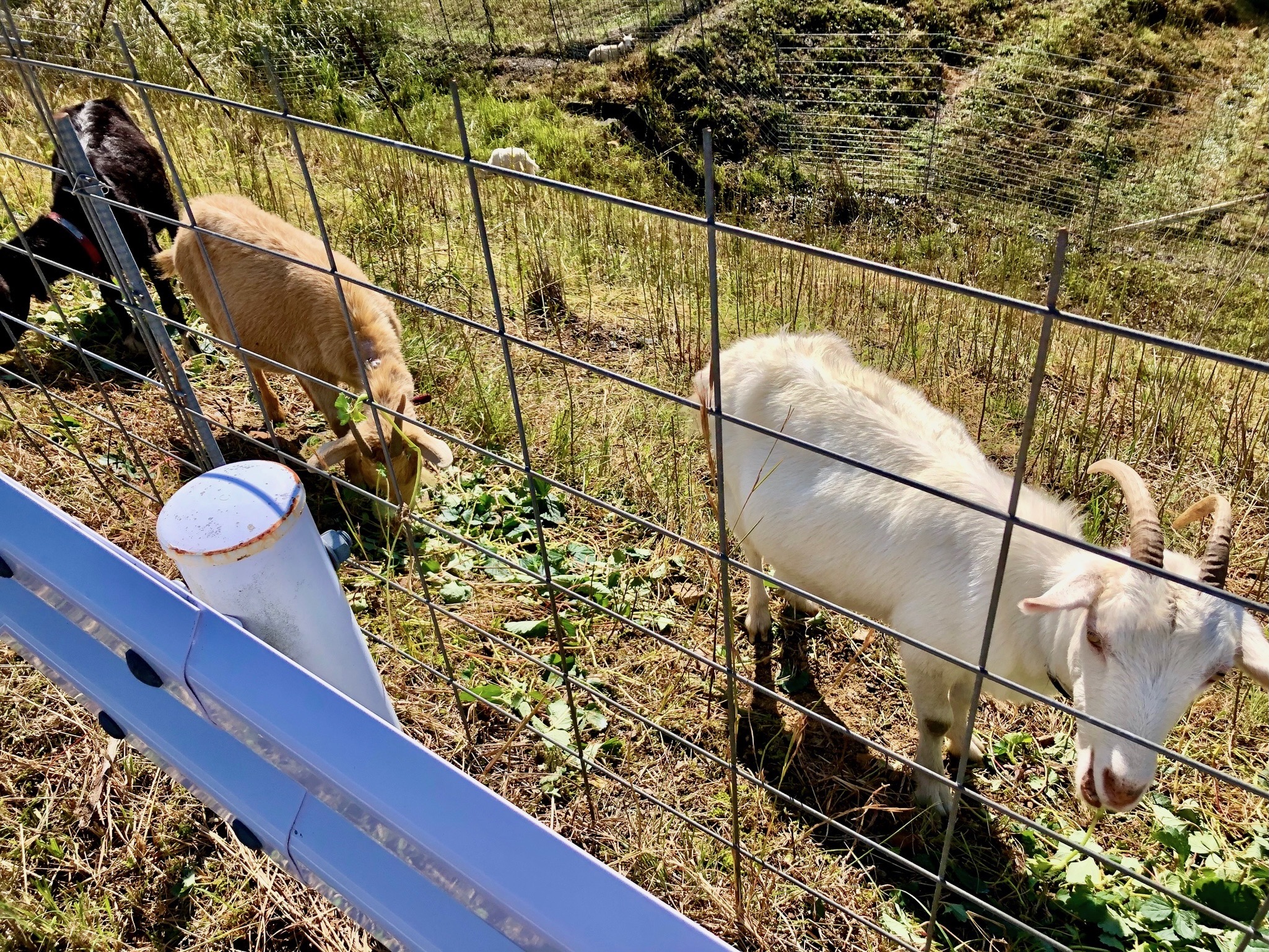
First though, Sharon had to pet some goats. I averted my eyes.
Late morning we arrived at Umenoki Park. 
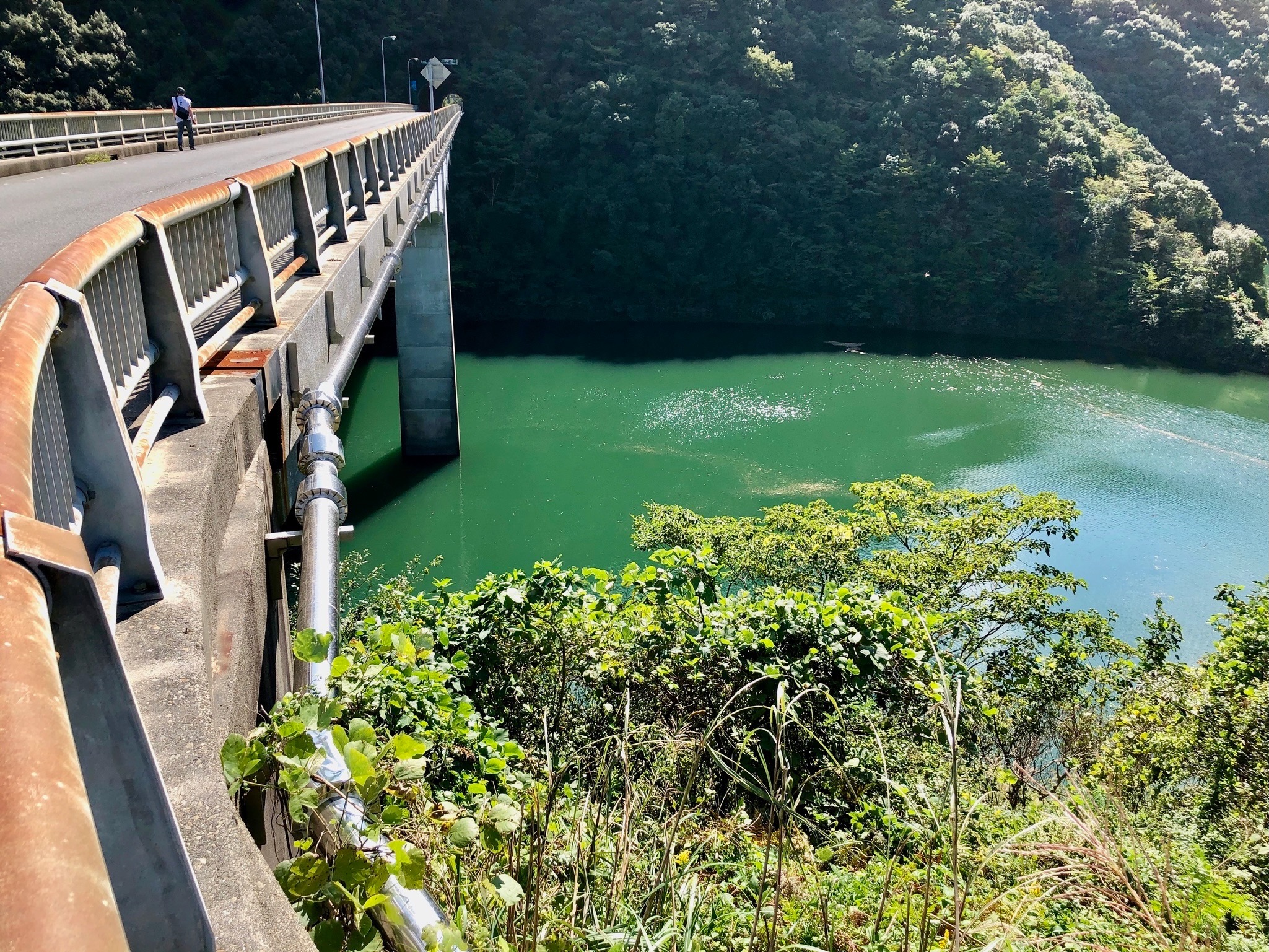
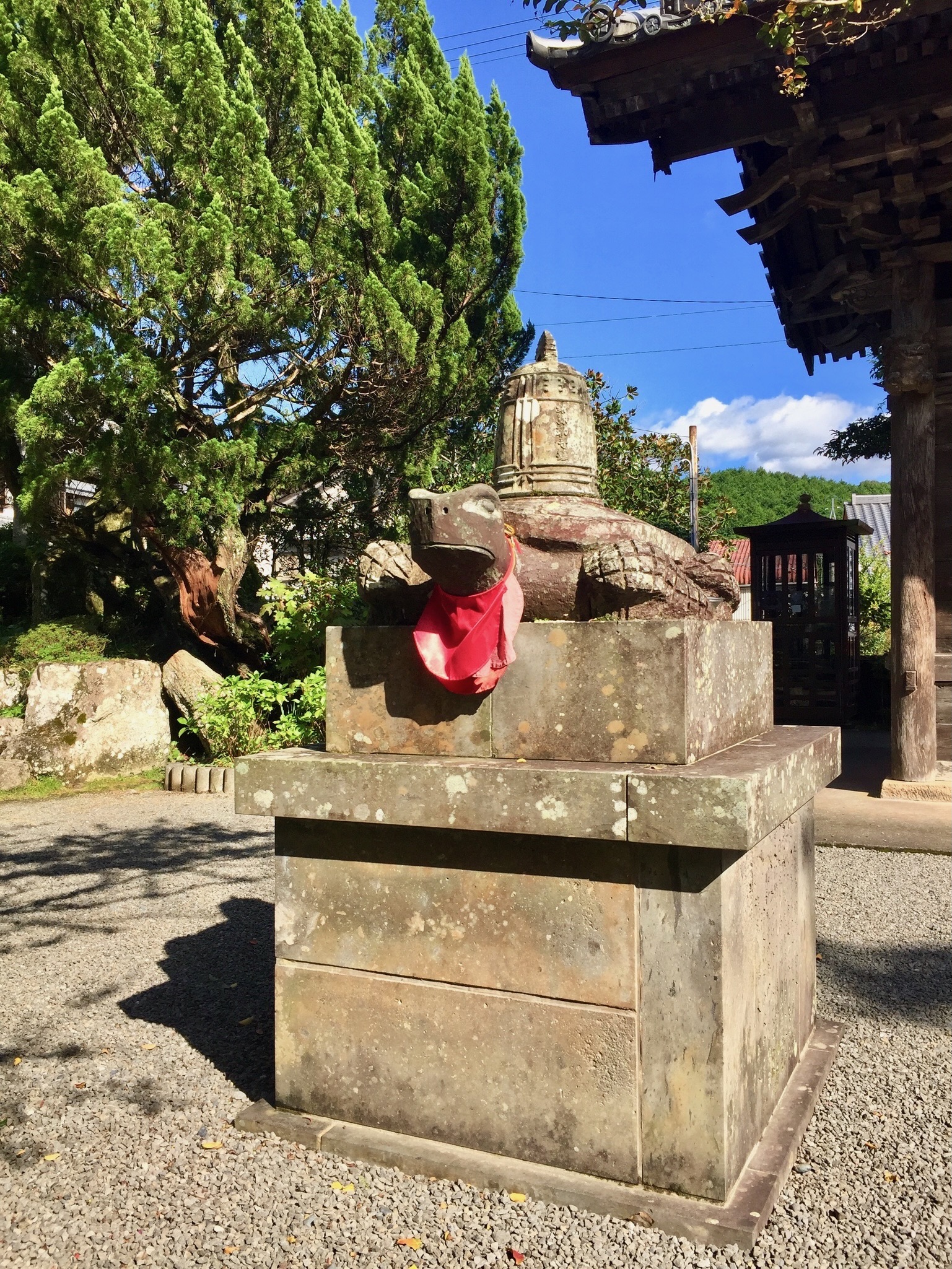
Early afternoon we arrived at our inn, Tsuruno-ya. We checked in, dropped off our bags and headed on to Temple 39, Enkoji. It was only a couple of miles down the road. Interesting place. Turtles all the way down.

Or at least a lot of turtle statues commemorating the turtle who, in 911, purportedly brought a red bell to Enkoji on it’s back from the ocean. 
As we walked though the gardens, all was quiet, except for a tiny voice wailing. A snake had a frog in its mouth. The frog was not going gently into its good night and was trying mightily to pull itself back out.

The frog didn’t make it and the snake slid away.

We paid our respects at the Main and Daishu Halls, and were moseying back to our bike, when a Japanese woman sweeping the gravel, pulled Sharon aside. 

I tagged along, first to the sacred 400+ year old juniper tree.
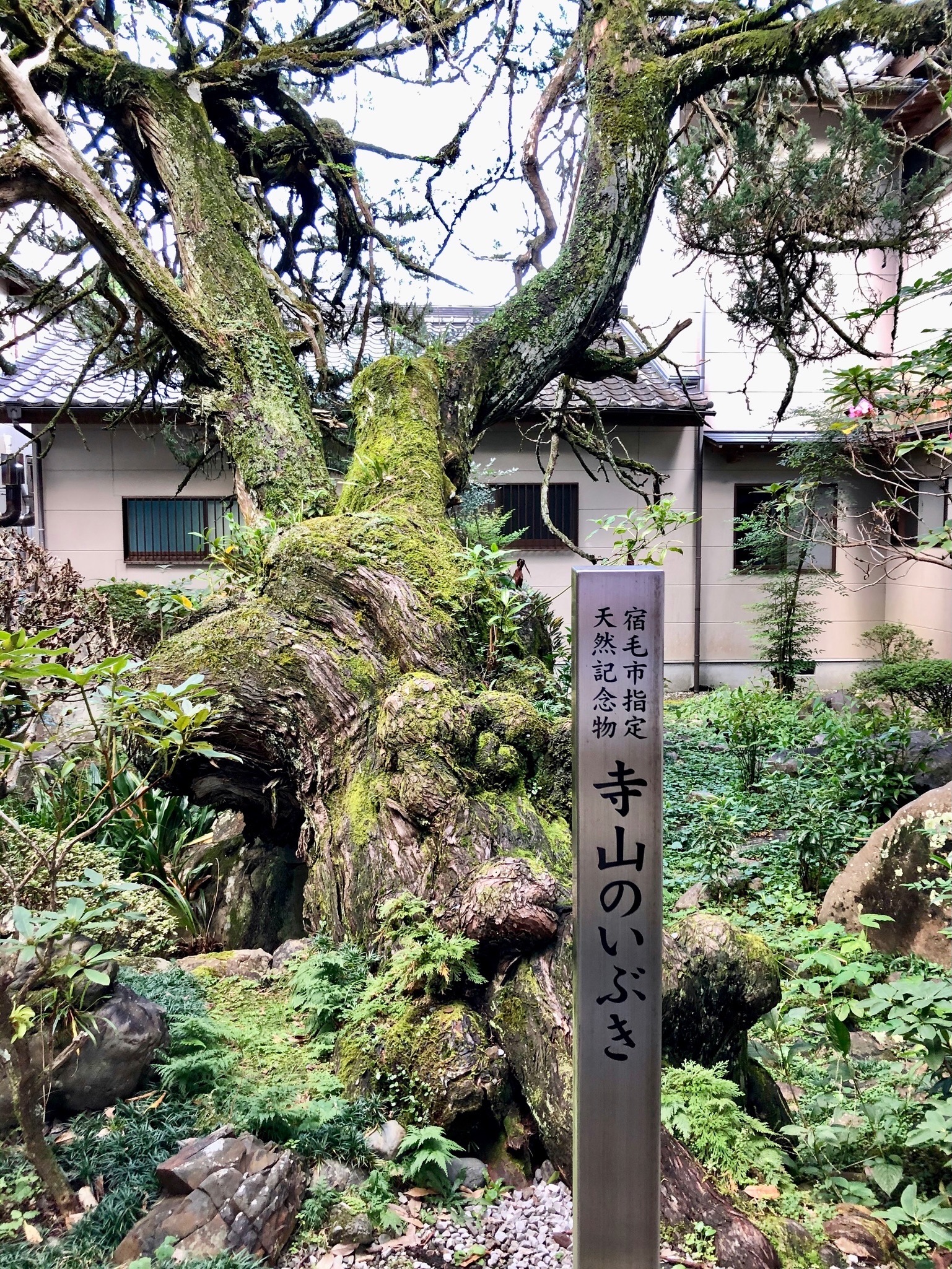
And then to the exhibition hall with Buddhist Art. This exhibition included both student’s and teacher’s work. Sharon’s new friend had a piece exhibited. 

Back at our inn, we settled into our room, took a shower and tub soak, and had yet another great dinner. 

The next day we would leave the prefecture of Kochi and start our journey through the prefecture of Ehime.

We were halfway through our trip. Our brake pads were getting rather thin. Our half-assed plan was Matsuyama City or Bust.

Matsuyama City was 8 days, and 20,000± feet of ascent and descent, away.
Link to next Shikoku Pilgrimage Post: Ehime

2019 Shikoku Pilgrimage: Tokushima

Our bike was assembled. Our test runs completed. Our GPS was up and running. We had our pilgrim gear. Our bike bags were packed.

Time to say goodbye to coziness and hit the Temple Road for real. If all went according to plan we’d be back in in a month, our 750 mile pilgrimage loop complete.

But, a typhoon was bearing down on Japan. A really big typhoon. Tokyo looked like a direct hit. But Tokyo was 300 miles away. Maybe we’d luck out.

Maybe not.

Day 5 October 12 Saturday; Departure & Temples 6 – 11

6 Anrakuji 安楽寺 Kamiita, Tokushima
7 Jūrakuji 十楽寺 Awa, Tokushima
8 Kumadaniji 熊谷寺 Awa, Tokushima
9 Hōrinji 法輪寺 Awa, Tokushima
10 Kirihataji 切幡寺 Awa, Tokushima
11 Fujiidera 藤井寺 Yoshinogawa , Tokushima 

2:00 AM. No rain. 

4:00 AM. No rain. 

6:00 AM. Rain. 

Sharon and I took turns checking the weather. Sharon would report on the devastation of Tokyo. I’d check my local weather app which showed rain clearing in the afternoon. 

At breakfast we asked Mima-san who ran the inn what she thought about the weather. Shrug. Which I interpreted as: clearing in the afternoon, and Sharon as: we were headed to our doom.

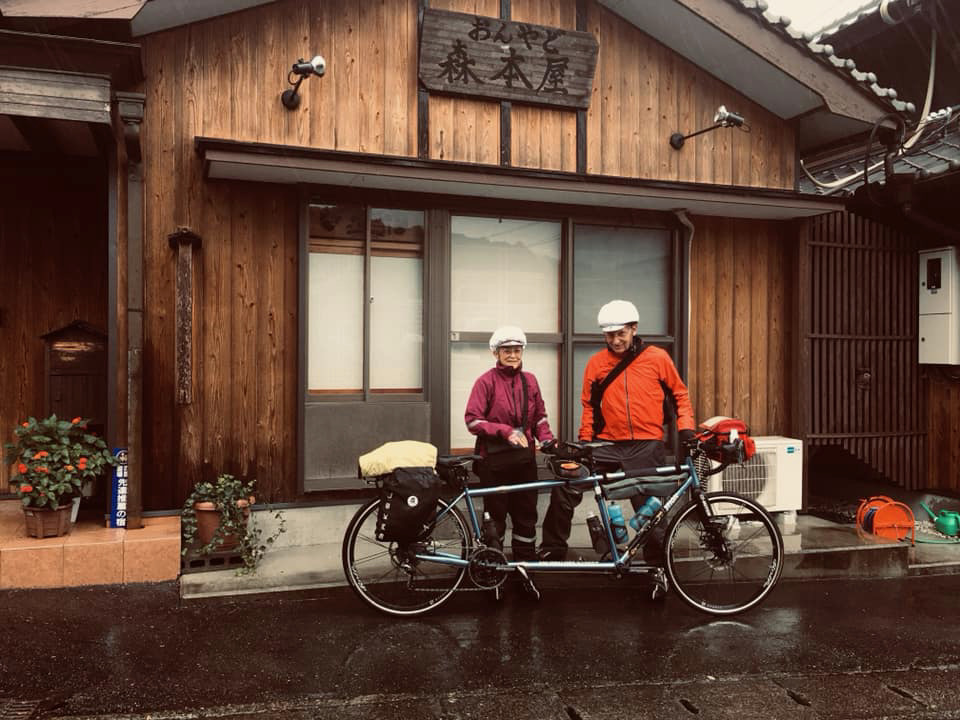
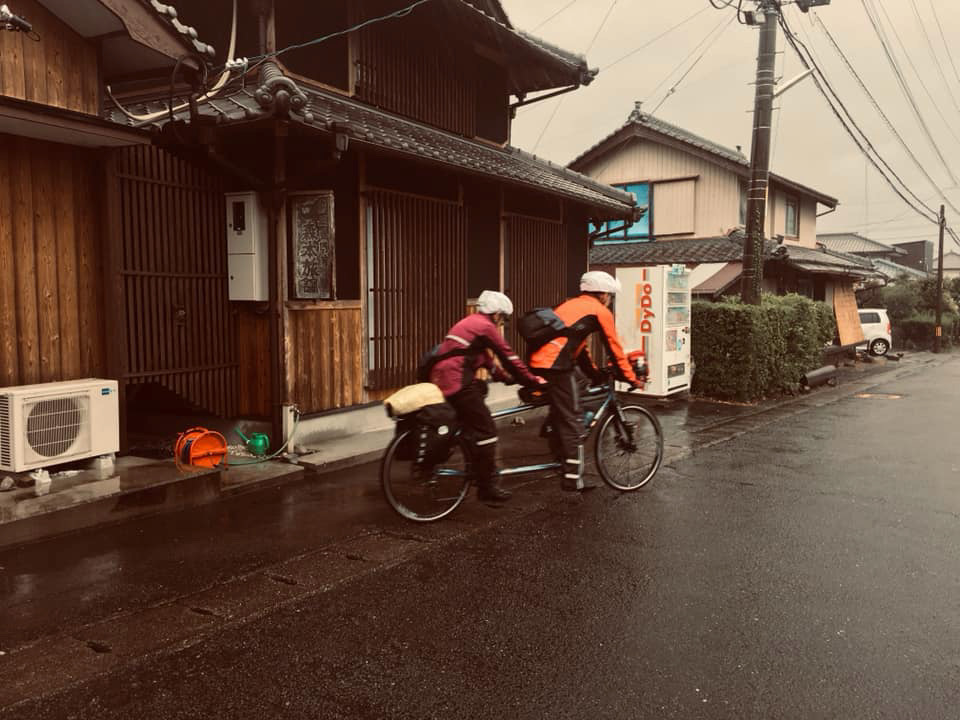
We headed out at 8 AM or so in full rain gear. It was pouring. Mima-san took pics. She was laughing. Crazy Americans ride off on a crazy bike into a Typhoon. Great stuff for a new Morimoto-ya Japanese facebook post. Which indeed was how it turned out. 

Ready, Set…
Go!

Temples 6 & 7 were cold, wet, and empty. No other pilgrims.

When we turned up the hill towards Kumadaniji – Temple #8, Bear Valley Temple- just before noon, the rain was still heavy. 

The temple parking lot was deserted. I took refuge in the temple office while Sharon headed up towards the Temple proper. The Temple office was large and deserted. I stood there dripping while this young-ish woman added the temple calligraphy and stamps to my book.

She offered me a cup of instant coffee. The perfect antidote to my dreariness. It tasted, well, like the best coffee I’d ever had.

Sharon re-appeared, and a cup of instant and a stamped caligraphy later, she and the Temple office lady were chatting merrily, huddled over phone pics.

The lady did have very cute dogs. 

From Temple 8 we headed down and out across the valley. The weather was breaking. Soon we pulled up at Temple 9. We did our temple thing and left some of our beloved-cat’s ashes in the temple cemetery.

Traditionally Japanese don’t feel like you need to buried in just one place, a little here and a little there works just as well. We feel the same. Yellowboy’s ashes have now been spread from Finland through Shikoku. 

We look for a place where he would be at home. Temple 9 was one of those. 

Although the clouds looked ominous, as we continued across the valley, the rest of the day was dry-ish We pulled into Temple 11, Fujiidera, mid afternoon. 

Temple 11 is the last stop of the easy first stretch. For walking pilgrims and for bicyclists. The mountains loom.

A Japanese pilgrim motioned around a corner of the Temple Hall. The beginning of the infamous hiking trail to Temple 12. He had a home-made convertible cart-backpack and knew what was coming. We’d meet him again in the days ahead, many times.

The walking pilgrims’ route was clear in our book. What wasn’t clear was how you get there from here, on asphalt, on a bike. I had decided in early planning that we would go the way less travelled. For better or worse. 

Our route wasn’t the tour bus route, or as it turned out, just about anyone else’s route, but I had programmed it into our bike computer and thus, we had cast our lot. 

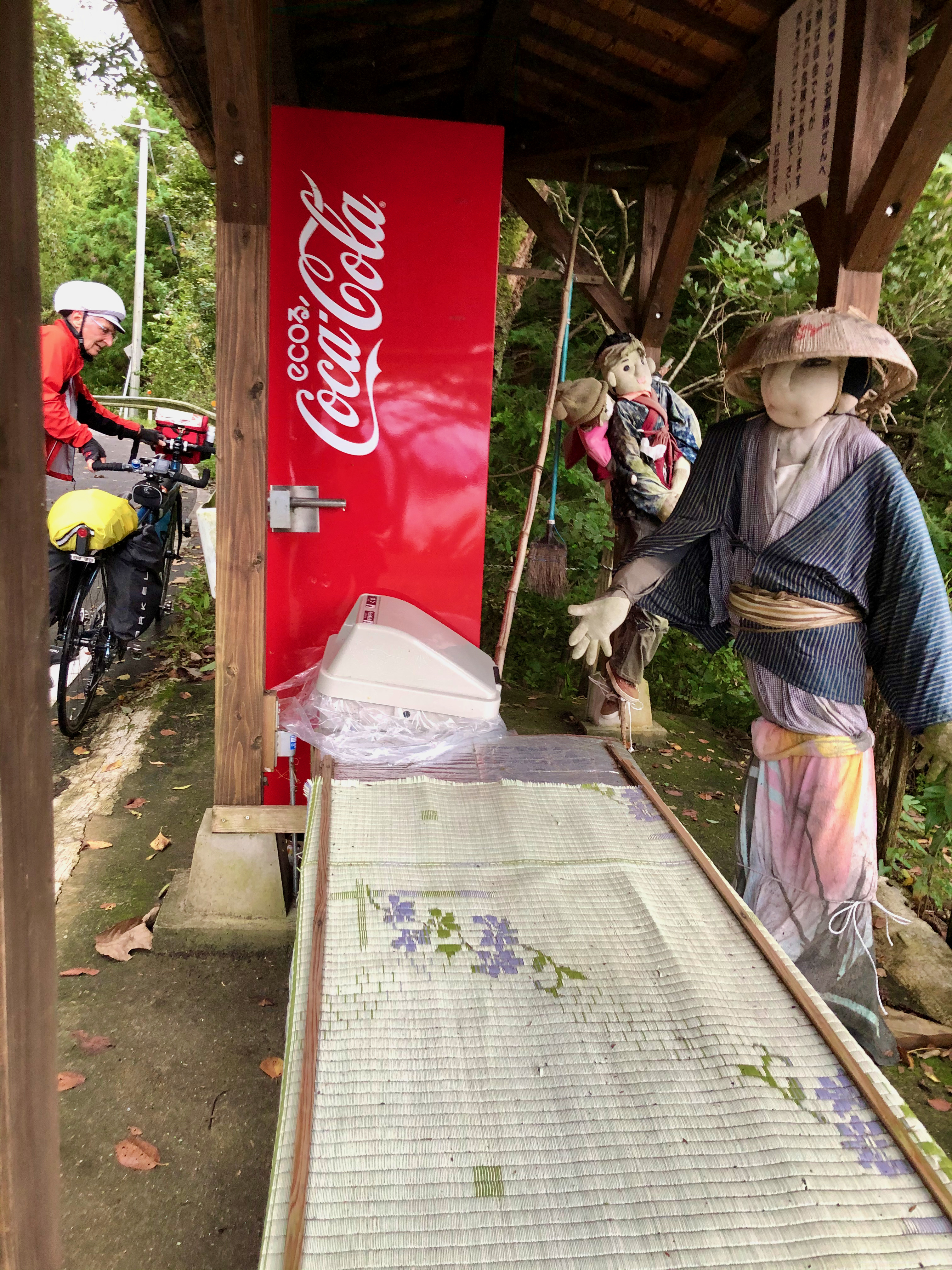
At the very top of the long monster climb out of the valley, in the middle of absolutely nowhere –  we hit our first dolls. And they were pilgrim dolls. 

Doubt we had seen a car or anyone else for at least an hour. The road couldn’t have been more the ten feet across. 

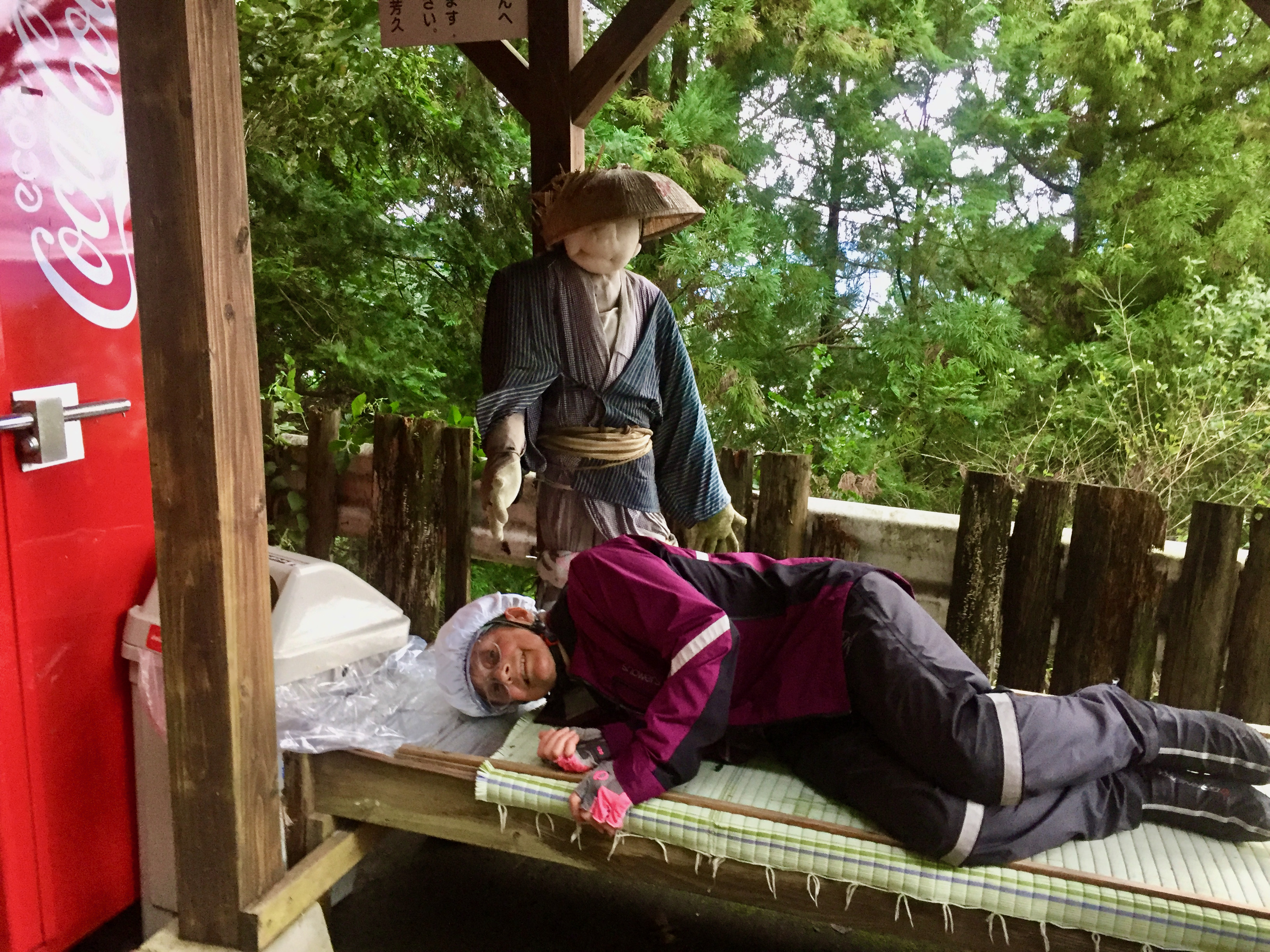
But here at the pass was a pilgrim shelter complete with a bed, a Coca Cola vending machine, and life-sized, fully-clothed pilgrim dolls. We knew what we were seeing and it was perfect. The real deal.

The backstory: Once upon a time, say 20 or so years ago, a Japanese woman, Tsukimi Ayano, moved back to her hometown Nagoro on Shikoku, to care for her father. Her hometown was dying – down to 30 some odd inhabitants, from over 300. 

The town was still there. Buildings, schools, and homes had lasted. The people hadn’t.

Tsukimi had plenty of time on her hands. She decided to make herself a scarecrow or doll if you will. She made it in her father’s likeness, clothed it in his clothes, and put it out in his field. 

Folks thought it was him. 

I could relate. Way back in the day, say 1971, I had an organic garden, which I thought needed a scarecrow. So I took some of my old clothes and stuffed them. Those being the days, I put my scarecrow into the garden upside down, head-in-the-ground, which is kind of how I felt at the time. I thought the shoes waving in the air were a nice touch. 

A couple of days later I was relaxing on the porch, when this woman comes screeching up the driveway.  She jumps out of her car and runs up to me in a panic, shouting, 

“There’s someone in your garden. And his head is stuck in the ground!” In her mind this was a life or death moment.

I smiled, and tried to explain it was just a regular scarecrow, but upside down.

She wasn’t having any. Livid, she started yelling and in no uncertain words, told me exactly what she thought of my “joke”, stormed back to her car, slammed the door and roared off.

Over the years, I have wondered about the intensity of that moment. A Scarecrow is just a Scarecrow except, when it’s much more.  

In Nagoro, if Tsukimi had left it at one doll, it would have been simply a perfect local moment. 

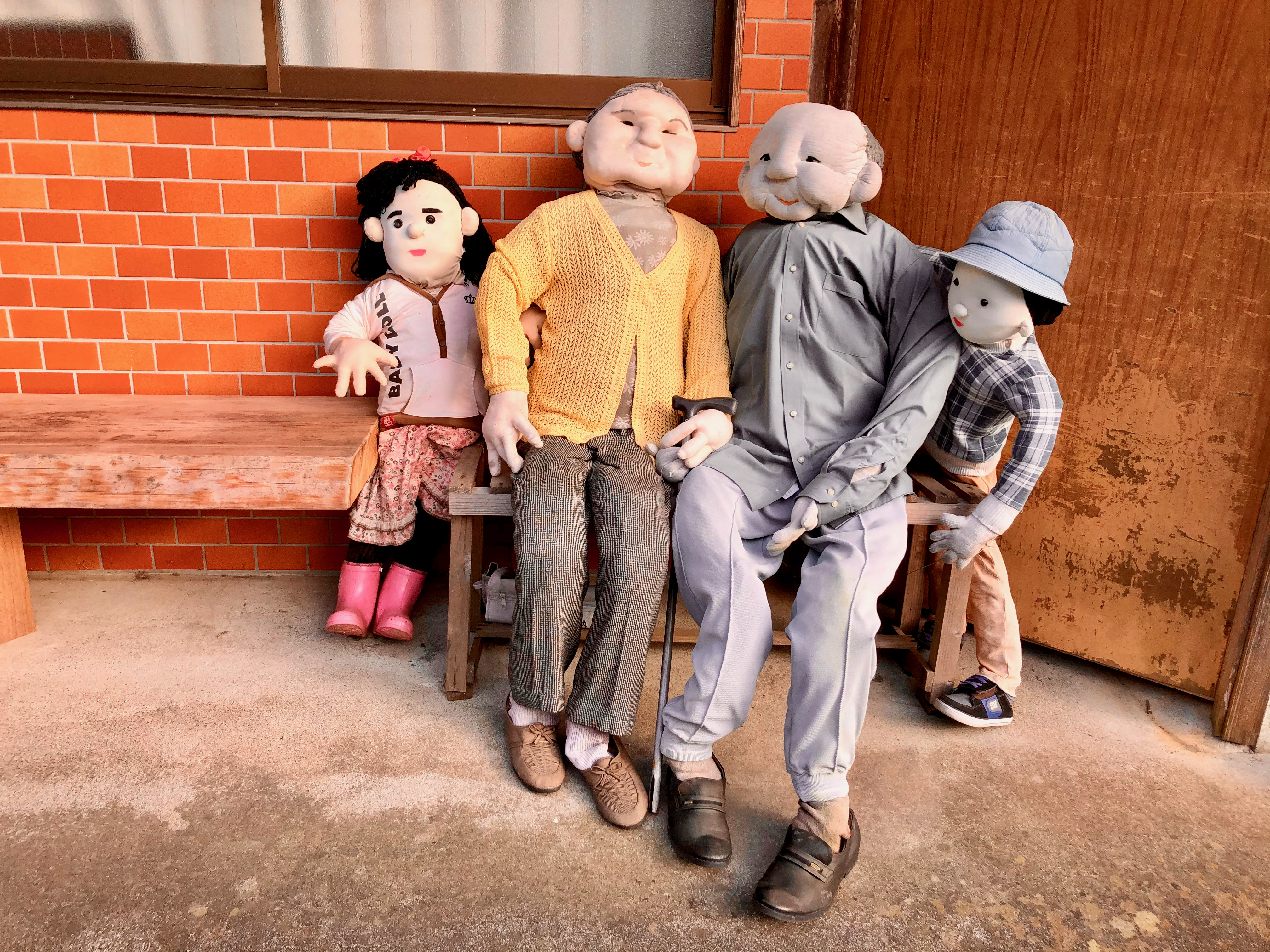
But she didn’t. One doll followed another and Nagoro slowly re-populated. Folks gone-by came back as dolls. In the places they lived, in the places they worked, in the places they just hung out. 

Beyond brilliant, here we’re talking the truly remarkable. Genius if you will. The big leap. On her own, Tsukimi slowly created a real time, fully-scaled Art installation.

Nagoro, was perhaps fifty miles off our route. Too far to justify a visit. 

As it turned out, fifty miles was close enough. The dolls had come to us.

On the way down the backside of Temple 12, a day later, we hit Dollsville again just before our inn for the night.

But that’s jumping ahead.

Temple 12 is a mountain temple. And not just any mountain temple, it’s the first “Henro-Korogashi” mountain temple, which means it’s a really tough one. A route where “pilgrims fall down”, or in our case a route where pilgrims push their bikes up +20% grades.

We knew we weren’t going to get there on this first day.

Our plan was to do part of the climb, and then make the big push the next day. 

On our descent from the pass, we almost missed our inn, Misato no Yu up and off to the right. Misato no Yu was a relaxed hot springs inn with dining. Their Japanese/French cuisine was pretty fabulous. We had western beds and even a hair dryer to dry our shoes.

I really don’t think the Inn owner thought we’d make it to Temple 12. He had this little smirk on his face when he pointed up the mountain and told us how far up we had to go. 

I basically ignored him, easy enough to do when he’s using meters and you don’t want to ask your wife for the conversion. Besides one way or another I had no doubt we were going to get there. I’d long since gotten over the “too proud to walk” thing.

Day 6 October 13 Sunday; Temple 12

12 Shōzanji 焼山寺 Kamiyama, Tokushima

After leaving Misato no Yu, we rode the first stretch, up along a splashing stream and then we turned off, got off, and pushed. Our bike computer said the max grade was 32.7%, which probably is impossible.

But metaphorically about right.

There was virtually no traffic on the narrow road. Every now and then, a micro-pick-up truck would pass us. I had fantasies of one stopping and offering us a ride. We could wedge ourselves in the back with our bike. The rear wheels might stick out, but it would work. 

No one stopped. Not surprising, as these were working folk with better things to do than save crazy foreigners from their own schemes.

In a somewhat ironic twist, we descended to Temple 12. For the other 99.999% of visitors it was the top.

There’s a moral here somewhere. I should probably add, this would not be the last time, we descended to a mountain temple.

We pulled into the Temple 12 parking lot just before noon, walked our bike up the carefully-graded, newly-engineered path to the base of the traditional stone stair. We locked our bike and headed up.

Temple 12 didn’t disappoint. Our first real-deal mountain temple. Sure, most visitors just drive up now. But past magic lingers. 

Most easily detected on the Shinto side. An alien mindset, ebbing away in the 21st century. Photo below.

Buddhism and Shinto have co-existed in temple locations, side-by-side for centuries and centuries, taking turns in favor.

After the Second World War, Shinto fell on hard times. The Emperor and the Shinto establishment were held responsible for the crushing destruction of Japanese culture and society in second world war. 

Rightly so. 

So who should we run into? Our charming German friend Anika.

She had made the climb on foot from Temple 11. She was lingering, hoping to meet up with a hiking companion still back on the trail.

Back at the bike, ready for our descent, we had our own issues. 

Our bike computer had gone on strike. No GPS connection. Our back-up in such situations was our phone, but Mr. Phone was dangerously low on charge. Breathe deeply.

Ah … the back-up battery, that came with our Japan Wireless pocket Wi-Fi gizmo. Yep, the cable fit and we were up and running again. Google Maps showed where we were, where we wanted to go and what turns we needed to make to get there.

The descent was smoke’n fast. In less than an hour, with no wrong turns, we were out front of what we thought was our inn for the night. No one was answering the door, but then Sharon noticed a guy puttering, doing something, a couple of doors down.

Yes, we were home. And soon a friendly face appeared and showed us to our room.

We had the place to ourselves. After a shower and soak, our young female host kind-of burst into our room, to get our laundry.

All I had on was my underwear. She couldn’t have cared less. Not an issue for her, well, not an issue for me. 

After she left, I threw on my Yukata, kicked back and relaxed.

We had passed our first real test on the road. Temple 12 is infamous for its challenges, both physical and psychological.  From here it was downhill for Temples 13 – 17, but next up was dinner and it was feast! 

Day 7 October 14 Monday; Temples 13 – 17

13 Dainichiji 大日寺 Tokushima, Tokushima
14 Jōrakuji 常楽寺 Tokushima, Tokushima
15 Kokubunji 阿波国分寺 Tokushima, Tokushima
16 Kan’onji 観音寺 Tokushima, Tokushima
17 Idoji 井戸寺 Tokushima, Tokushima

We slept well and after a full Japanese breakfast, we headed out. Our bike computer was happy to be fully charged and our GPS signal was good. Weather was co-operating and we were off.

At less than 20 miles, this was a short day distance-wise, but with five temples, we knew it would be full. 

Dainichiji Temple
Dainichiji Temple
Kanonji Temple

Late afternoon, right on schedule, we pulled up in front of our hotel in the heart of Tokushima. 

The twist was that the lobby was on the fifth floor. I had known this was coming. After a most-pleasant email exchange, we had been cleared to bring our bike up in the elevator. It would be kept in a hall behind the front desk. 

The hotel had done their homework. Our tandem was indeed too long to be accommodated in the underground bicycle parking nearby. 

We wiped down our tires rolled across the pristine lobby and waited for an empty elevator. We rolled in, lifting our bike carefully, vertically. No problem, an inch or two to spare before hitting the ceiling. 

After checking in we found our room. No sleeping on the floor tonight. We had a western bed, and our bathroom was wonderful. Something right out of a space station.

This was most definitely 21st century Japan.

After showers and soaks, we ventured out for dinner. We didn’t have to go far. There was a 7 Eleven opening off the first floor lobby. Thus we were introduced to the wonders of Japanese convenience stores. 

We loaded up, dinner, road snacks, the works, and headed back up to our room for a most-tasty picnic.

Day 8 October 15 Tuesday; Temples 18 – 20 Tokushima to Tano; [22 ± miles.]

18 Onzanji 恩山寺 Komatsushima, Tokushima
19 Tatsueji 立江寺 Komatsushima, Tokushima
20 Kakurinji 鶴林寺 Katsuura, Tokushima

We had signed up for breakfast when we made our room reservation. Good decision. 

A far cry from our inn meals. Not better, just very different. Urban entertaining. We ate our buffet breakfast at a table – with chairs – on the second floor overlooking the central Tokushima  subway entrance and, I think, the underground bicycle parking. 

Outside below, folks were rushing to work and uniformed school children were rushing to school. A mass of humanity flowing this way and that.  Inside, our breakfast compatriots were mostly business folk. Composed, but focussed. Rushing this way and that.

Sharon was having her own private food fest with everything exotic available. Which was a lot. 

I was lingering over my coffee, wondering what the day would bring. At 22 miles, it wasn’t a particularly long day, but it promised to have its challenges.  First we had to navigate out of Tokushima, then visit a couple of temples before #20, another Mountain Temple which looked pretty serious, then a descent and a river ride to our inn at the cable car base station for Temple 21.

On the ride out of Tokushima, we played a game of: Guess the Love Hotels.

Love Hotels are hotels catering to folks interested privacy for doing the deed. A somewhat Japanese institution. Makes sense in world of paper thin walls. Purportedly compete with anonymous check-in, double-blind pizza delivery, and in-room sex toy vending machines. And themed rooms which well, run the gamut.

You know you’re at a Love Hotel, if rooms are rented by the hour.

One might think that Love Hotels would be discreet and hard to identify. Au Contraire. The exterior aesthetic is look-at-me Disney.

Borrowed Photo- Love Hotel Chapel Christmas Courtesy of Wikepedia Commons

And from what I’ve heard, interiors follow suit. 

Later on our pilgrimage, we met a Female Canadian University Mathematics Prof. who couldn’t find a room, one night early on in her pilgrimage. Her only option was a Love Hotel. 

Her Taxi driver didn’t want to take her there. But he relented. She said her room was very comfortable. The bed was really big and most comfy. The other stuff was entertaining, but kind of irrelevant as she was traveling alone.

If we ever make it back to Japan for another pilgrimage or whatever, and are on our game, a Love Hotel stay seems like a no brainer, for old folks’ entertainment. 

Mid morning we arrived at Onsanji, Temple 18, and who should we run into but the same stout fellow we had met at Fujiidera, Temple 11 who had pointed out to us the hiker’s way up to Shosanji, Temple #12. 

A good guy with an ingenious low-tech solution to the pilgrimage backpack. Wheels for the roads. Back straps for the trails.

He didn’t speak a word of English, but he made it pretty clear, that he didn’t think much of our chances for making it to Kakurinji, Temple 20, on our bike. Like it’s way up here and the unspoken – you are old folks, and foreign old folks at that.

Curiously over the days that followed, we became pretty good friends. He was a cheerful, hardcore pilgrim on his seventh time around. He was fast, but we were faster, and we’d stop and chat every time we passed him and his cart. 

I’m not sure if its grudging respect we earned from him, but close enough. 

On our way up to Temple 20, Kakurinji, our bike computer registered a max grade of 35%, an improbable reading, but it was wicked steep and for long stretches with no let up. Most likely mid-20s, perhaps a bit steeper on the insides of a few switchbacks.

We walked the steep stuff and rode where we could, arriving at the temple mid-day.

It’s said that it doesn’t matter how you do the pilgrimage: On foot, by car, buses, motorcycles, or tandem bicycles. It’s the state of mind that counts.

Kakurinji, Temple 20, was a gem. One, where we wished we had far more time to linger. Our second mountain temple. At 1804 feet in elevation, it’s the fifth highest temple on the pilgrimage.

Kakurinji translates as “Crane Forest Temple.” The crane being a very auspicious symbol, symbolizing longevity. 

The descent down the other side of the mountain was steep. Like the steepest road, you’ve ever been on, steep. And it didn’t let up. 

I braked and the brake grips bottomed out. And we didn’t stop. Not good news. I scanned for uphill spots to crash. The thought being better sooner and slower, than later and faster.

But thankfully we gradually started to slow and eventually came to a stop. 

After more than a few deep breathes, I tightened up the brake cables, and we very, very slowly made our way down to the Naka River. 

From there it was only a bit over 4 miles to our inn at the base of the Ropeway to Tairyuji, Temple 21.

And a beautiful 4 miles it was. 4 miles of some of the most beautiful riding I have ever experienced. Little or no traffic, turquoise river water, and late afternoon light. 

We pulled into our inn, Sowaka, in Naka City, late afternoon, right on schedule.

Sowaka is located at the base of the ropeway, or cablecar if you will, to Temple 21, another mountain temple. We had decided early on, that the ropeway would be the right call for us. 

Sowaka Inn had the reputation of being a bit too relaxed for some tastes. Their motto: “Cleanliness, laughter and gratitude.” 

Miho with the girls. Borrowed photo

Whatever. We felt right at home.

One young women was kind-of at the front desk and another was puttering in the kitchen. We checked-in, parked and locked Mr. Bike in a side entrance, found our room, and unpacked.

We had a toilet, but no shower. So it was off to the communal, sex-segregated baths in our bathrobe-like Yukatas. 

I shared the Men’s bath with a half dozen Japanese men. This is a starker’s thing. Shower first and then it’s a really, really hot soak. Felt great.

At dinner over a couple of beers, mine, we talked about the next day. Up bright and early for a cablecar ride to Temple 21. Then a ride to the Pacific. 

Day 9. October 16 Wednesday; Temples 21 to 23. Tano [Naka City] to Minami Town

21 Tairyūji 太龍寺 Anan, Tokushima Cable car
22 Byōdōji Anan Tokushima Another tough mountain temple 
23 Yakuōji 薬王寺 Minami, Tokushima

I’m not sure what my problem was, but I was in a rush from the get go. I would get mine. 

I kind-of relaxed in the cable car. A beautiful day with beautiful views of a gorgeous landscape. No sweat, just a gentle swaying. Only a couple of Japanese tourists in the car and us.

We could pick out where Temple 20 should be on the far ridge. Steep stuff. Photo below.

Temple 21 Tairyū-ji, or Dragon Temple, was pretty much perfect. Kobo Daishi himself wrote about practicing here. Wonderful architecture. Well-maintained, no one around. 1000 year old cedars. Mists were lifting.

The epitome of Japanese mountain temple. Would have been a wonderful place to linger, but someone was in a rush. We paid our respects at the Main Hall and the Daishi Hall, with incense, candles, deposited name slips and token donations and headed back down. 

I kept thinking, if we could only catch the next cablecar, we could save 20 minutes. 

We arrived just as a car was about to pull out. We ran for it slipping in before the doors closed. I sat back congratulating myself, as we rode back down the mountain. We passed the super-sized Kobo Daishi and the super-sized wolf pack sculptures – scaled for cablecar views, when it hit me.

We hadn’t visited the Temple Office for our stamps in our pilgrimage books. 

We were in agreement. Stamps ruled. So it was back up for book stamps and then back down. Probably lost at least an hour. There is a lesson here somewhere.

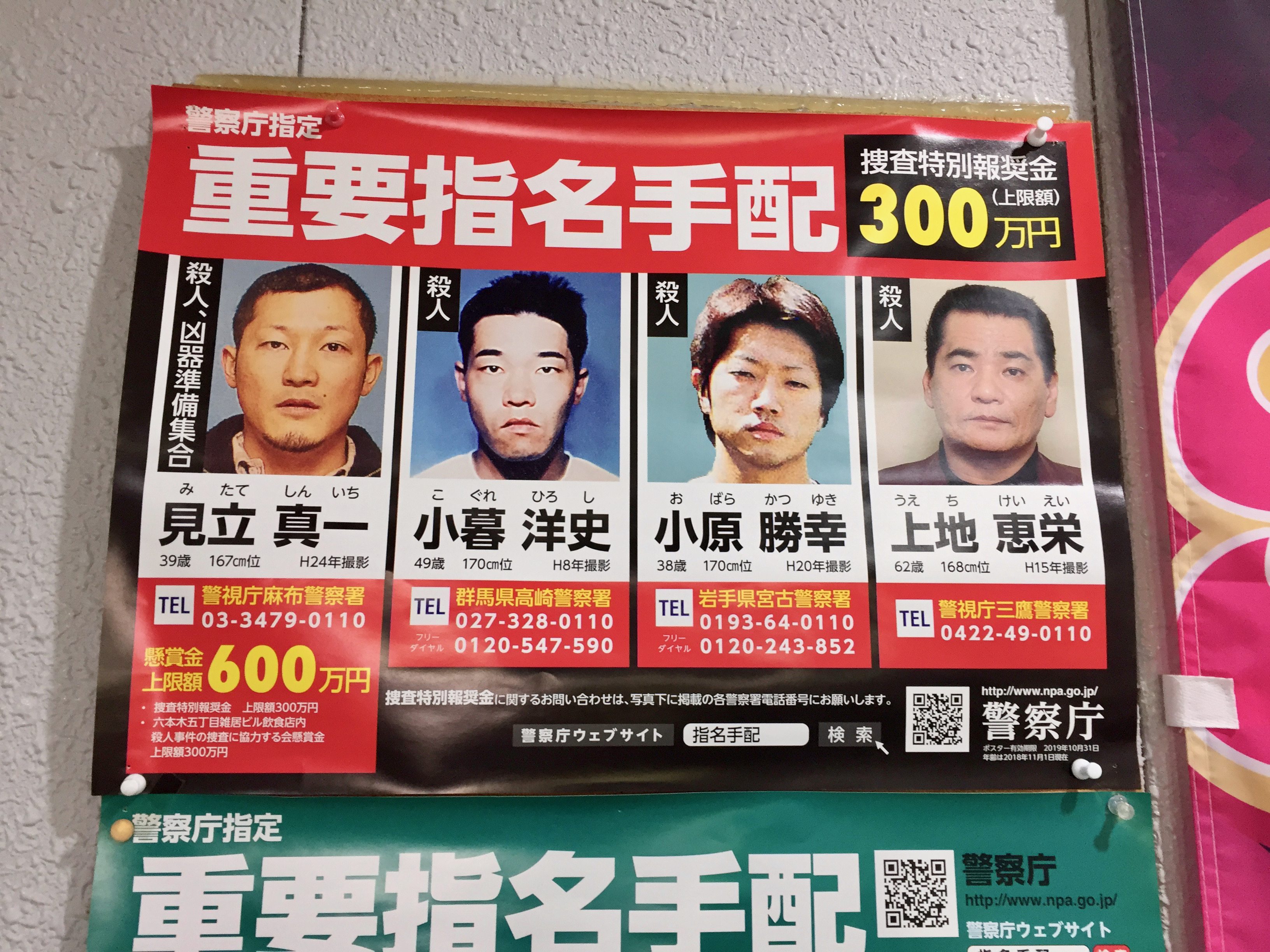
On the way out of the station, we stopped to contemplate this most-wanted sign.

We had read many reports on crime-free Japan. Hmmm. These guys looked pretty much the real deal gangstas. Food for thought.

We retrieved our bike and headed for Temple 22. 

Temple 22, Byodoji, was a charmer. Colorful banners and a bit of western history.

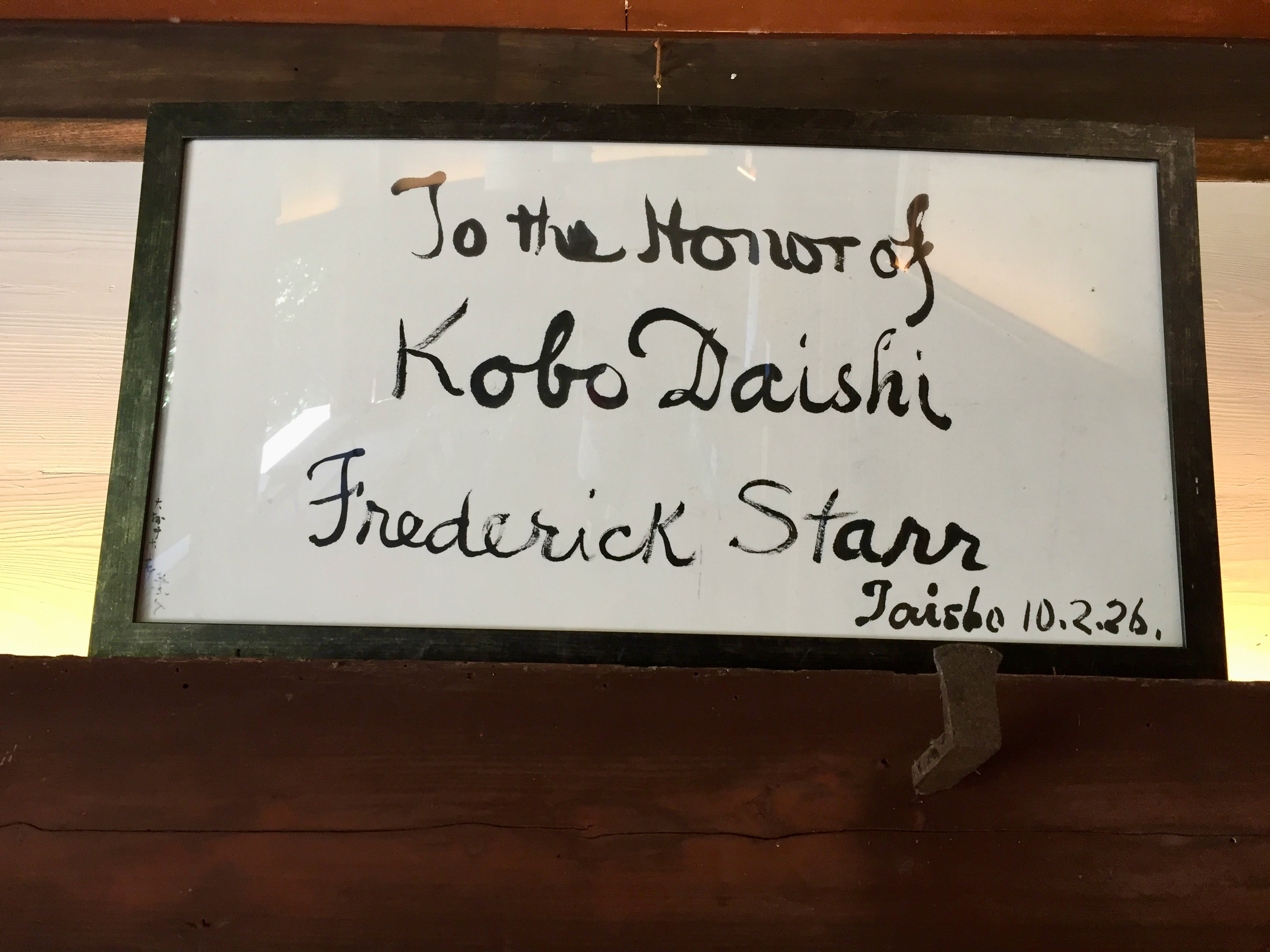
Frederick Starr, an American anthropologist, visited in 1926 and left a calligraphy of sorts. Proudly displayed. Starr is purportedly the first westerner to complete the pilgrimage. Just about a 100 years before us. He walked some. And used rickshaws and trains. In 1926 he would have been 72, Sharon’s age. 

And then it was off to Temple 23, Minami Town and the Pacific Ocean.

It wasn’t long, before we passed this cute, somewhat infamous warning sign of Mamushi snakes or Japanese Pit Vipers.  Mamushi are the most venomous snakes on Shikoku. Every year ten people or so die from Mamushi bites. 

I needed to take a leak. I stood well back on the pavement, shooting for the grass, watching for any sign of movement. All was quiet. 

Next up were bamboo forests.

And our first of many, many tunnels. More on those later.

And before we knew it, we were in Minami Town at the base of Temple 23, Yakuoji.

The light had changed in the last stretch to a warm soft impressionistic ocean light.

We hiked up and paid our respects.

We gazed out over the town to the Pacific. 

Back at our bike, Sharon struck up a conversation with a French Pilgrim. Conversation in French of course.

He would soon heading home. Limited time, but he said he would be back another year and would pick up his pilgrimage here, where he had left off.

We rode through town towards the ocean looking for our inn, Guest House Oyado Hiwasa. I suspected we were in for a treat. And we were.

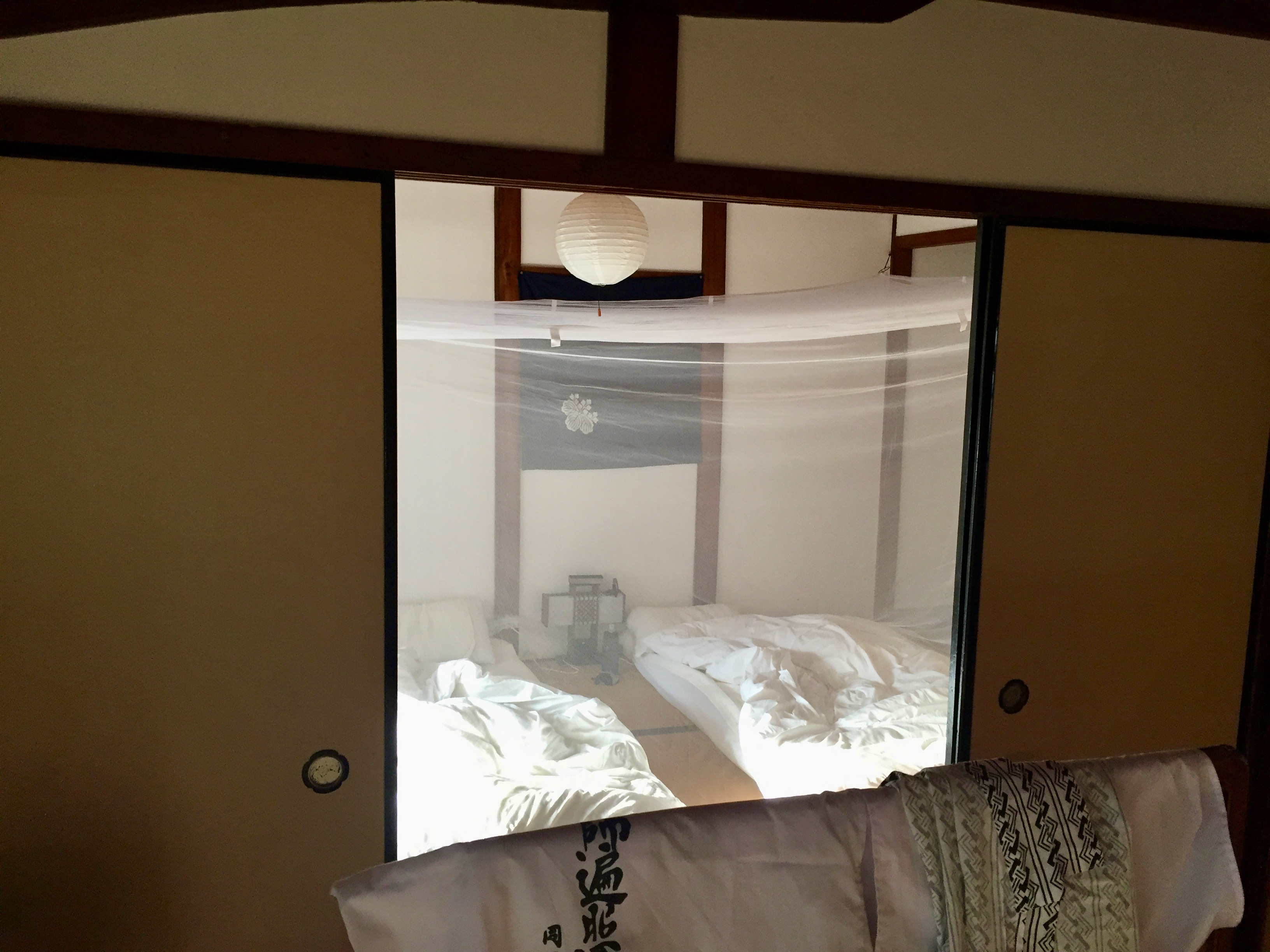
We had a nineteenth century traditional Japanese fisherman’s house all to ourselves. 

Kind-of too good to be true. Remarkable place. 

We were in the heart of the fisherman’s district.

That’s Sharon in the turquoise shirt at our place. That path out front is considered a road. Scaled for carts.

Jean-Phillipe had bicycled over with us to to show us the ropes. Jean-Phillipe owns and runs the Guest House and this house known as the Annex, along with his Japanese wife. 

Interesting guy. A French stone sculptor who wandered into Japan decades ago, went native and settled down in Minami Town. Respected by the locals. Shows internationally. Has a couple of cosmopolitan, arty, young-adult kids.

That’s Sharon and Jean-Phillipe in the kitchen

He showed us how to set up the mosquito netting in bedroom.

We talked about the ingenious post and beam, house construction. Good for earthquakes, good for heavy tile roofs and good for open plans. Beams with bends are a good thing if the camber is used to advantage.

The carpenters of 100+ years ago were proud of their work. They had carved their sign below a key post and beam joint. 

“When selecting the lumber, it is not uniformity but rather individuality of trees that is important.”

Room dividers floated between structural posts.

After Jean Phillipe took off, we took showers, put on our Yukatas, and settled in for the eve.

Day 10. October 17 Thursday; Day off. Minami Town.

I woke up thinking about disc brake pads. I had a bad feeling and went out back to confirm. 

Sure enough our pads were evaporating at an alarming rate. Would they last? 

Unlikely.

I had brought one set as a back-up, but that only solved half of the problem.

And those were in our emergency box back at our first inn. They could be shipped ahead to meet us. That would be step one. That said, we’d still need another set.

The good news was that our brakes are Shimano, Japanese. The bad news was that we had hundreds of miles to go before we would be in a city likely to have what we needed. 

We could order online : Amazon Japan? Or have them shipped from the USA expedited international? But we were a moving target. Logistics were an issue.

Ultimately we decided to simply to forge ahead. We had no problem stopping. For now.

In passing, Jean Phillipe said we shouldn’t try to ride up to Temple 27. Too steep. He tried it in his camper and the front wheels came off the ground. Hardly reassuring.

Next up Kochi and a long ride along the Pacific. I’ll add a link here when that post is done.

2019 Shikoku Pilgrimage: Back Story

We stumbled onto the Shikoku pilgrimage late 2018, researching a bicycle ride south from Kyoto.  

It was love at first sight. That said, in hindsight,  it had been waiting for us for a long time. 

The first thing to know about the Shikoku Pilgrimage is that it is Buddhist. And not just any garden-variety Buddhist, but esoteric Shingon Buddhist.

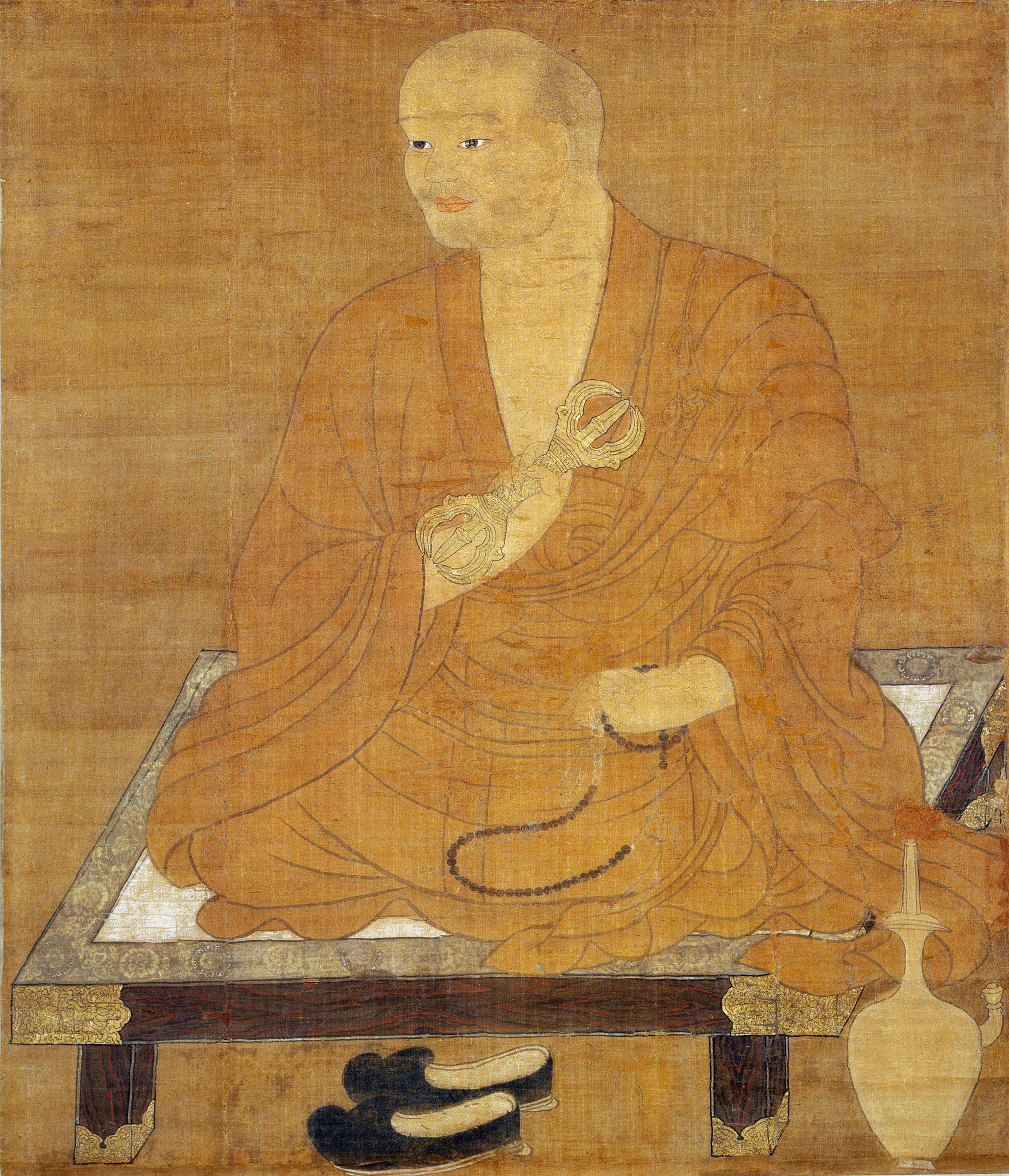
The second thing to know is that the pilgrimage revolves around Kukai or Kobo Daishi, the father of Shingon. (774 – 835)

Kobo Daishi, Courtesy of Wikipedia

Kobo Daishi was born on the island of Shikoku. He practiced on this island – in these temple locations.  It was here, he made his ultimate psychological breakthroughs. 

The pilgrimage is an homage to the man.

There isn’t really a Western equivalent to Kobo Daishi. If you combined Leonardo da Vinci, Thomas Jefferson, and Moses into one person, you might be getting close.   

Kobo Daishi was a brilliant artist, linguist, diplomat, and engineer who brought sacred teachings and texts back to Japan from China. A champion of regular folk. 

We already knew all about Kobo Daishi from our Buddhist journey. We had been married in a Buddhist Ceremony some 40 years ago, up to our eyeballs in Tibetan Vajrayana Buddhism, a close relative to Shingon.

Our Wedding Announcement

At the time we were running a solitary retreat center just north of the New Mexican Border. Peyote Road Men, Vision Quests, Drop City Communes, Alan Ginsberg. That sort of place. That sort of time.

FWIW, Alan Ginsburg came down for an extended solitary retreat. After just a couple of days he drove off in cloud of dust in the early morning. Not a word to us.

Not the first time someone had run away, but a bit surprising given his Buddhist street cred.

This pilgrimage seemed to offer the opportunity pay our respects, see Japan, and contemplate the next chapter in our lives, whatever that may be. Which is kind of how it all worked out.

Not in the way we expected, but that’s kind of the point – in the world of Kobo Daishi.

Planning

The pilgrimage is a loop of about 750 miles clockwise around the island of Shikoku. With 88 temples, the route is pretty much defined – just connect the dots.

Shikoku Pilgrimage Map. The numbers are Temples. Start at 1.

From other trips, we knew 30 to 50 miles a day would be about right, which would work out to roughly three weeks of riding – all things being equal – which of course they never are. 

We needed to factor in climbing, accommodations, and temple specifics.

As our first step we ordered the “Shikoku Japan Route Guide” from Japan.

A most excellent decision. We now had our overview, complete with detailed maps, elevation profiles, inn locations and temple protocols – all in one tiny book.

Elevation profiles looked extreme. Long flat stretches and then incredibly steep climbs. We double and triple checked our route with Ride with GPS software. Add three days. 

Inns not exactly where we needed them. Add a day.

Temple protocols. Only so many temples can be visited in a day if you are going to pay respects properly. Add a day.

We had a plan: 26 days of bicycling and another 9 for air travel, prep, rest and recuperation, packing and buffer. 35 days total.

We had a month window. 35 days seemed close enough. We bought our plane tickets. Arrive October 9 and depart November 12.

Now all we had to do was learn Japanese and get in shape.

Japanese

Sharon is one of those crazy gifted types. If you’ve seen the movie, “My Brilliant Friend” you kind of get the idea. She grew up dirt poor on wrong side of the tracks in a Spanish-speaking neighborhood in Florida. Went to college at 15. The truest of intellectuals, but on her own terms. An incorrigible iconoclast.

In the past 5 years or so, she has learned German, Italian, French, and Swedish. All I had to do was ask, buy the books, and sign her up for the language courses. 6 to 9 months later folks would be laughing at her jokes.

It’s oh so nice to have a travel companion who can speak the language.

When Japan started getting real, she told me point blank, “Don’t even think of asking me!” Fair enough. I’d do the studying.

I bought the books, found an app and started in. A few days later I had company. Someone couldn’t resist. I was shortly thereafter lapped several times over. 

Was I surprised when folks laughed at Sharon’s jokes in Tokushima? Yes, and no. Yes, because there’s always a new twist, and no, because that’s just how she is. 

When we were lost in the middle of nowhere, was I happy that Sharon repeatedly saved the day? You betcha. 

After one memorable GPS hiccup, we pulled up having lost our signal and our way, when seemingly out of nowhere, this magical little old lady appeared, as though she had been waiting for us. 

Sharon did her Japanese language thing.

The woman started nodding, laughing, and patting Sharon like a long lost best friend.

A somewhat regular occurrence, FWIW.

Training

We started bicycling three years ago in 2017. Sharon had a hip replaced the year before. Her rehab included a stationary bike. Bingo, inspiration. 

That winter we ordered a tandem that could be broken down for travel. The following Spring we started riding. That summer we took it to Italy for a group tour. Last year we took it to Finland and rode across the Finnish Archipelago – on our own. 

Each of the last two years, we logged about 1000 miles. This year we were just nudging another 1000 miles when we left for Japan. So I figure we’re no longer beginners – 

More like advanced beginners. 

Rationally this ride was way over the top, but realistically when you’re over 140, in tandem years, it’s best to get on with things while you’ve still got a shot.

This story will be told in 5 parts: This introduction and then 4 posts on the the 4 prefectures we circled through: Tokushima, Kochi, Ehime and Kagawa.

Day 1 , October 8 Tuesday; Fly to Tokushima City Japan (TKS)

We left our house in MA at 9 AM on October 8 arriving at Morimoto-ya Inn in Tokushima City at 9 PM the next day. We flew Boston to Toronto to Tokyo to Tokushima. 

Day 2, October 9. Wednesday [Itano Town Japan] Arrival in Tokushima

Toshimitsu Mima, or Mima-san, from Morimoto-ya Inn picked us up at the airport and served us a much appreciated late dinner when we reached the inn. We had been on the road 23 hours or so. 

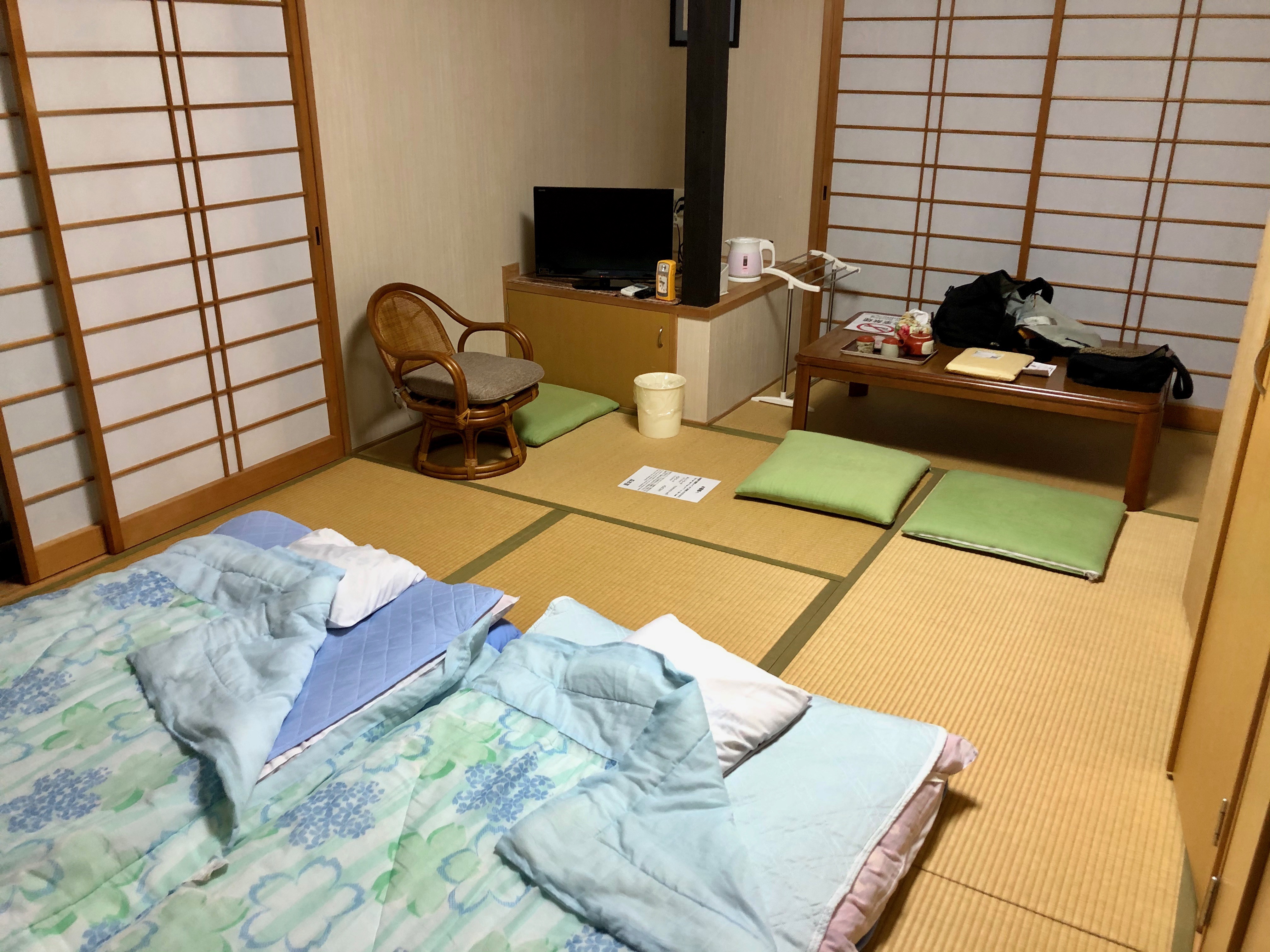
We slept Japanese style on futons on tatami mats on the floor.

And were introduced to the world of Japanese Toilets.

Every button is a most intimate surprise

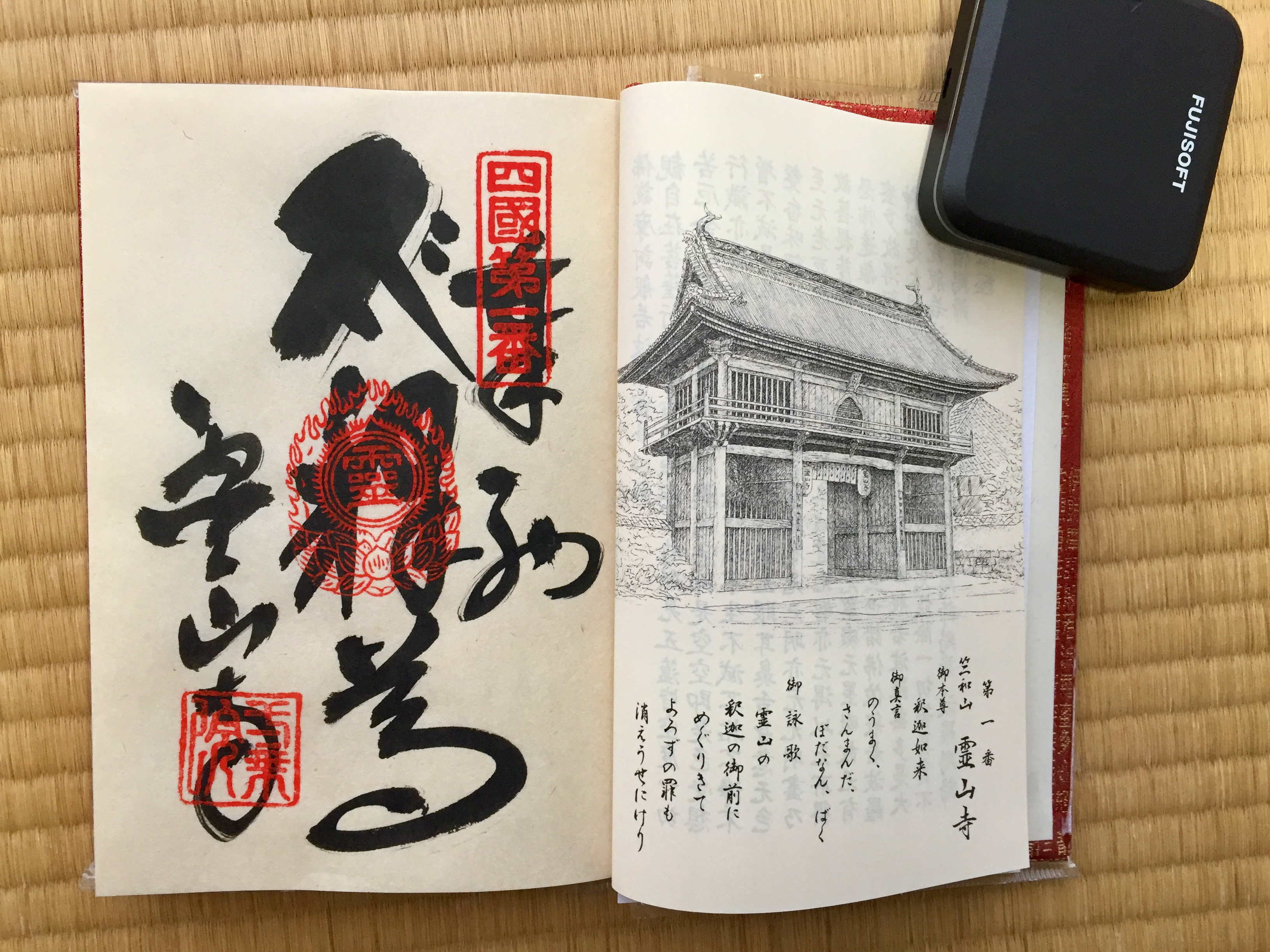
Day 3 October 10 Thursday; Test Run & Temple #1, Ryozen-ji

Temple 1 Ryōzen-ji 霊山寺 Naruto, Tokushima

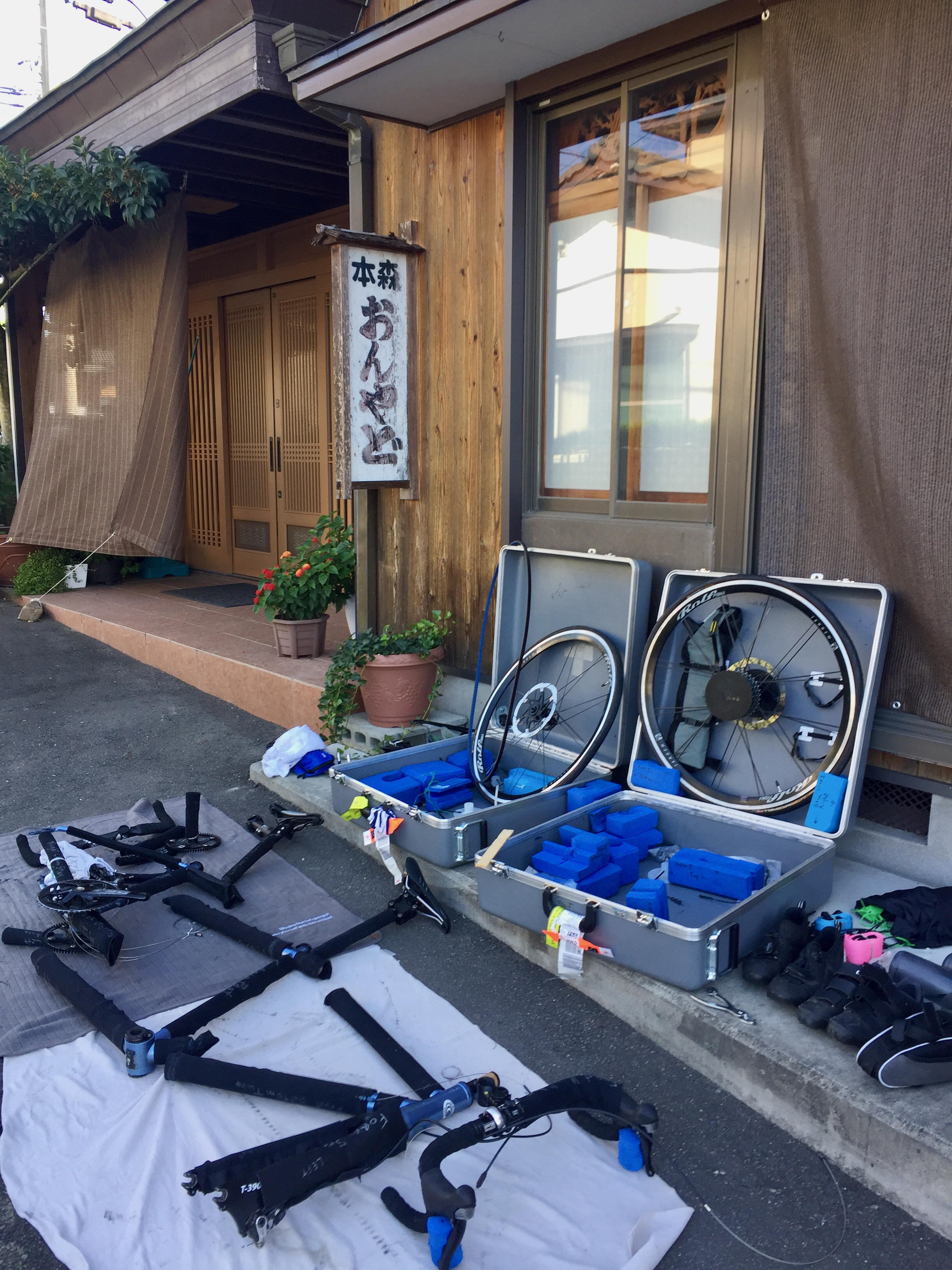
The next morning I put our bike together out front of the inn.

And we rode it on backstreets to Temple #1, Ryozen-ji. Both shifting and braking seemed fine. A good thing. And reassuring. It hasn’t always been so, after baggage handling did their thing, on other trips. 

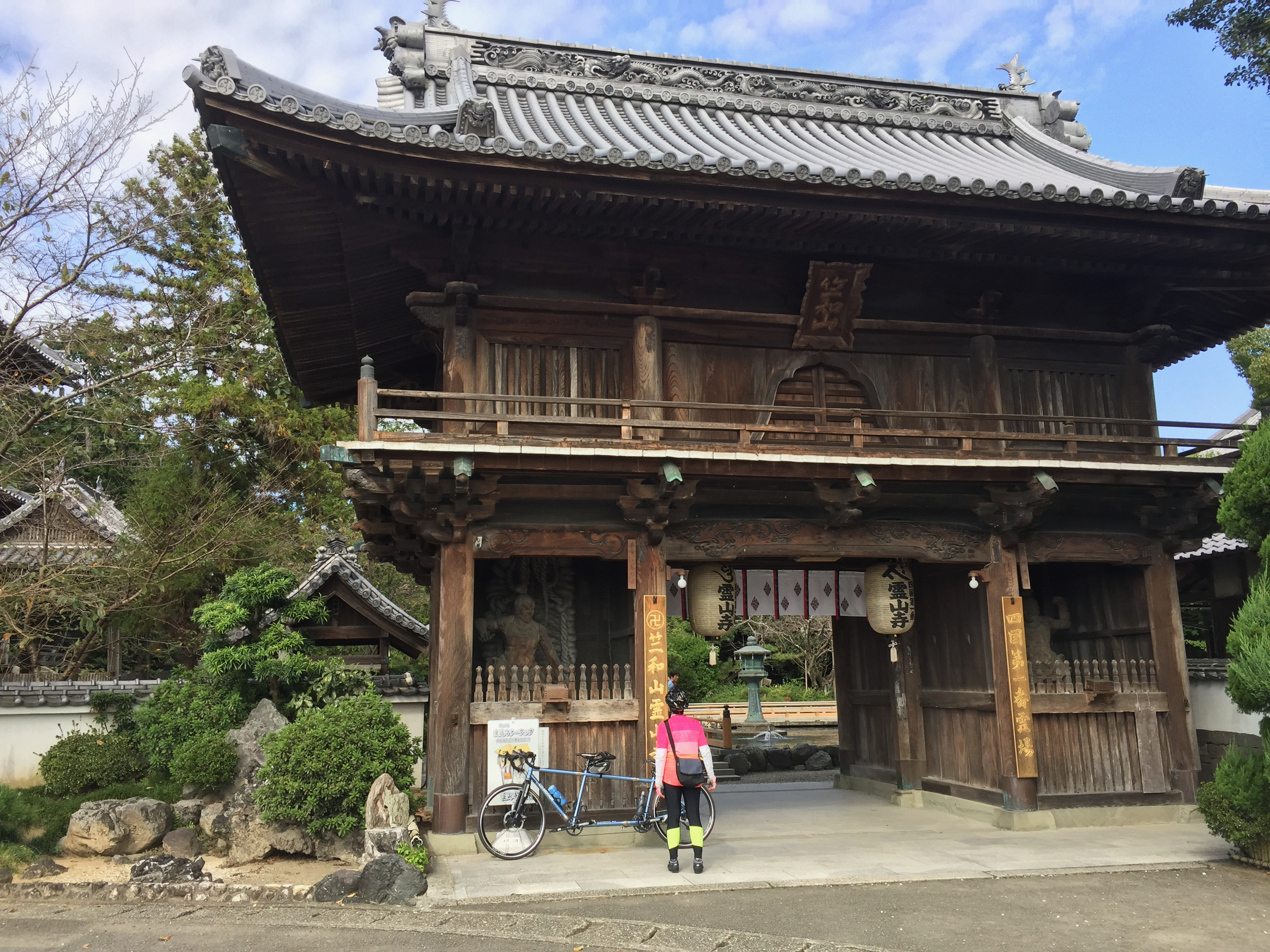
We pulled up to the temple gate. Our first of 88. 

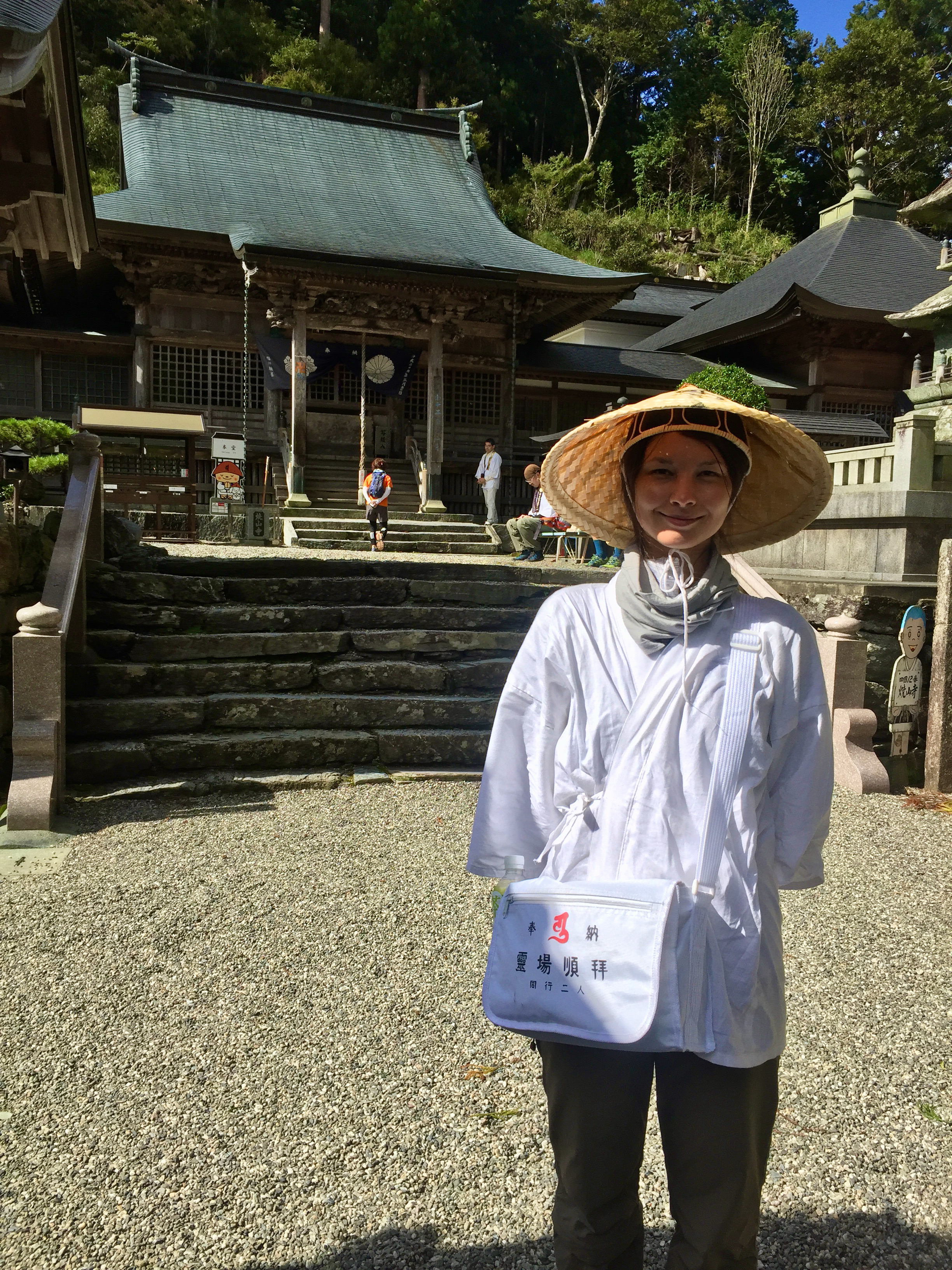
Mima-san had tipped us off that the place next door was cheaper than the temple store for pilgrim clothes and supplies. So we moseyed on over, and picked up white pilgrim vests, temple books, nameslips, candles, incense and a lighter. 

Suitably equipped, we were ready for our first temple.

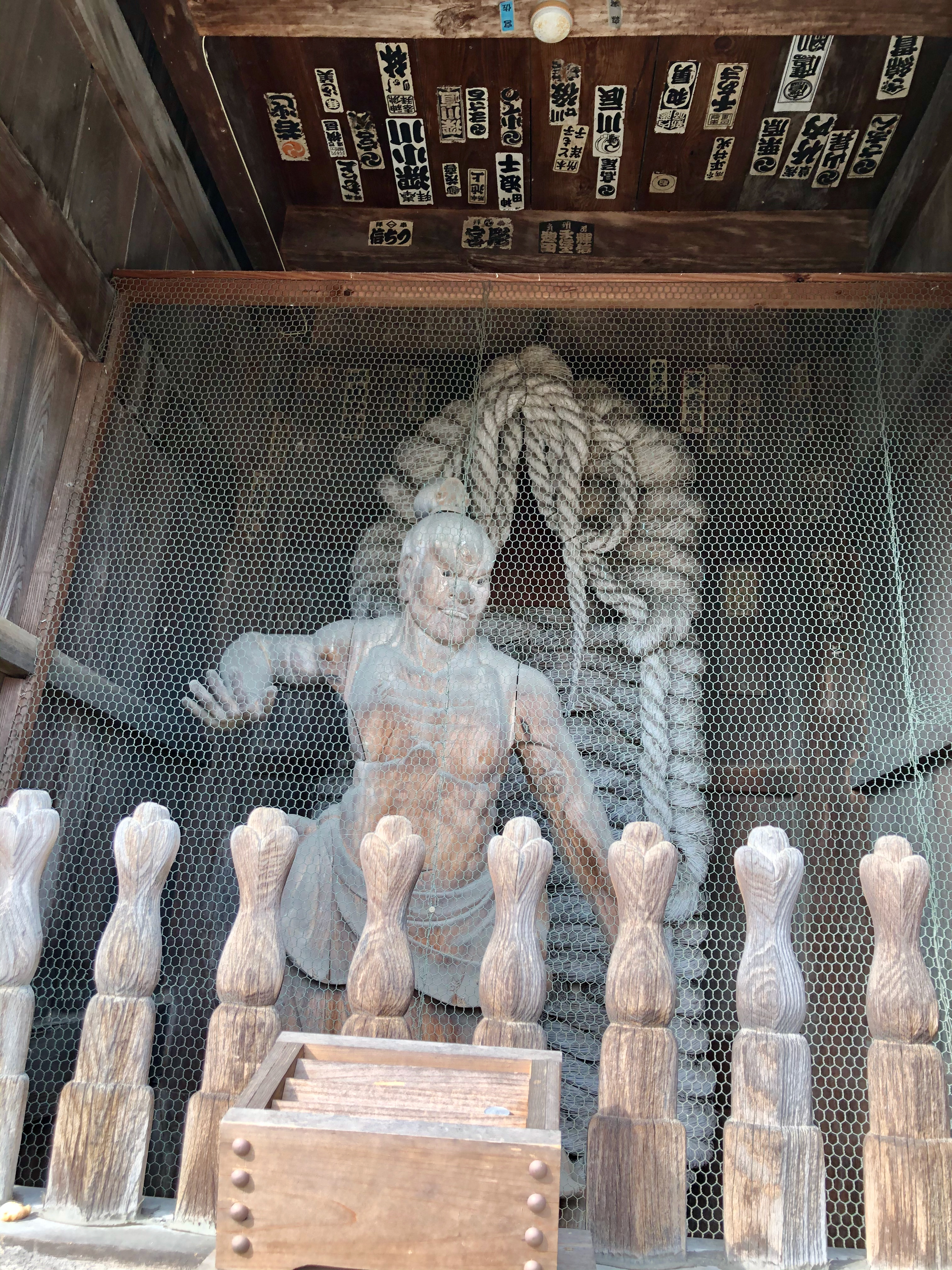
Back at the temple gate, we bowed and checked out the guardians. Always unique. Always no nonsense. Temples are considered sacred ground and the guardians are there to keep it that way.

So where to park the bike? I rolled it through the gate and locked it up on the backside. Where to start? In a flash, Sharon was off to the wash basin. Suitably purified she rang the bell announcing our arrival. 

I sat down on a bench next to another old guy and watched the Koi fish slowly swim around. 

In Japan, Koi are a symbol of good fortune associated with perseverance in adversity and strength of purpose. I was feeling the 13 hours of jet lag. The lolling Koi were about my speed.

Wandering through the temple grounds we soon found the Main Temple Hall, where following protocol, we lit incense and candles and left nameslips in the nameslip box and a small donation in the offertory box. 

Nameslips are something akin to a spiritual business card, including name, age, country of origin, and intent/wish. They are left at the Main and Daishi Halls, exchanged with other pilgrims and given to those from whom you receive gifts – osettai. More on osettai later. 

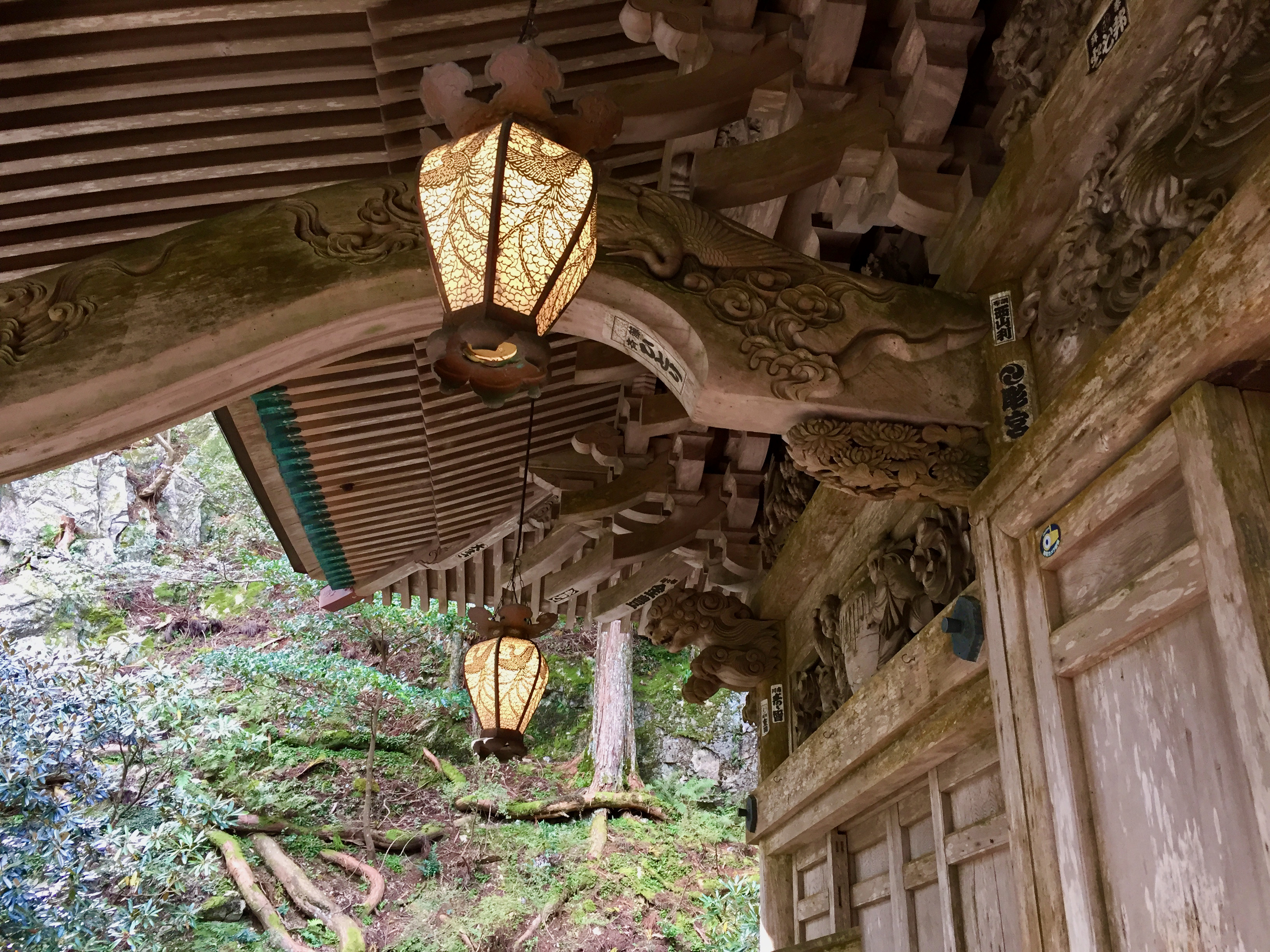
Then we wandered into the Main Hall itself. The lanterns were quite atmospheric. And the shrine felt oh so familiar. Memories flooded back.

Back in the early 1970s, I did a month long group Buddhist meditation intensive. Perhaps the first ever in the USA. All of us had been practicing formless mediation intensely several times a day and for weekend stretches, but never all day long for a whole month.  We wondered what would happen?

Bottomline: Nothing. Which is kind of the point. Lots of mini-drama though.

We’d be sitting there, eyes open trying to pay attention to our breathing and labelling thoughts thoughts, when out of nowhere now and then, someone would start laughing or crying. Internal monologues taking over. Nothing particularly new there.

One day a young woman next to me broke down sobbing. Later I asked her about it. Nothing to do with memories or fantasies.

She said that she had let a fly land on her face, and then walk across her open eyeball. 

At which point she broke down. Way over all the lines, & in the present to the extreme. Kobo Daishi stuff.

And I’d always thought of her as pretty easy going.

****

After the Main Hall Sharon and I made our way back to the Daishi Hall, lit incense and candles and left our nameslips per protocol. 

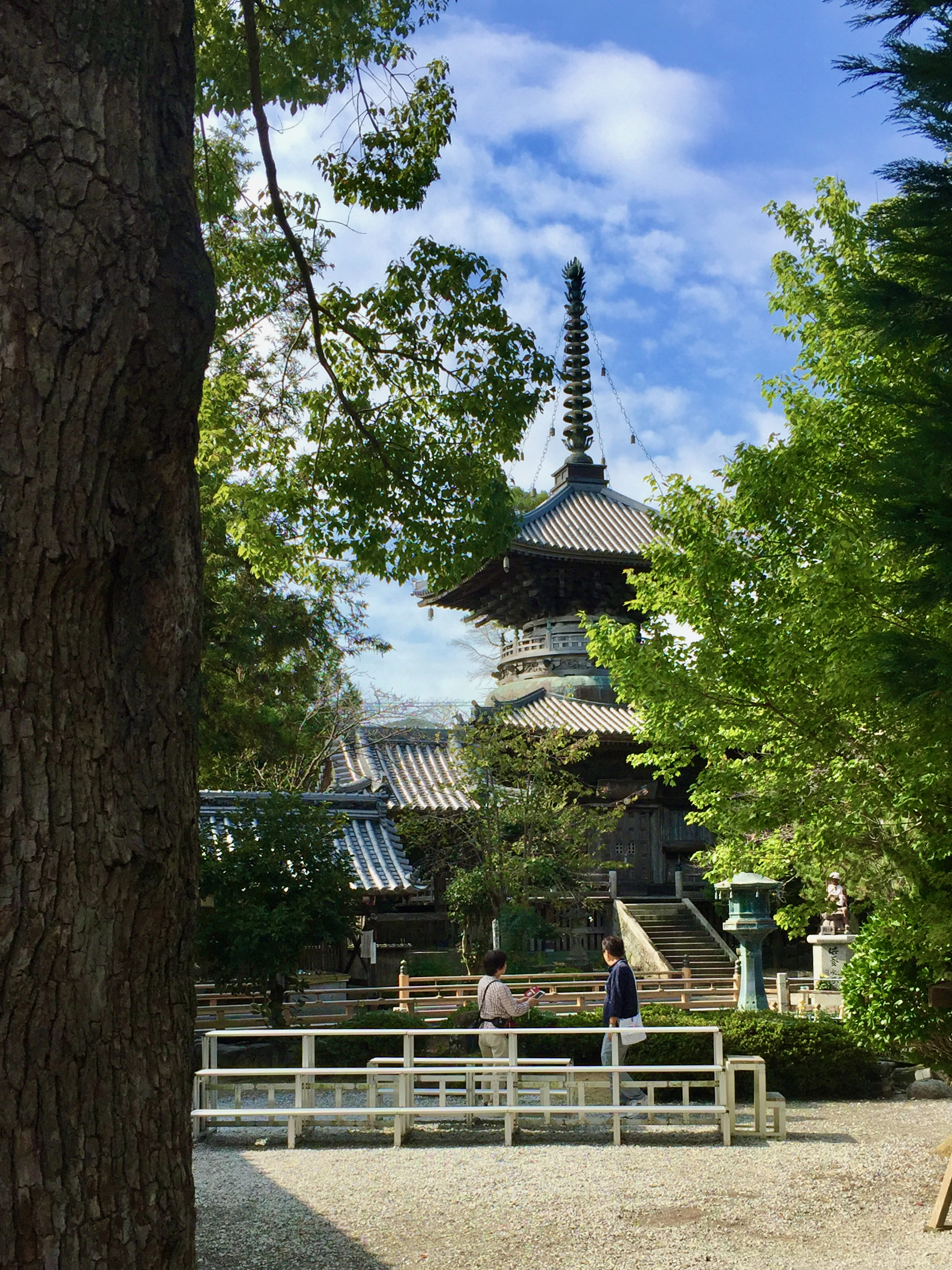
On the way to the Temple Office this was the pagoda view.

At the Temple Office we pulled out our virgin pilgrim books and received our first stamped calligraphies. 300 yen (about $3), well spent. 1 down 87 to go. 

We rode back to Morimoto-ya Inn, the way we had come. Arriving in time for an early private couple tub soak. Grandma knocked on our door to let us know that the tub had reached just the right, really-hot-temperature. We walked down the hall, and went in, locking the door behind us. 

We showered side by side, sitting on low stools with handheld sprays in the open room. Suitably clean, we slowly lowered ourselves into the steaming tub sized for two. Grandma had expected us to bathe together. 

Welcome to Japan. 

At dinner there were two Japanese, two Germans and us. The Japanese kept to themselves, as did the Germans until the meal had almost finished, & then the German woman broke into English. 

It turned out that she was German/Japanese with excellent English and Japanese. Her German friend, she had met that day on the road.

In her late 20s, she had spent the last 6 months caring for her dying mother, grieving at a crossroads in her life. Her band had broken up, and her boyfriend had left.

She had decided to do some of the pilgrimage as a time of reflection in memory of her Mom. She said perhaps she would visit the first dozen or so temples. Or as far as her limited budget would go.

We saw Anika again at Temple 12, photo below. 

In late November, I checked the Shikoku Facebook page, and there she was. 88 temples. Kudos Chica.

People do the pilgrimage for many reasons: honoring loved ones, religious conviction, a break from daily routine, or simply as a challenge. All are welcome. All equally valid. Kind-of like formless mediation.

We had heard that the Shikoku pilgrimage was pretty much undiscovered by Westerners. True. In our month on the road we met perhaps a couple dozen Europeans and only two other Americans. 

That said, the trend is fewer Japanese and more foreigners. Will this be an issue?

Yes, as Jean Phillipe explained a week later in Minami Town. 

Day 4 October 11 Friday; Another Test Run, & Temples 2 – 5

2 Gokuraku-ji 極楽寺 Naruto, Tokushima
3 Konsenji 金泉寺 Naruto, Tokushima
4 Jizō-ji 大日寺 Itano, Tokushima
5 Dainichi-ji 地蔵寺 Itano, Tokushima

The next day was another test run. We looped back to catch Temples 2, 3, 4 and 5. 

The first two temples were a piece of cake. Then we headed to temple 4 as dark clouds were gathering. One bad decision followed another as we raced to beat the weather. 

We arrived at what we thought was Temple 4, but really was temple 5. Then headed off downhill to where we thought 5 should be. Our bike computer kept rerouting us in circles, down on the flats miles off route. 

Rain started falling. We were tired, disoriented and getting our first lesson from the world of Kobo Daishi.

“Slow down and pay attention.” 

If we had just taken more time and paid proper attention, we’d have already been soaking in that tub at Morimoto-ya Inn. Instead we had to retrace our steps. Back at Temple 5 we faced a big climb to Temple 4 which we had barely missed when we went left instead of right. 

The women in the Temple 5 office laughed knowingly at our story, glanced at each other, and then one offered to drive us up to Temple 4 in her car. 

She walked us through the temple. At the wash basin, after washing each hand,  I went to wash my mouth out, per book protocol. She made a nasty face and said, 

“No. The water is dirty. Just watch and imitate.”

Which I did and from then on, after washing each hand, I simply let the water run back down the ladle’s handle and over my hand like 98+% of the other pilgrims. Cool, smooth, simple, symbolic and hygienic.

Sharon, the incorrigible one, continued with her mouth washings. As we worked our way around the island from temple to temple, I noticed that the really hardcore pilgrims did the same. 

Traditionally the 4 prefectures: Tokushima, Kochi, Ehime and Kagawa are associated with 4 places of training. Each have personalized lessons. Tokushima was the first: The Hosshin dojo or Place of Spiritual Awakening.

We certainly weren’t shortchanged on lessons, or more accurately, I wasn’t.

Back in the day, a friend used to laugh about Jack Kerouac thinking he could reach enlightenment by going faster. Suppose anything is possible, but that’s kind of the wrong end of the stick.

You’d think that after all these years, now in my old dog days, I’d have figured that one out.

Nah.

“It’s about slowing down psychologically and the connections.” My personalized Tokushima lesson.

The next morning we would bid our comfy and cozy inn goodbye. We did a final packing and sorting, with one eye on the weather.

A typhoon was bearing down on Japan. A really big typhoon. Tokyo looked like a direct hit. But Tokyo was 300 miles away. Maybe we’d luck out.
Maybe not. 

Link to next Shikoku Pilgrimage post: Tokushima.

Finland 3: The King’s Road

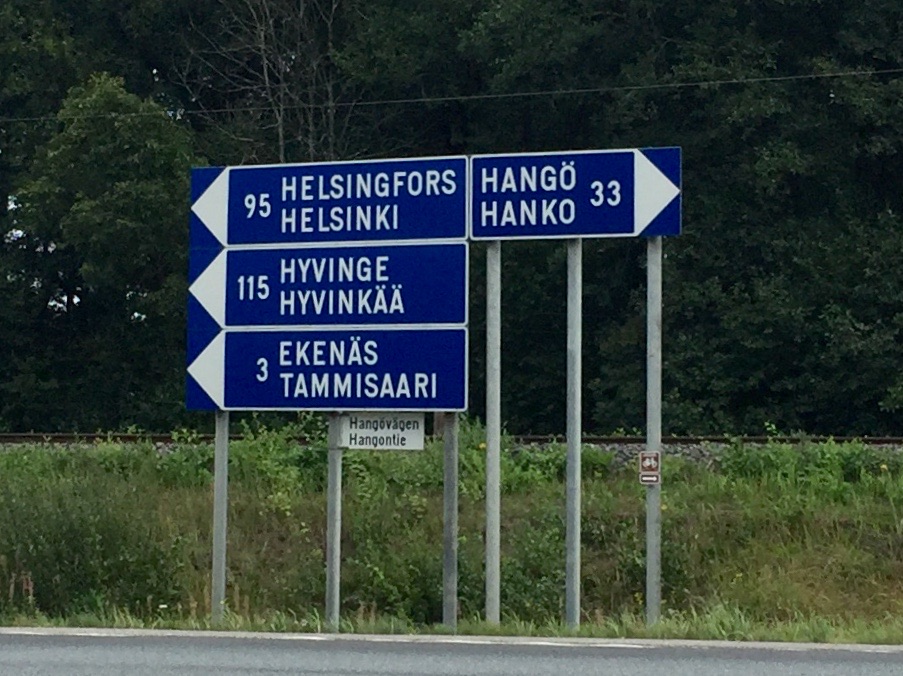
We pushed south from Matilda reaching Hanko on southern tip of Finland just ahead of the storms. Hanko’s August 25 end of summer celebration was our goal all along and we made it.

In Hanko we stayed with our Finnish counterpart Liisa and her daughter Saila for a three days. Did some visiting, did some mushroom hunting, did some sightseeing, and did some laundry.

Generally had a great time.

Together all of us said our final farewells to my Mom and tossed her ashes into the Baltic as she had wanted.

Then Sharon and I bicycled back up the coast to Helsinki along the historic King’s road.

Day 11  Friday August 24 Matilda to Hanko

We were up early. We had a big day ahead. The final push to Hanko.

The challenge of the day would be our route. We now knew enough to know that our bike computer had us riding many miles on gravel roads. Those dashed lines on our paper map were a dead give-away, and gravel was not for us. 

We came up with a plan, but first another wonderful Finnish breakfast. 

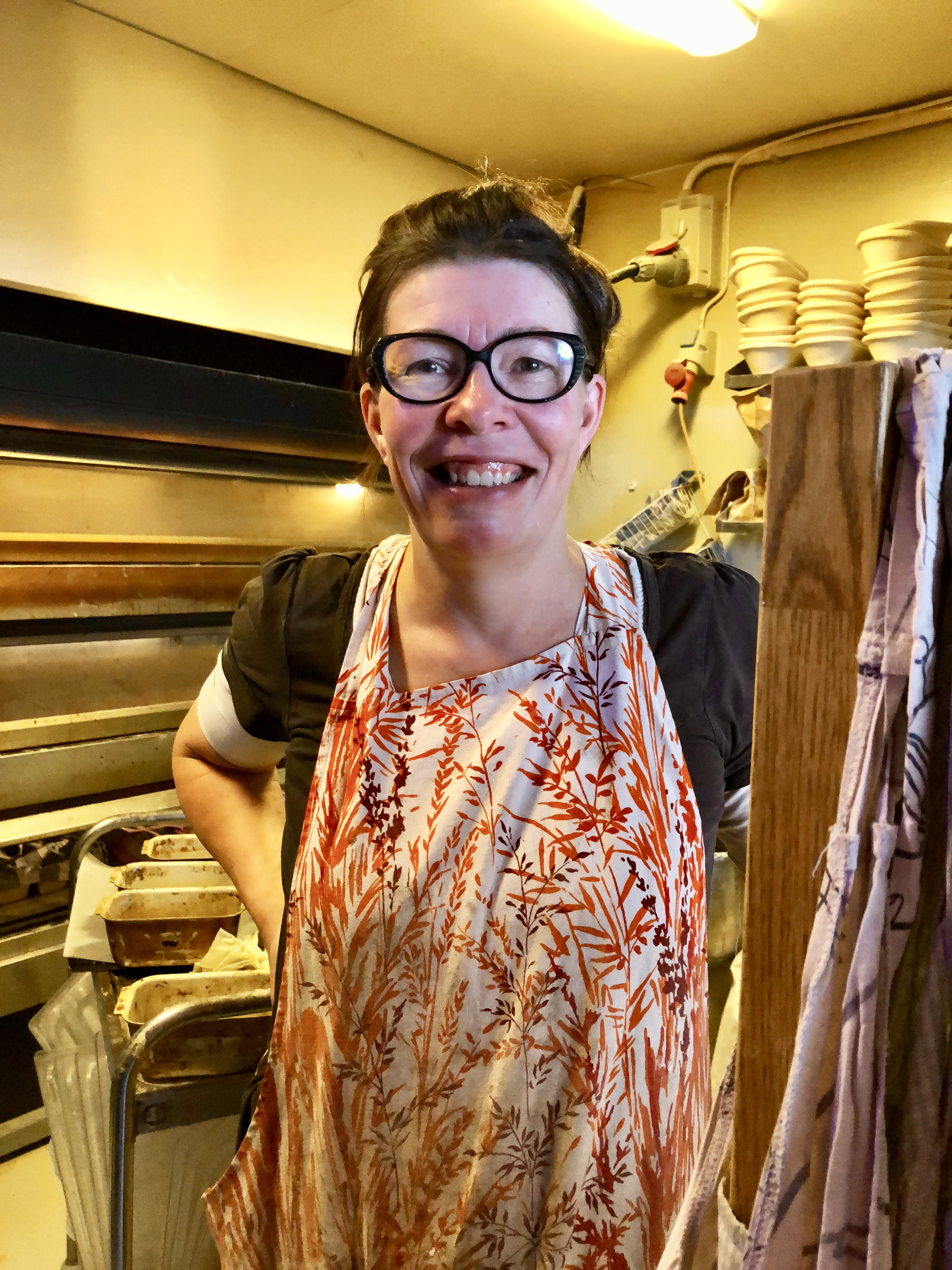
Then, we picked up a loaf of fresh bread from the baker behind Terho and lashed it on top of our trunk bag. Sharon and the baker had hit it off the day before, when Sharon was exploring. The baker threw in a couple of most appreciated extra treats.

fullsizeoutput_40a7

Sharon’s baker friend

After leaving the woods of Matilda the roads got bigger and and the traffic picked up

IMG_0098

We took the smaller side roads where we could. And were rewarded accordingly.

IMG_0099

Our rear bag bread shrank as the miles added up.

We had some nice wide smooth roads through some big trees.

IMG_0100

We finally hit the main route to Hanko a bit worse for wear, and running empty on water.

IMG_0101

We were huddled over our map, plotting our next move, when a car pulled up. 

Remarkably it was Saila. Helsinki family headed south to Hanko. We asked her how she knew it was us. 

“Not too many tandems in Finland.”

5 minutes earlier or later, and we would have missed each other. 

Synchronicity Magic. 

Perhaps it was the bag of my Mom’s ashes in the back of the car. Who knows? 

In any case, it was all for the good. 

Saila took our water bottles back up the road for refills. On her return we transferred our bike bags to her car. Another blessing. 

fullsizeoutput_40ac

We were able to ride the last 20 miles into Hanko on an unloaded bike. We followed the bike paths when available. We would veer off onto pieces of the old road to Hanko when directed. Once again weather was threatening. 

We arrived in Hanko only a bit damp. A half hour later, the heavens opened up.

By then we were safe and sound in Liisa’s house.

IMG_0103

Days 12 & 13; August 25 & 26;  0 miles 

My great grandfather Alexander and Liisa’s great grandmother Fredrika and were brother and sister. Our families diverged when all 5 of Alexander’s children and his wife emigrated to the USA in the early 1900s.

Liisa’s family, and Alexander, stayed in Finland.

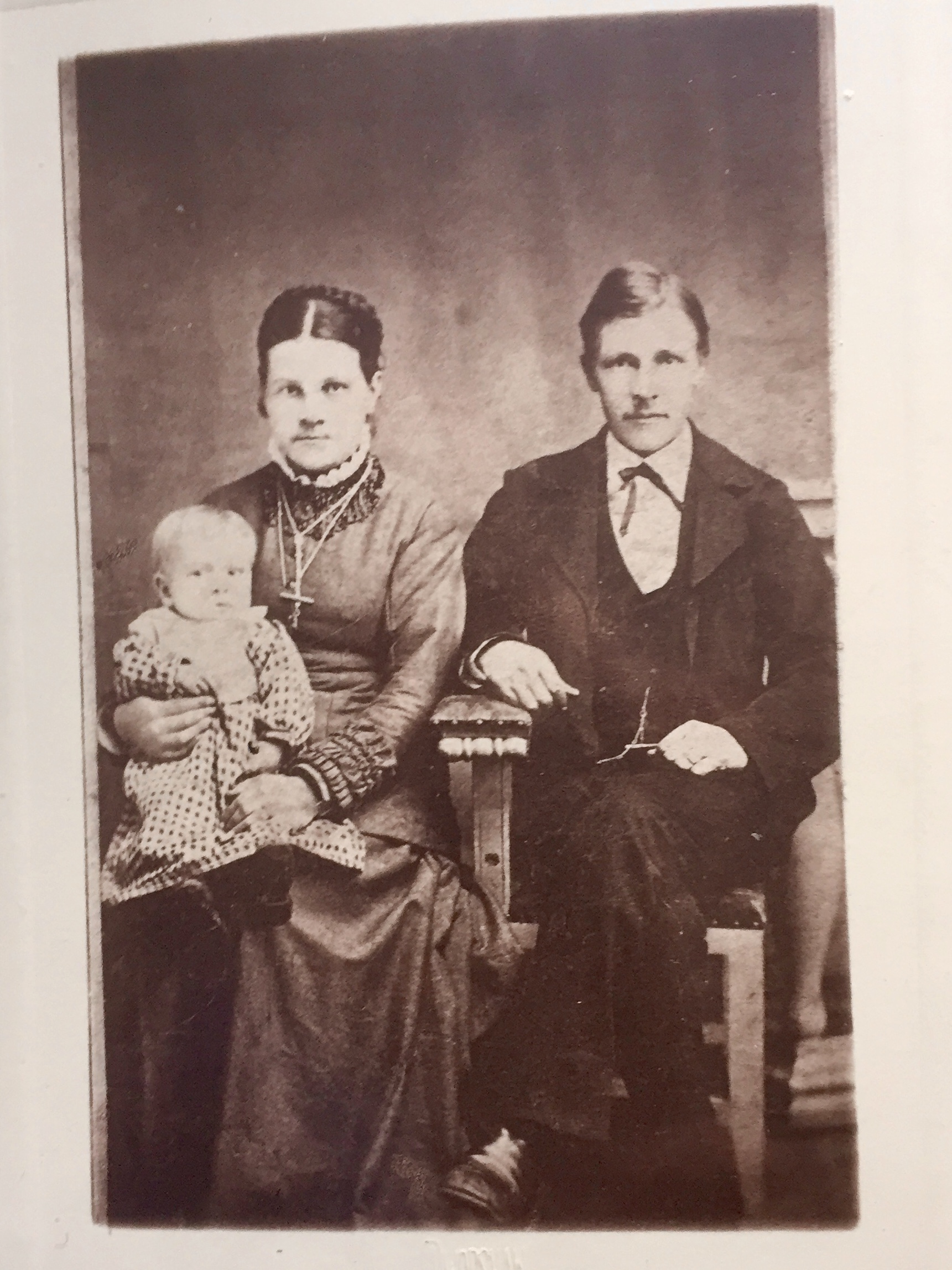
The photo below from the 1880s is Alexander, his wife Heta, and probably my grandfather’s older brother Abraham, the first born. 

fullsizeoutput_420e

Alexander and Heta’s was a family-arranged marriage. It didn’t work out. From what I gather, he was more refined intellectual than businessman. Heta was a bottom line kind of gal.

After the split-up, Alexander wrote a book, “The Pitfalls of Marriage.” No copies survive that I am aware of, but the title does kind-of say it all.  

I feel for the guy.

Hi marriage hit the rocks. His wife left him. And to top it off all of his children and ex-wife emigrate to the USA and he never sees any of them again.

Liisa says her side of the family held Alexander in high regard. He was said to be a thoughtful, responsible, and all-round nice guy. He had beautiful handwriting and a prodigious memory. Story has it that he memorized the whole Bible. 

Apparently all this wasn’t enough for Heta. 

In 1901, Alexander’s 2nd son Peter, my grandfather, was working in Helsinki as a watchmaker and engaged to the bosses daughter Signe, when he was drafted by the Russians to fight the Japanese. The photo below is from that time.

fullsizeoutput_41b7

Peter was a tough guy, faced with hard choices. He chose to emigrate to the USA, where eventually he married my grandmother Tyyne, another Finn, in 1919. By then he was an established successful businessman owning a jewelry store in Duluth MN.

Tyyne was a catch, if you like young, really smart, no nonsense, professional women, which apparently my grandfather did. Tyyne was an MD.

By all accounts theirs was a happy marriage. Complicated, but happy. I wish I had known them, but I grew up a couple of thousand miles away in California. But that’s another story.

fullsizeoutput_4211

But Peter never forgot Signe back in Helsinki, keeping her gold snake ring his whole life, hidden away: engraved with her name inside the band. My Mom found it sorting through odds and ends. 

Years ago I nabbed it. I didn’t care about the story, I simple liked the look. The diamond on top of the snake head was the clincher.

I’m still wearing the ring as I write this. I find it curious that the ring and its memories have survived more than a 100 years. 

When Peter emigrated to the USA, he left from Hanko, the southernmost port in Finland. Because of its location and the mild sea climate, Hanko was the only harbor open year round.

In the early 1900s, Finland was ruled by Russia and a popular destination for Russian nobility who built quaint charming summer homes, restaurants, casinos and so forth. Much of that charm lives on today, including Liisa’s house.

****

We were all up early. The next two days were pretty much open. Plenty of time for laundry, a visit to the robot boat, mushroom hunting, sightseeing, a swim in the Baltic, and a farewell to Mom.

IMG_0110
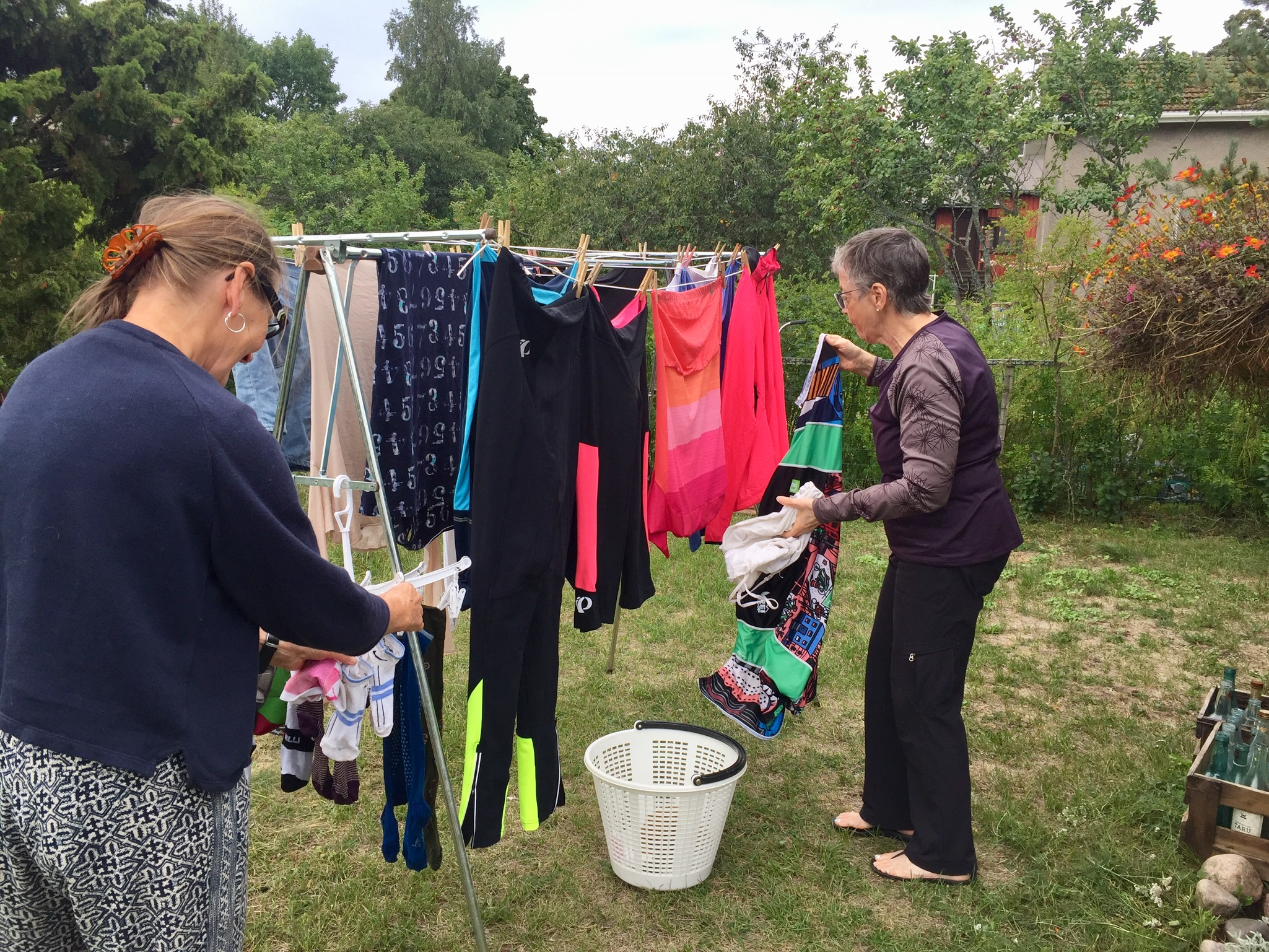
Great to have access to a washing machine
IMG_0111
Our visit to the Finnish “Robot” Boat
IMG_0122
Mushroom hunting

When the hour finally arrived to send my mother on her way. The four of us piled into Liisa’s car and headed for Mannerheim’s Café. It had closed for the day.  We had the place to ourselves.
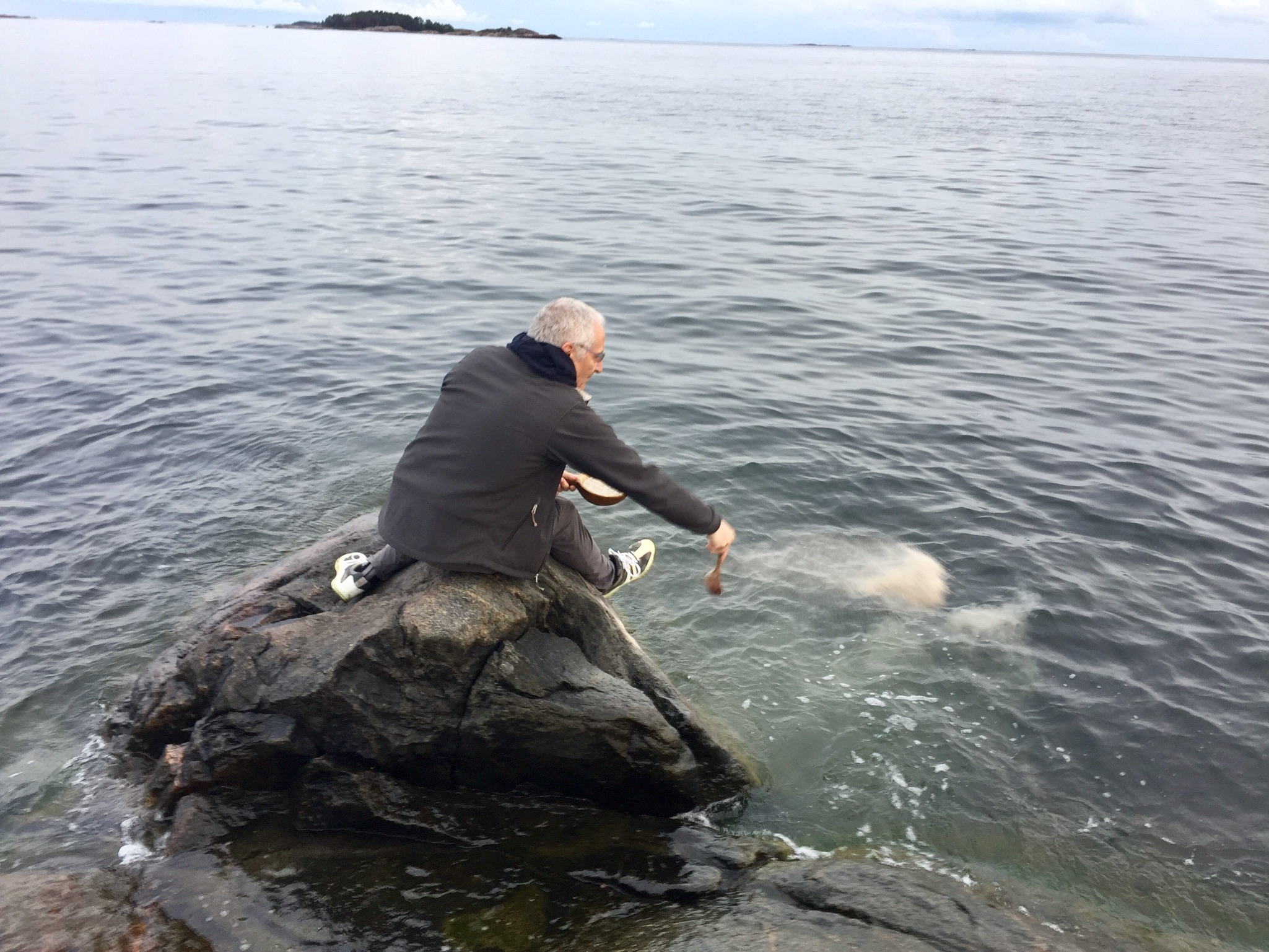
We walked around back to the rocks on the Baltic. On a rock outcropping, a millstone was setup as a table. This was the place. On cue, the sun dropped down below the clouds. All was still, save for the waves gently lapping.

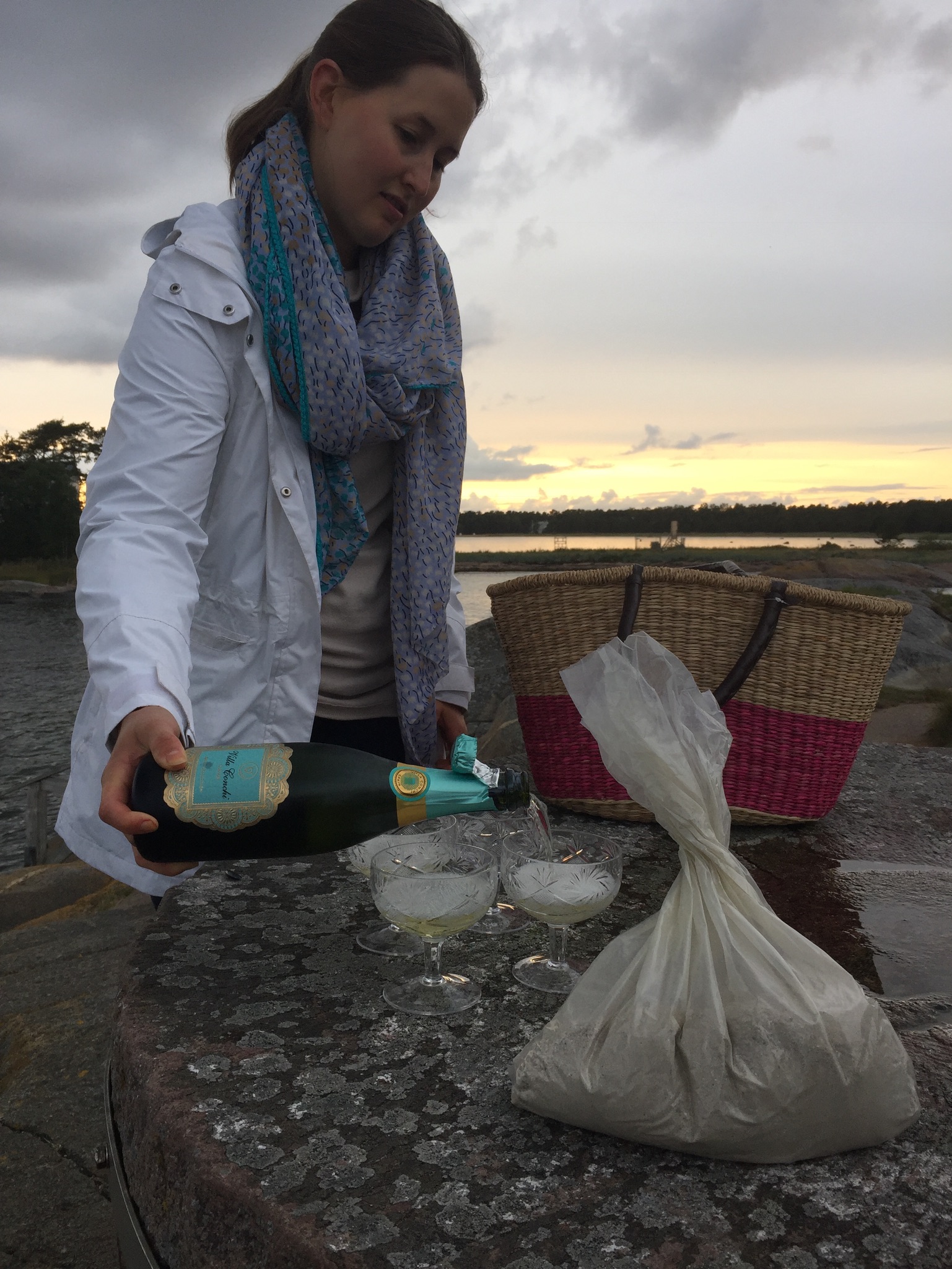
Saila and Liisa had brought the champagne and glasses. I brought Mom’s ashes. 

IMG_0117
Saila poured the Champagne

Time to say goodbye. 

Almost.  

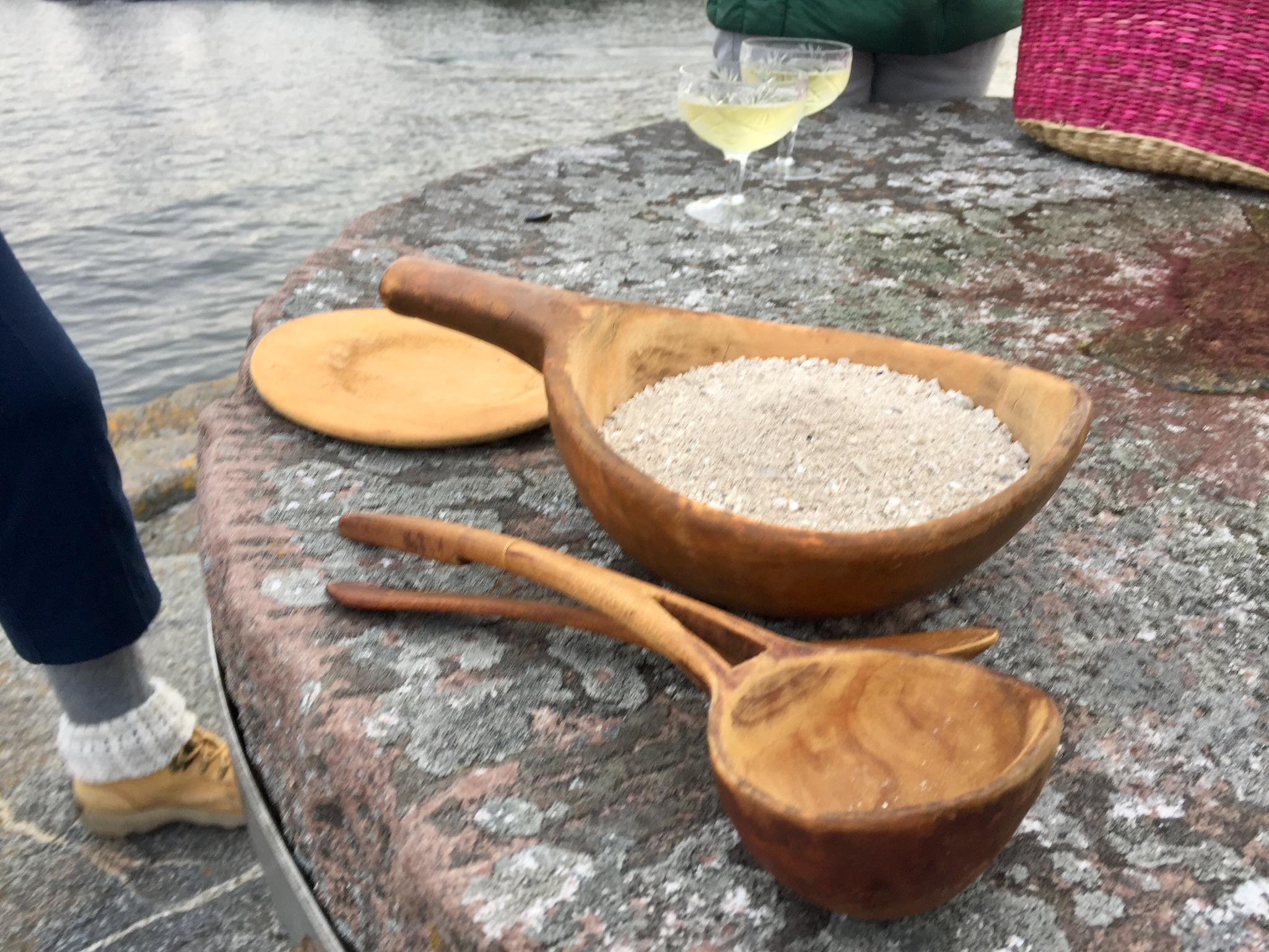
We needed a cup or spoon or something to scoop ashes. In an ah-ha moment Liisa remembered the wooden, antique, hand carved Finnish bowl, spoon, plate and ladle we had brought as house warming gifts.

They had come down in my family through my Mom. It had seemed fitting they return to Finland. 

Twenty minutes later Liisa was back. The wooden implements were perfectly practical and appropriate. 

IMG_0116

We toasted my Mom. I seem to remember saying something along the lines of: she did it her way. And that she was a bit of a free- spirit. Both creative and stubborn. Not an easy path.
Each of us took turns tossing her ashes into the sea, as we said our final goodbyes.

IMG_0118
We said our final goodbyes

I think my Mom would have been most pleased. She never explained her reasoning behind her request to have her ashes thrown into the Baltic here, and I never asked why. But, I think I know.

Many angles. Clever woman. 

Her ashes were to be returned to the homeland of her spirit. Hanko was both a gesture respect to her father, and Liisa’s family. And, our coming to Finland, would be a bonding between favorites in both family lines.

She was very attached to both Liisa and Saila. I suspect that she hoped that both would be here to send her off. Which is how it happened.

Well done Mom. 

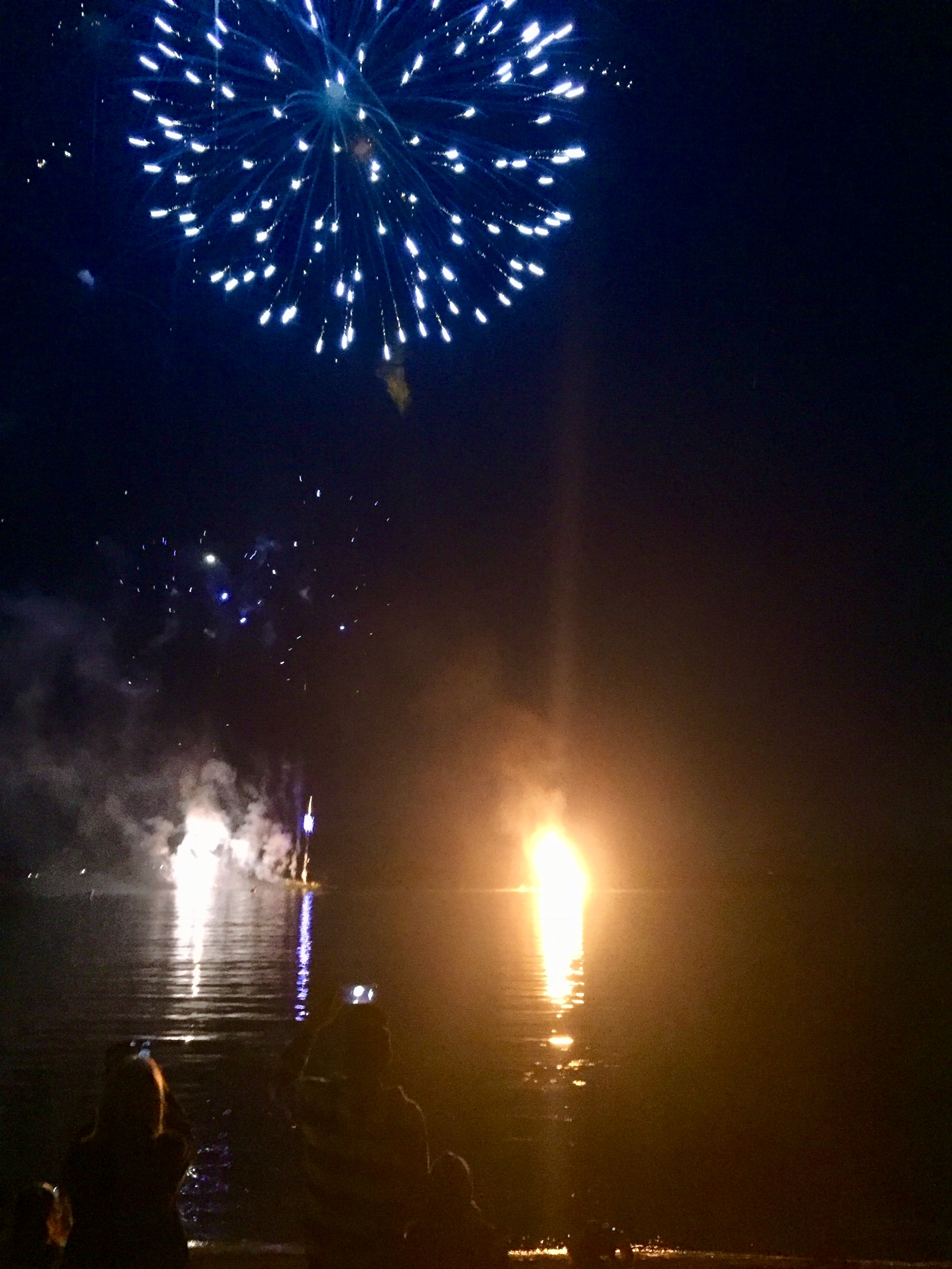
Our next stop was a beach for the bonfires and fireworks of the end of summer celebration. The bonfires were pagan tradition. The fireworks, a 21st century Hanko icing-on-the-cake. 

We had been in Hanko for the festival in 2005, on another beach. A far more vivid and raw experience. The bonfire that night had been big as a house. The guy next to me, had handed me a bottle of a horrible, awful, stiff, licorice drink. I had looked up the coast and could see huge bonfires on islands disappearing up into the archipelago. 

This iteration felt a bit too refined. Candles were placed along the water’s edge every 10 feet or so. I’m not sure if there actually was new age background music, but there were lighters, swaying and singing-along, so I think there was.

No matter. The magic was still there, swaying lighters and all. Fireworks coupled with the poignancy of Winter’s knock above the 59th parallel. 

Suspect Mom would have approved.

IMG_0120

Day 14; August 27 Hanko to Inkoo

Our mission accomplished, we still had another 2 days and 89 miles up the coast to Helsinki. The first stretch would be a retracing of our ride down the peninsula to Hanko. 

Not all that exciting.

Liisa suggested that we take the local train up to Raseborg, knocking a big chunk of mileage off the day. Not much downside as long as our tandem would fit on the train. A short field trip confirmed it would.

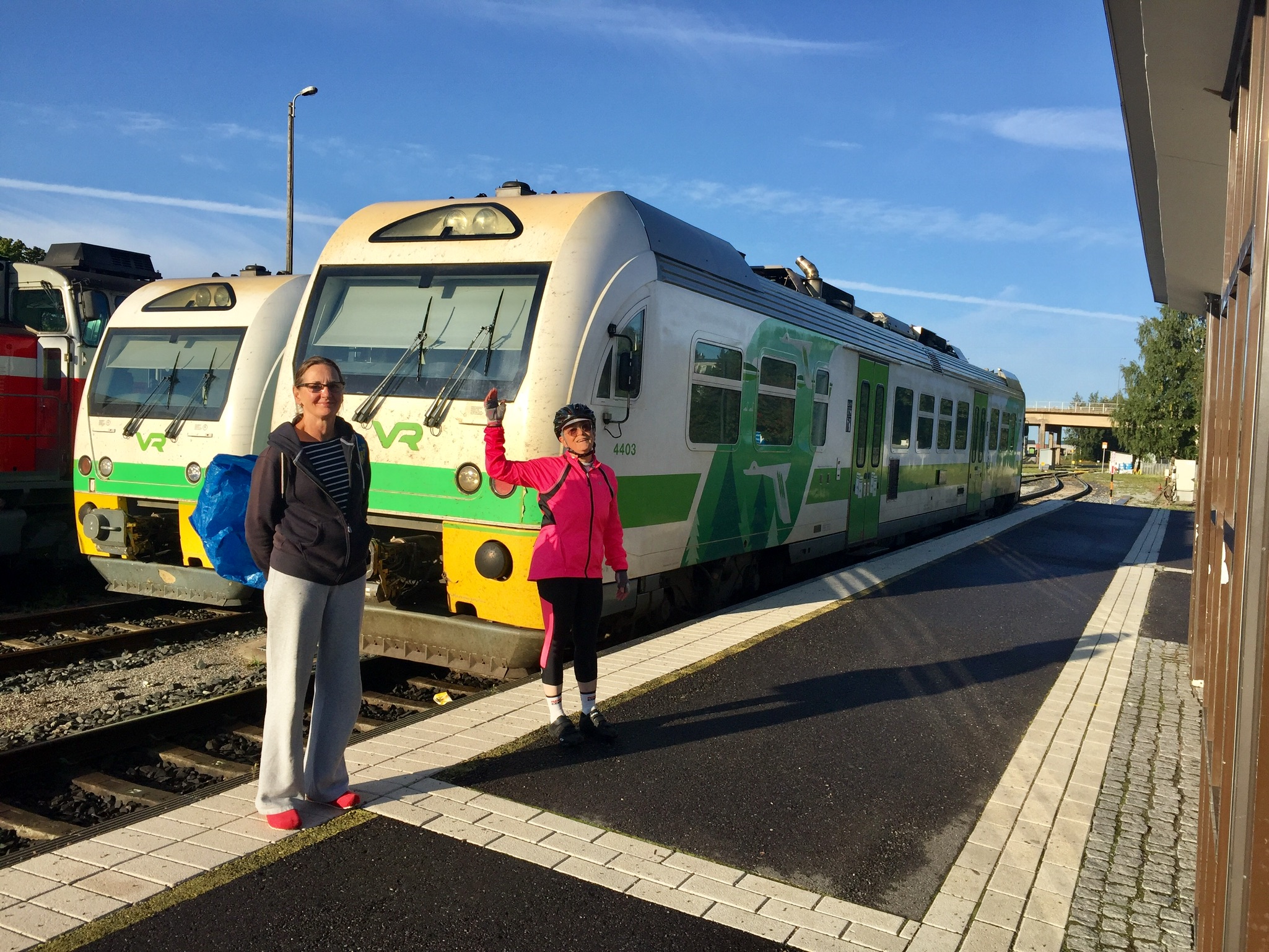
We rode our tandem to the station. Liisa drove over to see us off.

IMG_0124

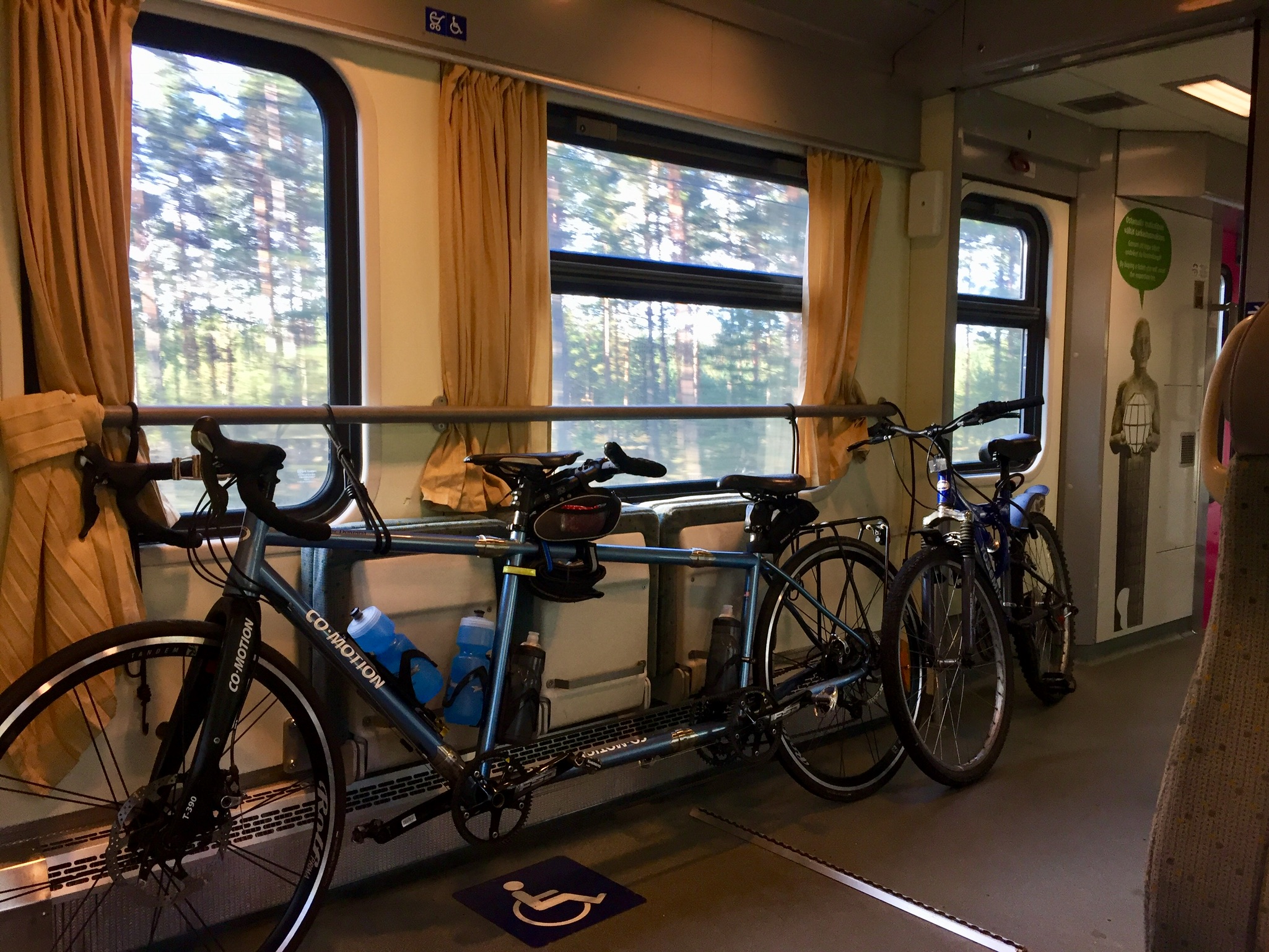
We had purchased our tickets the night before online – 2 pensioners & 1 bicycle. It’s kind of an honor system with a big stick. Every now and then someone inspects for tickets. If you don’t have one you pay not only for the ticket, but also a very stiff inspection fee.

IMG_0125

Our bike strapped in next to us, we settled into our seats. It was the Monday morning commute. The young woman opposite us was putting on her face. Sharon had the window seat. In a stretch through the woods, she saw a young moose – watching our train roll by.

It wasn’t long before we were in Raseborg. Far larger commuter crowds were ready to board. Once off the train we found a quiet spot to put ourselves together and come up with a plan. We were far off our computer-based route and would have to find our way on our own.

10 miles later we were back on our coastal route. We had passed the test.

IMG_0126

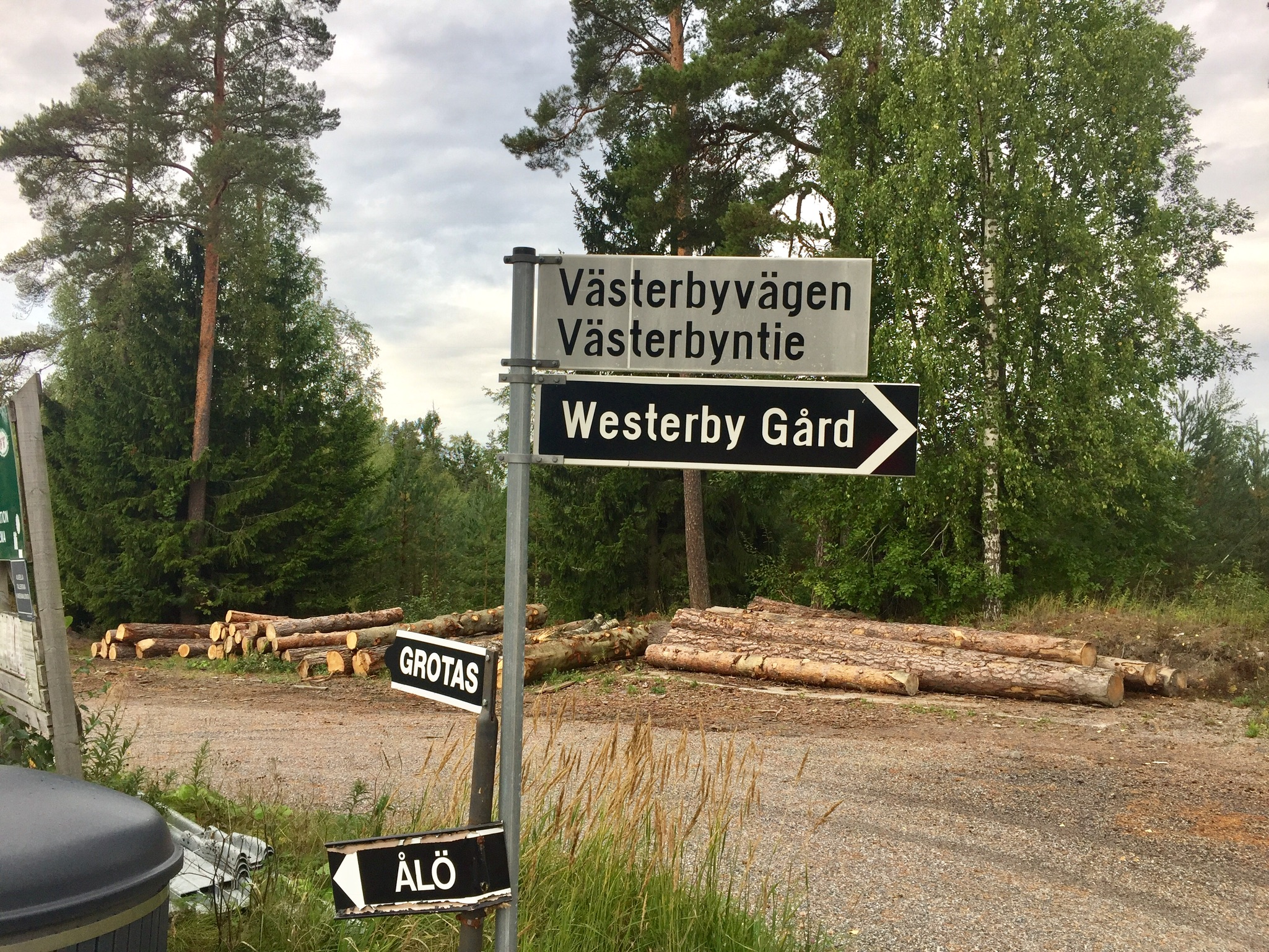
While we were standing by this sign, we got a good news email from Gunilla at Westerby Gard, our inn for the night. They would be opening their kitchen that night for a group which had just booked. Were we interested in dinner as well?

Yes!

The next stretch was the oldest road in Finland once linking Sweden and Russia. It’s also the likely route my grandfather took in 1902 when he traveled from Helsinki to Hanko and then on to the USA.

IMG_0127

Sharon still talks about about the wonderful, clean, fresh, cutting smell on this stretch. I suspect is was the ozone after the rains. Or perhaps it was just the earth at the end of summer in these parts of rural Finland. 

IMG_0128
Cheesecake and Coffee on the Museum Road

We stopped for cheesecake and coffee on a special section designated as a “Museum Road”. It was great riding- no traffic, scenic, rolling and winding.

And the sign confirmed that indeed we were at ground zero for historic roads in Finland – in four languages – Finnish, Swedish, English and German :

“Fagervik museum road follows the route of the medieval Great Coastal Road from Turku to Vyborg. The coastal road ran along the southern coast through the oldest parishes and ports. It is not known when the road was first established, but it is considered to be Finland’s oldest road.

Evidence of the age of the road includes 15th century records of bridges across branches of the mouth of the river Kymijoki. The coastal road was a national highway between Sweden and Russia and also a connecting link between castles of Turku and Vyborg.”

IMG_0129

The magic came to an abrupt halt when we hit route 186. We had choices. Gravel roads, or big roads with big trucks? We had sworn off gravel roads, but the semi’s were articulated and the shoulders were pretty much not there. 

fullsizeoutput_415a

Gravel it would be. We crossed route 186 and rode on the as-it-turned-out, not so bad gravel road to Inkoo and Westerby Gard. 

I was expecting Westerby Gård to be interesting and charming. It didn’t disappoint.

Set on a 17th-century farm in the Inkoo archipelago, Westerby Gård was a relaxed, clapboard hotel in the middle of nowhere. But only a bit over an hour or so, by car, from Helsinki, it catered to sophisticated folks looking for a break from the rat race.

Sharon made friends with Gunilla’s dog, we unloaded our bags, and then I parked the tandem in the barn.

IMG_0131
Sharon, Gunilla and a new friend

The dining area had a white theme. Check out that white wood stove! You won’t see too many of these. 

IMG_0133

After showering and relaxing it was time for dinner. We asked if we could eat early, before the group. No problem. Thanks Gunilla.

IMG_0134

It was all pretty much perfect for our last night on the road. Good food. Good drink. Nice folks. Great bed. Farmland quiet.

Day 15; August 28 Inkoo to Helsinki

After a great breakfast, we checked out, loaded the bike, and waved goodbye to Gunilla. We thought for the last time, but au contraire, we would see her later up the road.

Our last day of riding from Inkoo to Helsinki started with a few miles of gravel road. We stopped for this pic at the fork. 

IMG_0135

It was a nice gravel road.

IMG_0136

Then we were back once again back on the King’s Road which had stretched from Oslo to St Petersburg. Some of the old forgotten granite road markers had survived the centuries. Sharon noticed them first. No surprise there. 

After the third or fourth marker, I finally stopped for a closer look. These were the real deal from days long gone by. 

IMG_0137

Then my phone started ringing. In Finland I never answered my calls. USA robo-calls were forwarded and if I answered, I paid. 

For some reason I answered this one. It was Gunilla.

Did I still have our room key? A quick pat on my back jersey pocket confirmed that I did. 

I had meant to pass it over at check-out, but the conversation was very entertaining and I hadn’t.

This was a very valuable key. Ironically, Sharon and I had joked about the sign in our room, that if the key was lost, there would be a 200 Euro charge. 

It looked like the joke would be on us. 

Gunilla said, “No problem. I’ll come get it. Where are you?”

Well, we were about an hour out, by bicycle, which was only 20 minutes by car for Gunilla. We explained about where we were. She suggested, we not move, so we didn’t. 

As we were waiting, up strolled a guy with a charming little dog. He was also a bicyclist, and we shared stories as Sharon made another friend.

IMG_0138

Gunilla pulled up and we passed over the 200 Euro key. All’s well that ends well. A tip of the hat to Westerby Gård.

Back on the road, we passed a few more historic granite road markers along the old wooded rolling rural road, and then abruptly the mood shifted as we hit the extended Helsinki suburban sprawl. 

The bad news was that we exchanged the woods for 21st century strip malls and heavy traffic.

The good news was that we had bicycle paths and were into our home stretch. Soon we were paralleling the freeway to Helsinki. 

IMG_0140

Some paths crossed bridges. I didn’t take any pictures of the crazy twisting bike paths in obscure neighborhoods. Bike computer humor.

IMG_0141

By early afternoon we were approaching Helsinki. We had been worried about rain all day. Roads had been wet from recent showers, but we were lucky. Only a few scattered drops.

IMG_0142

After one last bridge we arrived in Helsinki. We stopped shortly thereafter at this public sculpture. It was really big and kind-of wedged onto plaza alongside big traffic.

IMG_0143

This 50 foot high, black-painted, aluminum sculpture is named “Rumba.” The official interpretation is that: 

“Rumba’s lively figure has inspired a host of interpretations. Some have seen it as the Nike, the winged god of victory from Greek mythology while others have taken it as a depiction of the dynamics of movement, referring only to itself as is typical of the 1990s modernist sculpture. The title is a reference to music, and in Martti Aiha’s opinion, it also refers to the “Rumba” of the passing traffic.”

The back story is that Alko, the Finnish government-owned alcohol company, donated the sculpture as part of its 60th anniversary. Alko’s headquarters are nearby. 

To me this sculpture epitomizes the Finns evolving relationship with alcohol. Something of a twisted tale. 

Back in 2005 my Mom told me that Finns have a reputation for liking to drink, but our family in Finland didn’t drink at all. Suspiciously, this line was repeated far more often than necessary. 

Once in Finland, Sharon and I exchanged amused and knowing glances, at each meal, when the wine came out, then were the mid-afternoon cocktails and the after dinner apertifs. Might have been some schnapps as well.

Mom loved it. Held her own. Never mentioned family drinking habits again.

IMG_0010.JPG

Photo above is from Hanko 2005. Liisa’s mother Kaija is on the left. Fun, generous woman and a beauty in her day. The boy next to her is Erik, Kaija’s grandson and Hannu’s son. Lisa’s brother Hannu had married German and lives in Majorca.

Which kind-of explains how Erik grew up to be a talented Finno-German musician who raps in Spanish. 

Erik

We wove our way into Helsinki, on the city’s bike paths. Left of the tree- bike path. Right of the tree – pedestrians.

IMG_0144

We pulled up to Hotel F6 in the early afternoon. Our friend Riku at the front desk, was happy to see us. He knew our story and plan and like many along the way, I suspect wasn’t sure we’d make it.

IMG_0145

Riku went for coffees and we exhaled.

IMG_0146

We walked the bike into the courtyard and pulled our bags off. Doesn’t look like all that much for two people, 13 days on the road. Then again, less is better – doubly so on a tandem. No regrets.

IMG_0147

We took the bike apart and started packing it up. Then it was time for showers and out on the town for a great dinner. 

IMG_0148

Day 16; August 29 Back to Boston

We finished packing in the morning and had a relatively smooth return to Boston.

Liisa picked us up for the drive to the Helsinki airport, but we had time to spare so we headed to her Helsinki apartment. We chatted, met her cats, and enjoyed the view.

She had a portrait on the wall.

Liisa explained that she had inherited it early. No one in the family seemed to like it. 

So Liisa asked us, “So who do you think it is?”

fullsizeoutput_415d
Kaija Portrait

Of course, it was her Mom, Kaija.  The portrait is dated 1957.  So she probably would have been in her early 30s. 

I love this portrait, the severity and intensity. Although I never saw this side of Kaija. I knew it in my mother. Most knew her as polite, friendly, artistic, and fun. But underneath all that, there burned this same Finnish severity and intensity.

On the way to the airport, Liisa told us a Finnish saying, which explains nothing and everything. A bit of Finnish Zen if you will. 

Oma maa mansikka; muu maa mustikka.

My country strawberry; other country is blueberry. 

I remember thinking at the time, how it made perfect sense. 

Now, I’m not so sure.

The very Finnish state of mind was fading.

Finland 2: The Turku Archipelago

We crossed the Archipelago on the Northern Route from Åland to Kustavi. Kustavi was the northernmost point of our journey at about the same latitude as the southern border of the Yukon and the Northwest territories in Canada.

From Kustavi, we looped south on the well-known circular Turku Archipelago Trail and then back up to the Finnish mainland @ Kaarina on the outskirts of Turku.

From Kaarina it was around and down on the Finnish mainland to Mathildedal, home of hipsters and namesake of our granddaughter.

From Mathildedal, the next leg (and next post) would take us down to Hanko on the southern tip of Finland, at the Southeastern corner of the Archipelago.

It would have been far more straightforward, and adventurous, to travel south through the inner archipelago from Korpoström, the southernmost town on the Ring Road, through the inner Archipelago to Hanko via water buses and ferries.

But it wasn’t meant to be. And not for want of trying. We were just too late in the season. Ferries had shut down and critical waterbuses had suspended operations for the year.

The Inner Archipelago will have to wait for another day.

Day 7  Monday August 20 Vardo Island to Kustavi

I breathed a sigh of relief when we pulled up to the ferry at Hummelvik. There were lines of cars and trucks, waiting to board. We pulled up and took our place. Then we noticed a few bicyclists upfront and to the side. We rode around and hung out with them. 

Motor vehicles board first, bicyclists last. 

IMG_0034
The Hummelvik ferry- A 6 euro 2.5 hour scenic ride from Hummelvik to Torsholma

Once on the ferry, we lashed our bike to a rail with our trusty plastic covered steel/kevlar cinch lock. We weren’t expecting choppy water, but you never know. Then we headed upstairs to the lounge where everyone hung out.

IMG_0035

We found a home upfront at a corner window and when the cafe opened, Sharon headed off to place an order for meat pies, another culinary favorite of the archipelago. 

We were both a bit stunned when they were delivered.

IMG_0036
meat pies

Where to start? We tentatively picked them up and took a couple of bites. An elderly gentleman and his wife at the next table were watching. He got got up and disappeared. A couple of minutes later he reappeared with knives, forks and napkins – and mustard and ketchup, which he placed as if he were a waiter. He returned to his table without a word. 

And then we all laughed.

Sharon scoured the lounge for reading material. After her morning Swedish lesson, she konked out. 

IMG_0037

The ferries had great public WiFi. I checked email and so forth and then took a stroll up top outside to watch the archipelago slide by. Another couple, also dressed spandex, were doing the same. We struck up a conversation. They were Austrians, probably in their late 30s, riding mountain bikes, out for the day. Clearly in great shape, and having a good time.

“Yeah, we love Scandinavia for bicycling, our next stop will be Norway for Birken, the world’s largest MTB race.”  They weren’t worried about the race or much else for that matter. I was starting to relax.

At noon, the ferry arrived in Torsholma, we were last off – after the cars and trucks and after all the other bicyclists. We took our time as we walked down the metal grating of the ramp.

So began our ride across the Åland archipelago municipality of Brändö which consists of over one thousand islands, ten of which are inhabited and connected to each other by bridges, causeways and small ferries.

The municipality covers an area 634 square miles: 39 square miles of land and 595 square miles of water. Population 465. 

Those 465 have their own coat of arms, which pretty much sums the situation up perfectly. Birds and fish, but no people.

Brändö coat of arms wikipedia
Brändö coat of arms

We loved Brändö. Quintessential archipelago. A highlight of the trip. Our road below.

Brando
Borrowed Aerial photo Brändö

In planning, I would joke, that I hoped we wouldn’t fall off the edge of the world.

Afterwards I say, that while we didn’t fall off, we did get to peer over the edge – While thinking of Brändö. 

Not surprisingly, there was no traffic, as virtually no one lives here and virtually no one passes through. Beautiful undulating roads, with postcard-perfect Baltic vistas in every direction. 

IMG_0039
Sharon on road- taken on one of the curves in the causeway in the aerial photo above

Curiously the landscape itself reminded me of one of my favorite places, the high Sierras in California above Tuolumne Meadows – gnarled low wind-swept trees and glaciated granite. Curiously, because Tuolumne Meadows is upwards of 8600 feet in elevation and alpine. Here we were perhaps 10 feet in elevation in a landscape flat as a pancake. 

 We had one more long ferry ride to reach the other side of the archipelago. We pulled up at the ferry landing. Just as a ferry was about to leave. It was smaller than I’d been expecting and I hesitated. Next thing I knew, it was too late. The ferry was pulling away.

I kicked myself for the next 45 minutes, until I looked more carefully at the posted ferry schedule. Thank god we hadn’t rushed on. 

Another on of those life lessons: There is one thing worse that missing your ferry –

Getting on the wrong one. 

As it turned out, we had time to kill. A couple of most-entertaining Lithuanian cyclists were waiting with us. A filmmaker and a bio-tech grad student. Mid twenties, they had bicycled their way over from Helsinki and were now heading back to Lithuania.

They had been stopping at yard sales across the archipelago, and showed us their treasures. We offered them one of our favorite energy bars … on one condition: 

That we get a Garuka Bar photo, which we had promised the makers after telling them of this adventure. Photo below:

IMG_0040
Garuka Jonas

After the photo shoot, it was fishing for dinner. A few bites, but no catch.

IMG_0041

And then Sharon and I posed for a photo.

IMG_0043

I wore my “Bike NYC 2018” jersey the first half of the trip, because I thought it was amusing. Sharon thought it was tasteless, which I also found amusing. I stashed it away in the home stretch after deciding she was right.

Our ferry finally did arrive and it was a big one.

IMG_0042

We settled back and watched the archipelago slide by.
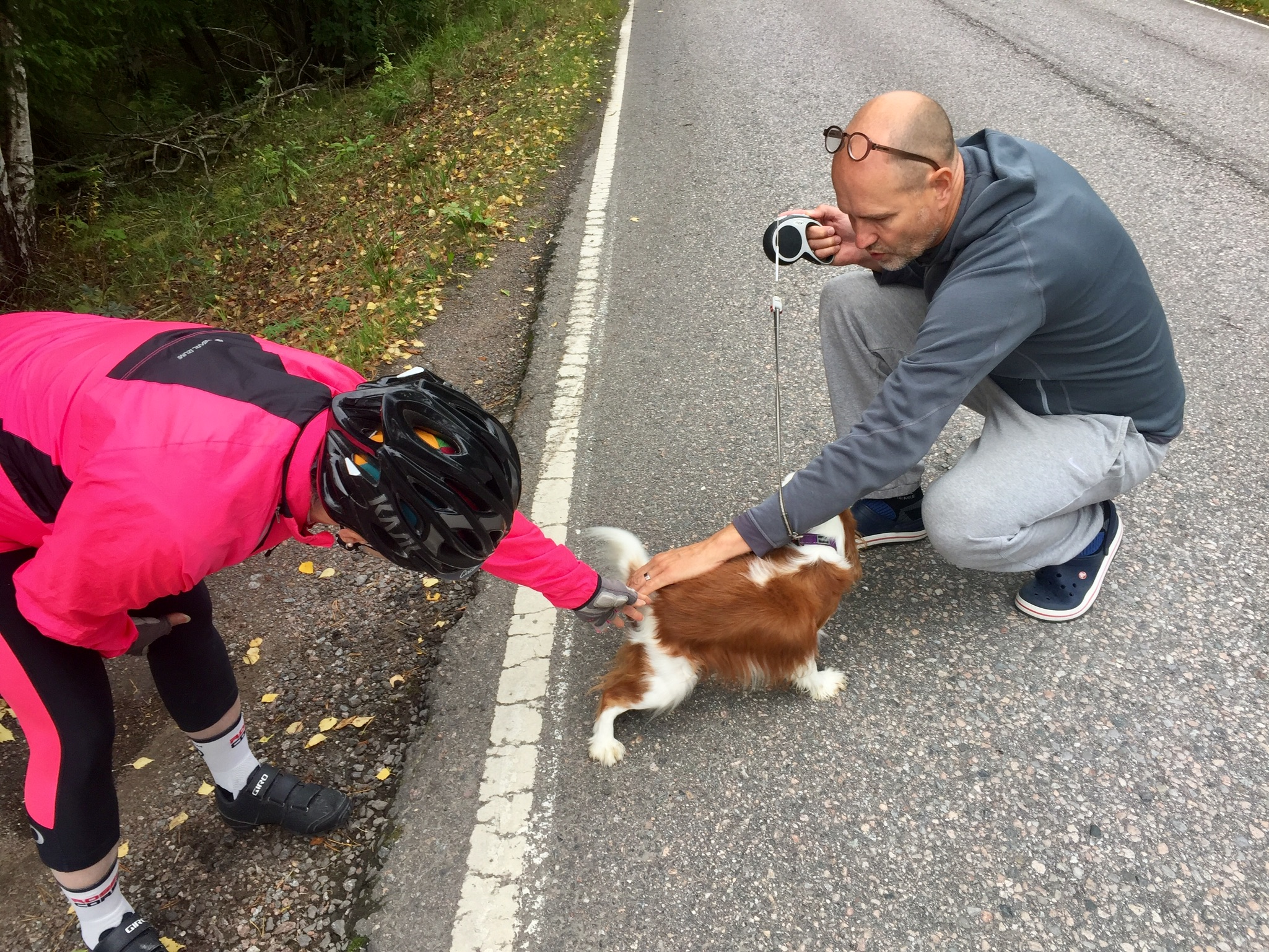
IMG_0044
There was some traffic on our route

The cafe opened and we offered to buy a round of ice-cream for our Lithuanian friends.
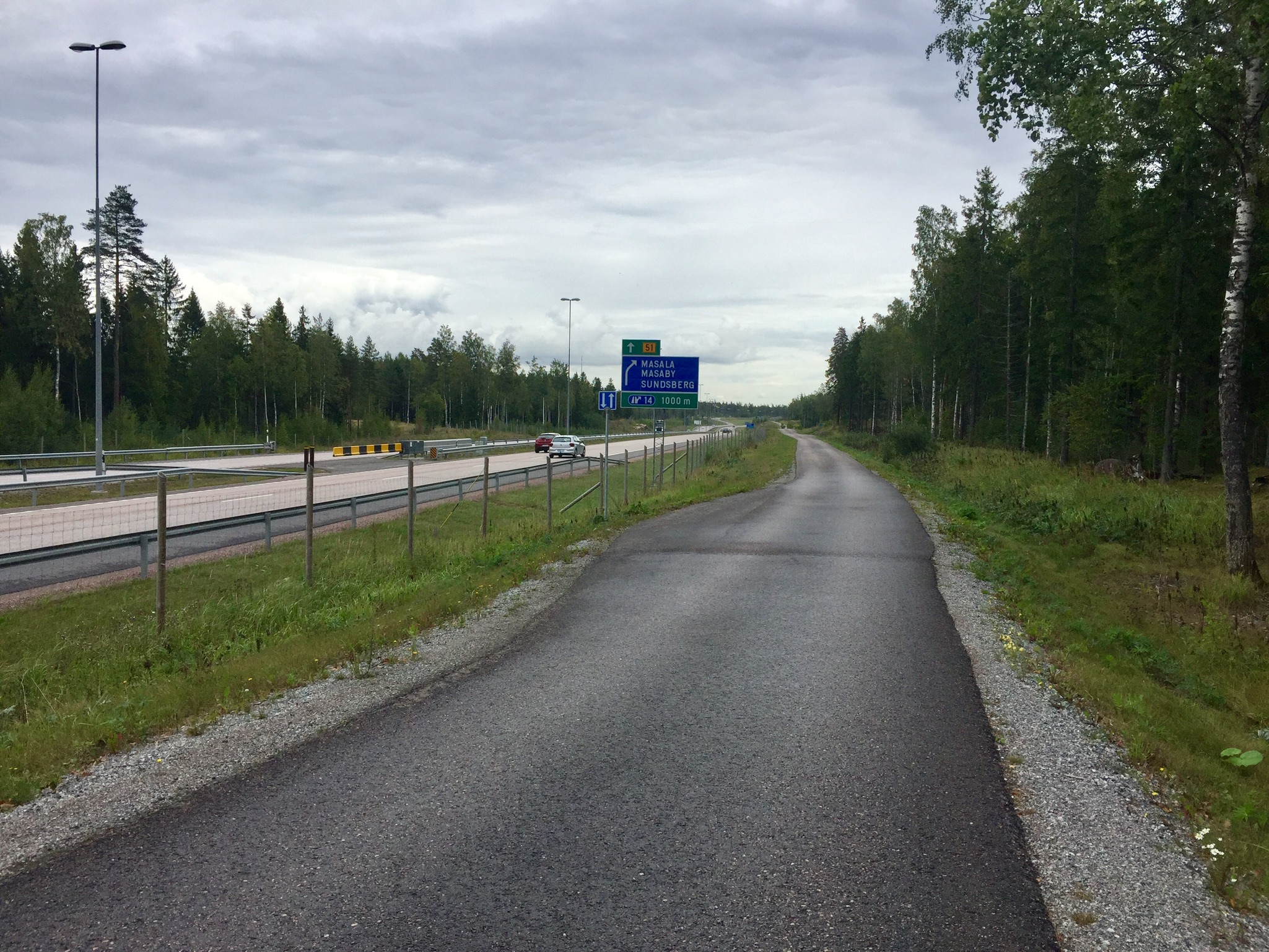
All of us went for the most unusual ice-cream bars – chocolate covered vanilla ice-cream with a licorice core with hot pepper. 

IMG_0045

You probably have to be a Finn to like them. Once in a lifetime was enough for us. The Lithuanians were of a similar mind. 

Once off the ferry, we thought it would be a straight shot to Petersen’s Boathouse, our evening destination. It would have been, if we had had a good GPS signal. 

As it was, we lost 45 minutes on a dead-end ride, one turn too soon, which took us into a forest, then onto a dirt road and finally to a loop of cabins at the end of the line.

We backtracked and eventually arrived at our destination.

Home sweet home in cabin #9 at Peterzens Boathouse below.

IMG_0048

We liked Petersen’s: nice folks, great food, sophisticated design, and antique boats. We were now in the Turku archipelago – the Finnish side. No more Swedish. 

I had been thinking of showering in the sauna, but on second thought, passed when the only signs were in Finnish for “Men’s” and “Women’s.” Which would you choose: Naiset or Miehet? No graphic clues provided.

Peterzens was more marina that B&B – a Finnish boat resort, if you will. And a nice one at that.

IMG_0047

Only an of hour by car from Turku, the oldest city in in Finland, and a tech center today, Turku’s prosperity and sophistication had reached Peterzens. 

Day 8  Tuesday August 21 Kustavi to Nauvo

The weather looked good for our ride into the heart of the Turku Archipelago.  This would be a full day of island hopping: The big islands: Iniö, Houtskär, Korppoo, and Nauvo.  Smaller islands: Jumo, Mossala, Björko.

At breakfast at Peterzens when we asked about the antique sailboats moored outside, we were told,

“They belong to the big men.” Translation: The high-end wealthy, probably from Turku. 

fullsizeoutput_3d70

Another couple were eating off by another window. Interesting match: He was older- 50ish, perhaps 145 lbs, a bit grey and grizzled, and on the short side. She was much younger- 30ish, perhaps 170 lbs, blond and vigorous, and at least a head taller. 

Clearly they got along just fine and had been together for a while. I thought to myself, 

“Way to go Finland.”

We checked out of our cabin and headed for the ferry. 

We arrived just in time. Rolled right on along with the Lithuanians, the odd couple from breakfast and a couple of Germans.

The seemingly-mismatched couple from breakfast were not Finnish after all, but another couple of Americans. 

Good folks from Brooklyn. He had been in a motorcycle accident and bicycling was therapeutic. They had taken a flier on a self-guided tour and had ended up here, in the Turku archipelago. 

Once we were rolling, we geared up. Pretty good country for tandems. We started passing the other bicyclists. One of the last was the German couple. 

We had chatted on the ferry. He had been trying to get a rise out of us by calling us “Asshole Americans,” which we found rather amusing. After a while he started calling himself an “Asshole German,” which he kind of was.

When the ferry had arrived at Mossala, he had sprinted off, leaving his girlfriend trying to catch up. First we caught her, and then eventually, we passed him. We smiled and waved. He grimaced.

Shortly thereafter we stopped for photos. He flew by. And after a bit, his better half rolled by as well. Photos below.

IMG_0056
IMG_0057
IMG_0058

We crossed paths for the last time at the next ferry. Sharon asked him if he was a doctor.

He looked incredulous, “How did you know?”

IMG_0060

“It was your use of Angioplastik.” 

Angioplasty is a fancy word for hip replacement, which Sharon unconsciously delivered in dead-on German. Score one for the Asshole Americans.

Sharon noticed that Oreos were being sold on the ferry for 1 euro each or $1.14 ±. We had been going through a misguided junk food = bicycling food thing right before this trip and it just so happened we were loaded with Oreos.

Which Sharon found most amusing.

IMG_0061

Before the trip, I had worked out our daily routes and entered them into our RideWithGPS software on our laptop, which then, thanks to some cloud-magic provided turn-by-turn directions for our Wahoo Elemnt Bolt Bike Computer monitored by Sharon. 

For the most part I just had to enter the beginning and the end of each day and our software generated the route.

Which worked pretty much flawlessly as long as we had a dependable GPS signal. We did have a wrinkle though- for some curious reason, the software was partial to gravel roads – which we were not.

On the day’s home stretch into Nagu on Nauvo Island, we were directed North off the main road. The first mile with a tailwind was great, but then we hit the gravel. 

Decision time. 

The question was whether to continue and hope for the best, or turn around and fight the headwind back to the main road. We forged ahead. 

Bad choice.

Scenery was great and there was zero traffic, but the gravel just kept on keeping on.  We rode slowly while I worried about our tires.

Our tandem is a road bike. We ride with 110 lbs of tire pressure. Not so great for gravel.  We blew out a tire in Italy after a gravel stretch. 

My mood was foul, as I waited for the blowout as we sliced ahead through the sharp rocks.

7 miles ± later we were back on pavement. We stopped for a break and looked around. Rich, slightly rolling farmland. A bit of forrest. It could have been our trial run in Vermont. I tenderly spun the tires against my riding gloves to scrape off the last of the gravel.

Perhaps all would be OK.  Which it was. But we made a vow to each other. No more gravel.

We had received a text message earlier in the day with a code for the front door of our evening destination, the Lanterna Hotel. We pulled up, entered the code and we were in.

IMG_0064

The key to our room was on the front desk as noted, and we made ourselves at home. After showers, it was off to dinner at the highly recommended L’Escale Restaurant, right around the corner. 

L’Escale restaurant
L’Escale restaurant photo, courtesy of restaurant

Dinner was great. Seafood with a French influence. The good life. The archipelago has its own black bread, svartbrod. Pretty wonderful. Not many other customers. The high season had passed. School in Finland begins mid-August. All the better for us.

We turned in early, but not before a bit more Duolingo Swedish study for Sharon. We still hadn’t seen anyone from the hotel. Mr. Tandem was happy to serve as an overflow clothesline. We had hung the rest outside on an empty clothesline, “For Hotel Use Only.” 

No harm, no foul.

IMG_0065

Day 9  Wednesday August 22 Nauvo to Kaarina

Today we would loop back up out of the archipelago into the urban suburbs of Turku. 

I am up early. So I took a walk. Nagu is a most pleasant resort town. 

Our ride in below:

IMG_0068

180 degrees from the above was another view of the L’Escale restaurant- the white building centered on the road in the distance. 

IMG_0067

I still hadn’t seen anyone from the hotel & we needed breakfast. Concern flickered.

On return, from the bustle and aromas, it was clear all was well. After a chat with the proprietress we would be in for entertainment as well. 

Breakfast on the enclosed sun porch was totally wonderful. See below. Eggs – cooked to order – not shown.

IMG_0069
IMG_0071

The decor of the hotel was a reflection of the personality of the proprietress. Scandinavian minimalism it was not.

IMG_0070

The walls were full of pictures, a kaleidoscope of genres and intent. A bit of hardcore religion here, a bit of kitsch there, and in between primordial landscapes. This woman was not blocked.

Along the way she explained that property values were up in Nagu, approaching those of Helsinki. Our Helsinki relatives rolled their eyes on hearing that one.

Back on the road it was soon clear that the remote stretches of the archipelago were behind us. Traffic picked up and the roads were sized accordingly. In a half hour or so we reached Pargas ferry – our 11th – and last of the trip. 

IMG_0075

Soon we were on bike paths, which we rode the last 15 miles or so into Kaarina. The Finns take their bike paths seriously – to their credit. Wherever possible, traffic is separated.

IMG_0077

A stretch of one path had been used for construction access. 

IMG_0076

Our bike path crossed bridges. The one below was the last of the archipelago.

IMG_0079

As we made our way into the suburbs of Turku, our path ducked under cross traffic with bike/ pedestrian underpasses. A nice touch. No broken glass in the tunnels. For that matter we didn’t find broken glass anywhere on our route. 

When we pulled up to Väliaikaisasunto, our inn/hostel for the night, we noticed what seemed to be a “Beware of Dog” sign in some language or other. Not Finnish or Swedish. Looked like Polish and was: Exact Translation: “Bad Dog and the Owner Even Worse”

fullsizeoutput_4205

And thus we were introduced to “Believe in Santa Claus”, the biggest dog I have ever met. 100 kg or 220 lbs. 

A totally nice guy too. And yes that was his full name.

Generally though he went by “Bélieve”, English, accent on first syllable.

IMG_0081

We asked about his breed, and were told “Danish Dog.” Which as best we can tell is a Broholmer, a descendant of Viking dogs, crossbred with Great Danes and English Mastiffs. 

 “Bélieve” had an artificial knee, made in Estonia. Surgery in Switzerland. He was 6 years old. The third Broholmer of the couple running the place.

We parked our tandem by Bélieve’s mattress in the carport on the other side of the fence, confident that no one was going to bother it.

Relaxing in our room, we heard Bélieve bark, though the word doesn’t do the sound justice. It was a foghorn burst, rolling out in the lowest of registers.

Väliaikaisasunto was closer to hostel than B&B. We had a private room, but the toilets were shared and downstairs. No food provided. We asked about destinations within walking distance for dinner and breakfast.

And settled on Hesburger for dinner. Hesburger is the king of fast food Finland with all the expected variations of burgers and fries. Founded in 1966 in Turku, there are now over 260 restaurants in 60 towns across Finland. 

The appealing Finnish twist for us were the Turkish-Mexican options.

We both ordered the Kebab Tortilla. A tortilla wrapped around kebab meat, iceberg lettuce, tomatoes, jalapeños and paprika mayonnaise. We found a table where we happily munched away, entertained by the drive-though on one side and indoor kiddie play area on the other. 

Back at Väliaikaisasunto we climbed the stairs to our room. We nodded greetings to the smiling guy in the hall, still dripping from the sauna, wearing nothing but a towel. Fell asleep to the wind in trees and the traffic noise from the divided highway down the hill.

Day 10  Thursday August 23 Kaarina to Matilda

We stopped for breakfast at Naantalin Aurinkoinen Oy on our way out of town. Bélieve’s Dad had told us, “Best Breakfast in Kaarina.” It was far from fancy, but pretty great.

IMG_0084

Pastries to die for. Avocado and feta lettuce and tomato on toasted focaccia. Best focaccia we have ever had. When we told the cute young platinum blond at the register we were headed for Mathildedal, she blinked unknowingly. Clearly a Turku local. 

We followed the bicycle paths out of town, but soon they dribbled out. We rode on the highway for a while, but soon we were faced with a decision. Stay on the main highway or take the longer secondary route?

It was an easy choice, our nice wide shoulder had disappeared and the traffic had picked up. And our bike computer sided with the longer more scenic route. We gave in and turned north towards the town of Paimio. 

Traffic into Paimio was on the heavy side, but we had a shoulder. We worked our way through the Paimio bike paths and headed south and east. After a couple of turns, the traffic was gone and the landscape opened up into rolling farmland. It was mid morning. Clouds threatened, but that was all. 

IMG_0085

We saw more tractors than cars on this stretch. We rode by a remarkable log house, and then looped back for a closer look. Check out the hay bale on the front corner.

IMG_0086

Not a soul was around. We found out later that it dated from the 18th century and perhaps had been a hunting lodge for Swedish royalty when they were in the mood for roughing it. The door couldn’t have been more than 4 foot 6 inches tall. 

My Finnish grandmother Tyyne might have had to duck. But not much.

Soon we were in the town of Salo, and turned south into a headwind. Threatening, but no rain yet. 

Mid Afternoon we pulled into Mathildedal, having outrun the wet weather. 

IMG_0091

Our inn for the night, was Sypressi, an 1840s log house in the middle of Mathildedal perhaps 100 feet from the sign above. Right off Sharon was fast friends with Mr. Dog. He wasn’t so sure about me.  

IMG_0094

We were staying in the Matilda Room. Our granddaughter’s name is Matilda so it was pretty much perfect. 

IMG_0092

This place was the real historic deal, with log walls inside.

IMG_0093

Our friends at hotel F6 in Helsinki had quipped, “All the hipsters are in Matilda,” which seemed to us, an odd comment to make about a small town in rural Finland, pretty much in the middle of nowhere.

We were curious.

We know from hipsters. Our son and his family live in Williamsburg, Brooklyn NY. Ground zero for hipsters in the USA. Walk down the street in Williamsburg and get a preview of what will be media-celebrated, as the latest fashion trends, 6 months hence.

Back home in Massachusetts, we play a game, walking through Harvard Square – “Guess who’s from Williamsburg.” Lots of pretenders. Few keep pace.

We wandered over to Kyläravintola Terho, the eatery next door. Terho bills itself as Mathildedal’s living room. Local craft brews, food, live music and so forth. 

Terho photo below is from Cosmopolitan Magazine.

OLYMPUS DIGITAL CAMERA

I was most pleased to discover that they served flights of local craft beer. 

IMG_0097

We settled back into our pillows and struck up a conversation with the most pleasant, most stylish, late 20s-ish blonde at the next table. She was a local, kind-of.  

Owned a house in Mathildedal. She was “living with renovation”. Telecommuting now to Helsinki. She worked in advertising copy. We laughed about the complexities of the Finnish language. She said that even as a professional and a native speaker, she wasn’t sure sometimes, that she had it right.

Truth-be-told, she and her fashionable little dog were more Cosmo Magazine than Williamsburg hipster. Other young folk filtered in and out. One young guy had the eye of the girl behind the bar. 

He had come in with a very large, very clean, very expensive backpack, and had settled in on the other side of the room. I had no doubt that his body fat percentage was very low. He looked a bit like a model from a catalog. 

Mathildedal is surrounded by a national forrest, so that fit. But something was off.

Then it hit me, his leather boots were waxed just so, but there was no mud, no scuffs. His haircut fashionable. His clothes more distressed than worn out, and on the tight side.

He was a bit more self-aware of his appearance than the run-of-the-mill trail junky.

Bingo. Mathildedal Hipster.

We wandered down the hill towards our recommended restaurant Ruukkifest Oy, overlooking the marina on this, the southwestern, edge of the archipelago.

Almost there, Sharon spotted the alpacas so we had to head over for a closer look.

fullsizeoutput_40a3

A couple of things to note in the above photo. This alpaca had just been sheared and that’s me in the red bicycle jacket up the hill. I’m averting my eyes because I knew Sharon would not be deterred. She was going to pet this guy, no matter what the signs said. 

I didn’t want to be watching when her fingers were nipped off.

No fingers were lost and the wool was said to be wonderfully soft.

At Ruukkifest Oy, we had the best seat in the house. No one else was there. Our waiter was a mild-mannered, pleasant guy. One of those folks who had walked to the end of the plank. And jumped. Landed on his feet here in Mathildedal.

We struck up a conversation. Driving into work, he had passed us, on our way into Mathildedal. Once we said “Tandem”, he knew it had been us. Not too many on these roads.

From the Netherlands, he had fallen in love with a Finnish woman. She didn’t want to move, because she felt that the Dutch language would be too hard to learn. It was those “H” sounds. 

So here he was in Finland, struggling to learn Finnish, at least an order of magnitude more difficult. So how difficult is Finnish? 

Not so bad if you speak Mongolian. If not, well, Buena Suerte. Good Luck.

Finnish has no connection to Latin or Germanic language groups. The graphic below sums it up pretty well. 

dragon-9gag.com (1)

Lohi is salmon. Käärme is snake. So a dragon is salmon snake. Simple. ¿No?.

Not only are words unrecognizable, but Finnish has 15 grammatical cases and the smallest change in the end of the word can change its meaning.

Back at our inn, we turned in early. Terho next door was pumping out Cat Power’s “Greatest” CD onto their back patio, which was pretty much under our window. Chan Marshall was a NYC hipster, 10 years ago.

Still a favorite of mine. Some folks used to go to her concerts just to see if she would break down, which she did on a regular basis. 

Thankfully, soon it was quiet. Small-town-Finland quiet, and I was gone.

Next: Hanko & the Kings Road [add new link. This one is old]