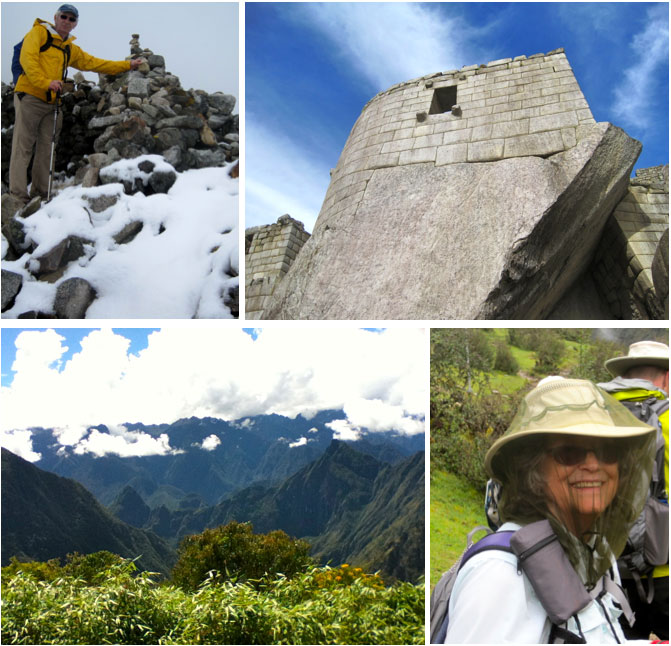
This was Indiana Jone’s country.
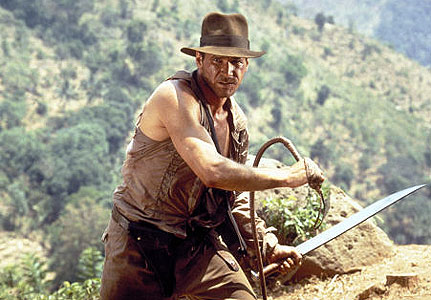
I suppose it shouldn’t have been a surprise.
After all, the character of Indiana Jones was based on Hiram Bingham, the so-called discoverer of Machu Picchu.
The Salkantay Pass at 15,213 ft. was above tree line- as expected.
As we came down the backside, there were stunted gnarled trees- as expected, then in short order we hit the “Ceja de la Selva,” or “Eyebrow of the Jungle.”
Cloudforest.
This was a surprise. At least to me.
Palm trees and orchids at 9000+ feet. Complete with flocks of parakeets.
And lots of mud.
Vital Statistics
At our pre-trek meeting, our lead-guide Antonio announced that the trek proper would be 49 miles from Marcoccasa to Machu Picchu.
Sharon turned to me,
“How come it keeps getting longer?”
She had a point.
I’d been telling her it would be 39 miles.
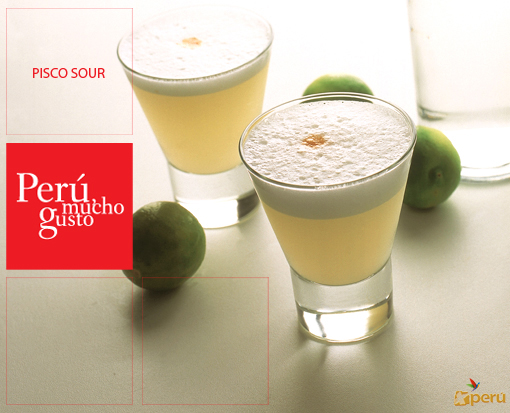
I mumbled and changed the subject to Pisco Sours, the national drink of Peru.
“Tasty ¿No?”
We started our trek at Marcoccasa, 11,979 ft.
The highest point was Salkantay Pass at 15,213 ft.
The ending (trek) elevation was the Llactapata Pass train station at 5809 ft.
Total cumulative ascent: 7724 ft.
Total cumulative descent: 12,428 ft.
Total distance: somewhere between 39 miles and 49 miles.
3 wheeled Asian Taxis, Mummy Hotels, and Targeted Arson
The van picked us up in Cuzco at 7:00 in the morning. We had three stops before our trailhead at Marcoccasa.
First up was the town of Limatambo, 1.5 hours from Cuzco. We got a bit of local flavor in the town market, but what sticks are the Asian taxis.
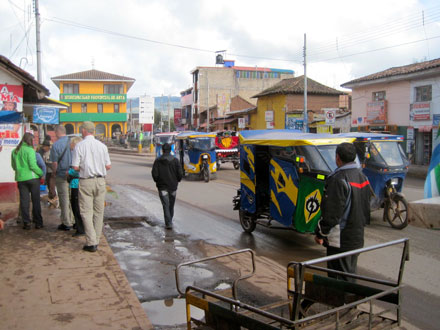
In a very 21st century twist, the town was swarming with 3 wheeled Asian taxis.
Complete with Asian graphics.
Fuel efficient, and priced right, these vehicles are the perfect fit for semi-rural Peru.
The dragon graphics seemed a bit out of place, but apparently that’s the way they come.
Our second stop were the Inca ruins of Tarawasi.
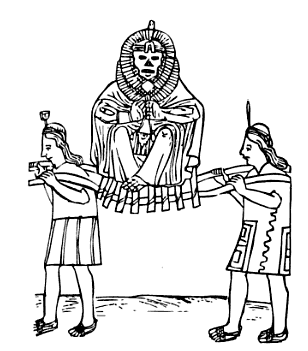
From reading our guidebook I understood that the Inca worshipped their ancestors and that the Inca royalty were special.
Mummy special.
Inca emperors were mummified. And as such, they lived on. Quite literally.
They continued to live in their palaces, and were treated as if they were still alive.
Complete with trips to the country.
When they stopped for the night, they needed somewhere to stay.
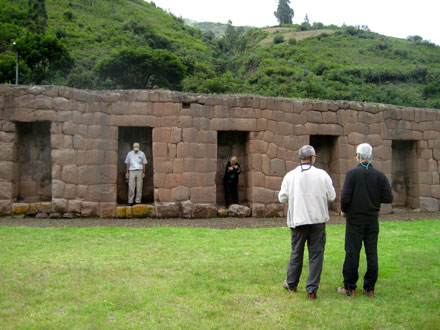
Tarawasi was such a place. A mummy hotel, if you will.
Lingering at Tarawasi, I got it emotionally.
It’s one thing to read a guidebook and quite another to stand in the niches where the mummies stood. And to look out onto the valley where they looked with their metallic golden eyes.
Our third stop before our trailhead was the mountain village of Mollepata. Mollepata is far, far off the beaten track. A town supported by farmers and (trek) mule drivers.
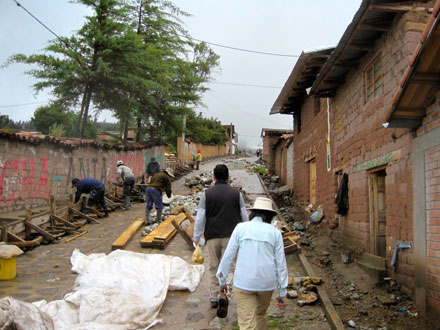
As we were walking back up to our van, I asked Whilder, our assistant guide, where the money came from, for the work on this side road.
It was pork.
There was an election coming up.
I asked about the trail fees which purportedly might be collected in Mollepata.
“You don’t have to worry about those, they burned the building down.”
The mayor had set himself up as the trail fee collector. The fees went directly into his back pocket. Nothing shared with the locals who did the trail maintenance.
The final straw could have been predicted.
Folks using the trail, simply skipped Mollepata and hence the fees.
Since tourism brought in much needed dollars, this was not viewed favorably.
The locals voted.
They burned the mayor’s tollhouse down.
And it has stayed burned down.
Targeted arson. With intent.
Apparently, message received.
Acclimatization, Lux Lodges and Shamen
Our trek began at a place called Marcoccasa at 11,979 feet above sea level.

This first day’s acclimatization hike took about 5 hours. I felt pretty good.
I’d chat with fellow trekkers, drop back to look for birds, then speed up to catch the main group, and so forth.
It was only in the last stretch that I started to feel not-so-great.
When we got to Salkantay Lodge at 12,690 ft, I had a serious case of the blahs. Sitting in our room, I felt vaguely hungover. I dozed off, propped up against the headboard of the bed.
I woke at dinnertime.
Sharon (competently) pointed out that I should tell our guides that I didn’t feel right.
I thought to myself, “Bah Humbug,” but did pull Antonio aside before dinner.
He clipped this little gizmo on my finger.
“No wonder you don’t feel right, your oxygen level is only 86%. Normal starts at 87.
Do you want some oxygen?”
“Nah.”
My big regret on this trip was not saying, “Yes.”
And hence setting up a wonderful photo-op.
After dinner, I was feeling better. My oxygen level of 89% confirmed my inner world.
The op opportunity had passed.

The lodge though, looked even better. “Lodge” doesn’t do the place justice. Upscale eco-hotel is more like it.
Our bathroom said it all. Glass shower enclosure with a rain-shower. The towels were warmed on their own warming rack. All fixtures were high-end European.

A tip-of-the-hat to the folks who designed this place. They managed to combine minimalist European with comfortable Eco-Lodge.
No small feat. And it was done in the local vernacular complete with a thatched roof and native stone.
The art on the walls was museum quality.
Selections from the owner’s private collection. What I thought, at first glance, was a print, turned out to be an authentic antique Incan condor-feathered headdress, hanging over the bar.
Better than most anything we had seen in Cuzco museums.
I awoke the next day early at 5:30 AM. I wandered the hotel alone. Yep, nice place.
This day was another acclimatization hike, a round tripper to a glacial lake a couple of miles above the hotel. Anyone who wished to, would get a chance to “swim,” and there would be a couple of shamen to do a blessing ceremony.
At breakfast I told Antonio that we had ashes of our most favorite cat with us. “It would be great, If these could be included in the ceremony.”
Antonio shrugged and suggested that on today’s hike,
“Don’t talk so much, and keep an even pace. You’ll feel a lot better.”
Points well taken.
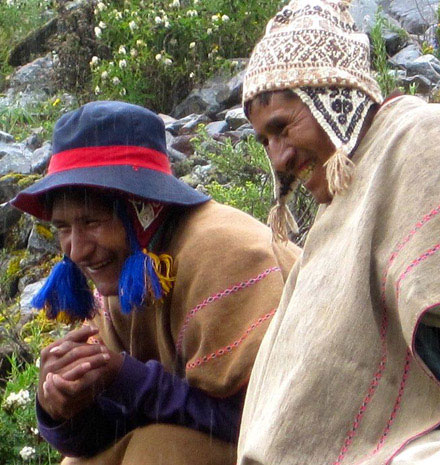
At about the 3/4 mark, we passed the shamans. A couple of remarkably cheerful-looking guys sitting by the side of the trail in the drizzling rain.
Lucio is the older on the right.
Sebastian, with the blue hat, is his student.
Interesting folks.
I had been quiet and deliberate in my hiking, and felt OK- all things considered.
Humantay Lake is 13,845 feet above sea level. Turquoise from the glacial melt. The glaciers didn’t quite reach the lake, but they were close. Mount Humantay , at nearly 20,000 feet loomed above, more felt than seen. Low cloud ceiling.

Our guide announced half-in-jest,
“Anyone up for a swim?”
Three of us took the plunge. As Sharon put it later,
“None of you guys are exactly Greek Gods.”
Yep.
And never will be.
And that water was cold!
I had neglected to bring a towel. Regret #2 of the trip.
The rain had picked up, and the shamans had set up their blessing ceremony under a tarp.

I was a bit surprised when Antonio asked me for YB’s ashes. Just in case, I had them in the bottom of my pack in a ziplock bag.
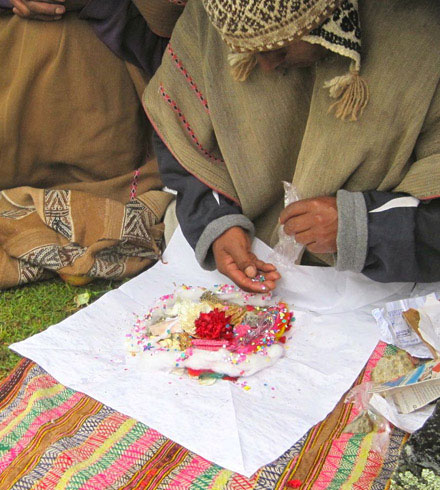
As it turned out, YB’s ashes anchored the offering, surrounded by white and red carnation petals.
We stood or sat in the drizzling rain as the shaman added layer upon layer to the offering.
A falcon flew by.
Pieces of the glacier peeled off and fell. The sun came out, disappeared and came out again. Over and over.
Lucio chanted continuously in Quechua as he built the offering.
I felt this heat on top of my head.
I was thinking about all this, as I slowly made my way back down the mountain.
Who should stroll up, but Lucio and Sebastian.
I was the last of our group along with our assistant trilingual guide Whilder, who spoke English, Spanish and Quechua.
I asked Lucio, through Whilder, about the sensation of heat on the top of my head.
“That was the blessing of the Apus [mountain gods].”
The falcon?
“A messenger of the middle world.”
Glacier avalanches?
Apus again.
I told Lucio about a recurring dream, where I am walking between very high, ancient mountain cliffs, with no one around. High on the cliffs I can see caves, which had been occupied centuries, or eons, before. I sense that the spirits [or people] are still there.”
Lucio answered with a noncommittal,
“That’s a good dream.”
I’m thinking, this place is just like that.
The blessing ceremony at the lake was supposed to end there with the burning of the offering. For better or worse, the day was too wet. Lucio and Sebastian, brought the offering back to the lodge.
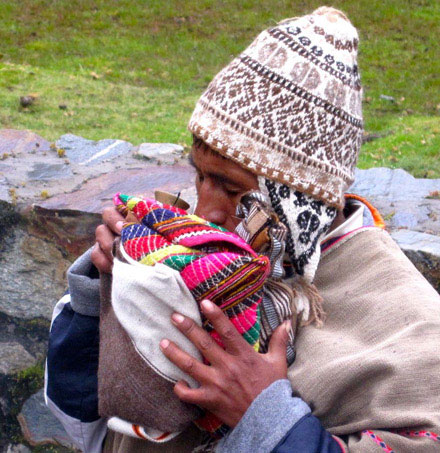
The lodge had an outside fire pit, where a suitable fire could be started.
An hour or so later the fire roared, Lucio gestured for all of us to leave, before he placed the offering on the fire.
That’s the way such offerings are done.
No waving goodbye allowed.
An hour later Sharon and I were sitting once again with Sebastian, Lucio and Whilder, in an alcove at the back of the hotel for a private coca leaf reading.
Lucio would ask us a question in Quecha. Sebastian would translate it into Spanish. Whilder would translate into English. Sometimes we never got to the English. Sharon was the focus, and her Spanish is, well, pretty good.
Sometimes Lucio would ask Sharon to blow on the coca leaves. Sometimes he’d blow on them himself, as he chanted. Then he’d flip the leaves quickly.
Flip. Flip. Flip. Ah.
Flip. Ah. Flip. Flip.
The “Ah’s” would come when the leaves would do something unusual. Point in a particular direction or land juxtaposed to the pattern up, or land upside down.
Then there’d be another round of questions.
And so forth.
Lucio was both perceptive and sensitive, as were the coca leaves. A lot of ground was covered.
I learned a lot about everyone at the table, including myself. The key seems to be synchronicity. Really easy when the synch is there. A mighty struggle when it isn’t.
The essence of any magical, spiritual, or artistic endeavor.
Afterwards we asked Whilder about Lucio and Sebastian.
They come from a particular high mountain area renowned for Shamans. The area was only opened up in the 1950s.
A Peruvian Inca twist on “Lost Horizons” or “Shangri-La.” An isolated area where centuries’ old spiritual traditions have lived on into the modern world.
We asked Whilder about Peruvian Shamanism.
There are three levels. Lucio was a middle level Shaman.
Sebastian, as his apprentice, was the lowest level.
The highest level Shaman have to have survived a lightning strike. Obviously there is a lot more to it than simply that, but living through the strike is the acid test.
A group of these heavyweights were going to get together in the area in the not-too-distant future, to do a blessing ceremony for the modern world.
Guests not invited.
After dinner, Sharon and I called it an early night. Tomorrow would be our big day.
Over Salkantay Pass
Our start was early, as our group hoped to make it over the pass before the bad weather arrived.
We had a climb of almost 2500 feet, over 5 miles, to reach Salkantay Pass at at 15,213 ft. In good weather it usually takes 3.5 hours.
The weather was still good-ish. A touch of blue sky, through mists and layers of clouds.
I was feeling pretty good. Time to celebrate my 61st birthday with a hike.
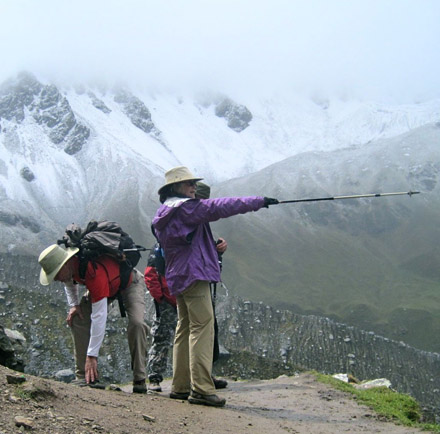
As we headed off, I repeated to myself,
“Keep it steady and and don’t blabber.”
We headed up the valley. The climb was steady.
The cloud ceiling cut off the looming peaks, but we could feel they were there.
After a couple of hours, we turned left, up and out of the valley. This was the steep stuff.

With the switchbacks though, it was manageable.
We headed up.
After maybe a half mile or the sun broke through.
We had a rainbow, as we looked back down.
Check out the little blue dots just above the rainbow. Those are horses with blue packs. The winding path they’re next to is the trail we came up. The white ribbon in the upper left is the white water of the roaring stream we followed up the valley.
A tributary of the Amazon.
The larger orange dots at the bottom left are pack covers on horses. The inverted “V” at the lower right is a turn of the switchback directly below.
Our group had two groups of horses. The pack horses which carried everyone’s stuff lodge-to-lodge, and two horses which accompanied our group. The latter carried water, snacks and emergency equipment.
These horses doubled as emergency transportation. Should anyone get into trouble, they could ride.

Sharon and I had brought apples from Cuzco for our accompanying horses.
No go.
Our guides explained that these local horses don’t know what apples are.
We asked the horses’ names.
“Well the first one is 911.”
And the second?
“Well he’s [pause]… 912”
Laughs all around.

Once out of the valley, with the switchbacks behind us, and maybe 4 hours into the day, we took an official scheduled break.
Antonio offered us some Peruvian jerky.
Tough stuff.
Sharon above trying to try a piece of Peruvian jerky.
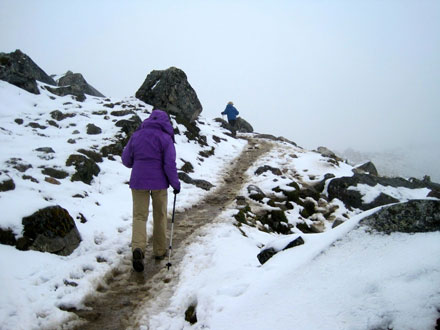
This was the last of the blue sky for the day.
We were only 45 minutes from the pass.
But in those 45 minutes, the weather closed in.
It was snow, slush, and mud.
Visibility, not much.
No matter. In short order we were at the pass.

Sharon and I had picked up pieces of quartz back down the mountain.
We placed them on the cairns at the pass. We posed for pictures.
In a most-sweet gesture, the group broke into a rousing round of “Happy Birthday to You”
And so I turned 61 at 15,253′.
So far so good, but we still had a 4 mile, 2400 foot descent ahead.
The wet weather arrived in earnest. Sharon and I pulled out our new rain pants and water-proof pack covers, and headed down. Visibility was a couple of hundred feet. The trail quickly turned into a stream.
So much for dry shoes.
We arrived at Wayra Lodge soaked from head to toe, but in good spirits.
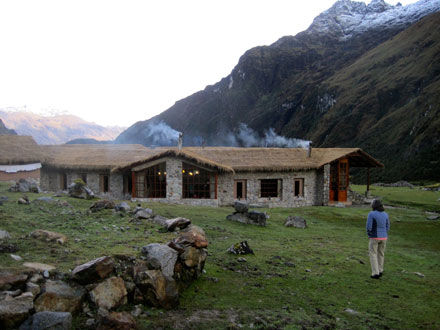
We really liked Wayra Lodge.
Modest and just about as far off the beaten track as they come.
Comfortable, a bit rustic, with lots of local flavor.
Wonderful wind-swept site,12,812 feet above sea level.
Ahead the valley drops away. On one side, cliffs down to another churning steroid-fed stream.
The uphill, takes no prisoners.

We could appreciate the real drama, the next morning, when the clouds and rain lifted.
Back from where we’d come, Mount Humantay appeared.
Or should I say, Mount Tucarhuay?
The real Humantay, at least according to the the Carta Nacional published by the Instituto Geografico Nacional, is on the other side of the valley.
Our lead guide rationalized that locals call Turcarhuay, “Humantay,” and that’s why Mountain Lodges of Peru does.
My theory is that, Mountain Lodges of Peru goofed early on, and now there’s no looking back.
Just like rocks added to a cairn, one internet reference reinforces another. One reality becomes another. And one mountain’s name becomes another.
With no roads, it took more than 6,000 mule trips to build Wayra Lodge, and I would guess also a helicopter drop or three.
To their credit, Mountain Lodges of Peru hires locally.
Which in this neighborhood, means the staff wakes every morning far far off the grid, hikes down to the lodge, pulls on their uniforms, and transitions into a multi-lingual international world complete with satellite internet.
Incan 15th century meets 21st century.
Cloudforests, Plasticized Chickens and Papas
Generally speaking, Peru has two seasons, wet and dry.
We were right between the two. I had hoped for dry-ish, but we got wet-ish, all the way down the 3400 feet and 6 miles to the next lodge.
No rain, but mud.
Our guide suggested that we all wear our rain pants. Not for rain, but for the mud. Knee-deep + and such. He also suggested insect repellant.

There’s insect repellant and then there’s insect repellant. We were prepared with 100% DEET, Jungle Juice.
Hardcore stuff for avoiding hardcore jungle diseases.
We could have gone organic, but one picks one’s battles.
We bought our Jungle Juice at our local REI in Boston. A petite, bubbly, 20-year-old coed walked us through our choices. She had recently spent several months in the Costa Rican jungles.

“Hey Malaria’s no big deal. Hey, my Costa Rican boyfriend has had malaria a couple of times. Those vaccines cost money. Malaria is no big deal.”
After her pep talk, we reached for the strongest stuff.
Purportedly 100% DEET can melt rain gear, but we had no such problems.
Sharon also had her mosquito netting.
As the day went, bugs were not the problem.

It was the mud.
With clever footwork, we avoided the worst.
The third guy, with the yellow towel is a dentist.
This dentist had run with bulls in Pamplona three times. The last time, the guy next to him had been gored and trampled.
He didn’t think he’d run Pamplona again.
He had lots of other life-endangering stories. The time his oxygen ran out on a deep sea scuba dive was one of his favorites. When he surfaced, his support boat couldn’t find him.
“I could have been left out there forever!”
Big smile.
I’m not sure what it is about dentists, and those in the tooth business. My last hygienist was into guns. Nice woman and ever so sensitive. But guns did it for her.
The transition from alpine to jungle was remarkable, mud and all.
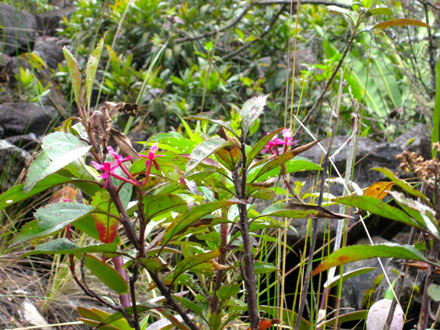
Palm trees and orchids at 9000 feet.
Flocks of parakeets too.
We stopped for a break at a local’s place.
They had set up covered, open, thatched outdoor rest-areas next to the trail.
We sat and munched on our food and fed the chickens, who knew this game.

For dumb birds they played us well.
We asked about their plastic decorations.
“It’s to confuse the hawks.”
I’m not surprised that those 15th century hawlks found these 21st century plastic-enhanced chickens a bit disconcerting.
All styled up, with a Japanese, Manga-like flair, I found them a bit disconcerting too.
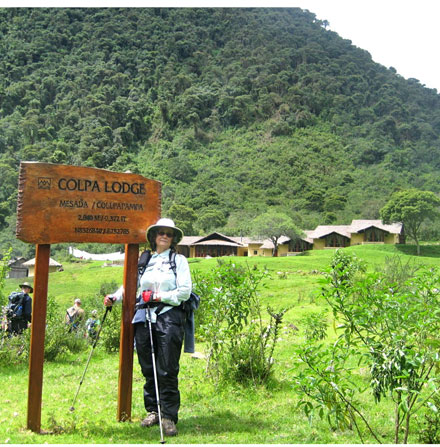
Mid-afternoon we trudged up to Colpa Lodge.
Another great site, this time at the confluence of three rivers.
And no, Sharon hasn’t gained 50 lbs.
She just has her rain pants on.
We had about an hour to clean up before the Pachamanca. I knew this was coming and was psyched.
A Pachamanca is a traditional festive Peruvian meal cooked by layering meat and vegetables with hot stones, and then covering the whole thing up with soil and leaving it to bake.
Kind of like a Hawaiian Kalua or New England Clam Bake, but in this case, traditionally Incan, including Incan staples such as guinea pig, alpaca, and a great variety of papas, or potatoes.
Genetic testing has provided proof of a single origin for potatoes: in southern Peru, and extreme northwestern Bolivia.
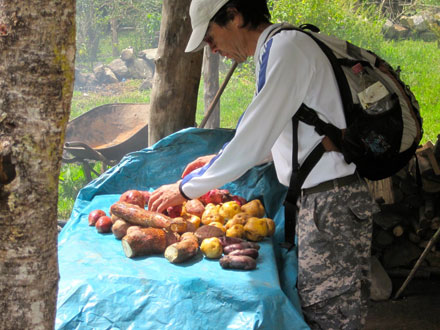
Following the Spanish conquest of the Incas, in the second half of the 16th century, the Spanish introduced the potato to Europe.
The rest is history.
Our Pachamanca was going to be close to ground zero for papas.
Can you guess the world’s largest potato-producing country today?
Yep, China.
Maple Sugar, Hardhats, and Landslides
Before our trip, we thought about what to bring for gifts. We settled on maple sugar candies. Tasty and unusual from a Peruvian perspective.
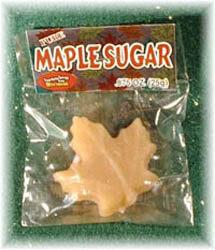
Online, I found a farm in Wisconsin, Maple Hollow, that made their own, in the shape of maple leaves, and ordered a trip-to-Peru’s-worth.
At the 11th hour I started to feel guilty. I had stumbled onto a section in our guidebook, where it was suggested not to bring sweets as gifts, as the locals didn’t have easy access to dental care.
In my mind’s eye, I pictured folks with rotten yellow teeth.
I need not have worried. Virtually every local seemed to have sparkling brilliant-white teeth.
A diet heavy in coca will do that.
The active alkaloids in coca maintain incredibly white teeth. The same oxidization that is responsible for overcoming high-altitude sickness also keeps the teeth pearly white and healthy.
“The coca leaf contains more proteins (19.9 per cent) than meat (19.4 per cent) and far more calcium (2,191 per cent) than condensed milk, and that it is richer in vitamin B-1 (276 per cent) than fresh carrots.“
The next day as we headed out from Colpa Lodge, Sharon passed out yet another round of pure maple sugar candies to this staff group.
Sharon explained, in Spanish, that these sweets were made from the sap of a tree in North America with no added anything.
Our token maple sugar gifts were well received, as they were throughout our trip. I could see the curiosity and real interest in the sideways glances. As if to say,
“Hmmm. North American candies made from tree sap. Strange idea. Looks harmless. What do you think?”
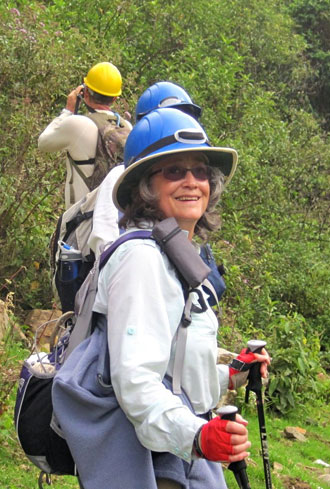
The next day we headed off for Lucma Lodge. Back down to the river. Across, up and then down the Santa Teresa river valley, through more populated rural areas.
We were told we would have to negotiate bits of missing trail.
Hardhats would be required.
Felt a bit goofy.
Then again I thought, better safe than sorry.
We soon hit the missing section of trail, which explained everything.
The trail was simply gone.
Rocks on the trail preceding, pointed to the landslide danger above.

The vertiginous drop to the river, told the story of almost certain death 500+ feet below.
We picked our way up and around.
The photo to the left doesn’t quite show our 6 inch wide trail.
We passed across just below the dark section at the top left of the photo above.
I remember thinking,
“Don’t slip”
We didn’t. And no one did.
Good thing.
From here on, we walked mostly on dirt roads. Landslides had made the regular trail on the other side of the river impassable.
Landslides had come down on our dirt road as well. Crews were out clearing the debris. As we picked our way between workers over a good sized pile, one guy turned to another and said in Spanish,
“Well here comes Granny.”
Without missing a beat, Sharon added in Spanish,
“Well, I am 64”
Froze him in his tracks.
At one point I had asked Antonio, what Spanish accent Sharon had. Was it Mexican, Caribbean, European, or something else? He turned, looked me in the eye,
“She doesn’t have an accent.”
So I guess Sharon’s Spanish can flex Peruvian, just like her English can flex Southern, when the occasion warrants.
Antonio had warned us that our shuttle van might not be able to meet us as planned. Another couple of washouts.
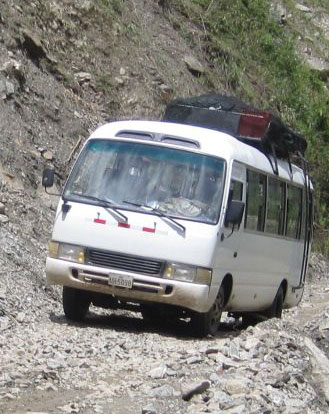
The shuttle did show up as scheduled, but the road was a bit narrower and pitched to the side a bit than usual, in some sections.
Once again there was a long, long steep slope to a churning river.
In the worst spots, we got out and walked. The driver, then did his thing.
I could never decide whether this drill was because:
If the van was to be lost, better to only lose one local than than a dozen tourists? Or,
The driver wanted to keep the shuttle light with no shifting weight? Or,
Simply not scare bejesus out of everyone?
Maybe a bit of all three.
The shuttle saved us 4 miles of hiking. Nice to ride, even with a bit of adventure. Big difference between a 10 mile day and a 14 mile day.
The shuttle dropped us off a mile from Lucma Lodge.

A pleasant 1 mile uphill stretch on the newly-restored Llactapata Inca Trail.
This was the homestretch to Machu Picchu.
The Inca Kings used this trail.
Alive and mummified.
I liked the stonework.
Even if it was more or less reconstructed, which I suspect.

Lucma Lodge, at 7003 feet, was another gem, set in an avocado orchard.
This was banana and coffee country.
Looking kind-of jungle.
¿No?
We cleaned up and headed about 5 minutes back down the trail to visit a local coffee grower.
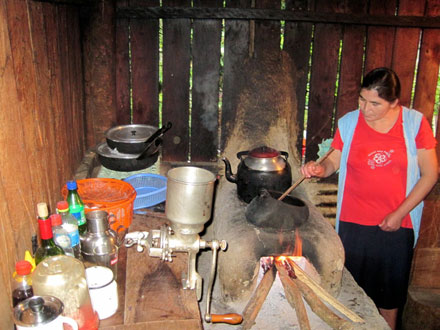
We watched as the Mrs. roasted fresh coffee beans over an open fire.
Our guide ground the roasted beans by hand.
Next the Mrs. brewed up a pot of about-as-fresh-as you-can-imagine organic coffee.
Yep it was great. One of the best cups I’ve ever experienced. Right up there with the Turkish coffee served at breakfast at the American Colony Hotel in Jerusalem.
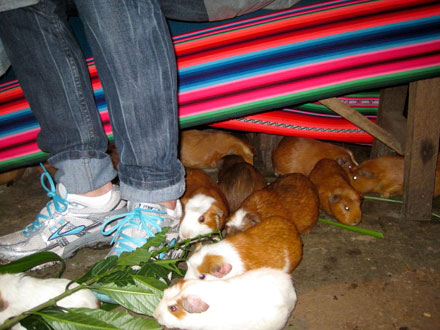
This event took place in a small one room shack.
The original home, not long ago.
Underfoot, on the dirt floor, were dozens of guinea pigs, or cuy as they are called in Peru.
Cuy were first domesticated about 5000 years ago in the Andean region of South America.
These parts.
Roasted coffee beans were for sale. We brought home our share, as did most. We asked our guide and it turns out that our take-home beans, came through the local Co-op, a far more efficient operation.
As we headed back to Lucma Lodge, we noticed a satellite TV dish on a house next to the shack. Our Mrs’ home today.
Somehow I suspect their cuy live only in the performance-dedicated shack with the dirt floor, but I could be wrong.
Llactapata Ruins, Bamboo Forests and Aguas Calientes
I knew from the altitudes, distances and times quoted in our trek literature that our last day was going to be tough.
First we had an almost 2000 ft climb over 3 miles, followed by an almost 3200 ft descent over 4 miles, which in reality, as we were to learn, was more like a 3200 ft descent over about 2 miles followed by a 2 mile level walk to the train station.
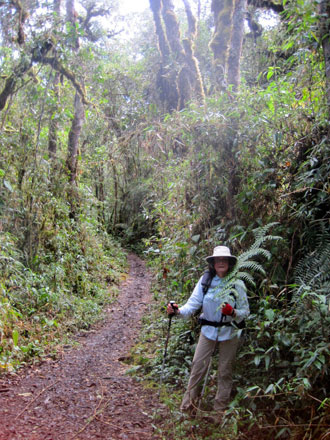
My misgivings were reinforced by our guides’ curious silence about the day ahead.
The climb went well enough. In 2-3 hours we were at Llactapata Pass, at 8974 feet.
This was a jungle pass.
What you can’t see in the photo to the right is that Sharon’s glasses are completely fogged up.
Yep, jungle at 8974 feet above sea level.
Pretty quick, we hit the view point I had been waiting for.
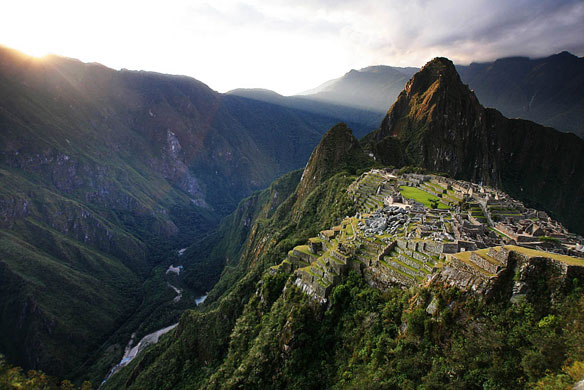
Our first glimpse of Machu Picchu from the backside.
I was prepared to be underwhelmed.
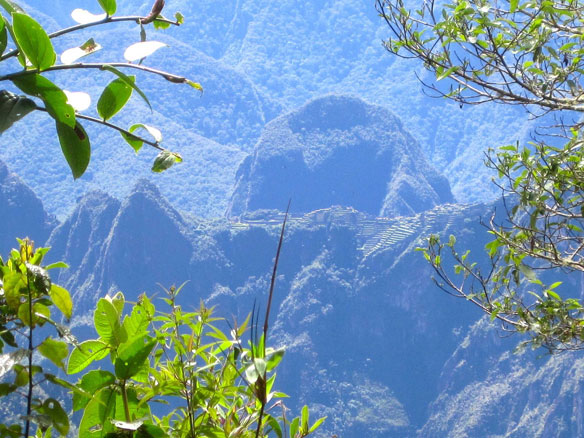
I wasn’t.
Next up were the Llactapata ruins.

“One of the most attractive ruins around Machu Picchu is Llactapata, a delicate Inca site hidden high in the cloud forest with the charm of having a superb view, the best, of the Sacred Citadel [Machu Picchu].
Early in the morning you can watch, as the Incas themselves certainly did, the clouds clear as the sun’s rays hit first one, then other parts of the citadel.
Llactapata is 200 ms [656 ft] higher than the main plaza at Machu Picchu and three clean and clear kilometers [1.86 miles] away over the deep canyon [3000± feet] of the Aobamba [Urubamba River].
From Llactapata you can see the tiny, bright jackets of tourists as they wander among the walls and ancient terraces of the citadel. Three formidable 6,000m [20,000 ft] snow peaks provide a dramatic backdrop to the forested ridges, cliffs, deep valleys and turbulent rivers.”
Llactapata was re-discovered in 2003, “That it is [was] in plain view of half a million tourists a year tells you something about the still-immense hidden areas of the Amazon forests.”
I really liked Llactapata.
We didn’t see much.
That was part of the charm, or mystery if you will. There’s not really much to see, as only a bit has been carved out of the jungle.
The jungle still holds the rest of the story. The site is large and still for the most part unexplored.
50 years from now, I suspect it will be a destination in its own right. For now, its a snack stop on an obscure trail. Kind-of like Machu Picchu was 50 years ago.
Underneath Sharon’s left arm, in the photo above, you can see a brown line in the grass.
This is a dead-on, stone-lined water feature, aligned to Machu Picchu. The view of Machu Picchu was just about the same as our first glimpse above.
Maybe 15 minutes further down the trail we stopped for lunch at a modest restaurant, in the middle of this nowhere.
We ate at picnic tables in a screened outdoor pavilion.
Good food.
Grilled Trout as I recall. Good service too.
Our guides goofed around with the owner’s kids. They clearly knew each other.
Remarkably sophisticated for the middle of nowhere. From what I could tell the nearest access road was 3000 ft below.
We asked our guide about the back story.
A local family runs the place. They own pretty much the whole side of the mountain facing Machu Picchu. Many have approached them with proposals, including Mountain Lodges of Peru, which would dearly love to build a lodge here.
For the time being, at least, they have turned everyone down. Living here, serving foreign trekkers lunch at their own private, drop-dead-special scenic viewpoint has won out over pocketing tens of millions of $$$.
We all make our choices.
My take is that it’s only a matter of time. Their patience will be rewarded. The price is only going to go up.
Although I didn’t realize it at the time, when we left the Llactapata ruins, we left the Llactapata Inca Trail. No one talks about this, but It would have held right and descended gradually to Machu Picchu.

This route is now lost in the jungle.
Apparently, it entered Machu Picchu at the drawbridge, a 20 minute walk from Machu Picchu proper.
Planks across a chasm.
This 14th century ” bridge” is now closed. A tourist fell to his death a few years ago.
After lunch, we headed out and down, and down. 3000+ feet down.

When we got to the river, we crossed on a 20th century suspension bridge, which none of us trusted entirely.
It swayed and rolled, as we crossed.
A curious combination of disconcerting and exciting.
Two hours later we dragged our sorry selves into the Llactapata Pass train station. It felt like the fatigue of the whole trip had rolled in, just like the dismal rain that beat down unremittingly.
Our train ride to Aguas Calientes was short. Only 6 miles. But we rode.
If we had missed this train, we would have had to walk along the tracks, in the rain.
We had 40 minutes to spare.
Aguas Calientes has been called many things. None of them good. My favorite used by one guidebook is “armpit.”
Its not really that bad.
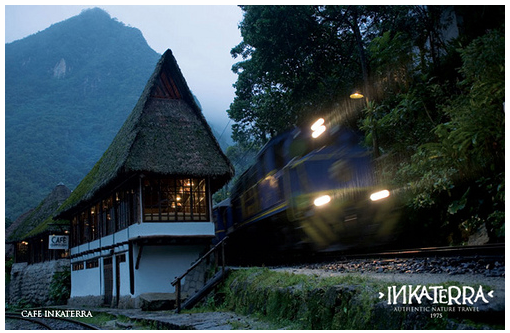
Especially if one is staying at the Inkaterra Machu Picchu.
Inkaterra Machu Picchu is not an MLP Lodge, but another beast altogether, catering to the highest end of Machu Picchu’s visitors.
An eco-hotel where money is no object, included somehow in the fee for our trek. After the first Pisco Sour, our moods brightened considerably.
Machu Picchu
The last day on our trek was over-booked, as expected.
It would have been nice to stay at the Inkaterra for several days and explore Machu Picchu at our leisure. We knew though, going in, that we had neither the time nor the money.
We had 4 hours or so at Machu Picchu. We did our best to make them count.
Machu Picchu is a world-class destination with crowds to match. Visitors are capped at 2500 per day, but that’s still a lot of folks, for a site that was designed for a population of 1000 or so.
Shuttle buses from Aguas Calientes seemed to be running every 5 minutes or so. We arrived at Machu Picchu a bit before 8:00 AM.
We handed our tickets to the guys at the entry turnstiles, and filed in
All guides must be licensed in Peru. Guides operating inside protected areas, such as Machu Picchu Sanctuary, must also have a special permit from SERNANP (National Service for Protected Area Management).
Our most-favorite assistant guide, Whilder, was to be our Machu Picchu guide, but he wasn’t able to make it due to illness.
His last-minute replacement, was a young Latina, Frieda, who had come up from Cuzco on the early-morning train.
She was wearing tight white pants, with a shocking pink jacket and matching silver and pink umbrella, with a wide brimmed tour guide hat emblazoned with “Condor Travel.”
She had an oversized bedazzled ring and copper-colored nail polish. Attached to the strap of her “Condor Travel” backpack was a matching bedazzled pink butterfly.
We had a two-hour guided tour of Machu Picchu. At each stop our Latina started her memorized presentation with “My friends, …”
When we got to the Intihuatana, or the hitching post of the sun, I asked her about the camera crane incident of 2000.
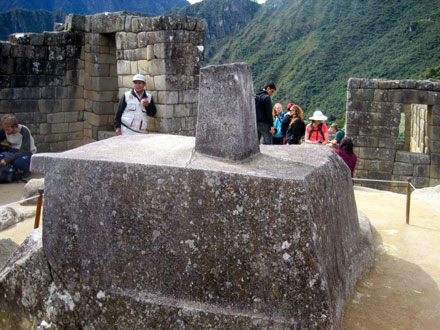
This Intihuatana stone is an archaeological treasure.
A sophisticated sundial built as an astronomic clock and calendar.
Machu Picchu purportedly has the only completely intact sacred Intihuatana stone. The Spanish destroyed the rest.
Not because they spared this one. They just never found Machu Picchu.
Many believe that the Inithuatana also possesses special spiritual and energy properties.
Back in the year 2000, a crane toppled over and knocked the very top edge of the Inithuatana off. In an ironic twist, the crane was filming a beer commercial for a Peruvian beer, Cusqueña.
The government line was that the company had snuck the crane in before dawn, when no one was looking.
Yeah, sure, right through the turnstiles in front of the hotel.
After the fact, everyone said they were very sorry.
And that it was someone else’s fault.
I asked our Latina guide what she thought about this curiously karmic fiasco.
Frieda nodded, smiled blankly, changed the subject, and was back on script in the blink of an eye.
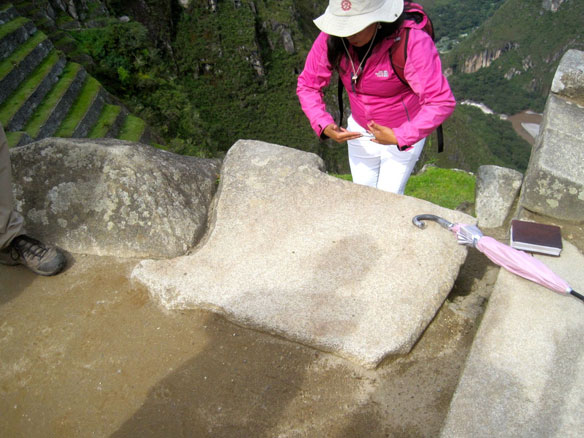
She hopped down onto a narrow ledge and told us all about this guinea-pig-shaped rock.
Check out the drop off behind her. No fear of heights. I’ll give her that. Yes, that’s a tight turn in the Urubamba River, off her left elbow, some 2500 feet below.
One of my favorite Machu Picchu places was a a small room off the main temple.

It is known as the Sacristy or Chamber of Ornaments.
Check out those two large stones on the bottom of either side of the entry.
Both have over 30 faces of the highest quality workmanship.
More sides, purportedly, than any other stones in Machu Picchu.
Frieda pointed out that if one were to hum in one specific niche it would resonate with overtones.
Yep, and how.
We tried a few other niches here and in other spots. Similar overtones.
Our conclusion was that ritual chanting was a big deal here and throughout Machu Picchu, and that this Sacristy was no simple storeroom or prep space.
Below is a piece of a borrowed photo of the remarkable Temple of the Condor.
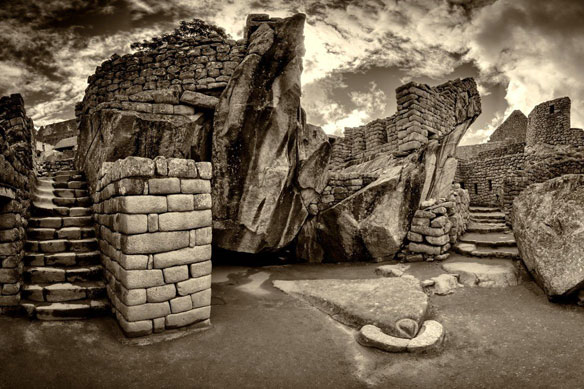
This photo has no distortions or special effects.
Just an alien Incan perspective on life.
The Condor’s head is the upside down 2- dimensional teardrop carved into the front corner of the flat triangular stone. The Condor’s white collar is the separate flat-faced, u-shaped stone in front- a cubist’s perspective.
The Condor’s wings are the existing in-place, wild rock formations.
The stone walls on top of the wings hold niches, which were for the visiting mummies.
Sharon and I were standing back against a stone wall, just about in the spot this photo was taken, when we heard some young folks trying to figure this place out.
The twist was that they were speaking Swiss-German.
Sharon helped them out in a mix of Swiss-German and English. Everyone had a good time.
Our tour with Frieda had ended and we were on our own for a couple of hours and revisiting our favorite places. We hiked back up to higher ground.
With Machu Picchu spread out in front of us, Sharon quipped in semi real estate speak,
“With a few improvements, like electricity, plumbing… and roofs, I’d move right in.”
[Borrowed photo above]
The basic rule of real estate is location, location, location.
Machu Picchu has that one knocked.
Remarkable Feng Shui.
Not by accident.
It appears that this site was selected for Pachacutec Inca Yupanqui (1438-71), the greatest of the Inca emperors. And selected because because it aligned with sacred mountains, which in turn aligned with key astronomical events. It probably didn’t hurt either that a sacred river wound its way below.

One of the most important constellations in the Incan system was the Southern Cross, one of the most distinct constellations in the Southern Hemisphere.
“The Chankana (or Inca Cross, Chakana) symbolizes for Inca mythology what is known in other mythologies as the World Tree, Tree of Life and so on. The stepped cross is made up of an equal-armed cross indicating the cardinal points of the compass and a superimposed square….

The hole through the centre of the cross is the Axis by means of which the shaman transits the cosmic vault to the other levels. It also represents Cuzco, the center of the Incan empire, and the Southern Cross constellation.”
As we were heading back to Cuzco in the MLP van, following our train ride from Aguas Calientes, following our day at Machu Picchu, Sharon peered out the side window, up into the dark night sky, and noted brightly,
“Finally, there’s the Southern Cross.”
I leaned over and looked blearily up, and out, just as the the van swung into a curve.
Missed it.
I spent the rest of the ride, as we twisted and turned though the night, trying to catch a glimpse.
To no avail.
In hindsight, a message of sorts.
Don’t leave the Southern Cross for the last night on a twisting road.
 Advencha before Dementia