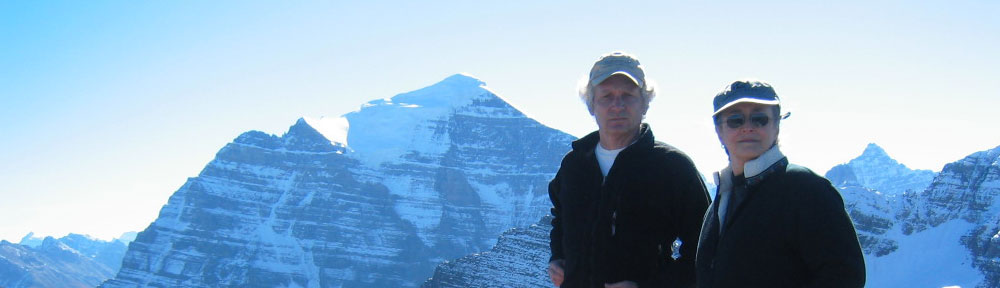

The recipe for this trip was one part relaxation, one part Spanish school, and one part butterfly excursion. We swapped out our hiking plans for bicycles, and pyramids.
Catholicism pervades life in Mexico’s central plateau, known as the Bajío. There’s Catholic and then there’s Bajío Catholic.
Catholicism
Mexico is the world’s second-most-populous Catholic nation after Brazil.
Our destination, the state of Guanajuato, is Mexico’s most Catholic.
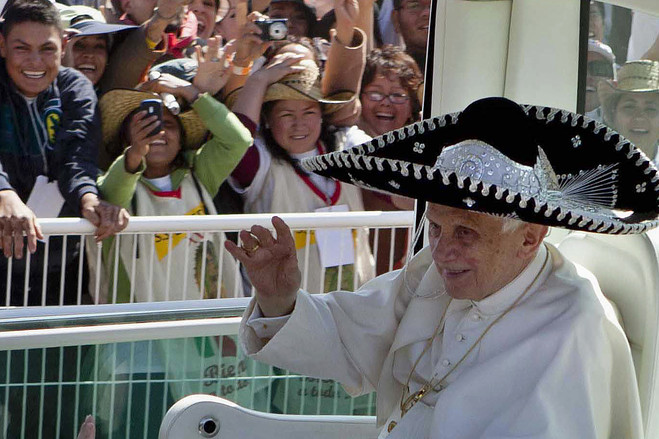
This is not lost on the Catholic Church.
In 2012 Pope Benedict XVI visited the state of Guanajuato and held a giant outdoor Mass near a mountaintop statue of Christ.
Which just so happens to be at the exact geographical center of Mexico.
We drove by on our way from and to, the the León airport.
We had pre-arranged, through our Spanish school, a ride to San Miguel, about 90 minutes away.
This statue of Christ, known as Cristo Rey, is 75 feet tall, and stands at an elevation of 8,461 ft above sea level.
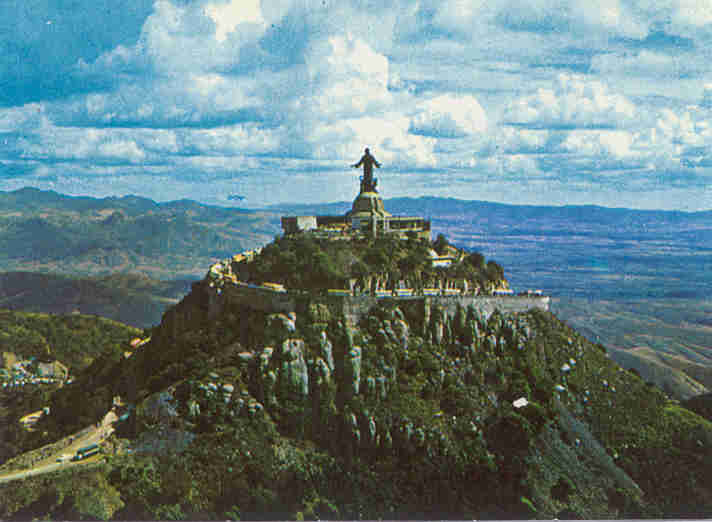
Cristo Rey is the second monumental statue on the site.
An anticlerical, Atheist, Mexican government used a whole lot of dynamite to blow the first one to smithereens in the early 20th century.
Not surprisingly, their symbolic gesture failed.
Metaphors rarely succumb to explosives.
The conflict between the Atheist, Mexican government and Mexican Catholic faithful is known as Mexico’s Cristero War and claimed up to 250,000 lives.
In the past five years, the drug-war violence in Mexico has claimed around 50,000 lives.
All our research said that San Miguel should be OK. Still, we played it safe.

As we drove by Cristo Rey, our driver Martín explained (in Spanish) the finer points of the Pope’s helicopter fly-over blessing of the statue.
When we asked about drug-related violence in San Miguel, he laughed.
I chose to take it as a good laugh.
San Miguel de Allende
This was confirmed, soon thereafter.
At our first dinner, in our home stay in San Miguel, a fellow student, Michelle, commented that after a month in San Miguel, she felt safer than in Seattle.
Michelle looked and acted like any upper-middle-class, retired woman from anywhere, USA. The wrinkle- she and her husband no longer have a home.
They live 6 months every year in China. The remainder, they divide up between the USA and grandchildren, and other destinations such as San Miguel.
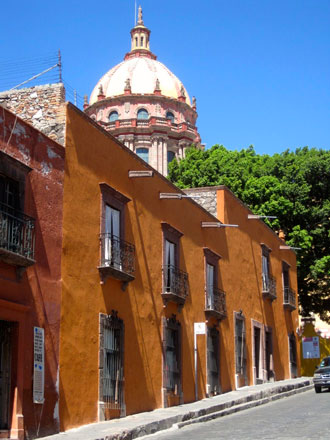
A street scene near San Miguel’s historic center to the right.
Curiously, when we tell our Mexican travel tale to friends, they invariably stop us, when we get to “home stay.”

“You stayed with a Mexican family?”
“Yep, and we had a great time!”
Good company, great food, great location, and most affordable.
What’s not to like?
Truth-be-told, we backed into it.
We started with hotels, and B&Bs, then backed off to a suite at the school. A home stay was even less expensive – and three meals a day were included. Our first home-stay choice was full up.
We think we did even better with Maria and Alexandro.
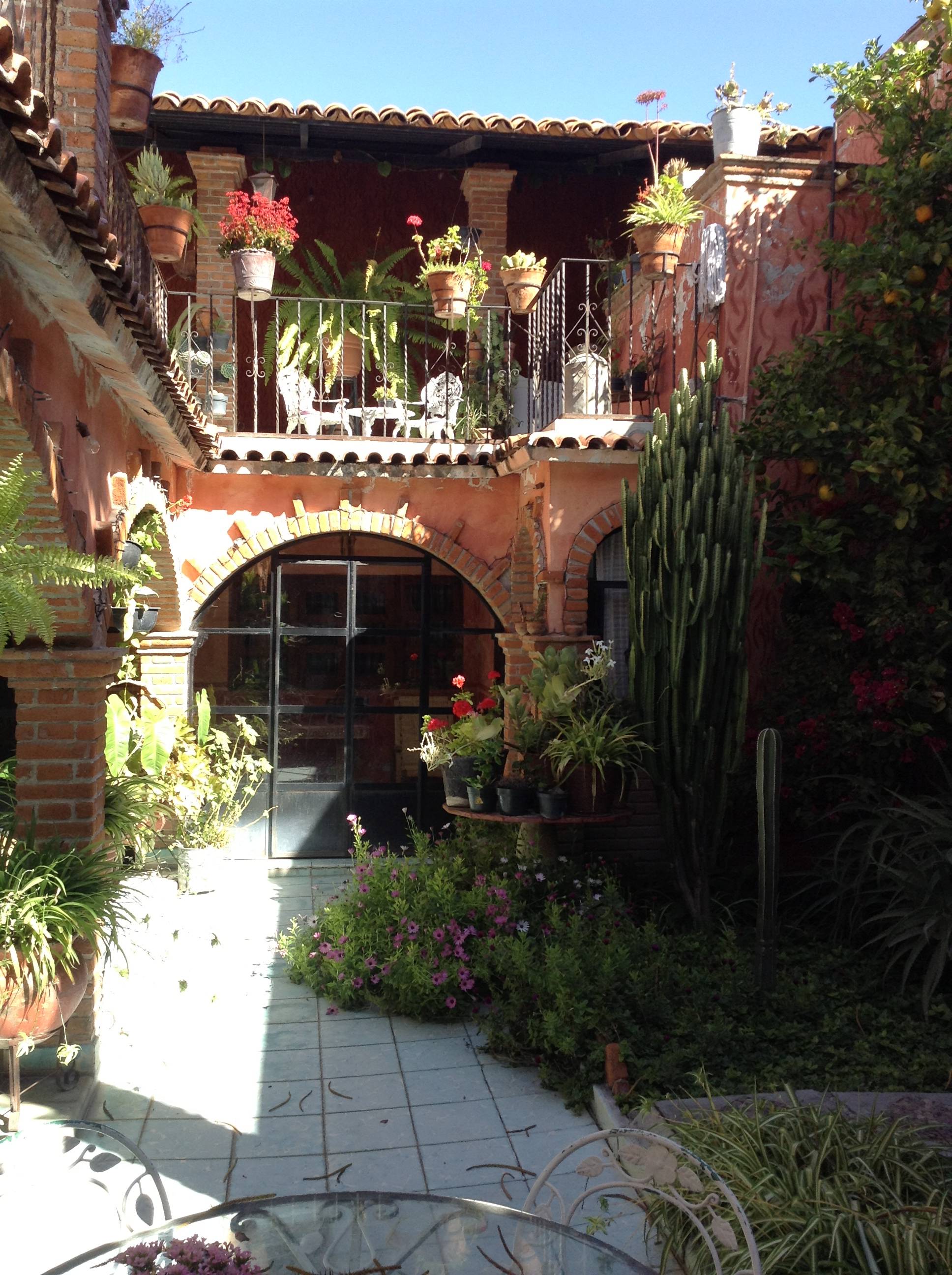
A wall to the street and a lush courtyard inside, Aurora No.4 was a traditional Mexican home.
The previous owner had twelve children, and rooms to accommodate them all.
Maria and Alexandro also have a family, but their kids are grown and gone now.
Their empty-nest solution was to open their home to students.
Seems to be working all the way around.
They get mostly entertaining guests, and cash.
Guests get a home-away-from-home, wonderful home cooking, and most-reasonable rates.
We had a free day before we headed off for Michoacan to visit the Monarch butterflies. We spent it walking the Centro Histórico of San Miguel.
Our first stop was the Jardin, the center of town, and only a ten minute walk from Maria and Alexandro’s. El Jardin is the central square of San Miguel, complete with locals, tourists, laurel trees, iron benches, street venders, and the Parroquia de San Miguel Arcángel.
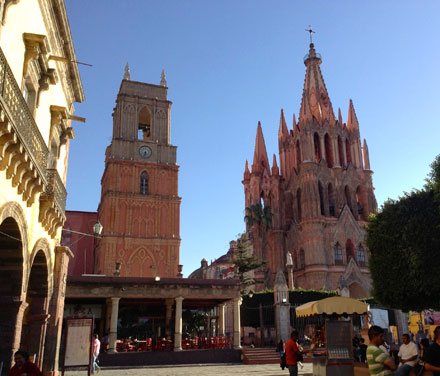
These days, the Parroquia is pretty much the symbol of San Miguel.
And rightly so.
The neo-gothic, pink sandstone towers of the church [on the right] are both remarkable and inspired.
The church itself was constructed in the 16th century, but this brilliant facade only dates from the 19th century.
Imagined from european postcards, the towers were designed and built by an indigenous bricklayer. Today, 100+ years later: they’re the symbol of San Miguel.
The church attached to the tower on the left, Iglesia de San Rafael, is older yet, and has stories too.
Apparently there was a time, centuries ago, in San Miguel, when city streets were not considered safe for the wealthy on their way to church.
The solution was to build tunnels from the larger homes to the church. These tunnels were large enough for horse-drawn carriages. Purportedly they’re still down there.

San Miguel is 500 years old.
A bit off the beaten track, the modern world passed San Miguel by, leaving the colonial architectural fabric of the city intact.
80 years ago, artists and writers discovered San Miguel. Next came the counterculture. Today monied ex-pats rule the day.
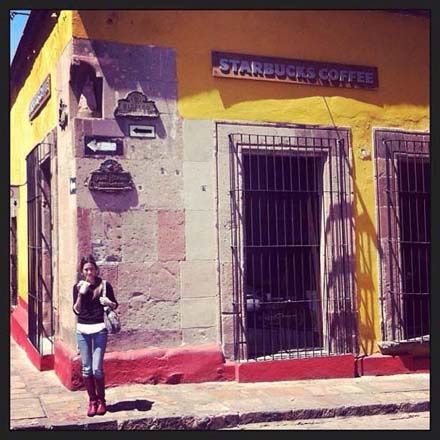
San Miguel has the most elegant Starbucks, I have ever encountered.
Right off the main square, tastefully ensconced in a centuries-old historic building.
From the outside, it looks a bit on the wild-west side.
Which it probably was.
I don’t doubt that six shooters are responsible for a few of the nicks in the stone, or that horses tied up out front.

Inside it feels like a high-end European boutique hotel lobby.
Complete with 14 foot high ceilings, tasteful, upholstered furniture, and original artwork.
Fast wireless internet connections too.
A whole lot of money was spent to deliver this Starbucks’ experience.
Clearly a popular destination for both well-do-do Mexicans and ex-pats.
This Starbucks is probably a 21st century metaphor of sorts for the mix of multinational corporation, developing country, and cyberspace.
A bit William Gibson, sans cyberpunk.
In 2008, UNESCO declared San Miguel, a World Heritage Site.
Today the old, old San Miguel is still here. There are no parking meters, no traffic lights, no stop signs and no gaudy fast food restaurants.
There are speed bumps to be reckoned with, and pretty police.
To my mind a a rather small price to pay.
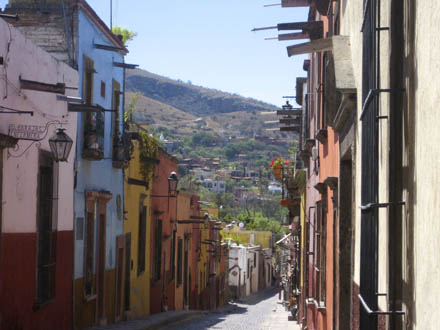
Professor Jorge Arteaga Soto, our school guide, explained that in San Miguel, only five colors are allowed for facades.
Apparently there’s a bit of flexibility when it comes to tints and shades.
Our trip to see the Monarch butterflies was to leave @ 7:00 AM the following morning- from St. Paul’s Church, which according to Google Maps was about a 25 minute walk from our home stay.
We found the church, and walked back. 25 minutes was about right.
Monarch Butterflies
The next morning before dawn, walking in the opposite direction, the experience was rather different. We had decided to walk just to see what San Miguel was like at this hour.
It was really dark.
We missed our first turn. It was a workday and a most-agreeable, local, middle-aged guy loading his pick-up truck, took the time to walk us back on route. All conversations were in Spanish.
We passed a solitary ghost-like street sweeper, she was cleaning the street cobbles with a handmade long-bristeled broom, which could reach down in between the stones.
Sharon was concerned we were lost. I put up a good front.
A couple of semi-lucky turns later, we arrived at St. Paul’s Church, right on schedule.

We threw our packs in the back of the van, took our assigned seats and were off for Michoacán, with Audubon Eco Journeys de Mexico.
We had picked Audubon, because of Mt. Auburn Cemetery in Cambridge.
Sharon and I have been walking Mt. Auburn for years now, as part of our get-in-shape regimen.
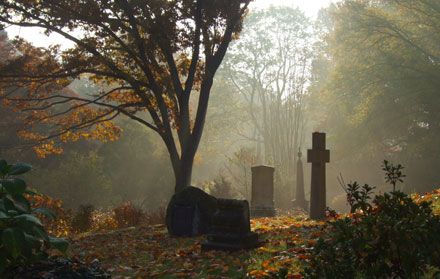
Mt. Auburn is a birder place. A 174 acre landscaped oasis in the urban desert.
Birders are a curious breed. Eccentric is probably an understatement.
The first couple of years, they’d walk by, like we weren’t there.
Then ever so slowly there was recognition.
First a nod, then a word or two. Remarkably recently we have been having real conversations. Albeit short.
Birders tend to be on the geeky side. Smart and organized. Sensitive too. A bit out on the Asperger’s spectrum.
Not a problem. A bit obsessive is an easy trade-off for smart and sensitive.
The question I ask myself as I look in the mirror: Am I becoming one of them?
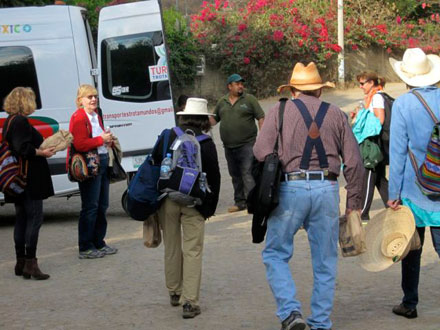
We felt right at home in the Audubon van for Michoacán.
This was an English speaking world.
Several Canadians, and several Americans, with a sprinkling of ex-pats.
Three hours + later we arrived at Agua Blanca Canyon Resort in Michoacán. We had the rest of the day to ourselves. We would visit the Monarchs the next day.
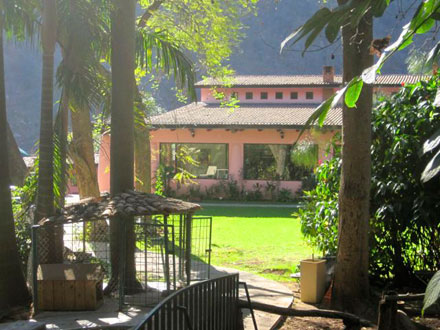
Agua Blanca is a family affair, run by the latest generation.
Our host explained that his personal crisis had peaked when doctors had only given him months to live.
It turned out to be a mis-diagnosis.
He’s still here and running Agua Blanca.
A changed man.
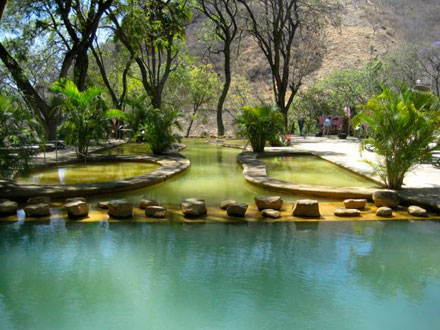
Agua Blanca is known for it’s outdoor thermal mineral hot springs pools.
These mineral pools were once reserved for Aztec Emperors.
The waters are purportedly good for arthritis, rheumatism, the kidneys and liver, blood pressure, digestion and sleeping problems.
The mineral content was indeed high. I felt extra cork-like as I bobbed around clutching my beer.
The running joke was that the years were melting away. The question was at what age we stop the process by getting out. I thought 32 would be about right. A Swiss-German woman piped up,
“Do you really want to go through the 40s and 50s again?”
She had a point.
As we were leaving the next day, I bumped into the owner. I thought his website didn’t do his resort justice. He told me that soon he would have a new website up.
I just checked.
It’s up. A sideways step, at best.
I’m not sold on the wisdom of headlining, the healing “radioactive waters.”
If I were in my my 40s, I might have cause to pause. From a 60s perspective, I can shrug.
The wisdom of age, or the indifference of age?
We piled into the van and headed off for the butterflies. The drive usually takes about an hour. It took us a bit over two.
After 30 minutes or so, we came to road block. Really big rocks had been strategically placed in the highway to stop traffic in both directions.
We slowed to a stop, about six cars back- and three beats later were headed back the way we came. It could have been this or it could have been that. Apparently, in Mexico, in such circumstances, you just get out of there ASAP.
Rodrigo, our trip leader told us not to worry, we would have plenty of time for the butterflies, as we would be parking in the limited-access lot closest to the entrance.
So we pull up to to main parking lot, Rodrigo leans out the window and after a lively conversation in Spanish we were waved up the limited-access road. Rodrigo tells us, with a twinkle in his eye,
“I told them I knew their boss.”
My Spanish is good enough to know that he really said,
“I’ve got a bunch of old people.”
Which I suppose was true enough. Ages ranged from 40s to nearly 90.
Our van parked at around 9000 feet above sea level. The butterflies were around 10,000 feet. Sharon and I were the only ones who hiked up. Everyone else rode horses.

We had our own spanish-speaking guide.
The hummingbirds were out and their favorite flowers were blooming.
We saw a few Monarchs.
The butterfly to the left is a guy.
You can tell by the little black dot on the black line next to his lower abdomen.
We made great time and soon rejoined our group, for the last level quarter mile to the slumbering Monarchs.
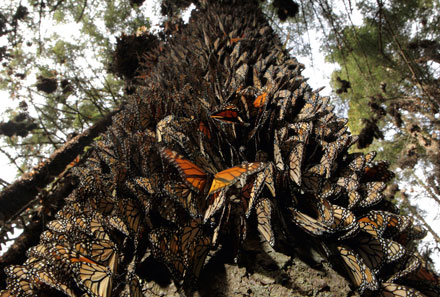
I’m not sure what I was expecting, but this was something altogether different.
Borrowed photo.
Think butterfly hive-mind.
Packed into tightly clustered pendulous masses, the butterflies were in a “torpor”, not as deep as hibernation, but still a very deep sleep.
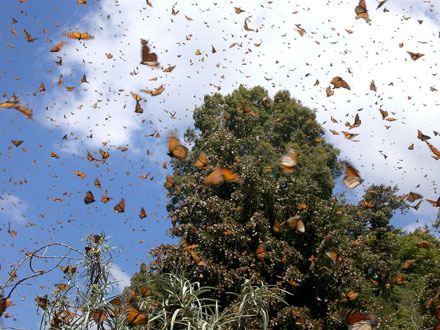
After flying up to 2000 miles, they’d earned it.
Another borrowed photo, that captures some of the feeling.
Each fall the monarch butterflies in the eastern USA travel thousands of miles to spend the winter in forests on 12 mountaintops in central Mexico. It is said to be the most spectacular migration carried out by an insect.
We were on one of those 12 mountains, in the Rosario Monarch Butterfly Biosphere Reserve- the lower left butterfly on the map below. The Rosario Reserve has been designated a World Heritage site by UNESCO.

It was March and the Monarchs were beginning to wake from their hibernation and at times, the air would become a swirling mass of orange and black as tens of thousands of Monarchs took to the air with a shift in the light or the breaking of a branch.
The traditional indigenous locals believe that the monarchs are the souls of ancestors who are returning to Earth for their annual visit.
It felt like that.
Bicycles
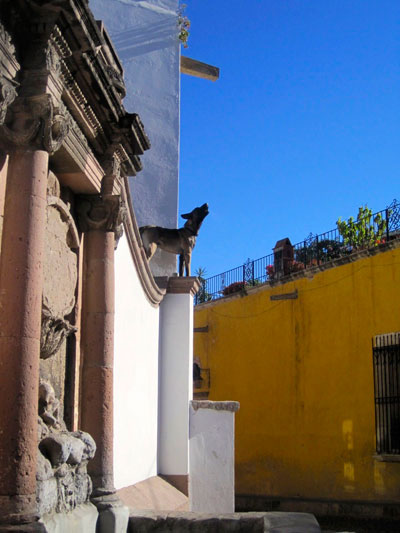
Back in San Miguel we hiked over to Bici-burro, a local bike shop I’d been corresponding with.
We had a long talk about trip options with Beto, the owner.
We also talked about dogs, life, death, and Mescal.
Beto’s dog Murri to left.
5 hours and a bit over 10 miles seemed about right for our bicycle ride.
Sharon is not a bicycle person. She has always hated trying to shift gears and she’s never ridden off-road.
Thankfully shifting has come a long ways in the last 20 years.

Our first stop was the first San Miguel, San Miguel Viejo dating from the 1530’s.
We rode up to the church. Not a tourist in sight.
Locals were setting up for a party.
Beto and Sharon to the right.
From there we worked our way out into the countryside first on dirt roads and then trails.
Loved the falcons, the church ruins and the broken bridge.
Thankfully we didn’t fall over on our two -on bike- river crossings.
The water in the Laja River wasn’t deep (16″ or so), but we would have gotten very very wet if we had tipped over.
Once we crossed the Laja River, several falcons made their appearance.
I looked up just as one slammed into another bird peacefully perched minding its own business. A cloud of feathers later, the intended prey made its escape.
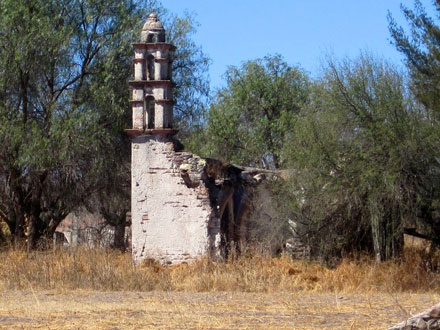
Beto explained that the church ruins were remnants of the early Spanish expansion into the region.
Crumbling amidst fields, they have been lost to the modern world.
This one was probably from the 16th or 17th century.
Once an outpost, now a postscript to a forgotten world.

Beto explained that the missing bridge half, had been blown away during the Mexican revolution.
We rode up onto the old road and looked off and down.
Our return route had no glamour, but 100% local flavor.

Not everyone in San Miguel lives lux.
This was literally the other side of the tracks.
Backyards, dirt roads and cactus the size of small trees.
We dropped down and rode the final stretch back along the railroad tracks.
Spanish School
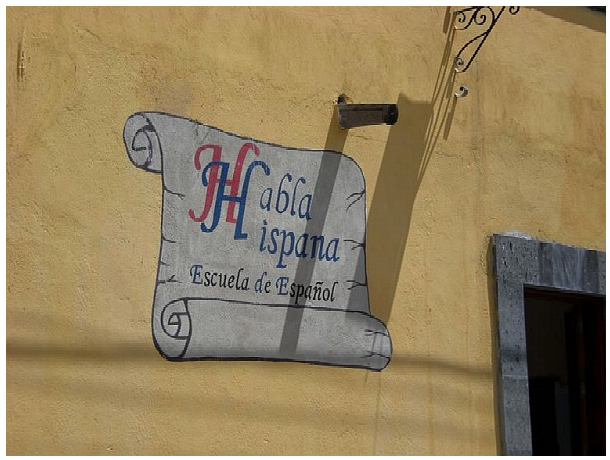
The new wrinkle for this trip was Spanish School.
Sometime in my mid to late 50s, I decided to take up the challenge of a new language.
“Mas vale tarde que nunca.”
“Better late than never.”
At registration, Marta, who runs the school along with her sister Angelica, asked me – in Spanish – about my Spanish education. I stumbled through a crude attempt at describing my self-study.
Next stop, Nivel Principiante, Beginning Level, for me.
A blessing in disguise, I felt curiously liberated. My reading and writing is much better than my conversational skills. Floundering around in beginning Spanish turned out to be quite educational and entertaining.
We talked – in Spanish – about a lot things, including slang and Mexican-specific idioms, such as the “Britney Señal.”

Britney Spears visited Mexico in 2002. Not in the best of moods she flipped off the cameras.
Mexicans took it personally,
And returned the favor, with a twist, naming her gesture in her honor.
The “Britney Sign,” as its known today throughout Mexico, to the right.
I have no doubt that there are plenty of folks south of the border who know this definitive gesture, as the Britney Señal,
And who have no idea who Britney Spears is.
It would be a curious twist of fate, if in the twenty-second century, Britney’s name lived on, only as a crude gesture, embedded in foreign culture.
Not out of the realm of possibility.
At registration, when Marta asked Sharon about her Spanish- in Spanish- Sharon, rattled off a few jokes. Not surprisingly it was Nivel Avanzado, Advanced Level, por mi esposa, for my wife.
Sharon learned her Spanish on the streets of Tampa Florida as a child. I have noticed that when she starts speaking Spanish her persona changes, complete with body language.
She becomes a Cubana, a Cuban woman.
Apparently from some perspectives, a Cuban woman- from the wrong side of the tracks.
In Nivel Avanzado, there was a refined European woman, who had been living in the USA for some time.
Sharon shared with me that she thought that this woman considered her uncouth and unsophisticated.
Then, there had been a discussion of literature in class. The European brought up that she was reading “The Decline and Fall of the Roman Empire.”

A classic written by the English historian Edward Gibbon.
Published in six volumes, from 1776 to 1788.
Gibbon was both eccentric and brilliant.
And a rather good writer. A bit off the beaten path.
This European woman was rather surprised, when Sharon chimed in that she had read the complete text.
Apparently, Sharon then went on to analyze Gibbon’s work, and writing style – in Spanish.
I have no doubt, in depth, complete with the body language and flourishes of a Cubana.
I don’t doubt that this European woman was a bit stunned. She’d be far from the first.
That’s Sharon. The hardest of hardcore sophisticated intellectuals, with the body language and attitude of a girl from the wrong side of the tracks.
We spent 20 hours a week in Spanish class. We had optional afternoon activities three days a week, which left plenty of time for side trips.
Highlights of our side trips included the local pyramids and the neighboring town of Guanajuato. In the interests of space, I’m skipping Guanajuato- a great town.
Here’s my favorite Mexican postcard, which we picked up in the gift shop of the Diego Rivera Museum in Guanajuato.

The artist was a semi-local, José Guadalupe Posada (1852-1913). Unappreciated in his time, he died penniless and was buried in an unmarked grave. Today his genius is recognized internationally.
The title of this illustration: “Alboroto de calaveras felices Y chapuceras.”
Official translation: “Happiest and joker calaveras (skulls)”
Our rough translation: “Uproar of Happy and Shoddy Skulls.”
In any case, this is pretty much the perfect snapshot of the pagan side of the Mexico.
Pyramids
So how do you hide a pyramid?
With a lot of dirt.

Our guide, again Jorge, explained that back in the early 16th century, when the local indigenous peoples heard of the arrival of the Spanish, they buried their local pyramid- to hide it.
Jorge, our friend Jade, and the pyramid, known as the Cañada de la Virgen, above.
The mesa where the pyramid sits is flat.
Covered with dirt, the pyramid must have been a rather large, unnatural mound. Curiously, the Spanish never found the pyramid.
Nor did anyone else- until the twenty-first century.
Even with pieces of painted stone sticking out of the top.
Jorge said that as a boy, he used to climb up the mound, and had seen bits of a mural jutting up.
These were pieces of the Red Temple.
In 2006, in the initial stages of the excavation, the rest of the Red Temple was uncovered. Including a mural similar to that below (p.33 of the Codice Borgia)
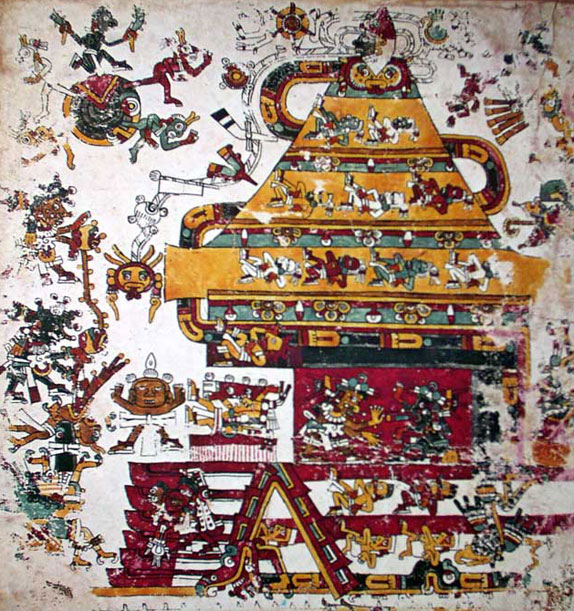
Bones were discovered beneath the red temple. Samples were sent for radioactive carbon dating. As expected they had been interred around 700 AD.
The twist was that this guy had died over 1000 years before that.
Which meant that his remains had been carried here by the people who built the pyramid during their migration into the region.

Not surprisingly, these indigenous people are are still here.
Photo to the right from the Visitor’s Center at the Canada de la Virgen.
Today, Otomis and Chichimecas can be seen on the streets of San Miguel. They come to town to sell and buy, attend church- and march in all night Catholic processions.
The Procession from Atotonilco

Sharon and I got up before dawn on our last full day in San Miguel and headed for the Templo de San Juan de Dios to greet the Catholic procession from the small neighboring town of Atotonilco.
I particularly like the juxtaposition of the two pictures above. These truly intensely devout guys could very well be the same proud pagans, painted up, and ready to rumble, in the second picture above. Just different days of the week.
Mexico is like that.
Once a year, this procession walks all night from Atotonilco, praying and setting off fireworks, while carrying three large statues.
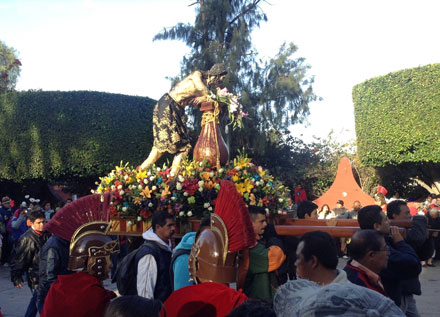
The most significant is El Señor de la Columna, widely revered for his ability to perform miracles.
There weren’t any tourists around, when we arrived in the plaza.
We snagged a front row curb. The mostly-local crowd soon packed the plaza solid.
As the all-night procession arrived, Sharon noticed the locals crossing themselves in a two-staged sequence, she wasn’t familiar with.
First they did a crossing on their faces. Then the traditional crossing starting with the left shoulder.
We never did figure out the face crossing.
In any case, it is all about “placing the cross on oneself.”
Properly.
Although I’m a lapsed Buddhist myself, I can relate. We certainly all have crosses to bear.
Whether the sequence is simple or more complex,
Best we should know how to place those crosses on ourselves properly.
 Advencha before Dementia