2018 Finland: Helsinki & The Åland Archipelago

This trip was my mother’s last request. At least the Hanko part.

As her end neared, she totally surprised me, when one day she announced, “Mark, I know what I want you to do with my ashes.” Pause.

I thought local, to myself, Walden Pond? Charles River? Revere Beach?

Not a chance. She had far bigger plans.

“I want you to go to Finland and throw my ashes off that rock behind Mannerheim’s place in Hanko.”

I was both stunned and proud of her. From the tone in her voice, I knew that she knew exactly what she wanted, and she had thought it through.

Lots of angles, covered. In this one request she paid homage to her family’s homeland, and she paid her last respects to her father. She pulled favorite family together. And she would go out in style. Details left to me.

None of these reasons were ever discussed. It was all between the lines. The Finnish way.

My favorite picture of my Mom is below – at her college graduation. She was 100% Finnish and looked it: A platinum blond with a touch of the exotic east.

rita college graduation 1946

She made it to 92. A full life. A bit of a wild child. She did it her way.

When my Mom passed last year, I knew what what needed be done. I knew where and I knew when. August 25 would be the best day, as it was the end of summer celebration in Finland. Big pagan fires and, as it turned out fireworks too. 

As long as we were going, why not make it an edge of the world bicycle adventure?

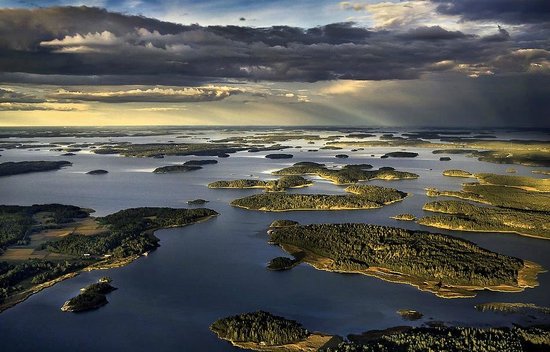
That would be the Archipelago Sea stretching between Sweden and Finland. 
archipelago-national
The Archipelago Sea. Borrowed photo

World class island-hopping, undiscovered bicycling. Using a generous definition of “island,” there are about 50,000, which makes the Finnish archipelago the largest in the world.

This trip snapped into focus when I realized we could fly into Helsinki, leave our luggage at our hotel, catch a ferry to Åland on the Swedish side of the archipelago and bicycle back across the archipelago to the Finnish mainland, then south to Hanko and for the home stretch, back to Helsinki.

The stake in the ground was the end of the summer festival in Hanko on August 25. Working backwards and forwards, I booked plane tickets, our ferry to Mariehamn in Åland, and our bicycle overnights at 30 to 50 miles a day. We had a plan: 300 miles ± of bicycling over 9 days,  lots of ferries and a couple of days off in Hanko.

This story will be divided into 3 parts: Helsinki & The Åland archipelago; The Turku archipelago & Mathildedal; and Hanko & the King’s Road.

Helsinki & The Åland archipelago

Day 1 Fly from Boston to Helsinki. Overnight on plane

IMG_0002

We left Cambridge at 6:00 PM. Two bike cases. Two carry-ons.

Hit international security at Logan Airport around 7:00 PM. 

Sharon was behind me, chatting with a young woman heading to Israel for Rabbinical Studies. I could hear them, “No I’m not doing the full seven year course of study.” Jay Leno walked by on the other side of the security glass, and my carry-on headed into a highest tech scanner I had never seen.

Sure enough, I was called over for suitcase inspection. I had feared exactly this. Mom was going to get the once over. 

He knew what he was looking for, and dug around until he found it- a suspicious 4 lbs plastic bag of chemical ash. He swabbed, checked analysis, and gave me the all-clear. 

He didn’t ask and I didn’t tell. Mom would be going to Finland. 

I exhaled.

Day 2 Helsinki Hotel F6

We arrived at our hotel in Helsinki at 3:00 PM the next day – a bit worse for wear. Little or no sleep will do that to you. The first leg to Reykjavik was the longest and our seats didn’t recline. Note to self, “No seats backing up against anything ever again.”

That said, the our hotel in Helsinki was pretty much perfect. Great location, great staff, great design. 

Hotel F6
Hotel F6

I get points for the buffer day on arrival. I lose those points for no buffer day on departure. But that’s jumping ahead.

We picked the Hotel F6 primarily for the location. We knew the neighborhood from our visit in 2005. Just south of the Esplanade, it was between the historic district, and the design district, next to the Marketplace and the close to the harbor where we would board our ferry to Åland in two days. 

Day 3 Helsinki Hotel F6

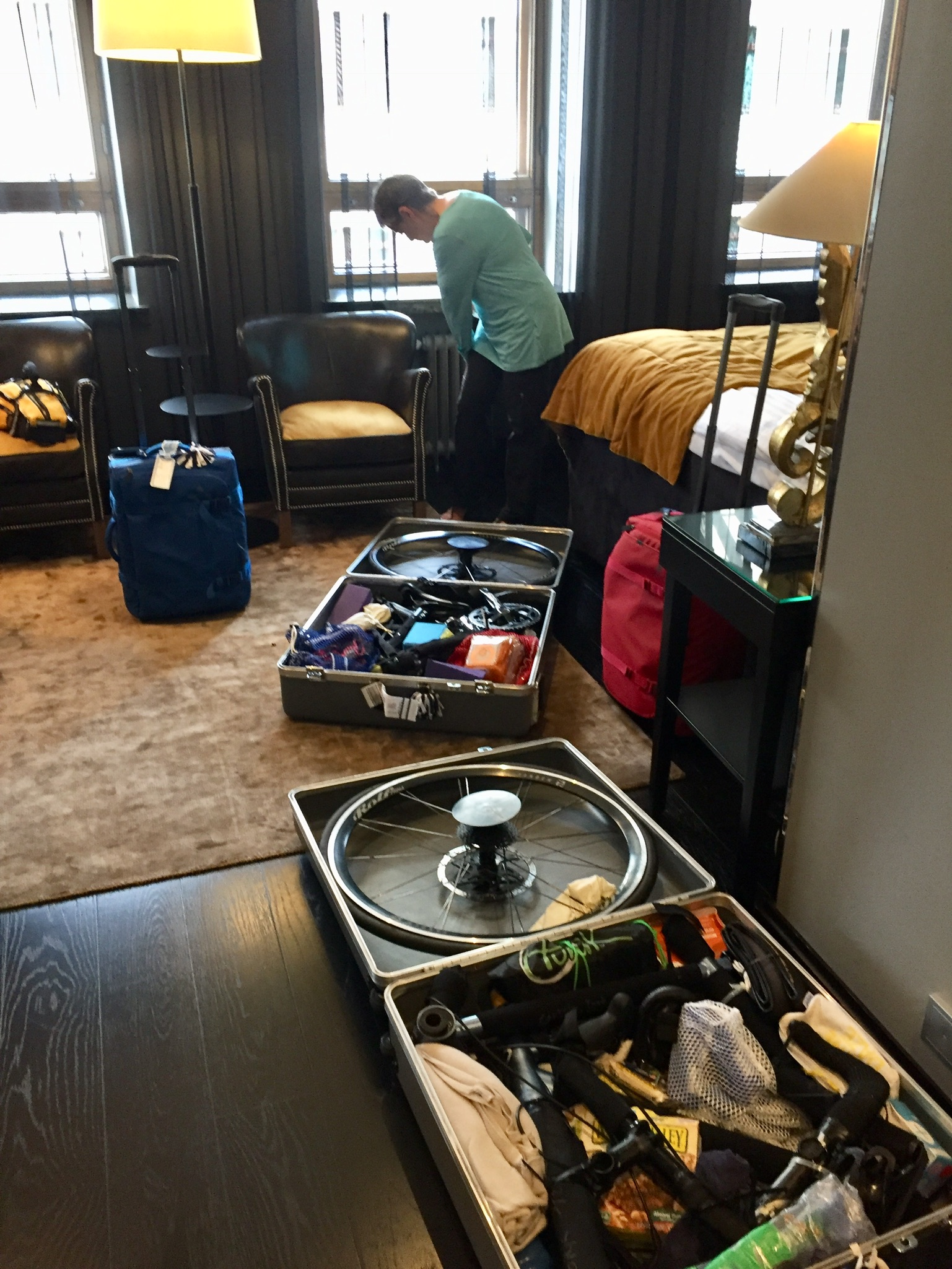
We awoke early the next day and after a Finno-Japanese breakfast started re-assembling the bike.
IMG_0004

It went smoothly, except for one, not so minor problem. Our front derailleur wouldn’t move when asked. So we emailed the man who knows all things bike – Ed at Belmont Wheelworks. It would be 4:30 AM in Boston.

Within a minute we had a response,”I’ll miss my ride if I answer this – I’ll get back to you as soon as I get back.”

Fair enough, and most-promising, if you know Ed, who can be rather hard to reach, unless he feels like it.

We finished putting the tandem together. No need to panic. No need to panic. No need to panic. No need to panic … Yet.

Sure enough, 2 hours later Ed emailed us a most-condensed and thorough essay on the dual ratchet system in STI shifters and the pawls used there-in, and how to re-engage them.

Which involved rolling the rubber boot off the shifter and removing a most tiny phillips screw. Unfortunately we didn’t have such a tool – but the front desk did. A few pokes and knocks later, all was well.

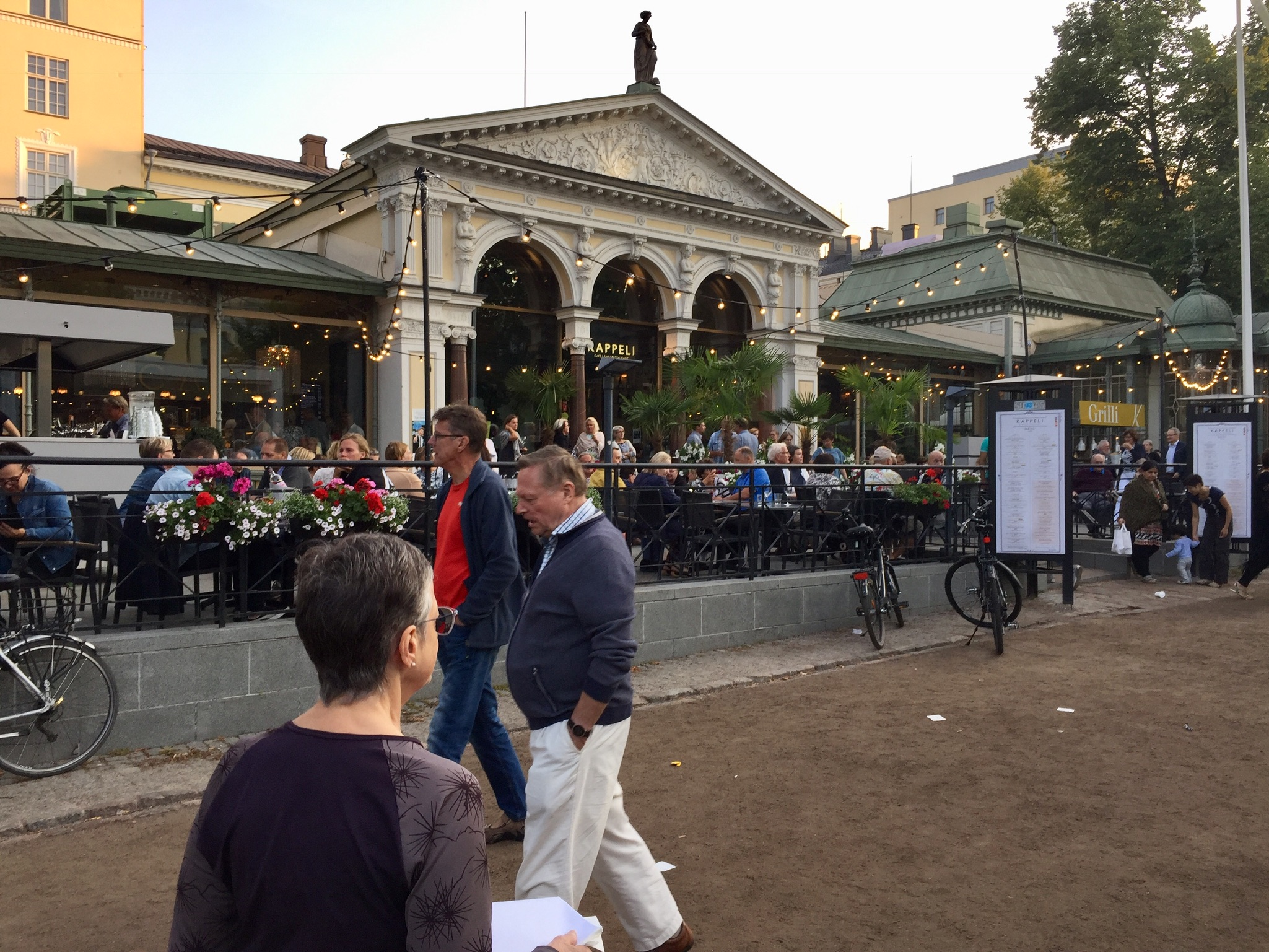
To celebrate, we went for a walk – down to the Esplanade, 
IMG_0007

through the marketplace and up to the Russian Orthodox Church.

IMG_0008

Recently it has occurred to me that my grandfather Peter probably spoke Russian, to go along with his Swedish, Finnish and English. No way to know now that my mother is gone, but it makes sense. The Russians were running Finland and he was working at a prominent Swedish jewelry store in Helsinki – below. 

fullsizeoutput_41b4

Peter was drafted by the Russians in 1901 to fight the Japanese. He chose instead to emigrate to the USA. Good choice.

Back at the hotel, we hung out for a while in the lobby chatting with a cordial young blond woman at the front desk. Highlights were the Japanese, Aerosmith and Swedish TV.

There were a whole, whole lot of Japanese at the hotel. She explained that Finland and Japan were sister countries with a shared design aesthetic. Finland has also become a Japanese European travel hub with new direct flights. 

Our son came ever so close to being Eero Smith. We figured the band would never come back. But got cold feet at the last minute. You never know. Lucky for him, as it turned out.

Our friend at the front desk found our story hilarious, but couldn’t understand what the problem would be. 

Then she shared that Aerosmith front man Steven Tyler was fond of Helsinki and had been known to play anonymously with Helsinki street musicians, and pulled up a YouTube video on her phone to prove it.

Which transitioned into a discussion of the exasperating political correctness of standard-fare Swedish TV which we had been watching almost every night for 9 months as part of our trip prep. 

Us, “Every chase scene, it’s the woman cop who tackles the bad guy.”

“Every show has a psychologist, who helps with understanding hurt feelings.”

“And the really bad guys are always international pharmaceutical companies.”

Finnish Blonde, “Fuck yes, that’s the Swedes for you. Always so nice and polite and condescending. You know, us Finns have some historical issues with the Swedes.”

Uh huh. Sweden lorded it over Finland for centuries. Ruling with an iron fist. Swedish was the language of the aristocracy, until replaced with Russian.

Day 4 Ferry overnight to Mariehamn

We checked out of our room. Left our luggage with the hotel, and headed for the Viking ferry for our overnight to Åland island mid-afternoon. 

We walked our loaded tandem along the Esplanade and then by the Marketplace, riding the last stretch to the check-in for vehicle loading. A pleasant young woman checked our passports and confirmed our online ticket. She then directed us to lane 4.

We were first in that line.
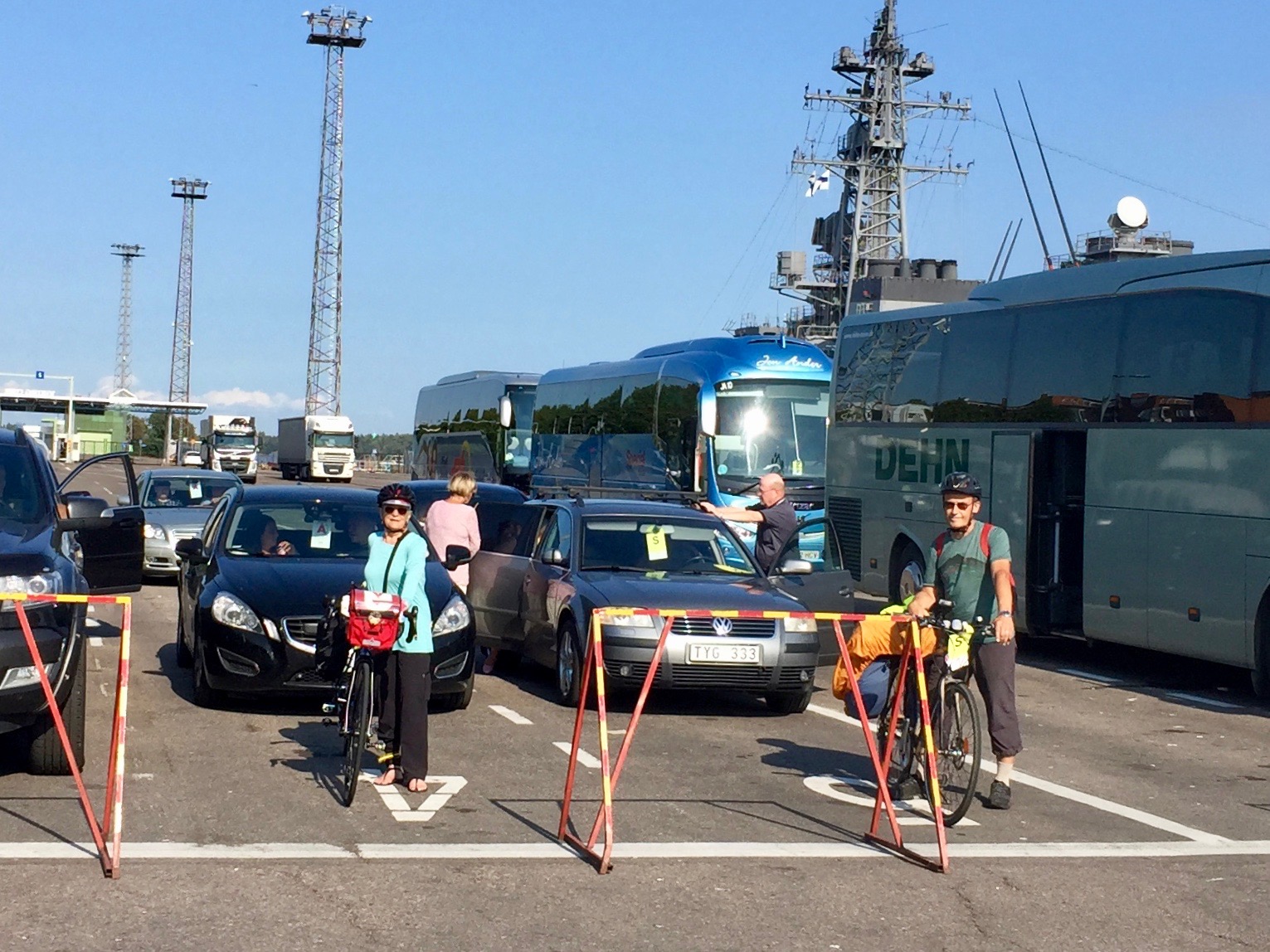
Front of the line

First in lane 5 was another bicyclist, a Finn, our age. He was headed for Germany where he was going to meet up with his son who would be bringing his American muscle car, to see how fast it would really go. 

We waited and waited. Our lane was the last to roll out. Around the corner we were directed to wait with the Jinx Crows, a Helsinki motorcycle gang, until the last remaining trucks were loaded. It was all quite entertaining.

Jinx Crows

Jinx Crows went right and we went left through the giant doors into the bowls of the ship. We were the last in. The Jinx Crows knew the drill, out came the nylon webbed straps to triangulate their bikes in place. 

We were directed back behind a semi-trailer. It occurred to me, that we had a strap too. Out came our cinch-able kevlar and steel 5 ft band lock. and lashed to a steel pipe, we were in business. Now all we needed was to find our room.

Fifth floor, up at the very front right. As we made our way down the long narrow corridor, who should pop out of a room in front of us wearing only a small towel around his waist waving at his friends behind us?

One of the Jinx Crows. A bit of skin in public. The norm.  Welcome to Finland.

We found our cabin, unpacked and then headed out for dinner. The grill on deck 7 was talking to us. We chowed, while watching the water slip away. Next we explored the ship. The door to the casino wouldn’t open from the deck, so we let that one pass. 

Up top we had pretty much a 360 degree view. The sea was calm. We could see perhaps 5 or 6 other cruise ships. Some close. Some far off. Some coming and some going. Business as usual on the Baltic, driven by tax-free shopping and cheap booze.

We turned in early, setting our alarm for 3:45 AM for our 4:30 AM departure in Mariehamn. 

The Åland Archipelago

Day 5  Mariehamn to Saltvik

It was night, or more accurately astronomical twilight, when the ferry doors opened and we followed the 6 departing cars out into Mariehamn. On the upside of the ferry terminal, we found a bench outside and waited for dawn.
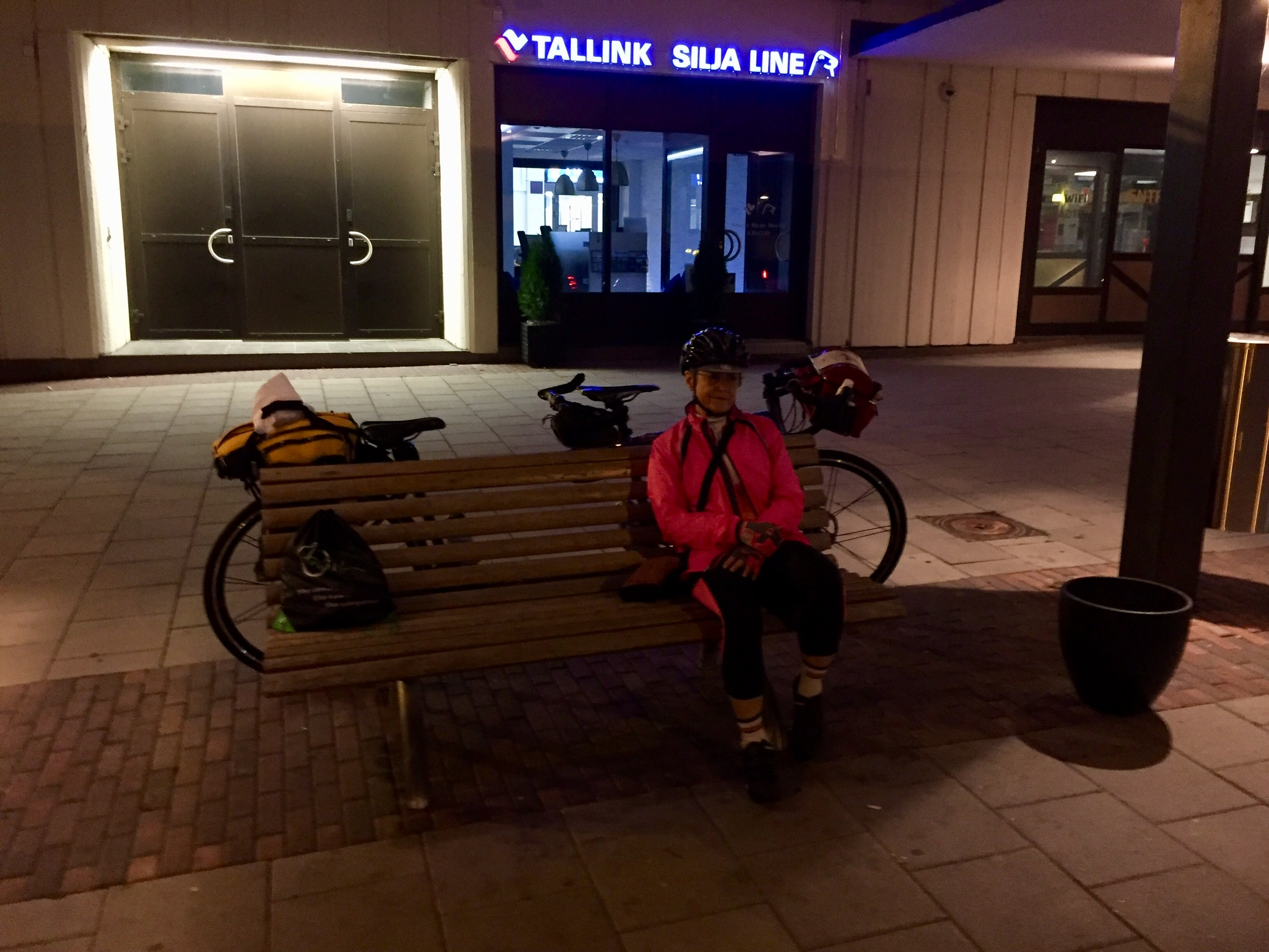
IMG_0011

Mariehamn is the capital of the the Åland archipelago, an autonomous territory under Finnish sovereignty. Back in 1920 or so, the League of Nations asked whether Åland wanted to be part of Sweden or Finland. Over 95% voted Sweden, so as the fates twist fate, the League granted sovereignty to Finland.

Not much seems to have changed in 100 years. Just about everyone in Åland still speaks Swedish, which actually makes eminent 21st century sense as coast of Sweden is only 24 miles of open sea away to the west.

We weren’t headed west, though,  but rather east, back across the archipelago to mainland Finland. First up was a very early morning wake-up ride south to the Nåtö Nature Reserve. 

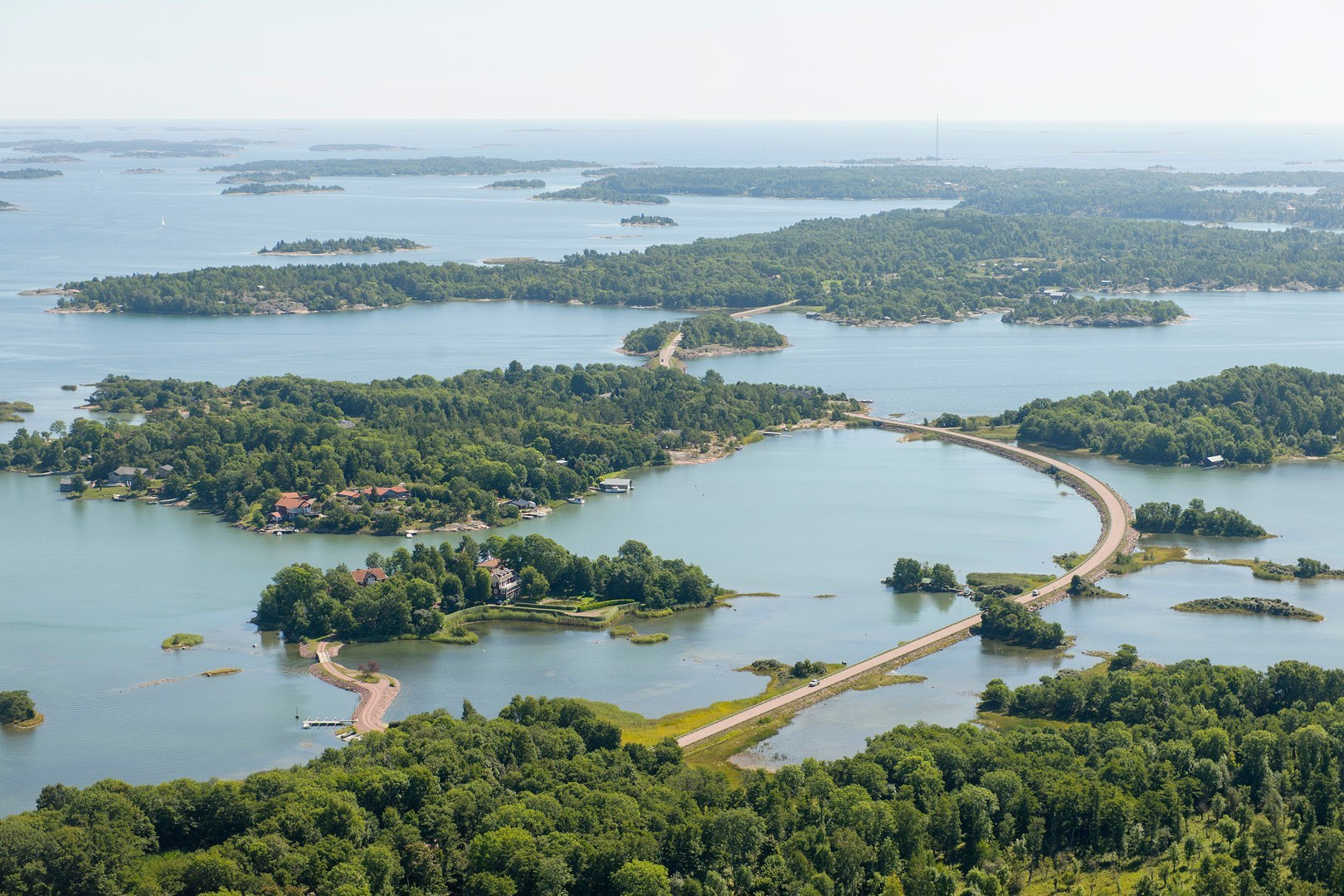
And yes, it looks just like this. Except the road is pink close-up. A whole bunch of blue herons took off as we rode by. No sign of anyone else.
järsö-vägen-åland
The pink road to Nåtö. Borrowed photo

We were back in Mariehamn by 6:30 AM. We had an hour+ wait for Cafe Julius to open. Second-rate pastries, second-rate coffee, and an ornery owner. No problem. It was the only open cafe in town. We were happy to have a seat at a table, some food and entertainment.

Sharon had been studying Swedish for last 9 months or so. This cafe was shaping up as her first real-world test. I was curious how immersion would play out. In character she grabs a semi-used local Mariehamn paper off a neighboring table and disappears into the Swedish copy.

A few minutes later she surfaces and gives me a full run-down on the local crime report. Ending with,

“Did you lock the bicycle?” 

IMG_0013

We were in waiting mode. Our next stop was the Mariehamn Maritime Museum, 1/4 mile away, which didn’t open for a couple of hours. Sharon disappeared once again into her Swedish paper. I refilled my coffee, and looked around. Full house. Interesting crowd.

A table of old guys were in the corner, clearly early-morning regulars. One poured me my first refill coffee. 

I recognized a family next table over from the ferry terminal. They had been asleep sprawled across chairs, also waiting for first light. Young parents, young kids. Good can-deal-with-it attitudes all around. French. 

A trio of young camping, bicyclists were yukking it up next table over.

A couple of hard-nosed working guys, perhaps at shift break, were eating the only available real food- plastic-wrapped sandwiches from at least the day before.

And one outcast local old guy off by himself at a table in the far corner, putting on a brave early-morning face. 

Folks filtered in and out. Eventually Sharon folded up her paper. Next guy over asked, in Swedish, if she were done. Having read every word, and reported on every detail in every article, she passed it over with a few words in Swedish. Time to move on. 

At the museum, we locked up on the anchor out front, found a bench and kicked back into 1/2-hour-waiting mode.
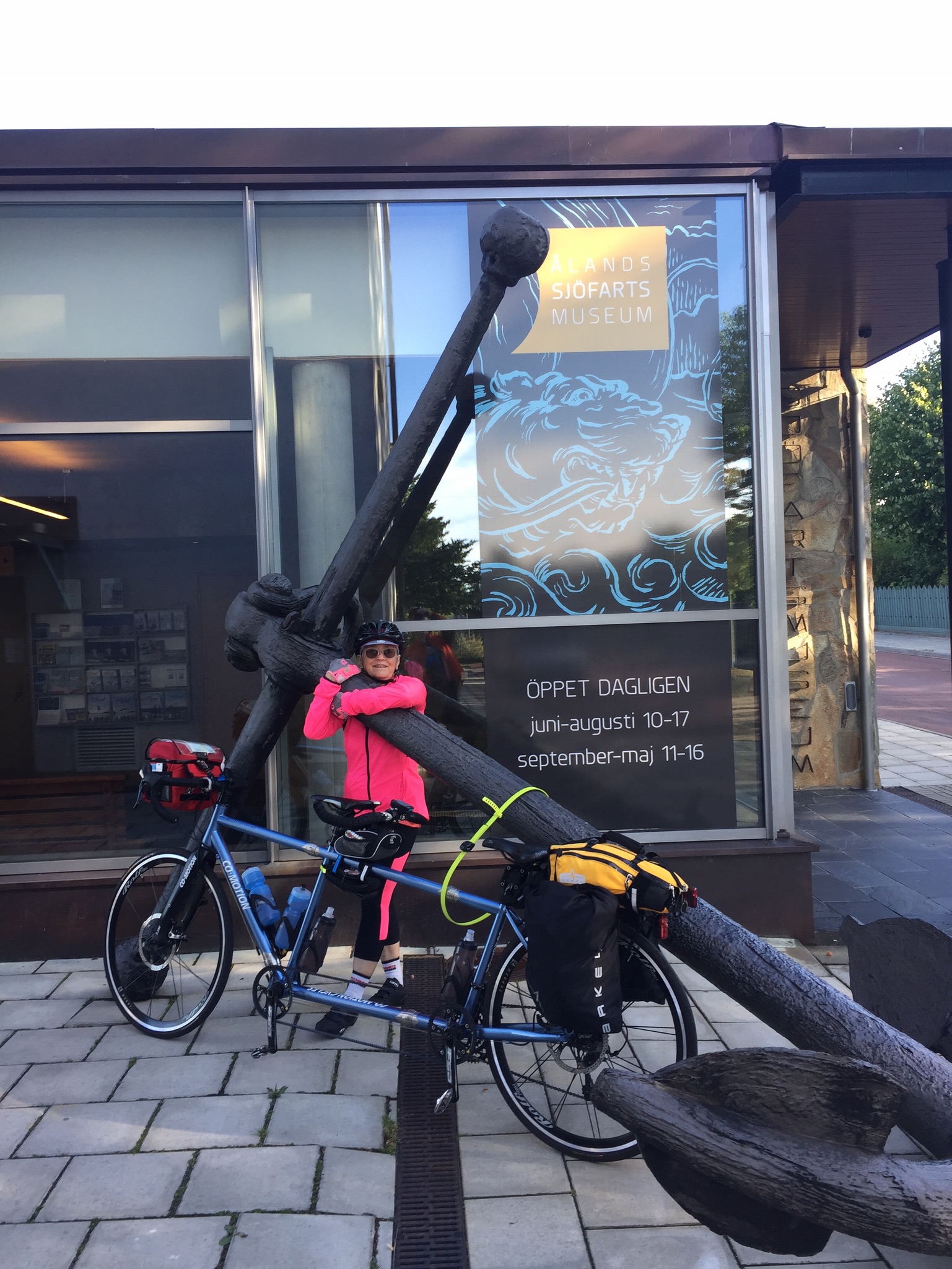
IMG_0015

In the distance a beautiful harbor. In the foreground a big bush full of yellow-ish berries that neither of us recognized. Birds were loving them though. Sharon gets up, saunters over, picks a few, pops them in her mouth and announces, 

“They’re great!”, and starts chowing down. 

I avert my eyes. We’ve been through this many, many times before. So far, remarkably, she has survived. Each time, though, I cringe.

Sharon heads off to read all the historic signs. I lean back. Beautiful light.

A local walks by, spots the berry bush, doubles back and starts happily munching away. After he had had his fill, and departed, I venture over and tentatively give a couple a try. Quite good actually. Didn’t eat too many though.

You never know.

The Maritime Museum opened and we headed in. 

Top of the list was the pirate flag. Only two authentic pirate flags are known to exist from the 18th century. One was here. It didn’t disappoint.
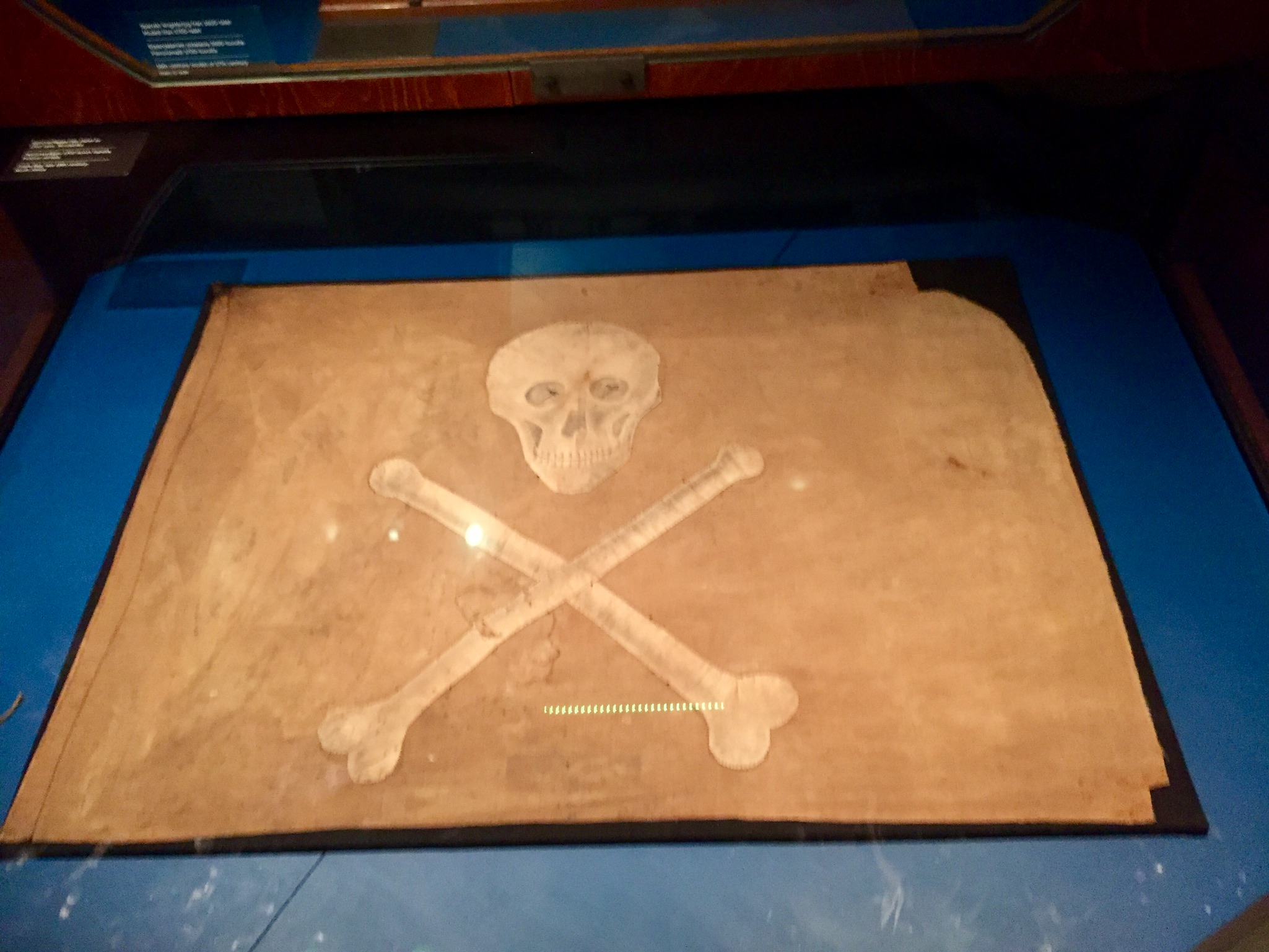
IMG_0016

What I didn’t know was that Pirate flags were either black or red. Black meant we’re going to take all your stuff.

Red meant we’re going to take all your stuff, but first you’re all going to die. 

Sharon says this flag was red. No doubt it must have stories to tell.

After a pass through the museum proper we headed off to the Pommern tall ship.

IMG_0017

The Pommern was undergoing restoration. We had arranged a private tour as this was the only way we were going to get onboard. This morning no one else was onboard.

There had been a fund-raising event the night before. Lots of empty wine bottles. Every good cause needs a good party.

The Pommern was a working cargo ship well into the mid 20th century. Locals would ship out for up to 2 years. Tall ships had continued to be cost effective because there were no fuel costs and one could be sailed with a crew of only 26. 

Until 1949 tall ships from Åland circumnavigated the globe and carried grain from Australia to Europe. Hard life though, and more than a few had jumped ship in Australia.

The archipelago has been a maritime culture from Viking times. The tall ships were the last of the glory days.

Our tour ended, and it was time to head north to Saltvik for the evening. 

We passed by lots of vistas like this on Åland.
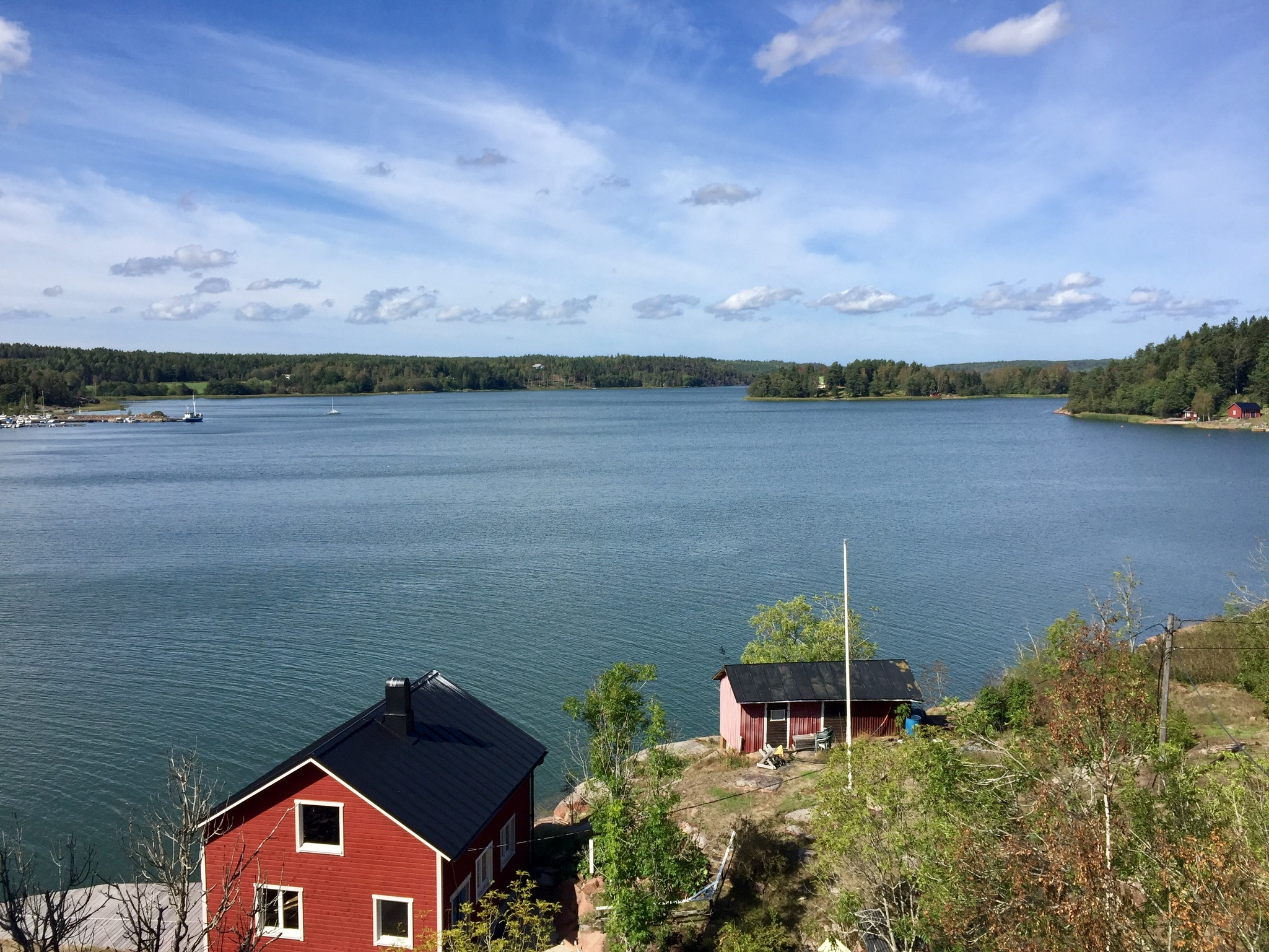
IMG_0018

All day, we kept seeing tandem bicycle signs like the one below, which made no sense to us, as we never saw another tandem in Finland.  It’s always nice to have one’s existence recognized though.
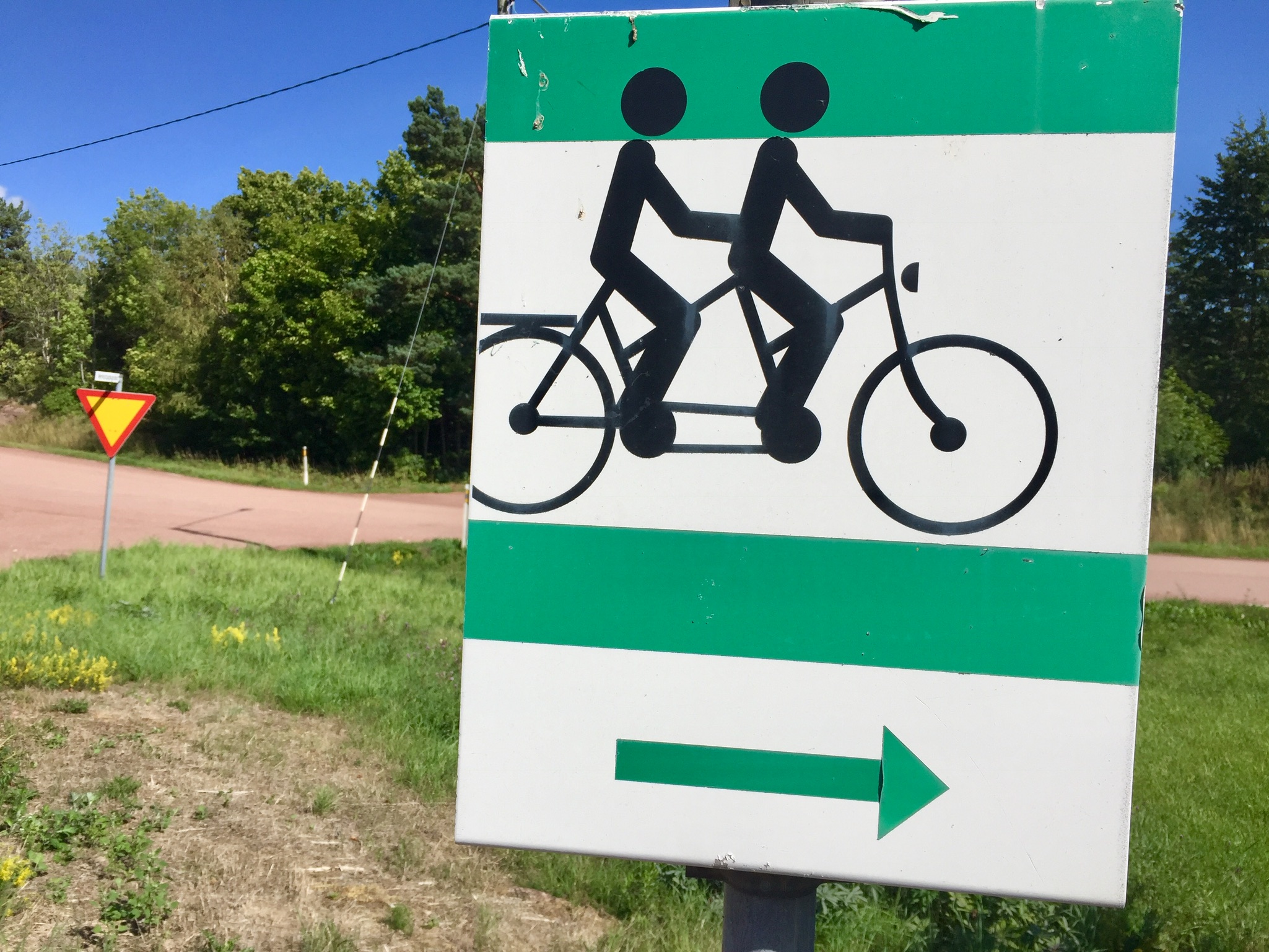
IMG_0019

We rode right by our last left turn at the Viking camp, which is kind of a fairground for re-enactments of times gone by. 

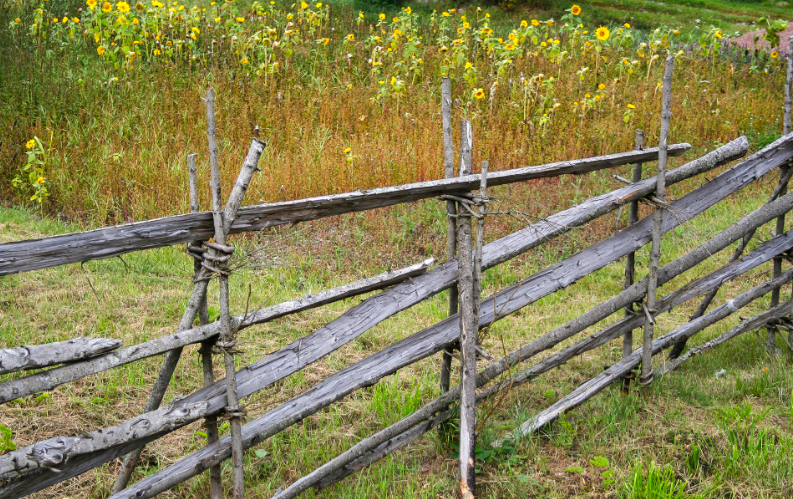
On second pass, we had a better look at the perimeter fencing which we would see across the archipelago. This was the real deal. Practical, functional and efficient. Proven over the centuries.

Museum-grade, but for now still just working. 
viking fence alan neche
Viking Fence. Borrowed photo

Good design lasts or lingers – depending on how one thinks about it. 

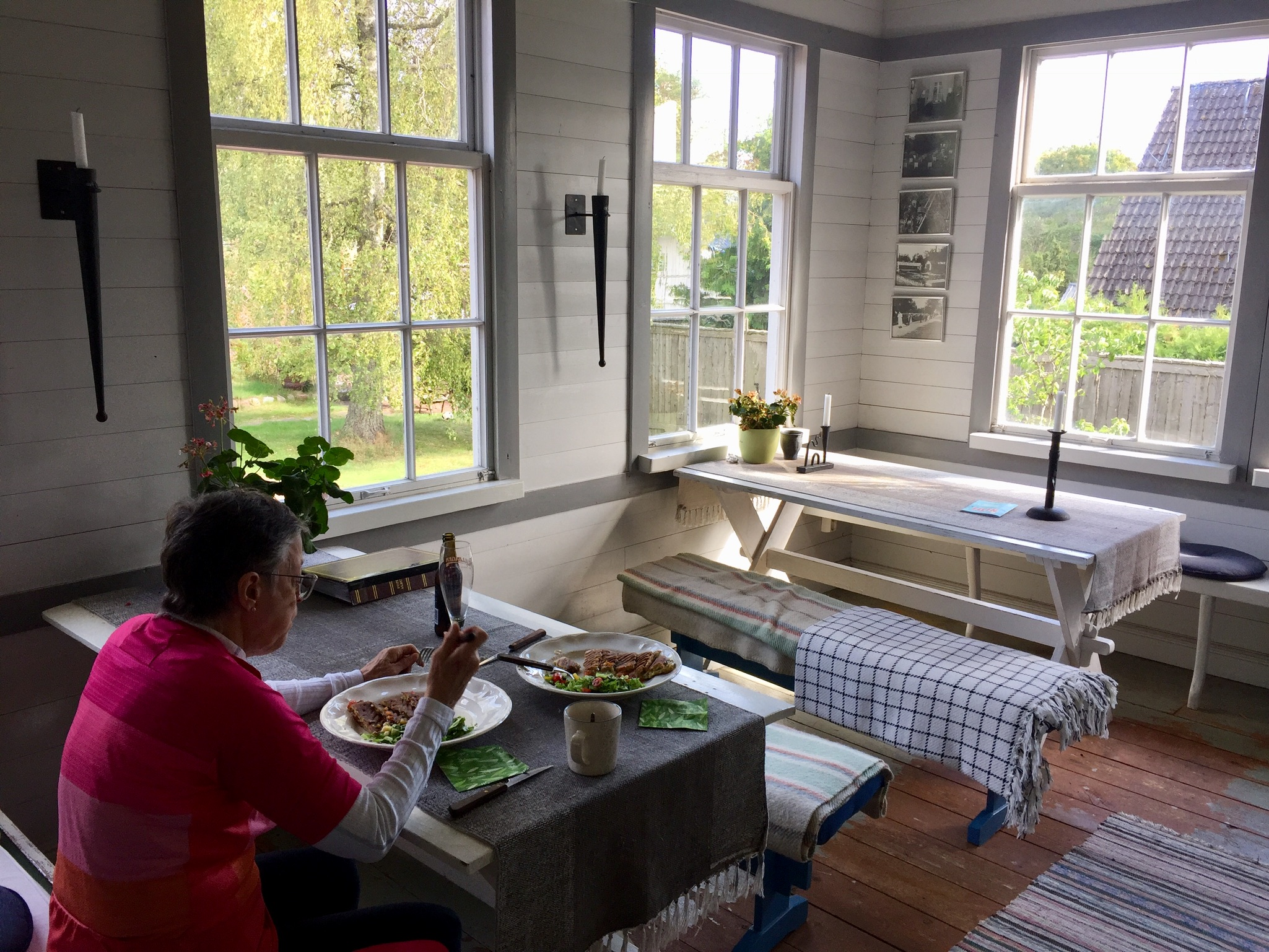
Saltvik was a highlight of the trip. And rightly so. It took a bit of edging into though. We were tired, still jet lagged, and it had been a very long day, when we pulled into Kvarnbo Gästhem, our B&B for the night. 

IMG_0023

We found out later that, Kvarnbo Gästhem had been sold out for over 100 days. When I first checked it was indeed sold out, but I kept checking, and one day, Bingo, there it was.

A couple of clicks later, this night was ours. 
IMG_0020

As we sat munching our dinner, we could overhear several Americans discussing their non-reservation with Martin, who runs the B&B with his wife Anna.

“We had this night reserved”

“Actually you didn’t. I emailed you that the reservation hadn’t gone through properly”

Silence. We had nothing to add.  

Later, we told Martin about our riding into the ferry in Helsinki with the Jinx Crows. From his decidedly neutral expression I could tell I was missing something.

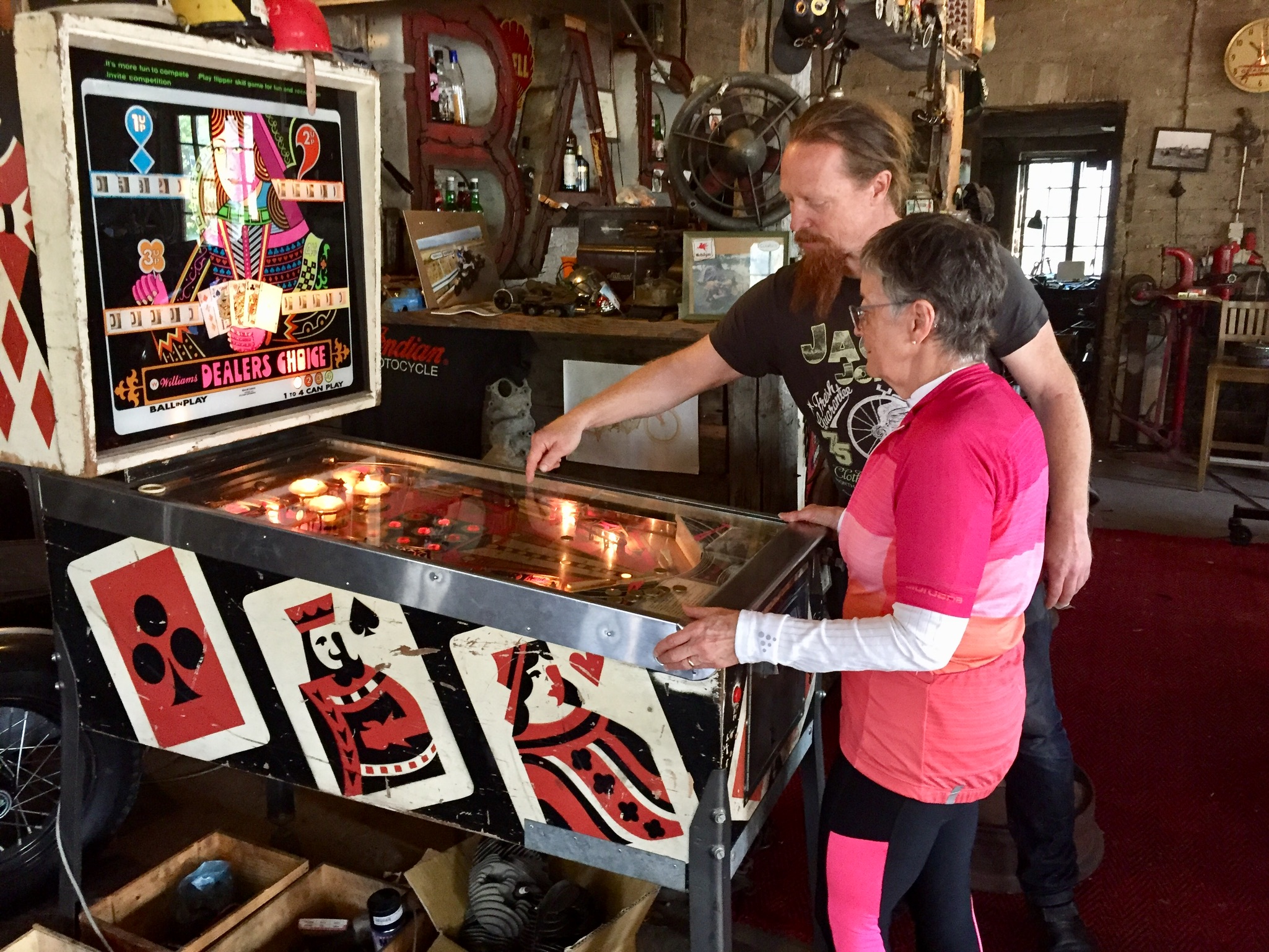
What I hadn’t picked up on was how seriously he was into motorcycles. This hadn’t been lost on Sharon, who knew all about such as one of her ex’s had been a biker. 

Martin took us over to his garage to show us his bikes. First he showed Sharon his pinball machine.
IMG_0022

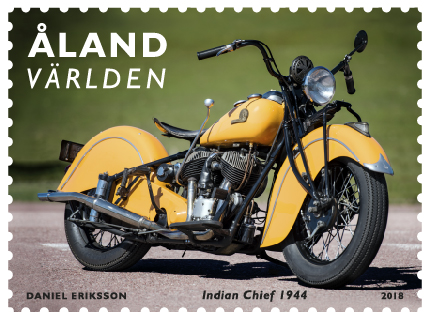
The showpiece was this 1944 Indian Chief motorcycle, immortalized on this Åland postage stamp below.
Indian Chief 1944 postimerkki

Martin had found it in boxes in Australia – unwanted Army surplus, brought it back to Åland and restored it. 

Relatives had been tall-ship sailers who had jumped ship in Australia. The Indian Chief we saw wasn’t for show, but a working bike. Martin had just gotten back from a 1250 mile ride across Europe.

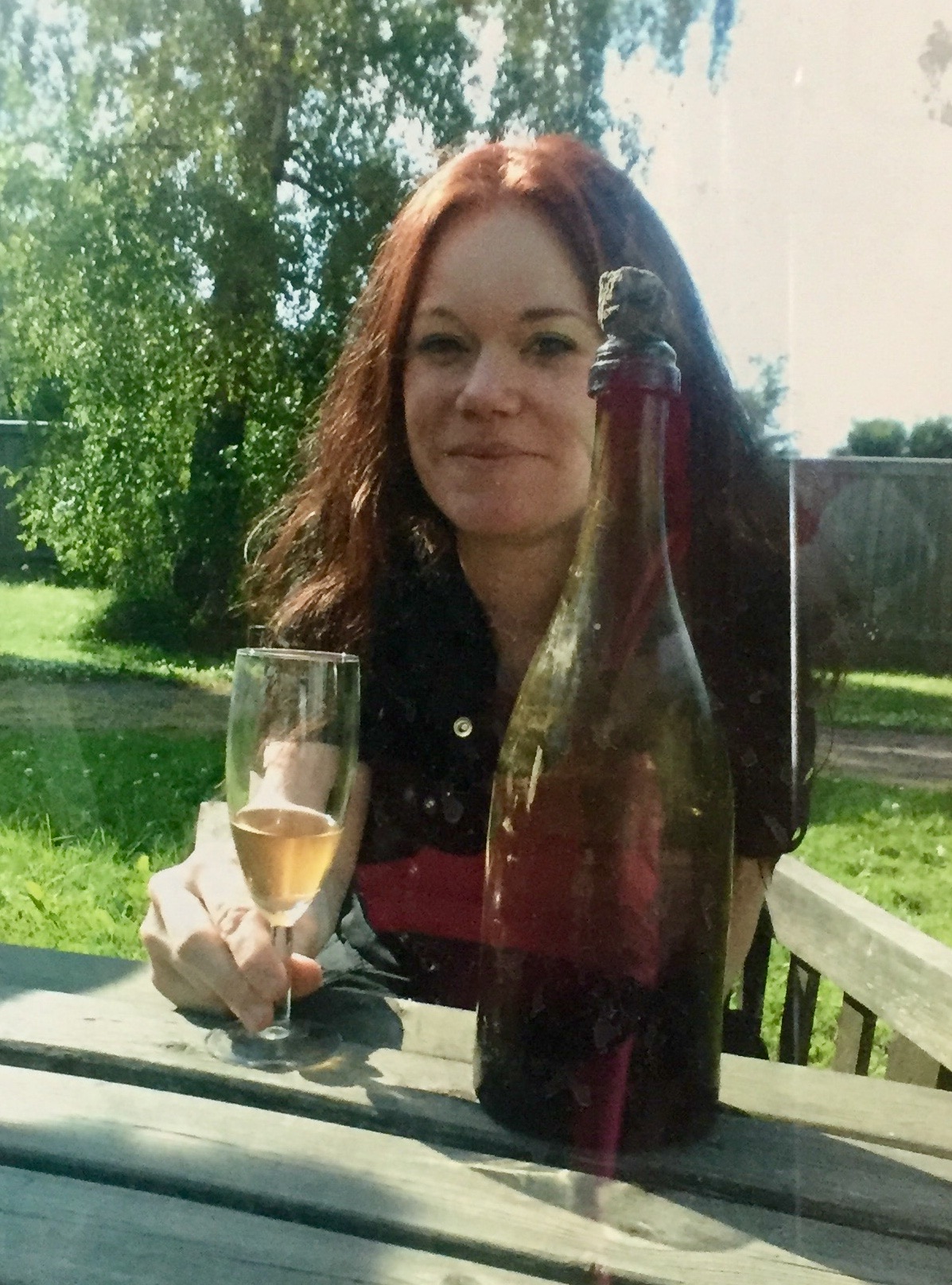
We just missed Martin’s wife Anna – 2010 photo from the local paper below.
IMG_0024
Anna sipping from a $50,000 bottle of Veuve Clicquot. Borrowed photo

Anna, a sommelier, is drinking the world’s oldest drinkable champagne, Veuve Clicquot vintage somewhere between 1841 and 1850. This bottle might have been sampled by Madame Clicquot herself, the French “Grande Dame of Champagne.” who would have been between 64 and 73 at the time. 

Another bottle from this batch later sold for close to $50,000 at auction.

So how did a local girl from Åland come to be drinking a $50,000 bottle of champagne?

It helps to live in an archipelago where there are a lot of shipwrecks and next to shipping lanes to historic courts like St. Petersburg. 

It helps too, if a particular shipwreck  carrying a particular cargo of champagne just happened to settle at a depth characterized by minimal light and temperatures ranging between 35 and 39 degrees Fahrenheit- Conditions pretty much perfect for preserving champagne.

And it helps if you are a local with good, curious friends who dive and like to party. 

This being Scandinavia there are all kinds of rules about shipwrecks, with government ownership front and center. This being Scandinavia there are local grey areas.

A local diver finds some bottles, brings a couple over to share with friends- not a problem, before anything is official. 

A media-twist later it’s a heart-warming world-class Saltvik tale, picked up around the world.

As the Smithsonian put the question,  “What does this stuff taste like?”

Martin said it was very tasty with tobacco overtones. 

A second bottle is still in the fridge. But don’t tell anybody.

Day 6  Sunday August 19 Saltvik to Vardo Island

Kvarnbo Gästhem is famous for their breakfasts. Ours didn’t disappoint. 

Kvarnbo Gästhem breakfast booking dotcom
Kvarnbo Gästhem’s breakfast – borrowed photo

The next morning, on our way out of town, we stopped at St. Mary’s Lutheran church. Sharon had visited earlier that day with Martin who is a church warden. He showed Sharon around.

One highlights was the silver Eucharist chalice from the 1300s – the oldest chalice in Finland. 

Martin had noted with amusement that it might be made of “hack” silver.  A Viking reference. Plundered silver was hacked-up silver. Value for the Vikings was weight not form. 

A Christian silver chalice made of Viking plunder, which may have been Christian in the first place. And perhaps nabbed from the Vikings before that.

St. Mary’s vicar was a 29 year old woman. Sharon said the blind organist singer sang like an angel.

IMG_0027

The Church is located in the middle of the biggest Viking graveyard in Åland, which makes a certain amount of sense, as this is the oldest place in the archipelago.

10,000 years ago there was no archipelago. The islands began rising after the last ice age when the weight of the glaciers was gone. 

First out the water was Saltvik.

The islands in the archipelago are still rising. Faster than sea levels. Faster than the erosion is wearing the islands away.  Up to 4 inches every 10 years.

Around the corner from the Church is Putin’s place. Yes, that Putin. It used to be Anna’s grandmother’s. The Russians grabbed it as war reparations. Many were, and still are offended.

So how does one tweak the nose of the macho Russian bear?

The Scandinavian solution was to set up a pop-up copy of the infamous Gay Bar from the movie “Police Academy” on the property, take a few photos, and post them on the internet. 

Mission accomplished.

comp-putin-island
Putin and his Blue Oyster Bar

The Russians were not amused. The perpetrators were brought into court. Charges were dismissed, though, by the local authorities. It was, after all, a brilliant tweak.

A half hours ride brought us to Kastelholm Castle, a Swedish-built medieval castle built in the 14th century. Time to practice stopping and seeing the sights. Off with the bicycle shoes and on with the sandals.

IMG_0028

We climbed up to the top of the ramparts.
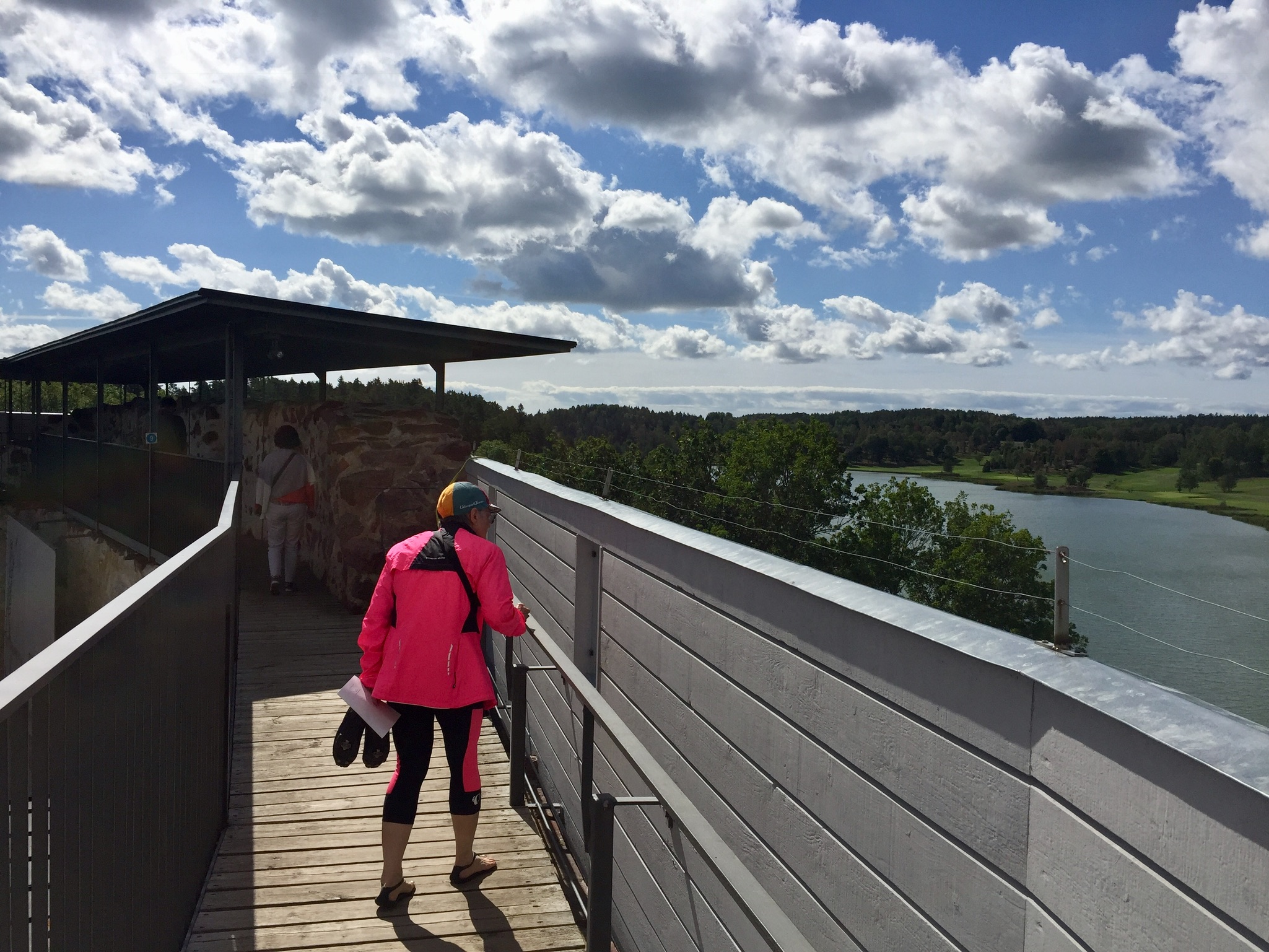
IMG_0029

Where we could look out across the rolling green landscape. A far cry from the water days of the 1300s, when the castle was surrounded by moats and sharpened stakes. 

Today it sits high and dry – 700+ years of uplift changes things. 

The interior courtyards and spaces were actually more interesting than the outside.
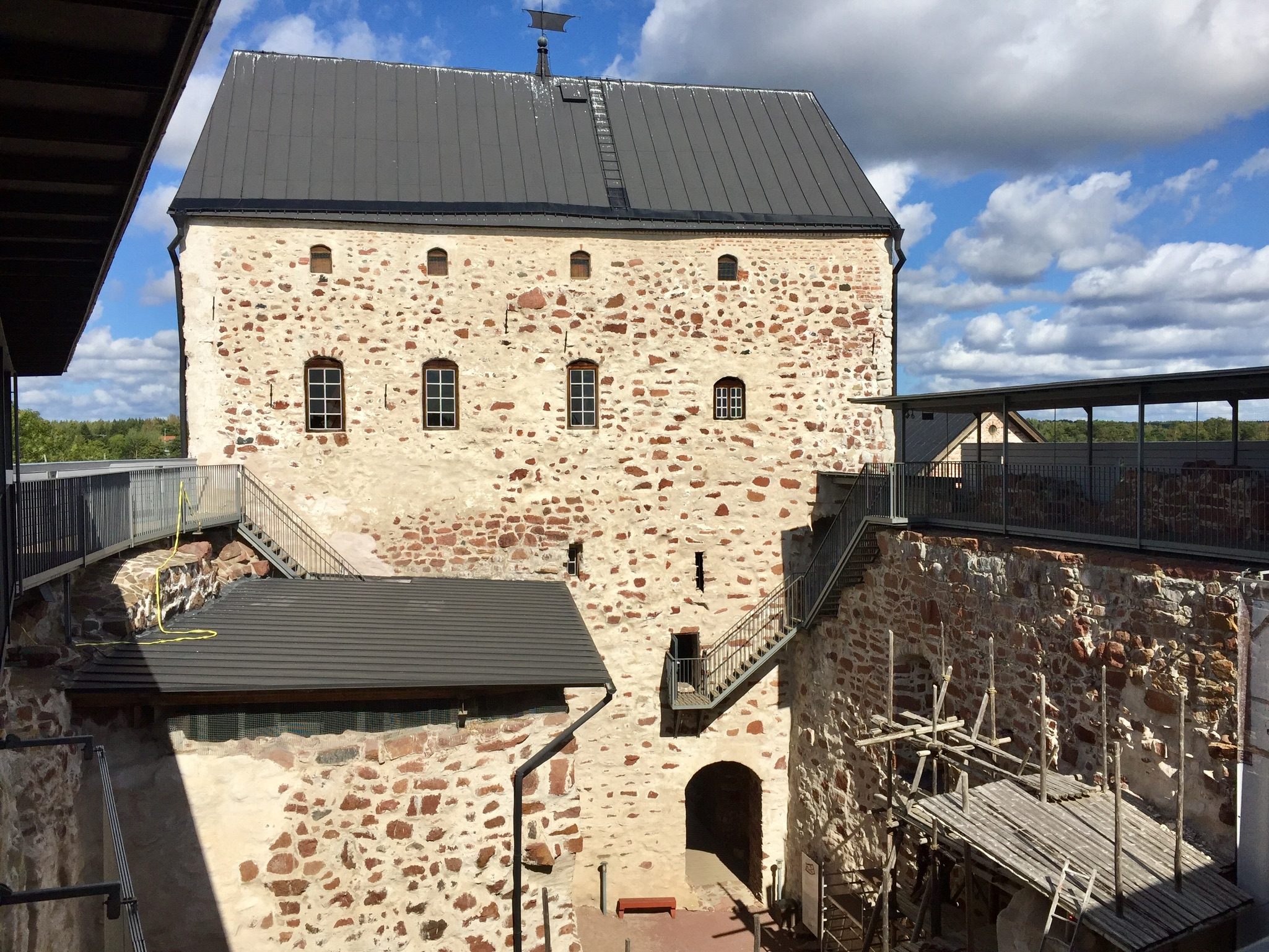
IMG_0031

One of the most compelling places was inside the inside – a small room on the third floor of the Kure tower, where Swedish King Erik XIV was imprisoned by his brother in the autumn of 1571. The official line is that Erik was insane by then. I have my doubts. 

Erik died 6 years later of arsenic poisoning, while imprisoned in another castle. 

Back on our bike we headed for Vardo Island. We had asked Martin about a place to stop for a late lunch/early dinner. It was Sunday and not much would be open. He checked and there was cafe/campground on Prästö Island that would be open.

“If you get to the ferry, you have gone too far.”

We crossed the bridge to Prästö and watched for cafes. We got to the ferry and doubled back. When we reached the bridge, we doubled back again across Prästö to the ferry. No cafe. 

On our next very slow pass back we pulled off at a clearly closed resort- just to make sure. There was one car. The owner had been running. We asked about our cafe. 

“Oh, that’s back on Åland across the bridge.”

We told our story.

“If you’re headed to Sandösunds Radhus, they have food”

News to us, and good news. 

Sharon had wandered over to a small roofed structure, the size of a big outhouse.

She reported that inside was a vending machine- for vegetables. Perhaps I should take a photo?

So regrets are born. I blithely replied,

“We’ll see others”

Well, actually no, and when I asked our Finnish relatives about such, they looked back blankly. 

The ferry to Vardo Island was a cable ferry pretty much exactly like the Ticonderoga Ferry on Lake Champlain between Ticonderoga, New York and Shoreham, Vermont. 

IMG_0032

We pulled into Sandösunds Radhus mid afternoon. Sandösunds Radhus is a resort on the far eastern edge of the Åland archipelago. Not much out here. 

We checked into our room – a bit like a USA Motel 6 with a green sod roof .

IMG_0033

Our casement windows, at first glance, were nothing special. 

However on closer inspection they were, hands-down, the most impressive we saw in Finland. Operable, built for extreme cold, with many insulated glass panes working like pivoting parallelograms, sealed with multiple weatherstripping gaskets. 

Besides our motel-like home, Sandösunds Radhus had floating saunas, a campground, a hermit cottage, a chalet, mini-golf, swimming, kayaking, bike rentals, a restaurant and behind us a super-sized teepee. 

Here in the middle of nowhere on the edge of the Åland archipelago, at the end of a gravel road, the owner was clearly having fun as a self-styled entrepreneur.  Our age-ish with plenty of pep.  

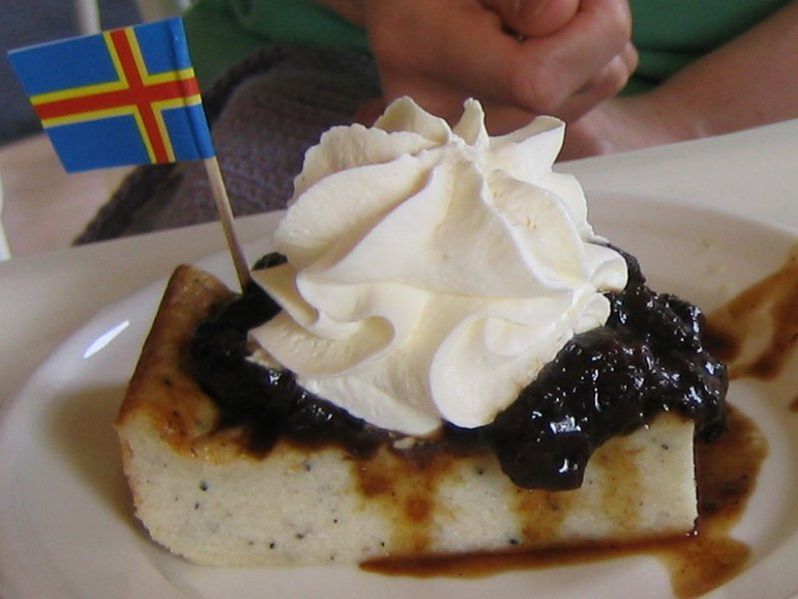
After unpacking we headed down to the campground restaurant for dinner. Sharon noticed Åland pancakes on the menu. She knew them from her Swedish studies – a signature dish of the archipelago. Not to be missed.

Once served, we recognized them. Having had them twice before. Previous incarnations had been small baked rice pudding pastry bars with a fruit topping and whipped cream. A sure-grab for me at a buffet breakfast, but … 
798px-Aland_pancake
Åland pancakes – borrowed photo

This time around they were bigger, thicker, and less professional. My guess an old local recipe. Not particularly sweet with a touch of cardamom. A bit foreign – in a good way.

The young woman running the register was clearly not a local. Sharon asked. 

“Oh I’m from the Philippines. In the winter I work in the ice hotels up north. Summers, I come south and work here.”

Sheesh. The Philippines are close to the equator. We were standing at 60 degrees north latitude, about the same latitude as Anchorage Alaska.

And yes, the ice hotels are much further north, made of ice and snow, and have to be rebuilt every year, since they melt in the summer. 

Purportedly excellent for viewing the northern lights in the dead of the arctic winter. Now on our non-bicycling list.

Our next day was going to be a biggie- crossing from the Åland archipelago to the Turku archipelago. 

The morning ferry from Hummelvik was a must-catch, departing at 9:30. We were about 6 miles away. No problem, if there were no problems. We turned in early.

Next: The Turku Archipelago & Mathildedal [add new link. This is old]
2017 Italy on a Tandem

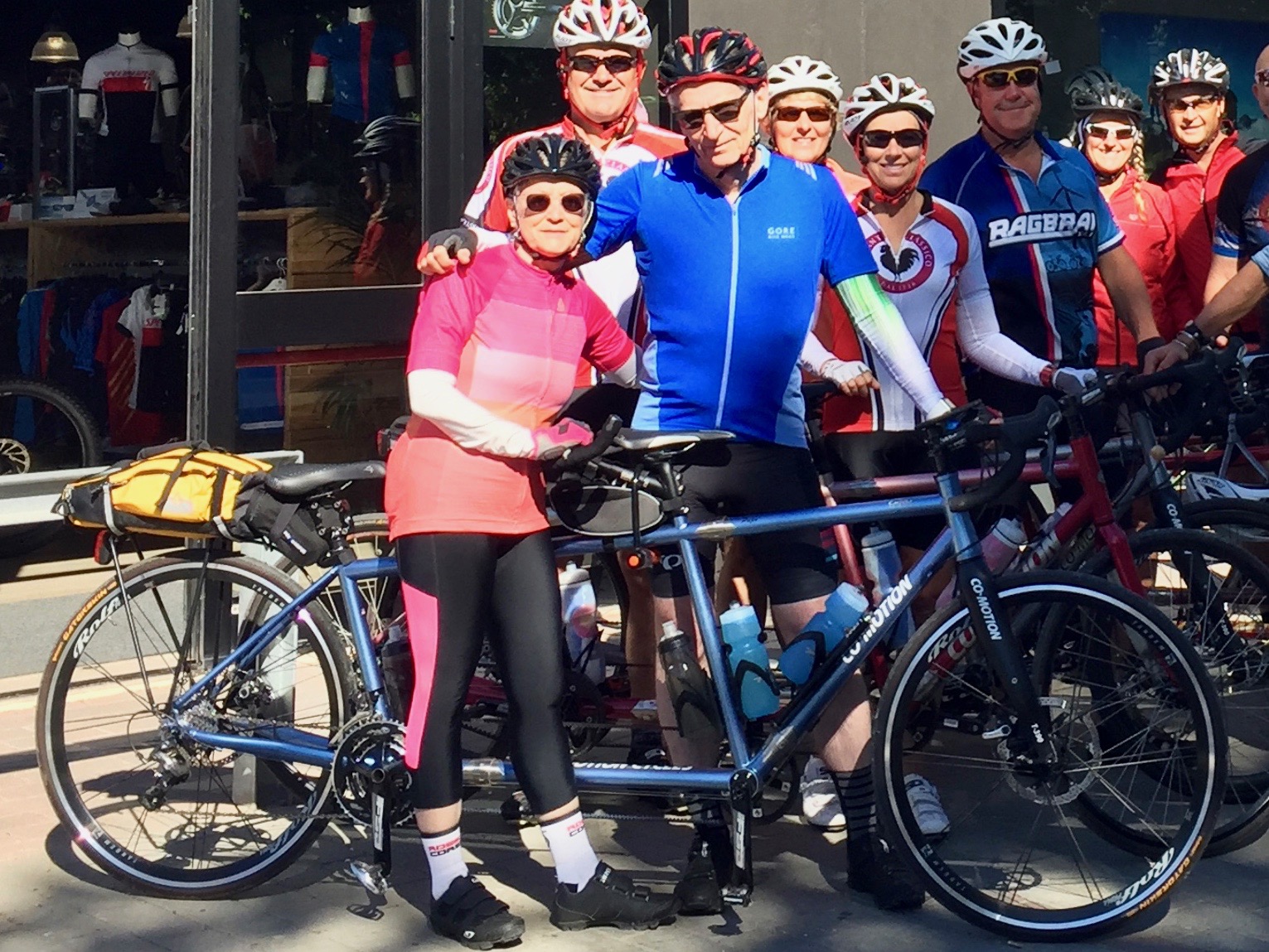
Italy pose & bike

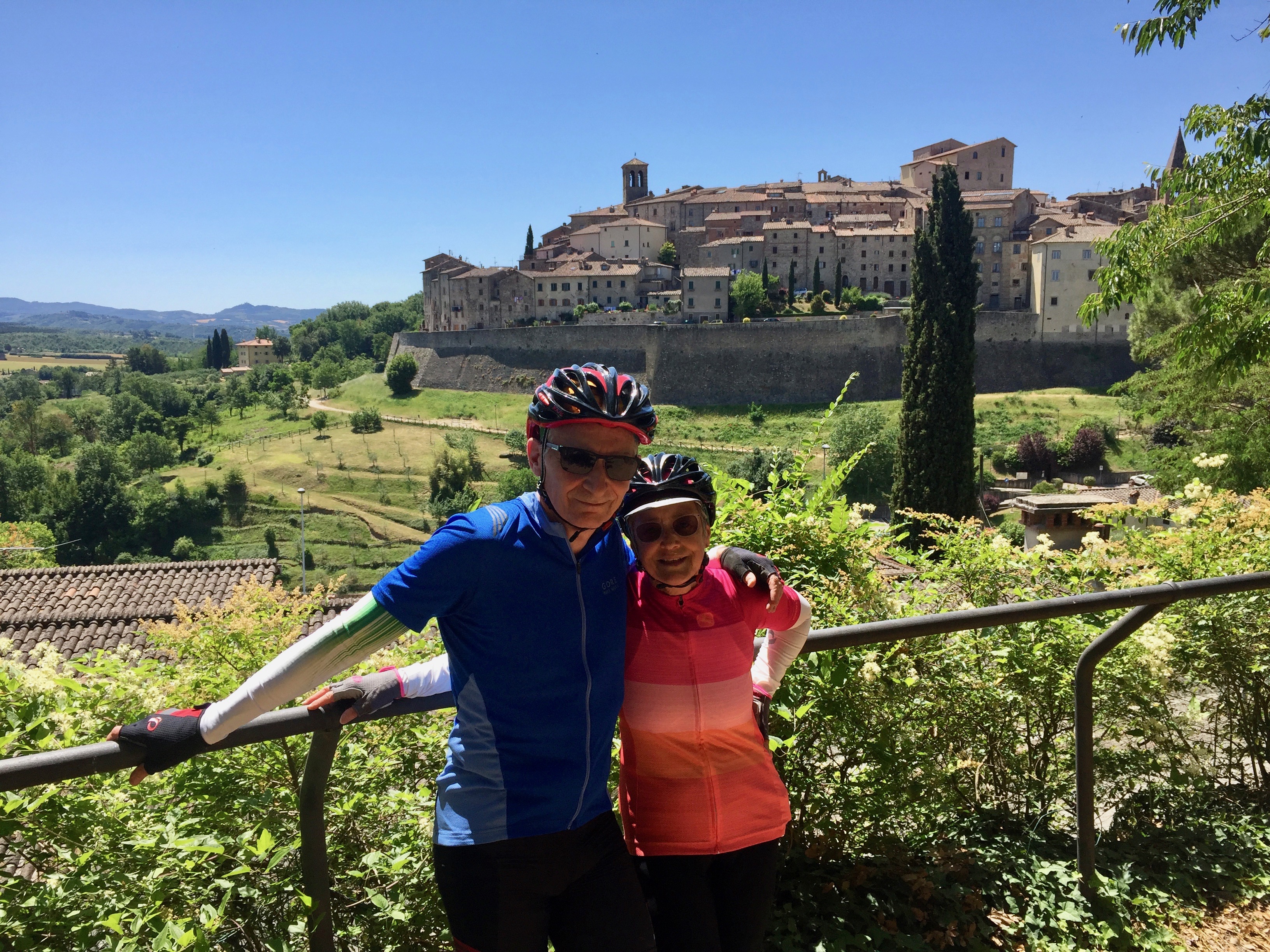
The plan had been to borrow a tandem. See if we liked it. Try a short local tour. Buy our own tandem. Build up the miles and eventually celebrate with a tandem tour in Italy. A perfectly reasonable 3 year plan.

On the other hand, we could just order a tandem.

grandpa pig.jpg

Put down a deposit on a European tour. Borrow a friend’s tandem. Have it rebuilt. Wait for the ice to melt. Learn to ride between snow storms.

Take delivery of our new tandem. Ride the 5 Boros of New York City with 32,000 other bicyclists. And celebrate our survival with a ride across Italy 3 weeks later.

In character, Grandpa Pig, “Snort”, went with option 2.

And survived. Barely.

Sharon graciously agreed to try to learn Italian for the trip. I had no doubt 4 months was plenty of time. Sharon rolled her eyes.

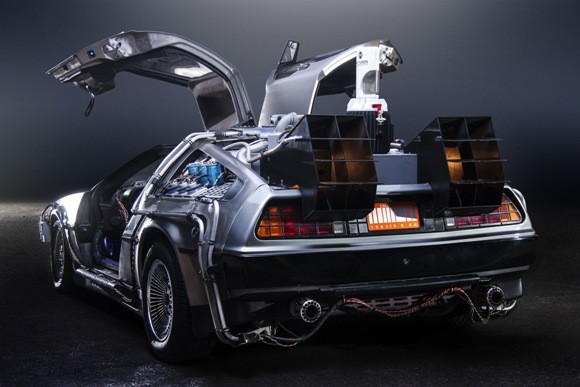
The Burley Rumba – Back to the Future

d964999.jpg

We ordered our Co-Motion Carrera Tandem towards the end of January. Delivery date Mid April.

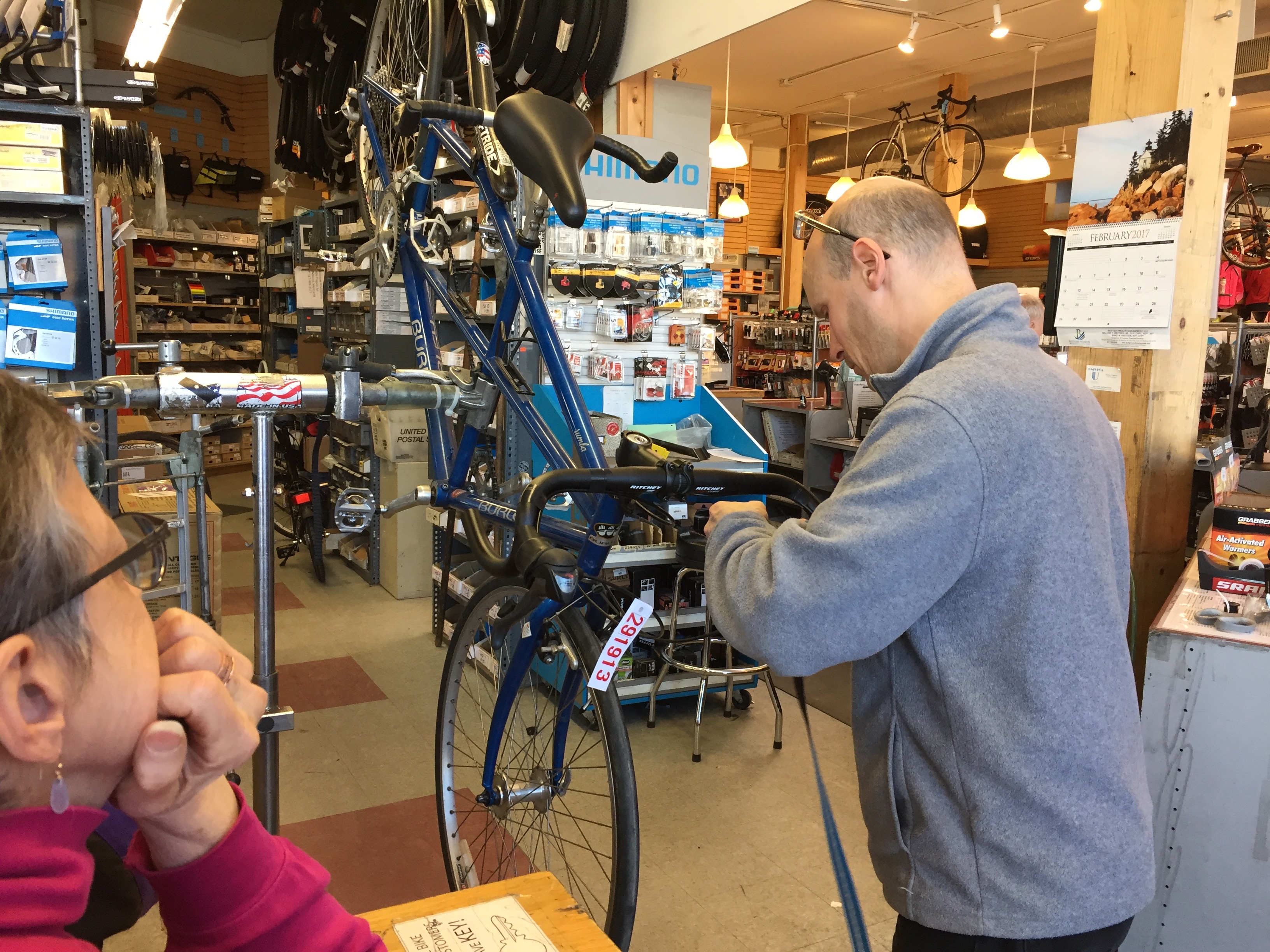
Friends had a Burley Rumba Tandem in their basement- untouched for a decade+. Dreams unfulfilled. They most graciously offered to loan it to us.

The Burley needed some work.  One makeover later, we had a new old bike:

Burley

“New shifters, old derailleurs (the compatibility chart is 3 pages long), running 8-speed shifting with only 7 gears (it’s a 7-speed rear wheel). Road brake levers with Canti brakes…  I came in ready to rebuild a tandem and see just how many things don’t work together – standard practice.

This is where it gets weird, everything worked.  Perhaps a little too well,

I was expecting to have to replace the 7-speed chain with an 8-speed, but I didn’t.  All of the cables were showing rust, so I changed all of them. The shifting and the brakes worked like a new bike right out of the box.”

Back to the Future.

Riding a Tandem – Never ever dump the Stoker

Riding a tandem is different than riding a single bike. A tandem is longer and heavier and balance isn’t the same.

Then there is the division of responsibilities, the challenge of synchronicity and the not-so-minor issue of trust.

There is an old saying about couples and tandems:

Wherever your relationship is headed, a tandem will get you there quicker!

Ed gave us the 15 minute beginners crash course in a parking lot across from the shop. Conclusion: Sharon was a natural stoker (2nd seat) – no fear, no wobble.

Yours truly, the captain, had a steeper learning curve ahead. Steering, braking, shifting and balance on stops needed work.

Ed summed my responsibilities up: Never, ever, dump the stoker!

Mid-March, we rolled the Burley a quarter mile across a snowfield to get to our first ride around a local pond.

Our Co-Motion Carrera – You must like to ride fast

Our Carrera tandem arrived right on schedule in April. A most beautiful bike. Complete with custom lettering: Advencha before Dementia and our grandparent names by the seat posts: Amona and Papo.

We had picked metallic blue. A nod to the color of the full metal jacket of the main character in the Japanese SF novel All You Need is Kill.

Carrera Specs:

• 700c wheels with rack and fender mounts

• Reynolds 631 steel tubing

• Dual disc brakes and Shimano Ultegra kit

• Tapered headtube & carbon tandem disc fork

• Rolf Prima tandem disc wheels

• Gates Carbon Drive timing belt

Gary, who put our tandem rack on our old Audi, took one look at the bike and noted:

You must like to go fast!

I didn’t understand then.

I do now.

NYC 5 Boro Bike Tour – If they get in your way, run them over

We were going to NYC to visit our son and his family- the same weekend as the 40th 5 Boro Bike Tour. 40 miles through 5 boros, NYC route streets closed to cars. I figured we could handle it.

Ed wasn’t quite so sure. The distance didn’t worry him. The other 32,000 bicyclists did. Especially the congestion at the start. His advice on how to deal with on-street aggression:

If they get in your way, run them over

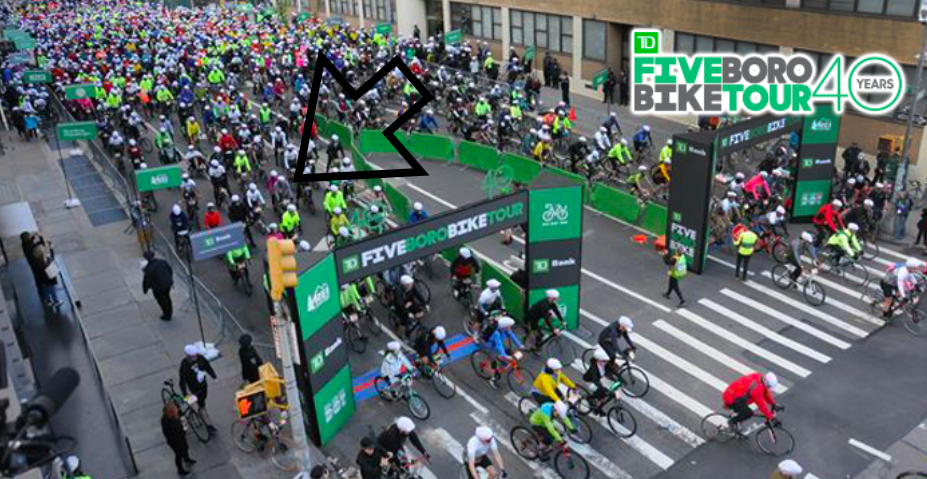
Here we are in the official start photo. We were upfront because we had VIP tickets, the only ones available when I signed us up.

Screen Shot 2017-07-06 at 4.38.58 PM

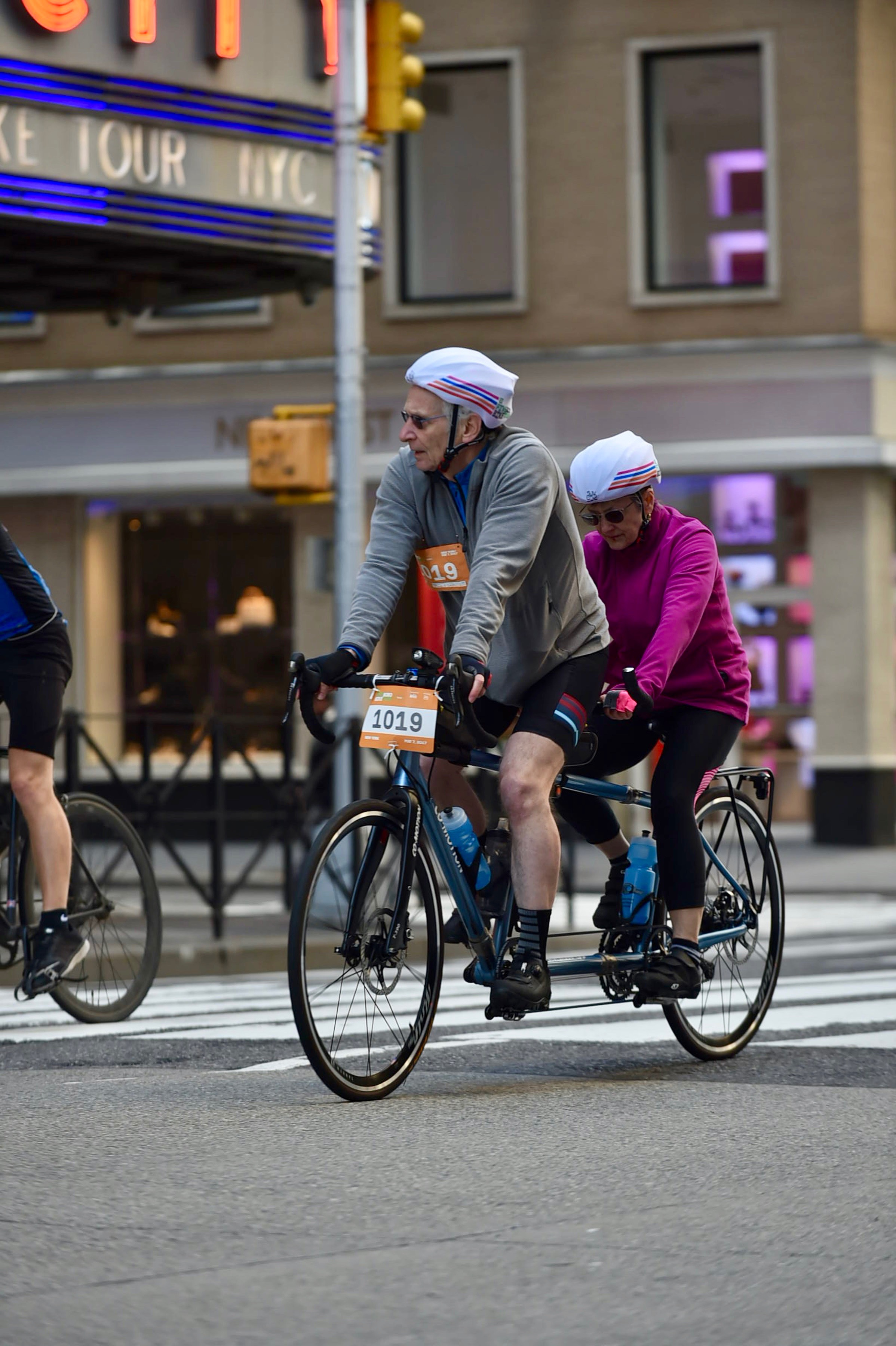
As it turned out, we had no problems with other riders or the official tour.

5 boro on bike

The most challenging part was the last few miles back to our hotel in the rain.

The first stretch post-tour was the 4 miles back to the Staten Island Ferry.

No problem there, with the ice-cream and party favors.

Manhattan on a tandem, mid-day, in the rain, was another matter altogether.

We used Google Maps Bicycle with turn-by-turn directions.

Which kind-of worked, except that the traffic noise drowned out the audio and I couldn’t read the screen.

And then the rain hit.

The dodgiest moments were the wet steel plates over excavations, in traffic, on curves.

Back at our hotel we walked dripping across the lobby, swung the tandem vertical, rolled into the tight elevator and breathed a sigh of relief.

One test down. Next up Italy. But first we had to pack our bike.

bike packing

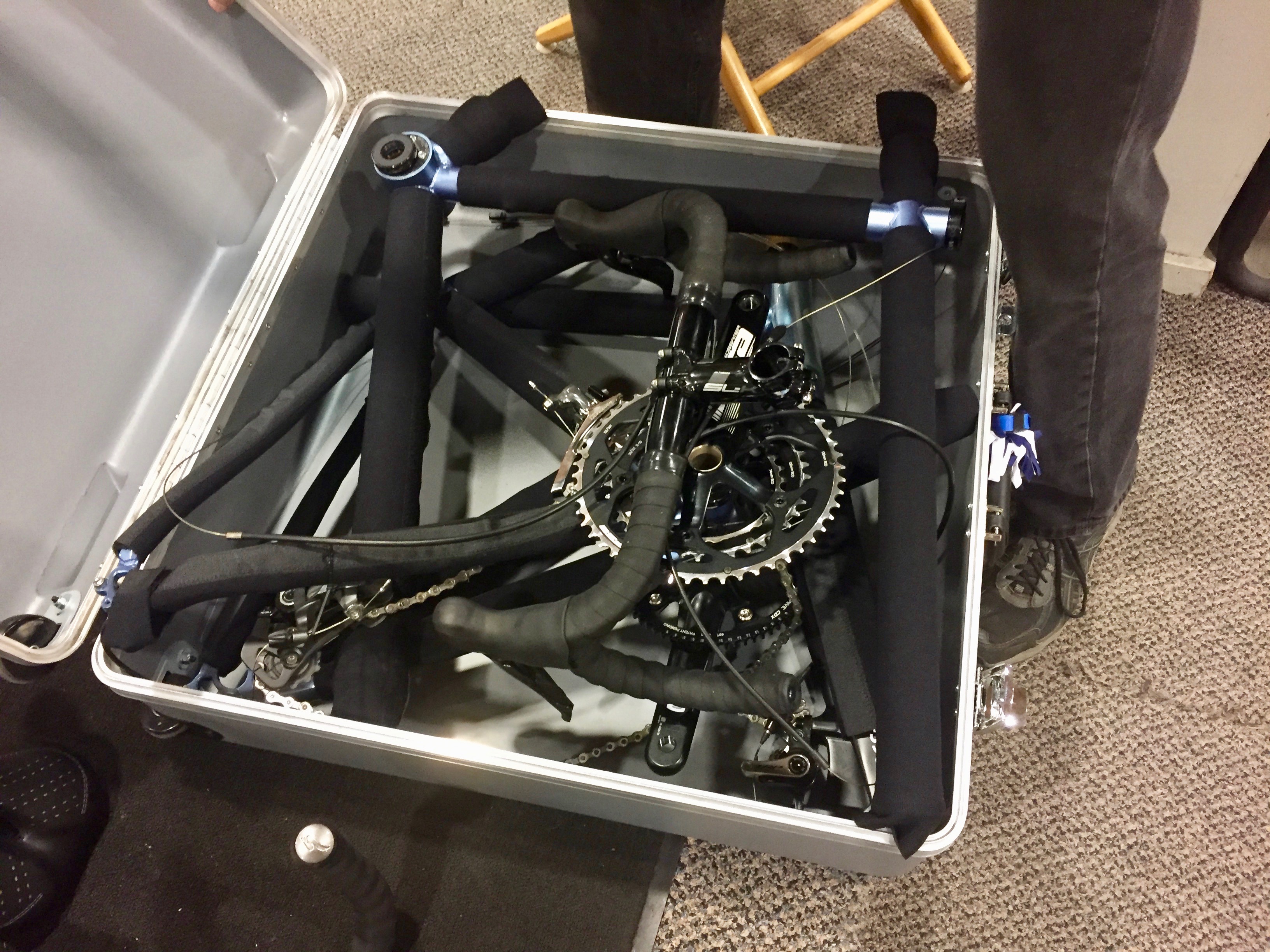
We had ordered our tandem with couplers so it could be taken apart, put into two standard-sized suitcases and checked as regular luggage.

The not-so-minor wrinkle was that the entire bike had to be disassembled.

And then put back together on arrival.

I figured I’d have time to master the process.

Not a chance.

With Ed’s help, the cases were filled and –  by a hair’s breath – latched.

I looked at Sharon. She looked at me. it was understood. We weren’t opening them again until Italy.

Then TSA got ahold of them. Then Air France lost one – for a while.

Italy

We flew from Boston to Florence with a transfer in Paris, where we ran a couple of miles to catch our plane. We would have missed it, but the pilot was late. We were last on- across the tarmac and up a mobile stairway.

We almost landed in Florence the first time. Pulled up 100′ from touchdown. The second try, we just flew around circling hesitantly. The third time we touched down.

The announced explanation was that winds were the problem. The whispered version had the pilot intimidated by Florence’s short runway.

In any case, he did hit those brakes hard.

When the Florence baggage carousel shut down, we were one case, or 1/2 a tandem short.

1/2 a tandem is less than nothing, and Italian bureaucracy only promised to deliver- eventually, so we camped out.

Thankfully the missing case arrived 2 hours later on the next flight from Paris.

By then the rest of the tour group had left in the fancy bus for Spoleto. We followed in the support van with our Italian guide Giovani.

Our tour would take us up through Umbria, across Tuscany, finishing in Liguria on the Italian Riviera. All by tandem.

Italy Map

There were ten other tandem couples on the tour including our tour leaders. An interesting group – early 50s to early 70s. All, except us, seemed tough as nails. Fast too.

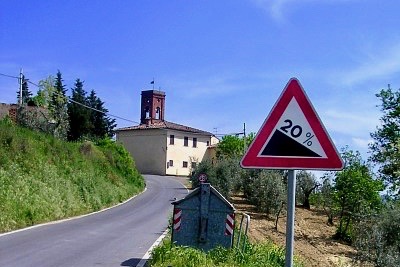
20% (1)

We kept up just fine on the flats, but the serious climbs were something else altogether.

20% grades we walked.

In total we rode over 350 miles and climbed over 20,000 feet.

There were no grade signs posted on the toughest stretch of our most difficult day.

Probably a good thing.

Arrezo to Villa Lecchi was 57 miles with 4530 feet of climbing, most of which came in 4 miles.

There’s a reason they call them “Hill Towns.”

Umbria

We had been up almost 24 hours when we rolled into Spoleto from the Florence Airport. Mr Sun was setting. Sharon needed to lie down. In a fog, I reassembled our bike with critical help from our tour mechanic.

Note to self, do yourself a favor next time and schedule a buffer day on arrival.

Spoleto is in Umbria, the only Italian region having neither a coastline nor a border with other countries. We liked Umbria.

Umbria was the pleasant surprise of the trip. Not as refined as Tuscany. But every bit as interesting and beautiful. Far fewer tourists too, though the roads were a bit rougher.

Small price to pay.

Spoleto

Our first day we did a short-ish loop ride out of Spoleto.

I would guess some of the climb was over a 10% grade.

Just about killed me.

At the bottom of the descent, right before this pic, I just about dumped Sharon when I misjudged my footing.

We’ve all done it, the others kindly said. For the rest of the trip the memory lived on in my left side.

Assisi 2

Our next stop was Assisi. Home town of St. Francis.

Sharon and I took the day off, as most of the others went off for another loop ride.

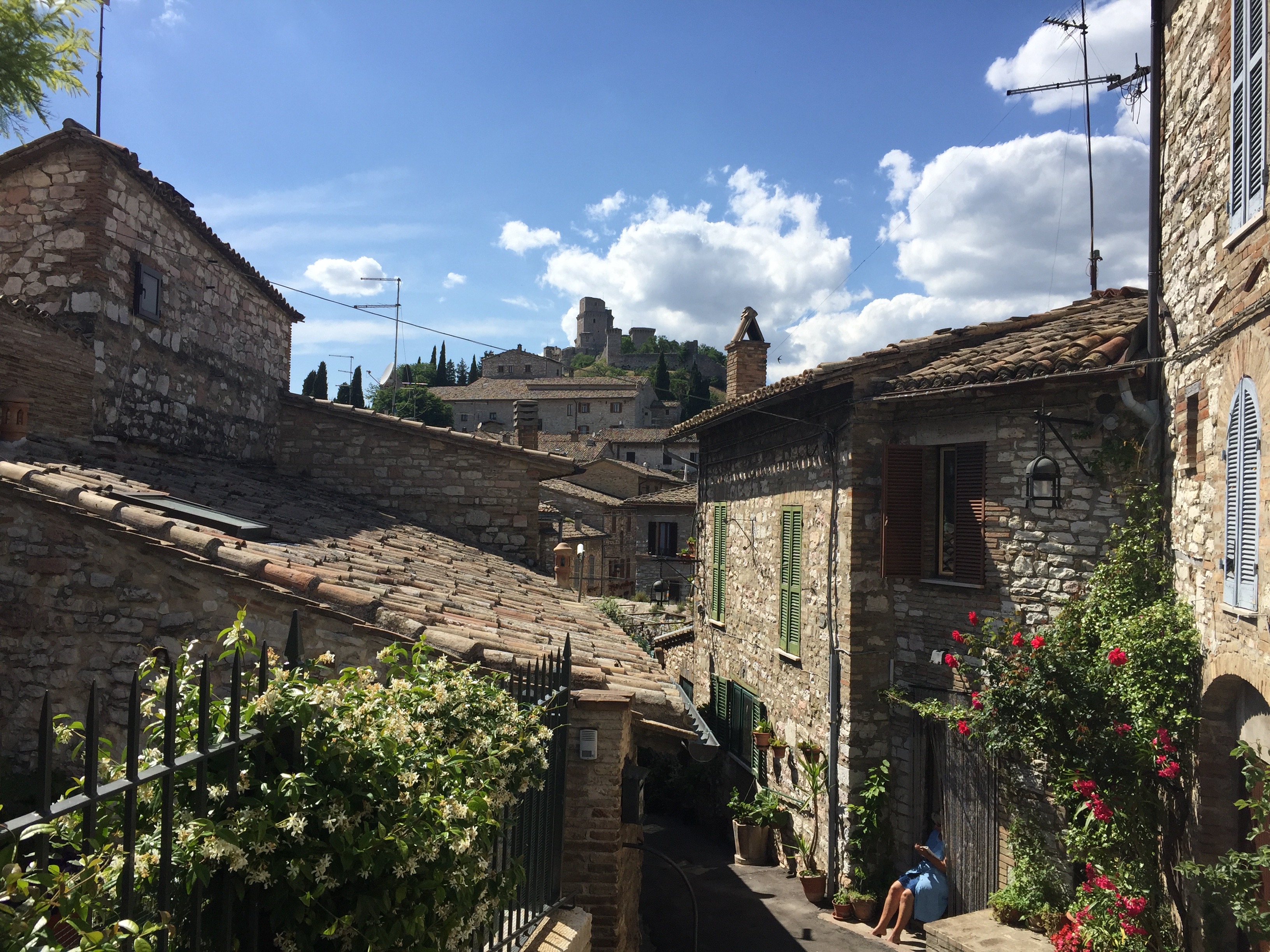
We had a great time wandering the narrow medieval streets.

Lost, we were making our way back up towards one of the towers along the perimeter wall.

Through an iron gate we caught a glimpse of a red Lamborghini parked cockeyed in amongst olive trees. A metaphor or sorts for today’s Italy.

Assisi basilica

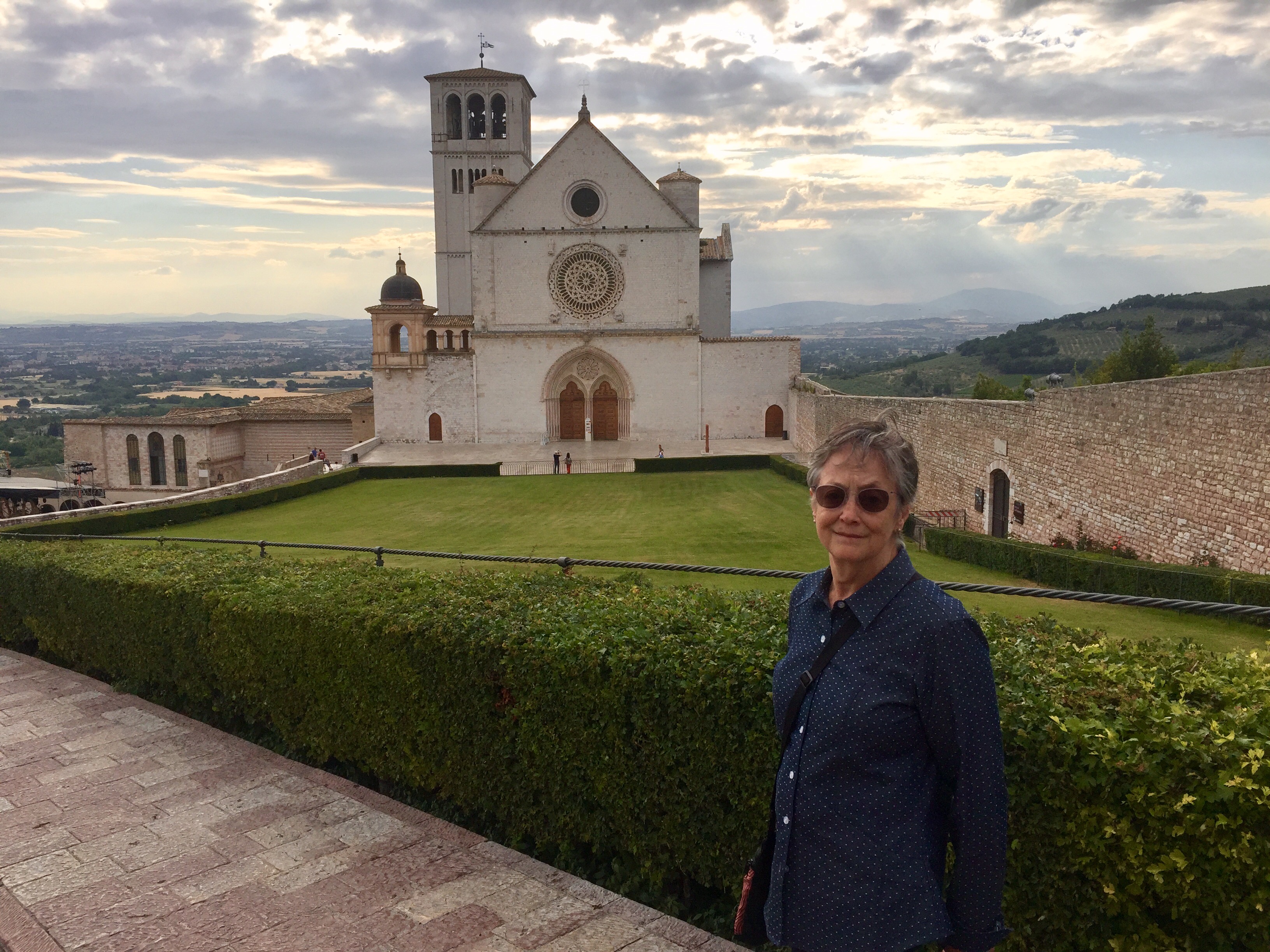
A local tour guide took us through the Basilica. Photo to the left.

Sharon loved the guy. He knew his history.

Afterwards Sharon went up and thanked him, somewhat extensively in Italian.

He looked a bit shocked and said,

I didn’t know you spoke Italian. 

Afterwards, Sharon explained to me,

I can’t say much, but what I say I say well. Yup.

Assisi hotel

Our hotel was drop-dead gorgeous. Once a nunnery, it was slated for condos until Roman ruins were discovered underneath.

The Roman ruins have been preserved as part of a spa and the whole place done over in High Italian Modern.

On theme, the female receptionist wore an impossibly tight, short skirt and dangerously high heels. Food was fabulous.

Assisi was the favorite of the trip. Layers of history. Wonderful views. Interesting all around. Would go back in a second. Our room was behind the last two windows at the corner in the photo above. We had our own private interior stair. Great views.

Tuscany

If Umbria was our initiation, Tuscany was the tease.

IMG_2082

We rode by many fantastic-looking towns. Anghiari above.

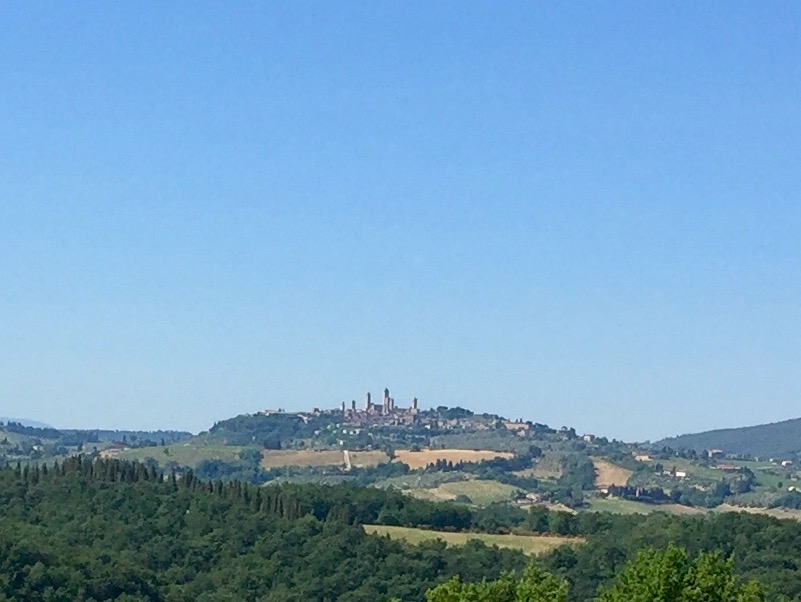
The epitome was San Gimignano. City of Beautiful Towers. One of the best-preserved medieval towns in Tuscany.

IMG_2105

This is as close as we got. Perhaps we’ll get there some day.

We spent our second night in Tuscany at Villa Lecchi, a restored 19th century residence in the middle of nowhere. Site goes back at least to the 900s. Below.

Villa Lecchi
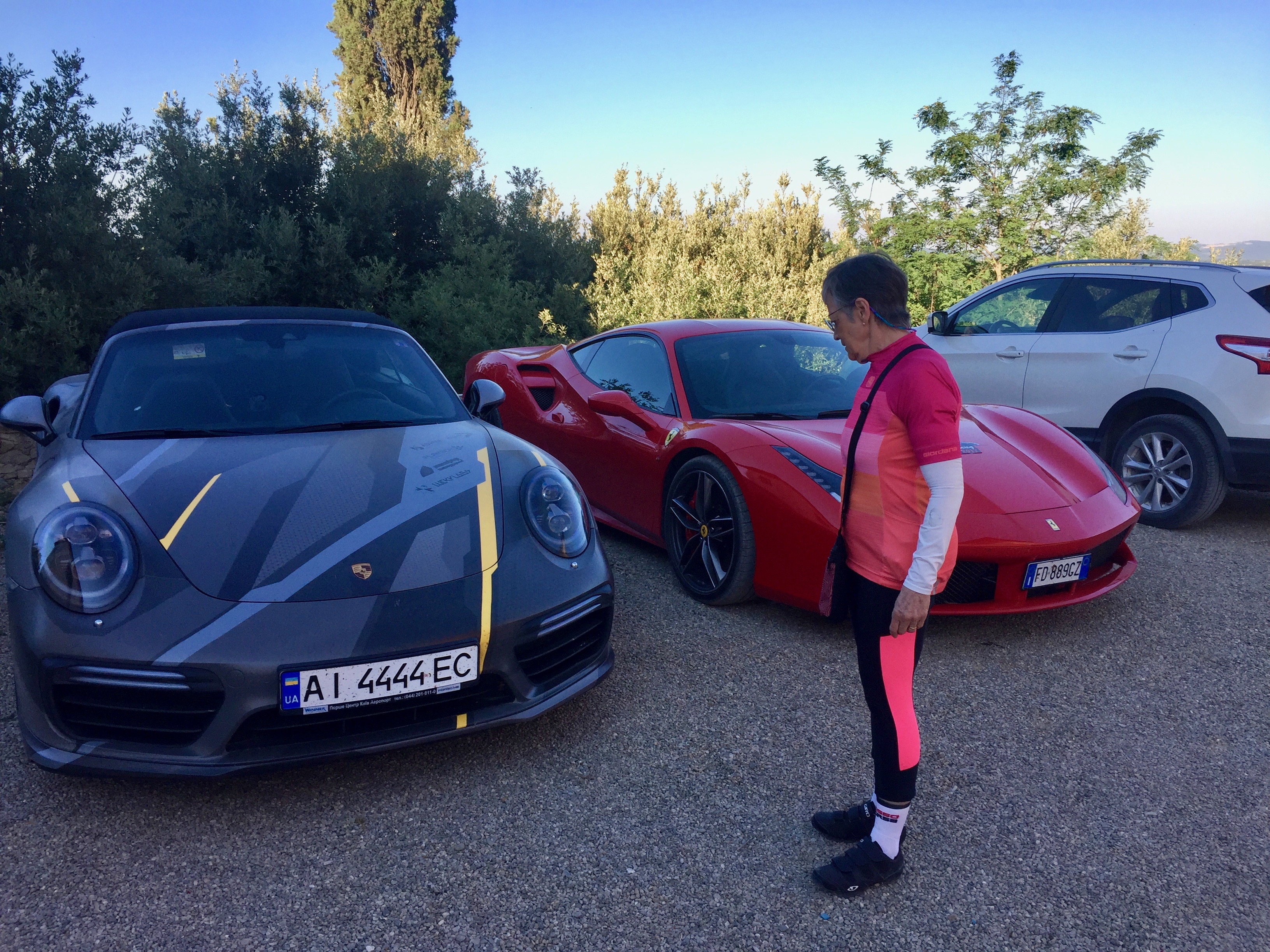
Ferraris

The Russian Ferrari/Porsche crowd likes Villa Lecchi.

Here is Sharon checking out their wheels.

On the way in our GPS acted up. We were alone and lost.

We flagged down a local in a dust-caked, old battered car.

Zero English. No surprise there.

He and Sharon had a very Latin, animated, convivial, loud conversation in Italian.

A very entertaining travel moment, & his directions were good.

We stayed 2 nights in Lucca, with a loop-ride to Pisa. Lucca is a sophisticated historic town. Narrow winding streets with high end shopping in every direction. Great gelato.

Pisa

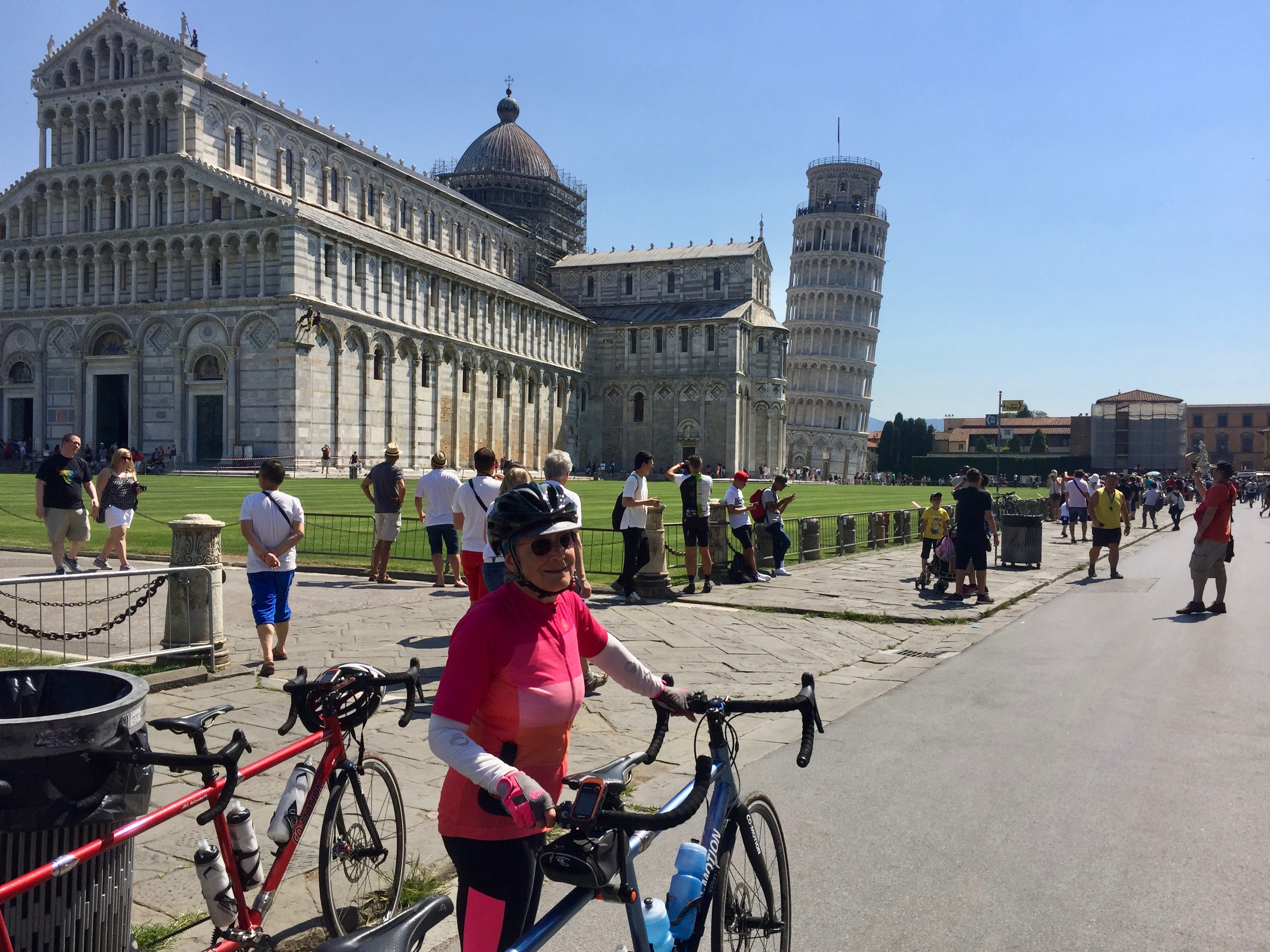
Pisa, on the other hand, was overrun with tourists. As we approached the Piazza del Duomo, there was no room to ride. We walked our bikes. The guards wouldn’t let us even lean our bikes against the wall. After 20 minutes or so, we headed back to Lucca.

Nonetheless the Piazza del Duomo, with the Leaning Tower is a rather remarkable place.

The next day, we rode our last stretch from Lucca to the coast and up to Lerici, Liguria and the Cinque Terre on the Italian Riviera.

Liguria

We rolled into Lerichi on our own, a bit worse for wear. We had blown a tire and then dropped behind on the climbs. The good news was that Sharon had mastered our Garmin GPS, so on the way in, we knew where we were and where we were going.

We could take our time.

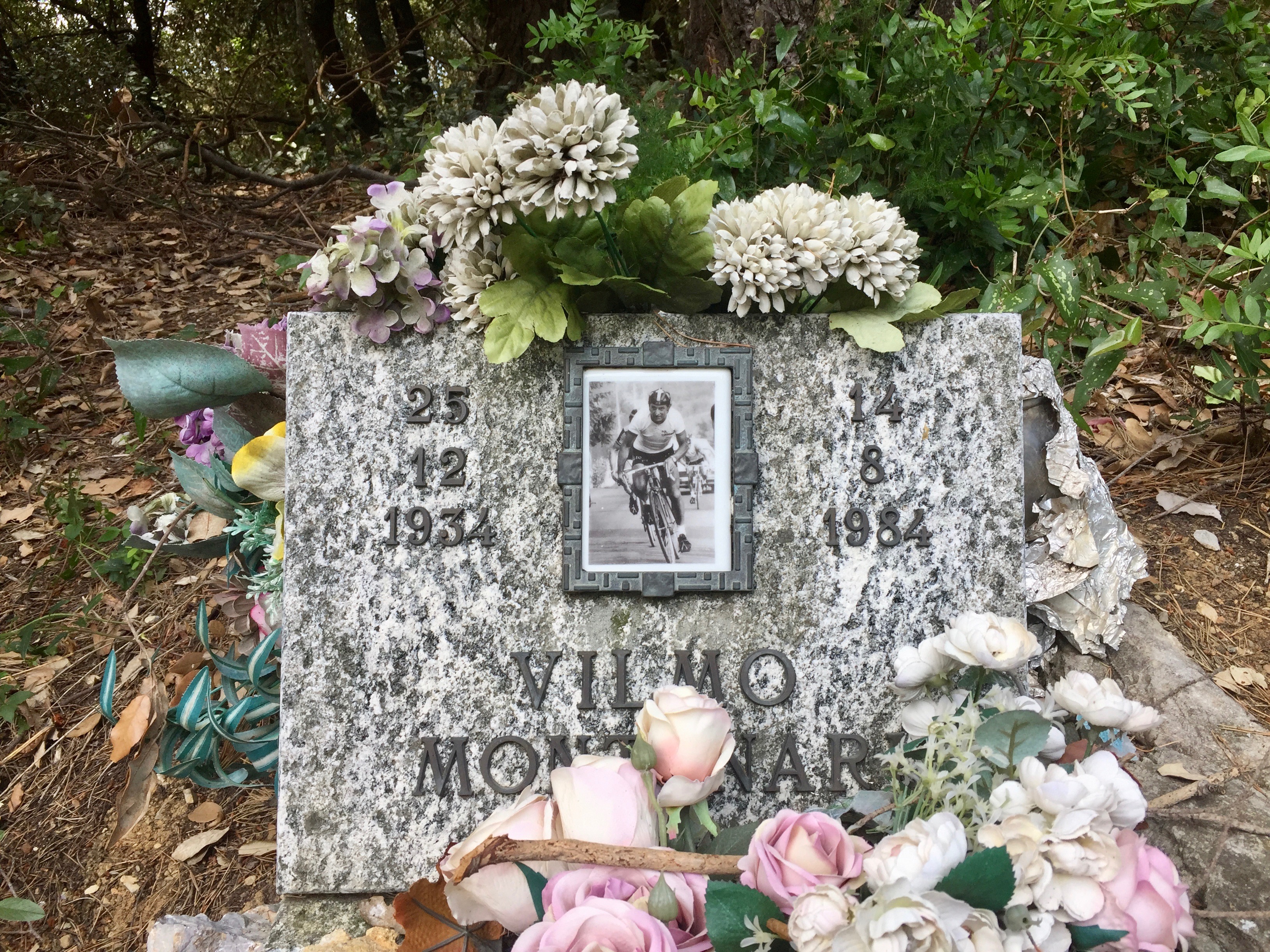
As we were walking our bike up through a series of steep switchbacks, we passed this memorial to Vilmo Montanari. We have no idea of his story, but it seems his life ended here in 1984 age 49, most likely on a bike, and clearly some folks still care. A poignant moment.

Note to self: Take care on those tight corners.

IMG_2161

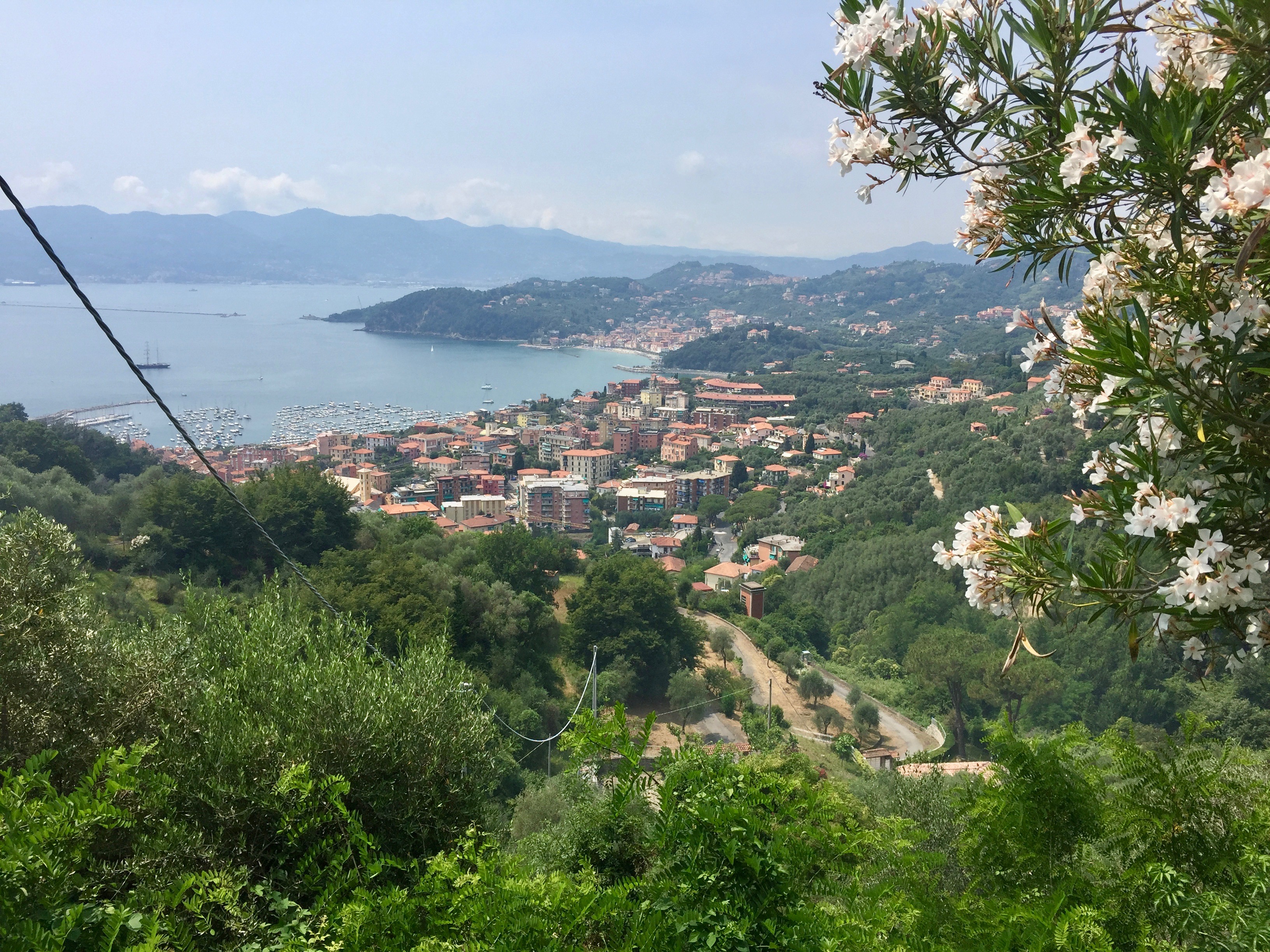
We reached the top of the climb and headed down. We were high up with views out over Lerichi to the sea. A great way to end the tandem part of our trip.

High Lerrichi

The tandem wrap: This tour was a stretch for us beginners- a tandem intensive, if you will. After riding with a fast, experienced crowd we now know we have a lot of work to do and miles to log. Spin classes are fine and well, but no substitute for time on the road.

The rough plan is to try to ride a minimum of 1500 miles in the next 12 months, and learn climbing techniques. And then ride the Finnish Archipelago next year.

My Mother passed this year and asked that her ashes be thrown into the Baltic Sea from a particular rock in Hanko Finland. We could bring the tandem and ride to Hanko down through the Finnish Archipelago from Turku.

Suspect Mom would approve.

Cinque Terre

We still had a day to explore Cinque Terre – an Italian national park and World Heritage site comprising 5 villages and surrounding hillsides. No bicycles for us, just a relaxed ferry cruise up the coast.

Untouched by time. Odysseus would know his way around this coastline. We joked about Cyclops popping up and throwing boulders at the ferry.

The villages were impossibly picturesque and choked with tourists. Rick Steves described the Cinque Terre as “one of God’s great gifts to tourism.” An edgy comment for Rick, but perfectly put.

Florence

Florence

Our tour dropped us off at an airport hotel in Florence mid-day.

Check-in wasn’t for a few hours.

What to do with our spare time?

The obvious solution was to catch a taxi into Florence and see the sites.

But where to start?

The young woman at the tourist office had a 3 hour plan.

“Don’t go in anywhere. Just walk the city.

Here’s a map. Here is a route. Come back to Florence, when you have more time.”

Wise advice.

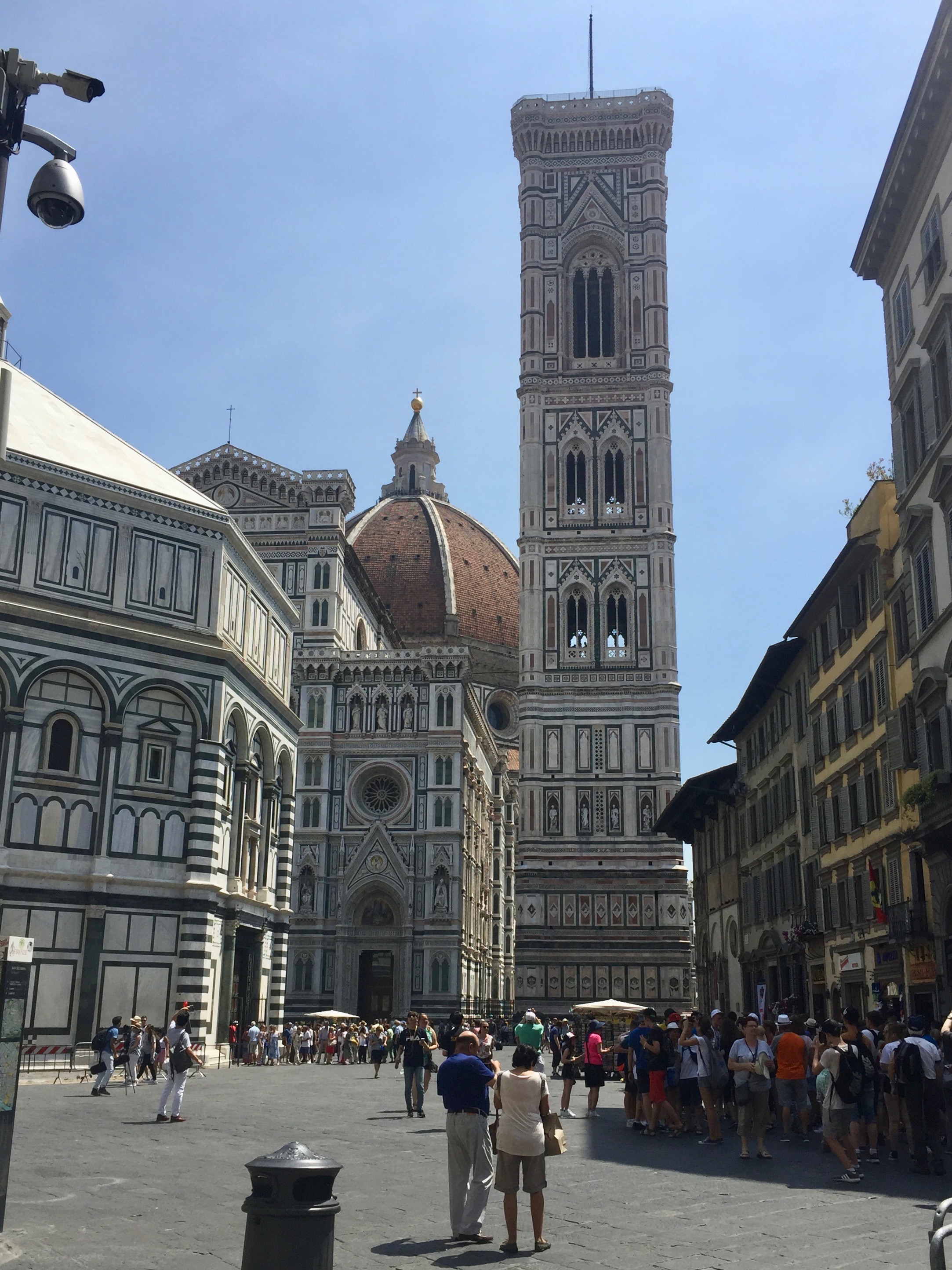
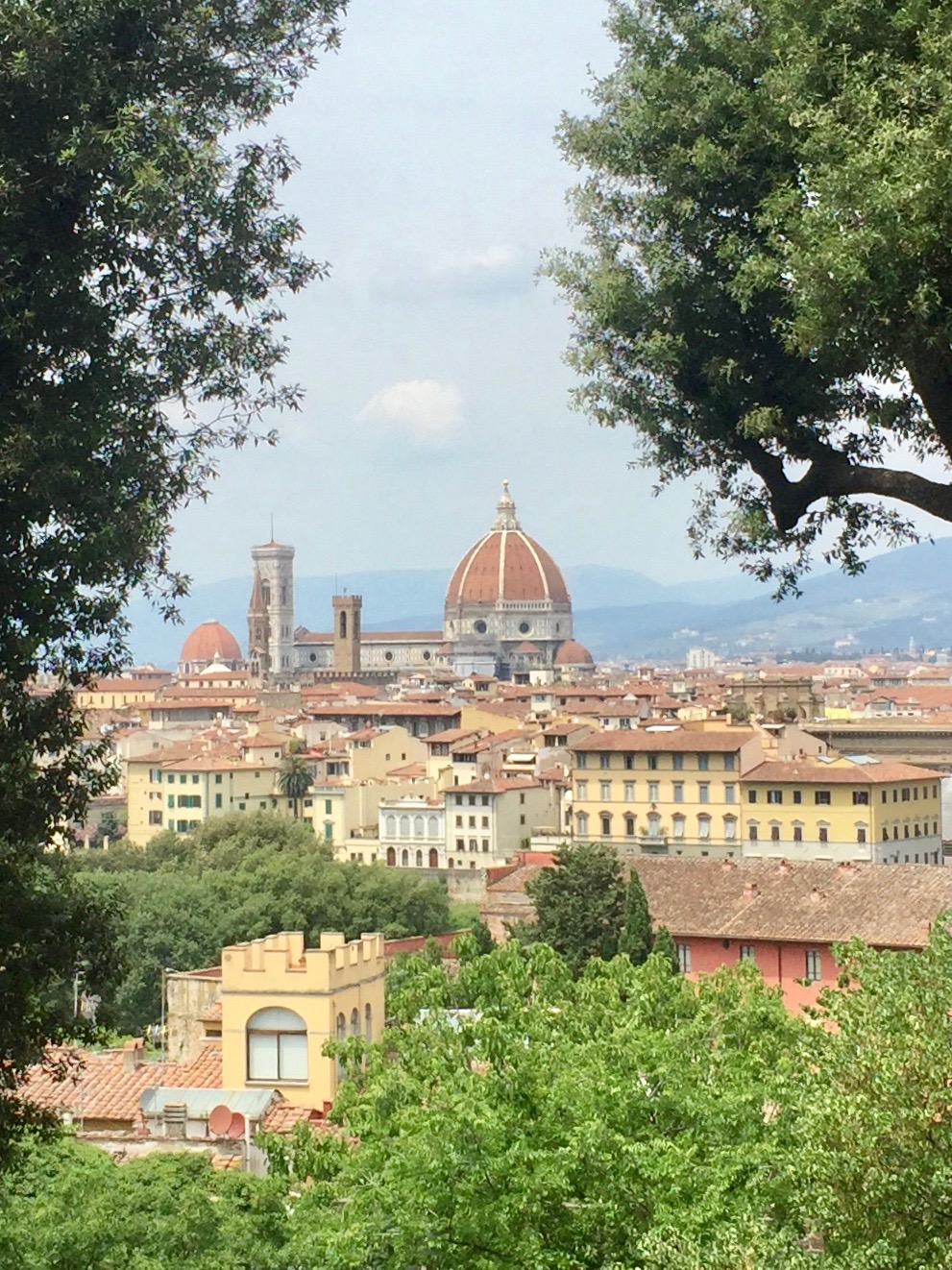
We circumambulated the Duomo and Baptistery, then headed to the Piazza Della Signoria to see a replica of Michelangelo’s David where it first stood.  The original is now safely stored away in a museum. Then it was over to the Biblioteca Nationale and across the River Arno with a climb to Piazzale Michelangelo and its sweeping views across the city – photo below.

brunelleschi's dome

Then back across the Arno via the Ponte Vecchio, a medieval stone bridge complete with shops, and then up to the Museo di Santa Maria Novella, where we caught a taxi back to the hotel.

Catching a taxi in Florence is a little different than in the USA.

No taxi stands.

They don’t stop if you wave. You have to call the office. I passed the phone to Sharon who took care of business, in Italian, of course.

Our taxi driver didn’t speak a word of English.

Sharon told me he said,

I’ve driven a taxi here for 30 years, I’ve never heard of your hotel. 

A quick google search later and he laughed, and said in Italian, Oh that hotel, they changed the name last week. 

Then he and Sharon exchanged jokes, in Italian, as we raced through the back streets, cutting across parking lots to save time.

Perhaps we will return to Florence in the not so distant future. No bike. Focus: Museums, Walking and Sightseeing.

Grandpa Pig owes Sharon this one.

Vamos a ver. We shall see.

2016 Paris

This Paris trip snapped into focus one night watching the tv show “Vikings.”

“Let’s stay there.”

vikings-paris

An island in the middle of the Seine. The historic heart of Paris. Seemed pretty much perfect, and as it turned, it was.

BTW left to right: Ragnar, Floki, Bjorn,Lagertha, and Rollo. Some are fictional characters. Some were the real deal. Rollo, the guy, without a shirt, to the far right became the first ruler of Normandy. His brother Ragnar, to the far left, was a legendary Viking king.

Both were likely relatives of mine – though curiously not through my Finnish side but through those nice proper midwesterners – the Warenne branch of the family.

534968751

The Vikings did sack Paris in 845. And purportedly the Vikings were led by Ragnar and the French did pay them off with mountains of silver.

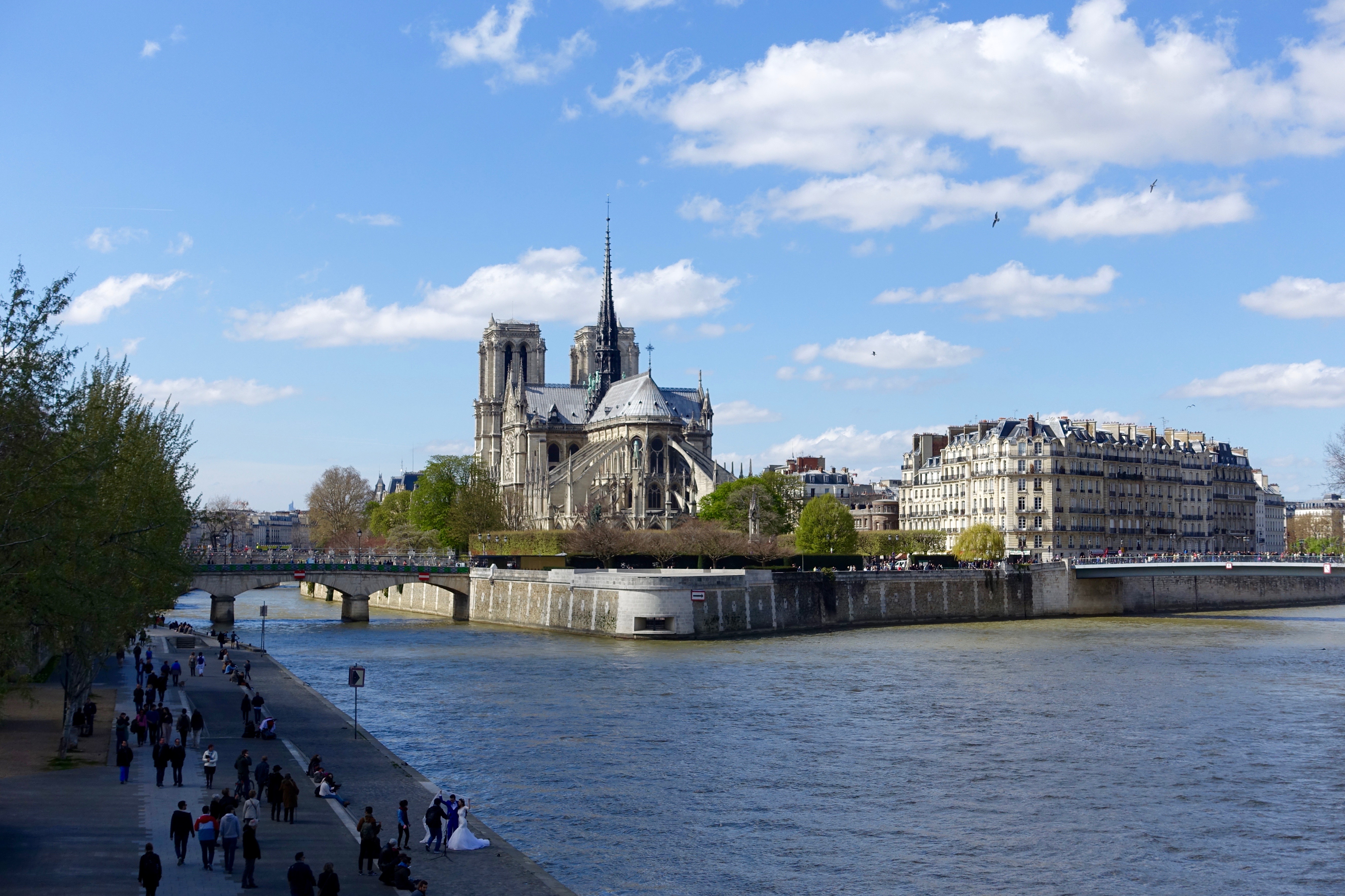
dsc00367

Today, the island is known as the Île de la Cité or “Island of the City.”  Home of Notre Dame and the historic heart of the Paris. Took this photo of the island from one of the bridges off the adjoining island, Île Saint-Louis, where our hotel was located.

Just noticed the bride in the lower center.

Paris is that sort of place.

lile-st-louis

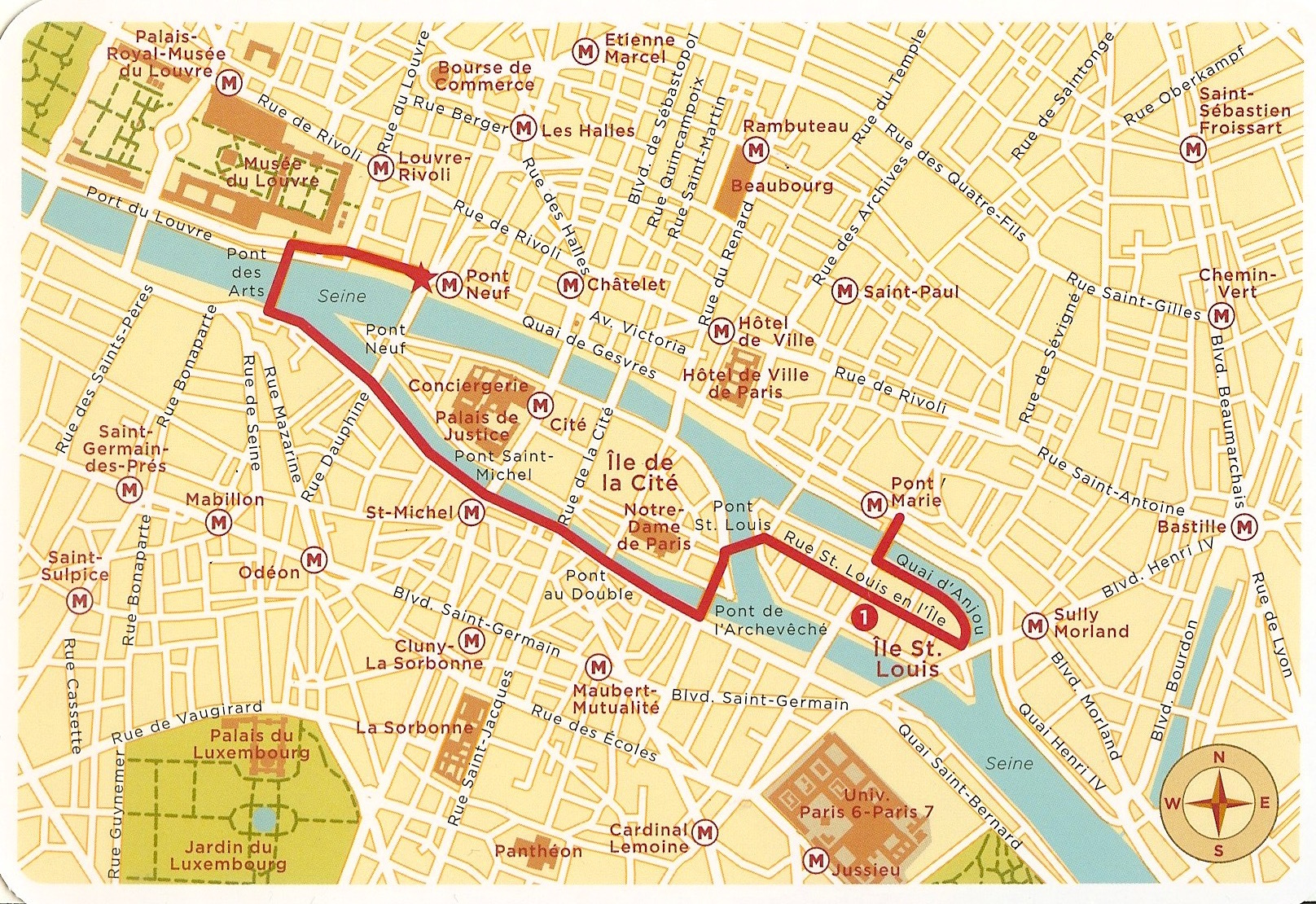
This map is one of our cards from “City Walks Paris” 50 Adventures on foot – a set of walks recommended by our trainer Mia, who lived in France for a year.

I would guess we knocked off seven. 43 to go.

The river Seine divides Paris into the Right Bank (up) and the Left Bank (down).

Across the river to the north of the islands is the neighborhood of Le Marais. Across the river to the south of the islands is the Latin quarter, which we crisscrossed many times.

We did venture about a bit further to the West and North of this map – on foot. We never used taxis, buses or the metro. We walked, and walked a lot- 5 to 9 miles a day.

Our hotel, Hotel Saint-Louis en l’Isle, was located on a corner, 4 streets NW of the number 1 on this map, on the Rue St. Louis en l’Ile. Just across the bridge to Notre Dame.

img_0738

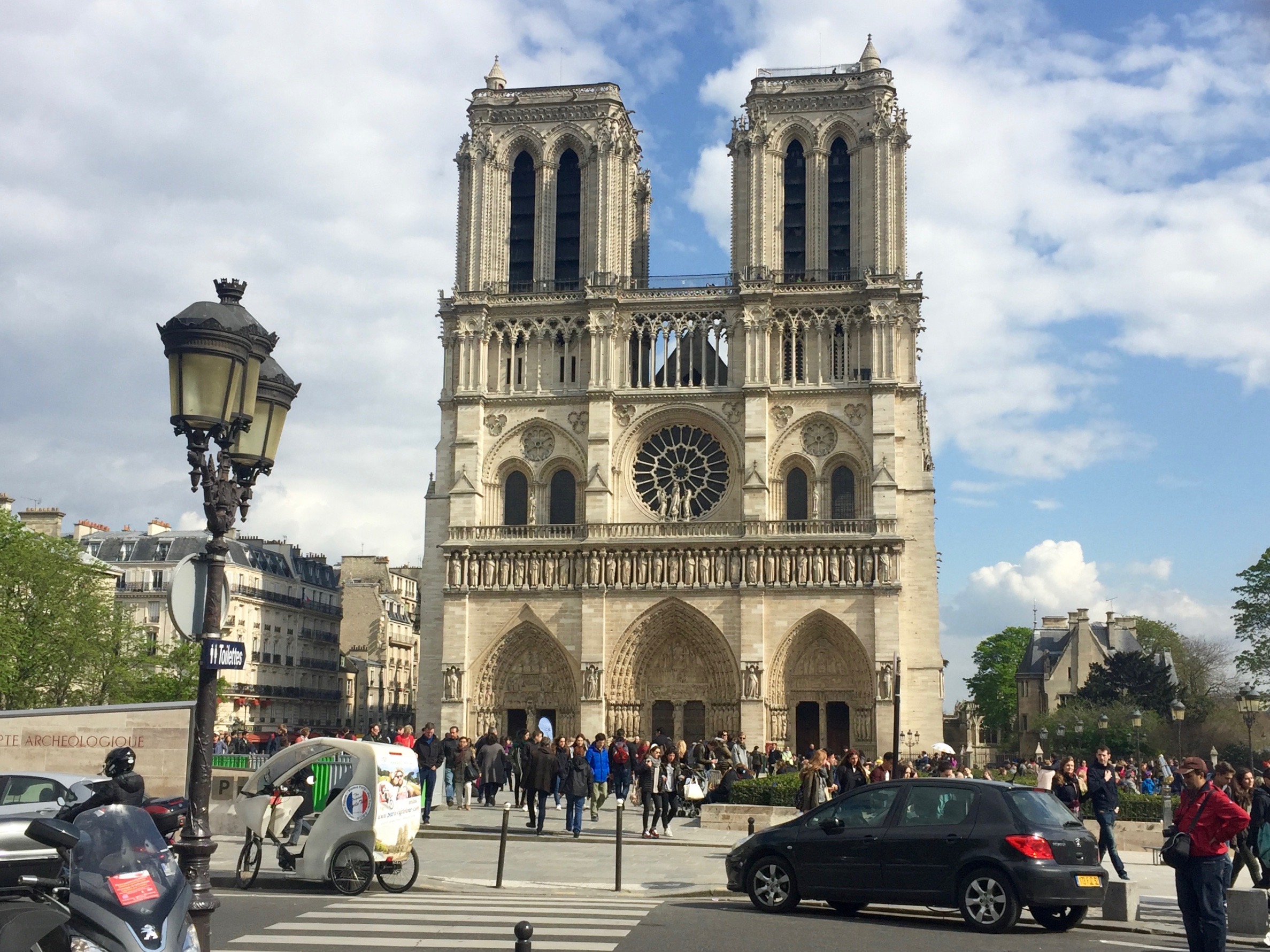
Photo above is Notre Dame from the bridge to our island.

There were aways crowds at Notre Dame. 14 million people visit each year. Rightly so. A masterpiece of French Gothic architecture.

Been here seven centuries.

While there are always crowds at Notre Dame, our neighborhood on the second island, only 5 minutes and a bridge away, was remarkably quiet.

Some tourist bustle in the middle of the day, but otherwise remarkably tranquil. Residential. Folks live here.

dsc00425

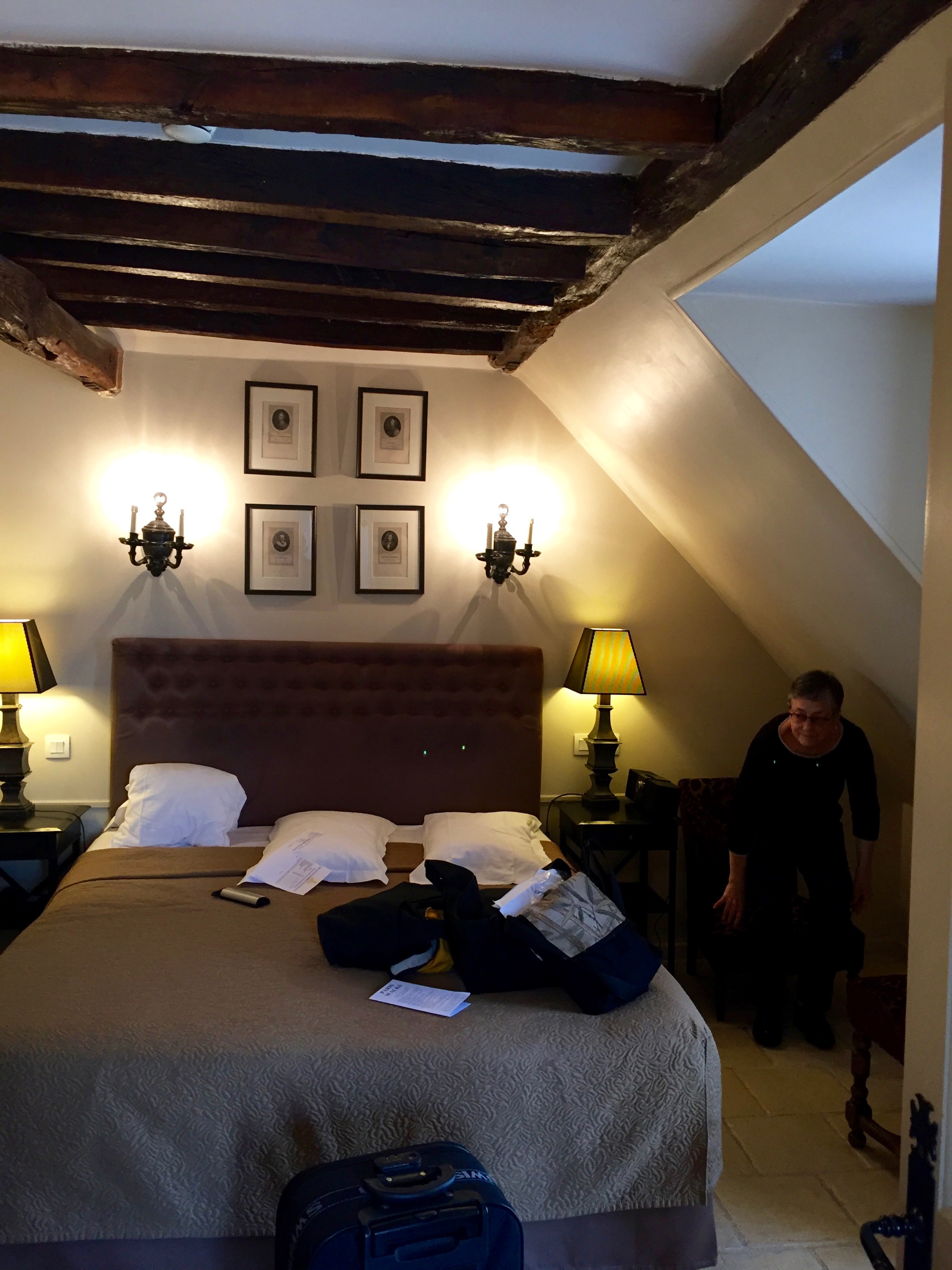
Our hotel had been a 17th century town house. It was small: 20 rooms; five floors.

As per plan, we had one of the two rooms on the top floor.

Up underneath the eaves. Like an artist’s garret.

That’s Sharon on our dormer balcony.

Reading. Of course.

pa

The next photo is the same balcony.

Another angle. Including a sliver of the Seine, and the Parthenon (dome), up on a hill, in the Latin Quarter, in the distance.

One night Sharon called me out onto the balcony to take a look.

The Seine was glowing with lights, while at the same time, the sky above was  pitch-black, glowing with stars.

We really liked our hotel room.

It felt just right for us little people.

pb

You can’t see it here, but Sharon is about to sit down in a chair with legs about a foot long.

The exposed wood beams were hand-wrought and pegged. Lots of character and history.

Our room felt a bit like a treehouse.

There was another mini-balcony off the bathroom, which had a different glimpse of the Seine.

And different views into neighbor’s homes at night.

And vice versa.

We were always sure to close our shades at night.

There was an elevator, which only stopped at a landing between floors. Thus serving two floors, sort-of. We could get to our room with the elevator up a short flight from level 4/5. An intimate elevator, perhaps 3’ x 4’.

Best way to get to a treehouse.

05690025

Before our trip, my Mom told me to look for a side yard at Notre Dame. When she visited more than 40 years ago, she arrived on her own with our dog Tammy (above). No dogs were allowed inside the cathedral, but someone let her put Tammy in the Notre Dame’s side yard. When my Mom returned, the gate was locked, Tammy was howling and no one was around. All turned out well, but that’s another story.

pd

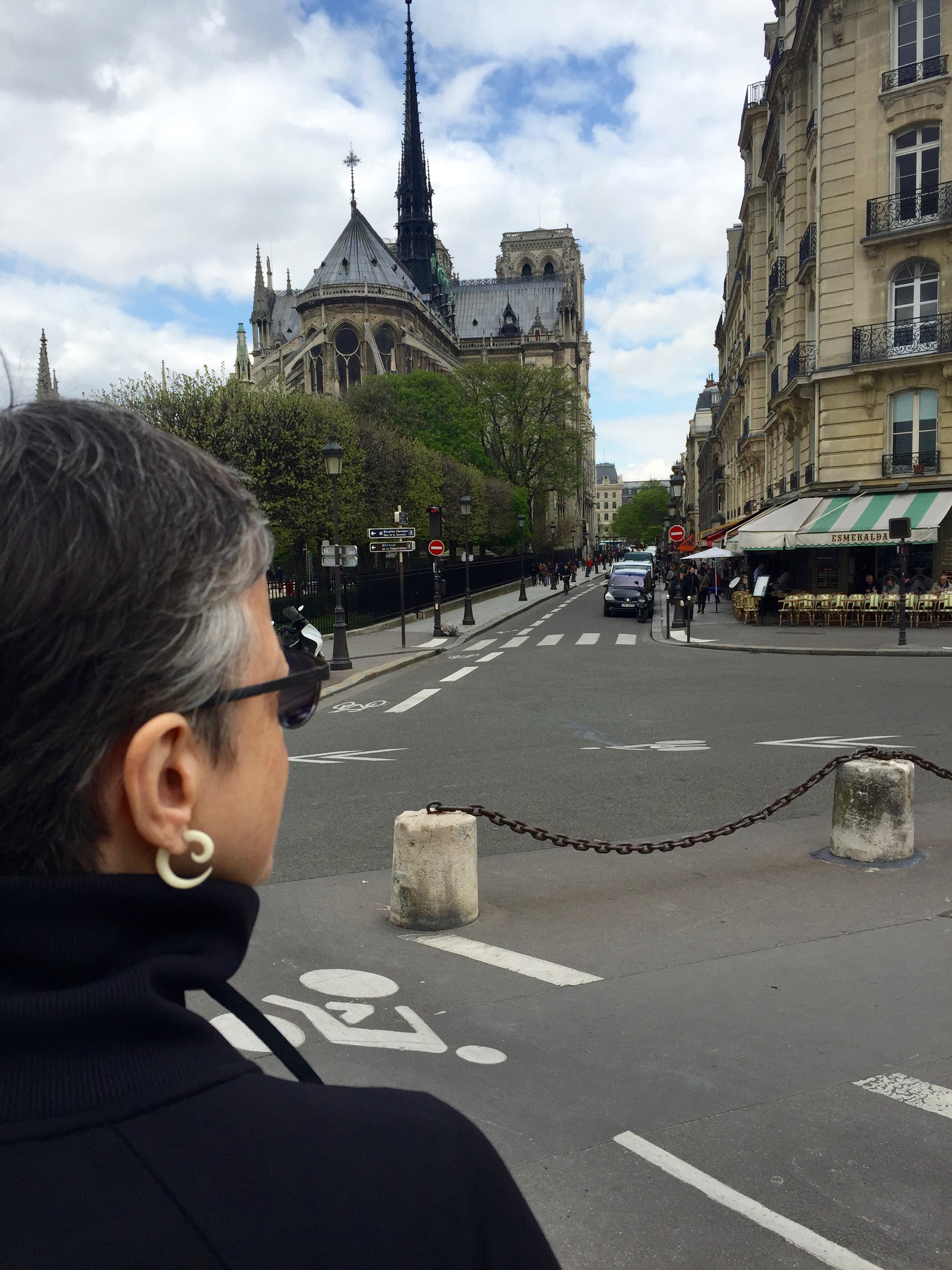
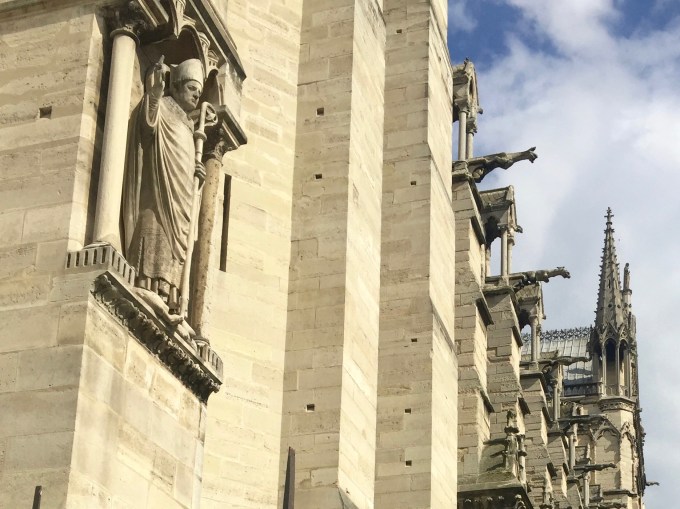
To the left is the wall of Notre Dame above the side yard where Tammy was fenced-in.

The stone detailing is remarkable. A curious mix of familiar pious saints and strange medieval, nightmarish fantasies.

The gargoyles reminded me of dragon’s heads mounted on the prows of Viking ships.

pe

Today there is a big open plaza in front of Notre Dame.

It hasn’t always been this way. Up to the mid-1800’s this area was a rabbit warren of narrow busy streets lined with houses, shops and churches. Aggressive city planning with Napoleon’s backing set today’s stage.

If you look carefully at the paving patterns in the plaza, you can see the outlines of the old neighborhood buildings, outlined in different colored paving stones. Nice touch.

pf

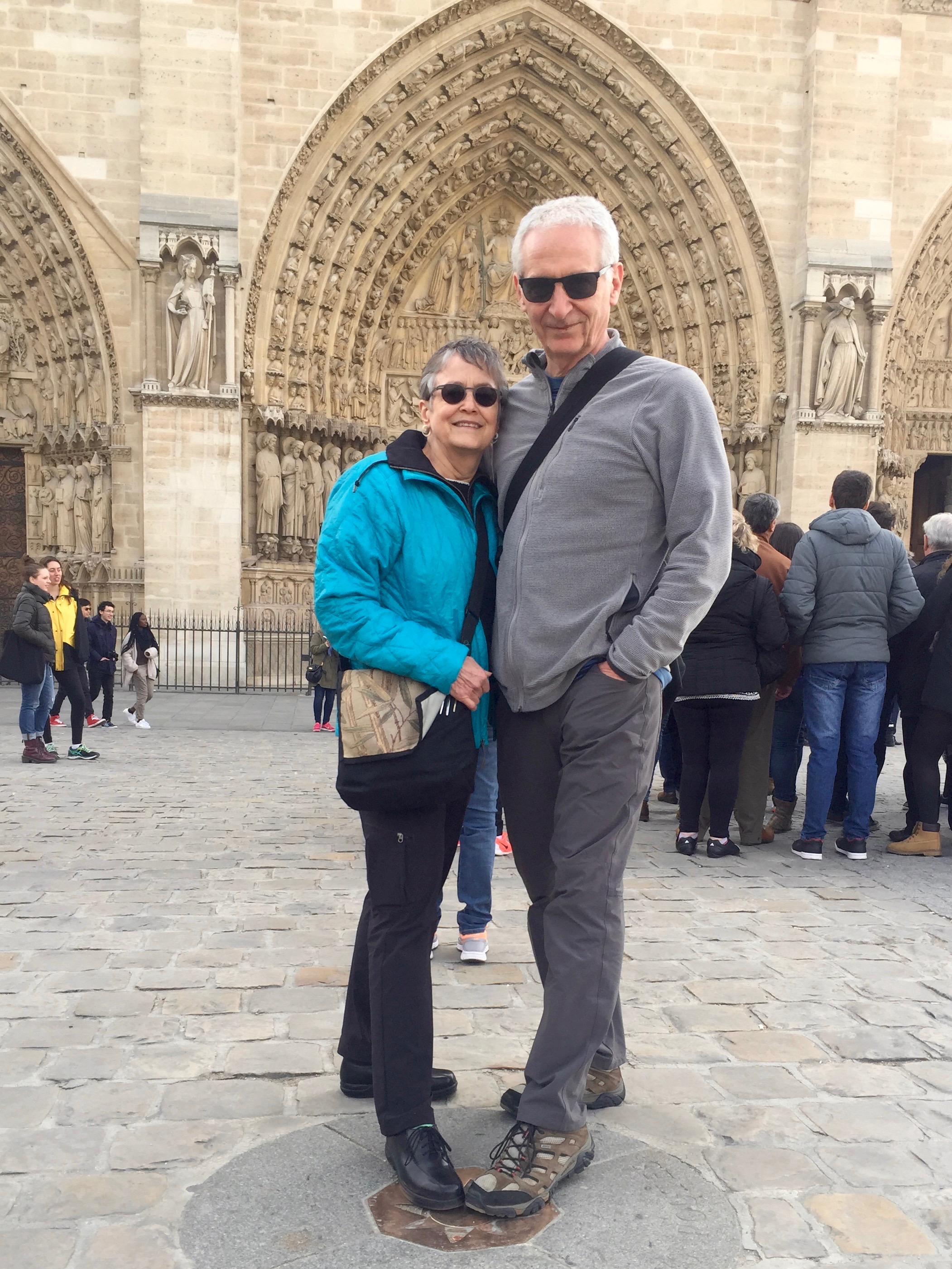
This bronze plaque is right in front of Notre Dame Cathedral.

Kilometre zero.

The point from which all French roads originating in Paris are measured.

I was sure the plaque was on the other side of the plaza, perhaps in the center of the outlying road or next to that manhole cover beyond.

“Sharon, go ask that policeman (in French) where it is?”

“Oh it’s back in front of the cathedral- where all those people are are taking turns posing (right in the most obvious place possible).”

Hmmm. There’s a moral here somewhere.

80_big

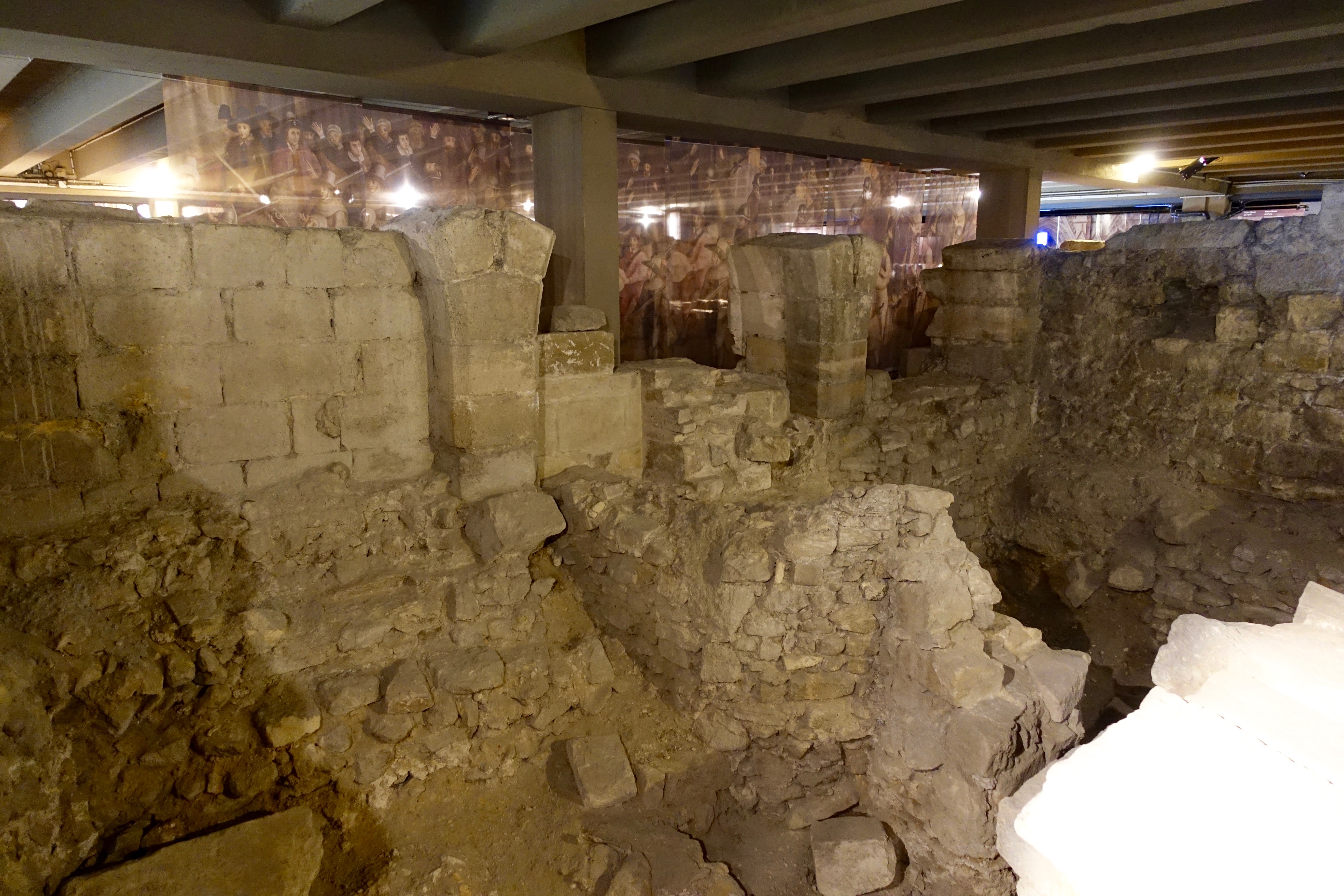
Below the big open plaza in front of Notre Dame is an archeological crypt. One of my favorite places.

Folks have lived, worshipped and done business here for thousands of years. Buildings were knocked down and spaces filled in. Excavations in the 1960s and 1970s uncovered remnants of these times gone by.

pg

Rather than remove the ruins or re-bury them once again, these remains were left in place and a roof added which is today’s plaza. Since the ruins are 20 feet below the plaza grade today, this ghost world lives on below the feet of the tourists above.

Romans, Vikings, and the pious walked these streets and drank in these taverns.

ph

This borrowed picture was taken from the top of the north tower of Notre Dame. Every day we walked by the line of folks waiting to climb the 422 steps for this view. We were tempted, but thought better of it.

We were celebrating Sharon’s 6 month milestone after hip replacement. No need to push things.

Perhaps next visit.

pi

We had told our Swiss friend Stefan of our Paris plans.

He said he’d come see us in Paris, if he could.

We didn’t expect to see him, but we did.

Stefan and girlfriend Cheryl caught the 4:30 AM train from Switzerland to Paris.

They walked into our hotel lobby at 9:30AM.

After breakfast at a local cafe we all headed out to see the sights.

pj

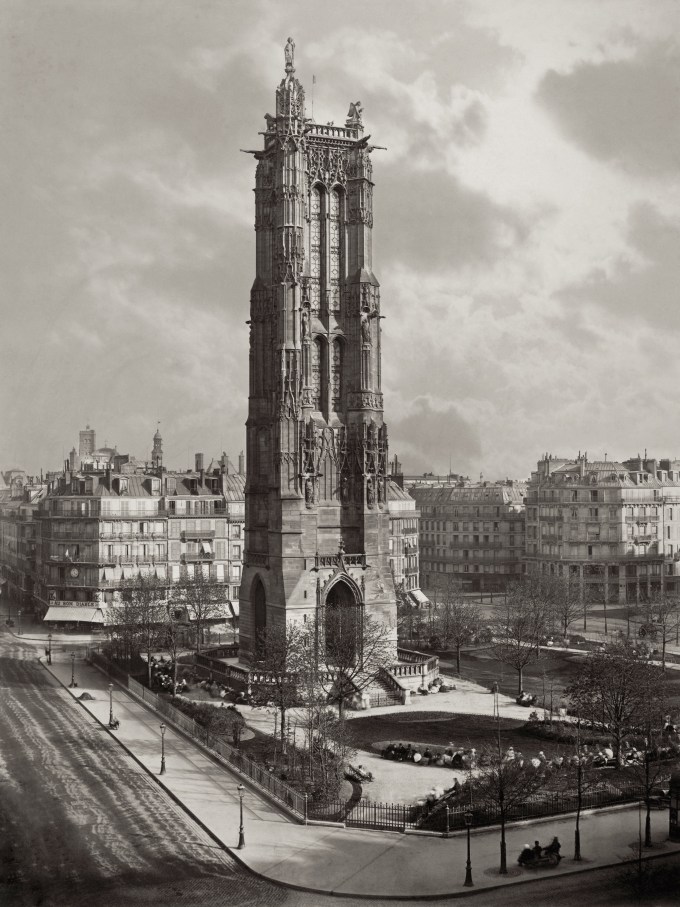
Our first stop  was St. James Tower.

The tower is all that is left of a once grand church built by the butcher’s guild in 1523 as a starting point for pilgrims setting out for the shrine of St. James at Santiago de Compostela in Spain.

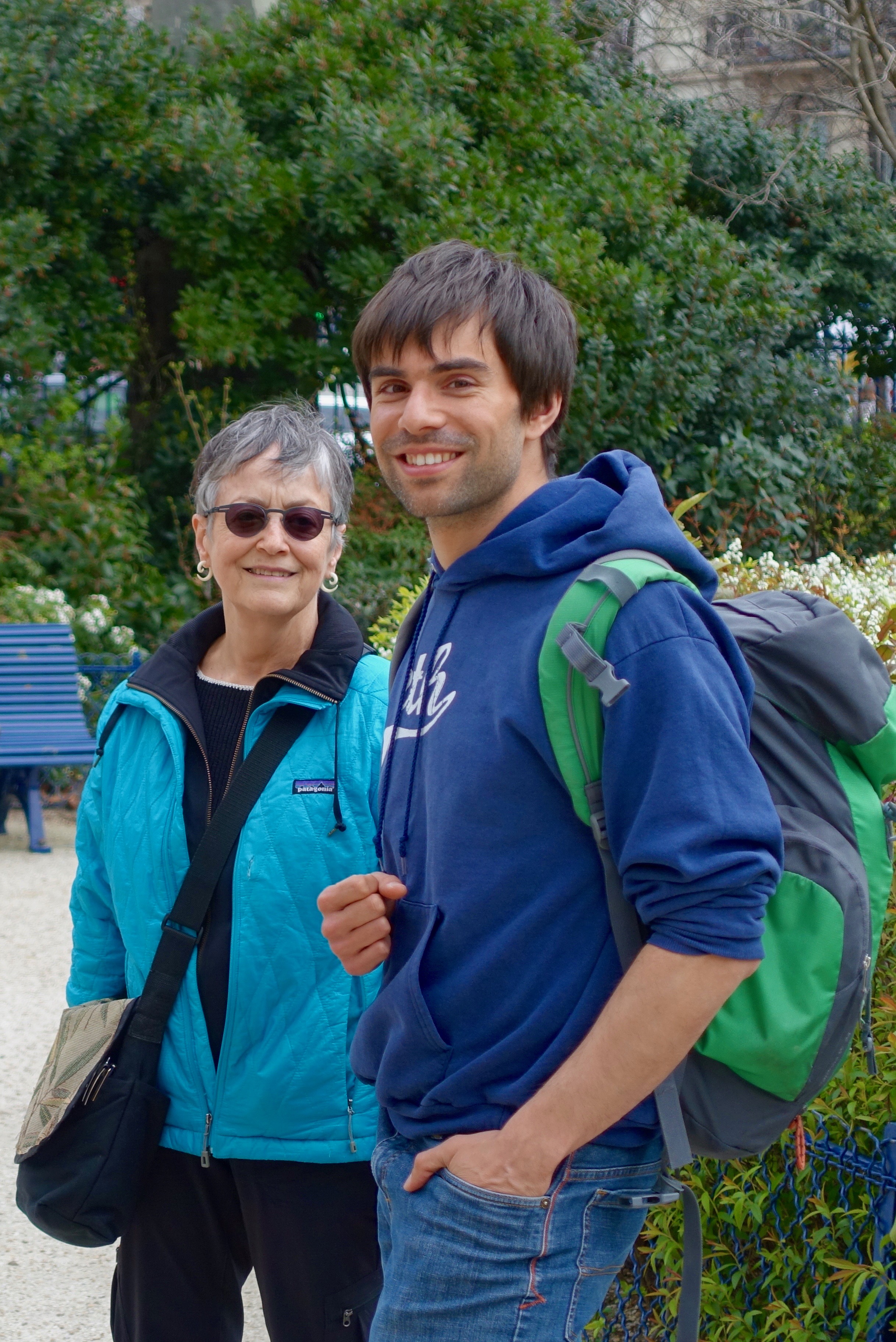
pk

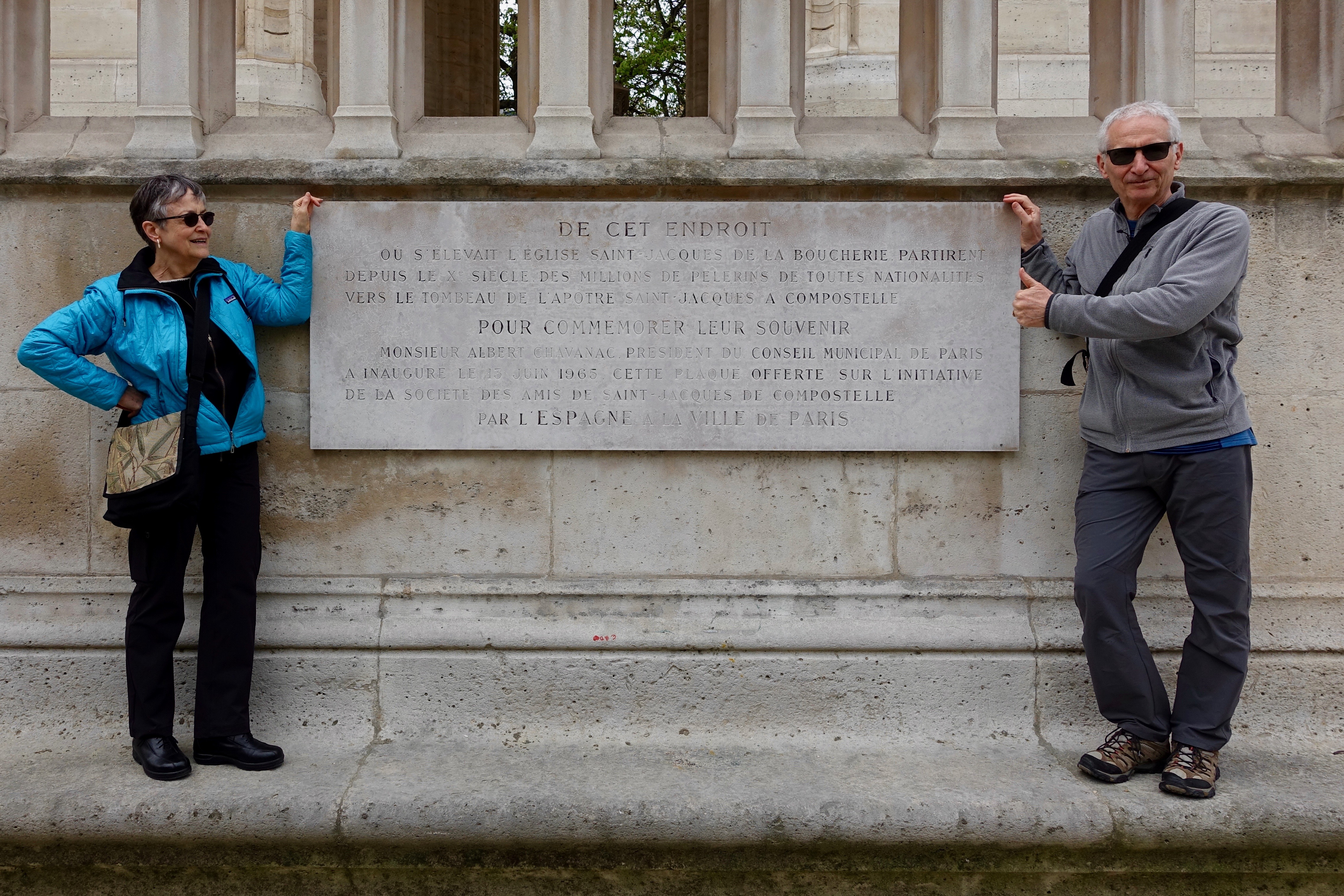
Here we are at the base of the tower.

In my mind’s eye, I can see us here someday, ready to set off for Spain on our pilgrimage.

pl

Few today actually start in Paris. As it roughly doubles the 400 mile ± trek across Spain. My cunning solution is to bike to Spain and then walk. I like the idea of a tandem bike. Affectionately known as the “divorce-maker”.

We shall see.

After St. James Tower Sharon, Stefan, Cheryl and I worked our way northeast  along the north side of the Seine. One of our first stops was the glass pyramid of the Louvre Museum for this photo op.

pn

We continued towards the Arc de Triomphe du Carrousel, the south western entrance to the Jardin des Tuileries.

img_8077

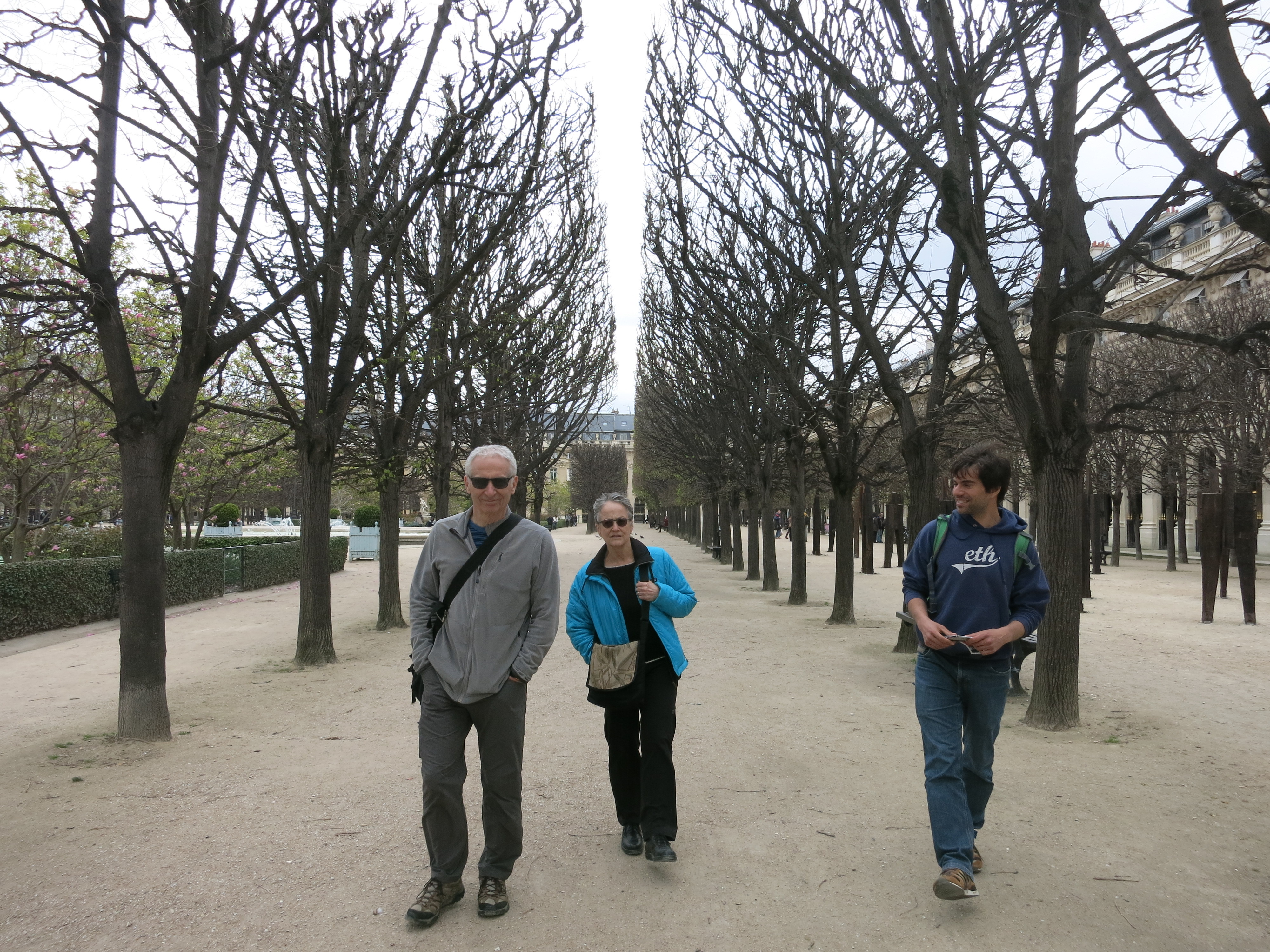
As you can see here in the Jardin des Tuileries, the leaves weren’t out yet. When we were planning this trip, I kept thinking, “Springtime in Paris,” flowers, birds chirping and the like. We were a bit early.

May 1 might be more like it.

We picked the second week of April because we could celebrate both my 65th birthday and Sharon’s graduation from physical therapy following her surgery.

After passing through the Jardin des Tuileries, we came to the Place de la Concorde. We could see the Eiffel Tower and up the Champs-Élysées. Tempted for a second I thought better of it. It was time to double back.

We turned right and north which brought us by one of the Ladurée bakeries.

pp

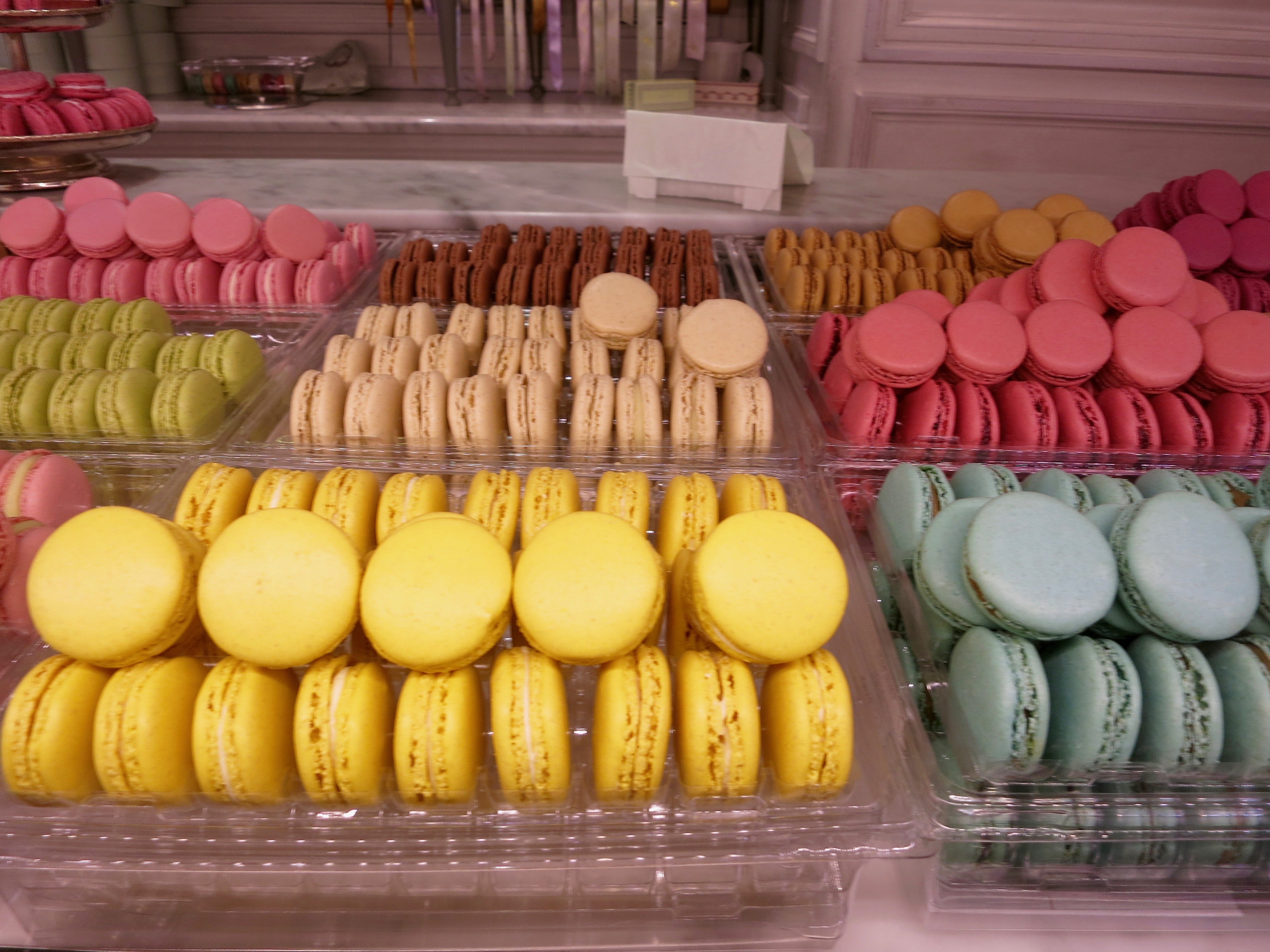
The Ladurée bakery was founded in 1862. “Ladurée’s rise to fame came in 1930 when his grandson, Pierre Desfontaines, had the original idea of the double-decker, sticking two macaron shells together with a creamy ganache as filling.”

img_8075_1

We each picked out two of our choice. Stefan and Cheryl most graciously picked up the tab. Ground zero for macarons. And Yes, they are as good as they look.

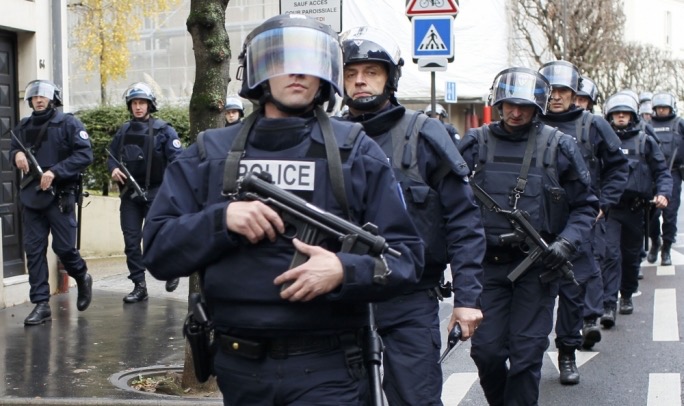
We bid out goodbyes to Cheryl and Stefan a few blocks before the metro station at the Place de Bastille. The closer we got, the more police we saw. The borrowed photo below captures the look and feel.

“No Sharon, we don’t need to find out what’s up. Let’s just turn here, and walk away.”

france_police_terrorism_machine_gun

On our return to the hotel we asked our friend Bernard at the front desk what was going on. He shrugged. “Oh just a bunch of folks on the dole, protesting for more money.” Another day of political theatre in Paris.

lobby-v6902511

Half the time Bernard would be sitting where Denis is here in this borrowed photo. We had heard about Bernard from Tripadvisor reviews. Many found him charming, but he rubbed a few the wrong way.

My favorite comment was from a couple who had asked Bernard to make them dinner reservations at 6:00PM. Bernard’s response: “Only children eat at 6:00.”

Very French.

So after a couple of days, Sharon decides to practice her French on Bernard. She asks him (in French), “Are you the inestimable, very kind and friendly Bernard?” He knew exactly what was up.

He wouldn’t answer. Sharon insisted. Finally he got up from behind the desk, came out and gave her a mock curtsey.

The next morning we were heading out to the Orsay Museum. We told Bernard of our plans. He told us that the museum was closed, “because they were painting the doors.”

Another guest overheard our conversation and said, “Thanks for the info, we had been planning on going to the Orsay today.” Bernard didn’t blink.

Neither Sharon nor I believed Bernard, so we went to the Orsay anyway. It was open as usual. On return, I told Bernard, “the construction is over at the Orsay.” A blank look back. He had forgotten our earlier conversation. “The doors are all painted.” A flicker.

There are no (interior) doors in the Orsay. Only open galleries.

We liked Bernard. On my (65th) birthday, when we walked through the lobby, he would sing happy birthday under his breath. When we asked about a good café, he got up from his desk, and … walked us up the street to his favorite.

Leaving the lobby empty. No one to cover the phones or the wide-open front door. A bit crazy, yes.

Very French.

All the other staff, liked Bernard too, we could tell. He would joke with them and help with whatever they were doing, running up and down the stairs. A very spry 60 years old.

On our last day, as he was helping our young female driver with our bags, I told Bernard, “The key is not to believe a word you say.”

He answered, eyes twinkling, “I’ve talked to you guys too much.”

****

In preparation for a hoped-for trek around Mt. Blanc in Europe. Sharon took four community-center night school courses in French, which is the equivalent of perhaps 2 college level courses. Or about 1/2 of basic French grammar. All the course titles included the word “Beginner.”

Bernard said that Sharon was doing well with her French. But that was Bernard.

The young woman who drove us back to the airport said the same thing. Could have been an ingratiating compliment- but I don’t think so.

The test was the shoes.

We travel light. Only one pair of shoes each. Sharon’s disintegrated on day 3. Literally. No hope. Bernard pointed us down the street to the closest shoe store. And off we went. Photo below.

skechers

The woman in the store spoke zero English. Sharon chatted away in French. Various shoes appeared and disappeared. The lady laughed at Sharon’s jokes. 20 minutes later we left with new shoes that fit just right.

No blank looks. Just nods. Test passed. I don’t know how Sharon does it, but she does.

On top of it all, even I could hear Sharon’s accent improving in only a week. In a month she’d be unstoppable.

Here in Cambridge, at Whole Foods, Sharon has made friends with a number of clerks from south of the border. They chat away in Spanish. I get a nod now and then.

A favorite is Gloria. Gloria is from El Salvador.

We know all about Gloria’s family. She knows all about ours. My Spanish is good enough to catch the general drift of the conversations.

One day Sharon complimented Gloria on her earrings. Gloria tried to give them to Sharon. Very Latina. “No, no, no…”

Gloria thought Sharon was from somewhere in Central America. She wasn’t sure from where. “¿Tampa, en los estados unidos (USA), really?”

I wasn’t surprised.

A mimic’s ear backed by a fearless intelligence goes a long way.

py

This pic is Sharon in front of the Musée National du Moyen Age or the Museum of the Middle Ages or the Cluny Museum. We really liked this place and would like to come back when all the galleries are open.

Many were closed for renovation. The current building is a 15th century mansion built over an excavated Roman-era bathhouse. Truth be told I was partial to the Roman spaces.

Our second visit was for a medieval music concert on period instruments in what remained of the the Roman bathhouse.

The musicians were great, and had no trouble dealing with the rather unruly guy who had somehow found his way into the paid performance.

As he was being hauled out, no one missed a beat. Neither performers nor audience. I thought,

“Heckling medieval artists.

Very French.”

pw

Our next-door neighbors in Cambridge were spending the year in Paris.

We got together to say hello. A highlight of our trip.

Fred grew up in Paris .

Deirdre is working on her Harvard PhD.

Their daughter Bea (Beatrice) has discovered ponies.

And Otis (the dog) is living the good life.

Paris is a good place to be a dog.

Otis is our buddy. We had bonded in Cambridge.

He recognized us immediately. Otis is not an easy dog, but he is with us.

jardin-du-luxembourg-fontaine-de-medicis

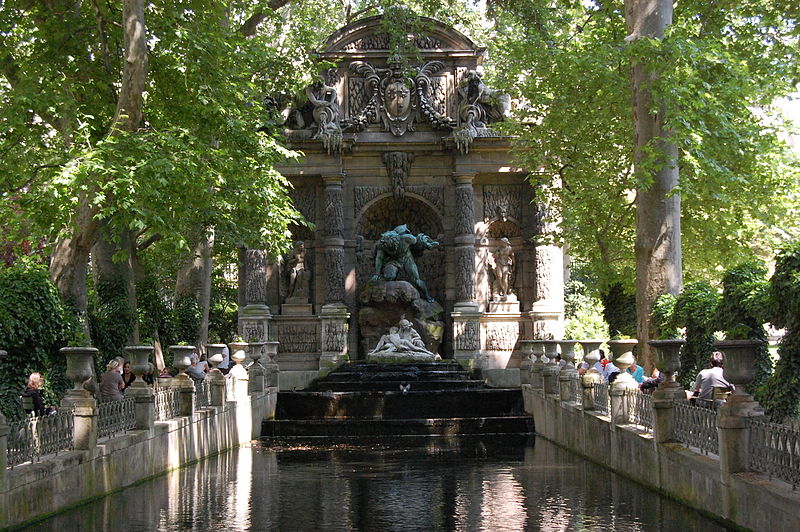
We met up in the Jardin du Luxembourg (Park) by the Médici Fountain (borrowed photo).

Otis was a bit nervous around the fountain. Earlier in his life, he had a rather traumatic near-death experience involving a bridge over the river Seine, an an ill-advised leap, an unexpected plunge, a desperate swim, and a just-in-time rescue.

The crowd cheered.

pr

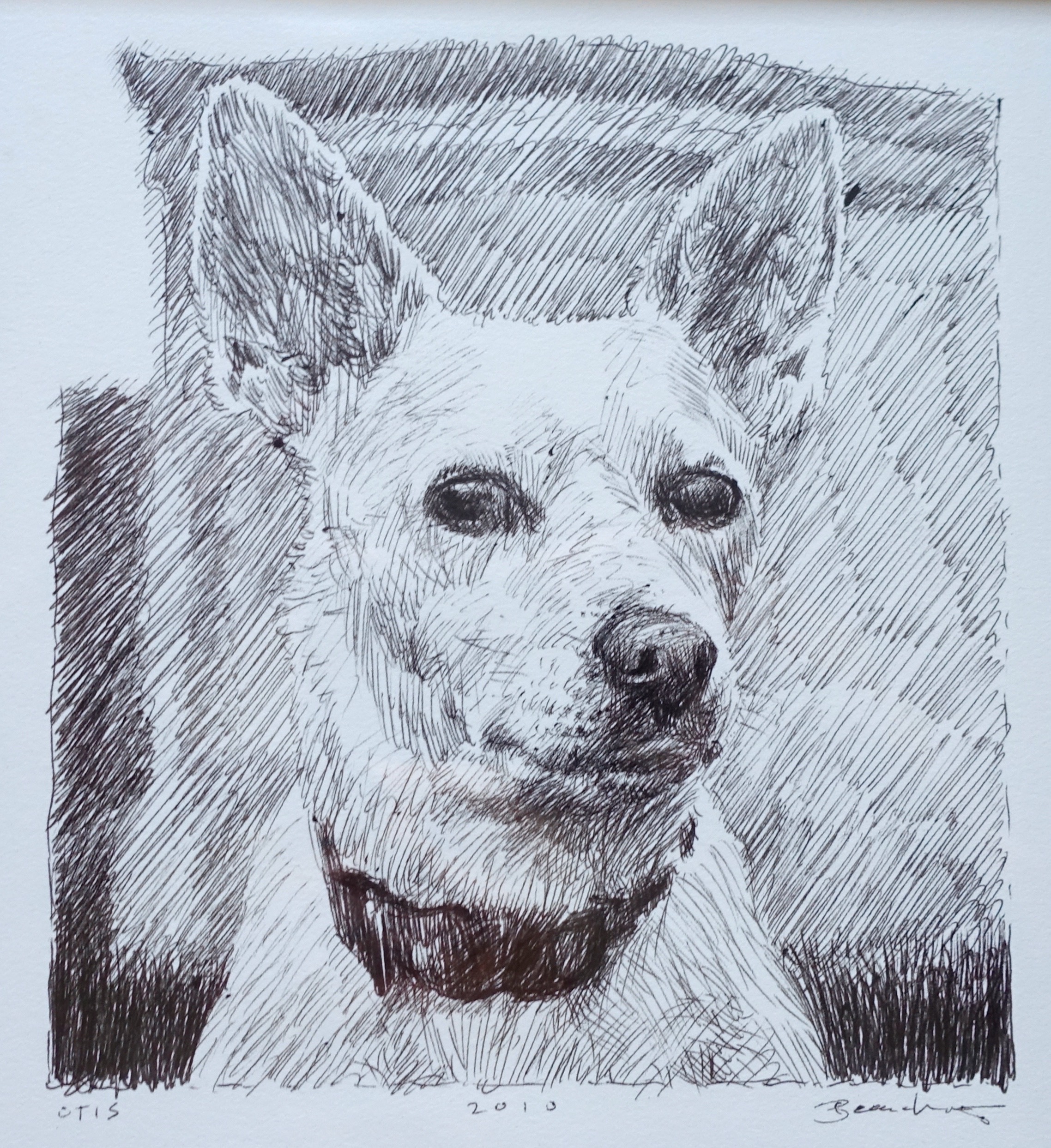
This 2010 portrait of Otis was drawn by a friend of Fred and Deirdre’s, who works for Pixar.

Every dog should be so lucky.

Reminds me of “The Fantastic Mr. Fox” if you’ve seen the movie.

Deirdre found Otis in Chicago on doggy death row. The clock was ticking down.

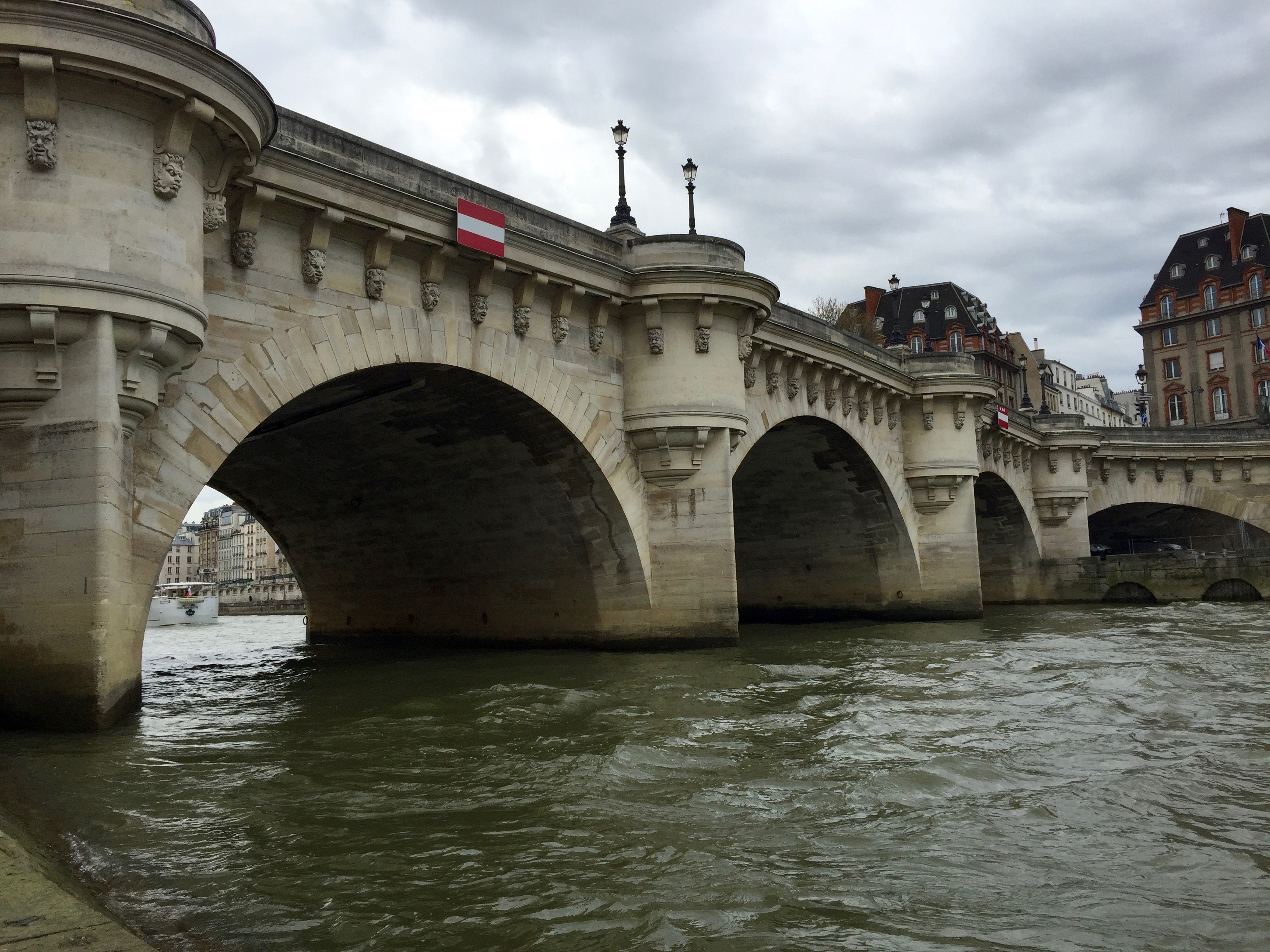
We had heard the story of Otis and the Pont Neuf bridge and decided to take a look.

The bridge is on the downstream side of the island with Notre Dame.

img_0847

Fred, Deirdre and Otis were walking across, when Otis spotted a bird above the railing. Otis leapt, clearing the 3 foot + railing with ease. That was the good news.

The bad news was that he then found himself 40 + feet above the river Seine in mid-air.

Down he went, disappearing into the depths of the murky green water. But back up he bobbed, paddling for his life. Deirdre started screaming. Fred took off running.

Fred made it through the park to the very tip of the island, down the last stair into the river, and plucked Otis from the water as he was swept by.

A cheer went up from the restaurant barges, folks in the park, and folks on the bridge.

Every time Fred tells the story he invariably mentions two things. First, he didn’t know that Otis could swim.

Second, that the water ruined his most-fashionable tennis shoes.

Very French.

2014 Spaghetti Western Hot

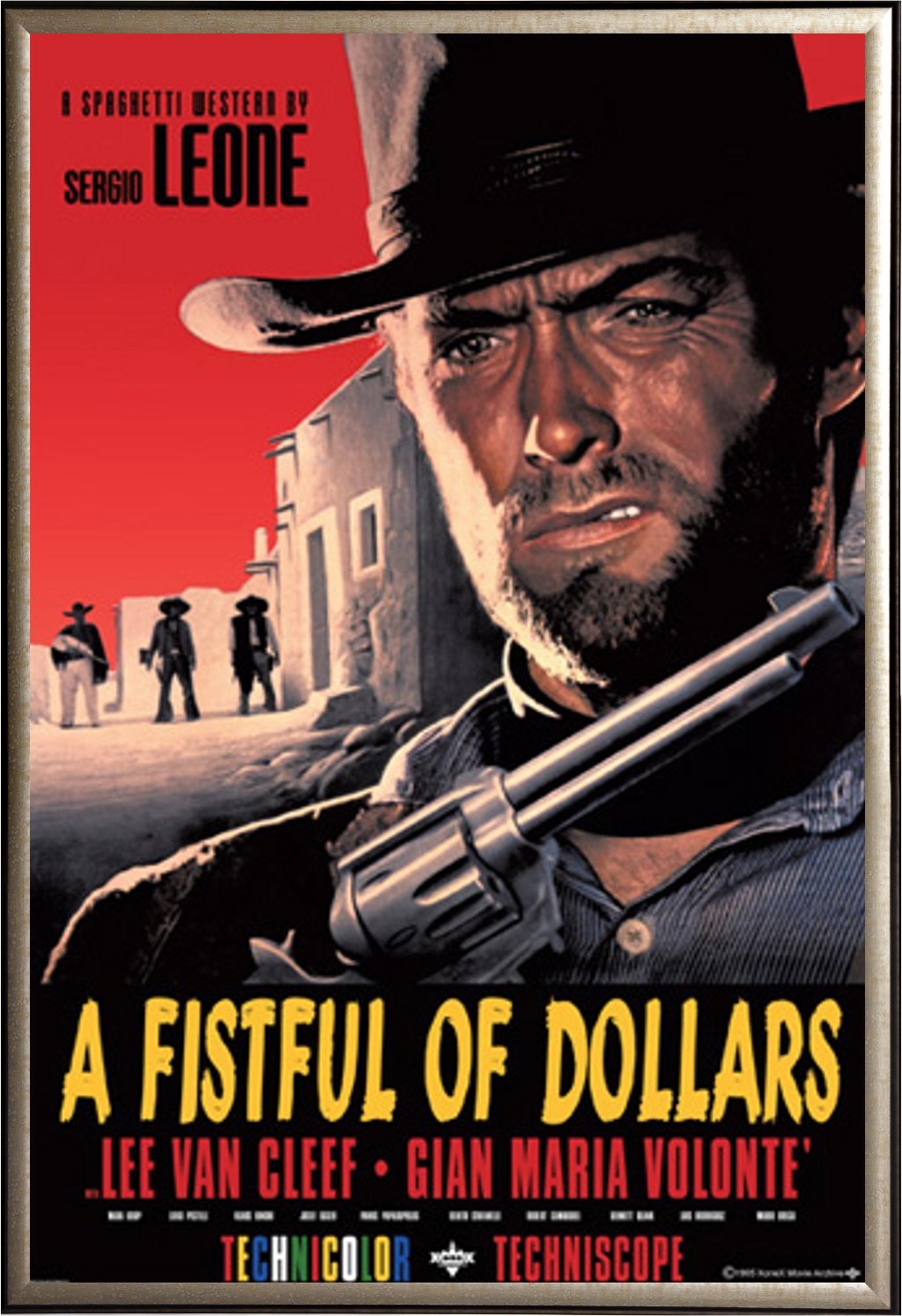
Nicaragua was Spaghetti-Western hot.

100 degrees in the shade.

Topping it Spaghetti-Western up, was the dust, the semi-arid landscape, the volcanoes, the political dreams-gone-bad corruption, and then there were the eccentric locals, and the scorpions.

fistful of dollars poster

None of these were necessarily bad things, at least as far as our trip was concerned.

Halfway through, we were rolling back from León to Managua.

We were the only paying customers in our transfer van.

There were three others.

The driver, a young- rather worldly-looking Latina in a very low-cut blouse, and a rather disreputable-looking character back with us.

His two upper front teeth were broken off half-way up. My guess, he was pushing thirty. Far worse for wear. Epitome of thug, body language and all.

Next thing I know, Sharon and he hit it off. My Spanish is good enough to have followed most of their conversation. One thing led to another.

They were talking Spanish literature and the best Nicaraguan bookstores. This guy liked his poetry.

Poetry is a Nicaraguan thing.

travel-blog-magazine-273_3

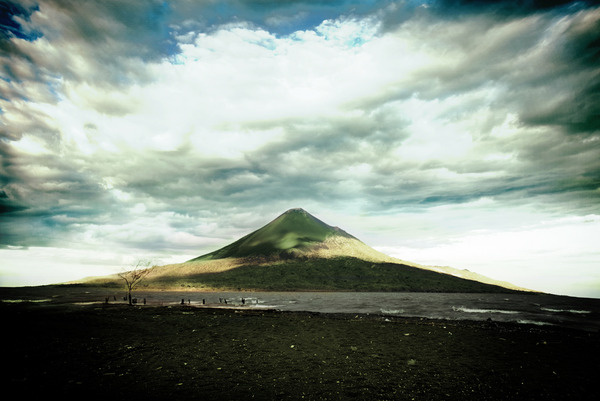
I look out the side window and there is Momotombo Volcano, active, with an elevation 4,255 ft.  [borrowed photo]

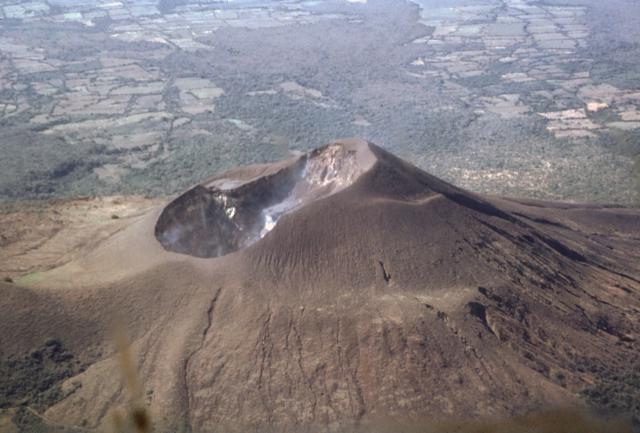
Not on our hiking list. We had picked the equally intimidating San Cristóbal Volcano as our mega-hike.

In the lowlands of Nicaragua, volcanoes are commonplace. Every 5 to 10 miles or so, there are such potential end-of -the-world-as-you-know-it reminders.

Around about then, I notice that our heavy-set driver has not one, but two baseball bats close at hand. The regulation bat was behind his seat, propped up behind his left shoulder.

The half-size bat was resting even closer, his side of the emergency brake – comfortably within reach of his right hand.

My analysis: the driver doubled as the muscle. The big bat was for outside. The little bat was for inside.

Sharon’s conversation had shifted from literature to Nicaraguan food and drink.

While we had already sampled some of the Nica culinary highlights, we hadn’t had semilla de jicaro, a drink made from jicaro seeds ground with rice and spices, and milk and sugar.

Jicaro drinks go way back, before the Spanish, to indigenous locals. To my mind, an experience not to be missed.

The van unanimously suggested we stop at their favorite roadside eatery – if Sharon and I were up for it. Translation – no safety net- food wise.

Our Jicaro drinks were delivered in a plastic bags tied with a straw, and ice.

Food and Beverages of Nicaragua 004

A kiss-your-ass-goodbye moment- if you’re playing by the food and drink rules.

I take a sip, then another. It tastes great- like a protein drink in the states. Both of us polished our drinks off.

24 hours later at Linda’s we were still feeling fine.

Maybe it was the probiotics we were taking. Maybe dumb luck. Maybe we’re toughening up.

In any case, curiously we had no intestinal issues our whole stay in Nicaragua.

Our friend Linda’s home in Managua was an oasis. Including the scorpions.

Managua

The perfect traditional Japanese ceremonial tea cup has flaws.

Imperfection is considered inherently part of the most perfect. Imperfection itself is most worthy of contemplation.

Like scorpions.

scorpion spray

On this, our second visit to Managua, we had the scorpion drill down.

Each night before bed, we took out our flashlight and, carefully scanned the floor: Under the bed, open areas, and especially the edge of the room where the wall met the floor.

Then we pulled our bed apart and, looked in-between the sheets and inside our pillow cases.

We slept with the flashlight between our pillows, to light our walk to the bathroom.

Linda stressed that should we find a scorpion, “Don’t step on it. Use the scorpion spray”

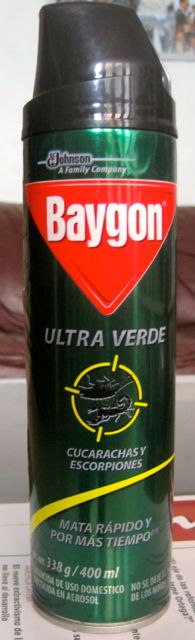
Johnson Family Enterprises, the USA maker of Windex, Pledge and Raid, sells scorpion spray in Nicaragua, under the name of Baygon.

If you step on Mrs. Scorpion, you might get her, but probably not the 100 or so babies she might be carrying.

At Linda’s the only scorpion we saw a baby, less that 1/8 of an inch long. On our hike on volcano Mombacho above Granada, we saw a 3 inch-long flattened black scorpion on the trail.

scorpbabies

My first Spanish teacher in León, Guadalupe, grew up in the country.

One day she went to put her key in her house-lock and dislodged a scorpion, which promptly bit her.

She went into anaphylactic shock.

It wasn’t the big black mostly harmless kind. It was a far more dangerous translucent cousin. Borrowed photo above.

Linda’s home backs up to nature preserve, which in all likelihood explains the scorpions.

Guardabarranco

And also the remarkable variety and number of birds.

Sitting by the pool with my binoculars, the question was which direction to face.

No choice was bad. At any one time, I would guestimate- 40 to 50 birds were present.

We saw more birds in Linda’s backyard than anywhere in Nicaragua.

The riches were almost embarrassing: hummingbirds, orioles, woodpeckers, warblers, goldfinches, flycatchers, tanagers, parrots, and the national bird of Nicaragua- the Turquoise-browed Motmot.

Borrowed Motmot photo above/right.

CocoPalm

Mid-morning Linda’s Motmot would fly up and land on the electric fence wire running above the 6 foot high iron fence surrounding her private park.

After a careful contemplation of the yard, the Motmot would be gone for the day.

Never a problem with the electric wire.

Linda’s yard was pretty much perfect, complete with coconut palms.

Photo right- Linda’s gardener Isidro knocking down coconuts.

Fresh coconut milk, is both tasty on its own and it mixes most nicely with rum.

On our way to Potosí, the week before, our guide Luis, had shared a most-macho Nica saying:

“Hay tres desportes en Nicaragua: Ron, Mujeres, y Beisbal.”

“There are three sports in Nicaragua: Rum, Women and Baseball.”

Underneath the bravado, Luis was a sensitive and insightful guy. To his credit, he followed up with, Nicaragua has a problem with alcohol, and abandoned single mothers.

nicabeisbal

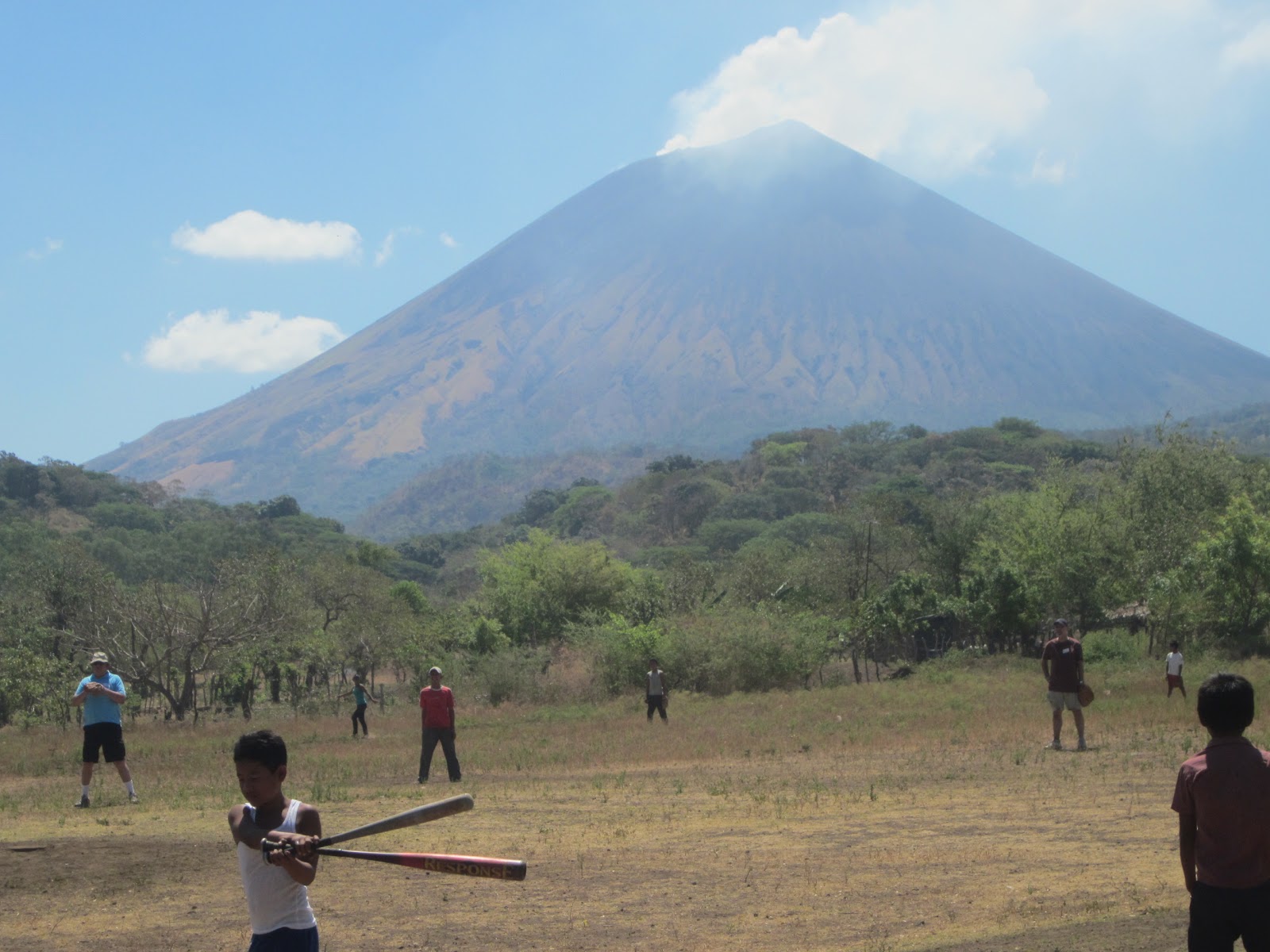
And yes, baseball is more popular than soccer. Borrowed photo left- with San Cristóbal Volcano as the backdrop.

When we pulled up to Linda’s on our return from León, we pushed the buzzer at her locked front gate. Linda fiddled a bit with the lock before it would open. Through the bars she told us:

“It’s a new lock. My little paradise, isn’t a paradise anymore.”

Once inside, she expanded,

“One of our neighbors was robbed last week – at gunpoint. They slipped in when the gate was open. They had guns. They threatened to shoot the children unless the parents opened their safe.

No one was hurt. Thank God.

We have installed a new alarm system. Our nighttime guards are on edge.

The police patrols have disappeared.

It must have been the Hondurans. Money talks. The drug violence has come to Nicaragua.”

Two days later over breakfast, Linda passed along,

“My paradise is back. Another yard man told my yard man: There were no guns. No threats. Some things were just stolen from an unlocked car when their gate was open.”

The first story. Hearsay as well.

The Nica bottom line?

There is no bottom line.

Choose your story. Change your locks. Check your security system. Upgrade to your comfort level.

Managua is the capital of Nicaragua. Home of over 2 million people.  It’s a third-world Los Angeles: car-centric, low rise, with suburbs, shopping malls, bad neighborhoods, and earthquakes.

We had two extended tours of Managua.

On our first full day in Nicaragua, we tagged along Linda and her friend Monica, as they picked up and distributed food and cooking oil for those in need. Big city, tough neighborhoods, interesting people.

Neither Linda nor Monica had visited any of our destinations. It was a scavenger hunt with a twist.

We crisscrossed Managua picking up and dropping off goods. Sharon in the front seat next to Monica- the printed directions were in Spanish.

streets of managua


The twist was that Nicaragua doesn’t have addresses as we know them. Streets don’t have names, addresses don’t have numbers.

Addresses are literally directions starting from a known landmark. For example: starting from such and such a rotary go 100 meters north, turn left and go 4 blocks, turn right and go to the end of the street.

In the back seat, I asked Linda about mail delivery.

She laughed.

“They throw your mail into the yard. You have to find it. No mailboxes in Nicaragua.”

On our last stop, the middle-aged nun explained that the few boxes of meat we had delivered would feed her 30+ children for a month.

The room was small. The ceiling was low. The pope’s picture on the wall was the last one.

No matter.

Sharon immediately picked up that the nun’s accent was heavy with Portuguese. Yes, Spanish was the nun’s second language.

They chatted like old friends- in Spanish, their common second language.

Our second Managuan tour was far more conventional. Linda and her husband drove us around town to see the sights.

Highlights were the Malécon (the waterfront), Ruinas de la Catedral Vieja (ruins of the old cathedral), and Las Huellas de Acahualinca (the footsteps of Acahualinca.)

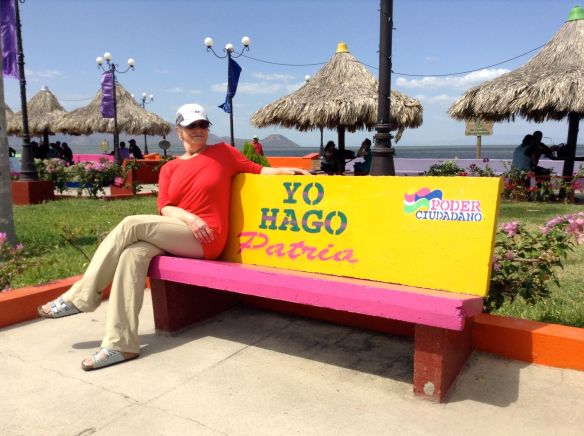
The Malécon development was paint-still-drying new. Pleasant. Armed-guard safe. Nicaraguan surreal.

malecon


We picked up lunch from one of the sort-of fake tiki hut establishments and munched the inoffensive offering while enjoying the view over mostly-dead lake Managua.

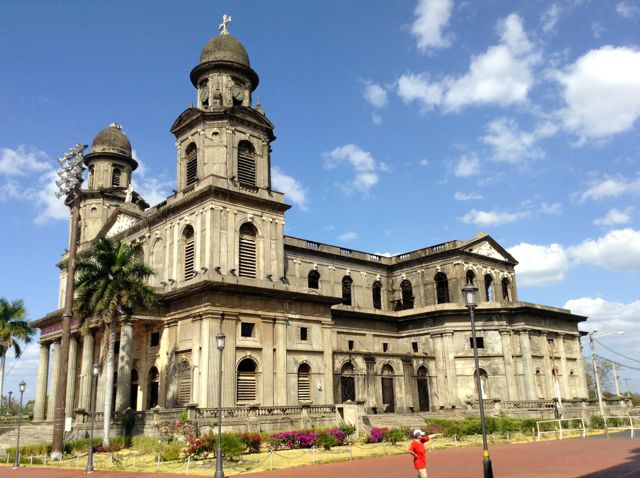
Next stop was the old cathedral. Today a burned-out shell and a reminder of past glories and the devastation of the 1972 earthquake. Foto below.

catedral viejo

A new modern cathedral has been built up the hill.

Plastic Jesus

Check out the lifelike plastic Madonna above the door (below). She hasn’t always been there. I’ve seen photos as recent as 2010 and she’s nowhere in sight.

There were more of these life-sized realistically detailed figurines inside, including the late Pope John Paul II. Borrowed photo below.

628x471

I almost bumped into a plastic nun with glasses when I came around a column.

These 21st century molded replicants were curious and a bit disturbing. I’m sure there are more here and there around the globe.

Probably only the Vatican knows where.

From the old cathedral, we headed north along the lakeshore, looking for the historical site of the footsteps of Acahualinca.

These were neighborhoods, not to be walked, or even driven through, at night.

We pulled up to the front door.

Linda’s husband paid one of the security guys to watch the car, and negotiated our entrance fee. We headed in.

Some 12 or 13 feet below ground level, is a dried, fossilized mud flat with human footprints. A snapshot preserved in volcanic mud- of a few minutes from a time long gone by.

footprints

How long ago?

The museum explains that these footprints are 6000 years old making them the oldest human footprints on the American continent. 

Checking online, recent carbon dating has them at about 2000 years old.

Where were these folks going and what were they doing?

The old story was they were fleeing a volcanic eruption.

Today’s interpretation is that these dozen or so folks were probably simply on their way to the lake to collect food and water.

Sharon wasn’t buying this recent happy-land version.

As she put it, the prints were left in a layer of volcanic mud. They were preserved under a layer of volcanic ash. It wasn’t just another day in the garden of Eden.

She has a point.

The Nica bottom line?

There is no bottom line.

6000 years ago fleeing a volcano, or 2000 years ago and out for a stroll?

Pick your story and upgrade to your comfort level. And don’t forget to pay the guy watching your car.

León

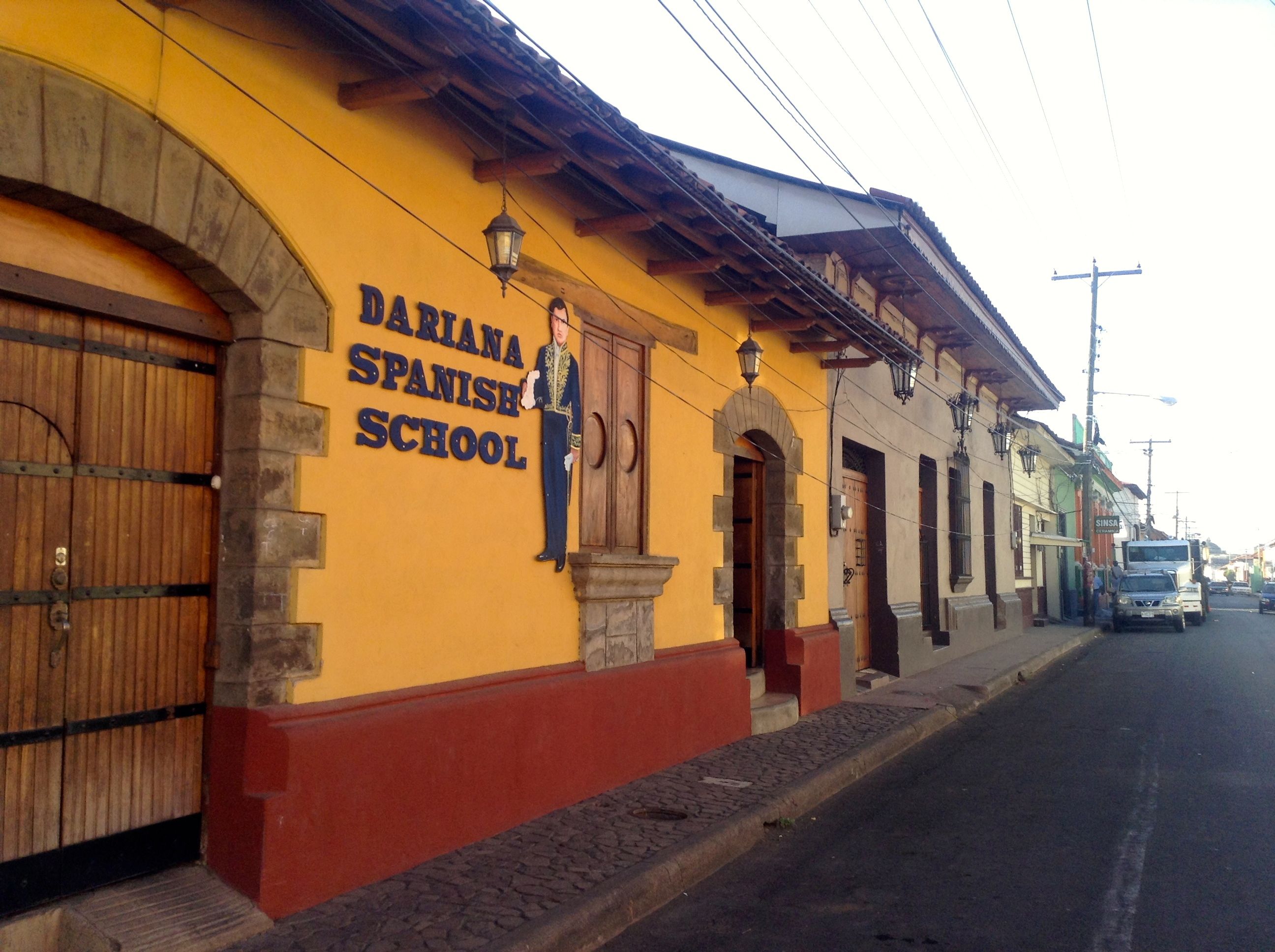
Dariana Spanish School exterior

Our first transfer from Managua dropped us off in León at Dariana Spanish School, where we would spend the next two+ weeks.

The school had made arrangements for us to live with a local family during our stay: Room & 3 meals/day.

So I ask Rolando, the school’s owner, director and all-round good guy, about potential food issues.

“Do you think that vegetables will be safe?” I ask- thinking about the fine points of vegetable washing protocol.

Without missing a beat, Rolando answered- in all seriousness-

“Don’t worry, you won’t have vegetables.”

Hmmm.

Rolando was busy at the school, so we headed off with Guadalupe, his most-charming, spanish-speaking wife to our home-stay around the corner.

I was not thrilled with the room. Peeling paint. A single light bulb hanging from the ceiling.

A single knob, cold-water shower and sink. No towels.

Sharon pointed out the lack of screens and how the dengue-fever-carrying mosquitos would feast on us.

I lay back, on my sprung bed, wondering what I have gotten us into.

As it turned out, a good deal with a smart, interesting Nica family. My problem was that I was suffering from a first world hangover.

Leon family

In their youth- photo left- the Mr and Mrs had both fought in the mountains as Sandinista guerrillas. They fought against the Somoza family, who had ruled Nicaragua as a family dictatorship from 1936 to 1979.

In a curious twist, their house had once belonged to one of the Somoza clan. I took the photo below from the dining room looking back towards the front of the house. Our bedroom’s door was just past the opening in the green wall- towards the left, beyond the small courtyard open to the sky.

Leon home1

In 1995 when the Cerro Negro volcano erupted 15 miles outside Léon, there was 3 feet of ash in this courtyard.

The family had been fortunate enough to have purchased their house on the cheap in the aftermath of the Revolution with the help of a foreigner who has since disappeared.

Today, the family is struggling to make ends meet. No help from the government.

Only those aligned with the Ortegas have the inside track today.

ortegayesposa

Daniel Ortega seems to be president-for-life, but many think his wife Rosario Murillo really runs the country. Photo of the two, left.

The story goes that Daniel sexually abused his step-daughter. In exchange for throwing her abused daughter out of the family, Rosario became a political force to be reckoned with.

We arrived in Léon, a few days before Spanish school. Per plan, we headed north. First stop, Estero Padre Ramos Nature Reserve for kayaking.

padre ramos kayaking

Estero Padre Ramos Nature Reserve is said to be one of the largest mangrove estuaries in the world. For us, it was similar to our kayak explorations in the Everglades.

Good stuff.

In the picture to the left, Sharon and our guide are both wearing gloves. They are the smart ones.

Your’s truly didn’t wear his- and paid the price. Recognizing we were in the tropics, we had slathered ourselves with sunblock.

I neglected to account for the water washing over our hands as we paddled. Water, of course, washed off my sunblock.

Two hours crisped the back of my gloveless hands.

Next stop was our overnight in Potosí, a poor fishing village in the far northwest of Nicaragua. A poor fishing village with expensive high-speed fishing boats. A short ride to Honduras and El Salvador- two countries where drug cartels are players.

Draw your own conclusions.

potosi beach

Potosí is the end of the Pacific edge of the Nicaraguan world. Bleeding off the tourist map.

We had been told many times that our accommodations would be “Basic.”

As it turned out, compared to our home in Léon, it was lux.

A one-knob cold-water shower with a PVC open pipe shower head. No problem.

We had towels!

Three steps outside our room, we were in the open-air restaurant/bar.

The food wasn’t just good, it was exceptional.  World-class.

sharonmrs.&loro

Sharon and the Mrs hit it off. The conversation turned to nacatamales, a beloved and most-tasty Nicaraguan specialty. Rosalpina promised that when we returned from our volcano hike the following day, she would serve us hers – not on the menu.

Up before dawn, we reached the rim of Cosigüina volcano in the early afternoon. The mountains in the distance in the photo below, are El Salvador- across the Gulf of Fonseca.

Cosigüina

Over lunch, Sharon asked our wiry, spanish (only) -speaking guide of indeterminate age, how long he had been a guide.

“20 to 30 years”

And who were oldest folks he had taken up this route?

Yours truly.

That evening, a bit worse for wear, we sat down to our dinner of nacatamales.

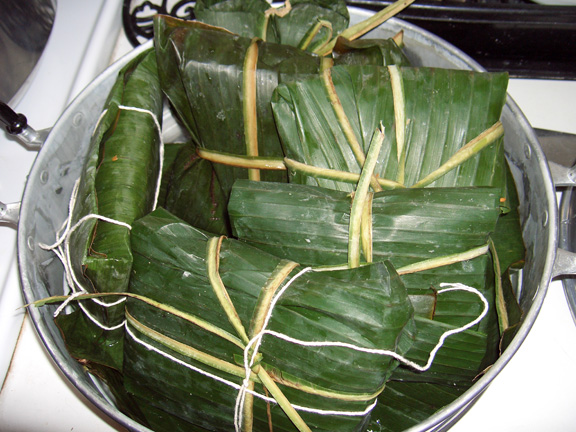
Nacatamales_in_steamer

Borrowed nacatamal photo to the left.

Nacatamal means “meat tamale” in Nahuatl, the language of the Aztecs. It’s a traditional Nicaraguan dish of seasoned pork or chicken meat, rice, slices of potato, bell pepper, tomato, onion, olives, cilantro, and fresh chile. All wrapped in plantain leaves.

Ours were a locavore’s delight. Best of the best. All local ingredients.

After our raves, the Mrs. shared that she had been trained professionally, and some folks came and stayed for days, just for her food. It was that special.

We returned to Léon and our family, more Nica than on departure.

Our room felt like an old friend. Our family laughed on hearing our stories.

Next up was Spanish school. Another best of the best.

insideDariana

The building was over a couple of hundred years old- originally a home. About 20 years ago it was renovated as a hotel / restaurant. The restoration was carefully and loving done. Complete with native hardwoods.

The hotel / restaurant idea didn’t work out and now it is Dariana Spanish school. Their loss. Our gain.

The veranda around the courtyard serves as an open air classroom.

Each student has their own teacher.

The gentleman in the red shorts towards the back is Bruno. Bruno is Swiss, with the body language and personality of a Latino. Not surprisingly he loves Nicaragua.

Sharon’s teacher, the first week (above), was Davíd. They got along great. Davíd told me several times how much he respected Sharon and how smart and interesting he thought she was.

This was a familiar refrain to me. Not only in Nicaragua, but in all our travels. Not to everyone’s tastes. But for those she hits it off with, she holds nothing back. And there is a lot there.

One day I ask Davíd, “So what Spanish accent does Sharon have?”

“Ecuadorian”

Curious. I guess that’s what you get when you cross Tampa street Spanish with her mother’s Cuban/ Spanish Castilian influence. And then there is Sharon’s own thing.

The gentleman Bruno is pointing at, is Rafael, Sharon’s teacher the second week. Another of Sharon’s buds.

Rafael was a cheerful, smart, educated guy with the most tragic backstory, I have ever heard personally. Abandoned by his parents as a very young boy on the streets of Nicaragua, he and his sibs literally scavenged on the streets to survive.

Through a series of remarkable circumstances, after many, many dark days. he eventually made it to university and graduated.

Today Rafael is happily married, with his own family. He loves to cook. Not the usual thing for a Nicaraguan male. Sharon and Rafael had been talking Nicaraguan food for days.

We’d tasted nacatamales, semilla de jicaro, quesillo, piñol, jocote, indio viejo, chancho con yucca, buñuelos, gallo pinto ( a couple of times a day), and vigorón (muchisimas gracias Carmen).

We hadn’t tried Vaho, or Baho if you will, one of the cornerstones of Nicaraguan cuisine. Borrowed photo below.

baho

Our second to the last day, Rafael disappeared at late morning break. He returned smiling with his favorite Bajo from the central market.

We spent the rest of morning chatting (in Spanish) and munching. While it may not look like it, Bajo is traditionally finger food. Who were we to argue.

On our last day, we received our diplomas. Sharon’s was advanzado. Mine was intermedio, a bit of a stretch, but I took it.

Our school days had run mornings. We also took part in the school’s afternoon León excursions. This post has run long enough so I’m skipping those details, except for the photo below.

leon cathedral-top

Taken when we were up on the roof of the León Cathedral, the largest cathedral in Central America. A world heritage site today, it was completed in 1814 and was consecrated by Pope Pius IX in 1860.

Many have been puzzled as to the size of the Cathedral. Rather large for Léon’s place in the world, at the time.

The story goes that the “Spaniards were sailing to the New World with two sets of plans, for cathedrals in Leon and Lima. There was a mix-up and the plans that were meant for Peru were used here instead.”

A very Nica story.

On afternoons when we didn’t have activities we hiked volcanoes. And we didn’t have far to go.

Volcanoes, Volcanoes, Volcanoes

After reading that we could get a ride part way up, I had signed us up for a climb to the top of San Cristobal Volcano, the highest volcano in Nicaragua at 5725 feet.

We drove by on the way to Potosí. Intimidating with no shade. Our driver, half our age, chuckled, “Better you than me. I’ve been up once, that was when I was young and it just about killed me, and by the way there is no road part way up.”

San Cristobal Volcano

Although we had paid up (nonrefundable), on returning to León, we decided that this hike would be too much. I called our tour company.

Before I could say anything, our main contact (another) Davíd said,

“I am very, very sorry, we have had to cancel your San Cristobal trek. It would just be too dangerous. San Cristobal is puffing and showing elevated seismic activity. We are happy to give you full credit.”

Graciously I accepted. A bullet dodged.

Next up was Cerro Negro Volcano Boarding. Sharon had a sore shoulder from a dive off the bed trying to silence a mis-set alarm clock. I would be on my own.

A previous guest with our family had broken some bones on her ride down the volcano. She had ended her stay in Nicaragua- in a cast.

Since its birth in 1850, Cerro Negro has erupted 23 times.

Cerro-Negro21971

Cerro Negro is a 45 minute drive from Léon. While geologically interesting, Cerro Negro’s 21st century claim to fame is volcano boarding.

#2 on CNN’s “Thrill seeker’s bucket list: 50 experiences to try before you die.”  One behind “Be a jet fighter pilot for a day” and one ahead of “Enter the Cage of Death, Australia.”

If not now, when? Below: Me and my volcano board below, on top of Cerro Negro- while I was still clean.

cerro negro me

Here is my favorite youtube video on volcano boarding Cerro Negro. Curiously, it turns out that Holly (narrator, professional surfer and Nica resident) has since married the brother of one of our doctor neighbors.

Apparently Holly went back to Cerro Negro in an attempt to log a far more faster speed.

Yes, some use speed guns. Here is a link to her volcano boarding wipeout- in slow mo- at about 50 mph/ 80 kph. Holly broke her ankle and called her doctor-in-law from the Nica emergency room, for some trusted advice.

As our neighbor put it, something was mixed up,

“They showed me an x-ray and it wasn’t an ankle.”

Our tour company provided my volcano boarding instruction, my board and  protective gear- jumpsuit, goggles, gloves, kneepads, elbow pads. I forgot my bandana- for covering my nose and mouth.

I was spitting out black gravel for a week.

Next volcano on our list was Telica, another active volcano in the León neighborhood. Telica’s most recent eruption was in 2011.

080082

Sharon’s shoulder was still hurting, so once again I was on my own. Expecting the worst,  I was pleasantly surprised when, in less than an hour of hiking, we were at the rim.

This volcano had an access road.

Our group was exceedingly international. Out of a dozen, only a few of us were from the USA. This had been true at our spanish school and in our Nica travels in general.

On the way up Telica I posed the question to this very fit, young Irish woman,

“So where are all the Americans?”

Without missing a beat or step, she answered,

“In Costa Rica.”

Yep.

telica

The Telica surprise, for me, was the sound. Like a jet engine or a blast furnace. If you look over the edge, like the Australian girl behind me, this is what you see (borrowed photo below):

nicaragua-A-235

We sauntered around the volcano, and watched the sun set into the Pacific. As the stars came out, we turned on our headlamps and hiked back down to our truck.

During our time in Léon, Sharon and I made a side trip to Granada and hiked Mombacho Volcano.

Granada

volcan-mombacho-wide

Mombacho volcano is only 6 miles from Granada, and one of two cloud forest volcanoes in Nicaragua.

Today Mombacho is considered to be an extinct volcano. The last eruption occurred in 1570.

Sometime before ∼140 to 345 A.D, the lakeside slope of Mombacho blew out, throwing rock sideways and creating the 365 or so tiny “volcanic” islands, today known as the Isletas.

We did the boat tour.

Some of these mini-islands are owned by locals. Some are high end vacation homes. Some are nature reserves. Some are restaurants. Some are hotels. I remember one with an elementary school.

All mixed up together.

Real estate as tapas.

Borrowed photo below.

800px-volcanic_island

Our boatman had been born on a family-owned Isleta- passed down for generations.

“And we’re never selling!”

Our hotel in Granada, La Gran Francia, purportedly one of the oldest European buildings in the Americas, was our treat- to ourselves. View from our balcony below.

gran francia exterior

Since it’s founding in 1524 Granada has been burned to the ground several times.

Each time our hotel (mostly) escaped the flames.

As the story goes, in the early 1800’s, after murdering his wife, the Duke of Praslin, helped by King Louis Phillipe of France, feigned his suicide and then moved to the very end of the known world- Nicaragua, where he lived in our hotel.

In the mid-1800’s, the hotel was occupied by the forces of William Walker, a US–backed mercenary and “President” of Nicaragua.

Luxury Latin America, adds that:

“According to legend, Granada’s grand dame was first constructed next to the ancient plaza in the late 1520s, shortly after conquistadors claimed this land, overlooking Lake Nicaragua, as their own. Perhaps used as an impressively upscale inn even then, this hotel has hosted Spanish royalty.”

An impressively upscale inn for the conquistadors?

Monty Python material.

So who stays at the La Gran Francia today? Interior courtyard below.

gran francia interior

If you arrive, like we did, at the beginning of the Granada International Poetry Festival, the majority of the guests will be internationally renowned poets, family and friends.

So how does one recognize such folks?

Paraphrasing Supreme Court Justice Potter Stewart’s 1964 threshold test for obscenity (pornography):

“You know them when you see them.”

We were clearly not running with the poetry crowd. We were up far too early, wore bright hiking clothes, and talked about volcanoes.

We had hoped to hike the longer Puma trail on Mombacho volcano, unfortunately it was closed for maintenance. The shorter Tigrillo trail worked out just fine. We had howler monkeys, trampled scorpions and gorgeous views.

The cloud forest on top was wet. Thankfully the trail had been designed accordingly. Complete with wooden steps, handrails, and drainage.

Our next cloud forest hike was another matter altogether.

Ometepe

When our spanish school finished, we headed for Ometepe, a two-volcano island in the middle of Lake Nicaragua, the largest freshwater lake in Central America- and the 19th largest lake in the world (by area).

We rode over on the ferry. Borrowed photo below.

cropped-425287_10151244573505626_1004300191_n

Over the last year, I rotated pictures of Nicaragua on my computer desktop. My business partner and sailor, confided in me one day,

“Those volcanoes caught my attention, but that ferry really, really scares me. Top heavy. In rough weather, a car could shift, and that would be the end of that (you).”

Ometepe ferry

Thankfully, our crossing was uneventful.

We made our way up to the top deck of the ferry. The sun was hot. The seats few.

We grabbed a couple and who should sit down next to us but Monica- of our first day’s drive around Managua.

She and her family were down for another relaxing long weekend. Monica was an Ometepe regular. She asked about our plans.

We explained that we were going to climb Maderas, the cloud forest volcano on Ometepe- The next day.

“Really? You guys must be in good shape.”

Looking back, I didn’t have a clue what I had gotten us into. I suspect Monica did.

Maderas Volcano is a bit over 4500 feet high, which would have been relatively manageable, without the mud and the fallen trees, roots, boulders and so forth.

We survived – but barely.

maderas mud

We were on the trail before seven, and back down around six, with the last light of the day. We were by far the oldest on the trail.

And did I mention the endless, churned, calf-deep quagmire of mud?

ometepe mud

As Sharon put it wryly afterward: Everyone should have this experience – once in their life. (And this was her once.)

She’s had enough of volcanoes, particularly wet ones.

That said, it was very beautiful. We hiked up in the mists.

We didn’t see any blue morphos butterflies, but we did see a number of huge buho butterflies and monkeys. It was rainforest with moss, bamboo, and bromeliads.

We reached the rim a bit after noon.

The question was whether to go for the descent to the lagoon.

Another younger group was pondering the same question. They had the same Moon guidebook as we did:

“When you reach the crater lip, the final descent down to the mist-swept crater lake requires a rope and should not be attempted without proper safety equipment…”

After some discussion, they turned back. Enough was enough.

Our guide, prone to sexually-graphic, chauvinist metaphors, contributed,

“You’ve got this beautiful young woman lying naked on the bed, and you’re going to turn around?”

Sharon had hit her limit. I was pretty shot, but had a bit left.

The solution, Sharon would wait at the rim and our guide and I would go for the lagoon.

maderas lagoon

In less than fifteen minutes, we were standing on the edge of the lagoon.

Our guide was busy hustling the ten, or so, Europeans in French.

Swim time for me. As I floated out on my back, the sun broke through the mists.

Kind of a Zen moment.

From here, it would be back. First to our room in Charco Verde Resort on the shore of Lake Nicaragua (below).

charcoverde

Then to Managua and from there to the subzero temps of the Northeastern United States.

Spaghetti-Western hot to Yankee-Gothic frigid.

2014 Pre Nicaragua

GuadalupechurchgranadaOur Swiss friends from Bern, Linda and Hubert, are now living in Nicaragua. They have invited us to come visit. We are going to take them up on their generous offer this February, 2014.

We figure February is the right month.

It will be winter here in Cambridge, while in Nicaragua, it will be summer.

image004In February, the average Cambridge temperature will be 30° F, while in Managua, Nicaragua, it’ll average 81° F.

Nicaragua can get really wet. February is about as dry as it gets.

The blue bars on the chart to the left are inches of rain.

In February, Nicaragua will still be green from the October and November rains, while the days will be sunny.

2014 is the right year, because Hubert and Linda won’t be in Nicaragua all that much longer.

The tentative plan is to stay with Linda and Hubert in Managua for a few days at the beginning and the end of our trip.

We don’t want to overstay our welcome, and they will be having European guests in town for the International Poetry Festival in Granada.

poetryfestival

Initially I was thinking we would hit a few Nicaraguan highlights and then slip across the border to Costa Rica.

Lots to see and do in Costa Rica, and it’s tourist friendly.

Nicaragua, on the other hand, is on the raw and rugged side.

Which is not necessarily a bad thing, if approached properly. The more I looked at Nicaragua the better it looked.

Nicaragua is relatively safe, inexpensive, and undiscovered.

howlermonkey

Linda says that friends, who visited from Germany, said they saw more animals in their first four days in Nicaragua than in two weeks traveling with a tour group through Costa Rica.

The deal was sealed, when I discovered Nicaragua’s volcanoes. Nicaragua has world-class volcanoes.

Nicavolcano

Costa Rica is going to have to wait.

We’re going to hike Nicaragua’s Ring of Fire, see the sights, and attend Spanish School along the way.

Dariana1

We will begin and end in Managua. In between, we will stay in León, Granada, and Ometepe.

Managua

Our plan is to avoid Managua.

Except for Linda and Hubert’s neighborhood, which is said to be both safe and lovely.

The rest of Managua is said to be neither. Best approached thoughtfully and carefully.

This is what Linda has to say about Managua:

“You mention culture.  Managua doesn’t have “culture” per se.  It has history, mostly sad.  And poverty.  As one young tourist told me before I’d ever been here, “Managua is a big, dangerous, ugly city and we got out as fast as we could.”

Managua is the capital of Nicaragua, today.

Nicaragua has been a bit out-of-control, and disorderly- for a very long time.

Nicaragua is the kind of place where in the 1500s the Spanish conquistadors famously fought each other in the War of the Captains.

Recently, criminals wanted in the USA have been spotted driving around in Winnebagos.

Maybe it’s the location. Nicaragua is a crossroads of sorts with the accompanying chaos that comes with such a location.

Nicaragua is smack dab in the middle of the Central American isthmus, linking North and South America.

central-america-map

Honduras, murder capital of the world, is to the north, while gentile Costa Rica is to the south.

We will be flying into Sandino International Airport in Managua.

Since the early 1970’s the airport’s name has changed three times.

Today, Sandinistas, rule in Nicaragua, once again. And the airport is, once again, called Sandino International Airport.

Screen Shot 2013-06-30 at 2.28.04 PM

After LInda and Hubert arrived in Nicaragua, Linda sent out the following in her 2011 Xmas newsletter:

“Since we arrived in the house, we’ve had two tarantulas, one black coral snake – poisonous; she laid at least two eggs – and a three-inch scorpion.

“Fumigate!” the wives of diplomats told me. We removed our clothes from the closets, put everything in the kitchen into plastic bags or the fridge, and moved into a hotel for one night. By the time we returned, Carmen and Isidro had swept and mopped all the floors. Not a dead bug was to be found, though an odor of chemical lingered. I slept with a mask over my mouth and nose, and an sleep mask to cover my eyes.

Today, no mosquitoes bite me constantly while I sit at my computer, and no ants patrol the kitchen. Our ants were so tiny, they survived in the microwave while it was running! Carmen and Isidro said lots of ants and cockroaches came out from the walls, but no scorpions or spiders. All our geckos survived, thank goodness! The birds were fat and happy, stuffing themselves. I hope they didn’t ingest too much pesticide!

Once again, I feel confident in my own home. I have learned to wear shoes and not to walk on the lawn or swim in the pool in the dark. Hopefully, by the time the next scorpion or snake appears, I’ll be so acclimatized I can just ignore it. There is plenty of room in the ravine just beyond the garden wall for all the snakes, insects, and mosquitoes.”

I find Linda’s comments on arriving in her new world, far from Switzerland, most charming.

That said, on this trip, I’ll be wearing shoes-

Always.

 León

cathedralofLeon

León is about an hour and a half drive from Managua and the second largest city in Nicaragua after Managua. As of 2005, the city had an estimated population of about 175,000 people.

366px-FlorDeCanaCentenarioGold18YR-LRLeón is the principal city of northwestern Nicaragua- An area that has been described as steamy, volcanic and intellectual. León is home to Nicargua’s best museums, oldest universities and finest churches.

Also home to Flor de Cana, a distillery for one of the world’s best rums.

Flor de Cana has won more than 100 international awards since 2000.

We hope to visit, taste some, and then if it’s as good as advertised, bring a couple of bottles home.

Which means I should acquire some of those specially-designed, leak-proof bottle armor bags for packing glass bottles in luggage- that Sharon has been hinting about for years.

Our Peruvian Ocucaje Verde Pisco made it home without mishap, wrapped with shirts and buffered by socks. One of these days my luck is going to run out.

No need to tempt the luggage-handling fates.

Old León was founded in 1524 and abandoned in 1610 when the Momotombo Volcano erupted.

In 2000, the remains of the founder of Nicaragua, Francisco Hernández de Córdoba, were found in Old León, sans head.

540px-Francisco_Hernandez_de_Cordoba

Cordoba was an officer under Conquistador Pedrarias Dávila, known as Pedrarias the
Cruel.

Cordoba himself seems to have been a good guy, at least in a relative kind of way.

As one Nicaraguan scholar put it,

“He’s one of the few Spanish conquistadors of whom there are no accounts of 
 atrocities against the Indians, That’s very unusual.” 

A6077Dávila, on the other hand, was a very bad guy:

 “The history of the Spanish conquest is filled with tales of wanton ferocity and 
 slaughter,

but even in that context, Davila was something special. In pursuit of the riches of the natives, he murdered them so profligately and so barbarically that when his men fell into Indian hands, they were forced to drink molten gold.”

As the story goes, Davila had Cordoba decapitated, because Davila thought he could become a rival.

“The head of Nicaragua’s founder [Cordoba] was stuck on a pole in the town plaza, a reminder to others of the costs of incurring Davila’s wrath, while his body was buried at the  foot of the altar in Leon Viejo’s only church.”

The 21st century end to this 16th century story:

When the remains of both Cordoba and Davila were found in 2000:

 “The remains of Hernandez de Cordoba were escorted out of Leon Viejo by a 
 military honor guard to lie in state at various sites throughout Nicaragua. After 
 that, they’ll be interred in a special crypt near the church where he was originally 
 buried.

Davila’s bones have gone to a back room at the National Museum.”

Clearly, no love for Davila, even after 500 years.

The back room of the National Museum- a very 21st century level of Hell.

León is a great base for visiting volcanoes.

Volcanoes, Volcanoes, Volcanoes

The Central American Volcanic Arc runs from Guatemala to Northern Panama. Nicaragua is front and center.

Volcanoes to spare.

There are 19 volcanoes in Nicaragua. They march across the Pacific lowlands, a volcano every 10 to 15 miles.

1-s2.0-S0377027307000686-gr1

If all goes according to plan, we will visit/climb 5 from León: Cosigüina, San Cristóbal, Telica, and Cerro Negro.

We will also visit/climb: Masaya volcano from Managua; Mombacho volcano from Granada; and Maderas volcano from the island of Ometepe.

Some of these volcanoes are young. Some are old. Some are tall. Some are short. Some are extinct. Some are active. Some are dormant.

volcano map

Cosigüina volcano is located in the far northwestern corner of Nicaragua, a bit out of the way, and as such it is one of the least frequented in Nicaragua.

Cosigüina blew it’s lid In 1835 in one of the largest and most explosive eruptions in Central America since the Spanish Conquest. The eruption cloud blocked out the sun in a 93 mile (150 km) radius.

Ash was thrown 870 miles north to Mexico City and and some huge pieces of rock splashed down in the ocean forming islands in the Gulf on Fonseca.

Islotes de Cosiguina

These would be worth a visit, but it might be a stretch. First one has to get to the local town of Potosí and then, the instructions go: “you can ask a fisherman to take you there.”

In any case, today, Cosigüina volcano is less than 500 feet tall with a lake inside. And purportedly has great views of El Salvador and Honduras, across the Gulf of Fonseca.

Consiquina lake

The forest reserve that wraps Cosigüina volcano is home to Scarlet Macaws. I’d love to see these in the wild.

costa-rica_scarlet_macaws_12

Speaking of birds, the national bird of Nicaragua is the Turquoise-browed Motmot  (below), found across all of Nicaragua. We’re going to keep an eye out.

Guardabarranco

Whereas Cosigüina is sleeping, San Cristobal, the next volcano down, is another story altogether.

San Cristobal is Nicaragua’s highest active volcano @ 5,725 ft.

San Cristobal

It’s an hour and half drive from León. And a 9 to 10 hour hike up from there. Vamos a ver. We shall see.

The pic below purportedly was taken on top of Telica Volcano. I like this image a lot. It has a warm, comfy, end-of-the-world feel.

night-telica

As you might gather from the red glow, Telica is an active volcano. The most recent eruption was in 2011.

We hope to visit Telica, I’m not sure we’ll do the overnight by the cone, but it’s tempting.

Cerro Negro, below, is youngest volcano in Central America.

Since its birth in 1850, Cerro Negro has erupted 23 times.

Cerro-Negro21971

Cerro Negro is a 45 minute drive from Léon. While geologically interesting, Cerro Negro’s 21st century claim to fame is volcano boarding.

#2 on CNN’s “Thrill seeker’s bucket list: 50 experiences to try before you die.”  One behind “Be a jet fighter pilot for a day” and one ahead of “Enter the Cage of Death, Australia.”

Liz Volcano Boarding

Here is a youtube video on volcano boarding Cerro Negro (volcano), with riding instructions and crash.

Hike up to the rim, hop on a board and ride down the 40+ degree slope.

We shall see.

Masaya volcano is Nicaragua’s first and largest National Park and as Linda says,

“It never fails to impress.”

I’m impressed already.

Masaya is supposedly the only active Volcano in the Western Hemisphere, where one can drive right up to the rim. For scale, note the car in the parking lot about half way up, on the left side of the pic below.

Masaya crater

Masaya spews tons and tons of sulfuric gas into the air every year. Apparently it’s one of the largest natural polluters in the world. Sounds a bit hell-like.

Which is exactly how the first Spanish saw it in the 16th century- in a very literal kind of way.

Masaya1

They thought they were actually seeing Hell’s front door. They named the volcano accordingly: “La Boca del Infierno” or “The Mouth of Hell”.

A group of friars climbed up to this mouth of hell and planted a cross in hopes of keeping the dark forces at bay. Although their efforts don’t seem to have been entirely successful, metaphysically, one has to admire their courage.

American-backed, Nicaraguan President-for-life, Somoza used to have his political rivals flown over the Masaya crater in a helicopters and dropped into the lava.

nicaragua-masaya-volcano-crater-lava

The Somoza family ruled Nicaragua as a family dictatorship from 1936 to 1979.  As far as cruelty goes, they probably outdid conquistador Pedrarias Dávila.

And that’s saying something.

Masaya is rather active. The warning below says it all.

Masaya warning

Here is a youtube video of Masaya’s 2008 eruption. American (likely) dad and kids on the walk along the rim, trying to get back to their car. It’s a classic. The audio might be even better than the video. My favorite lines:

This is not a good thing”

“Let’s go guys”

“This is not funny”

and the most inspired line…

“We should have made a sacrifice”

Granada

After a week or so in Léon, we will move a couple of hours down the road to Granada.

640px-Granada,_Nicaragua_2

Granada is the sister city of León. It was founded in the same year -1524 – by the same Spanish conquistador – Francisco Hernández de Córdoba. He of the lost head.

Granada is a tourist favorite. It is also home of many of the country’s conservative, economic and political elite.

In the 1970s, Somoza bombed León, but left Granada alone.

Granada sits on on the edge of Lake Nicaragua. Lake Nicaragua is big, about twice as big as the Great Salt Lake in Utah, though a freshwater lake, or “sweet sea” as the translation goes.

Granada is said to be Nicaragua’s most picturesque town. And restoration is underway- fueled in no small part by USA ex-pat money.

That said, Granada is no San Miguel de Allende. No Orient Express Hotels. At least-

Not Yet.

Our guidebook says that much of Granada’s “colonial” architecture is intact.

I wonder about that- given the number of times Granada has been burned to the ground over the years.

In the 1600s, Granada was the most important city in Central America. And the most prosperous- fueled by the incredible New World wealth, which passed through the town on its way back to Spain.

Curiously, Spain ignored Granada’s vulnerability.

Which, predictably, made Granada a target for creative, infamous pirates, such as Henry Morgan and William Dampier.

riochagres023Sir Henry Morgan, came up the San Juan River at night, and surprised the Spanish in 1665.

He made off with a whole lot of treasure, burning Granada on departure.

In 1670, another pirate, Captain Gallardito, overran Granada once again.

The Spanish had had enough, and built the Fortress of the Immaculate Conception, next to a rapid in the San Juan River, effectively sealing the pirates of the Caribbean, off from Lake Nicaragua.

5 years later in 1685, buccaneer William Dampier overran Granada. He surprised the Spanish by coming in from the backside- overland from the Pacific. On his departure, he burned Granada once more.

WilliamWalkerIn the mid-1800s, a freelancing American, William Walker, ruled Nicaragua for about a year.

Walker was a lawyer, journalist, adventurer, and a true-believer in American manifest destiny.

First, unsuccessfully, he tried to take over Mexico.

Thanks to a fraudulent election and the backing of Wall Street tycoon Cornelius Vanderbilt, Walker realized his dream in Nicaragua, albeit briefly.

He lasted as “President” for about a year, and in the tradition of preceding pirates, burned Granada to the ground on his way out of town.

Our current plan is spend about a week in Granada. Same formula as León: Spanish school, and volcanoes.

Mombacho volcano is only 6 miles from Granada.  Mombacho is one of the two cloud forest volcanoes in Nicaragua. Photo of Mambacho from Granada below.

Mombacho from Granada

Mombacho is still classed as active, though the last eruption was in 1570.

The big draws for us are the cloud forests and the dwarf forests which are home to many exotic native plant and animal species, including bromeliads and red-eyed frogs.

After a week in Granada, the plan is to sail off across wind-swept Lake Nicaragua to the Island of Ometepe for a few days.

Isla Ometepe

cropped-425287_10151244573505626_1004300191_n

I’m not quite sure what the draw of Ometepe is.

But it’s working on me.

I suspect it’s an archetypal thing.

A huge freshwater lake in the middle of an isthmus between two continents. In the middle is an island of double volcanoes. One active and one extinct.

And swimming around the island are freshwater sharks.

12.jpg

Ometepe has been considered special for a very long time.

petroglyphs_pre-columbian_art2

Native peoples believe the island is sacred.

Some say Ometepe should be considered one of the great rock art areas of the world due to the many petroglyphs and stone idols carved into and from basalt boulders spread over the island.

The oldest petroglyphs on Ometepe are said to date to around 1000 B.C.

Ometepe is the world’s largest volcanic island in a freshwater lake.

There are two volcanoes on Ometepe.

The northern volcano is Concepción, a perfectly-cone-shaped, active volcano. The southern volcano is the extinct Maderas, swathed in a cloud forest.

Linda and her family made the trip to Ometepe. Linda says she’s never going back.

Too isolated. Too third world.

We’re tempering our expectations and planning accordingly.

We hope to climb the Maderas volcano at 4600 ft.

This will be the big one of the trip. No 4 wheel vehicles driving us part way up. It’ll be legs all the way up- and all the way down.

We’ll have a guide, be expecting mud, and a very long day.

We’ll be in a cloud forest, with white-faced monkeys, mountain crabs, howler monkeys, and butterflies- including the Blue Morpho.

681x454

The iridescent Blue Morpho is one of the largest and most beautiful butterflies in the world, with wings spanning five to eight inches.

On reflection, it’s curious that butterflies seem to be becoming a theme in our travels.

I look at it as a good thing.