
I’ve been been getting acquainted with Tampa for going on 50 years. It’s Sharon’s Home Town. She gets another 25+ .
Between us, you’d think we’d have seen it all. Au contraire.
Only scratching the surface. It’s all in the perspective and framing of the experience. Little did I know of the Mayan connection, Circus Freaks, or Confabulated Pirates.
Sharon’s Mom lived just north of Little Havana. Ybor City was on the family circuit. We’ve been to uptown, and downtown Tampa.
We’ve been South to Sanibel and the Everglades. Inland East to Winter Haven and Orlando, North inland for kayaking on the Hillsborough River and bicycling on the Withlacoochee State Bike Trail.
But we’d never simply gone due West to the Gulf, nor had we explored up the Gulf Coast. Which is what this trip was about.
Neither of us had ever even seen a Manatee.
If not now, When?
Manatees are curious beasts. Been around for something like 50 million years. Somehow they’ve made it to 21st century Florida. Strip malls, speed boats, coal-fired power plants and all.
The time to see Manatees is in the winter, when temperatures dip into the 50s. The perfect time to escape Boston is in January, when temperatures drop below freezing.
We chose three hotels, and explored out and around from each:
- Safety Harbor Resort and Spa put us across the bay from Tampa and within striking distance of St. Petersburg and Clearwater. Manatees sometimes are seen from the docks.
- The Hacienda Hotel in New Port Richey is up the coast from Safety Harbor and close to ground zero for Manatees
- The Epicurean Hotel in Tampa, a favorite of ours. A foodie hotel in an artsy Tampa neighborhood. From the Epicurean, we could revisit old haunts and visit the TECO Manatee Viewing Center.
And as an added bonus at the Epicurian, we would be in the middle of Tampa’s Gasparilla Day. Tampa’s answer to New Orlean’s Mardi Gras.
Safety Harbor Resort and Spa
When we landed in Tampa, we knew the drill. We’d done it enough times.
Sharon stayed with the suitcases outside of the baggage claim, while I headed for the car rental, only a short shuttle train ride away. I looped back and we loaded up. 20 minutes later we were pulling up at Safety Harbor Resort and Spa.
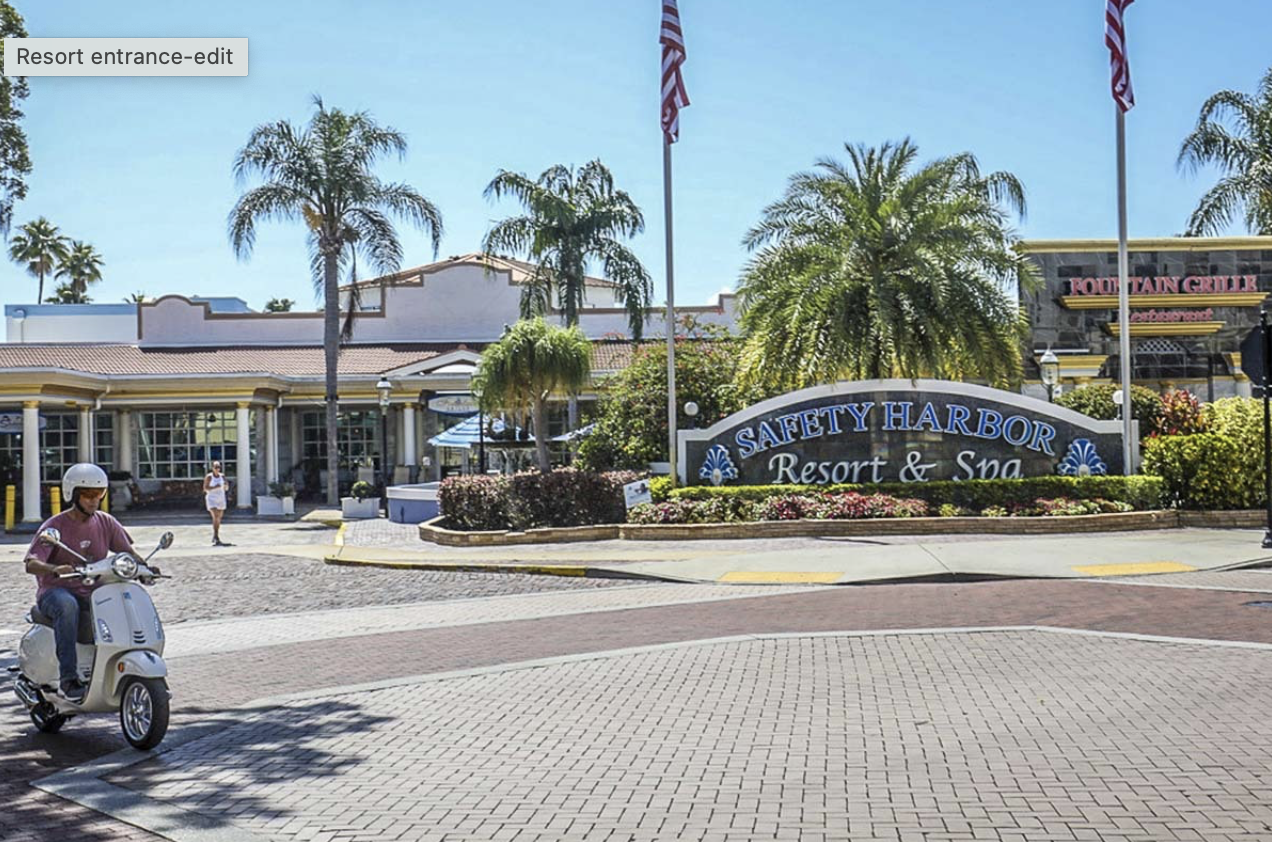
I had discovered Safety Harbor bicycling the previous Spring. A semi-moneyed enclave nestled up against the Bay just across the Courtney Campbell Causeway. Known affectionately locally as the Red Neck Riviera:
The Florida Heritage Landmark Sign out front of the Safety Harbor Resort caught my eye. The Espiritu Santo Springs here were named by the Spanish explorer Hernando de Soto in 1539. He believed he “had found the legendary Fountain of Youth, somehow missed by Ponce de Leon.”

Too good to be true? Well, Yes.
For starters, Ponce de Leon wasn’t looking for the fountain of youth. He just wanted $$$.
The whole fountain of youth thing was made up by a Spanish historian back in the day, who hated Ponce. He figured that such a goofy story would discredit the guy.
In a curious karmic twist, the historian’s machinations cemented Ponce’s name in the history books.
While Hernando de Soto did indeed visit Tampa Bay in 1539, his 900 men + war dogs didn’t wipe out the local Tocobaga people in Safety Harbor. They wiped out their cousins across the bay.
We checked in and headed for our room. I had tried to reserve in the historic wing, but had waited too long. As luck would have it, we ended up there anyway.
We were on the second floor. Tiny elevator. We looked at each other. Would the tandem – once assembled – fit? As it turned out, Yes, with the front wheel off and the bike vertical. Not the first time.
We woke to sunrise over Tampa Bay.

Bike assembly day. But breakfast first.
On the way to the coffee shop we hit the historic photos. Pretty great stuff.
The oldest were from the 1910s when the site was a classic Florida roadside attraction.

“Famous Mineral Water. Cures Rheumatism, Diabetes, Bladder Troubles, Brights Disease, Digestive Disorders”
I particularly like the guy hanging out on the porch and the word “Cures” in extra big letters.
The “Waters” are still a big deal. The spa downstairs is sort-of world famous. 50,000 square feet. Which no doubt includes the swimming pools. All spring fed.
The couple next to us at breakfast in the coffee shop, wanted to know if the water on the table was from the spring.
“No, that would be extra”
We weren’t worried. The cooler outside our room was 100% Espiritu Springs water. It never ran dry. We drank a lot. And our bicycle water bottles just fit for filling.
Today the Espiritu Springs water is filtered. They say back in the day it had much more character. Sulfur overtones. But it is still pretty great. Clean and clear.
Did I feel younger? Healthier? Perhaps, for a moment here and there.
We got to know the head maintenance guy. Came from Chicago over 20 years ago. Has been working here ever since. Recently lost a good friend, still in Chicago.
His friend was a cop and was shot in the back of the head, sitting in his patrol car.
Our maintenance guy loves the resort. Knows all the stories and the workings of the place.
I asked him about the spring flow.
“Millions of gallons/day”
“The spring is artisanal. It just bubbled up. Back in the 1920s, You’d arrive and there was a spring-fed fountain in the middle of the room to greet you.”
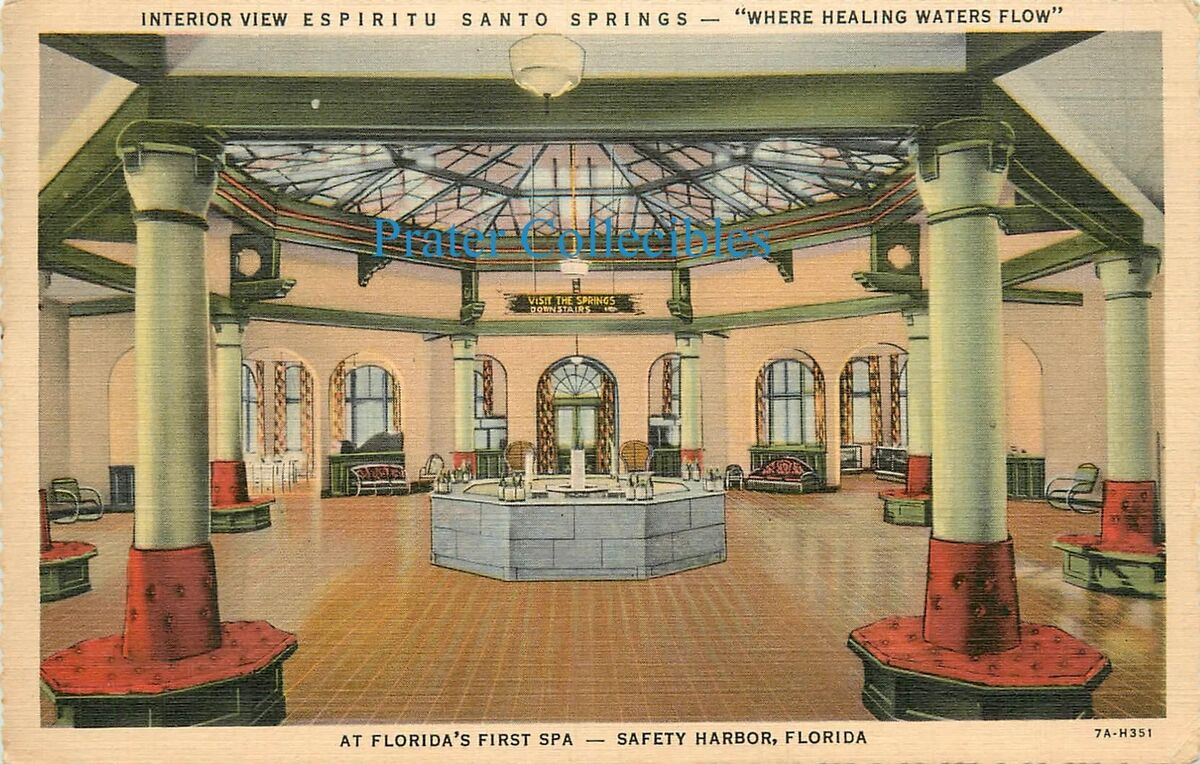
I figure this fountain was roughly where the domed ceiling mural is today, at the beginning of our St. Petersburg bicycle video below.
Today the spring comes up to the side of the lower Spa entrance and is piped off from there. The featured spring fountain in the lobby is just pretend.
You’d never even know this real deal historic spring was here unless you had a maintenance buddy.
Standing there was a curious 21st century spiritual moment.

St Petersburg
We’d visited St. Pete before, but had never visited the Dali Museum. This was our opportunity. The museum is located on the downtown St Pete waterfront, a short drive south.
“With the exception of the Dali Theater- Museum created by Dalí himself in his hometown of Figueres in Spain, the St. Petersburg Dalí Museum has the world’s largest collections of Dalí’s works.” World class. New, big $$, fancy-pants building too.
The plan was to get a lift via private transport to the museum and then ride back to Safety Harbor via the Pinellas Rail Trail. Which is pretty much how it worked out.
We found our transport through the resort. An airport shuttle just for us. Mr. Tandem just fit. Our driver was from the British West Indies. Not surprisingly, his English was good. We chatted about politics, and fruit trees.
He dropped us off at the Dali Museum. We locked up our bike and headed in.

It took Sharon all of about 5 minutes to figure something wasn’t right with Dali. I can’t remember visiting a museum where she didn’t take a photo. On this visit she took none.
Zero.
Her take on this famous painting,
“Sick”.
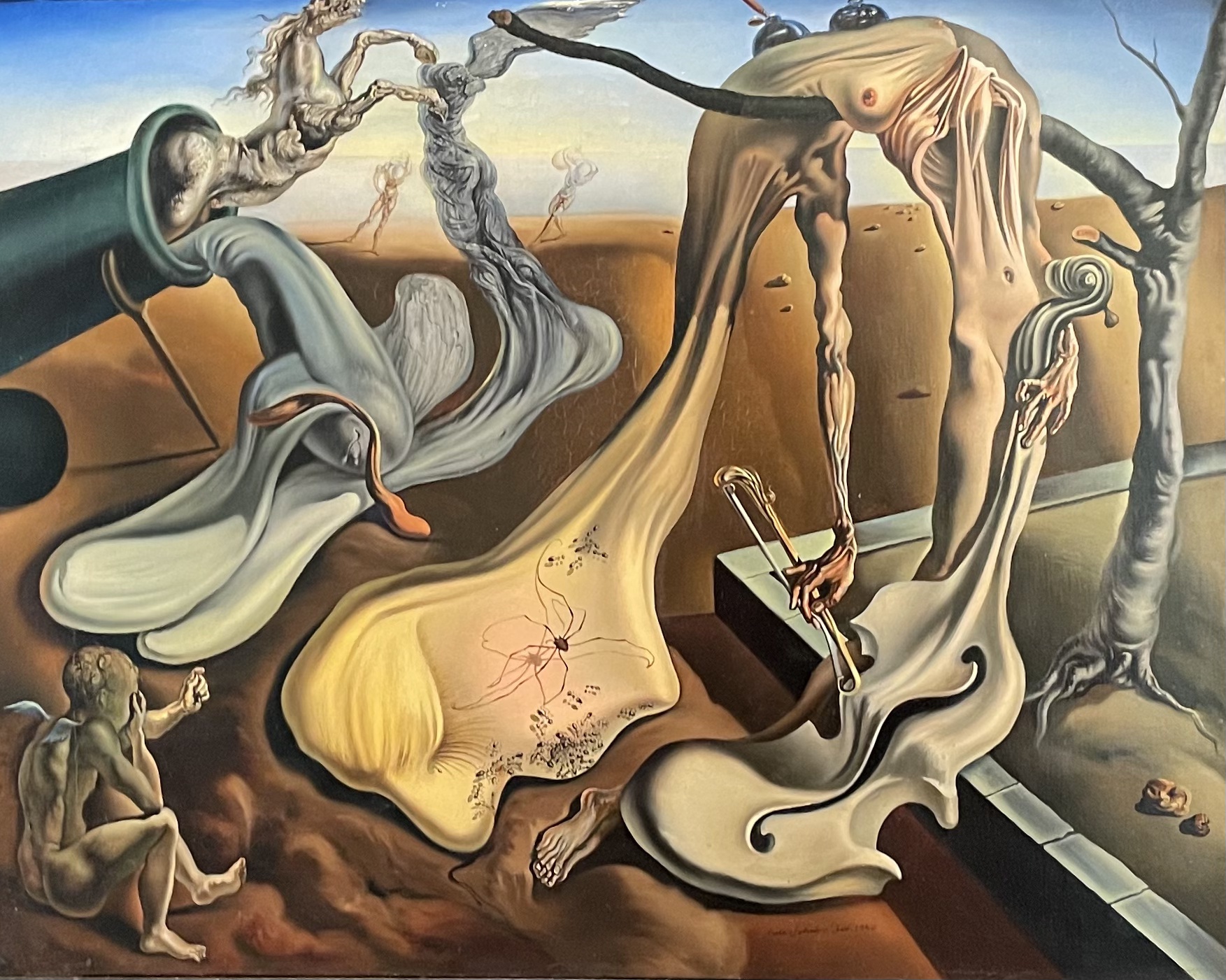
Probably true, but well done. Evocative and not derivative, like much of his later work.
I took a lot of photos. My favorite piece, Retrospective Bust of a Woman 1933:
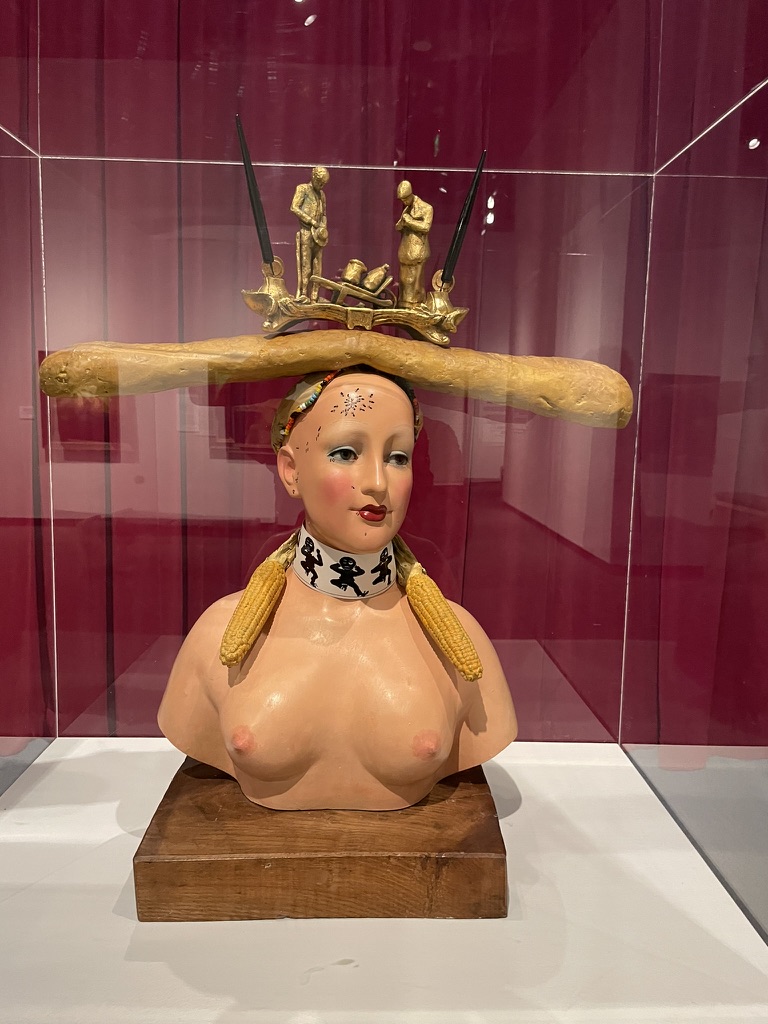
Pretty brilliant.
On the way out we stopped at the Café Gala. “Light Fare with a Spanish Theme.” Named in honor of Salvador Dalí’s wife, Gala.
Had some good food and a fun conversation with the guy behind the counter. He has been wandering the world. Spent a year in Europe following the band Hiatus Kaiyote around. An Australian Jazz Funk Band. He was thinking of heading to Asian next. We talked about Japan and the Shikoku Pilgrimage.
We didn’t talk about the Café’s namesake, Gala. Boy was she a piece of work. Given her proclivities and personality, it’s curious she has any café named after her.
In retrospect, it’s telling there were no photos of her on the walls.
No one ever referred to Dali’s wife Gala as sweet or light fare.
A demonic dominatrix, Yes.
Could she have really been as bad as all that. In short, Yes.
As the Paris Review puts it,
“At her best, Gala was difficult and intense. At her worst, she was nothing short of monstrous. She had no friends and maintained a malevolent distance from her family. Described as “cruel, fierce and small” and having “eyes that pierced walls,” she collected stuffed toys but once cooked her own pet rabbit. Her “demonic temper” asserted itself often; if she didn’t like someone’s face, she spat at them, and if she wanted to silence someone, she would stub cigarettes out on their arm. Not surprisingly, she was hugely unpopular.”
The stories go on and on.
“Women particularly disliked her. Gala was sexually voracious and had no respect for other people’s relationships.”
“The filmmaker Luis Buñuel, who, with Dalí, made the seminal short film “Un chien Andalou”, got so sick of Gala’s insults that he once tried to throttle her.”
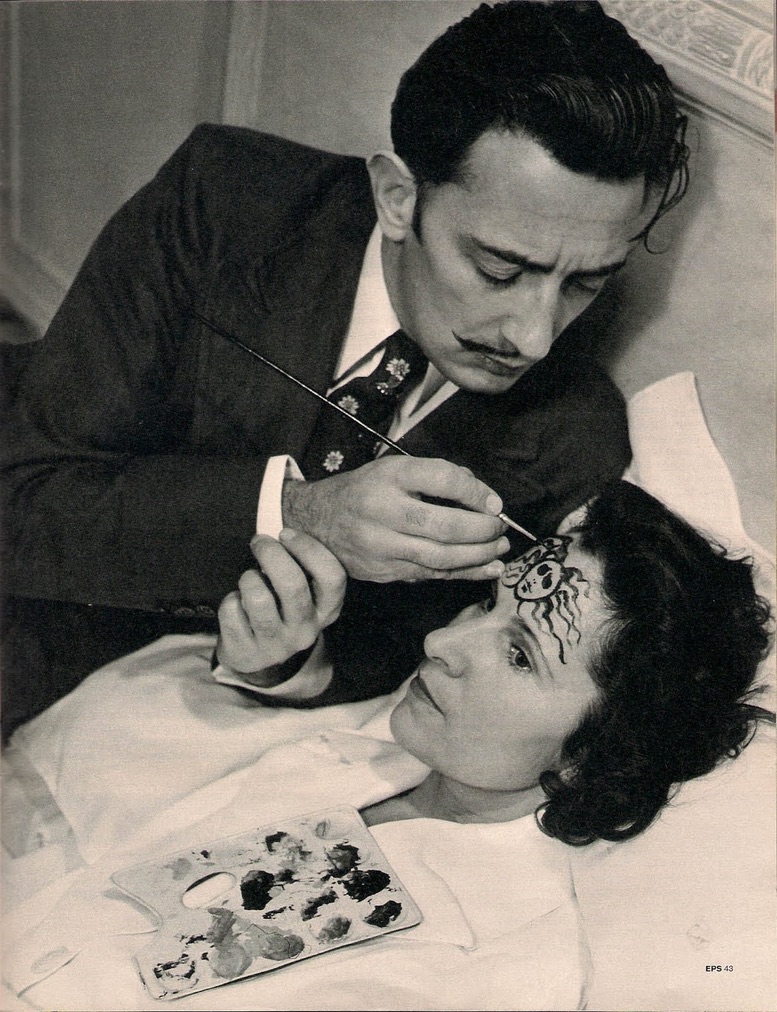
Salvador and Gala had an open marriage. He was devoted to her his whole life. Yes, there were some kinks. See his paintings.
Stories have it that his thing was to watch. Worked for both of them.
That said Gala was his life-long favorite subject. His muse.
At the end of their lives Salvador bought Gala a castle, but had to send a written request to visit. Gala had a harem of male lovers.
Back at the bike, no deflated watches, but we did have a flat tire. We pumped the tire back up and headed back to Safety Harbor via the Pinellas Rail Trail. Pressure held.
Click on this Video Link for our Ride. Don’t miss the weight lifters in slo-mo a short ways in. Very Florida.
Gold and Blue with shiny stone surfaces. Murals with half naked women.
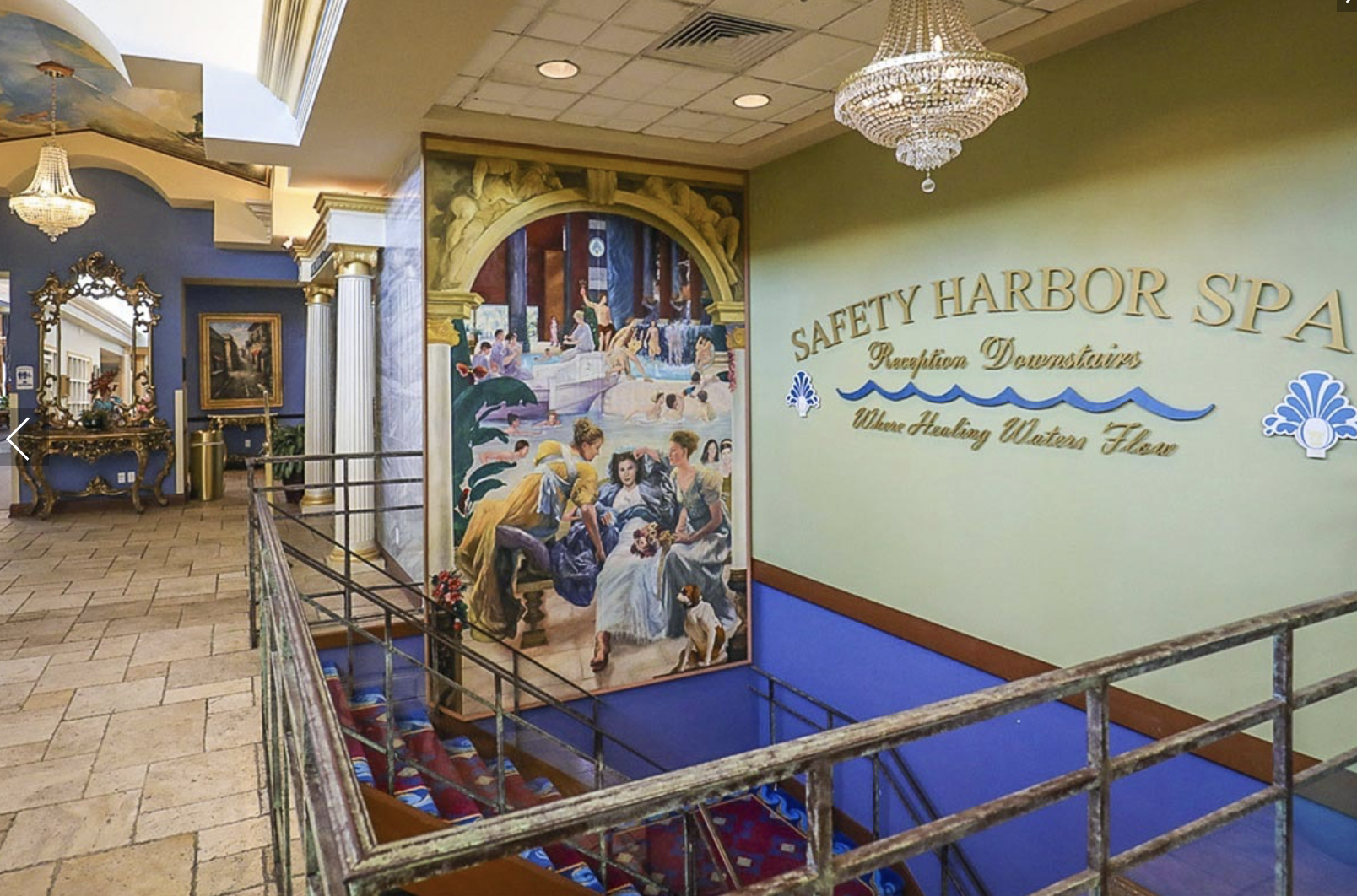
We knew this schtick. Many moons ago we had Greek neighbors. Same aesthetic. They had topped theirs off with a mirror on the ceiling over their bed.
Today’s hotel dates back to the 1920s. Florida was booming. The first Florida real estate bubble. Big money and deep-pocketed tourists.
The story goes that folks from New York City moved down to the resort for the winter. They’d even bring their furniture. But didn’t always want to bring it all back home. The choicest still populate the common areas.
In those times Tampa Bay came right up behind the hotel. The waters were shallow and it took a half-mile long pier to get out to where the ferries from Tampa could dock.

Today these shallows have been filled.
We walked across those wide flat lawns the next day in search of Manatees.
We made our way out onto today’s truncated pier. We had heard Manatees regularly visit. We checked both sides. To and fro. No Manatees.
Then we heading up shore to the Mangrove boardwalk.
Mangroves
Just up the shore a bit we hit the Safety Harbor [Mangrove] Nature Walk. I never get tired of this stuff. The 2500 foot boardwalk runs through the mangroves and along the edge of Tampa Bay.
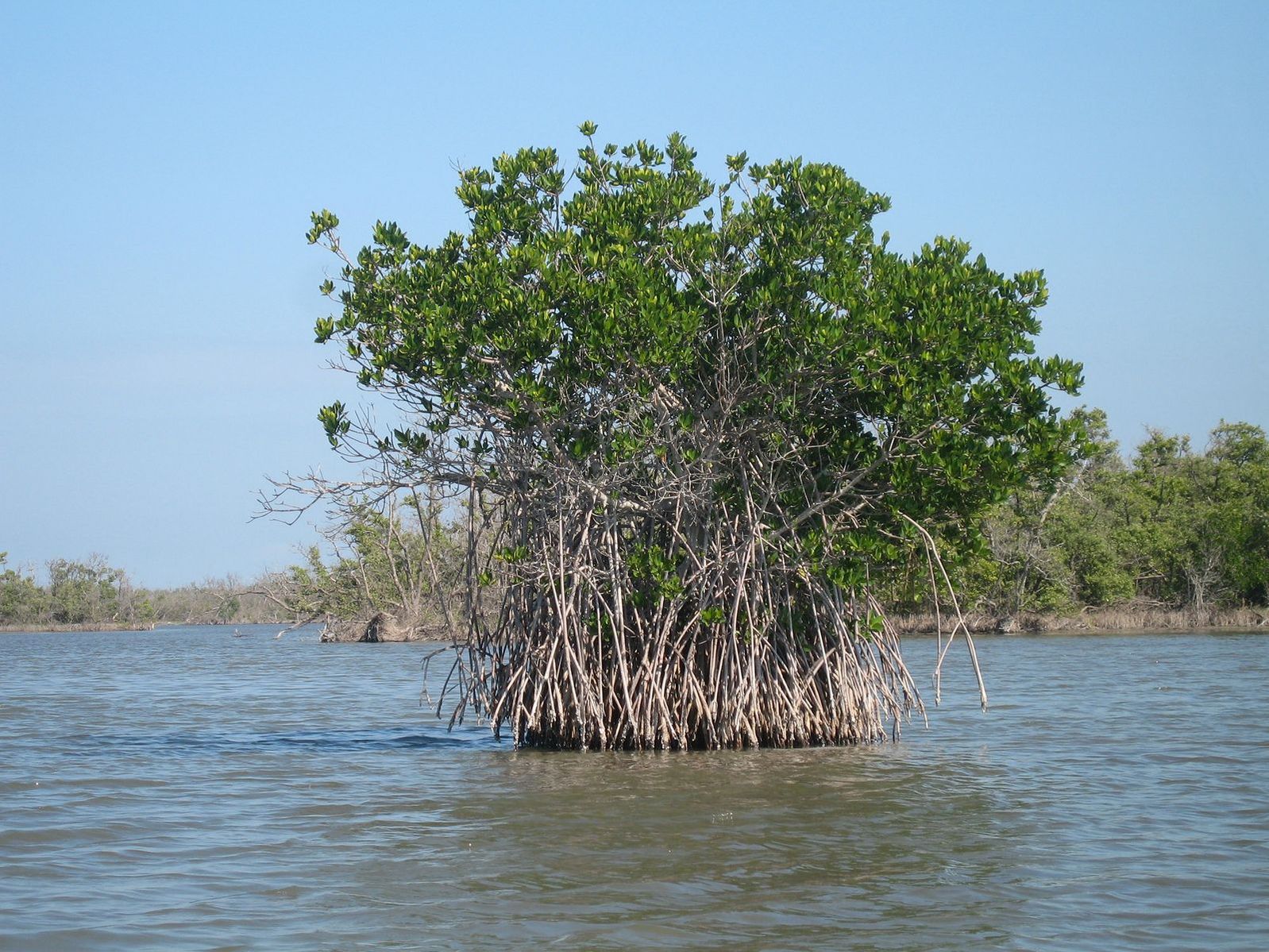
Mangroves are salt tolerant shrubs and trees that are adapted to live in harsh coastal conditions. They contain a complex salt filtration system with wonderfully complex root systems.
They thrive in the intertidal zones along marine coasts. Salt water/ fresh water mixes are their specialty.
They do not grow on land, and they don’t grow in the oceans. Mangroves only flourish in a narrow fringe of suitable in-between geomorphology, which is Florida’s specialty. Mangrove forests only grow at tropical and subtropical latitudes near the equator because they cannot withstand freezing temperatures.
I always forget that Tampa is the subtropics.
The Everglades is the largest mangrove forest in the Western hemisphere.
The Everglades are only a days’ drive south of Tampa.
50% of Tampa’s Mangroves have been lost, but that still leaves a whole lot. Survivors of days long gone.
Politics
One day last summer we were bicycling outside of Concord MA and struck up a conversation with a gentleman out walking his dog. He and his wife have a second home in Sanibel FL, a lovely town with shell beaches south of Tampa. Feels a bit like Berkeley CA, with hills swapped out for beaches and eucalyptus trees swapped out for mangroves.
“A great town we know well,” we offered.
He agreed with one qualification,
“The only thing wrong with Sanibel is that is in Florida.”
We all laughed … knowingly.
So what’s wrong with Florida?
You could start with the low-end strip malls which paper the state. Gun shops, pawn shops, strip clubs, churches. All mixed together. Same one story buildings.
There was a billboard for a plastic surgeon, as you came out of Publix Market in Sharon’s Mom’s neighborhood: Two words with a picture. Not much left to the imagination:
“Brazilian Butt”
And then there’s the politics. Florida has become a poster-child for a “Red State.” To my mind, more stereotype than reality. But then again, Tampa is “Blue.”
Sharon has always said that races mix more easily in Florida than Massachusetts. As a Latina, she should know. Her family came in all shades. A dash of Arab, a drab of Senegal, Benin and Togo. Voilà.
It took me 20 years to appreciate Old Florida. The Florida from before the malls. Usually hiding in plain site. The cigar rolling factory now self storage, or a restaurant from back in the day.
And it’s taken another 20 years to get a feel for what the area might have been like pre-1800s. Before Westerners rolled over the local native cultures.
This was the world of Mangroves, Manatees and Native American Mounds.
Mangroves are easy and obvious, Manatees and Temple Mounds, not so much. They’re there, but you have to look.
On our way to New Port Richey we stopped by the Temple Mound just up the way a couple of miles from Safety Harbor at Phillipe Park, the largest remaining mound in the Tampa Bay Region.
Great Fung Shui. Views across Tampa Bay. This Temple Mound was built by the Tocobaga peoples. Abandoned in the 1500s after contact with Spanish. Days long gone. Lethal politics long gone.
New Port Richey
Our next stop was New Port Richey, an hour’s drive north.
We picked New Port Richey because it is close to the northern end of the Pinellas Rail Trail. We could bicycle south. It’s also within striking distance for ground zero for Manatees. Crystal Springs and Homosassa Springs Wildlife State Park.
Last but not least Sharon’s parents once owned property in New Port Richey, sold many moons ago, but I’ve always been curious. Sharon’s dad Joe grew his little nail long to deal from the bottom of the deck. Not a guy to be trusted. But perhaps a good guy underneath it all.
Joe’s father came from a small town in Sicily, Santo Stefano Quisquina. Sounds like a family roots trip. We shall see.
Our hotel in New Port Richey, The Hacienda, once again, dated from the 1920s. The wild west of Old Florida. Various promoters were pushing New Port Richey as the Hollywood of the East Coast. It didn’t come to pass, but not for want of trying.
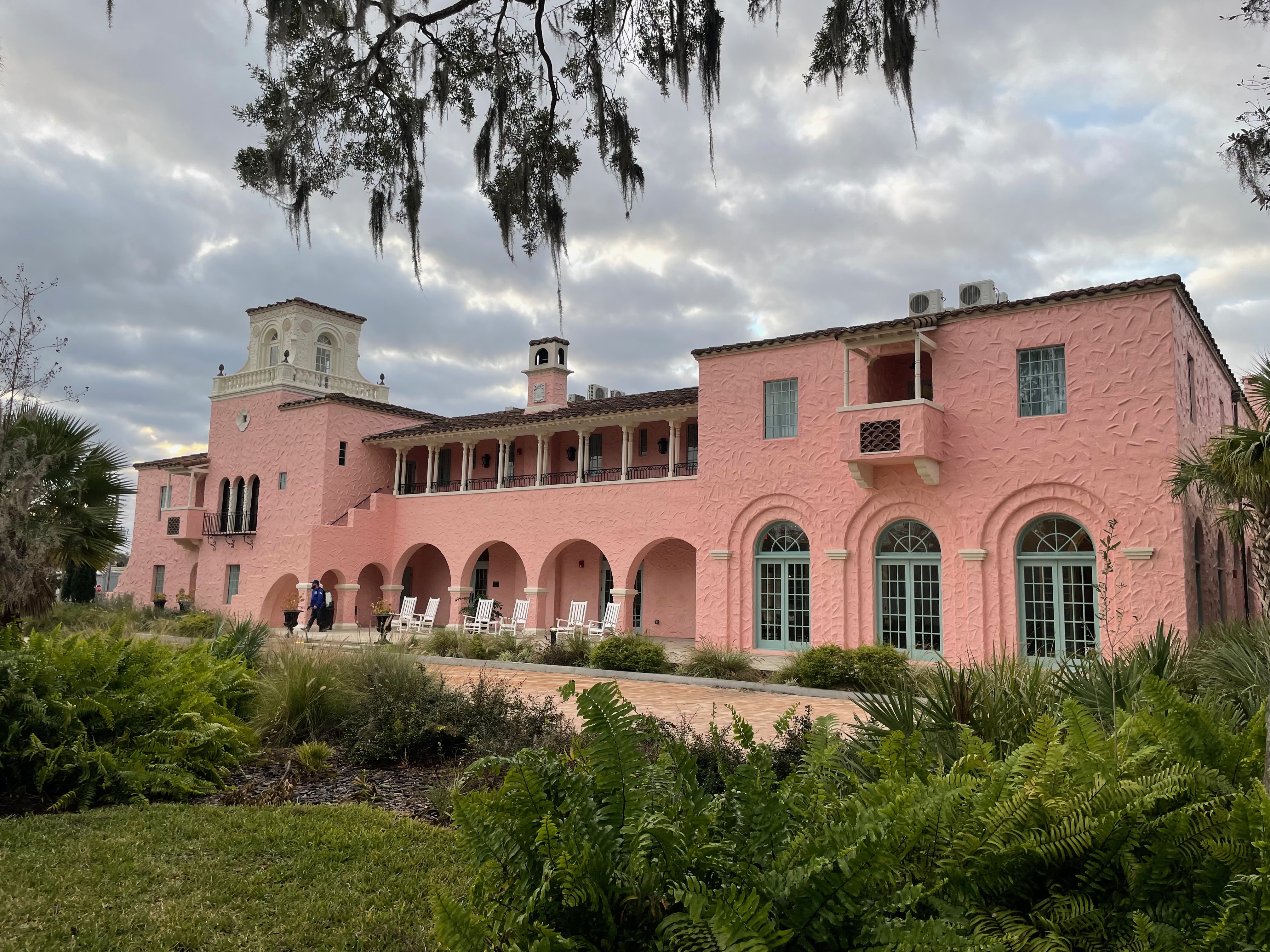
Gloria Swanson had a place in town. Rumors of scandalous New Port Richie behavior still linger.

Today Gloria has a parking lot named after her next to the Hacienda. The ripples are fading out. Kind of like old-time hardcore rock which has become today’s elevator music.
Homosassa Springs Wildlife State Park
Homosassa was one of our slam dunks for Manatees. It didn’t disappoint.
An hour + north of New Port Richey, today it is owned by the State of Florida and run as a wildlife refuge. Care is provided for Floridian wild critters large and small, who can no longer fend for themselves.
There is even a Manatee ICU.
This wildlife refuge had been a famous roadside attraction up to 1989 when the state took over.
Featured were exotic animals, including Hollywood stars.
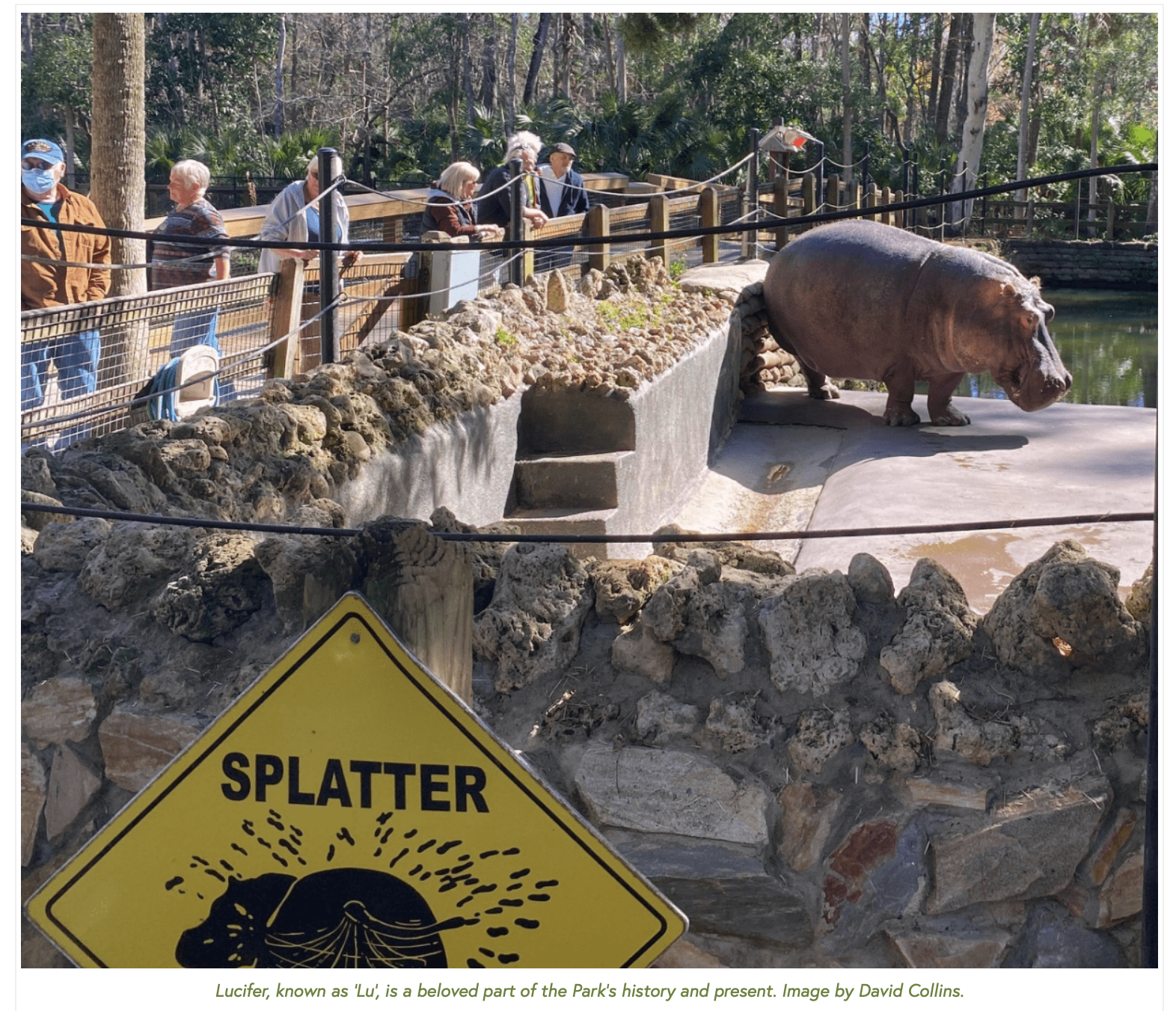
The most beloved, last-man-standing, was Lu the Hippo. Lu short for Lucifer was born in 1960, and was moved to Homosassa Springs to join the Ivan Tors Animal Actors.
Lu starred in Hollywood films, including “Cowboy in Africa” and “Daktari” and the TV shows “Art Linkletter Show” and the “Herb Alpert Special.
In 1989 when the Florida Park Service took over the park, all non-native beasts were moved – out of state. Except for Lu.
The Governor made Lu an honorary Florida citizen.
And so Lu today is the one and only Florida hippopotamus , and lives on at Homosassa Springs as the oldest hippo in North America.
During our visit, he looked bored and old. So it goes.
On a quick sweep around the boardwalk we saw black bears, red wolf, Key deer, flamingos, whooping cranes, and eagles. The rain was starting to beat down when we arrived at a manatee viewing spot. We had arrived.
Matatees all around. Water was on the murky side. I looked down and someone was looking back up at me.

Crystal River River Archeological Park
The next day was Crystal River day. Again, about an hour’s drive north on US Highway 19. Three Sisters’ Springs is famous for Manatees.
In scoping out the area, I noticed an “Archeological Park” nearby, featuring Native American mounds. Curious. We decided to make it our first stop. Easy peasy. Good choice.
Off the strip mall of Highway 19 we turned left just after the Crystal River Church of God next to the Denny’s, and just before the Ford dealership. 4 minutes later we arrived at the Archeological Park, a 61-acre, pre-Columbian site on the the shores of the Crystal River and overlooking an expansive coastal marsh.
Great Fung Shui. No doubt why it was chosen 2500 years ago as a special place. One of the longest continually occupied sites in Florida, believed to have been occupied for 1,600 years.
Perhaps it was this good karma that saved most of the main temple mound from the trailer park next door. In the 1960s, the temple mound ramp and about one half of the temple mound itself was grabbed for fill for trailer park expansion.
Round about then the site was donated to the Park Service. Probably a story there.
In any case a close, close call.
We pulled into the mostly empty parking lot and headed into the museum, the only access to the site beyond.
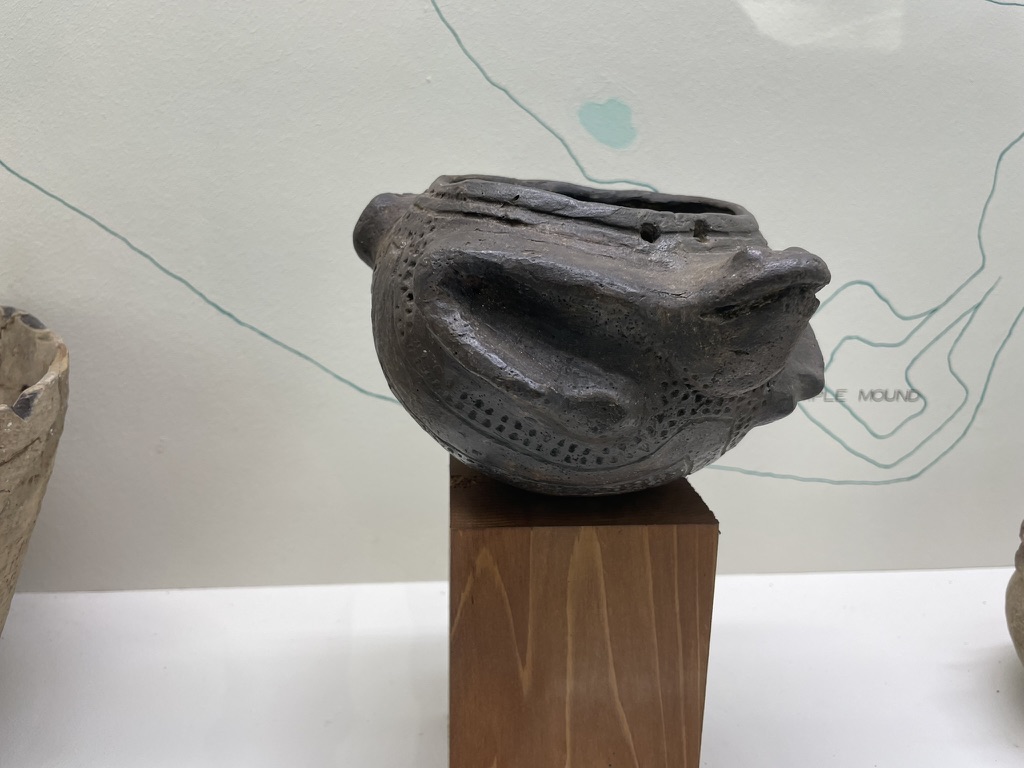
Modest place. Great exhibits. Not in the staging or the objects per se, but in the interpretation.
Orthodoxy explains the sophistication of the finds here, pottery etc, as dribble down from eastern North America principally the Hopewell Culture located north in the Ohio River area.

These exhibits hinted at another explanation: Seafaring Mayas. Referred to by some as “the Phoenicians of the New World.” Only now getting the respect they deserve. These Putun Maya of the Gulf lowlands got around.
Which explain the Mayan glyphs on pottery recovered from the mounds.
On Columbus’ fourth voyage, in 1502, journals describe a Mayan canoe measuring 8 ft wide and 50 ft long, propelled by 25 paddlers and carrying both passengers and cargo.

The Caribbean isn’t all that big. For such a 50 foot long vessel, Cuba was no problem. Nor would Crystal River be.
Curiously Sharon’s Mom’s genome has traces of indigenous Cuban DNA and Central American (Mayan) DNA. Perhaps one her forbearers arrived on one of these oceangoing mega-canoes.
The view from the top of the main temple mound was outstanding.
Click on this Video Link for Crystal River Archeological Site with the view.
I could see the the ghosts of the big Mayan canoes approaching.
This is the year, I seem to be turning into something of a ghost myself. They say the average age at which invisibility begins occurring is 52 for women and 64 for men. Sounds about right. Apparently at 73, I can now achieve complete invisibility. The shock seems to come when I uncloak or re-apparate. It’s an unconscious thing.
It started in the UK at the very end of the Ridgeway.
A couple were wild camping out of their van just off the road. I greeted them as we walked by, perhaps 10 feet away. The guy just about jumped out of his skin. I made a joke about how perhaps I was a barrow wight or some such, and had just appeared out of thin air.
He did laugh, but with a tinge of nervousness as he pulled himself back together.
Then there was the Jamaican delivery guy. I saw him through our front door shades and went out to the front stoop to see if he had something for us. He was photographing a delivery to our next door neighbors. I stood there waiting until he was done. He turned and froze in shock.
In New Port Richey. I went across the street from our hotel for an early coffee. The sky was just lightening up. I opened the door and walked in. The young woman facing me at the counter was fiddling with something. She nearly fainted, when she looked up and found me waiting patiently. First customer of the day.
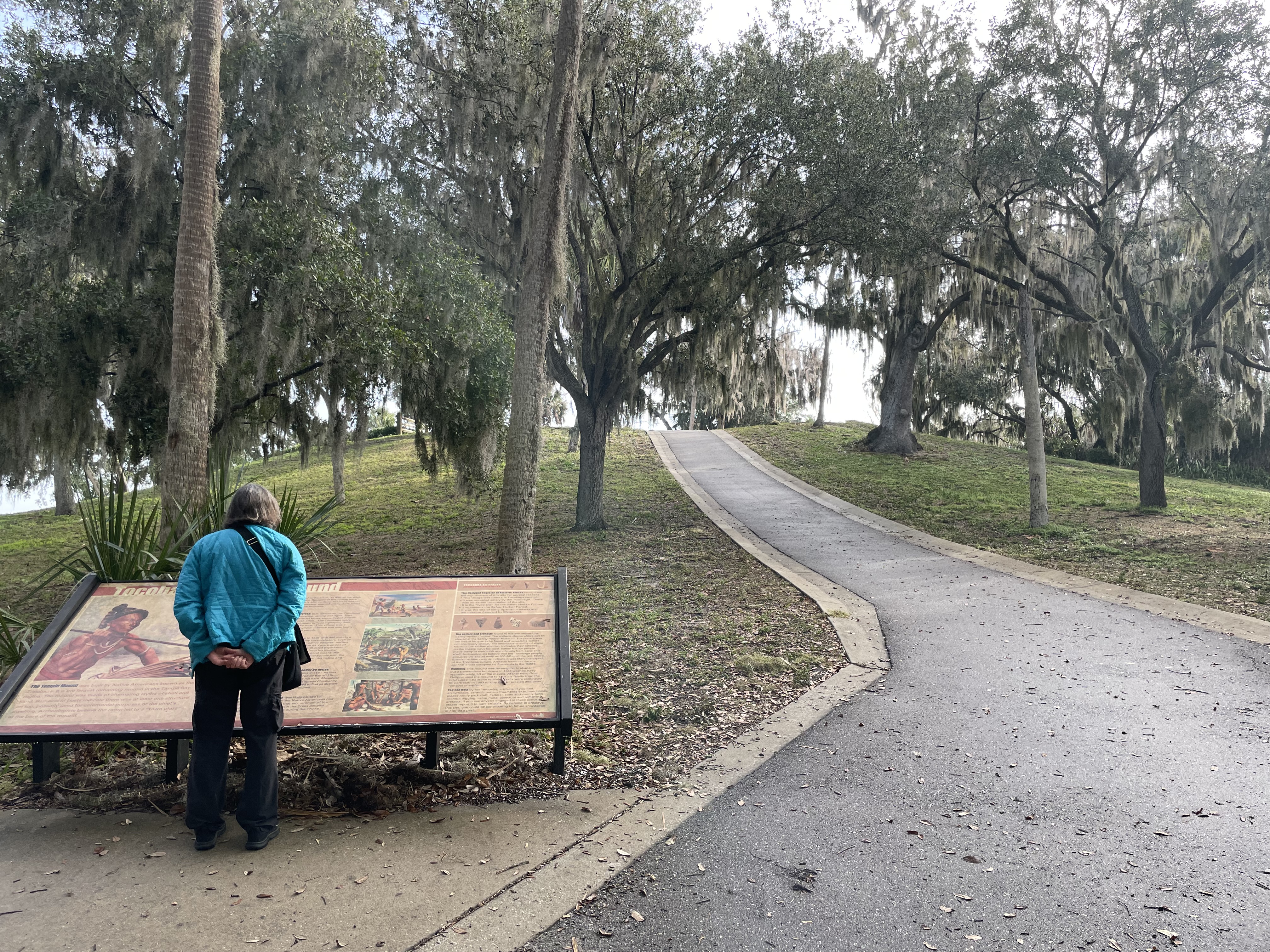
And here at the Crystal Archeological site, on our way out, Sharon and I walked up behind a couple of women studying an informational sign. She turned, saw me 2 feet behind her and went white.
She stammered, “I heard you come up, but there was no shadow, so I figured no one was there”
Sharon says it’s all my Japanese sneakers, but I’m not so sure. It doesn’t explain the missing shadow.
Eating Manatees
The Crystal River National Wildlife Refuge Visitor’s Center is a bit out of the way, we stumbled in trying to find the official parking lot for the Three Sister’s Springs.
It was brand spanking new and filled with great Manatee exhibits. And staffed with volunteers.
An earnest, seemingly-sweet, elderly guy comes out from behind the desk and asks if any of us have any questions. So I ask him innocently enough,
“Did the indigenous people hereabouts eat Manatees?”
He blew a gasket.
“Of course not. Manatees don’t hurt anyone. Why would people kill them? And the meat isn’t any good anyway, there’s no fat. And Manatees have thick skins, they’d be impossible to kill with arrows.”
He turns to his wife,
“Right Dear”
“Right.” She says shrinking and edging away.
Not knowing when to stop, I add,
“Well I’ve heard that when times get tough indigenous peoples and locals have eaten Manatees to get by.”
“Not true. That’s simply not true. No one eats Manatees. They are sweet creatures.”
I decide it’s time to let this one slide, before he has a heart attack. In the pause, he growls
“I’m here to help the Manatees, not to encourage people to eat them!”
He and his wife wander off, and I make my way to the cash register to buy my Manatee stickers. The woman behind the desk, adds in a low voice,
“They did eat Manatees”
Manatees
Manatees are curious beasts. Their closest living relatives are elephants, and hyraxes.

50 million years ago their forebears walked on land. Today Manatees spend their whole lives in water, preferring calmer rivers, estuaries, bays and canals. Fresh, saltwater or brackish, no matter.
They have two forelimbs, called flippers, with three to four nails on each flipper.
The absence of hind limbs and streamlined bodies are the result of millions of years of adaptation to their watery environment.
Like elephants they have very thick skins and prehensile snouts, which like elephants, allows them to grab things.
Hyraxes, found in Africa and the Mideast, look a bit like large rabbits but with sensory whiskers mixed with their fur all over.
Manatees have no fur, but they do have the sensory whiskers – over their entire bodies. Basically they are covered in tiny antennae.
Manatees are big, gray, slow, vegetarian, and oddly have no natural predators. Which seems counterintuitive for a beast the size of a cow which has no way of defending itself.
Swimming with the alligators, no problem. Apparently manatees are too big, and their hides too thick to bother with. Sharks aren’t an issue as manatees mostly keep to shallow waters 3 to 6 feet deep.
Like other mammals, manatees breathe air. They are champs at holding their breath. Up to 20 minutes.
They are warm-blooded, and as tropical animals, very sensitive to cold, showing signs of cold stress in waters less than 68°F. Florida is about as far north as they come and in winter why they can be found around warm springs and power plant warm water discharge.
Manatees sleep a lot too. Like 50% of their lives. Manatees sleep underwater. As they sleep they rise to the surface every 2 to 20 minutes to take a breath – without waking up. Or at least half of their brains don’t wake up. It’s called unihemispheric slow-wave sleep. Dolphins do it too.
They move like a dolphin in slow motion. They can swim upside down, vertically, and can do somersaults and barrel rolls, thanks to their tail fluke.
This round, flattened paddle-shaped tail, is rather mermaid like.
The top half, not so much.
On January 9, 1493, Christopher Columbus, sailing near what is now the Dominican Republic, saw three manatees. He mistook them for mermaids. And added,
“Not half as beautiful as they are painted.”
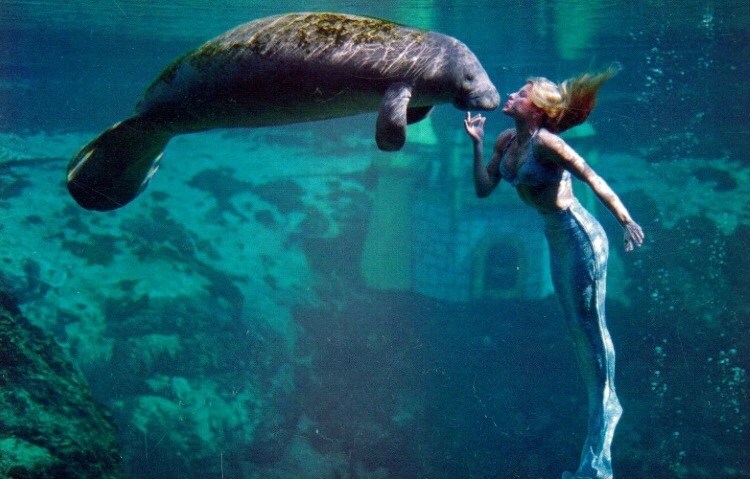
“Not everyone was quite so dismissive. A hundred years later, the English explorer John Smith reported seeing a mermaid, almost certainly a Manatee. It was “by no means unattractive”, he said, but I’m not so sure.
It’s just possible Mr. Smith needed to get out a little more.
Three Sisters Spring
We got our directions to the Spring proper. Not far. Just off US Highway 19. Ticketing was handled in a temporary pop-up space at the end of a dying strip mall.
A bit surprising given the Spring’s world class reputation. But this is Florida, and Manatees weren’t really fashionable until lately.
Three Sisters Spring had it’s own near death experience and not that long ago.
In 2005 it was purchased by developers who were going to develop the 57-acre property for 300 homes and a water bottling plant. Permits had been pulled.
Sometime soon thereafter, the lead developer rescued an injured manatee and had a change of heart, “This is not a Disneyland kind of place. It’s the real deal.” And sold to conservationists.
Supporting infrastructure in still a work in progress, but the springs themselves are pretty much picture perfect.
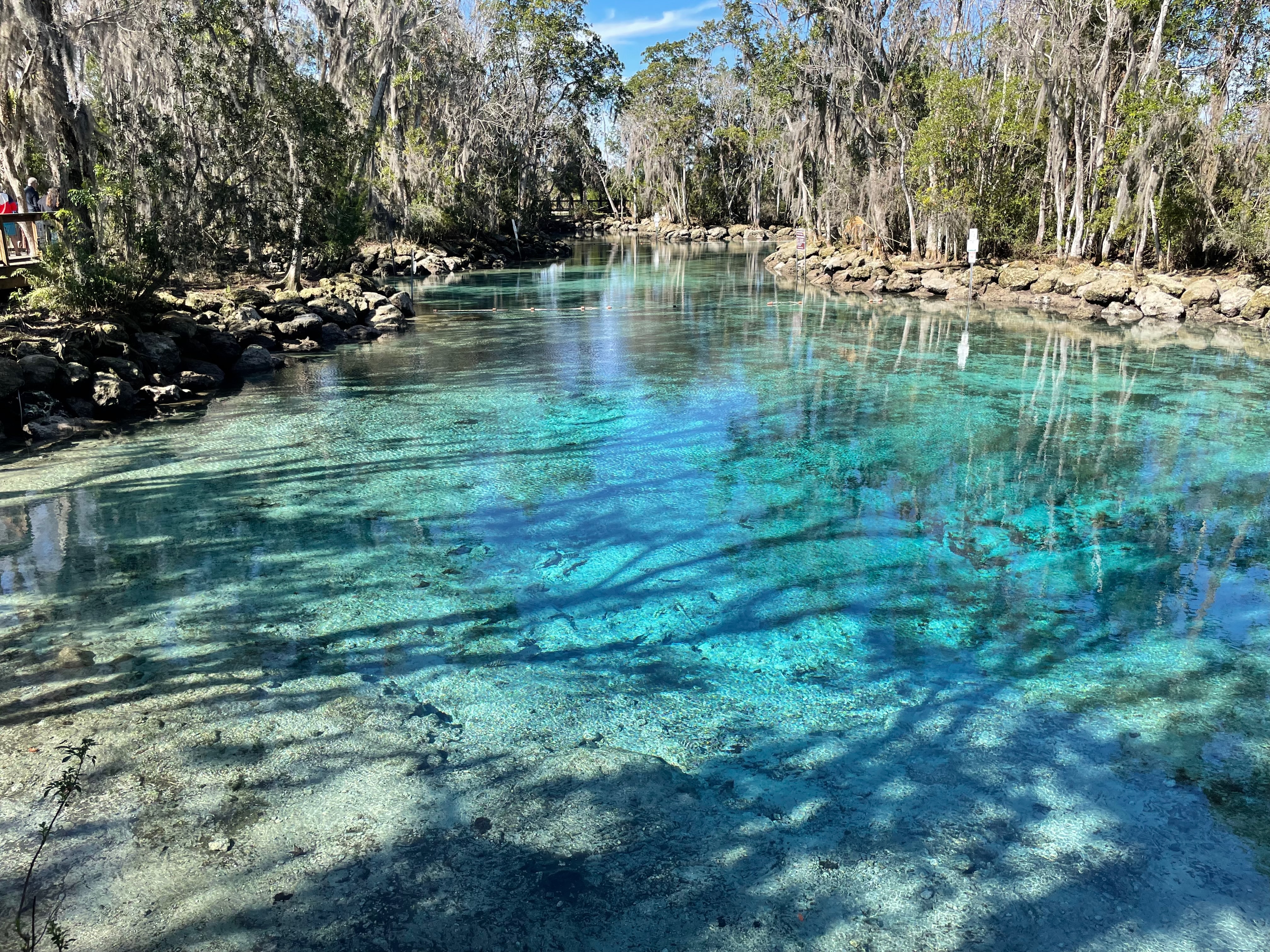
No Manatees at the Springs so we continued on. They had congregated at the entrance to the springs waiting for high tide to swim in.
Click on this Video Link for the Three Sister’s Spring with Manatees.
Tarpon Springs
The town of Tarpon Springs is at the north end of the Pinellas Bike Trail, about 10 miles south of New Port Richey. We drove down, parked in Craig Park, unloaded the bike, waved to the Manatees and rode south on the Bike Trail towards Duneden.
There’s a lot going on at Craig Park, in a very, very low key kind of way. A lot of history too.
Today, above water, it’s a modest small community park with grass and a concrete walk at water’s edge around a stub of water off the Anclote River close to the Gulf of Mexico.
This stub of water is known as Spring Bayou. Bayou because it’s slow moving and off the main course of the river. Spring because there is big spring down there. Hence the Manatees.
This is the Spring that Tarpon Springs was named after. Story goes that Mary Ormond, the daughter of one of the early settlers, named her tiny two-cabin settlement “Tarpon Springs “ after the giant Silver King-Tarpon that jumped and splashed in the bayou. The name stuck.

Today you’d never know the spring was even down there. But down there it is. And a good ways down. Like 125 feet down. I would have guessed depth at 10 to 20 feet, which it is in some parts before the drop off. Not a clue above water of the drama below.
Except for the Manatees and Dolphins.
Nor clues of the drama of days gone by. First settlers settled here in the late 1800s. Log cabins gave way to mansions in short order. The neighborhood was known as the Golden Crescent. A neighborhood of Tycoons and Artists.
Shallow-draft steamboats would tie up in Spring Bayou.

Another mineral health springs/ health resort story:
“On the east shore of Spring Bayou, just below tide water, a mineral spring was discovered. It is not clear what the analysis of this spring was, but those who drank the water seemed to derive great benefits from it. The spring was curbed and housed with a pagoda and became a favorite loitering place for invalids and old veterans, who spent the time reminiscing, telling what they knew–and possible some things they didn’t know. At any rate, Tarpon began to acquire a reputation as a health resort; probably the change of climate and balmy air had much to do with the healing of weak lungs and overworked nerves of some who came from cold climates.”
I suspect that the pagoda referenced above is the building behind the steamboat in the photo above. Which is the lead in to my favorite Tarpon Springs story. With a joke and punchline for the ages.
From R. F. PENT’s 1964 “History of Tarpon Springs : In the late 1880s:
“A very tragic affair happened late one afternoon. Major Marks and Mr. Connolly got into an argument in the Tropical Hotel; hot words were exchanged and Connolly ran to get his revolver. Marks made his escape through the door, or window, before Connolly could return. When he did, he ran out on the front porch, looking up and down the street for Marks. It was twilight and visibility was poor. A man by the name of Cork was coming up the street and Connolly, thinking he was Marks, fired, killing him instantly.
My father was present at the inquest. Mr. Connolly, after spending some time in jail, was freed by the courts and given his liberty. Connolly bitterly repented this rash act and later became a minister of the Gospel.
This is a very strange coincidence you say. Yes, indeed, but “with God all things are possible.”
Stranger still, a very grim joke grew out of this affair. The saying became current that:
Tarpon [Springs] was so healthful…, that …
“Someone had to be killed in order to start a cemetery”
In tragic context, black, black humor. The Tarpon leaps.
Duneden
Many say that the ride from Tarpon Springs to Duneden is the most scenic stretch on the Pinellas Bike Path.
I’m not going to argue. Our Go Pro was acting up, so no video. Maybe next time.
Dunedin is a place I’d like to come back to. I’m not sure we are done with Tarpon Springs either.
I routed us to Strahan’s Ice Shop in town. It didn’t disappoint.
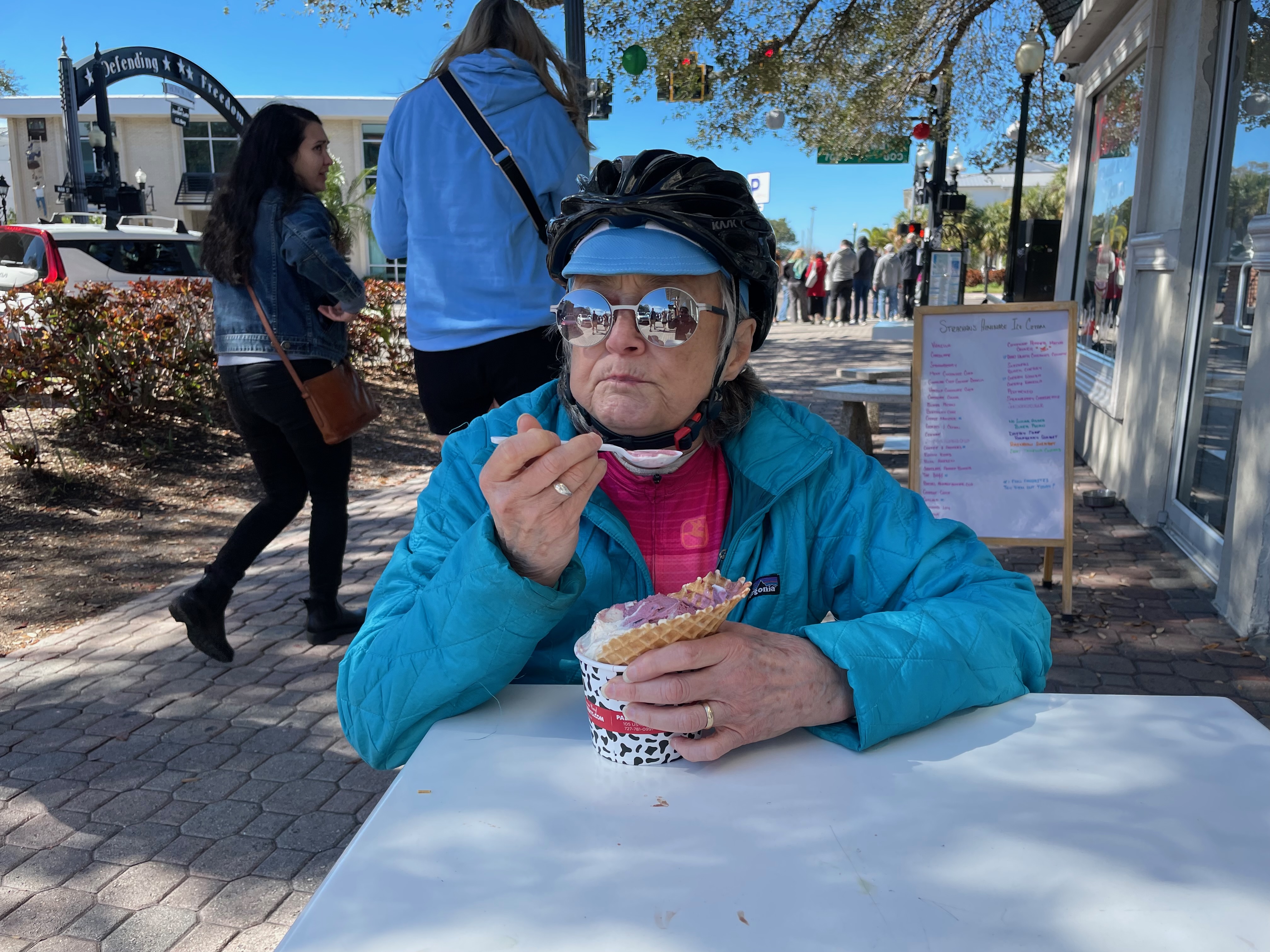
Dunedin is a popular destination. World class beaches and deep pocketed Europeans will do that.
We walked our bike back up Main Street to the Bike trail. Lots of tourists and slow traffic. The bike path crosses Main Street in the center of town. See photo below.

We walked the turn onto the Bike Path towards Tarpon Springs and we getting ready to take off, when we struck up a conversation with two guys sitting on a comfortable new bench. About our age. Had lived here forever. Local locals.
They had it figured out. Good town. The world comes to them. Sunshine. Music festivals, Farmer’s markets, Nice restaurants, Microbreweries, and Baseball.
Dunedin is the Single-A affiliate of the Toronto Blue Jays.
Just don’t let you grass grow too long. The town fined one guy $30,000. He had been out of town. $500/day adds up.
Tampa
Our last stop was the Epicurean Hotel in Tampa. We’ve stayed here before. A Foodie hotel. Towards the high end but worth every penny.
We had hoped to visit Burns Steak House across the street. World famous and not easy to get reservations. We had solved that with a Epicurean special package. Unfortunately it wasn’t meant to be.
We had followed up on a restaurant tip from a fellow we met while watching the Manatees in Spring Bayou. Food poisoning.
The Epicurean is in the Hyde Park neighborhood of Tampa. Only a few blocks from Bayshore Boulevard… and the annual Gasparilla Day festivities.
Gasparilla Day is Tampa’s Mardi Gras. Curious in its own way. A big deal and a big, 300,000 + [people] draw for Tampa. We had no idea, we would be at ground Zero with front row seats.
Not our kind of thing. But here we were.
South Howard Street out front was closed down early. Our room was on the second floor. Late morning, we peered down as streams of folks headed over to Bayshore for the parade.
Drinking had started early. The party was well underway.
Early afternoon we headed over ourselves.
Gasparilla Day is named for the pirate José Gaspar. c. 1756 – 1821. The festival is a re-enactment of a battle between Gaspar and American forces that occurred in Tampa Bay in 1821. Gaspar won the day. And being a Robin Hood sort, spread the treasure.
Or so it is said.
“Until about the late ’60s or maybe early ’70s, the press [and history books] still operated on the basis that this was a historical event,” says Charles Arnade, distinguished professor of international affairs and history at the University of South Florida.
But it was all a tall tale. Fakelore, if you will. But even Fakelore has a story.
This one starts with Panther John. The alter ego of José Gaspar, or more properly put, vice versa.
Panther John lived in a shack with his wife on otherwise uninhabited Panther Key, a small spit of land, in the ten thousand islands south of what is Naples today. A nobody in long lost, old Florida world.
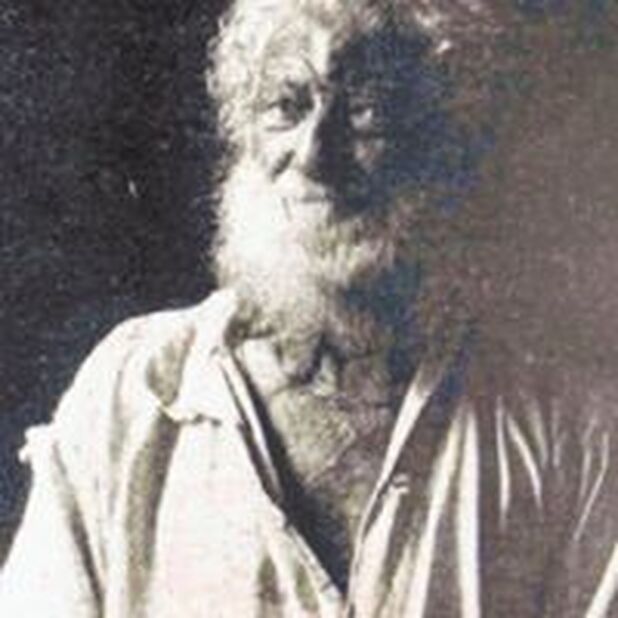
Panther John was an expert hunting and fishing guide. And he relished the tall tale.
When the census folks could catch up with him, he’d spin one up. One time he was born in the USA in 1828, another time France in 1785, Portugal in 1776 or in Honduras in 1795. And there were supporting back stories.
Often involving his alter ego, Pirate José Gaspar. Sometimes he was the pirate’s cabin boy, another first mate, and closest to the truth, he sometimes dropped hints implying that he was José Gaspar himself living under a false name. Entirely true in confabulated kind of way.
In the early 1900s the Gasparilla Inn Resort in the town of Boca Grande needed a hook for tourists. They ran with one Panther John’s story of José Gaspar and printed it up a brochure.

The rest is history.
As the Boca Grande’s Historical Society puts it,
“Gaspar, the Pirate, an entirely fictional character created for tourists’ sales promotion purposes in the early 1900’s, overcame the best containment efforts of historical research and explication, and like Collodi’s “Pinocchio,” came to life.”
In 1904 officials in Tampa inspired by the brochure, added their tall tale of Jose Gaspar’s Pirate invasion of Tampa. The idea was to juice up their May Day festival. That they did with a new and improved storyline:
José Gaspar, fought the USA navy in Tampa Bay, prevailed and turned Robin Hood distributing the wealth.
“Pinocchio” José Gaspar took his first steps towards legitimacy, when history books picked up the story without double checking sources, and listed Gaspar alongside real Florida pirates like Robert Searles, Henry Jennings, and Francis Drake.
In the meantime, the business elite in Tampa were partying it up. Play-acting the pirate invasion, receiving the key to the city and having an annual parade. Modeled after New Orleans’ Mardi Gras. Beads and all.
The May Day celebration had morphed into a white guys’ pirate themed dress-up frat party.

Some have rightly wondered: “What is it we’re celebrating exactly?”:
“Anyone familiar with the history of Tampa will tell you that the city’s story is riddled with its share of seedy, incorrigible characters: corrupt politicians, laughable law enforcement, rapacious businessmen and gangsters. In some cities, the mayor is allowed the small pleasure of giving away the key to the city as a gesture of friendship and appreciation. In Tampa, the elite demand it at gunpoint as a symbol of submission.”
And today the local business guys themselves no longer seem to be driving the bus. Slick Corporate Branding rules. Charm is the remaining rough edges.
It’s no longer simply the Gasparilla Parade, but the “Seminole Hard Rock Gasparilla Pirate Fest”
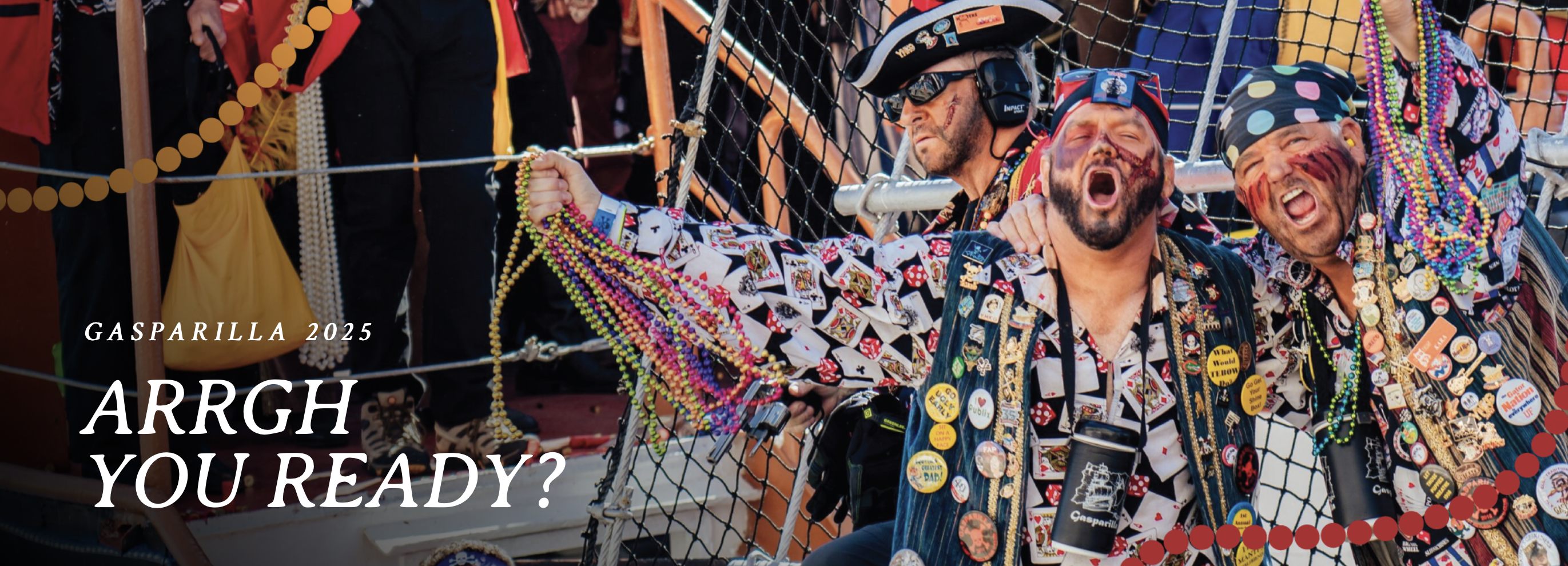
Title Sponsor: The Seminole Hard Rock Hotel and Casino, Tampa. Sponsors: Bud Light, Meridian Apartment Homes, Captain Morgan, City of Tampa, last and perhaps least Ye Mystic Krewe of Gasparilla, the original Frat.
Kind-of like a Disney World Pirates of the Caribbean wanna-be – with lots and lots of alcohol.
Standing at the chain-link fence entry to get close to the parade proper, we found a spot. It took a QR code to get by security. QR codes from one sponsor or another – at a price. $100 would get you 20 feet closer – where you could catch the beads thrown from the floats.
On one side were a group of college kids, on theme, dressed as pirates. They’d been drinking from early morning. We were adopted. Kind-of like family mascots to which all kinds of secrets could be told. Break-ups, sexual escapades, no matter. All in good cheer.
They asked how long we’d been married.
“46 years.”
And then they wanted to know how you know when you’ve met the right person.
“You’ll know it when it slaps you upside the head. Love at first sight is real deal.
Crazy off the charts stuff. Buena Suerte. Good luck.”
On our other side was a middle aged guy, also dressed as a pirate, chatting with a pirate guy with a rolling cooler and younger pirate 30’s – ish woman.
The guy with the cooler would spin a dial. If it went one way, the middle aged pirate would win shots from the cooler, if it went the other way, he’d do push-ups, never missing a beat in his patter with Miss Pirate.
As she made to leave, he pulled out his business card. She pulled out hers. Both Lawyers.
I’ve wondered what the Godfather of Gasparilla, Panther John, would make of all these 21st Century shenanigans?
Curiously I think he’d be most entertained. Pretend pirates to the left, pretend pirates to the right. Tall tales begetting tall tales. Right up his alley. What’s not to like.
The spirit of José Gaspar lives on.
The next day we drove south to the Manatee Viewing Center at Tampa Bay Electric’s Big Bend Power Station. Around 40 minutes south. TECO was our last slam dunk Manatee viewing site.
On the way we passed through Gibsonton or Gibtown for those in the know.
Freaks
I doubt anyone who has ever seen the 1932 movie “Freaks” has ever forgotten it. I certainly haven’t. A remarkable film. Either the epitome of exploitation or a compassionate, daring piece of genre cinema. It’s been called both. Put me in the latter category.

Director Tod Browning somehow convinced MGM to make the movie. He himself had runaway from home to join the Circus, so he knew the real deal and cast accordingly.
The stars of the movie were actual working carnival sideshow, or freak show, performers, if you will: Dwarfs, Siamese-Twins, Pin-Heads, a legless and armless fellow, known as the caterpillar and so forth.
Needless to say when this cast of irregular characters showed up on set in Hollywood, the MGM staff were horrified , as were audiences and critics, when the movie was released.
It took roughly 30 years, for the world to start to catch up with Browning’s vision. A screening at Cannes began the turn-around. Today the film is considered culturally, historically, and aesthetically significant. Rightly so.
The unsettling question posed by the film: Who were the real freaks? The odd looking folks on the outside or the pretty, regular people twisted inside?
So if you are one of the odd looking folks on the outside, where do you live off season, or where do you retire, where you can just be ordinary folks.
That would be Gibtown Florida. Today, just north of the Manatee Viewing Center of the Tampa Bay Electric Company. Quite a number of the Freaks cast ended up here.

The time to visit would have been the 1940s. Gibtown had an 8 foot tall fire chief married to Jeanie, the postmistress, 2.5 feet tall. Both members in the band above. Jeanie is second over from the bottom right. No legs. Her husband Al is the big guy on the upper right.
Turned out they were a great match and very happy together.
The police chief was a midget. Then there were the pinheads, tattooed men, bearded ladies, sword-swallowers and snake women. Living ordinary lives.
Not wanting any attention, Gibtown laid low. Hiding in plain sight.
Today, the so-called odd ones have pretty much died off.
When we drove through Gibtown, not a ripple flickered, of what it had been.
The stealth shields are still operational.
TECO
The crowds were out at TECO’s Manatee viewing center. Regular parking was full up.
We parked in the overflow parking lot and took the shuttle, a glorified articulated golf cart.
Our driver was pushing 18. He was fast. The Latin Syntho Pop Rap Music was his. He cut the corners close.
In short order we arrived at the Manatee Viewing Center and all piled out.
I’m not sure what I was expecting, but it wasn’t this.
The Center itself was a Cheerful Upbeat Disneyland.
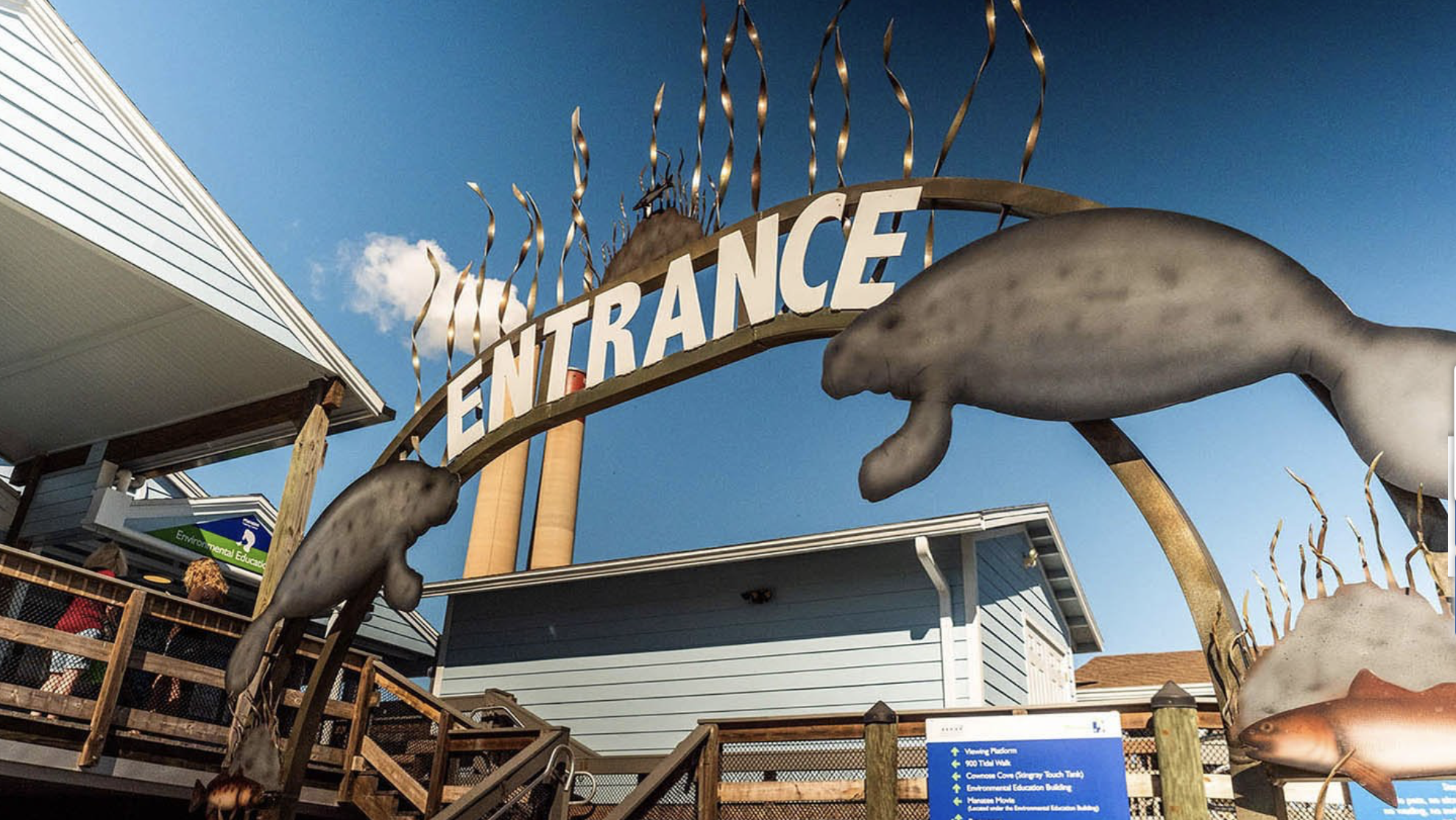
The view from the boardwalk was Mad Max or perhaps Bladerunner. A Dystopian landscape.
The word which sprang to mind: Post-Apocalyptic.
No crystal clear spring-fed lagoon, edged with mangroves, for these Manatees.
They bobbed like potatoes in the discharge canal’s warm water. Looming over all was Big Bend Power Station. An rusting coal-fired power plant.

We didn’t linger.
Desirée’s Story
My favorite Manatee story comes from Cambridge not Florida.
On hearing that we were going looking for Manatees , one of our favorite Trader Joe folks shared her Manatee story.
When she was ten or so, Desirée visited St Pete’s on vacation with her family. One morning she wandered off by herself, down to the dock behind the hotel. All was quiet. Then right next to her up popped a Manatee.
She had no idea what it was. But it was cute, like giant potato-head cute, and friendly. She sat there petting it, like something out of Sesame Street.
Eventually Mom started calling from a distant balcony,
“Desirée what are you doing?”
“Petting a Sea Monster.”
“Well stop it and come back inside.”
 Advencha before Dementia