2019 Shikoku Pilgrimage 5: Kagawa

The Shikoku Pilgrimage is unique in that it is a circle. When you finish, you are back where you started. Lots of symbolism there.

Kagawa was something else altogether. It was the smallest of the prefectures, but there were plenty of temples. 23 if you’re counting. Roughly 1/4 of the pilgrimage’s 88.

Kagawa’s journey is traditionally symbolic of entering of nirvana (涅槃 nehan).

So what was the difference in training for enlightenment (Ehime Prefecture) and training for nirvana (Kagawa)?

Let me rephrase that, What was the difference between a reality sandwich and a coin spinning so fast that both sides are visible at the same time?

No answers here, but we did learn how to make Udon noodles from scratch, and the past tense of “I’ll try my best.”
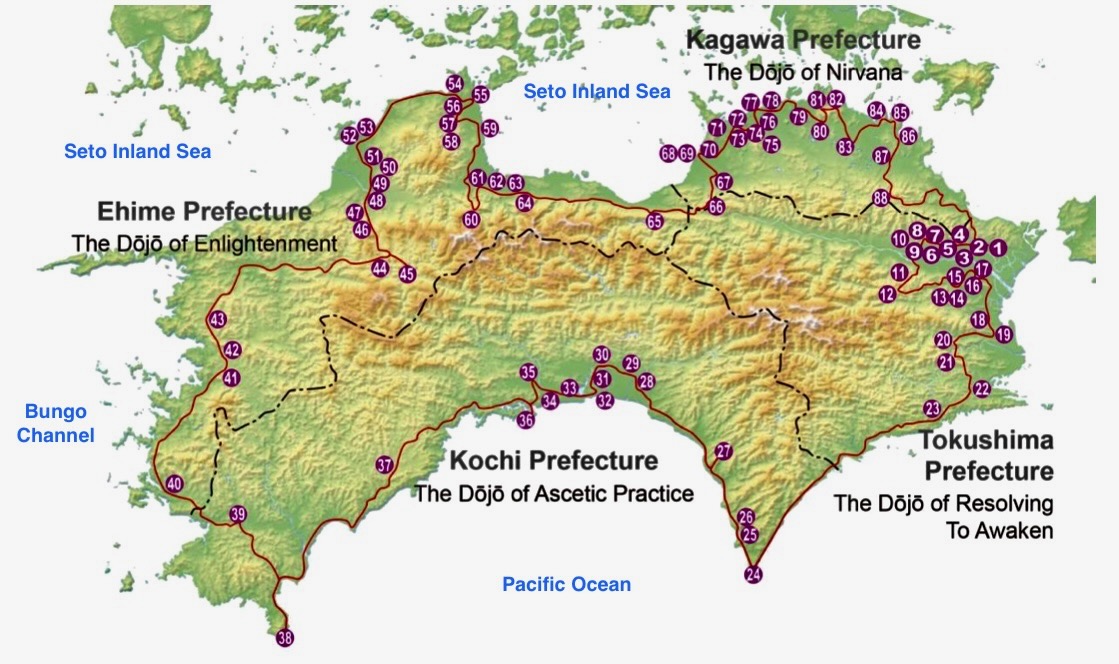
Shikoku Pilgrimage Route with Temples. Kagawa, numbers 68 – 88 + number 1

Day 29. November 5 Tuesday;  Mitoyo to Udon House. 2 temples

68 Jinnein 神恵院 Kanonji, Kagawa
69 Kan’onji 観音寺 Kanonji, Kagawa

We were in for a full day. Not far to go, but lots to do.

First up was Kotohiki Park famous for its coin-shaped sand-sculpture dating to 1633 ±. It was featured in our pilgrimage book, and not far off our route, so we swung by.

From the viewing platform on the hill called Mt. Kotohiko, we could see the super-sized sculpture below. It was big. Really big. The photo below doesn’t do it justice. Those are really big trees in the photo below.

Built entirely of sand from Ariake beach, beyond. It only needs repair twice a year. And it is perspective corrected to look round. Much longer in length than width.

They say that by looking at this sand coin, you can ensure long life, and luck in money matters. Long life has yet to be determined, but shortly thereafter we did invest in Nvidia.

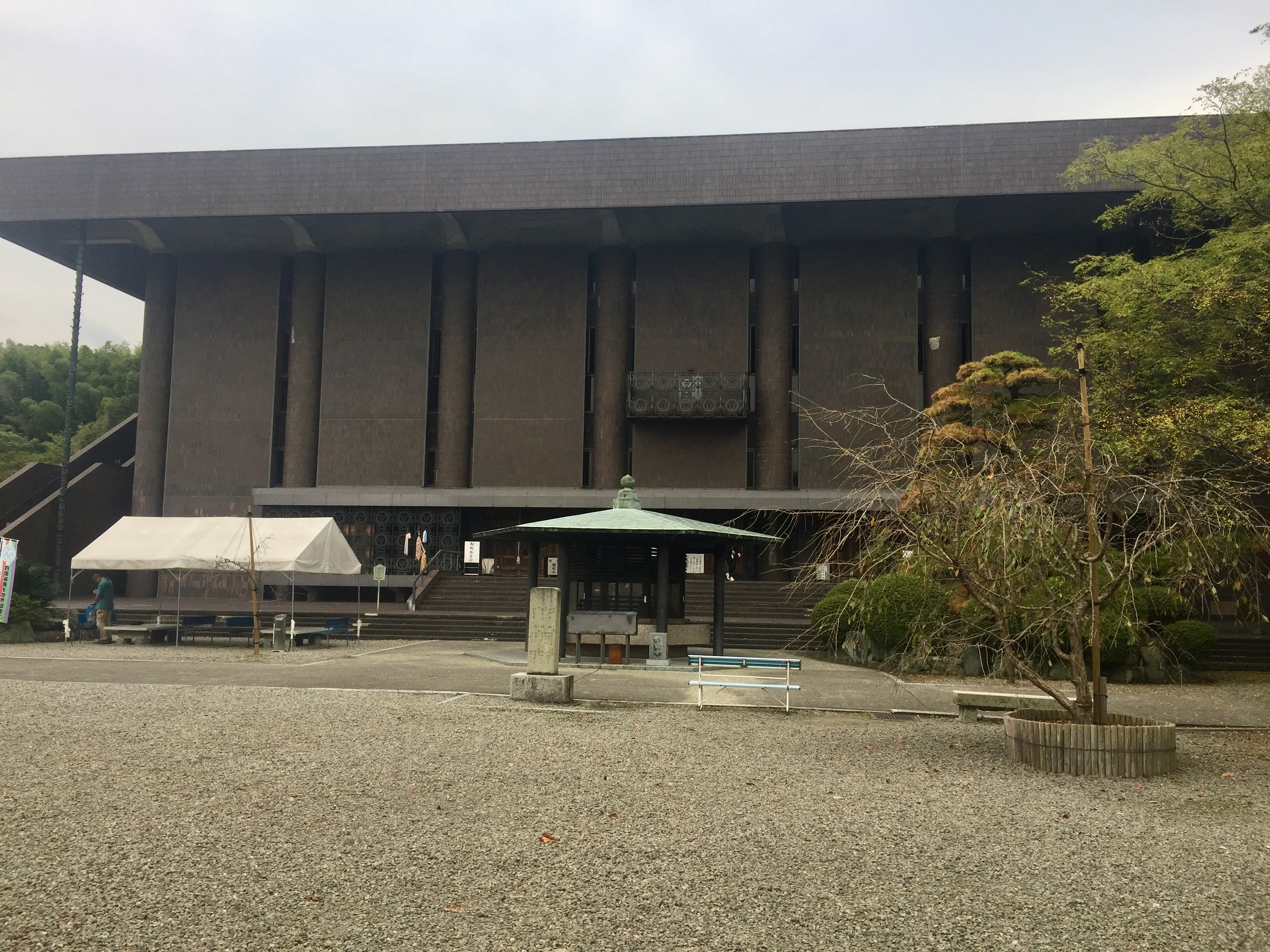
We had to swing back around for Temples 68 Jinnein and 69 Kan’onji. Side by side, they couldn’t be more different. 68 Jinnein is a fairly well done modern concrete box, whereas 69 Kannonji is wooden, earthy and traditional.

They begrudgingly share a temple office. A bit Hatfield – McCoys. Over centuries.

Our inn for the night was the Udon House, where we would attend a so-called master class in Udon noodles.

We arrived late morning with time to spare, before orientation, noodle history and the basics.

Why Udon noodles in Kagawa? Well, Kagawa is ground zero. If you are into Udon noodles. Kagawa is the prefecture for you.

We were just passing through, but why not?

After all, foodies make pilgrimages here just for the noodles. And that would be Sanuki Udon, thank you very much.

Square cut, firm, and supple. Main ingredients are wheat flour and salt. The ingredients take care of themselves, if you are in Kagawa. The magic is in the making.

Curiously the dough is kneaded standing on the dough. Weight is needed to develop the characteristic chewy texture of the noodles.
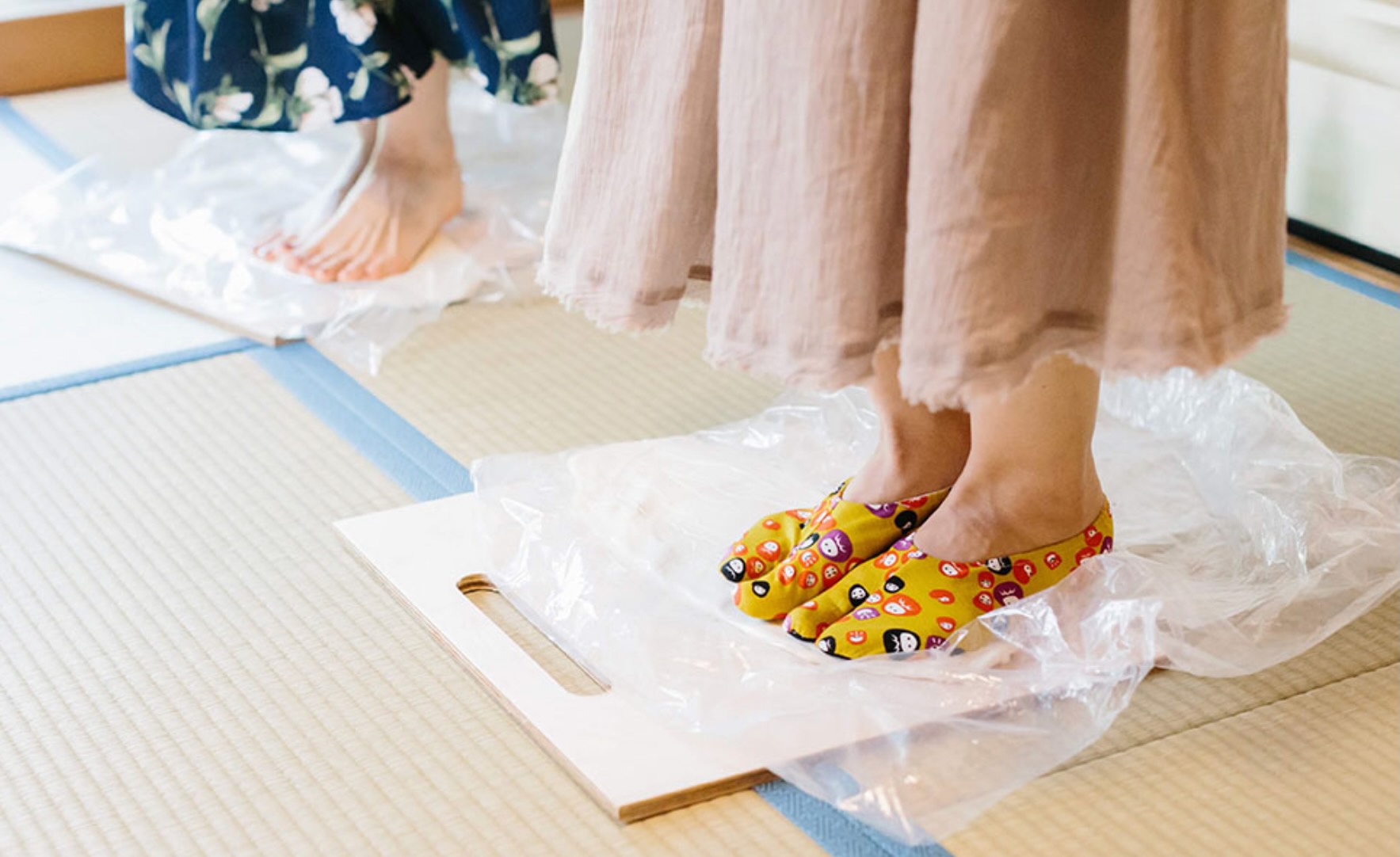
Photo Courtesy of the Udon House

Next up was a farm tour.

Our farmer/host used to live in the big city but moved to Mitoya to farm. As we were digging up sweet potatoes out in the middle of his field, he and Sharon struck up a conversation about the pilgrimage. He had done it on foot in his youth. He was fast.

One thing led to another and soon they were discussing the Diamond Sutra.

The Diamond Sutra, like the Heart Sutra, is considered a core Buddhist text. Same stuff, but another angle. Essence of the essence & the world’s earliest dated printed book.

Our farmer host was a bit stunned. But Sharon was on roll, and not to be denied.

“All conditioned phenomena 
Are like a dream, an illusion, a bubble, a shadow, 
Like dew or a flash of lightning;

Thus we shall perceive them.”

One of my favorite moments on the pilgrimage. In the middle of a field in the middle of nowhere. Mud on my feet.

Back at the Udon house, it was time to cut up our noodles. The chopper was wicked. The dough stayed still and the chopper slid. Oh so sharp.

Sharon went a bit Latina, shaving off a couple of finger prints. Just a bit of blood. No harm, no foul.

At dinner, we had a most interesting and poignant conversation with a young Japanese woman, concerned about Japanese resources only going to the elderly, leaving little for her generation.

“What will be left for us?”

The next morning we brushed our teeth with the staff on the first floor, packed up the bike and bid a sad, reluctant farewell. It had been a fun stay and far too short. And we were missing the Udon restaurant tour included.

We could have had Udon noodles for breakfast at the best places in town, but we had a full day ahead and someone hadn’t left enough morning time in Mitoyo.

Below is a 2 minute Udon House video, which pretty much tells their tale.

Day 30. November 6 Wednesday; Bicycling Day 23; Mitoyo to Tadotsu. T70 to T78. 9 Temples

70 Motoyamaji 本山寺 Mitoyo, Kagawa
71 Iyadaniji 弥谷寺 Mitoyo, Kagawa
72 Mandaraji 曼荼羅寺 Zentsuji, Kagawa
73 Shusshakaji 出釈迦寺 Zentsūji, Kagawa
74 Kōyamaji 甲山寺 Zentsūji, Kagawa
75 Zentsūji 善通寺 Zentsūji, Kagawa Kukai’s birthplace
76 Konzōji 金倉寺 Zentsūji, Kagawa
77 Dōryūji 道隆寺 Tadotsu, Kagawa
78 Gōshōji 郷照寺 Utazu, Kagawa

Another big temple day. You’d think we’d get tired of them, but we never did. Big, small; high, low; Modern, traditional. No matter. Mostly we just didn’t have enough time to explore and appreciate each.

Doryu-ji Temple

Our innkeeper that night at Vtangura was a widow. When her husband had died, she lost her license to serve meals and she lowered her prices to compensate. The place was hopping. It was bring your own. Microwave provided

There was a young German guy who spoke Japanese, a Japanese nun a few others.

The German was bemoaning the fall of the Berlin Wall. He was all in for full state supported study. Which had been provided in East Germany, or so said his parents.

Our landlady on hearing our mode of transport cut right to the chase,

“Don’t you argue?”.

“Well no, we worked that one out long ago. Sharon’s always right.”

Afterwards, the landlady gave me a sideways glance, and added

“I’m lonely.” I let that one go.

Day 31. November 7 Thursday; Bicycling Day 24; T79 to T83 Tadotsu to Takamatsu. 5 temples

79 Tennōji 天皇寺 Sakaide, Kagawa
80 Kokubunji 讃岐国分寺 Takamatsu, Kagawa
81 Shiromineji 白峯寺 Sakaide, Kagawa
82 Negoroji 根香寺 Takamatsu, Kagawa
83 Ichinomiyaji 一宮寺 Takamatsu, Kagawa

Japan has more than its fair share of weird creatures. Temple 82 Negoroji is, or rather was, the home of the Ushi-oni or devil cow. Some 400 years ago this Ushi-oni was terrorizing the locals. A famous archer of that day, Takakiyo, killed the beast. Some today think it might have been an orangutan. But that doesn’t explain the horns

This Ushi-oni’s horns are said to be in box in the temple. The statue stands out front below.

Ushi Oni

Temple 82 Negoroji is high and the descent was steep. Unfortunately we took the wrong fork at some point and soon found ourselves way off route, with no sensible way of retracing our steps.

As things leveled out, we pulled up next to a 6 lane expressway to regroup. We tried asking a most accommodating fellow directions. He spoke no English and even if he did it would have been a lost cause. Suspect temples weren’t a big part of his world.

We headed off along the frontage road and eventually found Temple 83 and from there our inn for the night Sasaya Ryokan.

Day 32. November 8 Friday; Bicycling Day 25; T84 Takamatsu to T88.  5 temples

84 Yashimaji 屋島寺 Takamatsu, Kagawa
85 Yakuriji 八栗寺 Takamatsu, Kagawa
86 Shidoji 志度寺 Sanuki, Kagawa
87 Nagaoji 長尾寺 Sanuki, Kagawa
88 Ōkuboji 大窪寺 Sanuki, Kagawa

We were nearing the end. Today we would reach Temple 88. The end of the pilgrimage for many. But we would continue on the following day to Temple 1 to close the loop.

Temple 84 Yashimaji was high above Takamatsu and the site of a major battle between the Heike and the Genji clans during the 12th century. We took a taxi. Fabulous views. Fabulous back story.

Temple 85 Yakuriji was high as well and had a cable car or funicular, if you were. Sharon struck up a conversation with a very entertaining monk. Out on his own, visiting temples, having fun, with no senior monks looking over his shoulder.

Note staff

Temple 86 Shidoji stopped my mind. It all started innocently enough. We were wandering through the grounds admiring this and that. Especially the shrunken heavy earth moving equipment painted in pastel colors.

Sharon wanted so much to hop on start it up and drive around. I restrained her with empty promises of heavy equipment joyrides. Then again you never know. Even old dogs can learn new tricks.

Just about then a very excited elderly Japanese gentleman came running up to us. No much English, but we got his general drift. He all but pulled us along the path, and then back behind some buildings and through narrow gates. He had just finished raking the karesansui or dry landscape style garden. And wanted to show someone. We were it.

A detail below. Check out that rake work. And the focus that must have taken not to leave footprints. He was right to be proud.

This dry garden was fabulous. Not on the regular tour, but famous in its own right. A collaboration between the renowned garden designer Mirei Shigemori and the Japanese-American sculptor Isamu Noguchi. Noguchi has been one of my favorites for a while now.

One of Noguchi’s things was rocks. I attributed the character of the dry garden rocks to him. On second thought perhaps I was jumping to conclusions.

Before the dry garden, Mirei Shigemori rebuilt another garden on the temple grounds – with his own “modern twists.” This garden dates back to the 15th century. How about them rocks:
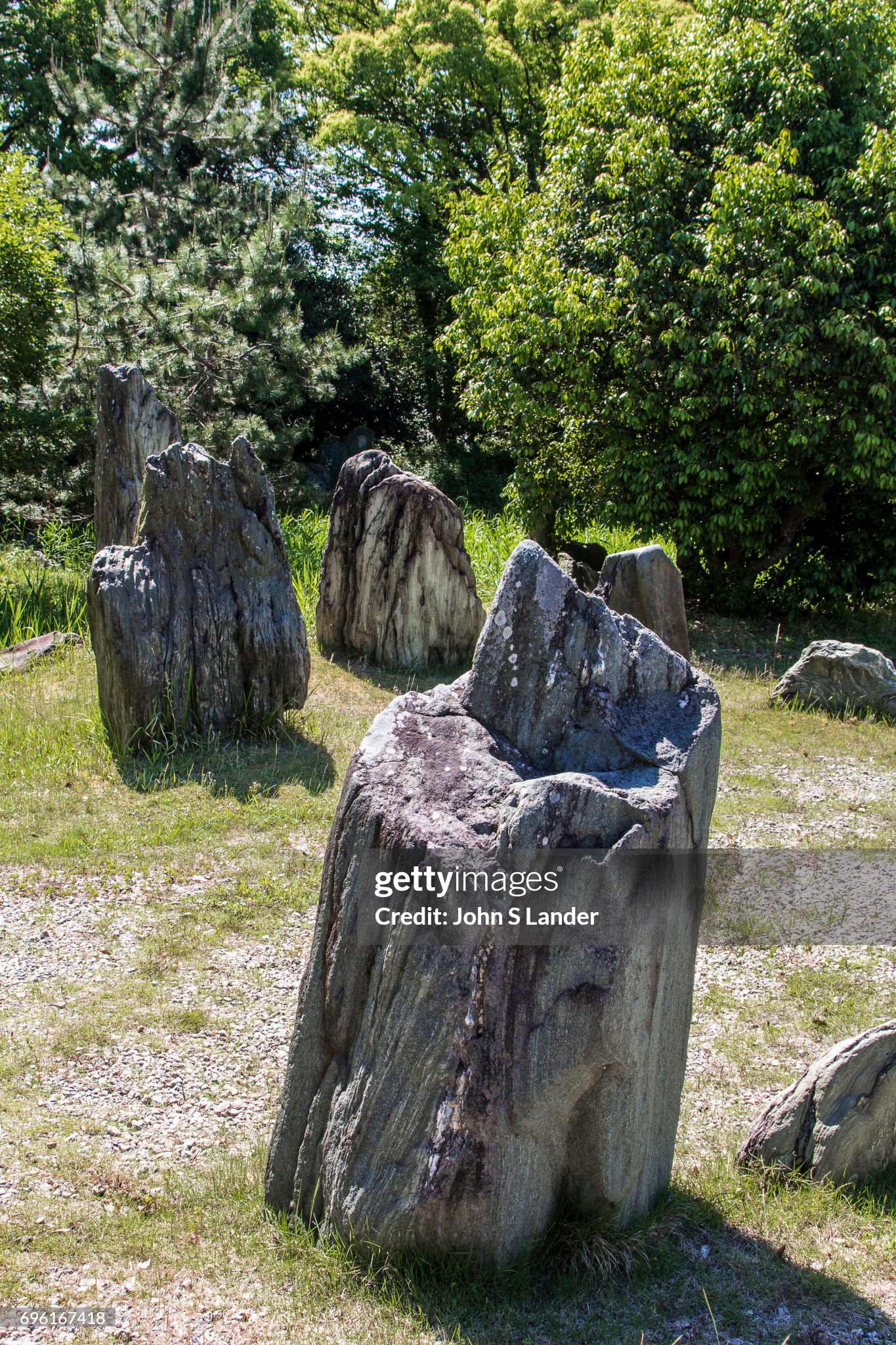
Rocks were apparently a Mirei Shigemori thing. Below is a photo from his private garden in Kyoto. On my bucket list. What more could you want?

We walked back out front to Mr. Bike. The phone rang. A call from the USA. It was our daughter-in-law.

Our son had just had a seizure. He was in the hospital, and OK-ish. She passed along that he wanted us to finish our trip. My mind stopped. The wheels spun. A Go-en moment.

Go-en means both fate and chance. Considered 2 sides of the same coin. Spin that coin fast enough and it’s Go-en.

In Buddhist speak, we’re talking dependent origination. Everything arises in dependence with other factors. We’re talking simultaneity. Nothing exists independently. Everything is interconnected. Or something like that.

You’re never going to conceptualize Go-en or explain it. But you know it when you see it. Think the guy who misses his plane which then crashes with no survivors. Call it fate. Call it destiny. Call it chance. Call it whatever you want.

Goen. Actually En

A tip of the hat to the French filmmaker Emilie Berteau and her movie 88. We emailed her. & She explained the specific concept of Go-en for us, and she passed along a Japanese proverb:

Japanese “GOEN” is the spiritual expression of Relationships or Connections. Here is a famous Japanese proverb;袖触れ合うも多生の縁 (Sode hureau mo tashou no en) = ”Even a chance acquaintance is decreed by destiny.”

We pulled into Temple 88 late in the day, and parked the bike. We walked by a beautifully designed stainless glass enclosure for pilgrimage hiking staffs. Those who have finished the pilgrimage can leave them here, where they will be burned in a special ceremony, twice a year.
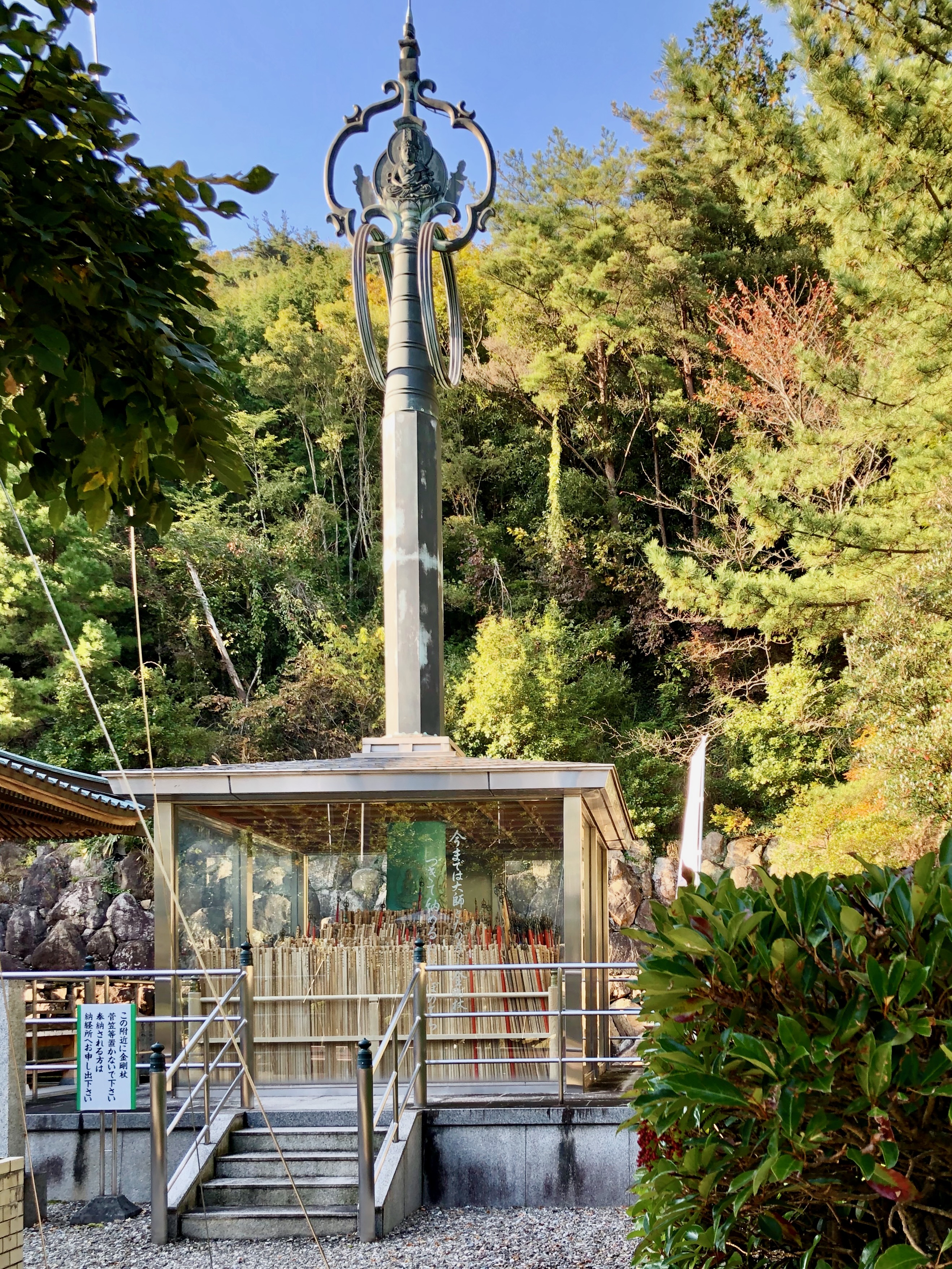
On closer inspection, virtually all the staffs looked hardly used.

The explanation- bus tours. It is said that upwards of 150,000 folks make the pilgrimage every year or at least “embark on the journey.” Of these, some go by car; Some motorcycle; Some public transportation; Some helicopter, but by far the biggest percentage are the chartered bus pilgrims.

By bus, they can do the pilgrimage in 2 weeks and don’t wear down their staffs. 40 pilgrims to a bus plus a priest and a guide. We learned early on, you don’t want to get stuck at a temple office behind a guide with 40 books needing stamps and calligraphies.

Perhaps only 1500 people walk the pilgrimage every year from start to finish. I am guessing a few bikes make it to all 88 temples. And then there was us. Senior USA citizens on a tandem.

As we entered the Temple proper, there was a Japanese guide holding forth to a group of what looked like extremely wealthy Japanese businessmen. Perhaps a pilgrimage highlights limo tour?

Finding our inn was easy. It was across the street.

Day 33.  November 9 Saturday; Last Bicycling Day 26 T88 to Tokushima. 1 temple

T1 Ryōzen-ji 霊山寺 Tokushima

We slept well. A hot soak, good food, and good company will do that.

We were pretty much done. Or so we thought.

I went out to load up the bike for our last riding day. A tire was flat and it was cold. Like put-on-everything-we-brought cold.

Within the first mile we had a monkey dancing down the road in front of us. Curiously archetypal. In these parts, monkeys are messengers of the old Gods.

As we descended, mists were rising from the rice fields.

We had a climb back up and over to Tokushima. Back in the day there had a guarded check point here between prefectures. Today it’s a back road which crests up and over.

I vaguely remember a small sign indicating the remains of a long gone guard post, up a foot path, up the hill to the right. Though that could be a false memory. In any case we pushed on. No traffic. We were far off the beaten track.

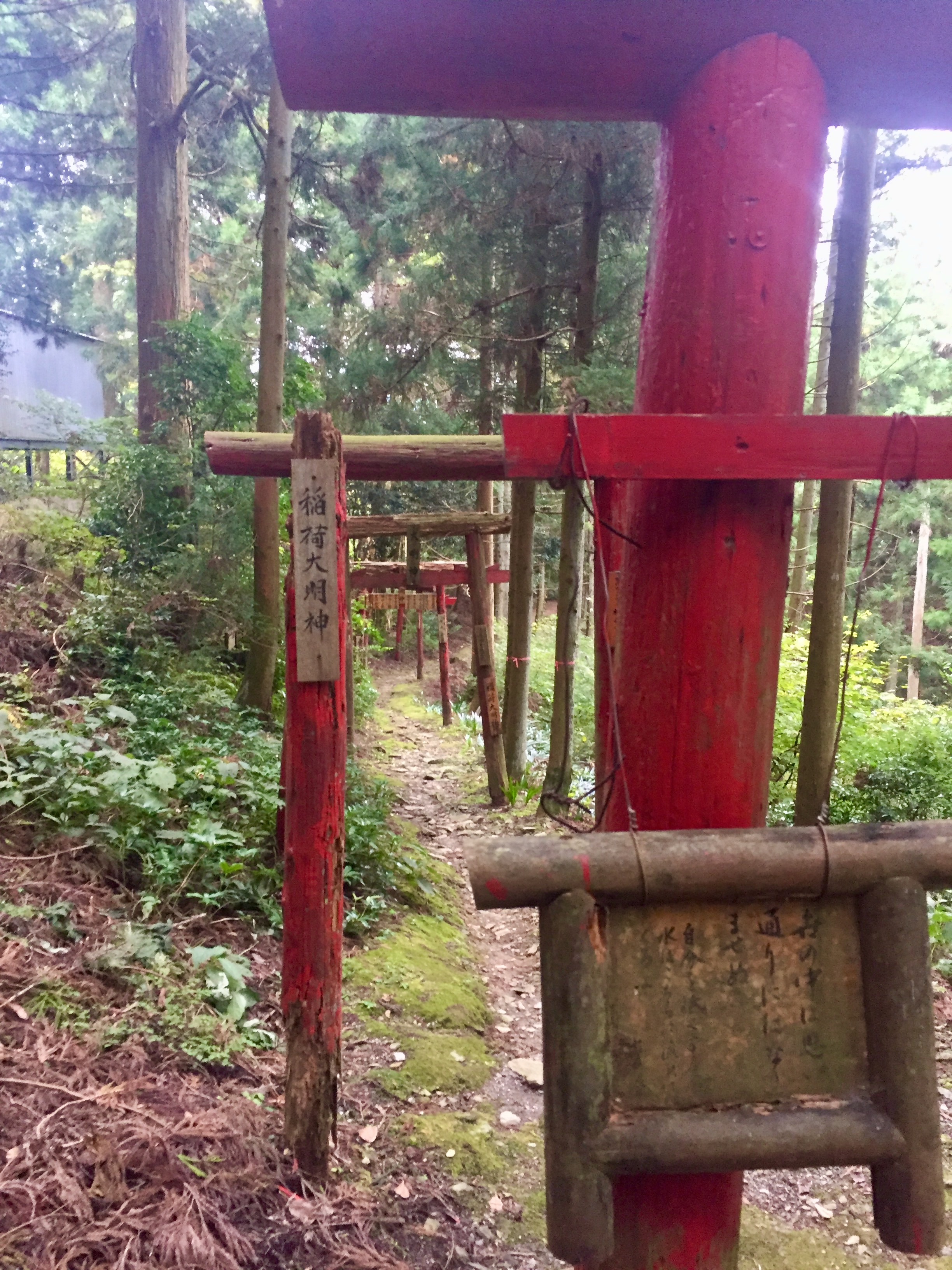
I do remember quite vividly a very small unassuming Shinto Torii gate indicating a local spirit who dwelt thereabouts.
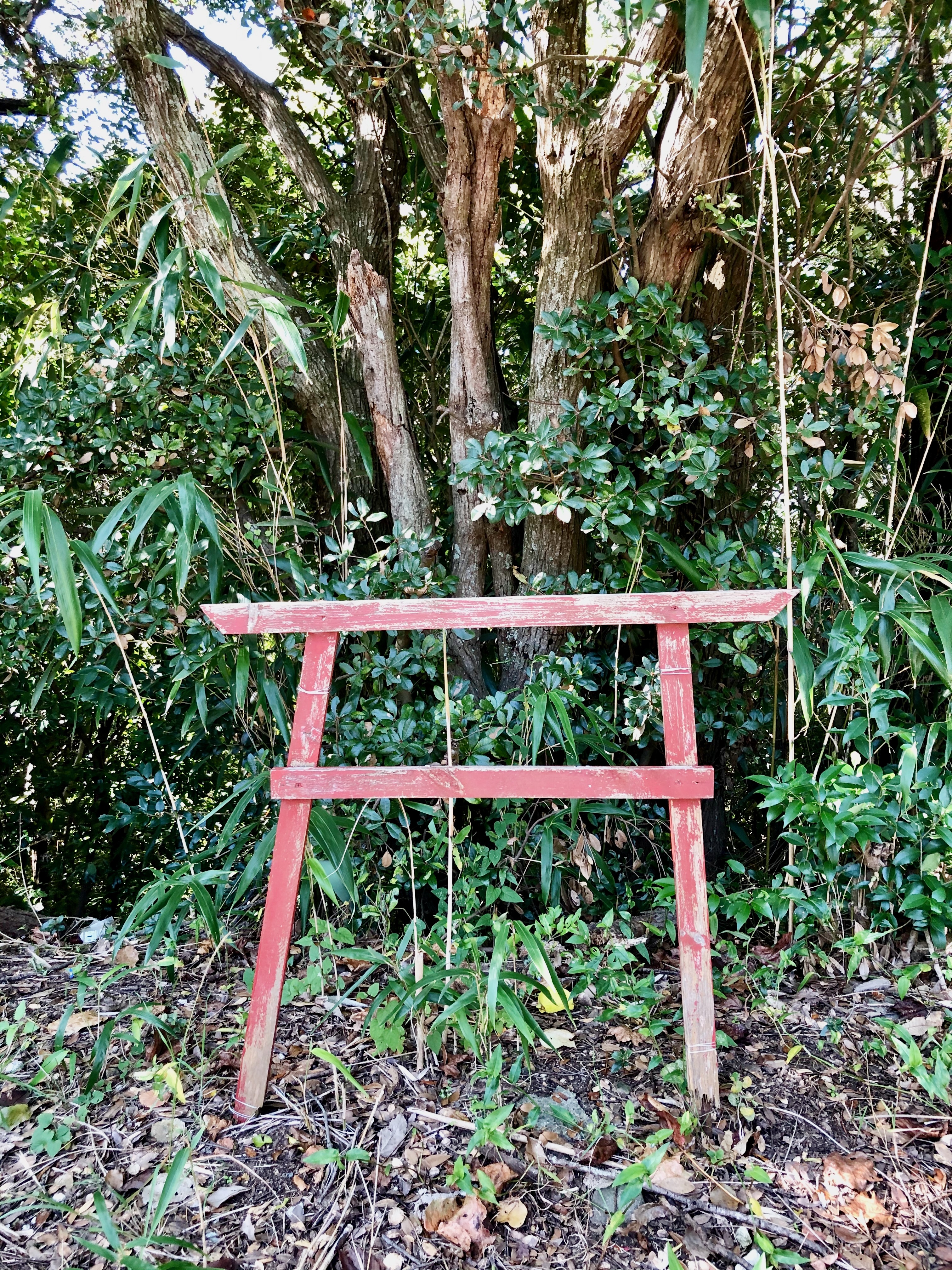
The descent to Tokushima was easy and quick. In no time we were back at Temple #1 Ryōzen-ji.

The Koi were still lolling about. We paid our respects and headed to the temple office. A new stamp and a new calligraphy was added at the end of each of our books. See below.
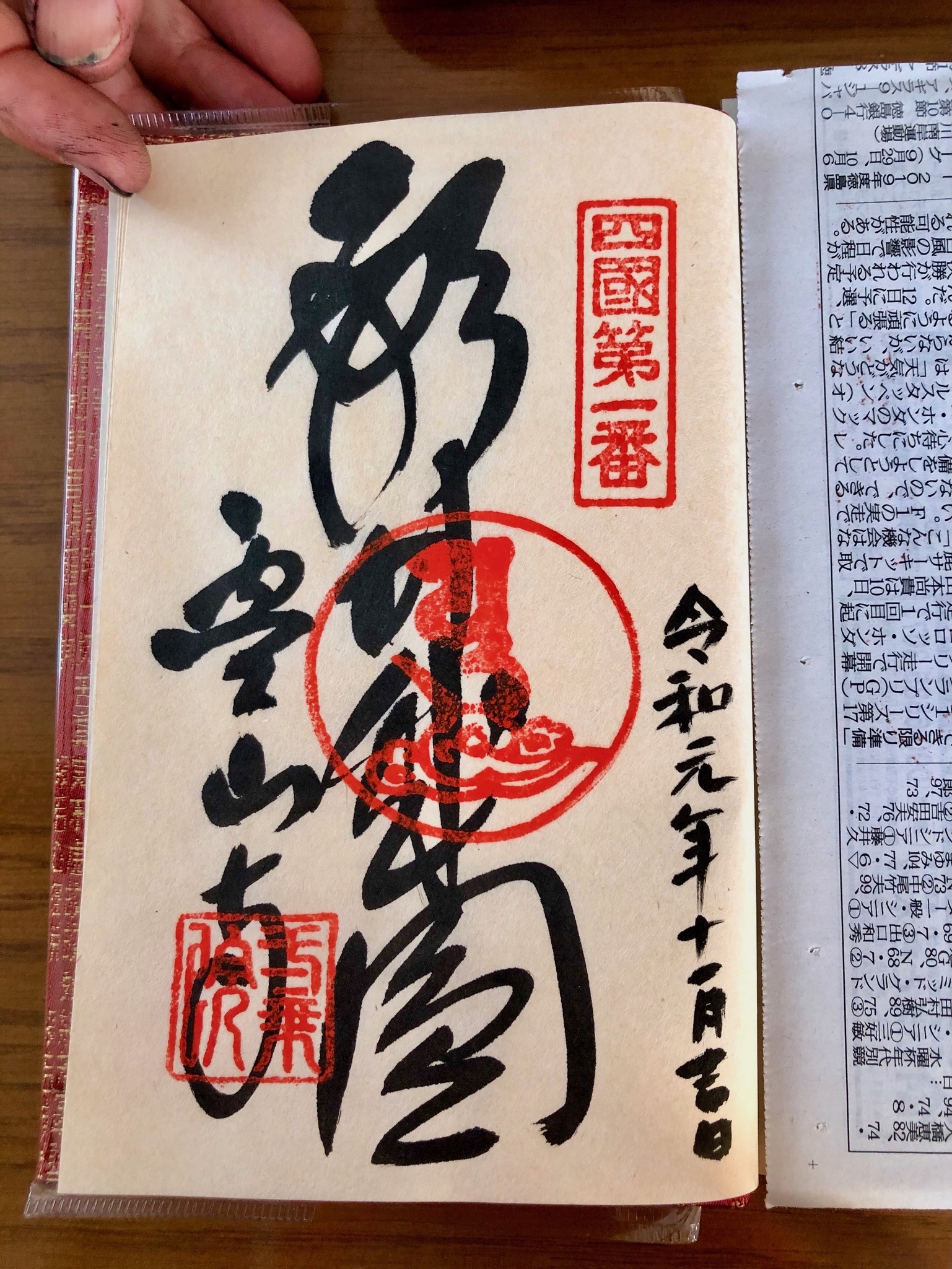
The best I’ve been able to sort it out, this last calligraphy gives the temple name, the date, confirmation that the pilgrimage was completed and a comment to the effect that “The Buddhist practice you’ve longed for since your previous life has been fulfilled perfectly”. At least, that’s how a monk explained it to someone else.

We had learned the concept of trying your best throughout the pilgrimage. Folks, usually bus pilgrims at temples, would take a look at us and our bike and say “Ganbatte.” Which translates roughly as “Hang in there” and/or “Don’t give up.”

Our response, was the traditional, “Ganbarimasu.” I will do my best.

During my conversation with the perhaps-monk working on my book that day at Ryōzen-ji, I said “Ganbarimasu.” Meaning “I do my best.”

He corrected me, “Ganbarimashita.” Past tense. Meaning “I did my best”

Emphasis on the past. We were done. It was official.

From Ryōzen-ji, it was a short familiar ride to our inn, Morimoto-ya. Like coming home. Which it was. Morimoto-ya was our home-away-from-home. Mimasan, the proprietress, had picked us up at the airport, stored our luggage, waved goodbye when we took off in the typhoon, and sent us re-supplies when we were on the road.

We pulled in, stashed the bike, took a hot soak and kicked back. Mimasan had cooked us a special dinner in celebration of our return. We even got our own table and our own dining space just off the main dining area, where several pilgrims were already eating.

They were curious about our special treatment. Mimasan:

“They just finished the pilgrimage, on a tandem bike! And they did it all in only 21 days!”

An exaggeration which we didn’t correct. It was her story and she was sticking to it.

Day 34.  November 10 Sunday; Bike Packing Day.

Mimasan was a bundle of energy. She ran the inn. Kept her family in line. Had a side company making candles in the mountains, and was a dancer. She might play a couple of musical instruments too, I don’t remember exactly, but it would be completely in character.

Not surprisingly, She and Sharon became buds. So when she wondered if Sharon might like to go see the recycling center, Sharon was on it. Off they sped in Mimasan’s micro van.

Did I mention that Mimasan drove fast?

I slowly packed up the tandem out front. An elderly bonzai-tree type gardener was trimming up a remarkable limb overhanging the entrance, near where I was doing my packing thing. An elderly woman came out of the inn walked over to the outdoor vending machine next to me.

She bought a can of something or other and brought it over to him. I don’t remember any words being exchanged. It was a slow dance.

Sharon had a great time at the recycling center. Mimasan wanted to know if we were up for conveyor belt sushi. But of course.

We sped off. The establishment was in a mall. Like any mall anywhere.
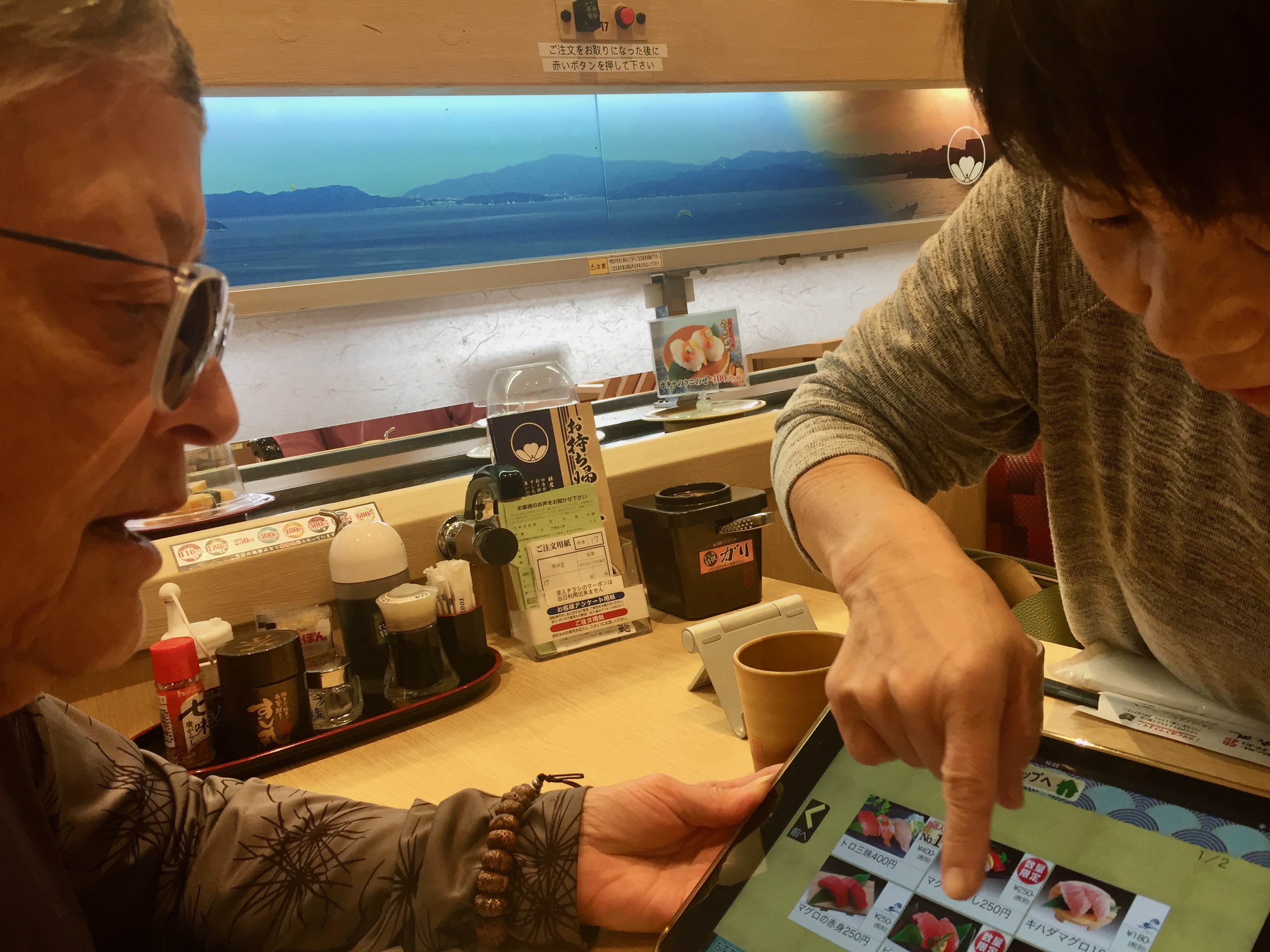
You could order your sushi off a tablet or just grab one off the conveyor belt running by the table. Bill was figured up afterwards from the color coded pile of dishes. We had a tasty great time. And a very high pile of dishes.

Day 35.  November 11 Monday; Buffer Day; 1 Temple

T5 Jizō-ji 大日寺 Tokushima

To my credit I had scheduled a buffer day. An extra day to absorb planning snafus or whatever. We were all caught up, so we asked Mimasan for ideas.

“Well, you could walk up the hill to Jizō Temple. There’s a lot there”

Yes. Deja vu and a whole lot more.

Our first visit was about a month ago. It had been raining. We were disoriented and in a rush. A woman in the temple office had saved us. We stopped in to give her our regards.

She was pleased that we had made it and survived. Suspect she was a bit surprised, but she never let on. Since we had time on our hands, she suggested we visit the 200 Arhats who had their own temple building up the hill,

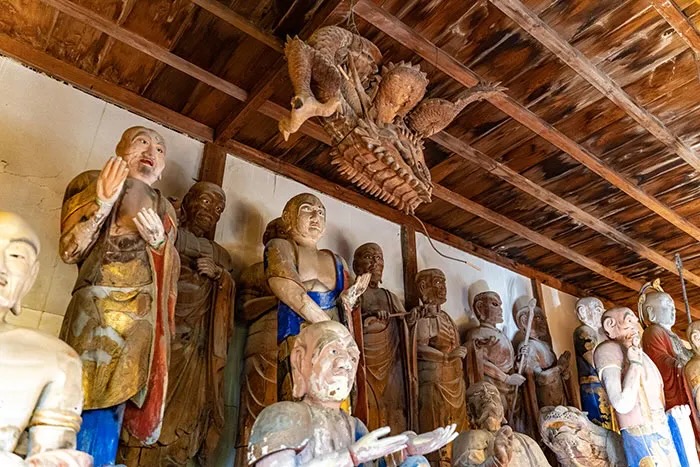
Arhats are disciples of the Buddha, who have attained the highest level of ascetic practice.They are considered to be protectors of the teachings and could use magical powers to assist the faithful. Often portrayed with individualized facial expressions, suggestive of an extreme ascetic lifestyles and honored as examples of the individual spiritual quest.

The Arhat hall was musty, modest and magical. These Arhats were life-size. A bit worn for wear, but after all they are well over 200 years old and hadn’t led easy lives. Some had travelled all the way from China.

They found a home here in 1775, when two temple priests (brothers) built them a hall. All was well until 1915 when a careless visitor started a fire and burned the hall down. 300 Arhat brothers were lost. The current hall was built in 1922, and today’s 200 Arhats moved back in.

These guys are survivors.
Today Jizō Temple, feels modest, but it wasn’t always so. It has a history and then some. Game of Thrones stuff.

Things started with a bang in 821 when Emperor Saga ordered Kukai to found the temple. Emperor Saga and subsequent emperors and warlords provided the support to make Jizō Temple an extraordinary extended world on Shikoku.

At its height, Jizō Temple had more than 300 branch temples. On this site alone there were 26 pagodas. All long gone now.

So what made Jizō Temple so special that emperors and warlords would become patrons?

That would be Shogun Jizō.

Shogun Jizō @ Jizō-ji Temple

Jizō is an important Bodhisattva or “Saint” in the mainstream Buddhist tradition. Primarily known today as a protector of children and travelers. A typical Jizō is depicted as peaceful, and highly likable. Almost cuddly.

Then there is the dark side of days gone by: Shogun Jizō. Victorious Jizō, Protector of Warriors. In battle, he’d take a hit for you. Help you prevail. A battle-field protector.

The monks of the old Jizō Temple weren’t warrior monks, but monks who gave magic to warriors.

This being Shingon, there were secret transmissions, visualizations, mantras and mandalas. A secret doctrine for those who could pay the price.

Today’s Shogun Jizō is described as a much nicer guy. He drives out wrongdoers and prevents disasters.

After our self-guided tour of the Arhat Hall, I was in a contemplative mood. We wandered back down the hill. I sat down on the stairs to admire the view. Temple on the left. Graveyard on the right. Path descending between the two. Town and Mountains beyond. Photo below pretty much says it all.
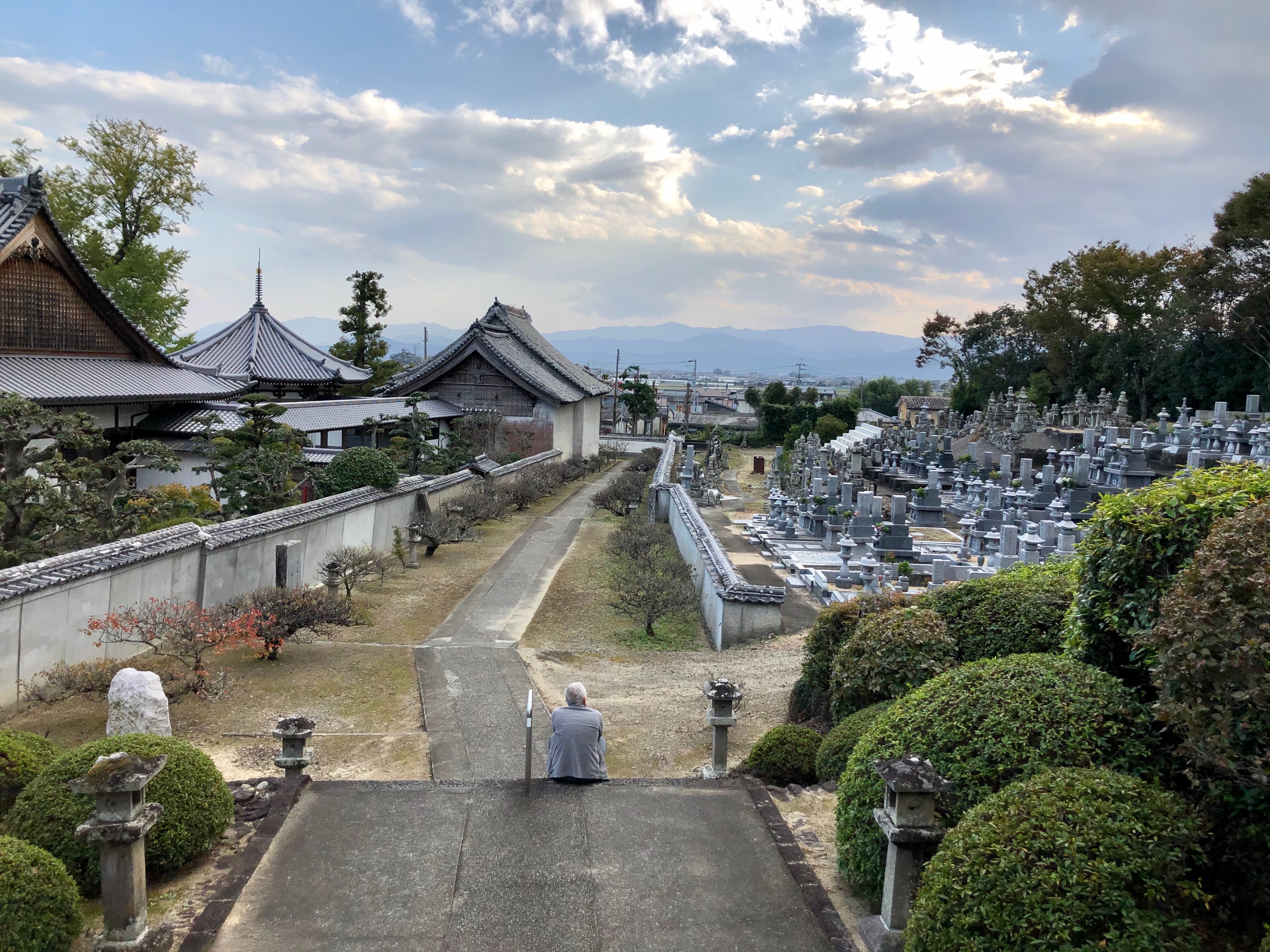
So what would be next?

That would be Covid. The first cases were already in Japan, but we escaped unscathed.

Four months later at the height of Covid panic, we would be walking through empty airports on our way to Florida to help out family. Again we emerged unscathed.

Dumb luck, or fate? Or both at once? Go-en. The coin spins.
2019 Shikoku Pilgrimage 4: Ehime

Ehime was a bit out of control. Maybe more than a bit. 

Our Ehime Dojo of Enlightenment experience included Demon Talismans; No brakes; Scheduling chaos; Murder hornets; Chopstick conundrums; Funerals; Ugly American transformations; and a Halloween party.

Then there were the drunken salarymen, basketball monks, a crazed Swiss couple, and the lost inn.

It was a most interesting ride. As we used to say back in the day,

“Not much love & light, But there were plenty of reality sandwiches.”

On the pilgrimage, Ehime is considered the prefecture of enlightenment. Maybe the world was trying to tell us something.

What do you think?

Shikoku Pilgrimage Route with Temples. Ehime, numbers 40 – 65

We were in Ehime for 10 days.

Day 19. October 26 Saturday; Bicycling Day 14;  Sukumo to  Nishi-yugo Center; 1 Temple

39 Enkōji 延光寺 Sukumo, Kōchi
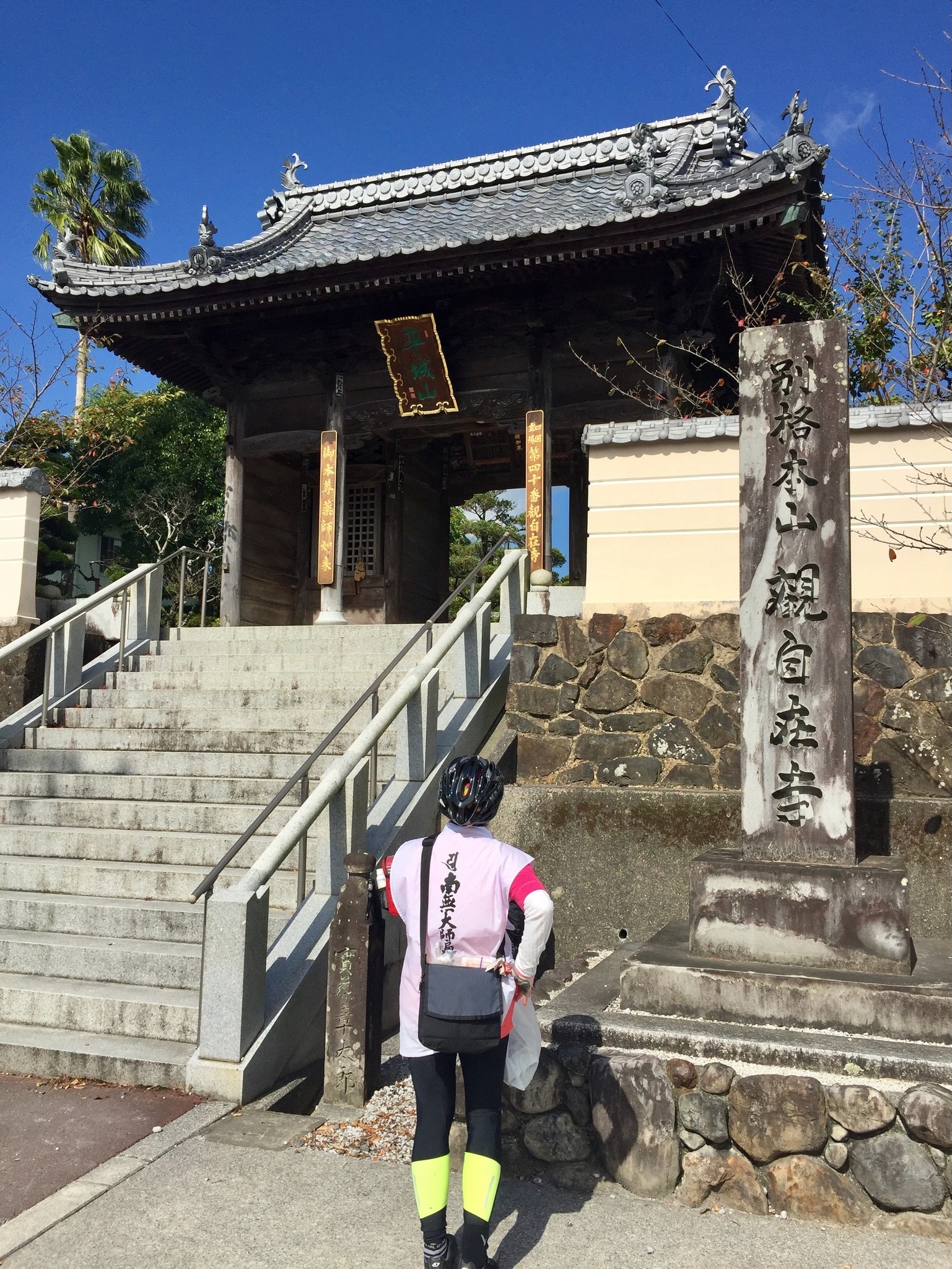
40 Kanjizaiji 観自在寺 Ainan, Ehime.

On the road we passed the turnoff to Temple 39. Gave a tip of the hat to recently departed Mr. Frog, and headed up the coast to Temple 40, Kanjizaiji, the first Temple in Ehime.

T40 is the temple furthest from Temple 1 on our pilgrimage loop. The other side of the world if you will. Nothing out of the ordinary. Nice temple. We paid our respects. The usual drill.

It wasn’t until we returned to our bike, that the magic kicked in.

I was sitting on the curb snacking, behind Sharon in the photo below, when this kind-of ageless Japanese woman appears, sits down next to me, and wants to talk. We chat and then she heads down the hill, only to reappear shortly thereafter with talismans for each of us.

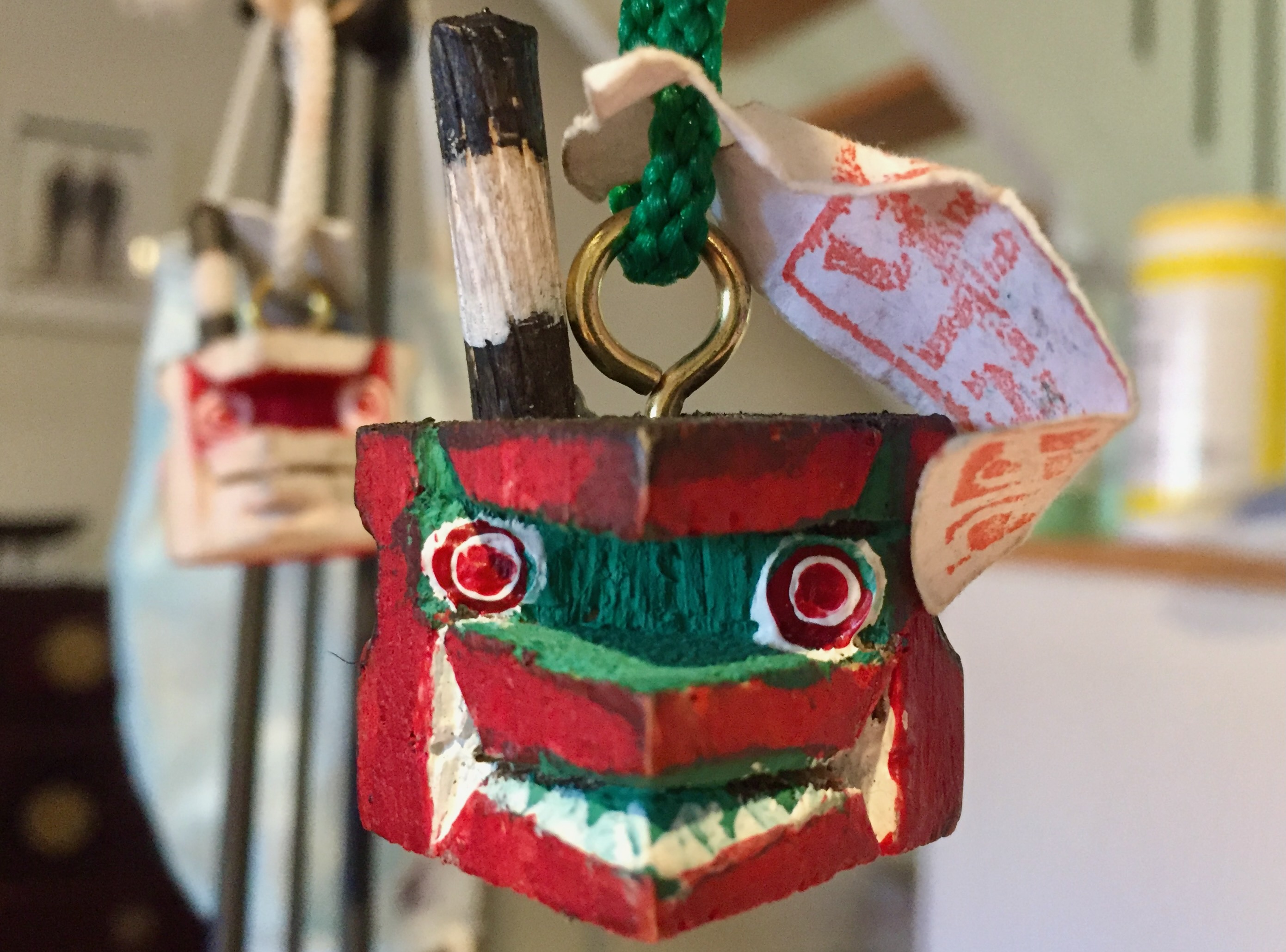
Best I could understand is that they were kind-of like a St. Christopher’s for travelers, but with a Shikoku pilgrimage Buddhist twist. Demons and so forth.

These were Uchi Oni demon talismans, protectors against evil spirits and bad luck. Converted Demons if you will. Still had their powers, but on our side now.

We carried them with us for the rest of the trip. During one chaotic moment, I lost mine. Sharon found it in the dirt. It had lost a horn. Figure Mr Oni had taken one for me.

Much appreciated.

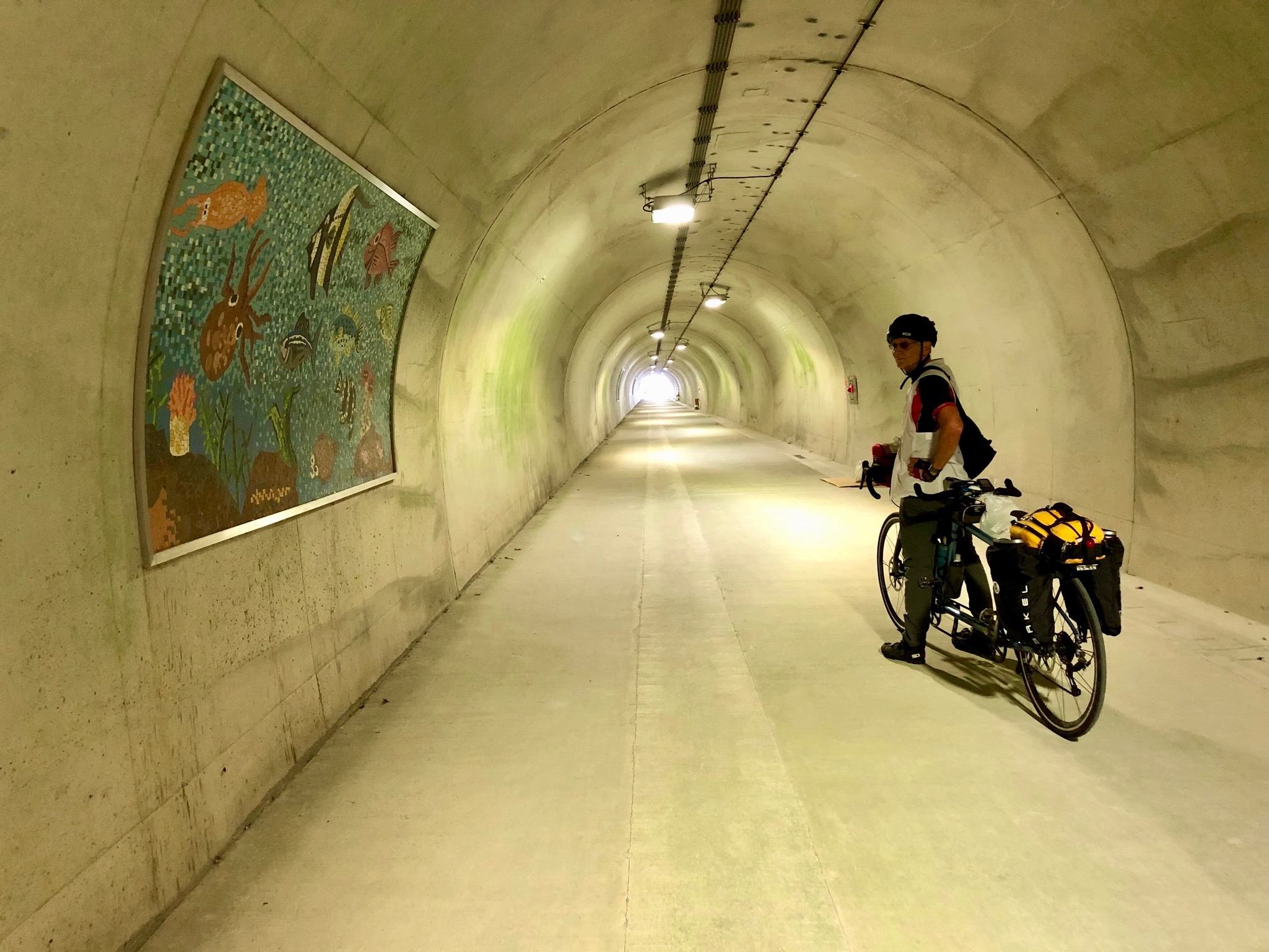
We continued up the coast. We came to yet again another tunnel, or more accurately 2 tunnels each with their own tunnel entrance. We stopped and puzzled it out.

We could have pushed through the car tunnel, but we had a most remarkable alternative. A Bicycle tunnel. No cars allowed, complete with artwork, to humor and educate us.

We pulled into our digs for the night late afternoon. I really didn’t have any expectations. Reservations were made based on location. I didn’t know anything about the place.

Turns out, we had stumbled into a Japanese deep sea fishing center, Nishi-Yugo. Perhaps Shikoku Pilgrims showed up once in a while, but this place was all about the fish.

Photo below from the balcony/outdoor hall on the way to our room. Great room with our own soaking tub. Wonderful views of the harbor and fishing boats.

They say that back in the day, fishermen in these parts played an important role in defending Japan against pirates and Mongolian invasions. I can see that. They knew and still know these waters like that back of their hands.

We moseyed down to dinner. An honored guest had been out fishing. His catch below.

We were the only folks inside for dinner. Food was fantastic. But we couldn’t make headway with the snails. Our waiter/cook watched, much amused. We were trying to pull the our snails out of their shells with chopsticks. We’d almost get there and then the juicy parts would snap back inside.

Our guy eventually took pity on us, came over and explained that we simply needed to grab the slippery buggers with our fingers and pull, pull hard.

A Gordian knot moment.

In the meantime, he had been rushing in and out bringing more sake to their honored fishing guest who was eating his catch outside, cleaned, cooked up and served by the staff.

We checked out the most-happy fishing pics on the wall. Honored guest wouldn’t make it into this hall-of-fame.

Day 20. October 27 Sunday; Bicycling Day 15 Nishi-yugo Center to  Seiyo City. 2 Temples

41 Ryūkōji 竜光寺 Uwajima, Ehime
42 Butsumokuji  佛木寺 Uwajima, Ehime

I have a soft spot for Temple 42. It is the temple where folks come to pay respects to beloved pets who have passed. Photo below is the little shrine or Kachikudo, filled with favorite toys, pet snacks and so forth.

If this weren’t enough. Every year on the day of the Ox of Doyo, or Japanese mid-summer’s day, the temple gives blessings and prayers for the fulfillment of wishes not only of the folks who made the offerings, but also the fulfillment of the wishes of the beasts themselves.

Is this great or what?

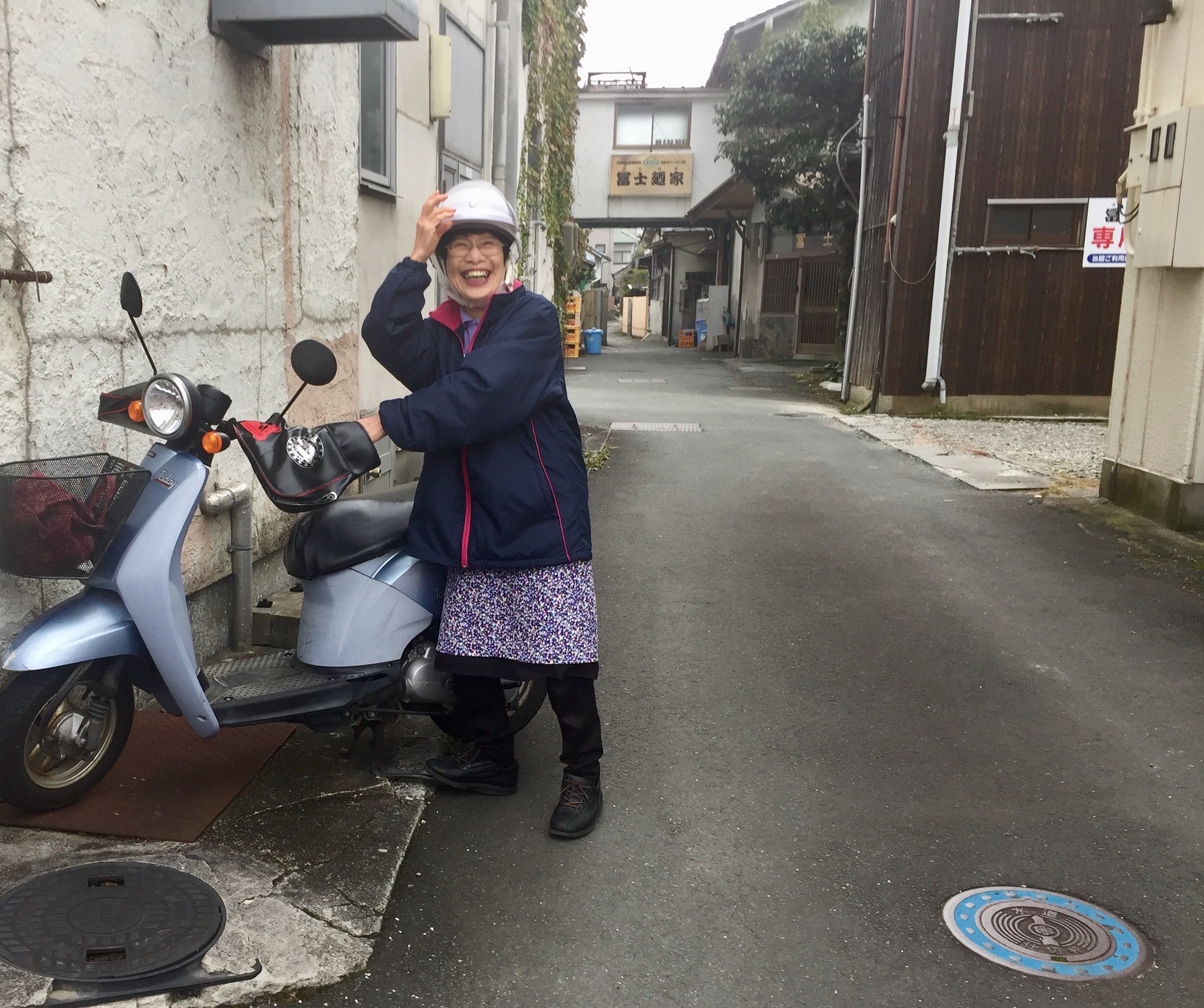
We pulled into Matsuchi-ya Ryokan in Seiyo City late afternoon. Fun and helpful folks. Here is a pic of one of the staff with her motor scooter. A picture is worth a thousand words.

Check out that Manhole cover. A work of Art.

Our plan had been to take a day off here. Seiyo City is known for its streets of traditional buildings, some dating back to the Edo period, & working sake and soy sauce breweries. Fine museums too. Or so they say.

We never had a chance to find out. It was Matsuyama or bust. And we would need time there to find brake pads. We pushed on the next morning.

Day 21. October 28 Monday; Bicycling Day 16. Seiyo City to Oda. 1 Temple

43 Meisekiji 明石寺 Seiyo, Ehime

But not before visiting Temple 43. It was in town and pretty close, but we had to ride around the long way because we were on a bike. We were pushing a fully loaded Mr. Tandem up the last steep stretch to the temple when we heard tinkling laughter behind us. We couldn’t see who these women were because of the heavy mists. Visibility was perhaps 30′

Turned out, They were a couple of very young nuns. Perhaps 20 years old. Perhaps younger.

We next ran into them at the main hall where they were chanting the Heart Sutra. A classic, and standard fare on the pilgrimage.

“… gate gate pāragate pārasaṃgate bodhi svāhā…”

“…gone, gone, gone beyond, completely beyond, awakening, rejoice…”

I was quite enchanted with the scene. Sharon, the hardcore one, not so much,

“Total Newbies. Sheesh they haven’t even memorized the Sutra. They’re reading it.”

On the way out of the temple, the mists were lifting. Giant spider webs were glistening in the sun. We never saw the spiders, but they grow them big around here, the size of your palm.

Then Sharon spotted something walking down the path that she did find enchanting. A Sparrow Bee or Murder Hornet. It was big, perhaps the size of your thumb. Wingspan 2 to 3 inches.

She was enamored as she bent down for a closer look, “It’s so, so, so cool”

Yes, it was stunning, but I thought to myself, “And you do know that they kill people every year. Right?”

Back on national Route 56 we continued up the coast to Ozu City and turned inland. We started our climb to the Kuma Highlands along the Oda River to Oda and our Inn for the night, Fuji-ya Ryokan.

Our host apologized for the state of her inn.

“It’s very old, and falling apart.”

The place totally worked for us. Like staying overnight in a Samurai movie.

Day 22. October 29 Tuesday; Bicycling Day 17 Oda to Hacchozaka ; 2 Temples

44 Daihōji 大寶寺 Kumakōgen Ehime
45 Iwayaji 岩屋寺 Kumakōgen Ehime

It was drizzling next morning. We suited up in our rain gear and headed out for our climb to Mayumi-Toge Pass. At the top, we were up on the Kuma Highlands.

10 ± miles later we were parking the bike out front of the main gate of Temple 44. It was still dripping, when we headed up through giant, ancient cypress and cedar trees. The cypress are estimated to be 1000± years old and the cedar 500±.

I know that because I used google lens to translate the all-Japanese sign info into English.

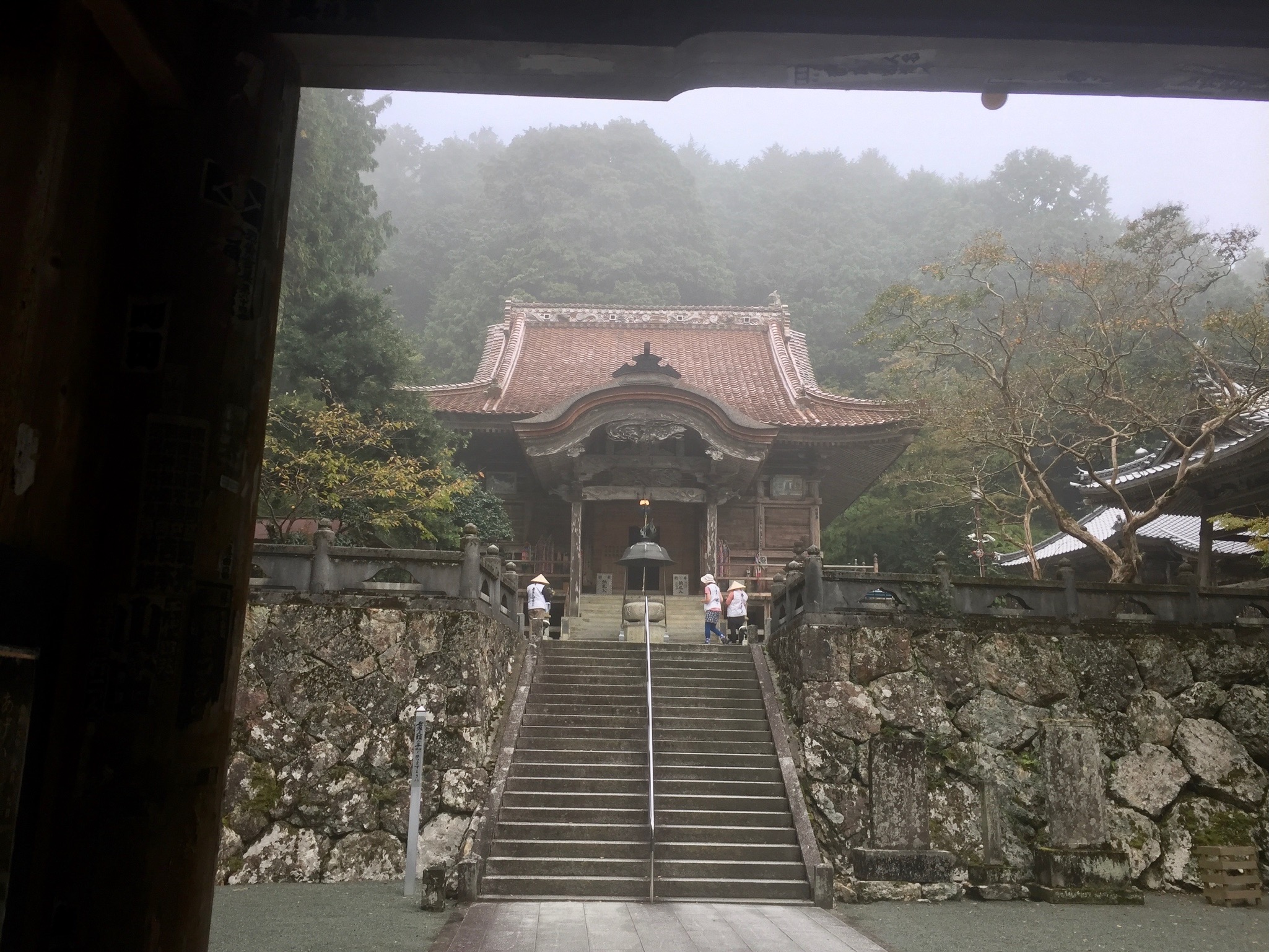
Temples 44 and 45 are special. At least they talked to us. Off the beaten track. Lots of history. Great sites. If time and health allow, it would be most interesting to go back and stay a while, just to get to know these 2 places better. Many mysteries.

Word has it, that these two temples were once related. Temple 44 being the public face and Temple 45, the secret side. But that was a long time ago. Today back country hiking trails still connect the two, though.

The Niō Gate was adorned with a massive pair of pilgrim’s straw sandals. In the photo below, one can be seen inside on the left of the opening. The other, on the right, is not visible. They are replaced every 100 years.

Why the giant sandals? Lots of explanations. Probably a bit of truth in each.

The temple guardians are to the left and right of the entrance. These are big guys. Big guys need big sandals.

The sandals symbolize walking. Important on the pilgrimage. Although we were on a bike, we get it. We paid our respects passing through.

The sandals are also a tip of the hat to those pilgrims now long gone. Straw sandals were their footwear. Good for protecting against Mamusa snakes and murder hornets. Should they be stepped on.

Basho, Japan’s most famous Haiku poet visited Temple 44 in his wanderings in 1687. Near the temple office there is a monument to him with the following haiku. Perhaps written here.

taking medicine
it is as bad as having
frost on the pillow

Well said. I can relate. Frost on the pillow.

Our inn for the night, Hacchozaka, was in-between Temples 44 and 45. We arrived early afternoon. There was still time to ride on to 45 and back. The idea was to check in, and drop off our bike bags. Then make a quick loop, thus saving time and miles for the next day.

We were about to head in the door, when cars pulled up behind us, and out of the inn came a party dressed in black. The widow stopped in front of us, gave us a blank look. Then looked down at our front bag, smiled and in a low clear upbeat voice said,

“Kawaii.” translation – Cute. Pilosa had made a new friend.

Pilosa had been riding in the front of our front bag zipped in like a figurehead on a bow of a ship. Pilosa is a sloth of the stuffed-animal variety, who’s been traveling with us for a while now.

We bowed and let the funeral party flow around us. They loaded up into their cars and were off.

We checked-in and were off to Temple 45 down the road. We overshot the Temple parking lot, but thankfully realized the error of our ways and doubled back right before a big descent.

It was late in the day and the souvenir stalls were closing up. We pushed Mr. Tandem up past them, where it felt a bit safer, locked it, and started our hike up. It was a long steep climb.

We passed a very old hunched back Japanese woman climbing up with a staff. Perhaps 90s. She looked like she could die any moment, but didn’t care. She was going up, and if it killed her, so be it. A good place to die. Her eyes were sparkling/ throwing off sparks.

There was a younger woman with her who also seemed to think that the old woman could die at any moment, and was very worried.

We think the old woman made it up. No bodies or rescue crews on the way back down. We still talk about her 5 years later. An example for us all.

I stumbled onto the video below researching Temple 45. The Temple’s website uses it as their header background and kindly provides the link to the drone company’s site which has the video.

T45 is a remarkable site with a storied past. The buildings have burned several times, but an atmosphere lingers. This was a place of intense meditation practice.

Up at the temple, there was a ladder to what looked like it could have been a meditation cave. I was tempted.

But it wasn’t meant to be. We had our bike shoes on. Better safe than sorry.

Day 23. October 30 Wednesday; Bicycling Day 18 Hacchozaka to Matsuyama. 6 Temples

46 Jōruriji 浄瑠璃寺 Matsuyama Ehime
47 Yasakaji 八坂寺 Matsuyama Ehime
48 Sairinji 西林寺 Matsuyama Ehime
49 Jōdoji 浄土寺 Matsuyama Ehime
50 Hantaji 繁多寺 Matsuyama Ehime
51 Ishiteji 石手寺 Matsuyama Ehime

We were on the road early. We backtracked a bit before starting the climb to Misaka-toge pass. A narrow winding road. No traffic. Except for a couple of lightweight motorcycles, racing up and down. High school guys, switching off with others at the bottom.

We could hear them in the distance, shifting through the turns. They’d race up past us to the summit. Then they’d turn around, descend past us, switch off and give it another round. Never tiring.

At the top, there was a cute little tunnel to another world. This one was decidedly down.

About 3000 vertical feet down.

Our brake pads were gone. It was pretty much metal to metal. We sang a pretty high screeching metallic tune all the way down.

Near the bottom we had to negotiate a steep, narrow, twisting, cross-over local road to the main road to Temple 46. It was one of those curious local-in-the-extreme, in-between places. Likely teaming with local spirits.

Our brakes were shot and it was so steep that we walked down a good portion. We could hear gun shots. It was posted.

Not the usual, “No Hunting.” But rather “Beware of Hunters.”

When we reached the main road, it was a relief. We were going to make it to Matsuyama City, even with no brakes, and we hadn’t been shot.

Temple 46 was a far cry from 45. Flat, sandy soil, palm trees and tropical plants. Pleasant enough. Domesticated.

Temples 47 to 50 were more of the same. Not without charm.

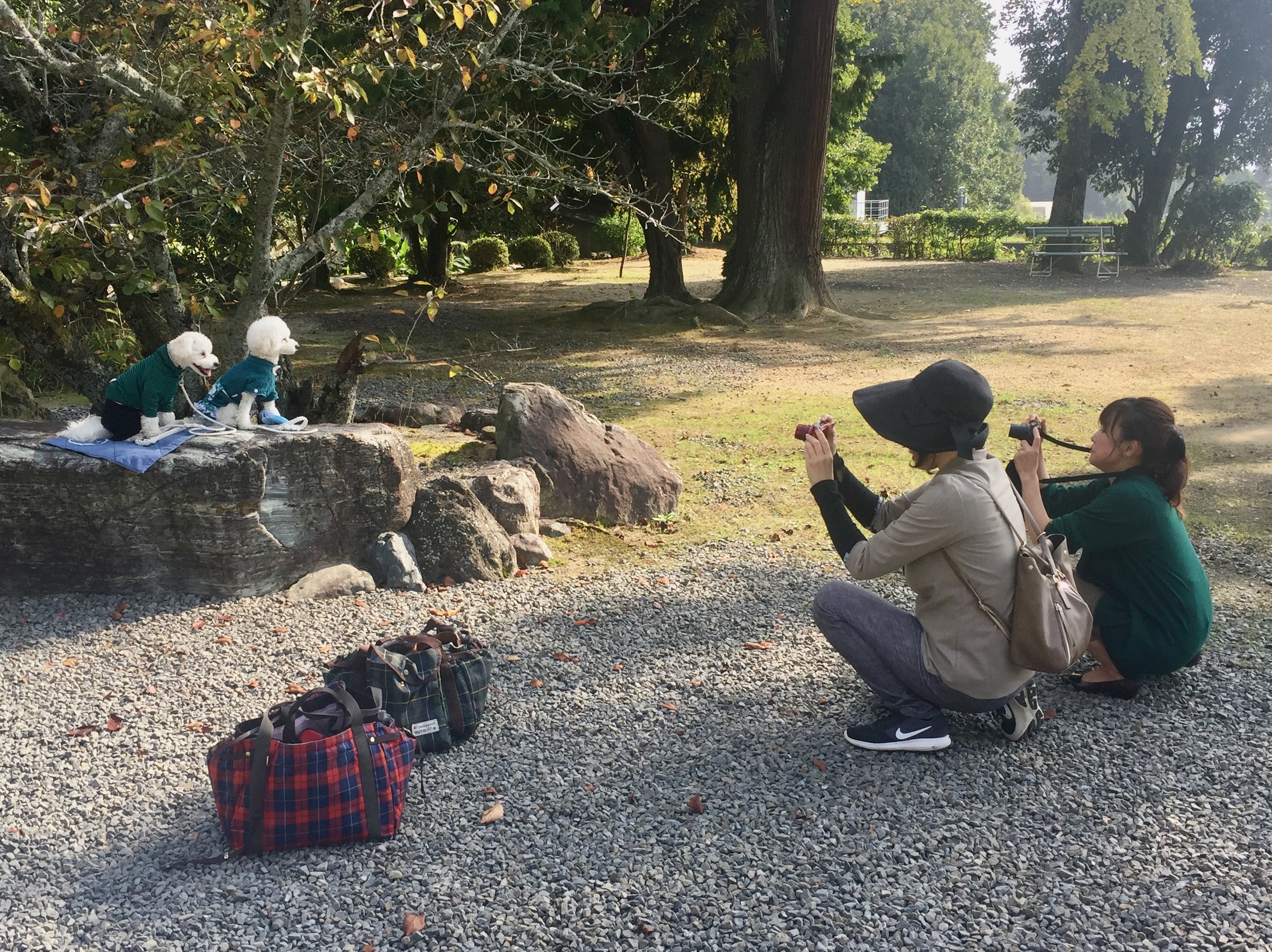
At Temple 50 Hantaji, there was a photo shoot going on. Girls n Dogs.

Matching Dogs with matching girls with matching plaid carrying cases. Even their cameras seemed to match. The dogs seemed all in. I couldn’t help wondering about the boyfriends/husbands. Did they match? Were they all in as well? Was it worth it?

Then there was Temple 51, our last temple of the day. It was big and big-city. Not entirely in a good way. Kind-of Carnivalesque. Lots of folks selling this and that – trinkets, munchables, and so forth.

I breathed a sigh of relief when we pulled up to the Daiwa Roynet Hotel in downtown Matsuyama, but unbeknownst to me, we weren’t quite home free yet.

The lobby was on the second floor. Elevator access only. While I unloaded, Sharon headed up. We needed to know where we should park the bike. We had had a good experience at the Daiwa in Tokushima. They were most accommodating. I had emailed the Daiwa here several times, explaining that we were doing the pilgrimage and needed somewhere to store our long bike.

No response.

Sharon reappeared shaking her head. Reception told her that they don’t do bikes. End of story.

I headed up. I don’t remember exactly what I said, but I was tired and ornery – An ugly loud American. They ended up storing our bike in their luggage room.

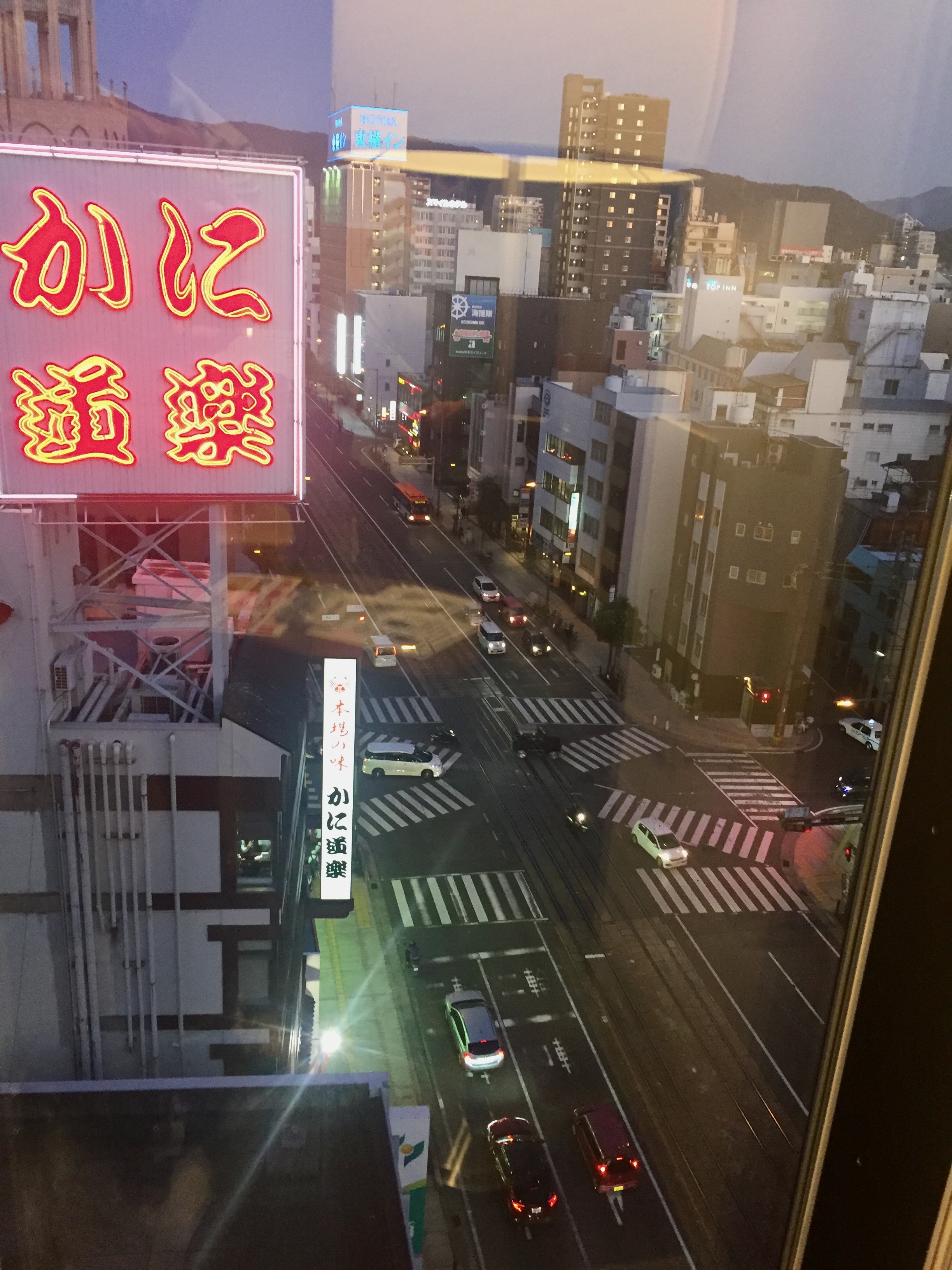
Our room was nice. On one of the upper floors. Bright Lights/ Big City. A counterpoint of sorts to the pilgrimage inns to which we had become accustomed. Very 21st century.

Daiwa Hotel. Room with a View

Day 24. October 31 Thursday; Day off; No temples; 1 Castle

It was our Get-New-Brake-Pads Day and our day off… And Halloween.

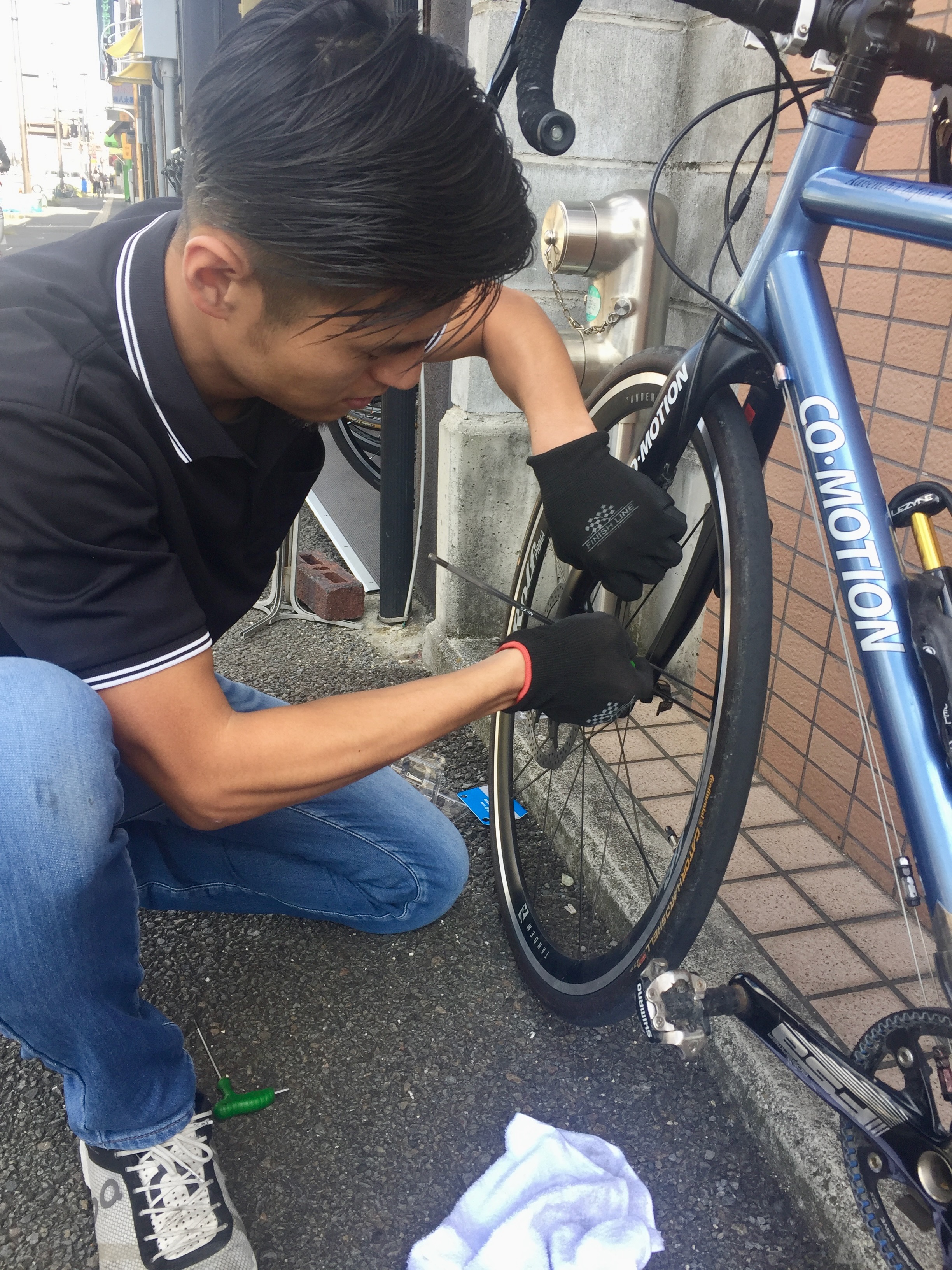
We were sitting out front of Sugiyama bike store 1/2 hour before they opened, and first in the door. Our mechanic was excellent. Knew exactly what he was doing.

Swapped out our pads on the street. He wasn’t used to tandems and was concerned about getting it on their bike stands. He rolled his eyes when he pulled the brake pads. Nothing left.

No surprise to us.

Miraculously, the disks themselves were fine. To celebrate, we went inside to shop. A Sugiyama bike jersey was talking to me. Today a treasured possession, but wearing out. It has served well.

Next up was Matsuyama Castle from the 1600s. Built on a mountain in the middle of Matsuyama Plain. We took the chair lift up most of the way and walked from there.


It was a beautiful clear day. Remarkable 360 degree views from the top. We could see: The mountains from where we’d come; Matsuyama City itself; Our path ahead; And across the Seto Inland Sea to the Island of Honshu to the North.

We decided to have Halloween dinner at the hotel. There was an “Italian” restaurant on the first floor. A truly Halloween dinner it turned out to be.

A macho, 6’+ tall Frenchman and his wife were sitting next to us. They were hiking the highlights of the pilgrimage and traveling in-between on trains and buses. They recognized us,

“We were on a bus (nice and dry) which passed you pushing your bike up that (boring) stretch in the rain”

“Yep”

Our conversation wandered from there. They had done all the pilgrimages, and in style. We hadn’t heard of the Via Francigena from Paris to Rome. Sounded interesting.

On the other side of us, were a group of salarymen. Drinking hard. Mr. Boss at the head of the table, was holding forth. When they left, Mr. Boss led the way out. Bringing up the rear, was a guy who hadn’t been able to keep up. He could no longer walk on his own. Compatriots held him up on either side.

On our way out, we passed the private glass-faced dining room. A Halloween party was in full swing. Super Mario-themed. Lovely Moms and their kids. I stuck my head in and wished them all,

“Happy Halloween! Well done!”

Coming from an American, they took it as high praise. After all, Halloween has become known as a quintessential American holiday.

They laughed and waved.

Day 25. November 1 Friday; Bicycling Day 19 Matsuyama to Imabari; 2 Temples

52 Taizanji 太山寺 Matsuyama Ehime
53 Enmyōji 圓明寺 Matsuyama Ehime

We were back on our original schedule. Still heading North, but not for long. At temple 52 we turned East-ish and rode along up along the Seto Inland Sea. Lots of working fishing boats,

And a Petrochemical Plant later, we arrived at B.H, Tsuyoshi. Our inn for the night.

Our top picks were full, so B.H. Tsuyoshi it was. Run by a mother and daughter, this was a bargain basement pilgrimage Inn. Not for the proud or picky, but it worked for us.

Good food, a washing machine, and we had a clothesline in our room. Good company too.

The only other guest was a hardened pilgrim, who tipped us off on inns up the road. This was not his first rodeo. He had something like 7 or 8 pilgrimages under his belt. Clearly he had stayed here before and liked it.

Perhaps the Missus was the top-up. The 2 kept exchanging glances.

We had what looked like a cement plant, as the view out our window.

Day 26. November 2 Saturday; Bicycling Day 20 Imabari to Saijo. 6 temples

54 Enmeiji 延命寺 Imabari Ehime
55 Nankōbō 南光坊 Imabari Ehime
56 Taisanji 泰山寺 Imabari Ehime
57 Eifukuji 栄福寺 Imabari Ehime
58 Sen’yūji 仙遊寺 Imabari Ehime
59 Kokubunji 伊予国分寺 Imabari Ehime

We had a full day of Temples and a climb ahead. We were on the road early.

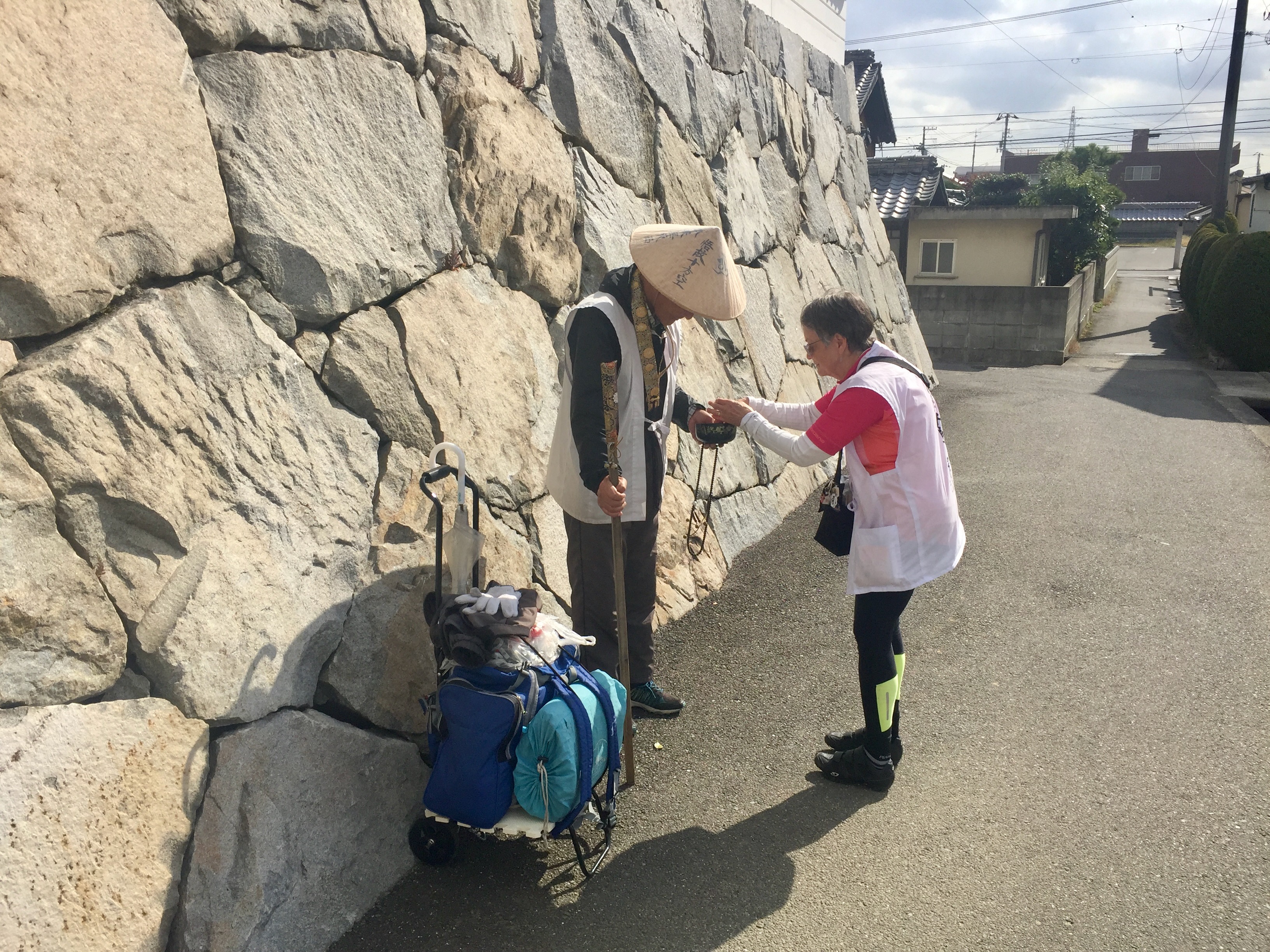
At Temple 56 there was an elderly pilgrim standing quietly against the wall outside the gate with his bowl outstretched. Sharon gave him our change. Each bowed to the other.

Shikoku has shokugyō, or career pilgrims. They live on the road, looping endlessly. If this guy wasn’t shokugyō, my guess is that he was pretty close.

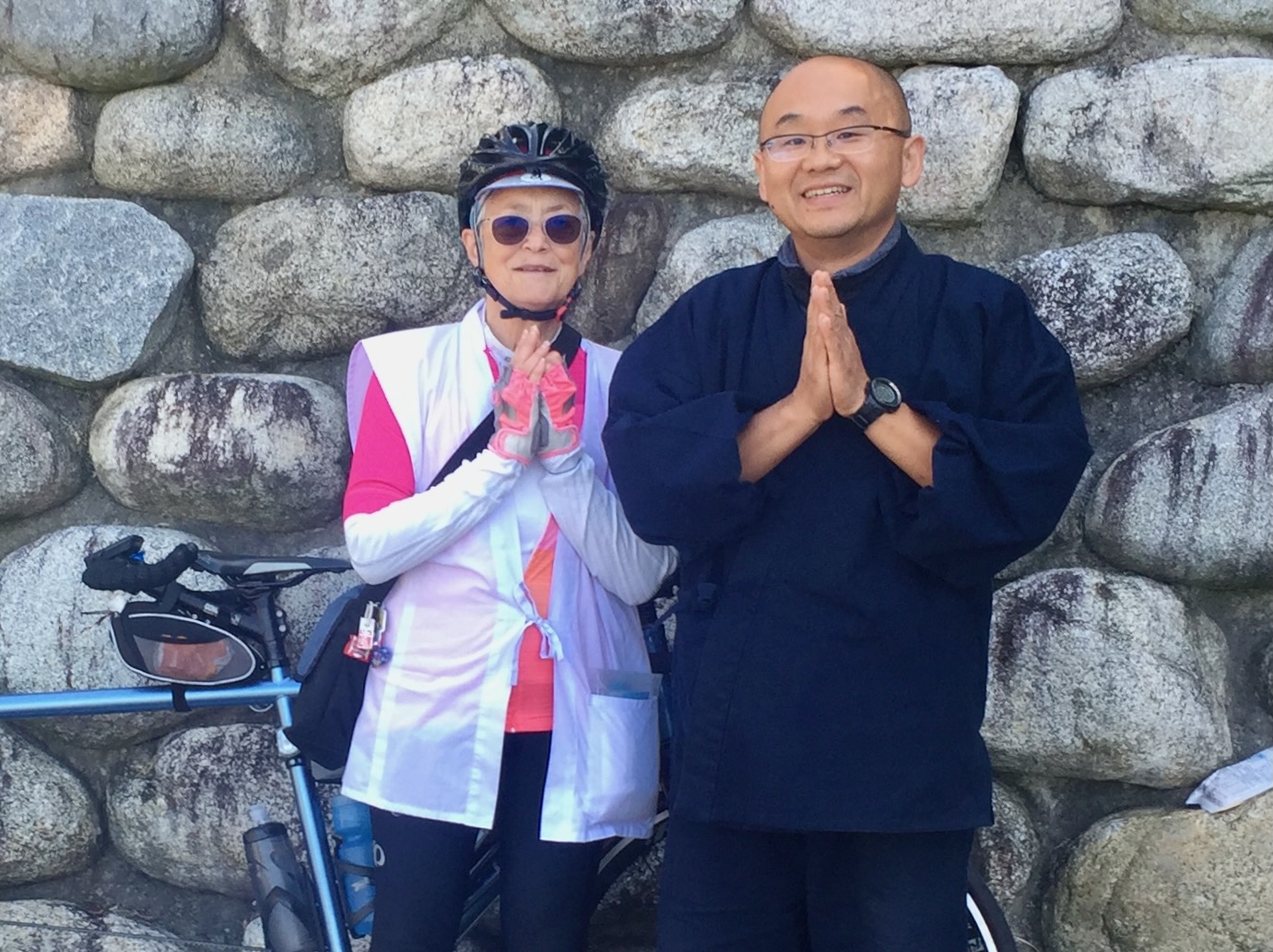
At temple 57, Eifukuji, Sharon made yet another friend. A monk buddy. As we were waiting for our calligraphy, Sharon was trying to explain our journey to a monk in the office. Pilgrimage, check. Tokoshima start, check. Bicycle, check. Tandem bicycle, no check.

Pantomime: 2 people / 1 bicycle. Still no check.

We got our calligraphies and headed down to our bike. A couple of minutes later who should come bounding down the steps but Sharon’s Monk Buddy. He had figured it out, and wanted to see for himself. He was very excited.

2 people / 1 bicycle!

We worked our way up on back roads to Temple 58 Sen’yūji, near the summit of Mt. Sareizan. On a break we met a local. We offered her our name slip. Standard procedure. She wasn’t having any, or humoring us.

“I don’t do that stuff”

Perhaps Christian, perhaps it was something else. No way of telling. She was friendly enough and that’s what counts. Fantastic views back over the Seto Sea.

We headed back up the mountain through bamboo groves. Stopped where the pilgrim trail veered off up to the left. Parked the bike and headed up on foot. Traditional approaches are always best.

Curiously this one bought us up on the backside of the temple and the basketball hoop.

As we were waiting for our calligraphy, we chatted with one of the monks. He had spent time in San Francisco in the late 1960s/ early 1970s. Both Sharon and I had been there at the same time, but our paths hadn’t crossed yet.

She was married to someone else and I was in high school.

Sharon had seen Janis Joplin at the Fillmore. I had walked in the end of the world parade for the predicted earthquake. Our monk friend was studying at the SF Art Institute.

We all laughed about life’s curious twists and turns. Chance and fate, 2 sides of the same coin.

There was a long uninspiring stretch on our way into Saijo City, and our inn for the night. Heavy traffic, broken pavement, a minimal shoulder, with kind of a strip mall thing going on. It was all a bit dodgy.

Out of the corner of my eye I caught a glimpse of a guy with a camera behind a parked car. His lens was trained on us. Odd.

About a half mile later, there was this same guy at the edge of building with an even longer lens, focussed on us. Not a coincidence.

This guy was tracking us. After a few more repeats. We stopped and asked him what was up.

His English wasn’t the best. He worked for a local paper/radio station. Very nice cameras. Clearly a pro. How he knew we coming, how long he had been following us, or what his photos would be used for, we never found out.

Perhaps we had our 15 minutes of fame in the local media. Perhaps not. Curious experience nonetheless. I would have loved to have seen his photos and heard his take on us.

Reflections in a Japanese mirror.

Day 27. November 3 Sunday; Bicycling Day 21 Saijo to Niihamao 5 Temples

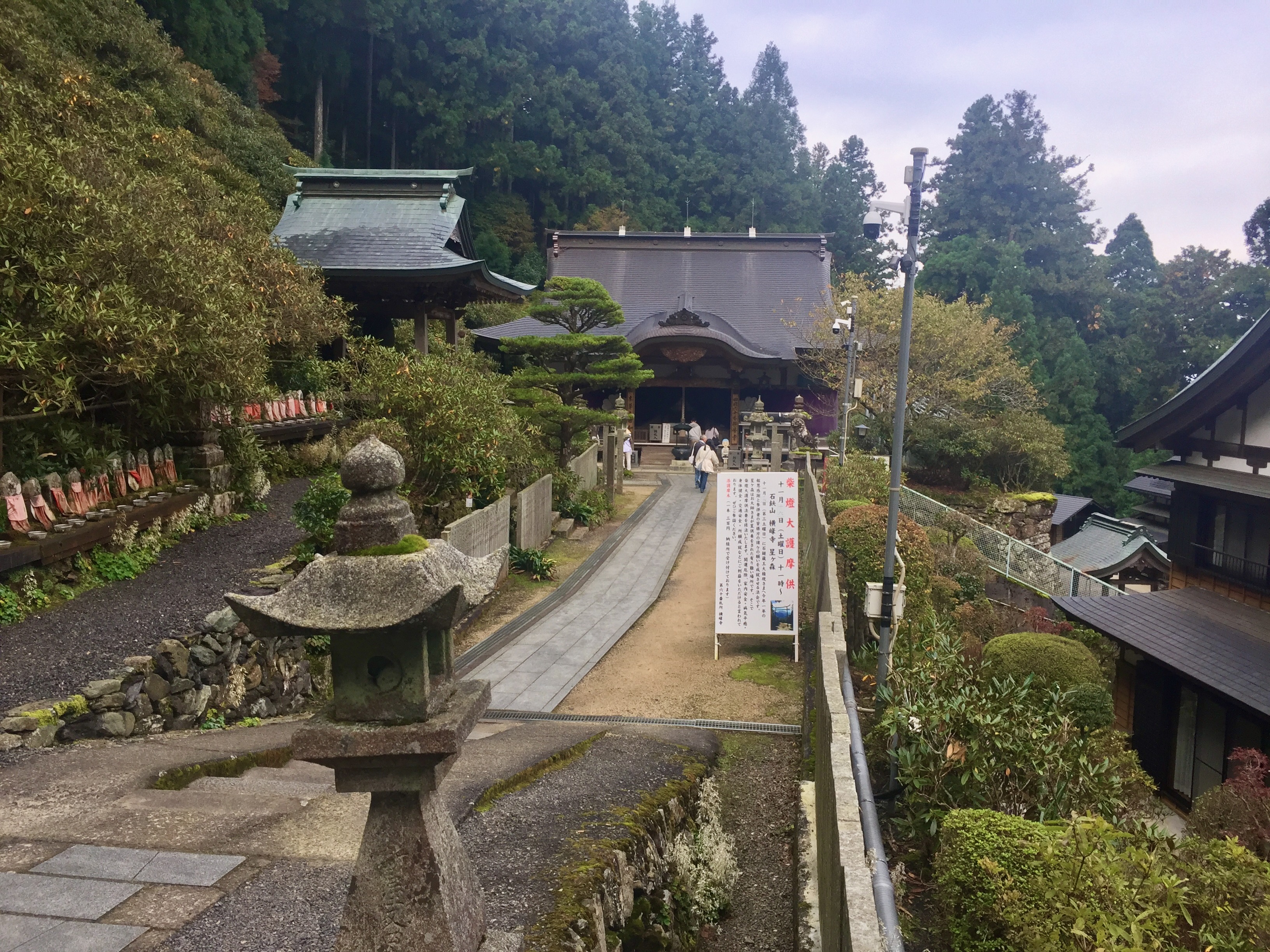
60 Yokomineji 横峰寺 Saijo, Ehime
61 Kōonji 香園寺 Saijō, Ehime
62 Hōjuji 宝寿寺 Saijō, Ehime
63 Kichijōji 吉祥寺 Saijō, Ehime
64 Maegamiji 前神寺 Saijō, Ehime

Our first temple of the day was Temple 60, Yokomineji. A big, big climb.

With an elevation of 3189 ft, it’s the 2nd highest point of the pilgrimage after T66, Unpen-ji, coming up the next day.

Unpen-ji has a tram. Yokomineji, No.

Once again, someone hadn’t planned so well. 5 temples with a monster climb. We knew the solution: Starts with a “T” and ends with an “i”: Taxi.

Up and up we drove.

We parked in the lot and headed up on foot. Our taxi driver had agreed to wait for us, as long as we didn’t linger.

On the way up, we passed this trail of Torii Gates heading down to the left.

They were talking to us, but we didn’t explore. A full day ahead and we knew the consequences of lingering. If our taxi took off, it would be a long walk down the mountain.

A Torii Gate is mostly a Shinto thing, marking the transition from the mundane to the sacred, where spirits are welcomed.

Afterwards, I checked out what we had missed: A sacred view, and a Shinto temple long gone.

The Buddhist temple itself, didn’t disappoint.

Back on the tandem our next stop was T61, Kōonji, a concrete Brutalist Temple.

Not much to say. Reminded us of Boston City Hall. Not a compliment.

We pulled into our inn for the night, Yokoya, on the early side, around 2 PM. We knocked and then knocked again. We were early and knew it. Kicked back and relaxed. And knocked again.

Eventually a bleary, middle aged Japanese woman with vaguely pink hair opened the door .

“You’re early”

“Yep, we know.”

“Hmmm, well I guess you might as well come in”

And in we went. We met a nice bleary eyed guy on his way out.

Did we interrupt an afternoon delight? Perhaps. So it goes.

Yokoya Inn was new, at least as a pilgrimage inn. As a house, it was very old. It was a traditional Japanese house with a circulation hall around the perimeter. Foundation was posts on stones.

Pretty great. We had the place to ourselves. A tip of the hat to the hardened pilgrim back at the place with the view of the cement plant, who had recommended this inn.

After we unpacked and had our hot tub soak, we all reconvened in the kitchen, and talked about the pilgrimage, as our hostess cooked up dinner.

“You both fit in the ofuro (wooden hot tub)?”

“Yep, we’re little people, and we get along.”

“Oh, I see” Laughs

She was very into the pilgrimage. She had moved here from a big city to do her part. She wasn’t too thrilled though, with her neighbors,

“A lot of folks around here, just aren’t very nice or considerate. Doing the pilgrimage you are in a bubble. Outside that bubble, isn’t always so pleasant”

Day 28. November 4 Monday; Bicycling Day 22 Niihamao to Mitoyo. 3 Temples

65 Sankakuji 三角寺 Shikokuchuo, Ehime [last temple in Ehime]
66 Unpenji 雲辺寺 Miyoshi, Tokushima]
67 Daikōji 大興寺 Mitoyo, Kagawa

This was our last day in the Prefecture of Ehime. And our last day of Enlightenment Training. What a day it was. The ride to Temple 65 was straightforward enough. A big climb, but we were kind-of used to that.

From there to Temple 66 Unpenji, we were off book. For the most part up until today, our route was on roads, followed the traditional pilgrimage route, more or less. Here we were on our own. A bit unnerving, as we had no paper map, street signs were in Japanese, and our GPS was not entirely to be trusted.

We ended up in downtown Shikokuchuo, and were soon riding along on the coast. As we turned inland we could see the paper mills, this stretch is known for.

We reached the Temple 66 ropeway, mid/late afternoon. A couple of ice cream bars and a 7 min ride later we were at the temple proper. Leaves were starting to change color. Lots to see. Sharon was excited, I was continually checking my watch, worried about time.

Back on the bike we had to push to reach Temple 67 Daikōji before the office closed at 5. We made it, but barely. Back on the main road, the sun was setting.

At which point, our GPS decided to take a nap. I pulled out my cell phone and asked for directions to our inn. It was 443 miles away in Tokyo.

We rode very slowly into the dusk. We had a direction, but no clue. Then we heard a voice. A guy was sitting on the side of the road, waiting for us. His house was our inn.

The kindness of strangers.

We unpacked and headed for the Ofuro. It was a bit worse for wear, but it was an all wood traditional tub, and the biggest of the trip. The water was hot, and we relaxed.

Back in our room upstairs we could hear an intense couples argument. We couldn’t make out the language. They clearly were at odds. She was not happy. He wasn’t giving ground. They went on and on and on. Bordering on crazed.

I figured perhaps our host was having issues with his wife.

At dinner, a Swiss couple was sitting next to us. They were pleasant, smiling and articulate. Not hikers, perhaps sampling the pilgrimage via trains and buses. Then the light went on. It was them, I had heard. Nothing gave it away, on the surface or in the conversation. But you know, when you know.

By the next morning we had figured out our host and savior was likely an unemployed widower. Perhaps late 50s/60s, he was making the best of his situation. He did the cooking, the serving, and the saving of lost pilgrims, all on his own.

That night would be our first night in the Kagawa Prefecture. We just had had our first lesson in our training for enlightenment.

We had arrived in one piece, and there we were, safe and sound. A good thing, for which I am very thankful.

There is a Confucian saying which pretty much sums matters up.

“No matter where you go, there you are.”

It’s not just Confucius. Thomas à Kempis used this line in the1400s. It can also be found in the “Imitation of Christ” and in the 1984 movie “The Adventures of Buckaroo Banzai Across the 8th Dimension.”

So is this line Deep Wisdom, a Koan puzzle, or a Surrealist joke? Or something else altogether?

The same could be asked of this remarkable assemblage which was in the inn’s entryway:

A stuffed duck perched on a carved branch, surrounded by fabric flowers. One still with its sales tag. An extra large pinecone, and a jar of potpourri. And the pièce de résistance – A wasp’s nest club.

“No matter where you go, there you are.”

Link to next Shikoku Pilgrimage post: Kagawa