2025 The Great London Scavenger Hunt

Curiously the seeds for this trip were planted in Ireland. I kind of fell for an artist’s porcelain lighthouse-ish tower. But it wasn’t meant to be. One thing led to another and I found another porcelain tower even better.

This porcelain tower had been an art installation at the Victoria and Albert Museum in London called the Tower of Babel.

The Tower of Babel @ the Victoria and Albert Museum. 2015

The tower was almost 20 feet high, and built of 3000 bone china miniatures, each depicting a real London Shop, and each for sale, as part of the concept. 

Installation View. Photo by Thierry Bal

I contacted the artist, Barnaby Barford, to see if any shops were still available. I wasn’t so sure, as the installation had been way back in 2015. But there were a few orphans left. The unloved.

We purchased 6. Bentley & Skinner Below. This miniature porcelain shop is just a tad bigger than the pic below : about 4″ x 5″. Fantastic detail. The front is flat. The flag, the awnings, window displays and shadows, are all just graphics.
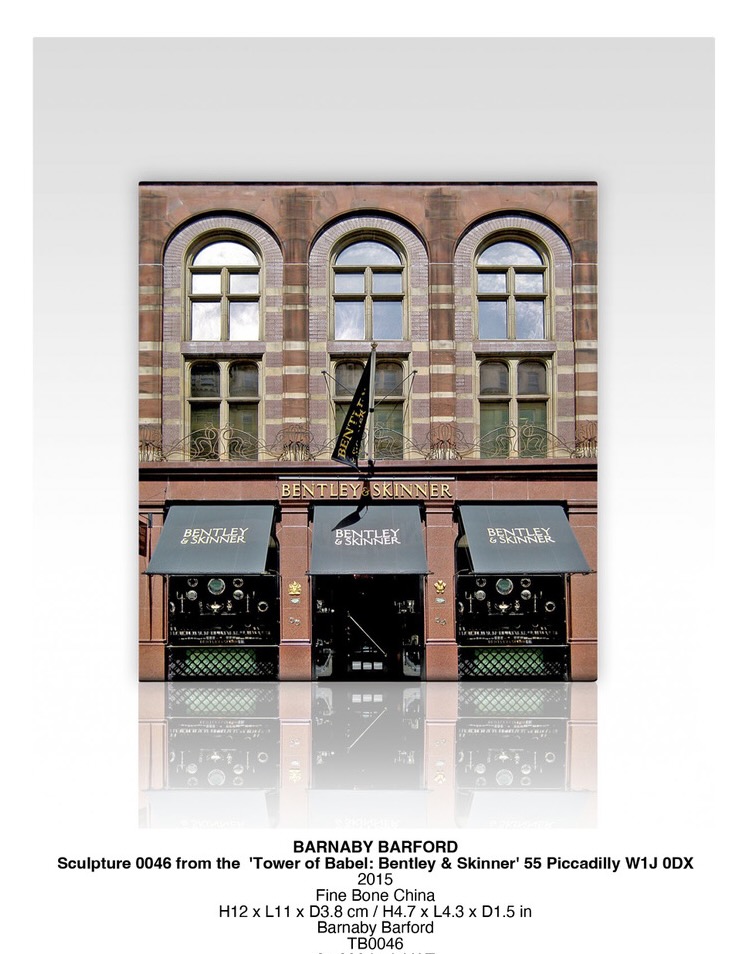
To construct the Tower, Barnaby used a foam base into which he stuck the shops using custom skewers off a lift.
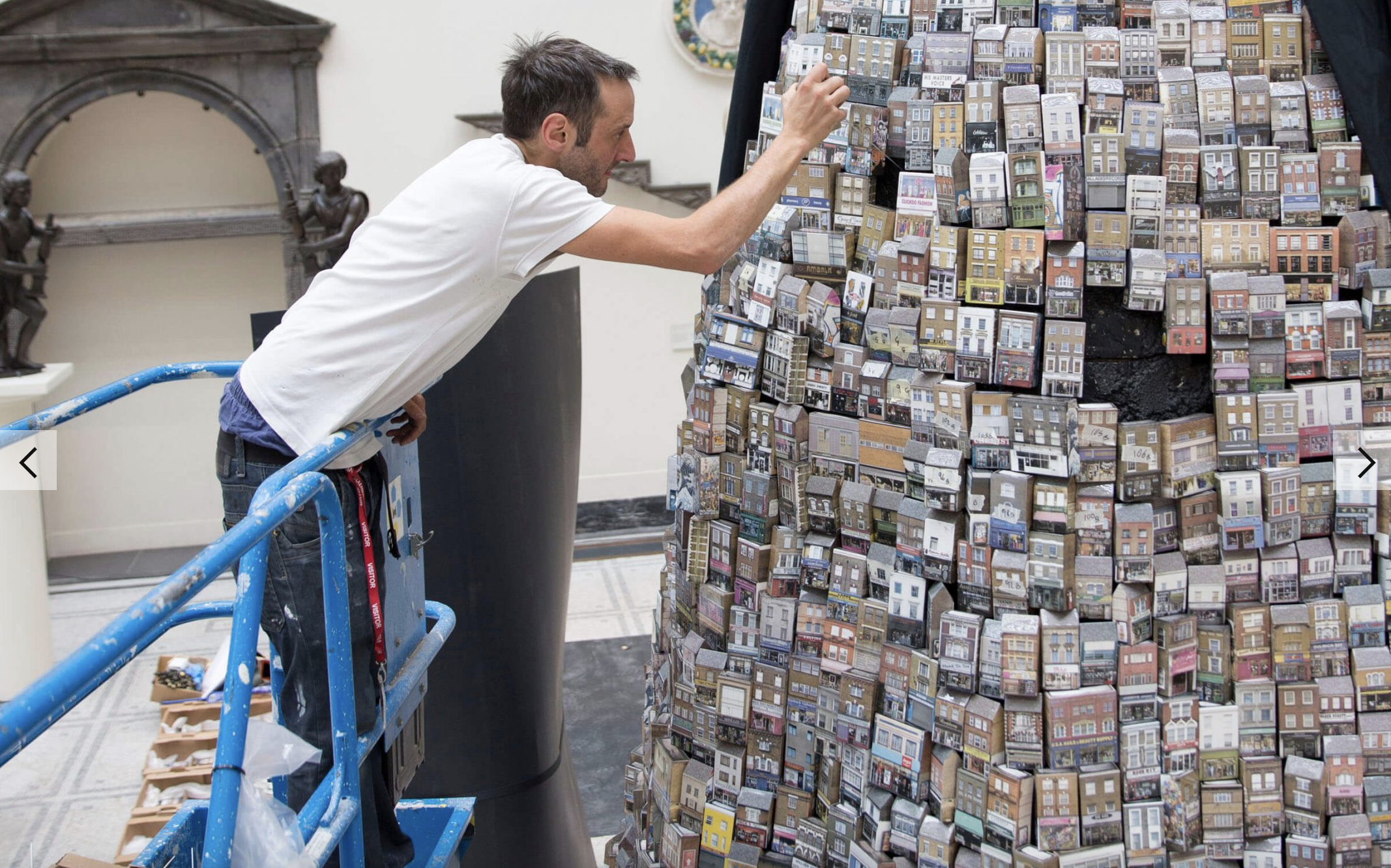
Barnaby building the Tower of Babel. 2015. Photo by Thierry Bal

Barnaby bicycled over 1000 miles, visiting every post code in London, photographing shops. The Tower’s 3000 were the ones that made the cut.

Our porcelain shops came with addresses. So we could find them, if we were to go to London.

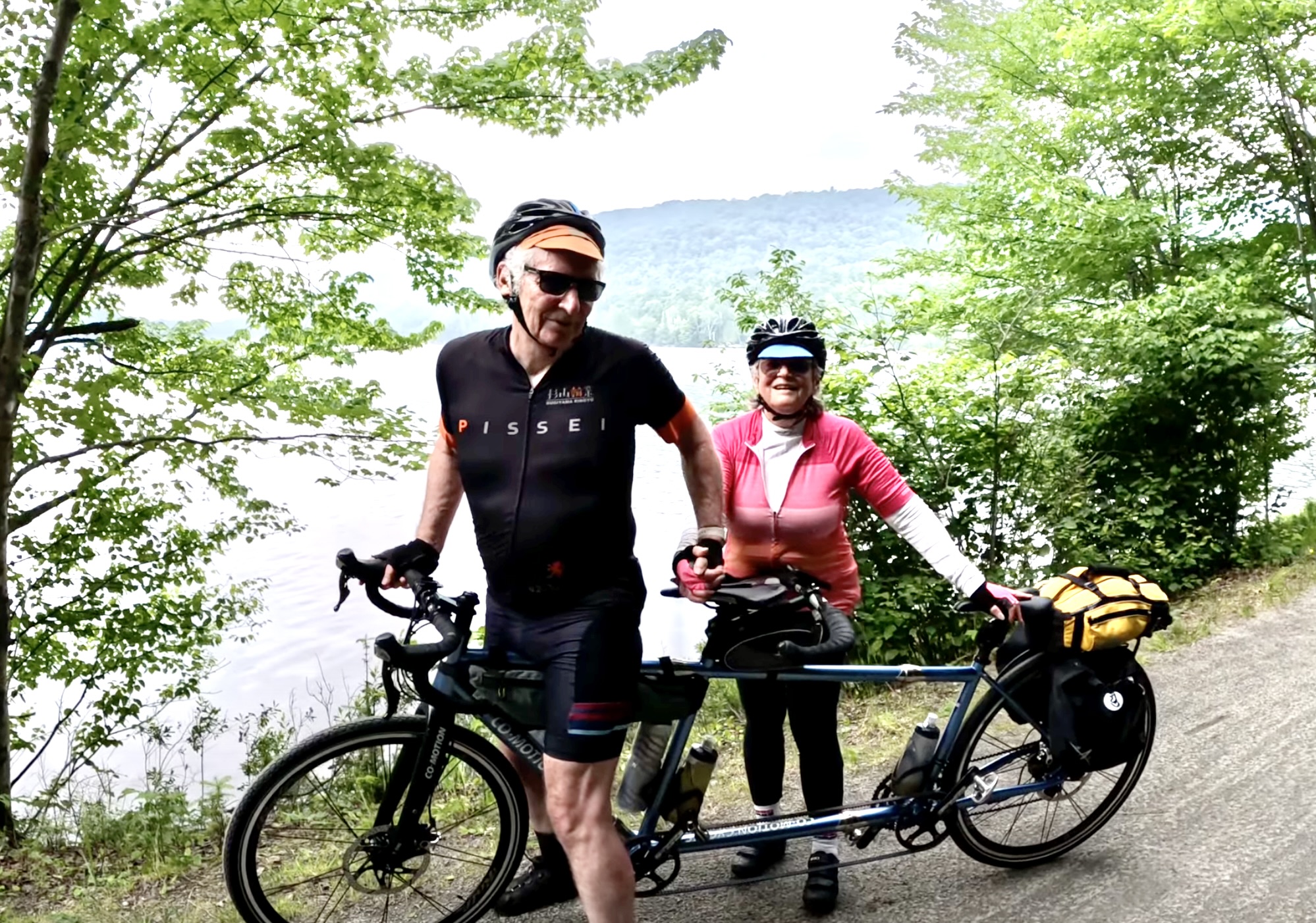
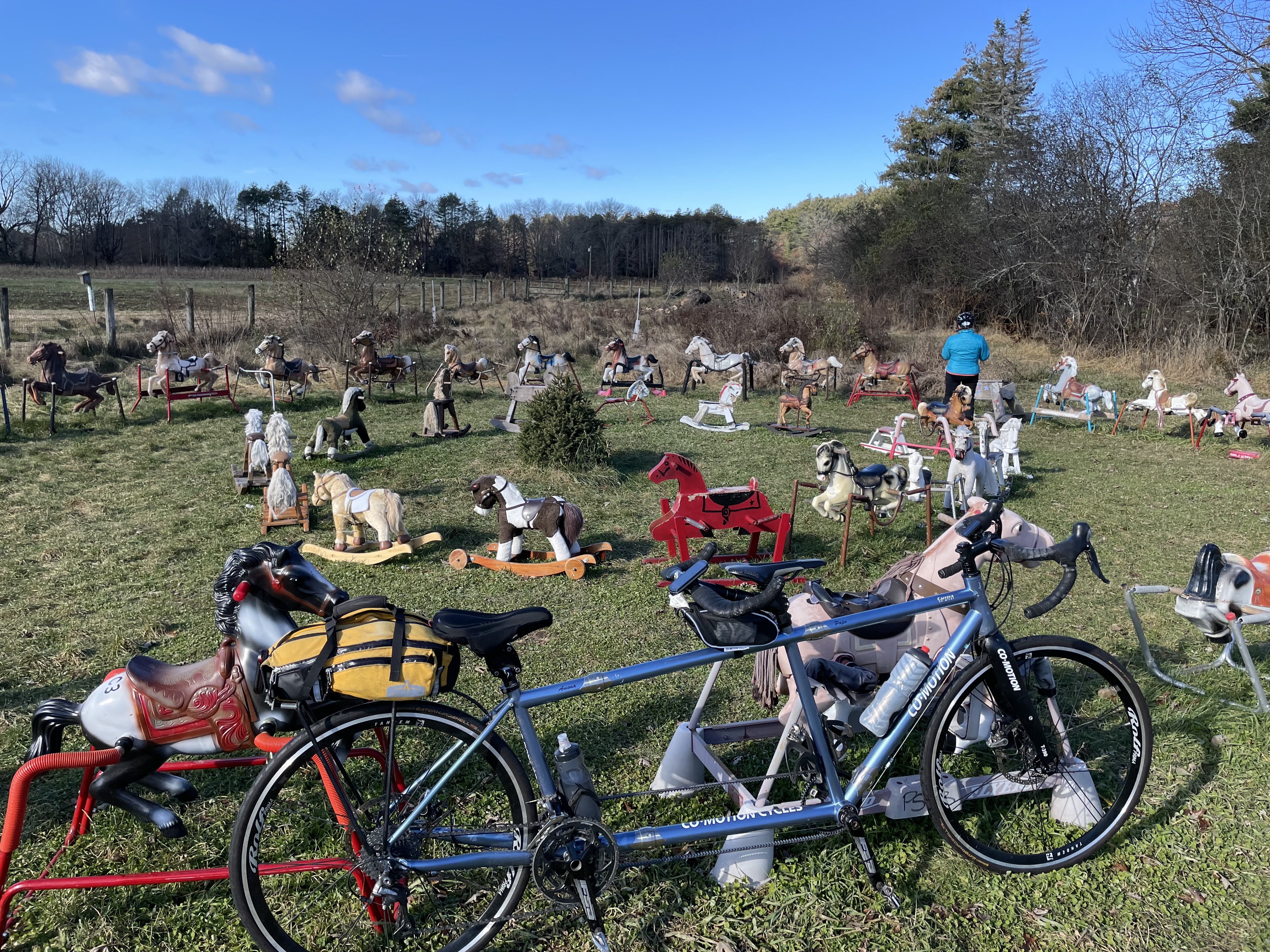
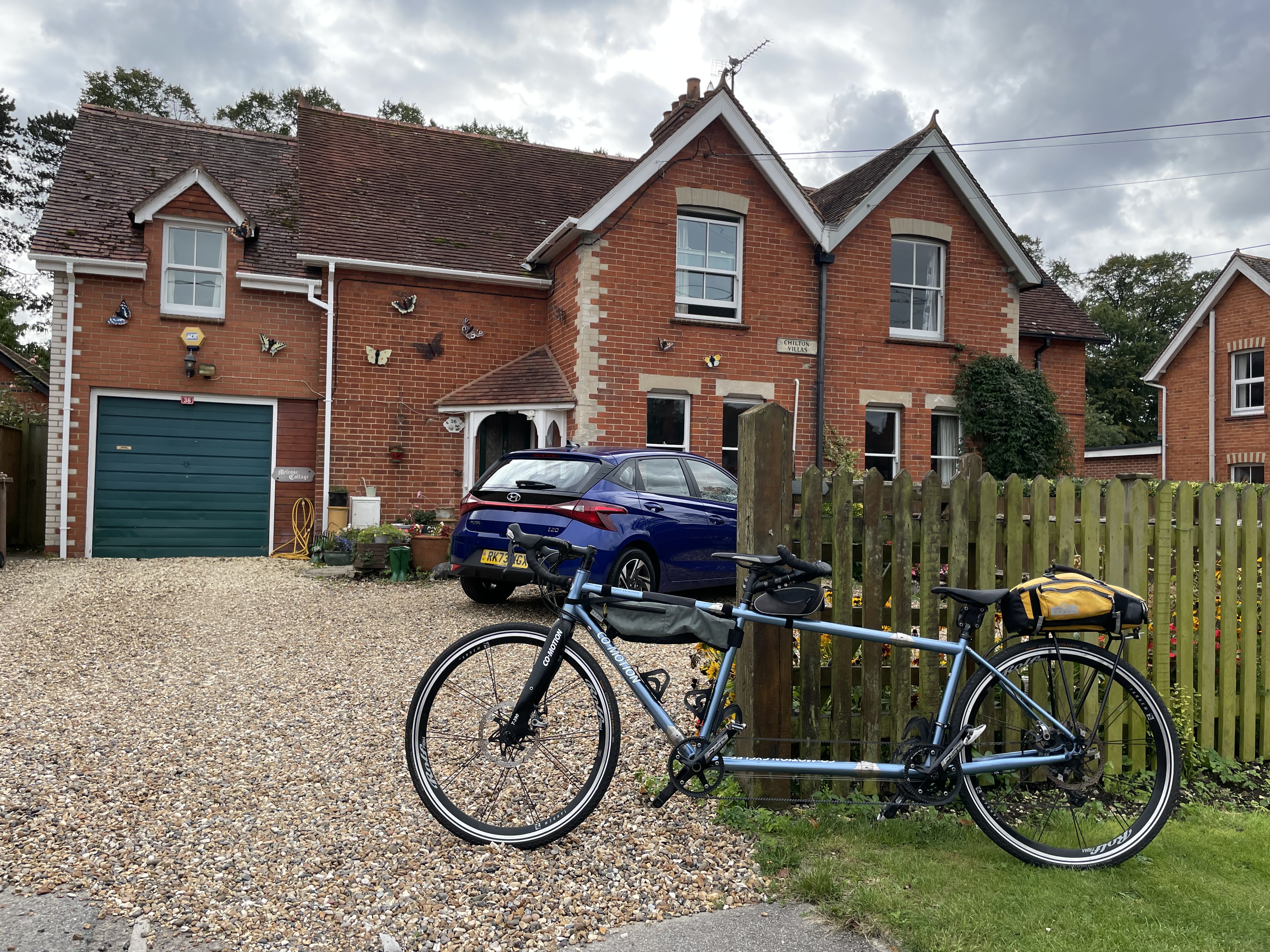
Which on further thought seemed like a great idea. We could even bicycle to them, just like Barnaby had, if we brought our tandem.

We had a plan. Closing the circle, as it were. We went for it. Our personalized great London Scavenger Hunt. 

And besides we had never been to London. Sights to see, museums to visit and so forth. The big surprise were the Rivers of London. 

The Drive into Town

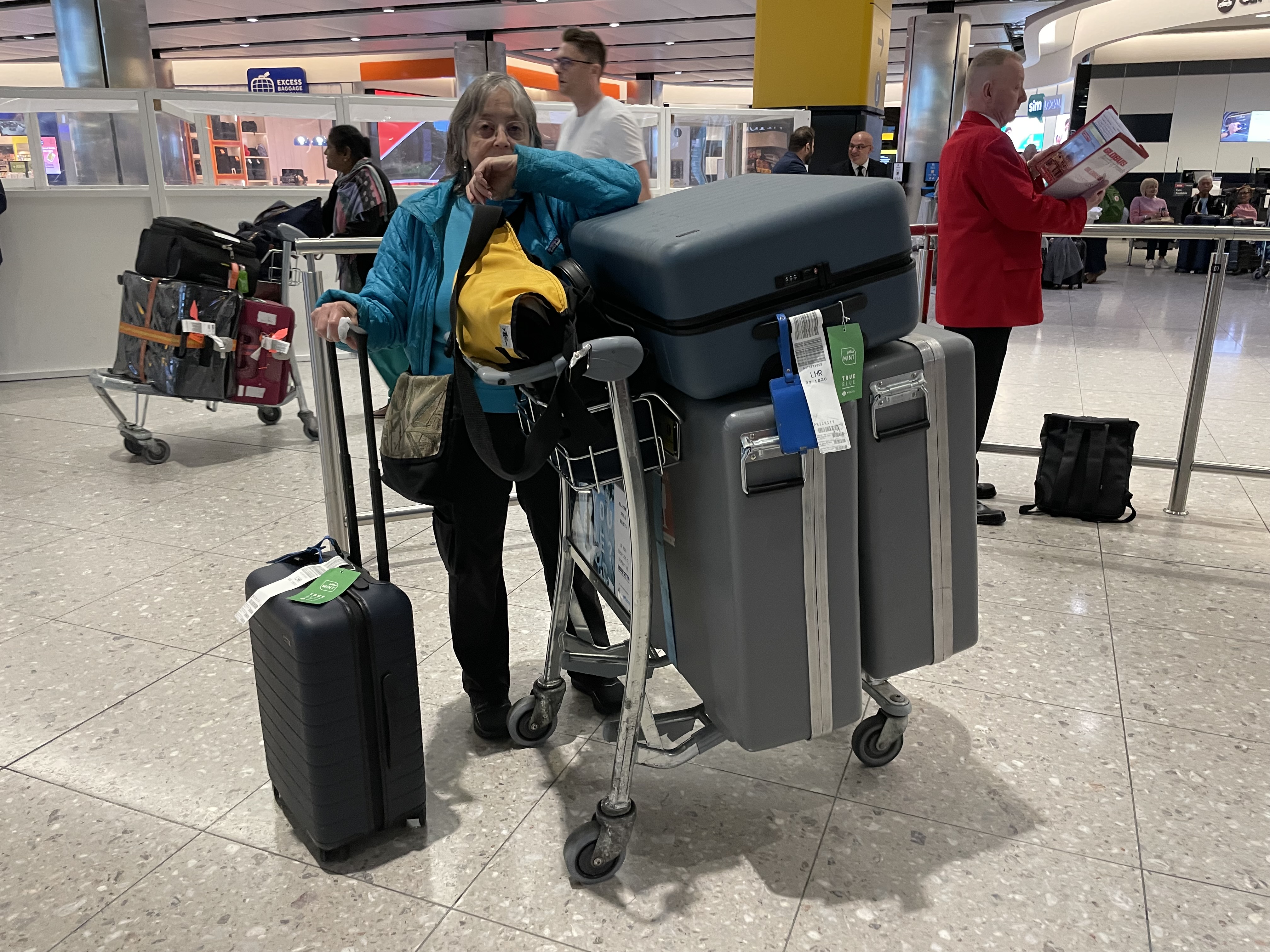
Deep, our Pakistani friend/driver picked us up at Heathrow Airport 7:30-ish AM. We had flown all night, and were bleary. Nonetheless, Deep took us into London via the slower scenic route, through the heart of the city. He thought it would be good for us. And he was right.

If you are ever in London and need private transportation or need bags moved from here to there. Deep is your guy. https://www.movemybags.com
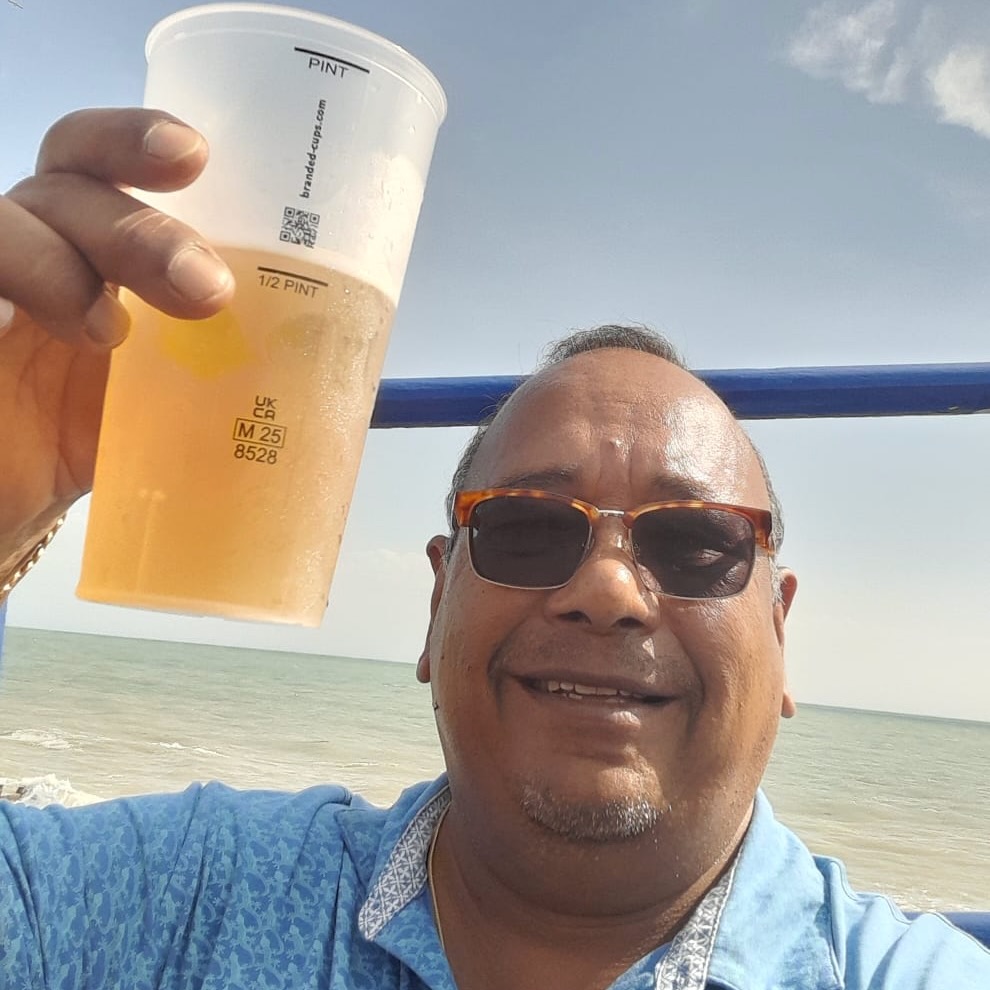
Deep

As we approached Piccadilly Circus on Brompton Road, it was slow going. The rush hour squeeze. A few brave souls on bicycles wove their way through as best they could. 

One bicycle guy in front of us was thinking about trying to slip his way through between a double decker bus and a van next to it.

Bad idea. He backed off. He might have fit, if he squinched his shoulders, but his handlebars, No. Sharon and I looked at each other. We would be bicycling through here ourselves in a few days.

Deep was giving us a running commentary. Pointing to the side streets:

“See those buildings. Modest on the outside, but another world altogether beyond the front door. Middle Eastern Big Money.” 

The adjoining Mayfair district has a number of nicknames. “Little Doha”, “The Qatari quarter” and my favorite, “Qataropolis.” The Al-Thani family, the ruling family of Qatar,and their relatives and associates owned a quarter Mayfair in 2006. No doubt more now.

We passed Harrods Department Store.

“Famous for being an iconic luxury department store offering an unparalleled shopping experience, a grand and historic Egyptian-style architecture, an extensive selection of high-end and designer goods, and its famous, albeit expensive, Food Halls. Its fame also stems from its reputation for impeccable service, being a global tourist destination, and its symbolic value as a testament to British luxury and exclusivity.”

And who owns this testament to British luxury and exclusivity today? You guessed it, The Qataris.

Moving on ever so slowly, we reached Piccadilly Circus, which as Deep proclaimed, is the center of London. 

Traffic at Piccadilly Circus. Photo by Jonathan Wilson

Why is this square considered the center of London?

Well, it’s a central crossroads where 4 roads meet and the location of a key Underground Station. It’s also in the heart of the city’s entertainment and shopping district and a popular tourist and meeting point. 

And as such was a place to acquire heroin, and was notorious in the 1960s as the center of London’s illegal drug trade. 

We inched our way through. Not a drug dealer in sight. 

In the blink of an eye we passed through Chinatown. 

Deep then swung through a number of back streets like the back of his hand and we were out front of our hotel, the Hoxton Holburn. 

We ended up here though the recommendation of our friend, now manager at the Hoxton Williamsburg, our favorite hotel in NYC, who had passed along a discount code and moral support.

It was a great location for our purposes. A ten minute walk to Covent Gardens and great Indian food. Only a few blocks to the British Museum and a couple of blocks to the John Soane Museum.

We could walk to the Thames River, although it was a bit of a hike, And we could bicycle   north to the Regents Canal and the River Lee. 

And besides, it looked like our kind of place. An ex-telephone exchange building repurposed as a hotel with big friendly, street level public spaces.
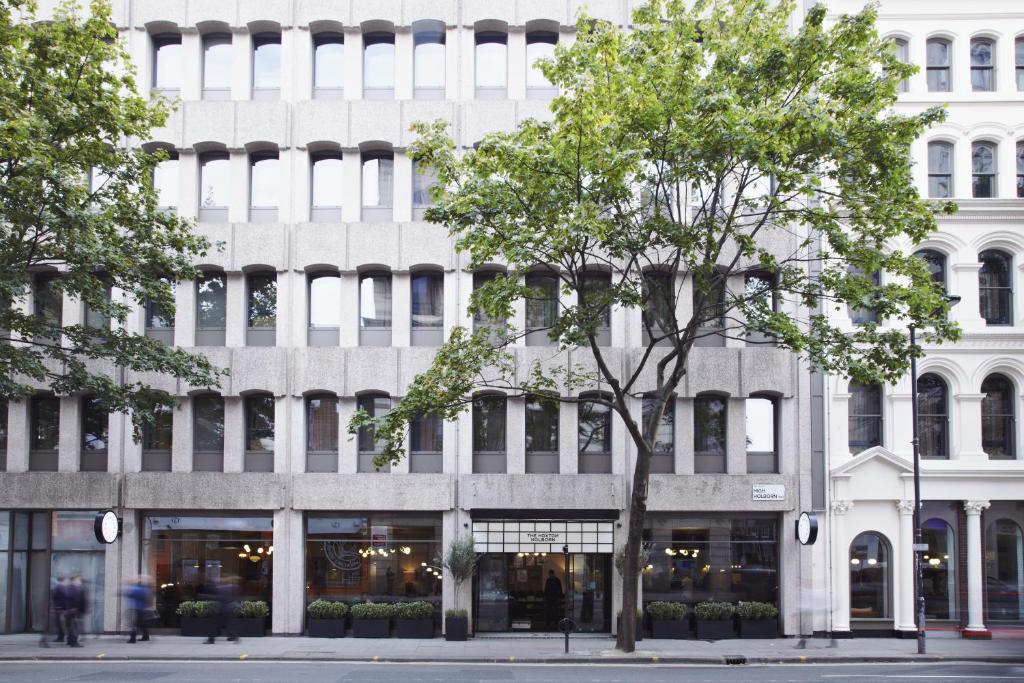
Hoxton Holburn Hotel

Deep dropped us off and took off, and we wandered in. The front desk was most friendly, but their computer didn’t show us checking in until the afternoon. Someone had missed something. I got to talking and the manager wandered over, checked her computer and sent us on up to the back side of the 5th floor. 

Where we were very happy, for the next 10 days. It was incredibly quiet and where we had perhaps the best view in the hotel. Out across the rooftops of London to the London Eye in the distance.
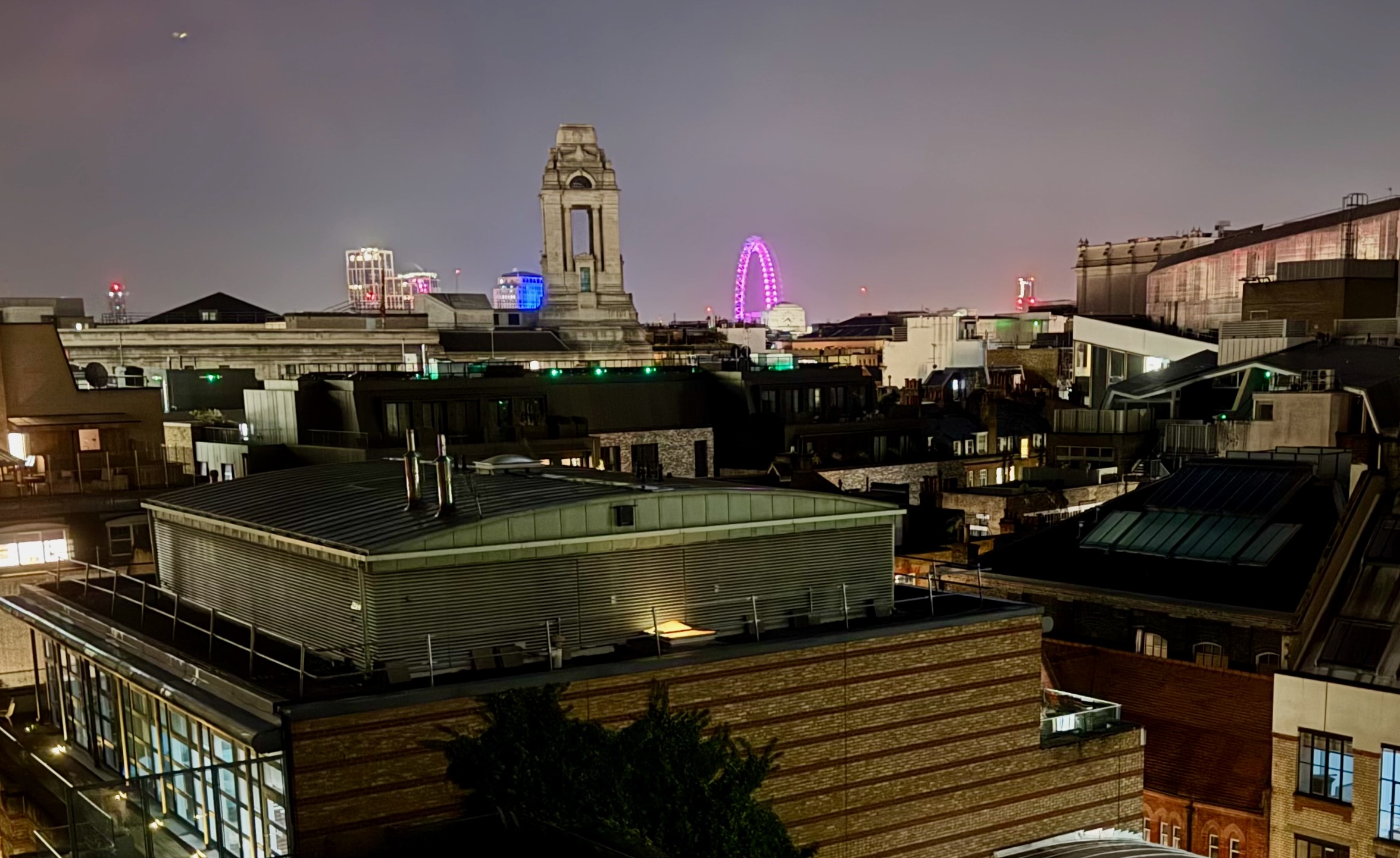
Our room’s view across the rooftops of London to the London Eye in the distance.

The British Museum and Shakespeare

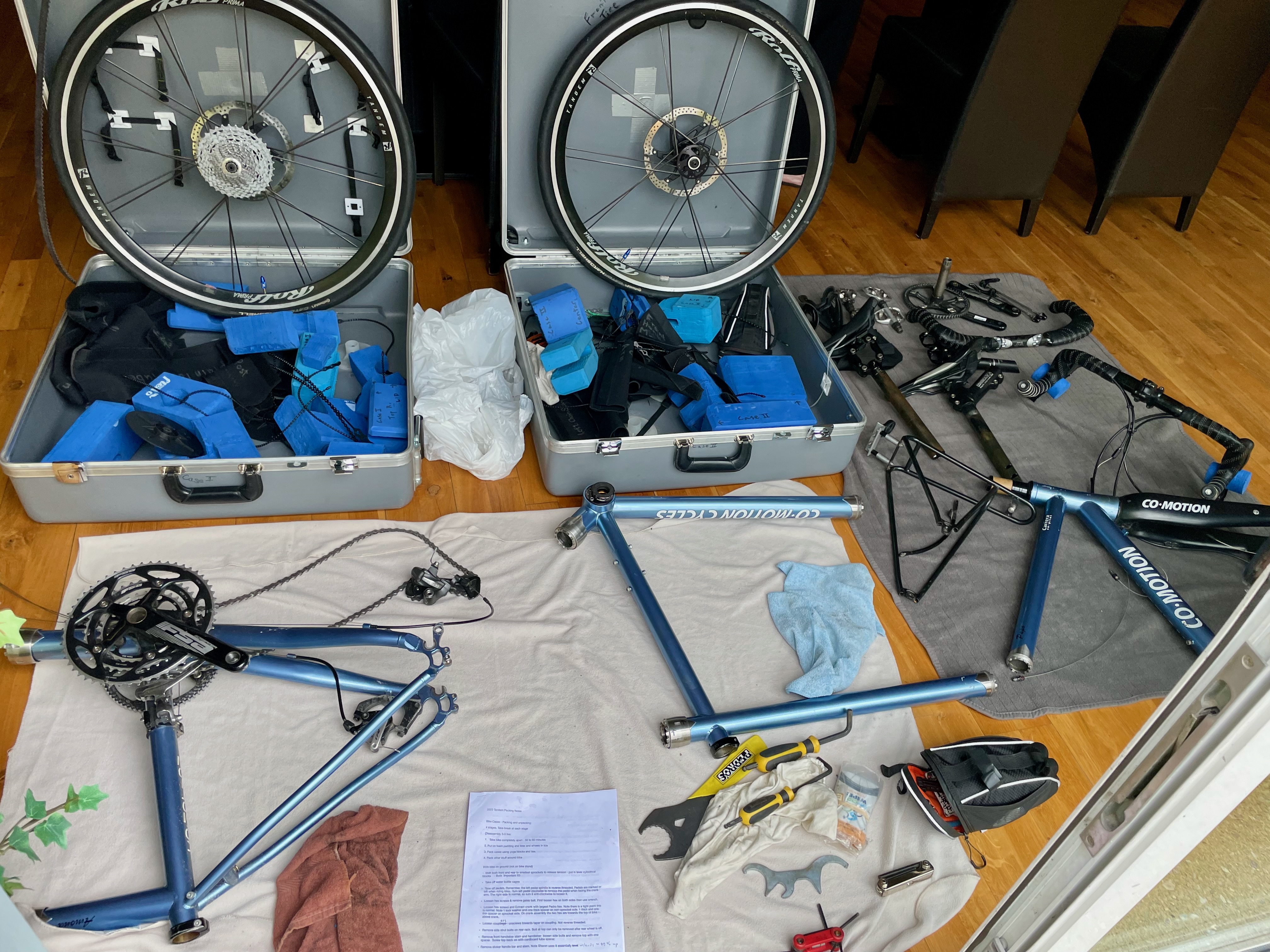
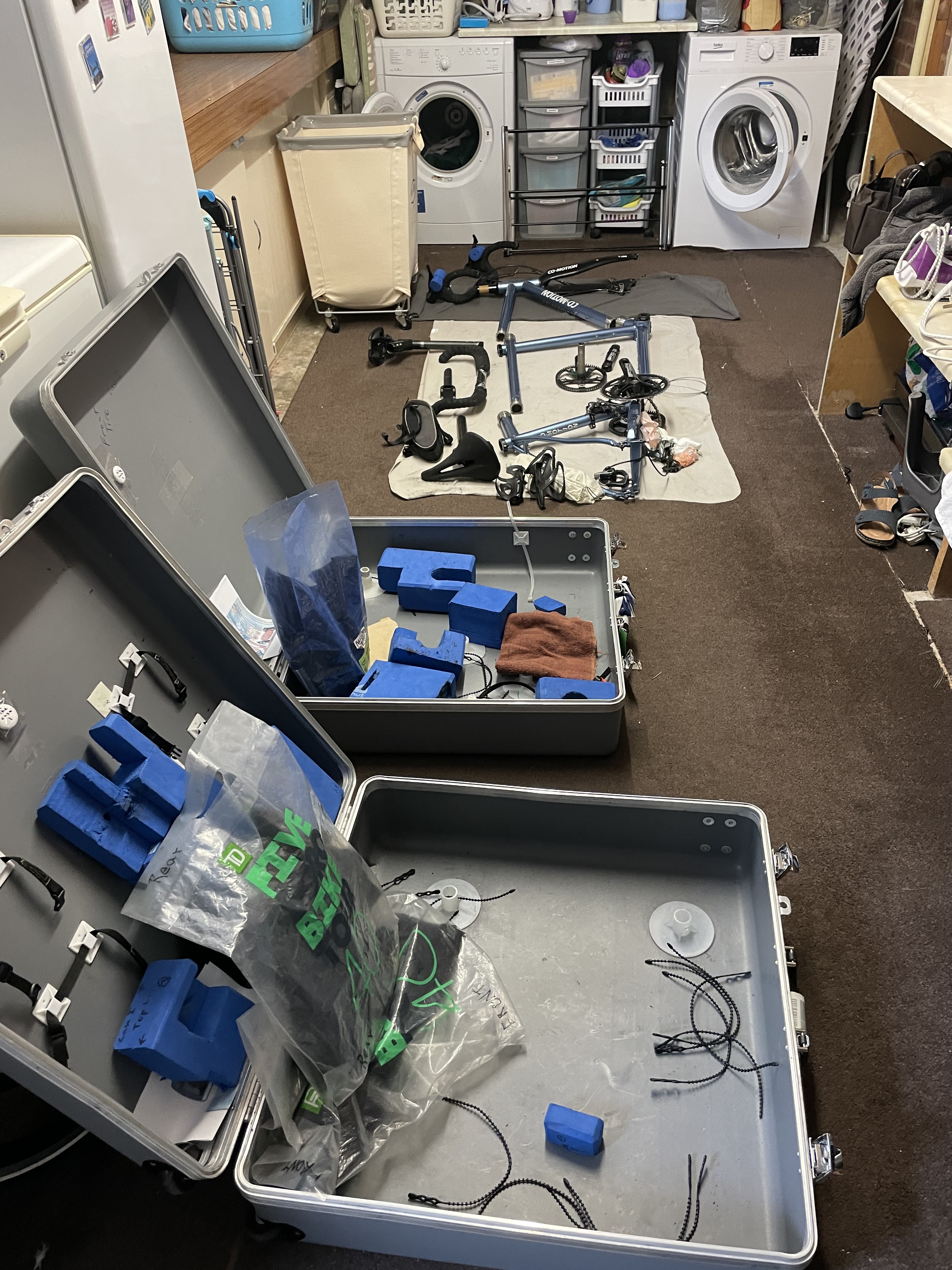
It rained and then rained some more. Which wasn’t a problem as the British Museum was only a couple of blocks away and I had a bike to assemble.

We had a plan. We both headed off to to the British Museum.

The British Museum is big. Like big, big. Half again as big as the Met in NYC. And it is beautiful and it is free. Though it is advised to schedule admittance online, which we had done a couple of months before. 

We saw the Hoa Hakananai’a, a colossal ancestor figure from Papa Nui/ Easter Island, and a whole lot more.
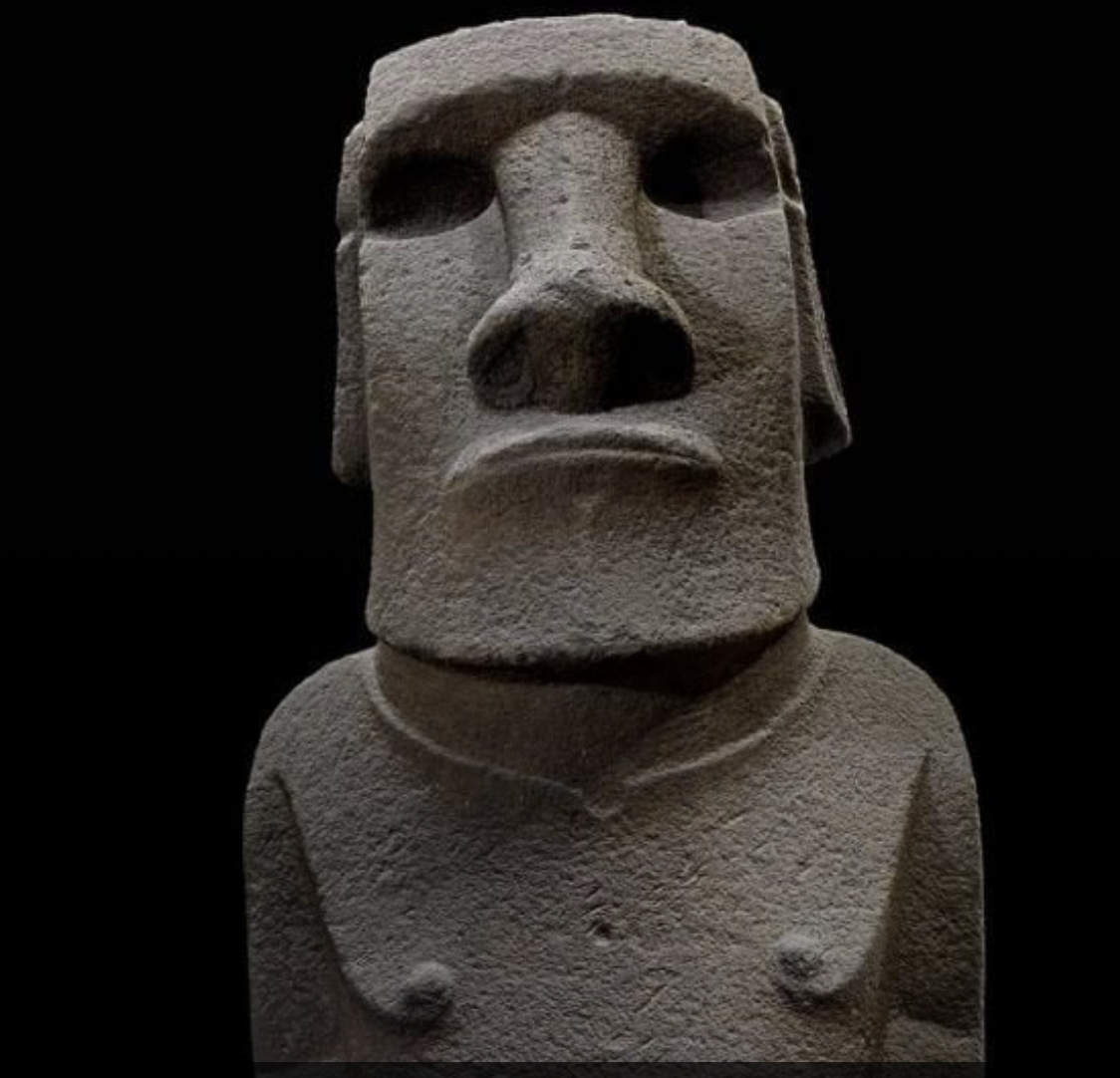
Hoa Hakananai’a

After an hour I headed back to assemble the bike. And Sharon took her time and museumed-to her heart’s content.

She brought me back a BLT, dropped into a book and in short order the bike was fully reconstituted. 

We kept Mr. Bike in our room for the whole trip, as no one seemed to care. We could have locked it up off the loading dock. We had management’s permission. But all up, it was easier and more comforting to have it in our room. 
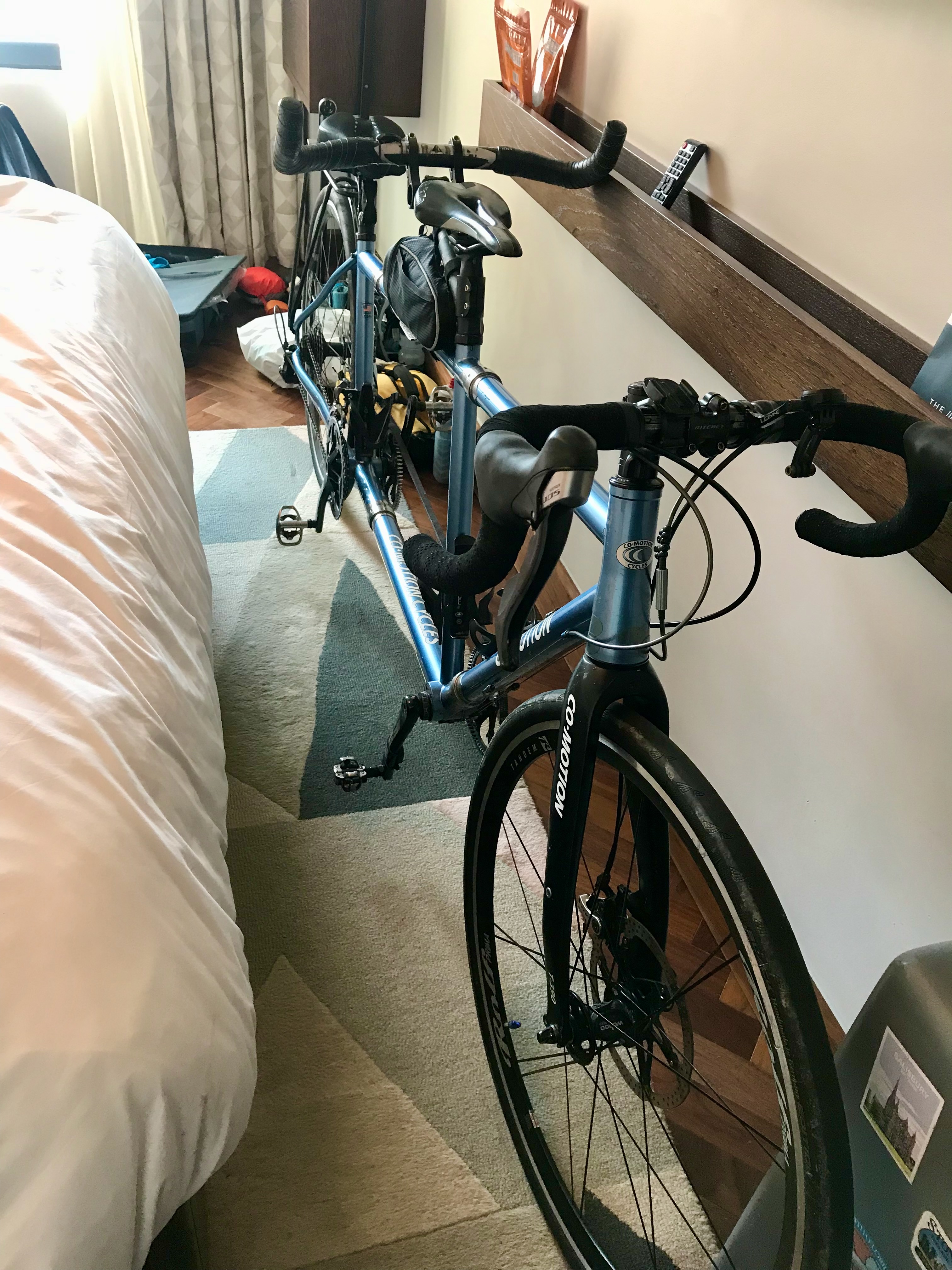
A tight room for a tandem. No problem. We’re all friends

It wasn’t that hard for me to get by on the way to the bathroom. Mantra was butt to the bed. That way I could lean back and neither handlebars or pedals would catch.

The next day we had scheduled our visit to Shakespeare Globe Theatre and the Tate Modern Museum. Sharon wanted to ride in a London Black cab and this was as good a time as any.

The front desk called in our request. 5 minutes. 

15 minutes came and went. I went back in. The front desk laughed,

“Someone else must have grabbed it. There’s another one out front. Why don’t you take that one?”

And we did. Whoever it was for, well they can take someone else’s.

First up was the Tate Modern Art Museum. Remarkable place. A converted Power plant. Very well done. Turns out in the right hands, a sympathetic aesthetic. Monumental spaces with industrial materials and a totally wonderful site on the Thames. 

We had lunch on the top floor of the Tate with quite the view over London. St. Paul’s Cathedral and the Millennium Bridge across the Thames River.
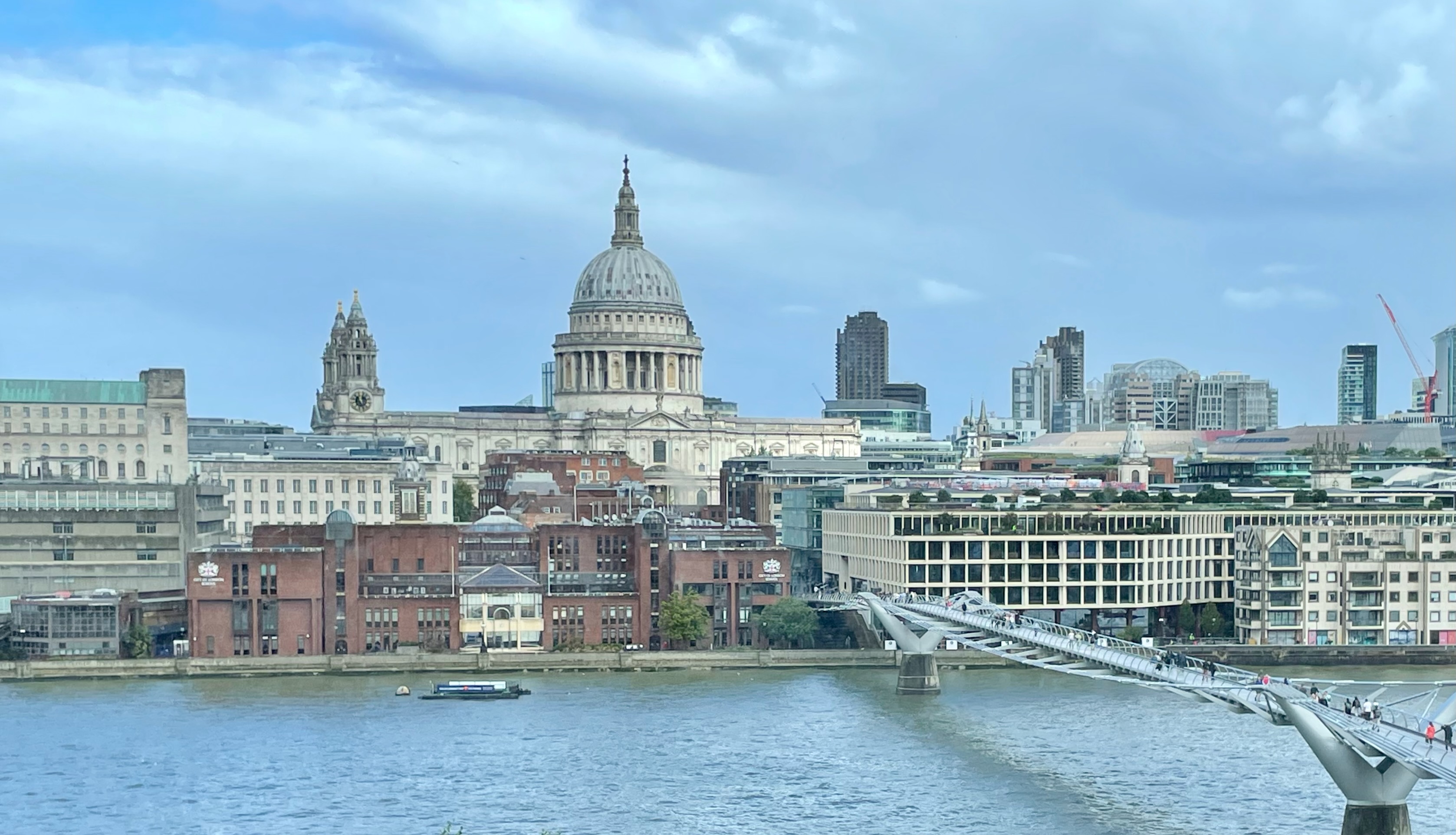
St. Paul’s Cathedral, and the Millennium Bridge across the Thames River from the Tate Museum

Pretty much right next door to the Tate is today’s Shakespeare Globe Theatre. We wandered over for our show. 

This Theatre is the third generation. 4th if you include The Theatre, which was the first successful permanent theatre built exclusively for the showing of theatrical productions in England.

The Theatre was built in 1576 and stood in Shoreditch not too far from our hotel, in what was then, as today, an entertainment district. In 2025 it’s pubs, bars and nightclubs. In the late 1500s it was bear-baiting, taverns and Shakespeare. 

Shakespeare wasn’t considered highfaluntin then. Perhaps the opposite. The highbrow were welcome and had special seating, but they kind-of had to make their way to the theatre on the sly. Shakespearian theatre wasn’t socially-accepted entertainment for the upper crust. More guilty pleasures.

When the Shoreditch lease was up in 1599, the owners of the land on which the theatre stood refused to renew the player’s lease, thinking they would end up with the theatre, and its very valuable oak timbers. 

Wrong. While the landowners were out of town celebrating Christmas, the players and their cohorts took the Theatre apart and moved it close to this site on the Thames.

The Theatre was reconstructed the following year and renamed the Globe. First show: Shakespeare’s Julius Caesar. Not a bad way to get up and running. 

This Globe Theatre burned down in 1613, but was rebuilt the next year on the same foundation with same name. This Globe Theatre had a good run, until it was closed by the Puritans in 1642. Two years later it was demolished to make way for housing.

The current Globe Theatre opened in 1997. A faithful reconstruction of the original. Open air, intimate, with remarkable acoustics. We had seats where the upper crust would have been seated, complete with rented , most-welcome cushions. That would be on the first gallery up.

The current Globe Theatre which opened in 1997. A faithful reconstruction of the 1642 original. Image John Tramper

Our show was Twelfth Night. A gender bender to start with. No problem there. Shakespeare knew folks. Our problem was with the current troupe’s improvements, which in this case meant more gender-bending on top of Shakespeare’s. Made it a bit hard to follow. At least for me. 

Why try to re-invent a brilliant original? Maybe I’m just getting old. Then again, maybe I need to re-read Shakespeare.
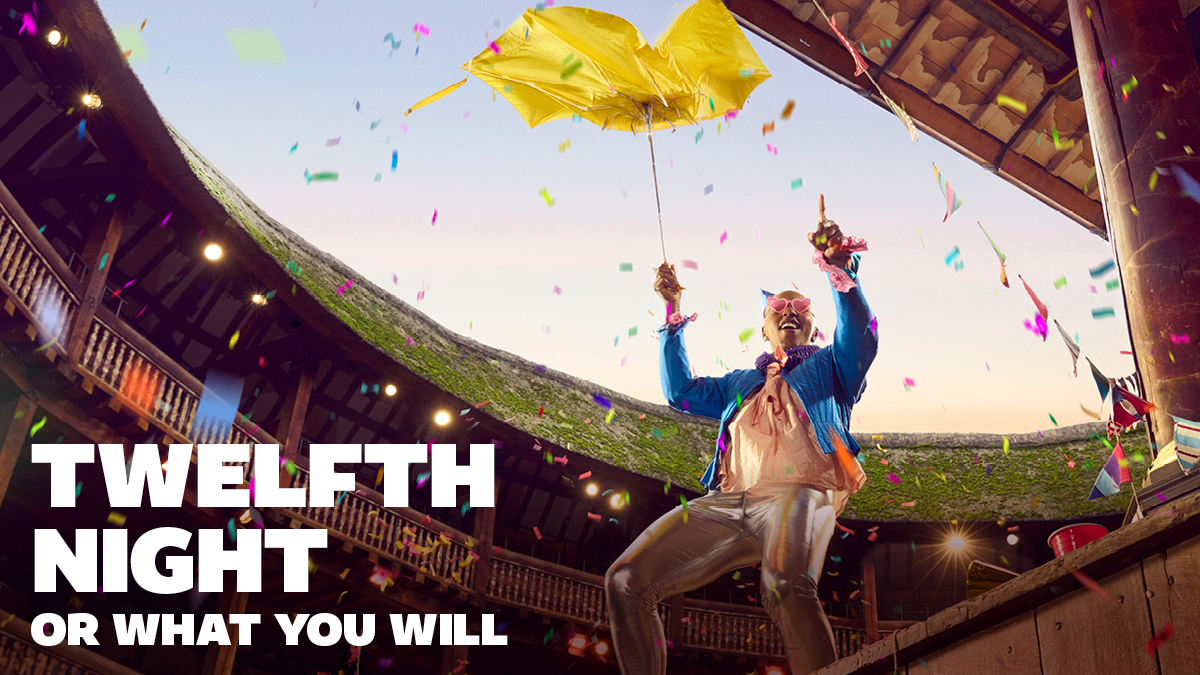
Most fun, in any case.

After the show we wandered out after returning our cushions. And made our way across the Millennium Foot bridge, by St. Pauls Cathedral and back to our hotel. 

Rivers of London and a visit to Barnaby’s Studio

We had an invite to Barnaby Barford’s art studio. And in the spirit of the trip, we were going to bicycle there. And back.

This first London bicycle ride looked straightforward enough on paper. We’d cut up to the Regent’s Canal and then ride east, take a sharp left and head north on the river Lee. First we had to get to the canal.

But before that we had to get out of the hotel and on the road.

What could go wrong? 

We were on the 5th floor, and pretty sure that our-now-assembled tandem would fit in the elevator, if we took the front wheel off and stood it up. Which it did with perhaps a 1/2” to spare. The front desk was amused when we rolled out on the first floor. Perhaps a first in their world. 

We rolled Mr. Tandem through the extended lobby, full of folks. Remarkably nary a sideways glance.

Outside we loaded the bike up. I went to bring up our route on our bike computer, but the route wasn’t there. I headed back up to our room for a re-install, while Sharon stayed with the bike out front. Internet in our room was dodgy, so I wandered out into the hall for a better connection. I hit gold near the elevators and we had our route.

Back at the bike, I decided to top up our tire pressures. Probably not necessary, but why not?  On removing the pump hose, the rear wheel valve stem came out too. Pressure promptly dropped to zero. 

After re-installing the valve stem and after 3 minutes of high-cardio hand pumping tire pressure held. Thankfully. 

We headed off walking the bike. Lots of traffic and best to be careful. After all, traffic is backwards, and we had two roads to cross. We found a safe launch spot. Got on the bike and waited for an opening in traffic. 

Something was wrong. I looked down. I had Sharon’s pedals, and she had mine. Neither of us were happy, but it would work, we could swap later.

3-2-1 and we were off. 

We had waited for rush hour to clear. Traffic wasn’t Piccadilly Circus bad, and lanes were full, but we soon discovered the saving grace. The left lane was reserved for Buses, Black Cabs and us (bicycles). We ride fast enough to keep up with traffic.

After a bit we turned hard left and headed north for the Regent’s Canal.

Or more accurately the tow paths along the Regent’s Canal. The Regent’s Canal was built in the early 1800s. At that time, horses towed boats on paths alongside the canal. Today these paths have been paved and are used by walkers and bicyclists. They are most scenic and much in demand, as we were soon to find out. 

A tight right turn later we were on the Canal. I hadn’t really thought about what to expect. I had been focused on simply getting to Barnaby’s Studio. He had recommended this route.

The first thing that hit us were the narrow boats tied up along the path. A bustling world unto itself. The tow path was manageable as long as we ducked under the low bridges, were careful to give all the folks with headphones space and watched the water’s edge.
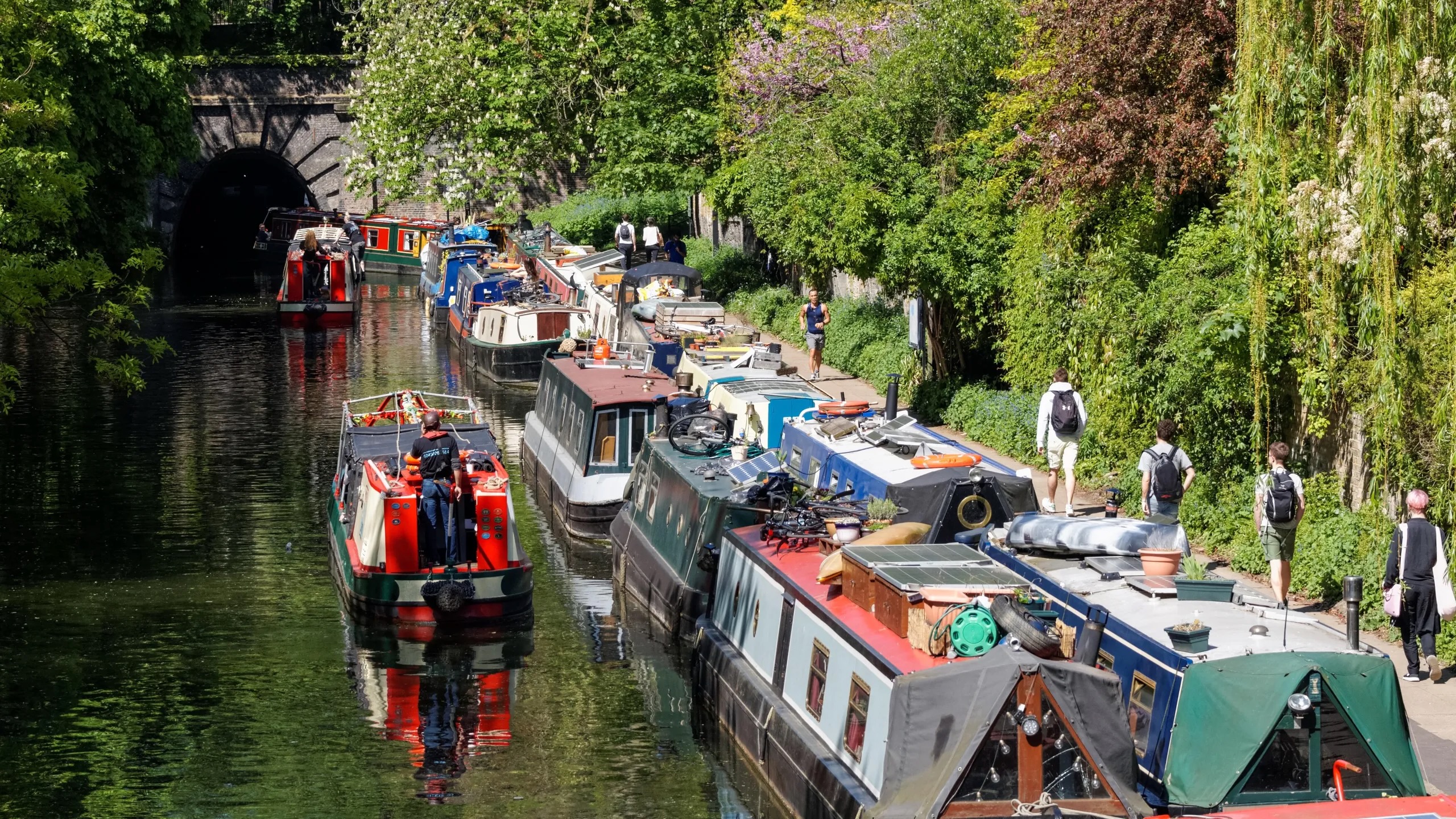
Regent’s Canal. Photo courtesy of the London Museum

No guard rails. We were often riding 16” from the drop-off into the water.

We came up on a guy engrossed in his music. As this was the UK we passed on his right. 

“On your right,” I called out. He jumped right. We hit shoulders. Our mass was greater that his and he bounced off.

Perhaps the diciest moment was when the path dropped hard right under a bridge. There was a tight hard left at the bottom. I hit the brakes as Sharon emphatically suggested we stop. Which we did. On the slope. And a good thing too as we were pointed into a lock filling with churning water. And no guard rails. Sharon:

“My handlebar is scraping the wall. Can I get off now?”

Not surprisingly, given how things were going, we missed our turn north on the River Lee. Our bike computer had given up and we were making do with my phone.

We eventually tried it the old fashioned way, we asked a local. He was sitting on his woebegone narrow boat. The saddest on the stretch. He was missing a tooth or three.

He shared that after he had moved here, he had missed the turn himself a few times. He gave us excellent directions and sent us off with a wave. Good guy. Wish him well.

The last 1/4 mile to Barnaby’s was more of the same. We were navigating by phone, now on low battery. We knew we were close, but my phone didn’t know we could have just slipped between guardrails and virtually been there. 20 minutes later we arrived at Barnaby’s studio. Unit C-1 in Hastingwood Trading Estate, an industrial park.
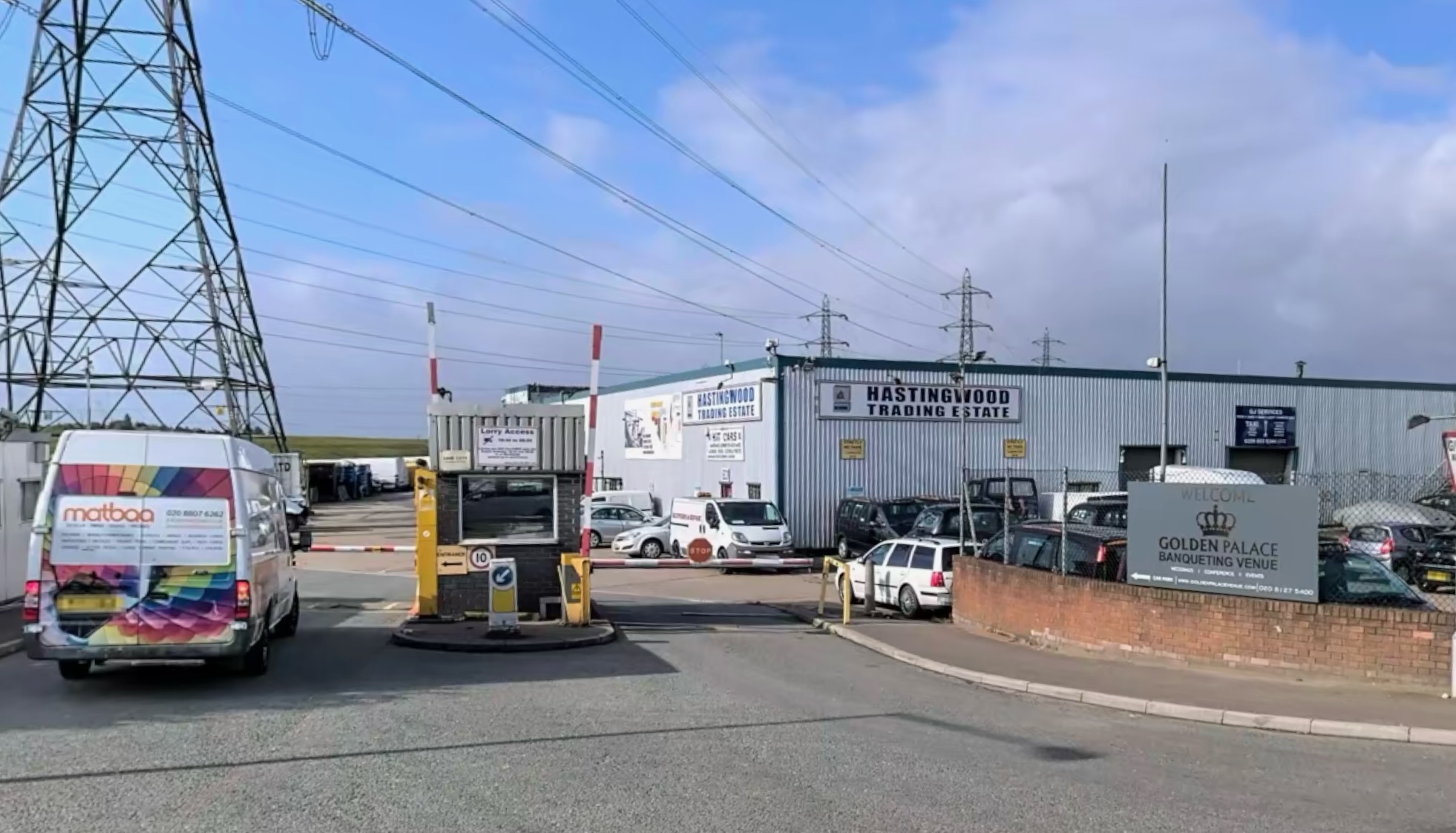
Hastingwood Trading Estate

Nothing fancy on the outside. But great stuff inside. 

From our pieces and the Victoria and Albert Museum’s Tower of Babel, we knew Barnaby had a love of porcelain. Here we could appreciate, what happens behind the curtain. 

Give Barnaby credit, he is a laid back guy. As we stumbled in, I nearly smashed into the centerpiece of an upcoming show with my bike helmet. 

A wonderful 2 + foot diameter hanging globe built up lovingly of innumerable porcelain shards and figurines with a dash of this and that.

Barnaby quietly suggested that I should be careful. 

Later as I was shooting a video of his studio centered on the globe, Barnaby noted,

“I don’t mind that you take pics, just don’t share them.” Of course, a big upcoming show, no premature unveilings.
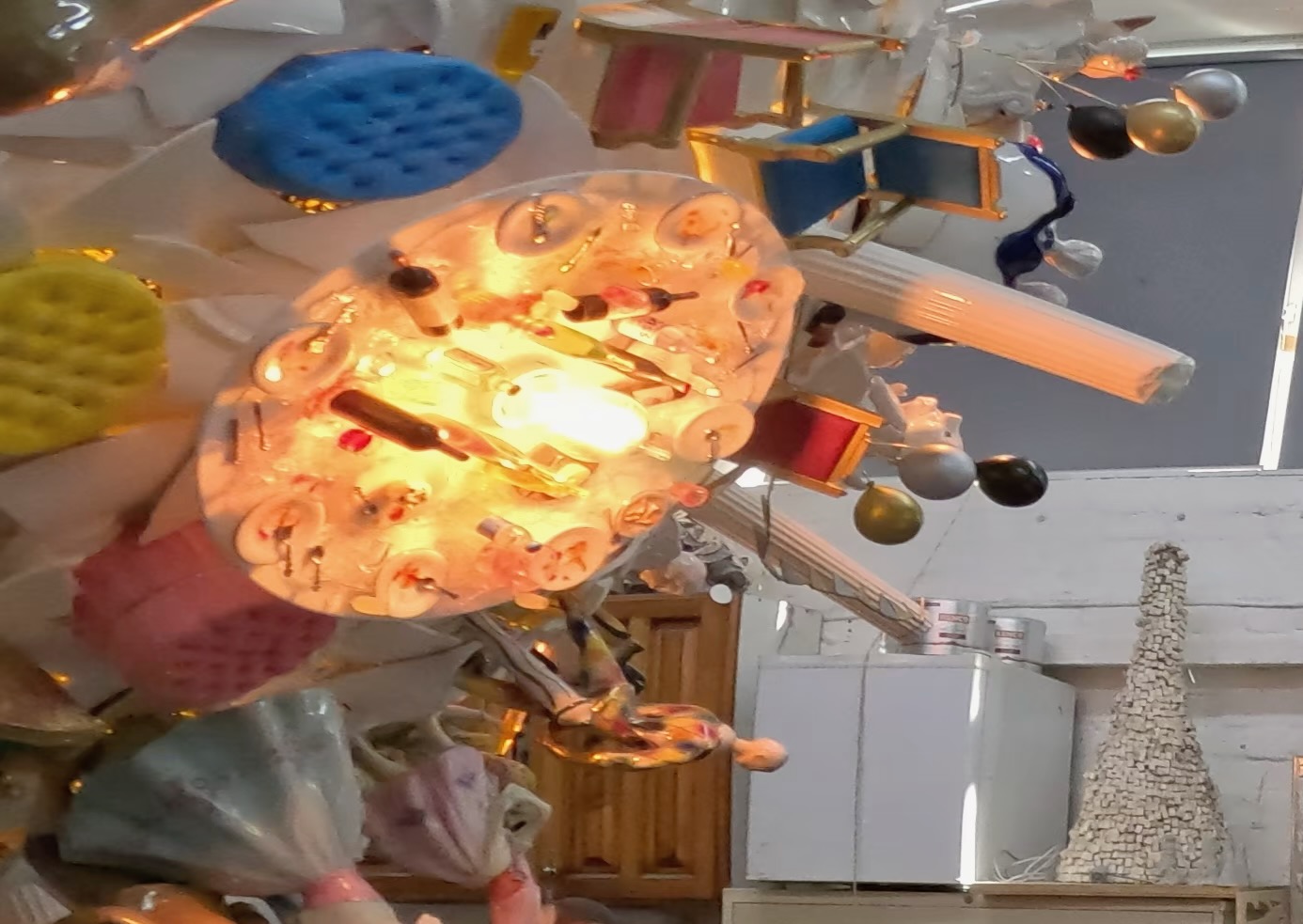
A bit of the wonderful 2 + foot diameter 300# hanging globe built up lovingly of innumerable porcelain shards and figurines with a dash of this and that.

A couple of things to note in the above tease pic. In the left foreground is a small detail of the globe, I just about crashed into. Note the table and the exquisite detail of the used place settings and the tipped over wine bottles. In the background right is an early clay mock-up of the Tower of Babel. 
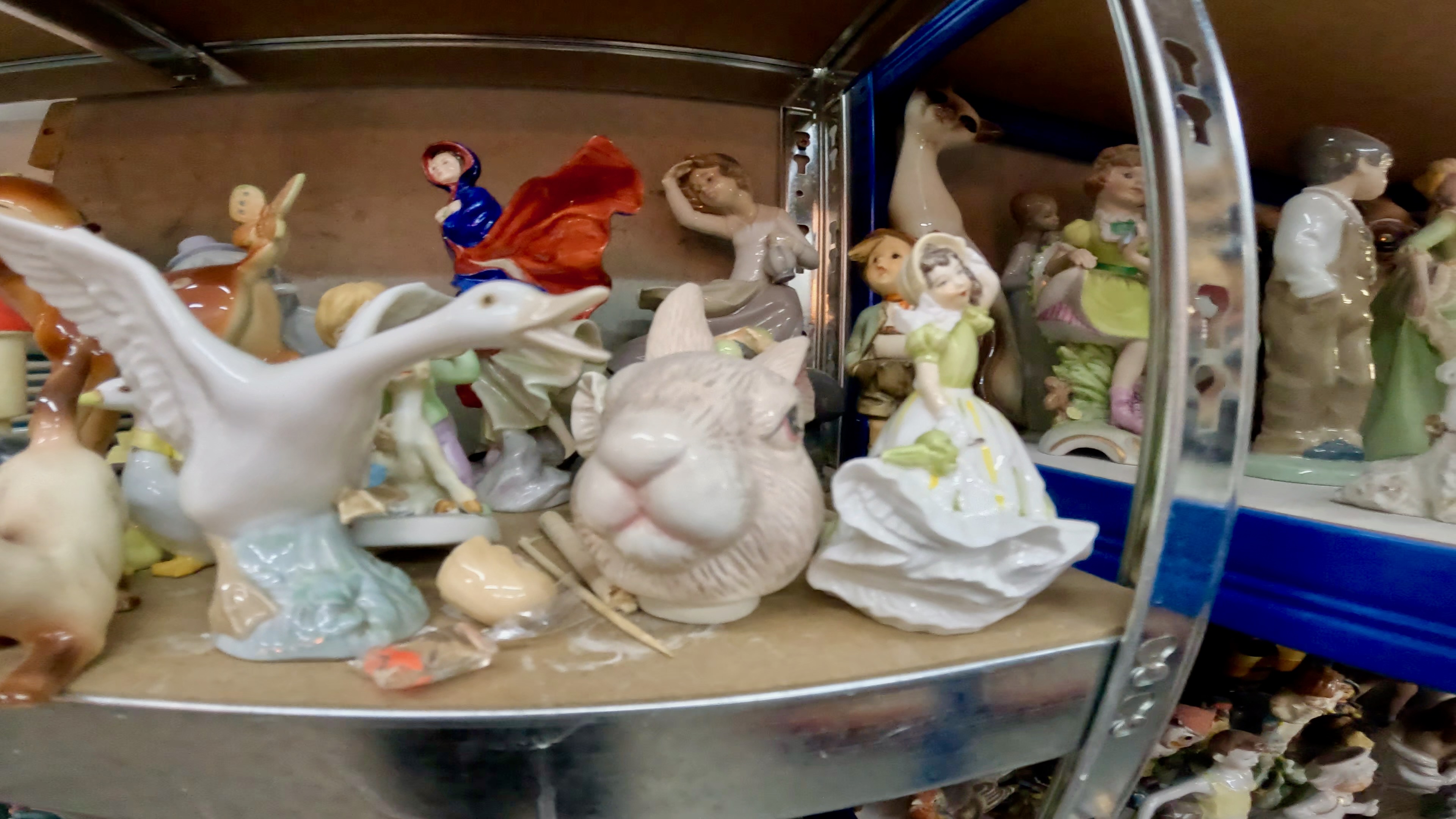
Barnaby’s studio was loaded with porcelain figurines.

Barnaby’s studio was loaded with porcelain figurines. See above. Most come off the internet. Used, and full of life and full of character.

Below is Barnaby and his studio. With assistant Zach building some sort of wonderful 3D printed spiral base. Probably the show’s co-centerpiece once it’s populated with figurines and so forth.

Barnaby and his studio, with Sharon and Zach

We would love to be at the gallery opening for this next show. Another closing of another circle. Vamos a Ver. We shall see. Not out of the realm of possibility. April 2026.

Here is a short video of our ride to Barnaby’s studio and back:

Link to: Rivers of London

John Soane’s Cabinet of Curiosities

The John Soane Museum was only a few blocks east of our hotel. Soane was a most famous English Architect. Some say the greatest.  The museum is his home kept as it was at the time of his death in 1837.

Which itself is a bit curious and has a backstory. Sir John did not see eye to eye with his eldest son, to put it mildly. In those days it was English law that the oldest son was to inherit. 

To get around that, Sir John pulled some strings, and through a private act of Parliament, the museum was born, and his son George got nothing.

We wandered over. No tickets required and free like most London Museums. This is the smallest of the National Museums. Which makes sense as it is simply a house. Or more accurately three row houses made into one. 

Much has been made of the facade, but it was tented on our visit. Restoration in progress. This is what it looks like without the scaffolding:

A lot revealed here of the Soane aesthetic. A curious combination of minimalism popped, with traditional classical elements pushed hard. Note the crazy floating surrealist column capitals. A hint of things to come inside.

There was a short line. When we arrived late morning, the Museum was already full up. Folks could only go in when others came out.

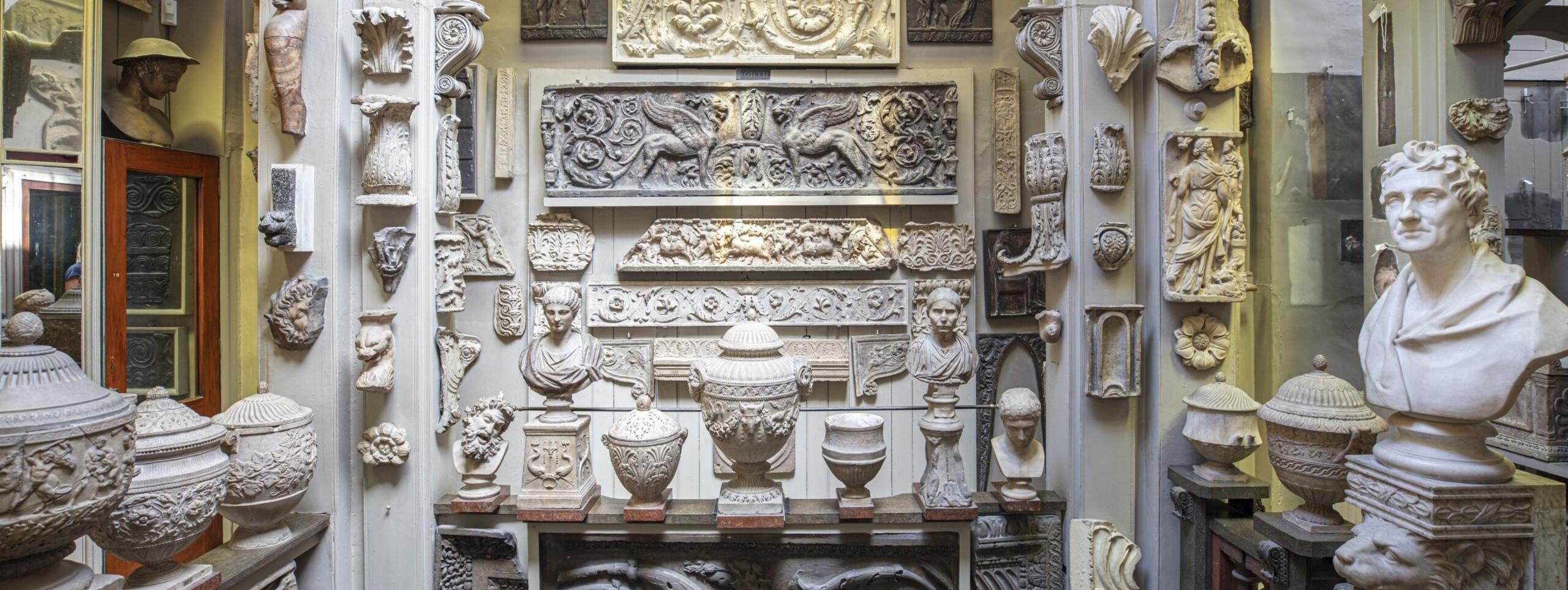
It’s probably safe to say that Sir John was a bit of a hoarder. His home was filled to brim with stuff. 40,000 objects or so they say. Great stuff, but stuff nonetheless. On entering everyone was given a plastic bag for extraneous stuff: camera’s, backpacks, purses and so forth.

We carried these smooth-surfaced bags full of our stuff through the museum so that nothing would catch on all of Soane’s stuff. The museum has tight spaces and narrow corridors.
Soane owned a couple of Piranesi prints. Giovanni Battista Piranesi (1720–1778) was an influential Italian artist known primarily as a printmaker, architect and archaeologist. Soane was a fan.

He didn’t own the Piranesi print below, but this one perfectly captures the more-than-full interior aesthetic of Soane’s home/museum.
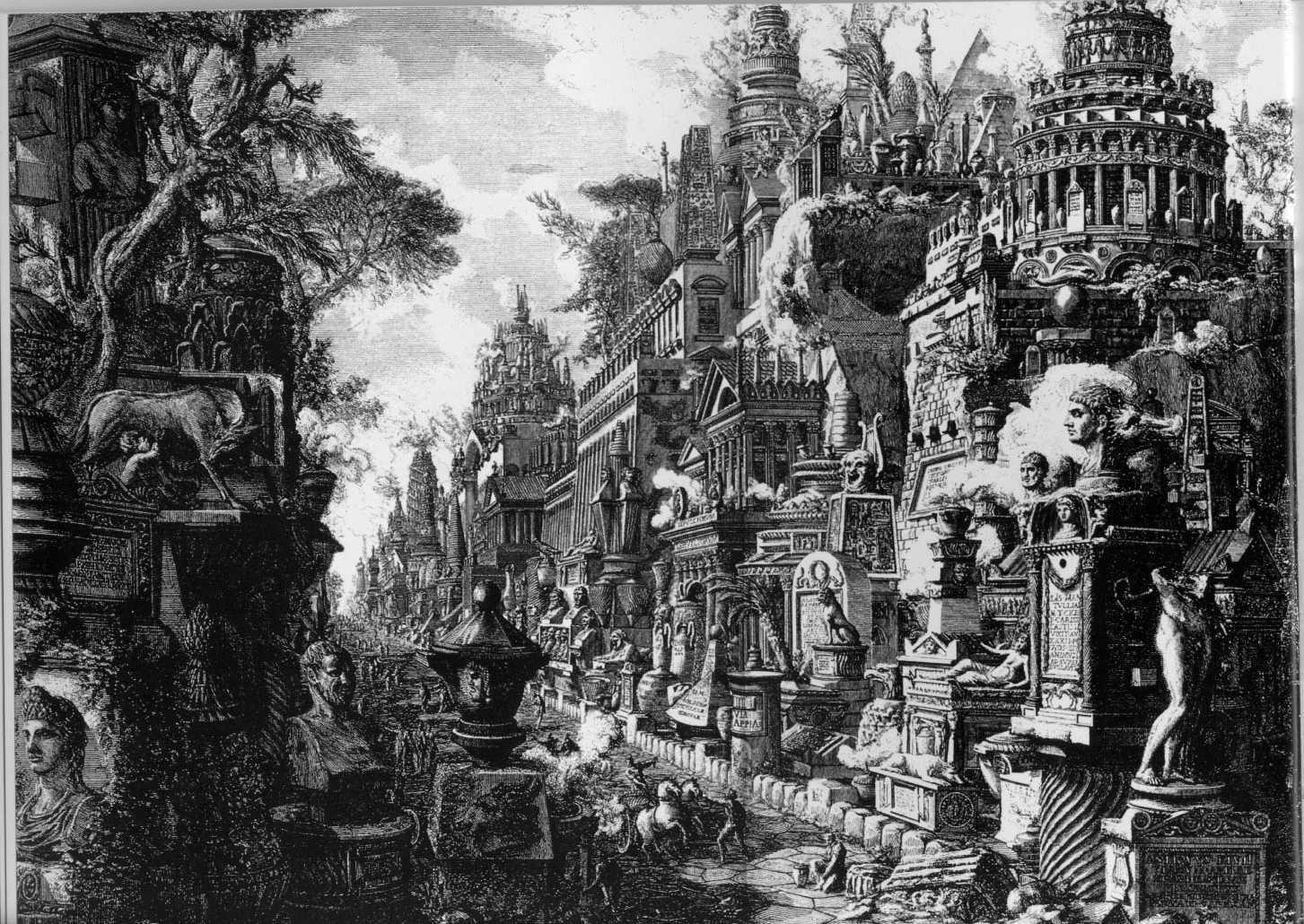
The Appian Way as it appeared in Piranesi’s imagination (1756)

Sir John, along with many of his contemporaries were fascinated by ruins. Empires crumbling. Buildings crumbling. Past, present and future.

Soane’s biggest architectural project was the Bank of England. At the time of its grand opening, the below remarkable illustration of its ruin was done by one of Soane’s disciples. No doubt at Soane’s direction.
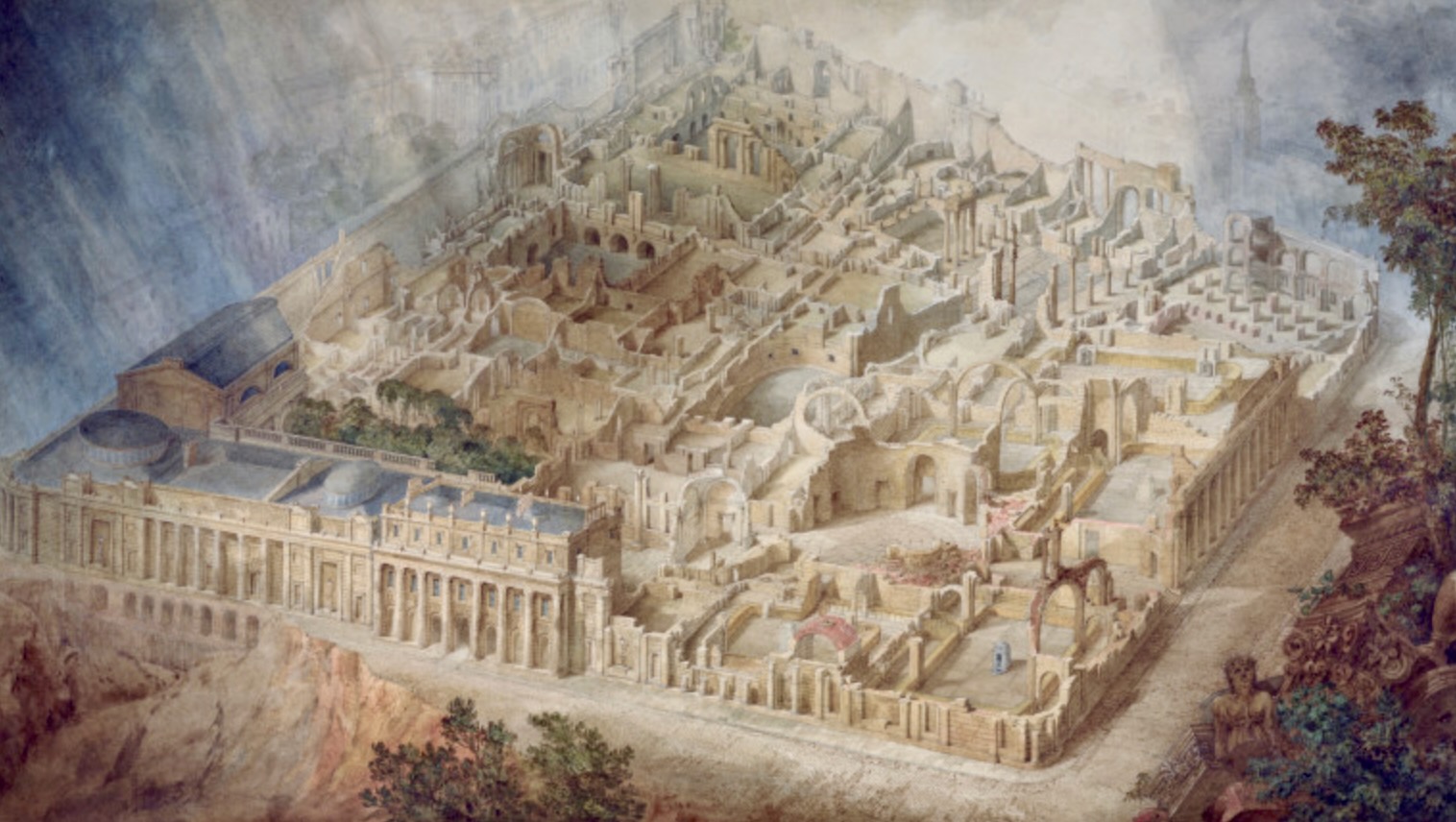
A Bird’s-Eye View of the Ruin of the Bank of England 1830. J.M. Gandy

Perhaps this meditation on ruins was Soane’s anxiety over the future of his achievement or forebodings over its future, or simply contemplation of the passing of all things.

In any case, kudos to Sir John for this image. Perhaps more famous now than the actual building itself. Long gone now.

Barnaby had tipped us off about the not-to-be missed Hogarth paintings, hidden away in the picture room and only shown at certain times. While we were waiting, we asked if we would be able to see them.

“12:30.” Which was great news.

As it was only 11:30 we had plenty of time to poke around beforehand.

During his day Soane had amassed a vast collection of antiquities, furniture, sculptures, architectural models and paintings. Stuff filled every nook and cranny. The collection has accurately been described as a maze without a plan. 

Which is part of it’s charm. If there is a method to the madness, it would be the architectural spaces. Below is a section through the museum from 1818.

Section through the Museum and Breakfast Room

These were the days of natural lighting. The lower you got, the darker it was. The basement, complete with an Egyptian sarcophagus, has been aptly described as:

“A gothic novel in miniature.”

We headed upstairs to the picture room for the Hogarth unveiling. We were characteristically early. 

The picture room was yet another tight space only 13 by 12 feet, but Soane had managed to squeeze in 118 paintings. 

His magic trick: picture planes. Only some pictures were visible at a time. The Hogarth’s were folded away.

We had time to kill and struck up a conversation with the local spirit. I say local spirit because the gallery attendant was a curious man. Middle aged, pretty much nondescript in every way except for the bright blue smooth high-topped leather shoes, which gave him away. 

So I ask him, you’ve probably spent 1000’s of hours in this tiny windowless room:

“So which are your favorite paintings?”

I am thinking the big names, Hogarth, Fuseli Canaletto, Turner, Piranesi.

Au Contraire, his favorites were William Hodges’ 2 picturesque paintings of Indian landscapes, painted in the late 1700s, when traditional India was crumbling in the face of the British.

What our spirit found curious was that today, the wheel has turned again. 

“This time its us. The British Empire has crumbled.”

Below, William Hodges’ Mosque at Fatehpur. More Ruins, though this time old time India.
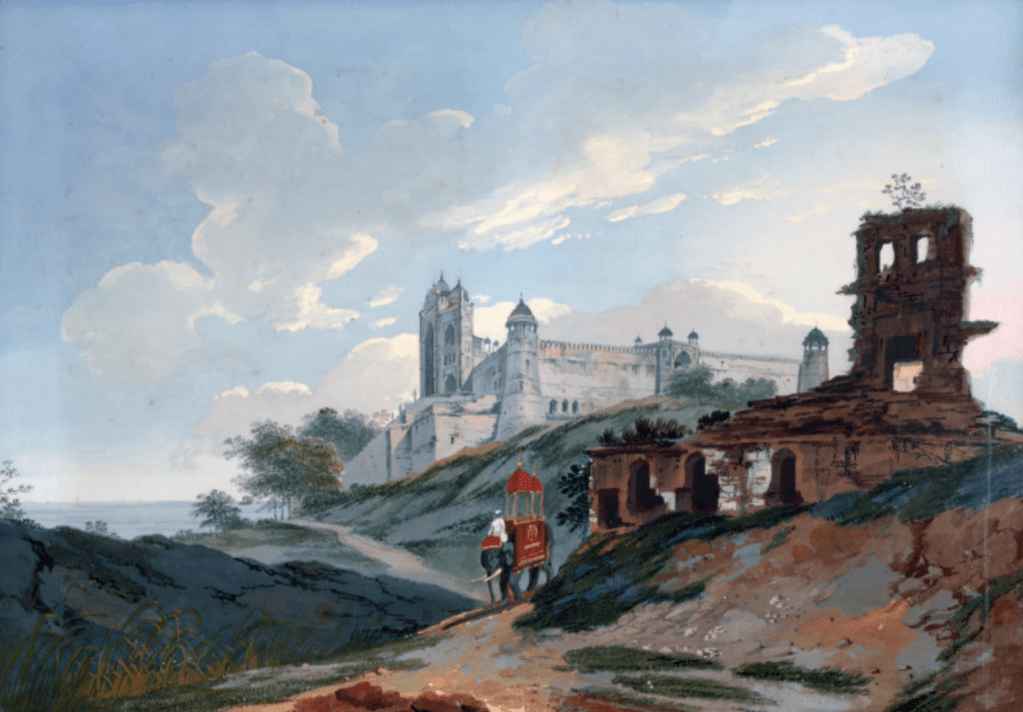
Mosque at Fatehpur by William Hodges

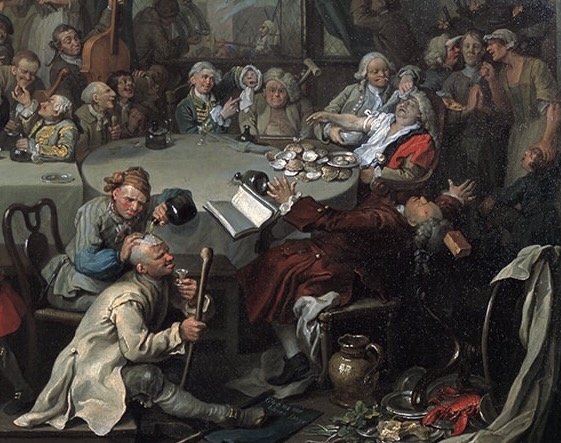
And there were the magnificent Hogarth’s. Soane owned two series: Rake’s Progress, 8 paintings and The Election, 4 paintings. Below is The Humors of an Election I: An Election Entertainment.

So much detail. I’m going to put it in a slideshow below. First the full painting and then a few closeup vignettes to muse over. This painting is all about what it takes to get elected, and the corruption endemic in the electoral process. Same old, same old.
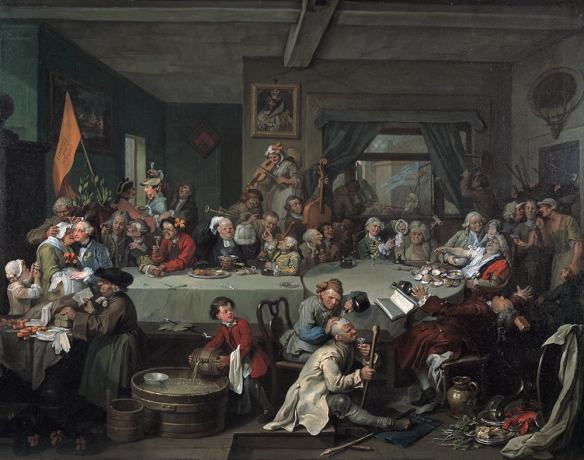
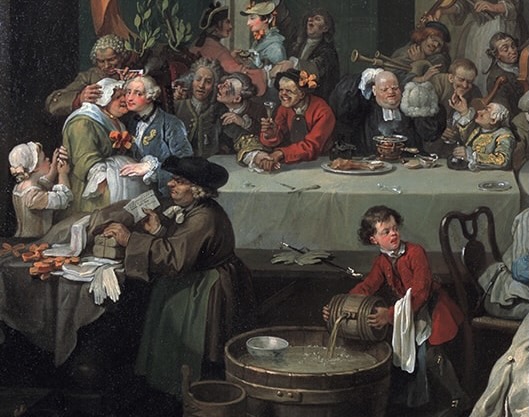
The composition of the overall painting shown on the first slide, parodies Leonardo da Vinci’s painting of the last supper.

On the second slide, note the little girl slipping the ring off the gentleman’s finger. On the third slide note the mayor collapsed from over indulgence in oysters. He’s being bled for his restoration.

I totally get Barnaby’s appreciation of the Hogarths. Hogarth’s scenes could easily be done with porcelain figurines.

Irani Cafes in London

Indian food in the UK is far far better than what is commonly served in the USA. Like another league entirely. Which makes sense considering the centuries of shared history.  

Our son visited London earlier this year and gushed over Dishoom in Covent Garden only a short walk from our hotel.

Yes, it is that good. We went back for seconds. 
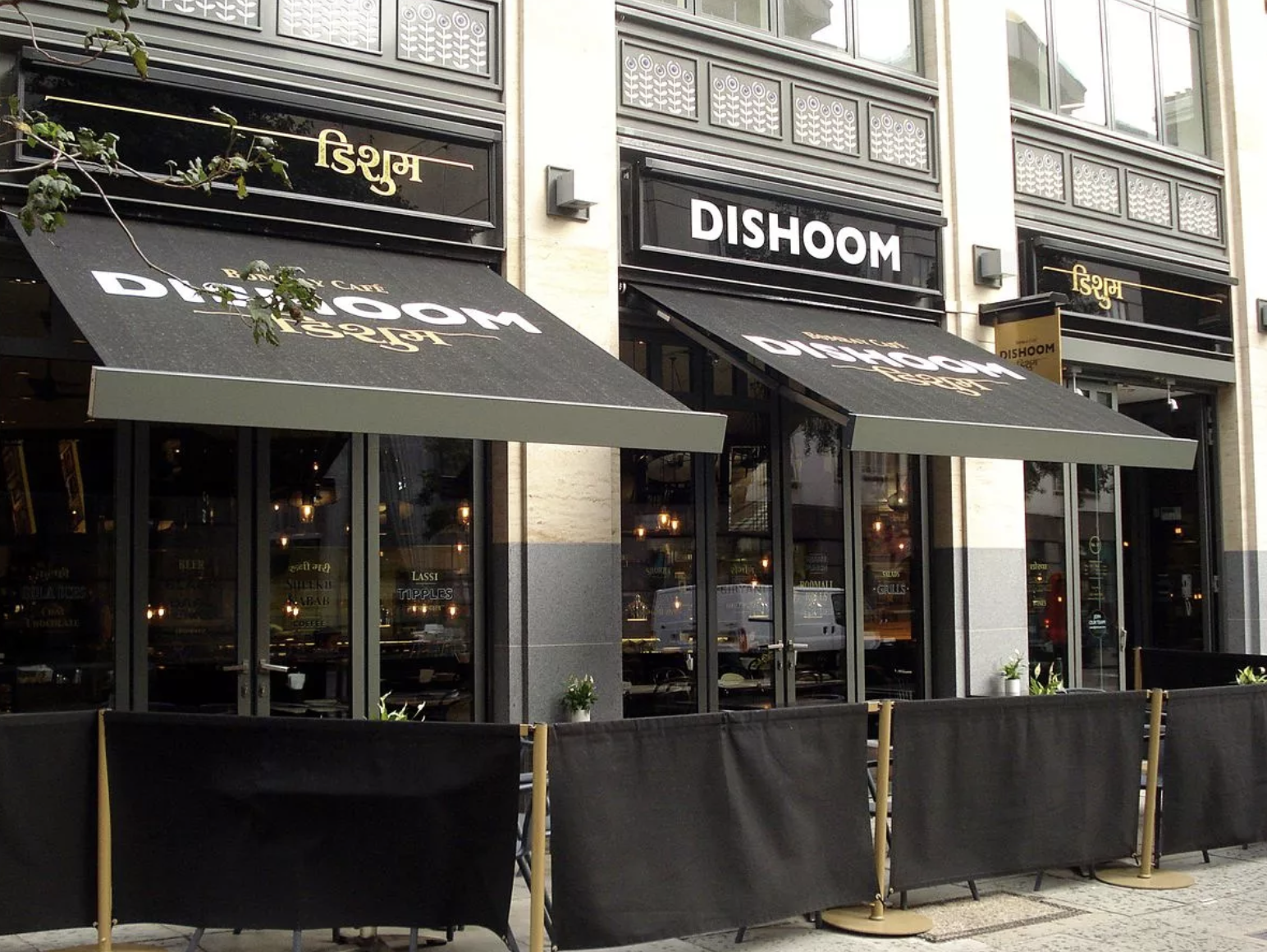
Dishoom Restaurant. Where the line can run the length of the street. Image kake/Flicker.

Dishoom isn’t just Indian, it’s Irani Cafe Indian. Wonderful food with a story. Persian influenced, Indian food tailored for British tastes.

Irani Cafes in Bombay were originally opened by Zoroastrian Irani immigrants to British India in the 19th century. The Qataris kicked them out of Iran.

Fading out now in Bombay, today known as Mumbai , the baton has been passed to London.

Dishoom has self-consciously leaned into the Irani Cafe tradition with 21st century ambitions. Founded in 2010 by Harvard Business School graduates. Now with five sites in London and one in Edinburgh. Soon to make the leap across the pond to the USA and NYC.

As one of Dishoom’s founder’s put it,

“You can eat an Irani breakfast, a Hindu Gujarati lunch and a Muslim dinner here and every single dish will be distinctly from Bombay.”

“Dishoom” is a well-known onomatopoeic sound effect from old Indian films, representing the impact of a punch or a flying bullet. The name is also used informally to describe having mojo.

The place has mojo. Enough to secure an investment deal with private equity valuing the company at approximately $400 million.

Our waitress told us that if she worked 5 years at Dishoom, she would get an all expenses paid vacation to Bombay. She was counting down. 

Our son was right. The Black Daal is to die for.

We might have to go back to London, just for the Dishoom breakfast menu.

The Great London Scavenger Hunt

The big day had arrived, and we had a plan. We were riding Sunday morning at dawn. Up and at em early on the least-traffic day of the week. 

Our six shops were our six destinations. 4 were in Quataroplis (Mayfair) or very close. These were the high end. Then we would do the outliers. Coco Kingdom in Kensington West beyond Hyde Park. And then back to our hotel and if all was going well, Northwest to Islington and the shop where Flight Centre had once lived.

Barnaby had designed his tower of Babel with the most exclusive shops at the top and the most so-called derelict at the bottom. All part of the concept of London’s hierarchy of consumption.

Curiously and totally by chance the route dictated by our shops was a spiral down Barnaby’s tower. From ultra high-end to work-a-day. Lots of life at the bottom of the tower.

This promised to be a most entertaining and educational ride.

****

Our pedals were swapped back, our bike route confirmed, our tires topped up for pressure. The day was dawning nice and we were off. 

Everything that went wrong on our first ride, went right on this one. Bike computer was great. Traffic was good. The fates were with us.

Our first two shops were just outside Piccadilly Circus. Bentley and Skinner looked just like our porcelain miniature, with a couple of bays added. 

We got turned around looking for Trickers.

We had most entertaining conversation with door man on cigarette break who got us back on route. And then another entertaining conversation with a garbageman, who was a smart foreigner, who found us amusing.

Trickers, again looked just like our miniature.

Our Tricker Miniature, which looks exactly like the real thing. We knew it instantly, when we saw it.

Two down and we were off to Quataroplis proper. Our shop Mathew Williamson had been replaced by IRO, the London flagship store for the French luxury fashion brand:

“Born in Paris, and inspired by the 70’s & 80’s American rock scene, IRO is driven by the desire to build a simple and strong wardrobe composed like a soundtrack.” 

We then rode around Berkeley Square’s pleasant loop and peeled off on Davies Street, where we spotted a full-sized Tyranasaurus Rex headed to the park sans flesh. 

We pulled up hard. This Dino was a show stopper. Very cool and impressive, and as is usually the case with such, there’s a backstory. 
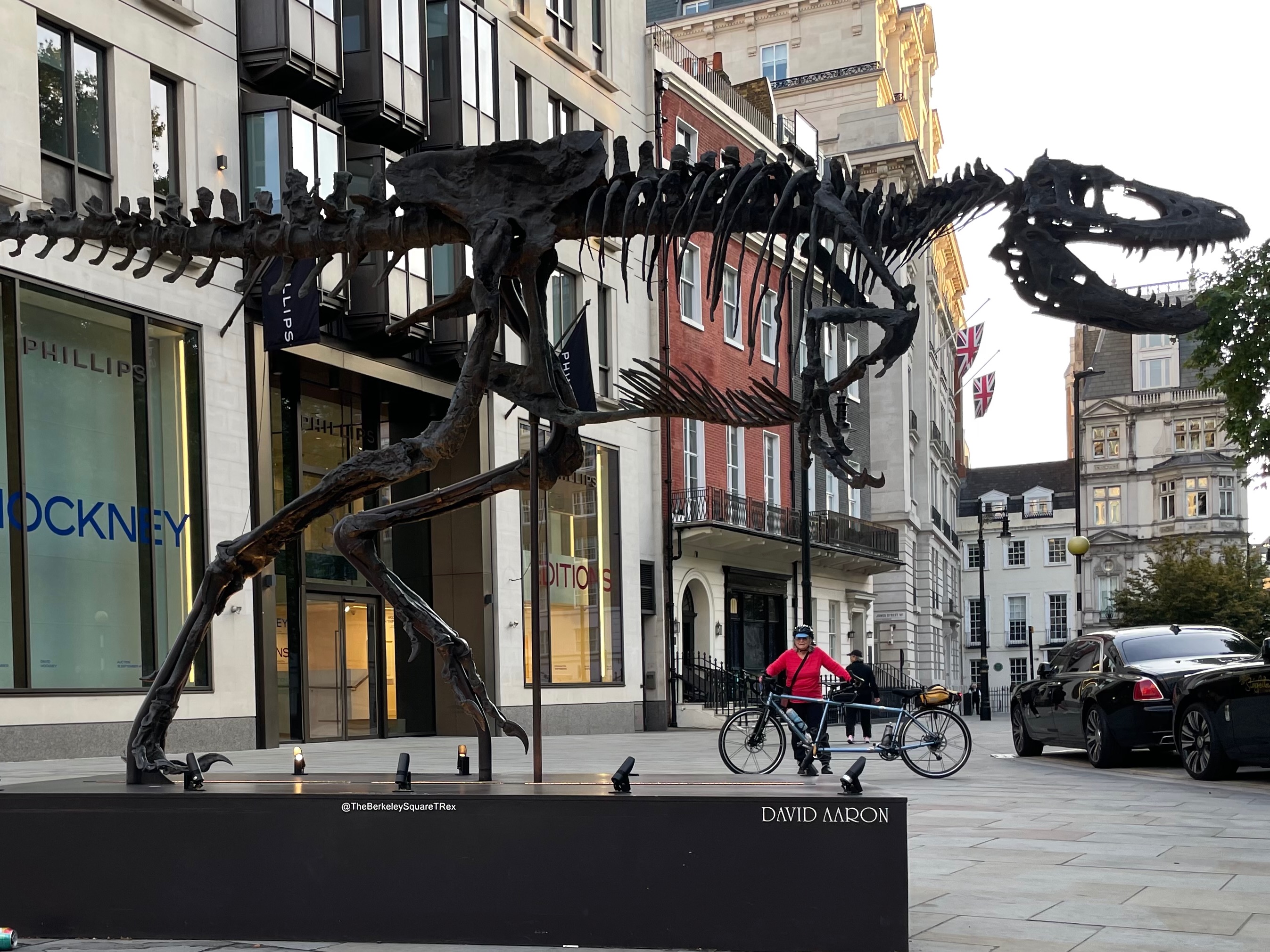
Chomper

This guy is affectionately known as “Chomper” after the baby dinosaur in the 1988 cartoon, “The Land Before Time.”  Unearthed by the third-generation cowboy Clayton Phipps in 2019 in Montana, the real bones once resided in the nearby David Aaron gallery. Real-bones Chomper went up for sale for $20+ million in 2023. After which the trail goes cold. Likely purchased below the event horizon. 

Only a block hence we arrived at our next shop, Bluthner Piano Centre. Now doing business as Bacchanalia Mayfair. 

With shop #4 checked off, we headed to Kensington via Hyde Park to look for Coco Kingdom in Notting Hill. Coco Kingdom is perhaps my favorite of our porcelain shops. Character in spades. Morning was still early and traffic was light. 

Alas, Coco Kingdom Fashion Boutique is now just a memory. Living on as our miniature and the Alamy Stock Image below.

Coco Kingdom in it’s day

We headed back. Arriving at our hotel no worse for wear. It was still early-ish and we had the energy so we headed to Islington and our last shop: Flight Centre.

Flight Centre too had moved on, replaced by the Thai Therapy & Spa. Sharon made a couple of off-color jokes about what could actually be going on. And I’ll leave it at that.
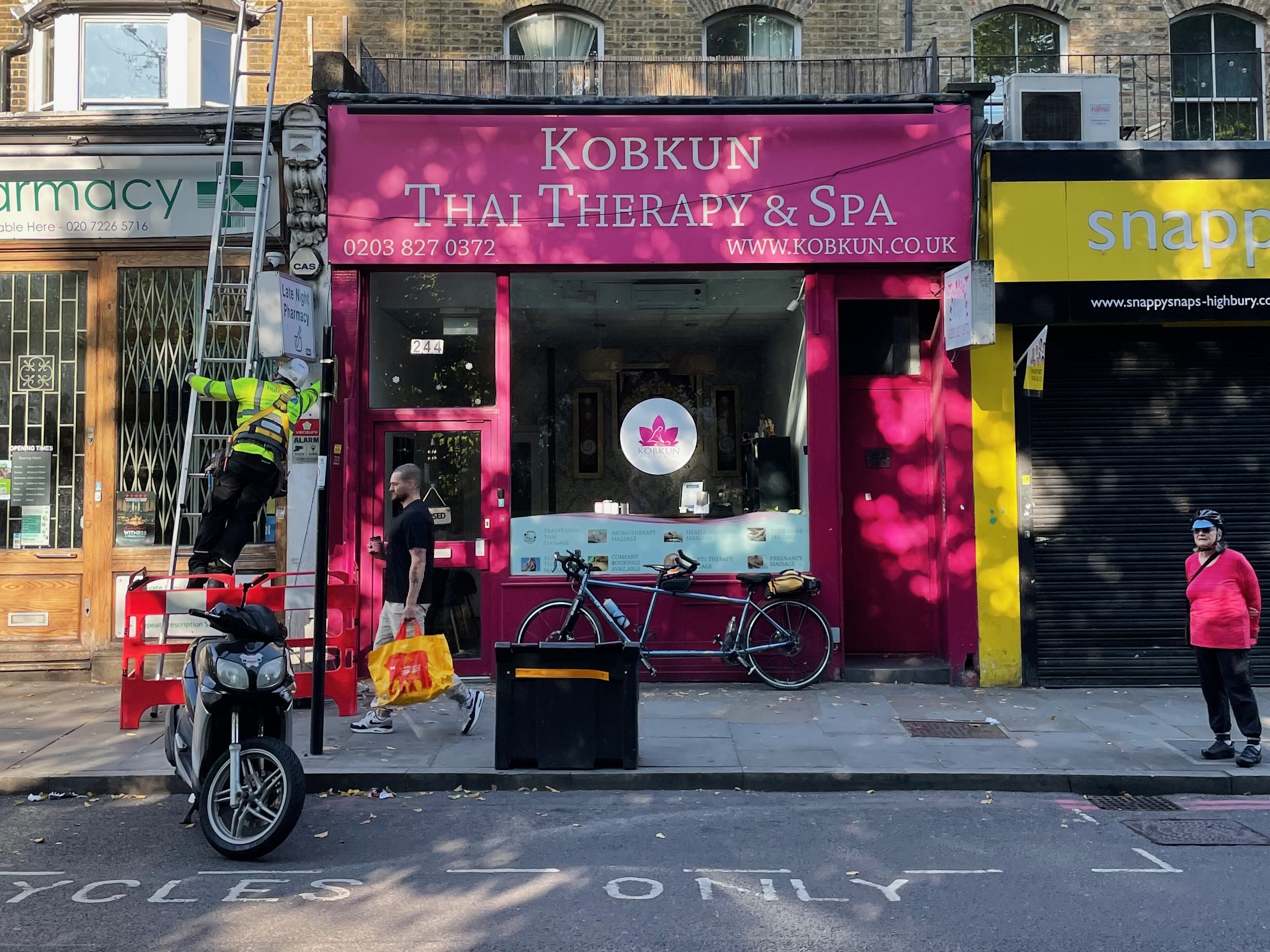
Flight Centre is no more

If you look carefully on the left, you’ll see a guy on a ladder replacing lights. After we got his OK on the bike photo-op placement, I say,

“Nice day, too bad you have to work on a Sunday”

He laughs,

“I’m just happy to have a job”

And that was that. Our great London Scavenger Hunt was complete @ 244 Upper Street @ 8:52 AM on Sunday September 7, 2025.

Here’s the video if you’re interested. One of my favorites. Music is Ry Cooder and Manuel Galban; Los Twangueros; 2003; from the CD- Mambo Sinuendo 

The Great London Scavenger Hunt Video

****

Looking back, it seems so improbable that a porcelain lighthouse, tucked away on a ledge in a stair, in a hotel, in Kenmare, Ireland, would have precipitated this trip. But that’s the Goen of this one. Chance, fate and interconnectedness simultaneously at work.

Goen. Actually En. The Go not shown, is just an honorific. Fate and Chance. One and the same.

So, if we leaned into it, what would be next?

Barnaby’s show is April, 2026. Perhaps if we ask nicely, we can snag an invite. And at the same time work a bit more on our London-to-do-list. Epping Forest might be calling too.

Vamos a ver. We shall see. 
2024 Wild Atlantic Way

The Wild Atlantic Way is relatively new. At least as a tag line. The trademark was registered in 2008 by Ireland’s national tourism development authority. The places go themselves are old, old, old. Folks have been hanging out in these parts at least 33,000 years.

Today’s Wild Atlantic Way is 1500 miles of road along Ireland’s Atlantic Coast. 

At one point I had schemes of pushing for the whole enchilada.

At the end of the day, it just wasn’t meant to be. Too many miles. Not enough time. At least for old folks riding on a tandem bicycle. 

We decided to just focus on the low hanging fruit. The southern stretch: the Dingle and Kerry Peninsulas. Dripping in history, and Irish soul.

Smaoineamh Maith. Good idea.

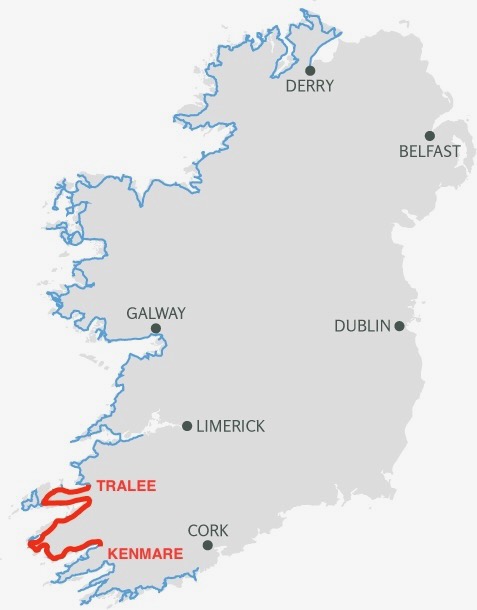
Our ride: Tralee to Kenmare. The Dingle and Kerry Peninsulas

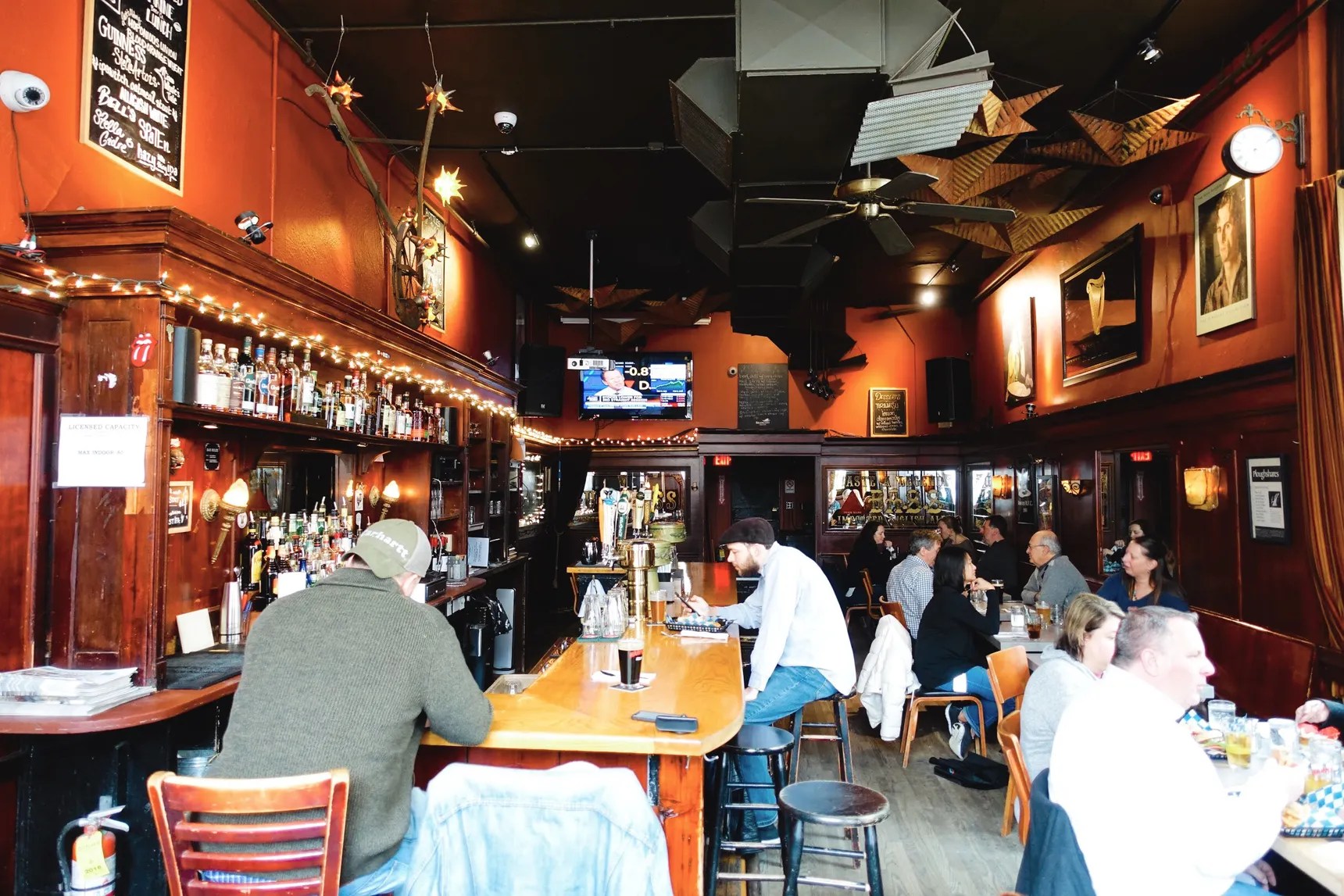
The Plough and Stars

Plough and Stars. Photo courtesy of the Plough and Stars.

So we’re sitting in our local Irish Pub, The Plough and Stars, at the best table in the house, right next to the window onto Mass Ave, when this elderly gent walks up, tapping the floor with his cane and addresses us, 

“You’re sitting at my table.”

The place is pretty empty, after all it’s 11:30 on a Sunday Morning.

I give him a blank look. Thinking: 

“There’s lots of tables, and so what makes ours, your table”

He gives me a hard look, and tapping his cane adds, 

“I own the place.”

Was this guy for real? Dressed nicely, well worn and dapper. Irish accent. A judgement call.  

We slide over to the adjoining table. Truth-be-told, every bit as good.

He sits down and adds,

“I own the whole block”

And so we met Peter O’Malley, a bit of a legend, locally and internationally. Advisor to the World Bank, etc, etc. And yes, he does own the whole block and a whole lot more.

Goes to show you never know who you’re sitting next to, or who wants your table. 

Peter (right) and his brother Padraig in days of yore. Photo courtesy of Plough and Stars

Peter was waiting on friends, as were we. We got to trading stories. 

He was from Ireland. We were training for it. Which he found amusing.

“Skellig Michael, Eh.

Well, I heard a story, the monks first came from North Africa. The Atlantic is like the desert. The island was their desert hermitage at the end of the world.”

The bartender, recently over from Kerry adds, 

“Nice bicycling in Kerry. Just don’t try to go over Conor Pass”

At which point my heart sank.

Over Conor Pass

From Boston, we flew all night, arriving at Shannon Airport just before dawn.

Customs was a mere formality. 

Our transfer to Ballyseede Castle, ambled in minutes later at 6 AM. We headed out into morning night, bike cases in tow.

Good thing our ride was a Tesla. Larger inside than outside. Kinda-like Dr. Who’s Tardus.

Our bike cases barely fit. Perhaps a 1/4 of an inch to spare. We all laughed a relieved laugh.

We had a bit over an hours drive. Sharon sat upfront, as she is the more entertaining of the two of us. Conversations wandered from electric cars, to Irish tariffs, to politics, and old personal stories. 

On both sides. 

Our driver David was 50’s-ish. Very perceptive guy. Round about the time he was telling his tale of an English ex-girlfriend and bar toasts with disreputable far left political types back in the day, I started wondering IRA? 

Perhaps. Many levels to that equation. Our revolutionary war is way back. In Ireland, not so much.

We were dropped off a bit after 7 AM. Front desk hadn’t arrived. We dozed in the  rooms off the lobby, as the day rolled in. 

Ballyseede Castle Entry

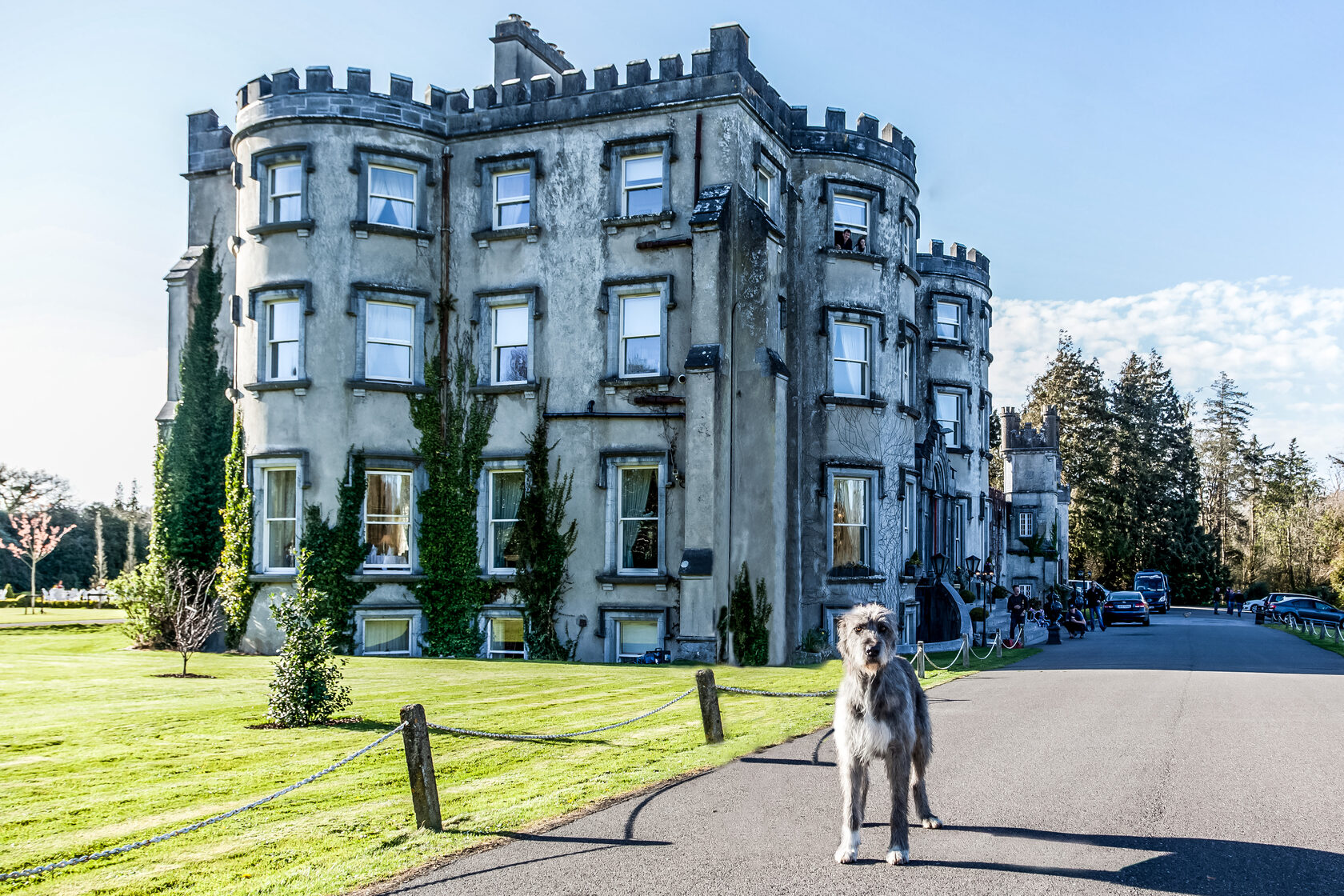
Ballyseede Castle was a lot of fun. Complete with wolfhounds, and gobs of history. Truth-be-told, it’s not really a castle per se. More of a manor house dating back to the 1700s.

Ballyseede Castle. Photo courtesy of Ballyseede Castle

What’s left of the real Castle was somewhere out in the Ballyseede Woods. That would be the place where the English finally caught up with Gerald FitzGerald, 14th Earl of Desmon, cut off his head, and sent it to England for display in November 1583.

So we walk up to reception And start chatting about the adjoining Ballyseede Woods. I think the entrance is on the back left corner of the parking lot, Sharon thinks it’s on the right. 

Left it is. 

A couple of times a year, I win one of these.

“So now she has to be nice to me.”

I hear a woman’s voice behind me,

“Nice-er”

I continue,

“Time to celebrate with a Guinness.”

Same voice,

“Two and she’ll be gorgeous”

Pause.

“Three and I’ll be gorgeous!”

Laughter all around. 

So we met Mollie. Owner of the castle. And owner of the Wolfhound-in-residence Joe, who chasing her car, could hit 28 mph.

We head down to the bar/cafe. 

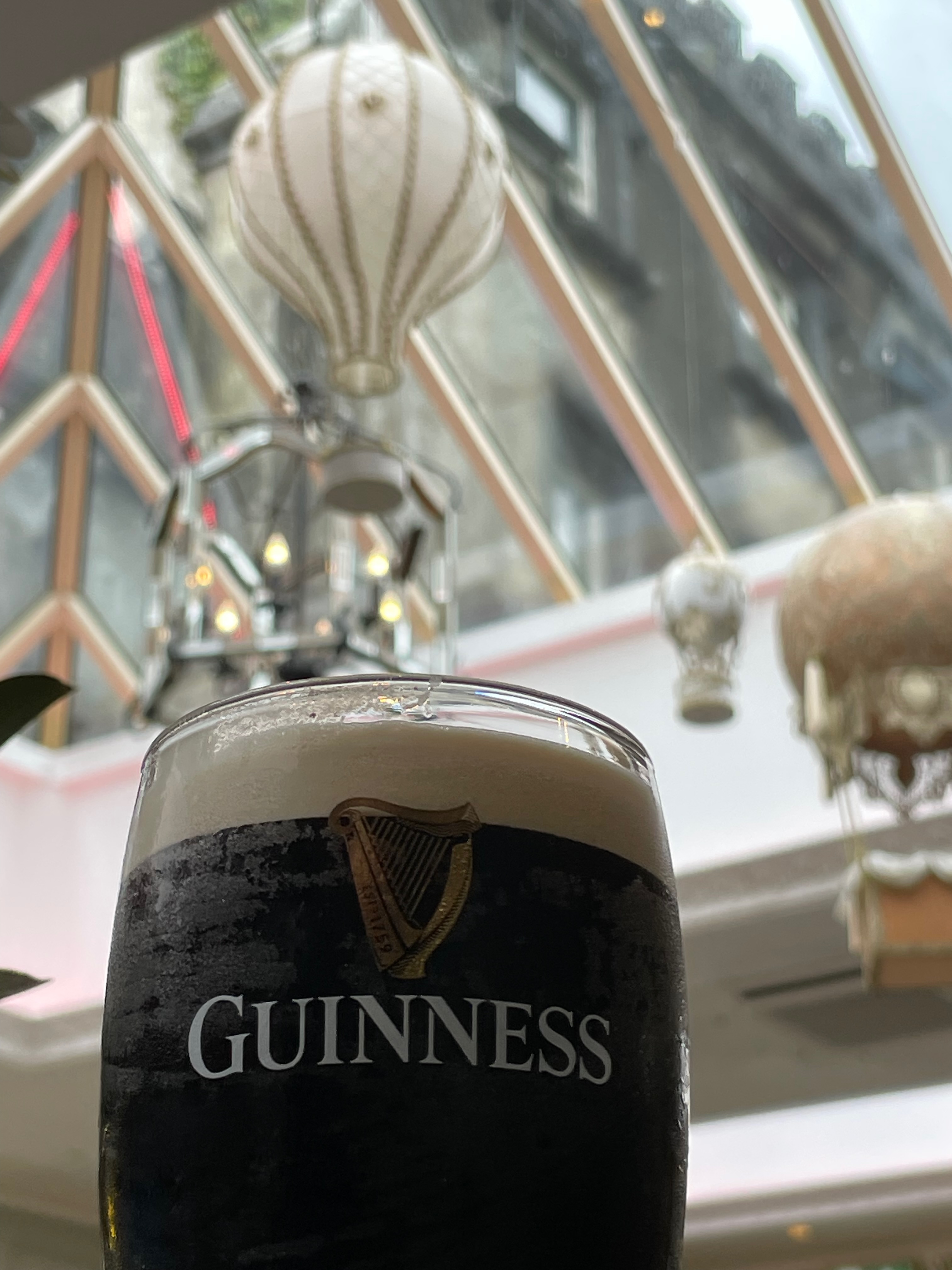
Yes, Guinness is a totally different drink in Ireland. Creamy head and fine tiny bubbles.

Everyone says Guinness doesn’t travel well. The further you get from Dublin, the less the drink. True enough. Though we have yet to make it to Dublin.

The next day we headed off into the Ballyseede Woods. 

The Ballyseede gardener said way back when, 30+ years ago, he had seen the foundations of the original castle in the woods, but it’s not marked, and he’s never been back.

We explored the Ballyseede Woods a bit, but found no sign of any castle. We did run into a couple who had lost their car.

“We parked our car in a lot just like this one, but our car’s not here. This isn’t the lot.”

We could offer no help.

When we told folks at the Castle our story, 

They laughed. “Yup. Lots of folks get lost. Did you?”

No actually, well at least no more than the usual.

****

Our tandem assembled, our bags packed, we said our goodbyes to Ballyseede and headed off towards Conor’s Pass. 

Outside the gates, a couple of left turns later we were riding along the northern edge of the Ballyseede Woods. Here we passed the memorial to the victims of the 1923 Ballyseede Massacre. One of the worst atrocities of the Irish Civil War. And that’s saying something.

British Crown forces brought 9 Irish IRA prisoners to these, then remote parts, tied them together in a circle around a land mine, and then triggered the land mine. Just for good measure they tossed in a few grenades and machine gunned the remains.

The cover story was to be that the IRA folks had been blown to smithereens clearing mines along the road. The remains were shoveled up and put in 9 coffins.

Which might have been the end of that, except for a curious twist. 

Only the body parts of eight men were in those 9 coffins.

#9 lived to tell the tale. He was blown clear and blown unshackled. He crawled away and told the real story. He considered his survival a miracle.

Yep.

Stephan Fuller 1922. 2nd from left at back

Stephen Fuller lived to the ripe old age of 85. Story has it that that in later years, he considered having O’Daly, the Irishman responsible for the incident, killed, but decided it was better to leave him to live with the knowledge of what he had done.  

Well played.

****

We skirted the heart of Tralee on the bypass, which thankfully had nice wide shoulders, turned off on some small lanes and caught the bike path along the canal for a stretch. At a break we had a pleasant chat with some Europeans, with big packs and nice gear. 

Hiking the Wild Atlantic Way’s Dingle Peninsula, which we were now riding.

We told them we were headed over Connor Pass in a couple of hours and they kind of rolled their eyes. All but saying,

“Yeah right”

****

The Dingle Peninsula is a bit world famous. Quintessential coastal Ireland. Bucolic countryside, sweeping beaches and razor-edged cliffs. But only tiny tour buses on this stretch, as the big ones tend to get wedged on the overhangs of Connor Pass.

The climb to the pass comes all at once, in the last few miles.

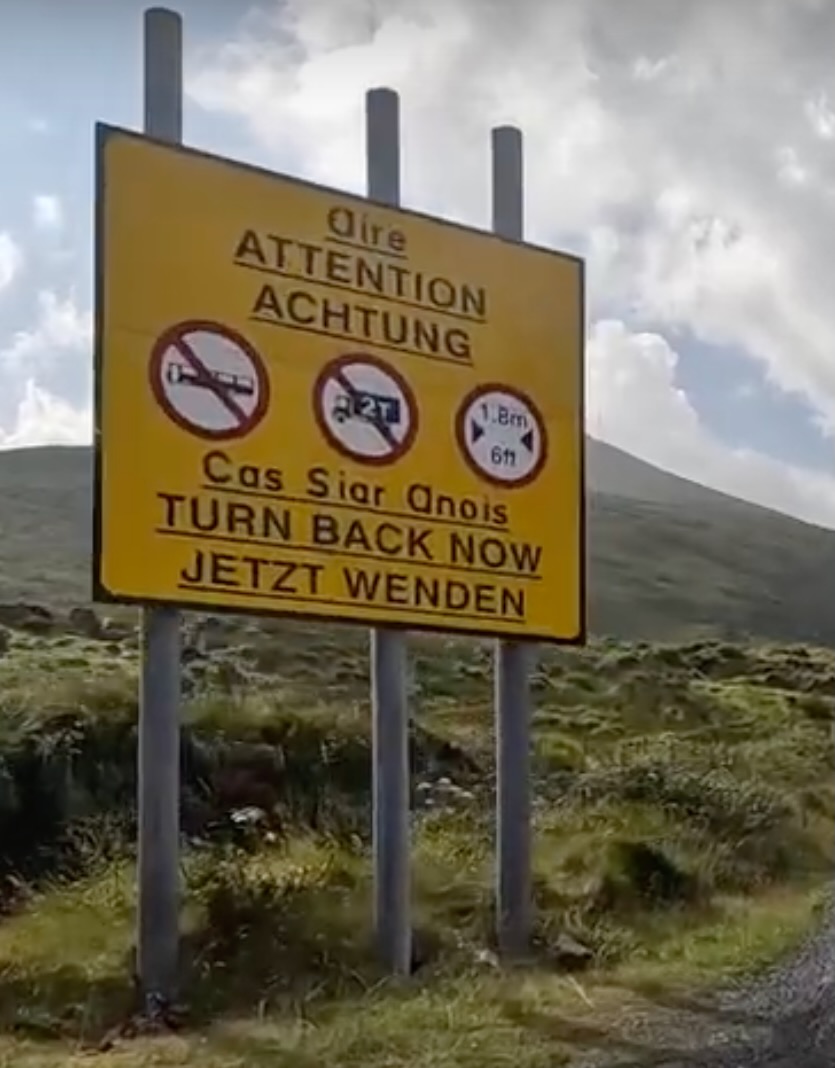
My favorite sign of this trip:

“Turn Back Now”

Folks at the pull offs on the climb, found us amusing. 

In a kind-of, I can’t believe it, you’re too old, you’re gonna die, kind-of way.

At the top, truth-be-told, I breathed a sigh of relief. 

We had a brief chat with a guy on a bicycle heading north, down the way we had just come up. A European with many, many, many miles on his bike. 50s-ish. He ridden across the USA 3 times. Countless Euro-routes.

He looked at our tandem. Shook his head.

“How do you guys do it?”

A mystery to us too.

We headed down to Dingle. Kind-of flying. Cooled it at 35 mph. Sheep were grazing loose on the long tasty shoulder grass. It would be very bad for us if they took a notion to cross take 3 steps onto the road.

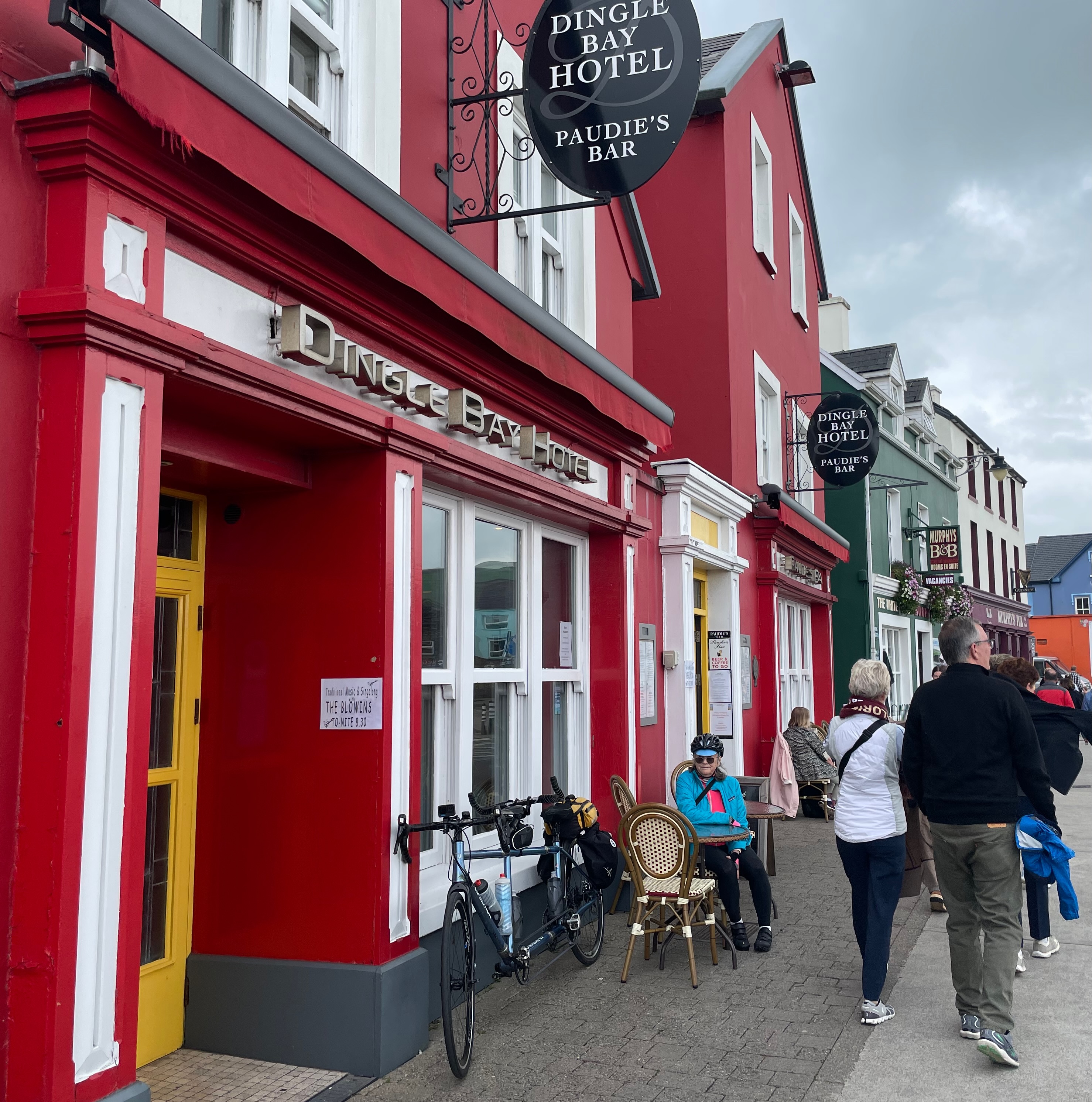
We coasted into Dingle. Right up to the front door of our hotel and adjoining pub.

Here is a link to an 8 minute video of our day’s ride

Dingle

After catching our breath, we headed into the hotel. Great place. Great folks. Most accommodating. 

“Is there somewhere we can store our bike? BTW it’s a big boy. 8 feet long.”

“Sure, just leave it in the breakfast room. Right through that door.”

Too easy. 

“So what happens in the morning?”

“Well we’ll roll it into the overflow dinner area.”

“And at dinner?”

“We’ll roll it back”

And so it went for three days. Mr Tandem was amused. 

****

So we’re sitting down in front of our wonderful full Irish hotel breakfast the next morning. Our tandem contentedly nestled in the far room.

We hear a familiar accent from the only other couple up this early.

A retired electrician and his wife from Peabody Massachusetts, none too happy with Massachusetts overwrought building codes. 

A third couple wanders in. Motorcyclists. In full leathers. Also Americans. 50’s- ish. We chat about radios. They love theirs. Can talk to others and each other on the road.

Later we ask our spitfire of a waitress, 

“So what’s with all the Americans?”

“90% of our guests are American.” 

Explains the soundtrack.

****

John Denver was droning on. 

“Colorado Rocky Mountain high… Colorado…”

John Denver’s music has been described as “cheesy, tacky, overly sentimental, bloodless and cliche. A step above muzak only in as much as it has vocals.”

I’m not sure I’d go that far, but you get the idea.

Henry John Deutschendorf Jr. aka John Denver dropped his musical pebbles in the pond in the 1970s. 

The ripples have been ever so slow to fade out. We hadn’t heard him in the USA for decades, but he lives on in Southern Ireland half a century later.

A hundred years from now, would not be surprised if John Denver is one of last the voices from the 20th century rippling down through time. Perhaps in Elon’s Mars’ station:

“Colorado Rocky Mountain high… Colorado…”

Curious what lasts and how.

Last week, I learned that Mr. Denver had a dark side. KInd of like learning that one of the Muppets has a dark side. 

His first marriage ended with John chainsawing his conjugal bed in half.

Ghosts and Whale Songs

The Blasket Islands are a short-ish boat ride from Dingle. Remarkable place. We suspected as much and signed up for an island landing/whale watch early. Our only problem was that our boat would be leaving from Harbor Pier in Ventry, 4 miles down the road from our hotel. 

We asked our buddy at the front desk for taxi help. 

“Ah, you will want Oamar. Dependable guy. Maybe the only taxi in town working mornings. Everybody else is sleeping in. Taxi business around here is late night. The bars and all”

True to form Oamar showed up at 9:00. Clearly Muslim. The extra “a” kind of makes his name Irish. No? Sharon and he immediately hit it off, sharing family stories. 

Oamar, swings down onto the pier does an impossibly tight 3 point turn.  First the front end out over the water, then rear end out over water. Swings about and lets us out. 

Not only a good guy, but a good driver.

It’s a swimming party. Low 60’s F air temp. Low 60’s F water temp. But the sun was out and the locals were celebrating with crazy dives and such. 

We put on our extra layers of clothes, filed onto the boat along with a dozen or so other intrepid adventurers, and were off.

Here’s a 2 minute ± video.

Sharon loved the boat ride. Crashing through the waves was totally her thing. She needn’t have worried. 

Today the Islands are uninhabited. The last folks left in the early 1950s. Some to the mainland and some to Springfield, Massachusetts. Just up the road from us.

Photo Courtesy of the Great Blasket Island Experience

The Blasket Islands are famous for the ghosts of those who lived the isolated life here. The islands had been inhabited from at least the 1200’s. Isolated as they were at the edge of the known world, pure Irish speech and stories surviving from centuries past.

Mined by anthropologists, linguists and writers, when the Blasket time capsule from ancient days, was discovered in the late 1800s. 

Our boat captain said he had grown up on the island. Told a great story about wild all-night parties. Folks from the mainland would come over and party with the locals like it was 1999. The next morning the main-landers would gather themselves up and return to the regular world.

Suspect his story is a tall tale for us tourists. Local tales have it the other way around: 

The guys on Blasket would periodically head off to mainland Dingle for their bacchanalia. Dragging their sorry asses home, post-party.

Island isolated life taking its toll. Far more likely to my mind.

In any case, the islands are dripping in some sort of magic. 

When the last folks left the Islands, they brought a tune with them: Port na bPúcaí , or Song of the Ghosts. 

Story goes that in great mist on a silent evening, the song rose up from the sea. Coming from everywhere at once. A musician in the boat memorized it. Funeral music paying homage to the deceased King of the Faeries. 

Perhaps also part whale song:

“The person who heard the music, while he was out on a silent evening in a coracle, a stretched canvas boat, in a deep mist, thought it was the fairies making the music. In fact, there was a pod of whales below him and their singing was amplified by the boat, which acted like a speaker and transferred the sound into the air around the boat.”

King Puck

Our next stop was Killorglin at the hinge between the Dingle and Kerry Peninsulas.

Killorglln was a counterpoint of sorts to the tourist towns. A working town. Complete with a goat king.

I knew we had picked the right hotel when I looked up and above the bar was a goat head in the place of honor.

Sharon was up to speed and launched into a most entertaining conversation with the bartender and his buddy. Both had clearly been around the block a time or two. 

They rose to the bait when she asked them how much either of them had seen one person drink. Sharon had done her homework back in Dingle. She had found a book in a niche about Irish pubs. The book’s bottom line was 30 pints. 

“Nah, never seen that. 20 pints is about it, and he walked out … on his own.”

Sharon followed up on 2008 legislation tightening up on drinking. 

“Not good for us. We used to have 26 pubs in town. Now it’s down to 12″

I was curious about the Puck Fair, 

“I heard that during the three days of the fair, pubs could stay open 24 hours.”

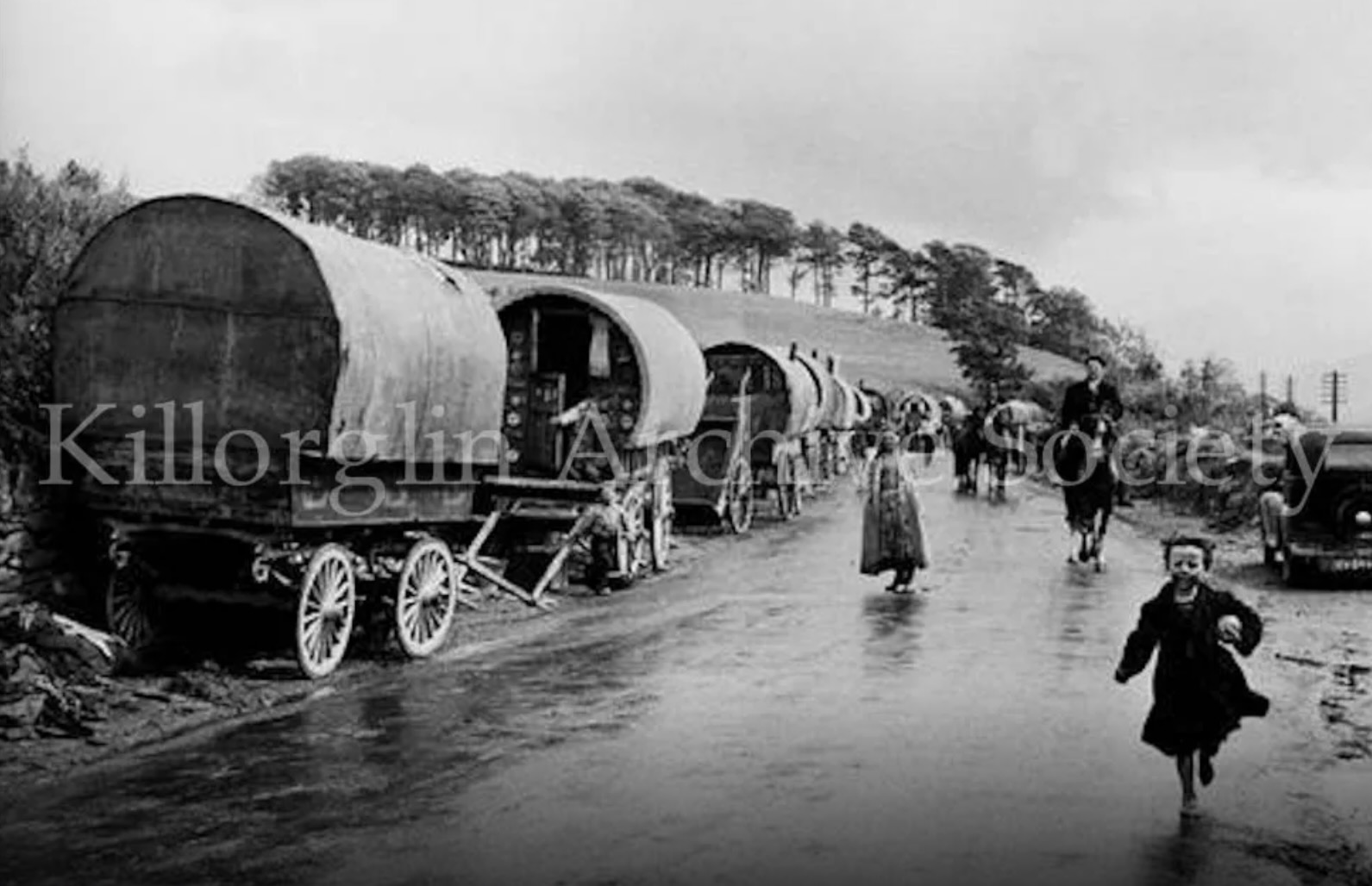
“Yes, in those days it was on the wild side. But good for business. Now we have to close at 3 AM. The fair’s been cleaned up too. Probably for the best, though I kind of miss the gypsies.

They considered it their fair.”

Old pic of Gypsies on the road we came in on

KIllorglin’s Puck Fair is both famous and infamous. Ireland’s oldest fair is the last of Europe’s goat festivals. Pagan stuff. Once also celebrated in Greece, Spain, Scotland and England. 

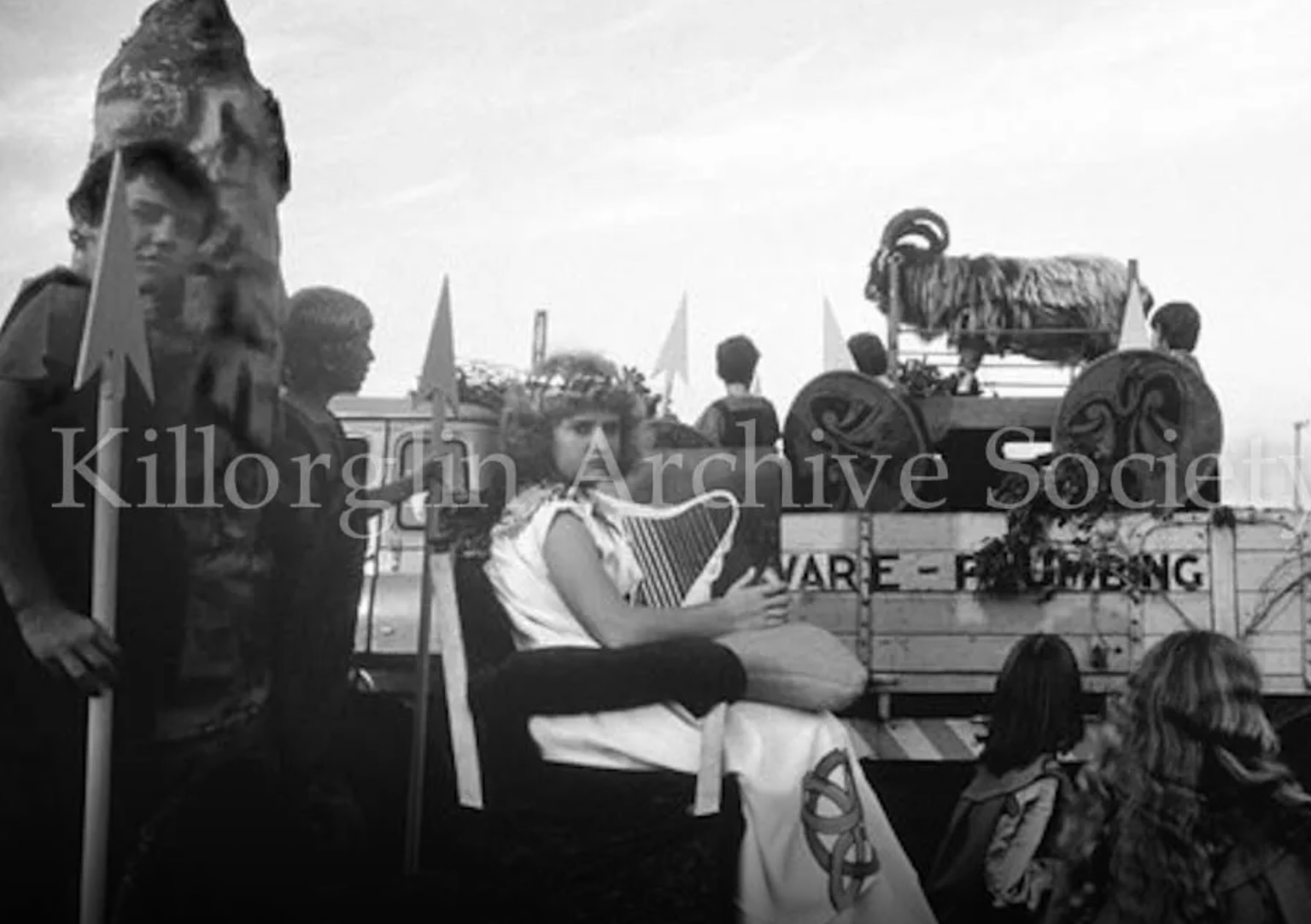
Every year there is a new King and Queen. The King is a wild goat brought down from the highlands. The Queen is a local school girl. 

King Puck is a wild goat. Queen Puck is a local virgin. She crowns him and then they are married in the midst of a three day wild rumpus. 

The Virgin and King Puck

Make of it what you will, but even sanitized, it’s still a bit dodgy. 

The semi-famous American poet Muriel Rukeyser visited in the 1960s.. 

She stumbled on the fair while scouting the festival on behalf of the filmmaker Paul Rotha, who was interested in Irish gypsies or “travelers.”  

No film was ever made, but Muriel was inspired to write a monograph-length travelogue about the fair called, “The Orgy” (1965). Excepts courtesy of the Irish Times: 

“She saw “a man with rats and ferrets running over his chest and back, and a contortionist tied in a knot of himself”. She saw fierce fights. She noticed that the raffle being conducted at the foot of Puck’s tower had a first prize of £60 or a trip to Lourdes. She noted “the high squealing sexual laughter at the bridge, the heavy wordless sounds, hot dogs in the square, the goat snug and dry under his own roof . . . bare-foot children following the piper”.

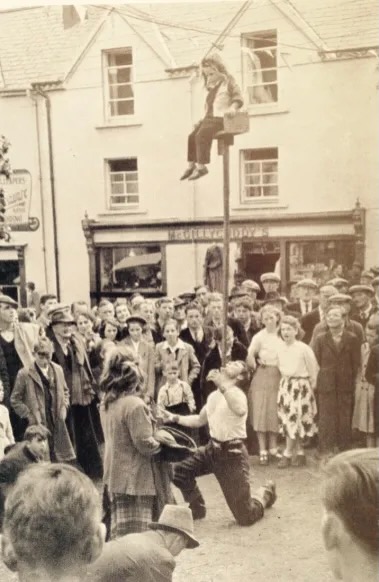
For as far back as anyone can remember, King Puck has presided over his fair for all three days from a 50 foot high platform erected in the main square.

King Puck on his Platform

Today animal rights activists have intervened over concerns for King Puck’s comfort and well-being on top of the tower for 3 days. No veterinarian’s testimonials seem to suffice.

These activists have suggested ethical solutions, to their minds, which would keep with tradition: “They could have competitions in wood-carving, sculpting, they could have an animatronic goat.”

An animatronic goat would be a sad, sad end, for the last of the goat festivals.

As T.S Elliot put it, “This is the way the world ends. Not with a bang but a whimper.” 

Don’t call them “Tinkers”

Irish gypsies have no connection to the Roma gypsies of mainland Europe. Similar lifestyles, but not similar DNA. Genetic analysis points to Irish marginalized some 1000 years ago. Perhaps at the time of the Norman invasion. 

On our way out of town, we stopped at Killorglin’s tourist office. We chatted with the local behind the desk about local drug busts and gypsies.

“Yes, he was an upstanding citizen, a pillar of the community, and then he was busted. You never know. As a rural coastal town, we are a gateway for the flow of drugs into Europe”

We could relate. and told her, our story of Everglade’s City in Florida. A rural coastal town and a gateway for drugs to the USA. Locals who knew the turf could make the big bucks. The running joke was – you know something’s up when you see a $10,000 house with a $50,000 pick-up truck parked out front.

She laughed knowingly and added that she kind of missed the gypsies even though they were a bit of trouble.

Puck Fair Balancing Act

The Tinkers were made most unwelcome in the mid 1960s as part of the Puck Fair sanitization efforts. She corrected me,

“Don’t call them ‘Tinkers’, it’s very rude. Today they’re known as ‘Travelers’.”

“Still they were a lot of trouble.” 

Rumors have it that the Travelers used to crown their own king, in secret, at the Puck Fair.

Another Way to Die

We had made it over Conor Pass. Now we just had to survive our climb up Skellig Michael. 

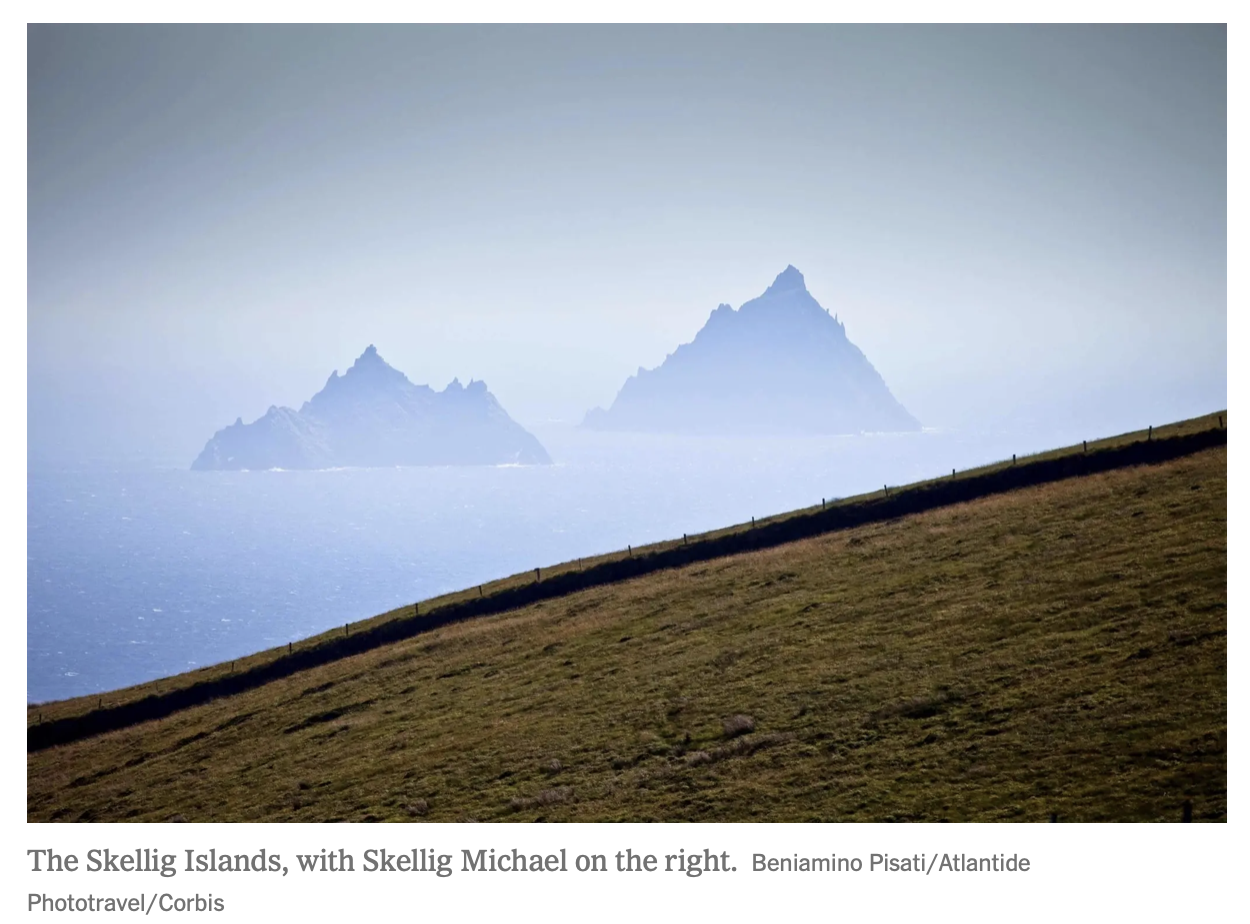
Skellig Michael is an island some 8 miles off the coast of Portmagee, at the tip of the Kerry peninsula. A desolate rock pinnacle jutting up out of the ocean. The top of a mountain, the rest of which is beneath the sea.

Monks lived on this remote rock, from A.D. 600 to 1200 ±. It has been a pilgrimage destination ever since. Though only for the stout of heart.

There was a mandatory orientation at the base of the climb. 

A young woman encouraged us to be most careful, pointing out there had been serious fatalities due to falls. At which point Sharon muttered,

“As opposed to what, Non-Serious fatalities?”

Behind our cheerful orientation ranger, a middle aged woman was descending oh so slowly, on her rear end, step-by-step. Her face was stone-cold white.

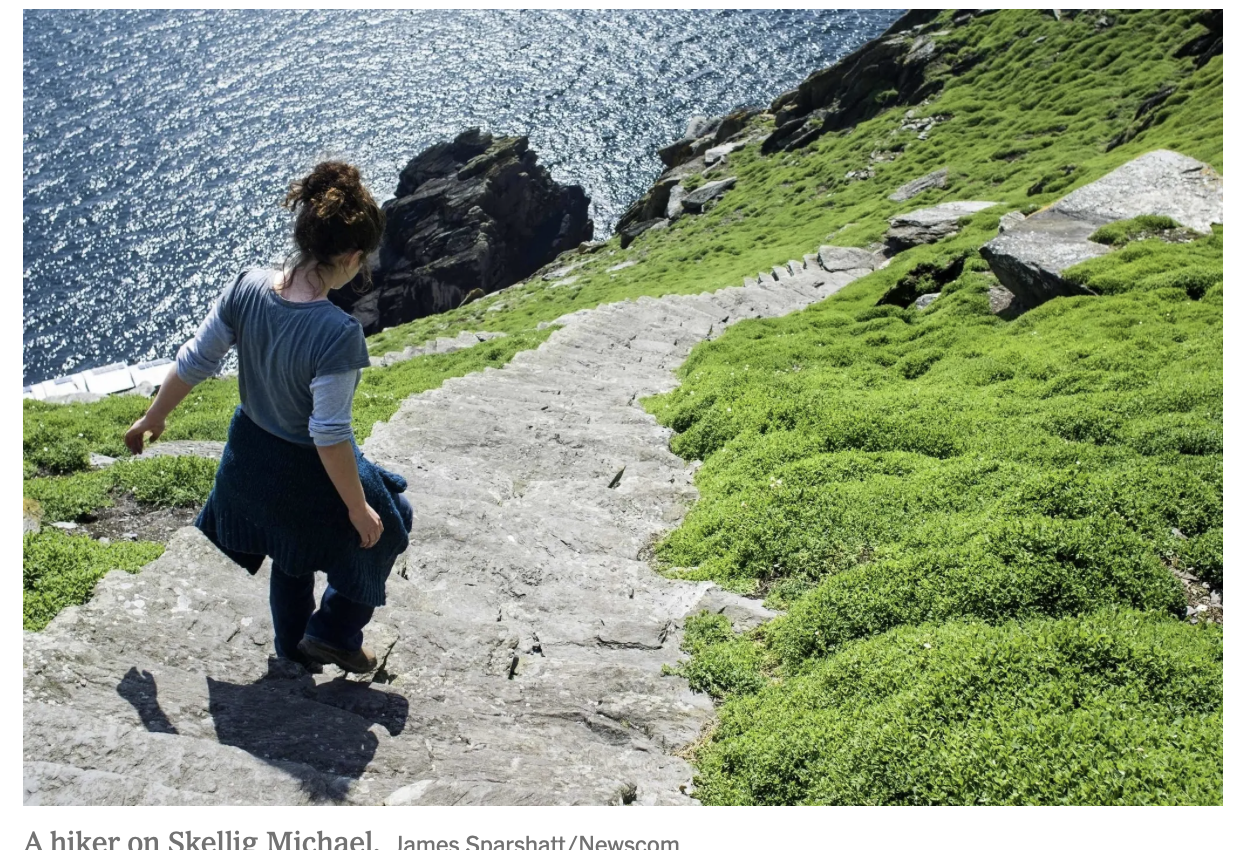
620 Dry laid stone steps are the only way up and the only way down.

We had done our due diligence and had our hiking poles in hand and hiking shoes tightly laced. 

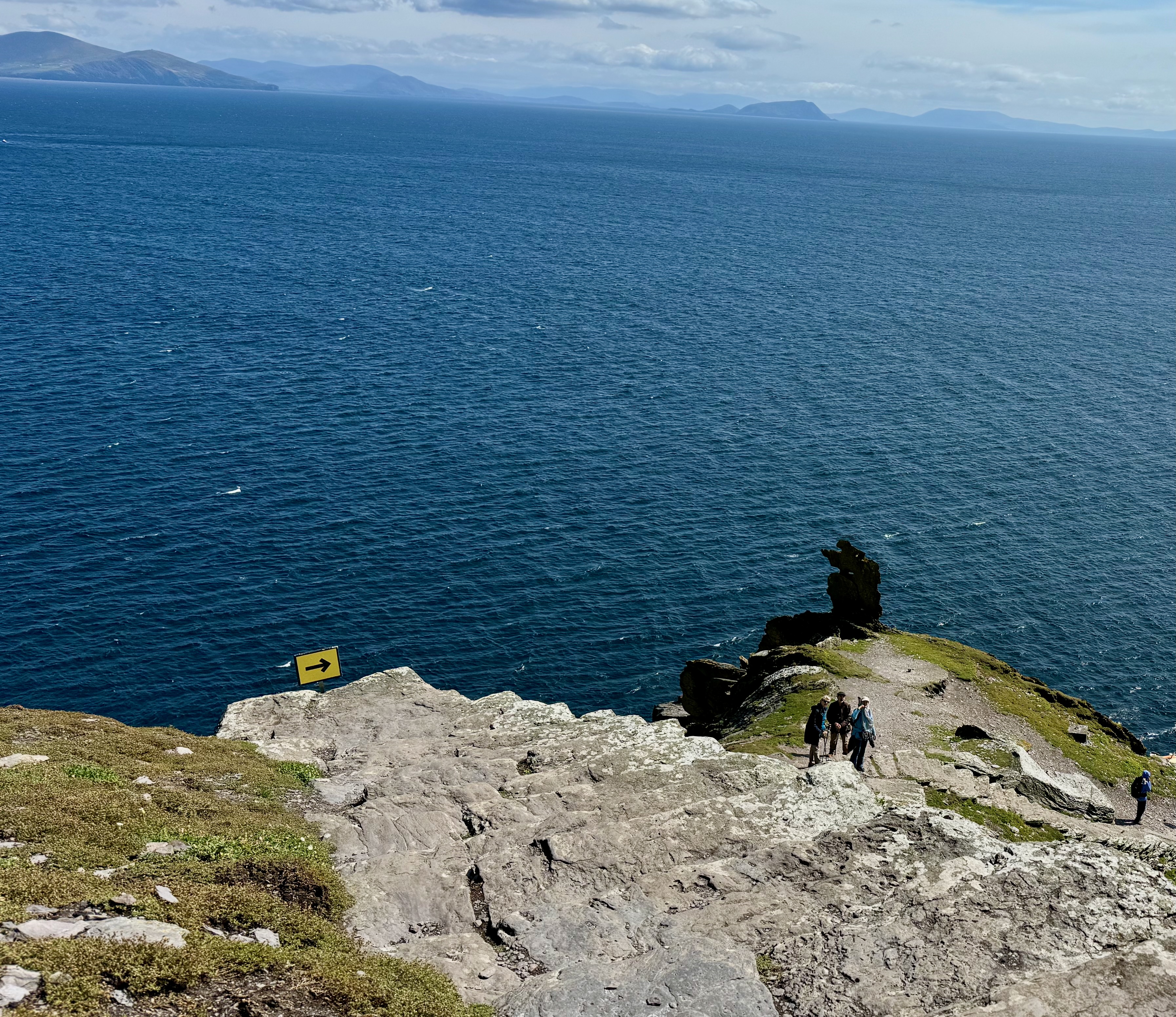
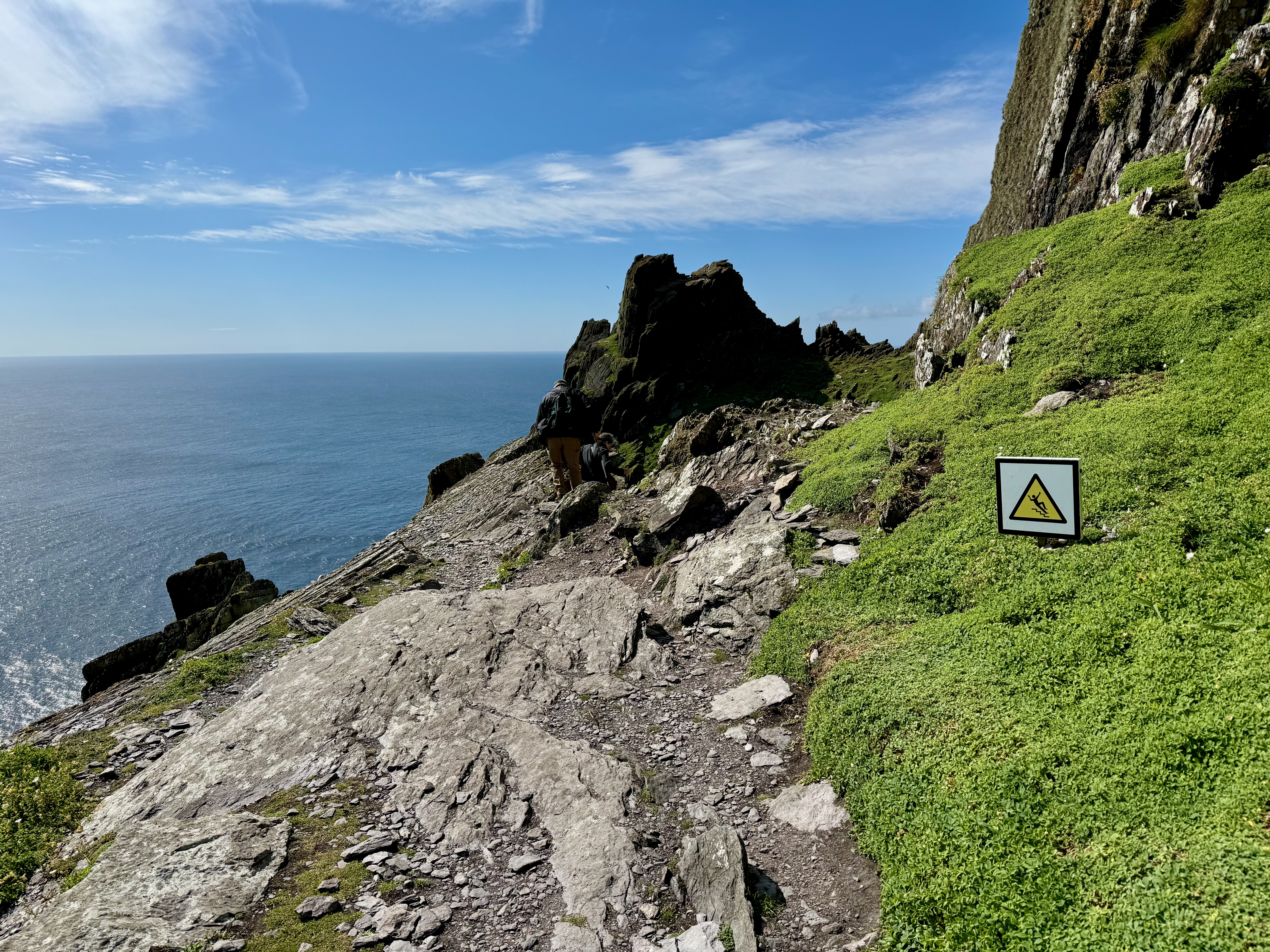
We particularly liked this arrow at a 90 degree turn in the path. Take one more step and you’ll die. Modest enough. True enough.

There were no guard rails. After last couple of Americans fell to their deaths, along the stretch below, the Irish government thought long and hard, but nixed the idea of safety railings. They did add that 12″ x 12″ warning sign.

The logic being railings would give visitors: 

“A false sense of security”

We did just fine. We’d seen far worse. Like Switzerland.

No trees. No shelter. An edge of the world experience.

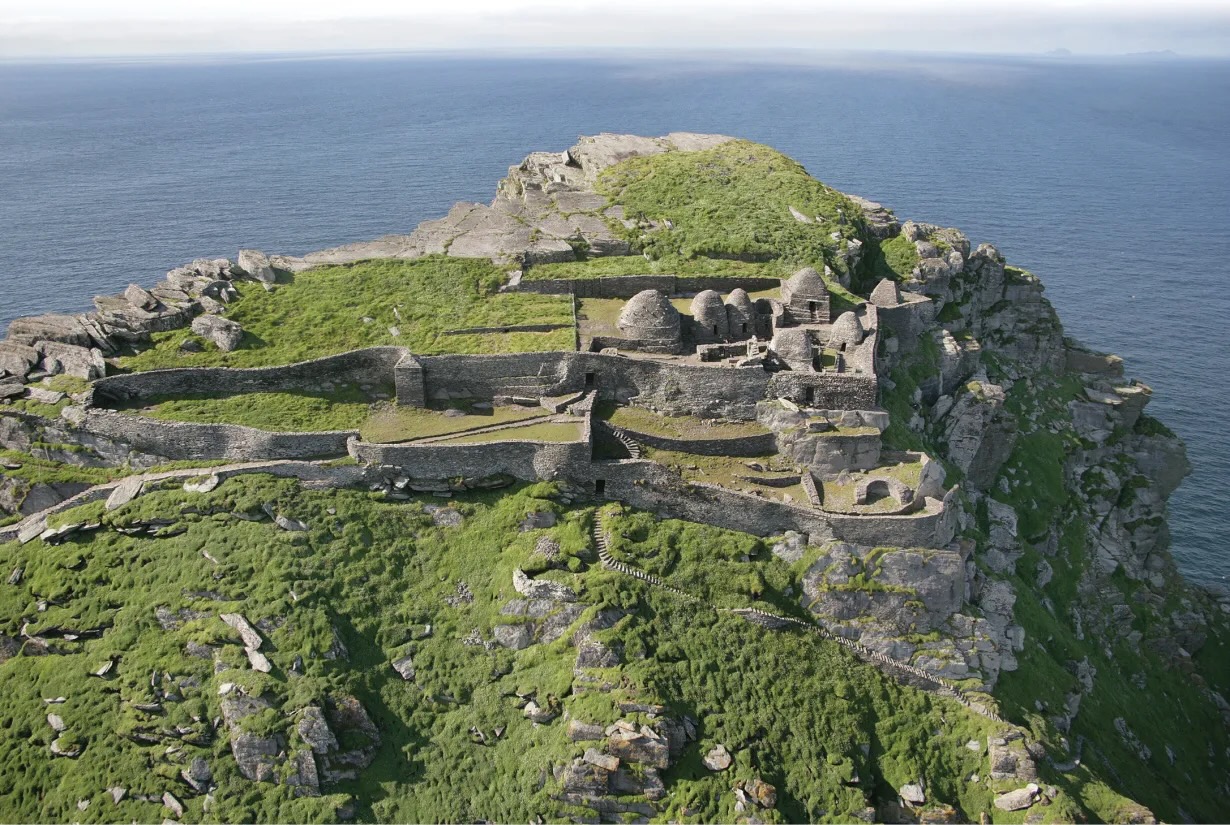
Aerial Photo Skellig Michael Monastery

“An incredible, impossible, mad place…

I tell you the thing does
not belong to any world
that you and I have lived
and worked in:  it is part of
our dream world.”
– George Bernard Shaw, from a 1910 letter.

Here is a short video – 7 minutes – of our visit to this tiny long-since abandoned monastic settlement.

There was a Christian pilgrimage group on the island at the same time as us.  

They were thrilled, “We’ve been praying for good weather for a year. And look at today.”

Indeed, it was most pleasant, warm and sunny. The previous 4 weeks had been miserable. Only 2 days suitable for landings. 

The next day our hard-nosed Irish taxi-driver guide Muiris asked us about our visit to Skellig Michael: 

“Did you feel closer to God?”

Actually, Yes. Though I’m not exactly sure what that means.

Remarkable place. Shaw had it right. Part of our dream world.

The Kings of Corcu Duibne

The Dingle and Kerry Peninsulas were once the kingdom of the Corcu Duibne in prehistoric and medieval County Kerry. Say about from about  the 5th to the 12th centuries. 

Curiously our trip ended up being from the northern edge of their territories to the southern edge.

The Corcu Duibne were tough, and accomplished, which is what you’d expect from the sponsors of Skellig Michael. 

These local Kings provided the skilled masons who built at least parts of the Machu Picchu-like dreamscape of Skellig Michael, its fantastic terraces and buildings. The Kings also provided some provisioning of food and mainland estates.

The Vikings plundered Skellig Michael and carried off the abbot Etgal, for ransom in 824. Etgal died and the kings of Corcu Duibne never forgot and exacted revenge, in due time.

****

Many think that the Corcu Duibne created the Irish Ogham alphabet. Over one third of all Irish Ogham inscriptions are found in what was their kingdom.

We never saw an Ogham stone. We got close though. Muiris explained that he couldn’t take us because the new owners of the property had cut off access. Here is a pic of the Ogham stone on the mainland opposite the Blasket Islands.

Photo Courtesy of Dr. Paul MacCotter

Translation is roughly: “Son of a Dog”. No doubt meant as a compliment.

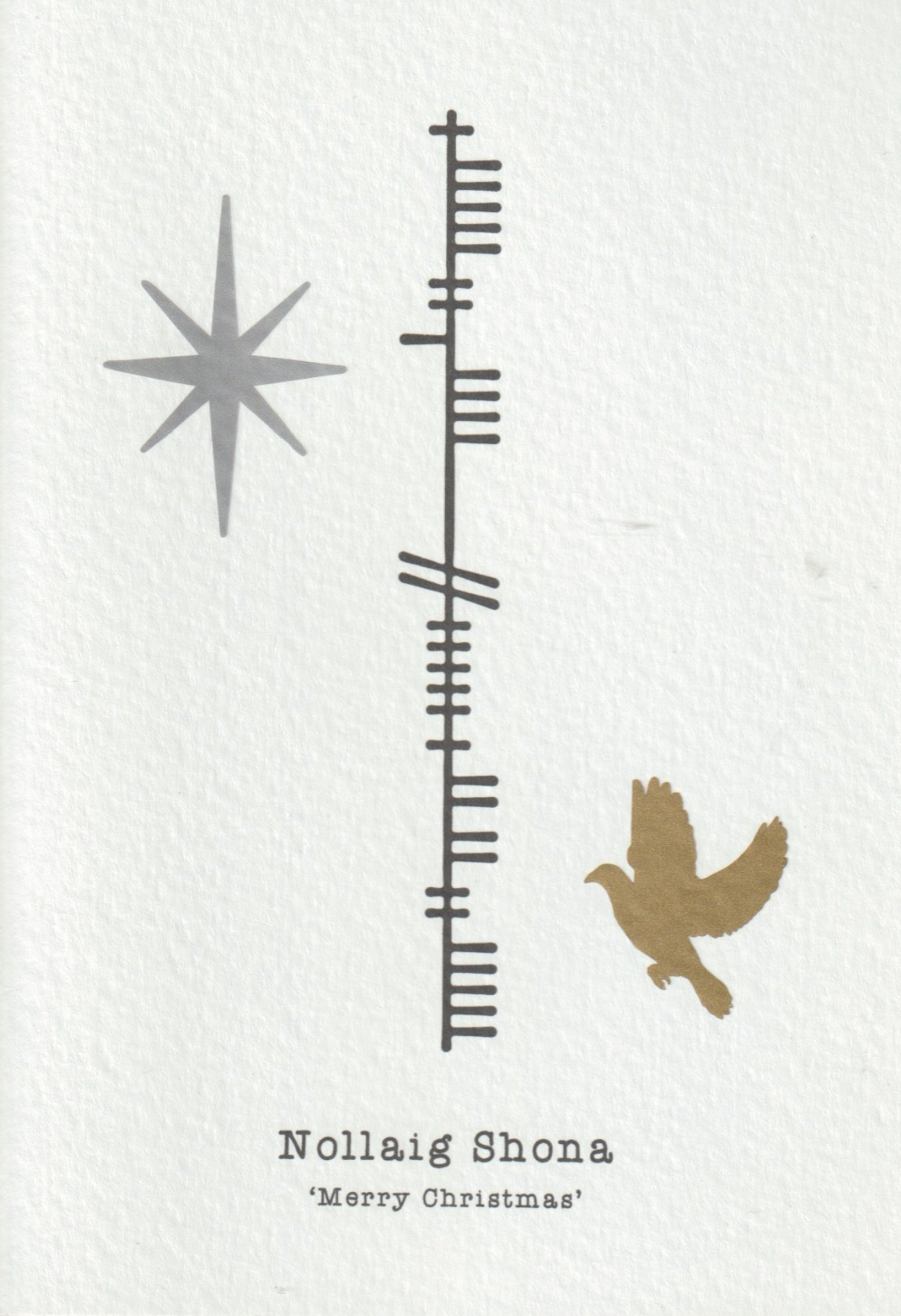
We found Xmas cards for this year with “Merry Xmas” in Irish and Ogham. 

As we were exchanging Cuban Flan for the bestest Greek Pastries at John & Nicks Texaco, Sharon explained to Paul how to read the Ogham on our card. She knew the marks.

“From the bottom up. Like Japanese…”

He was delighted.

“We have lots of Irish customers. I’m going to test them”

Suspect the Corcu Duibne would be pleased.

Tiz your round Dan!

We had another pass to cross on our ride from Portmagee to Caherdaniel, but I wasn’t particularly worried. No where near as intimidating as Conor Pass.

The predicted high winds got my attention though. 

Indeed they were gusting and swirling when we pulled out of town. When we made our turn onto the main road, it was clear we had lucked out. The winds were at our back. They pretty much blew us all the way to Caherdaniel. 

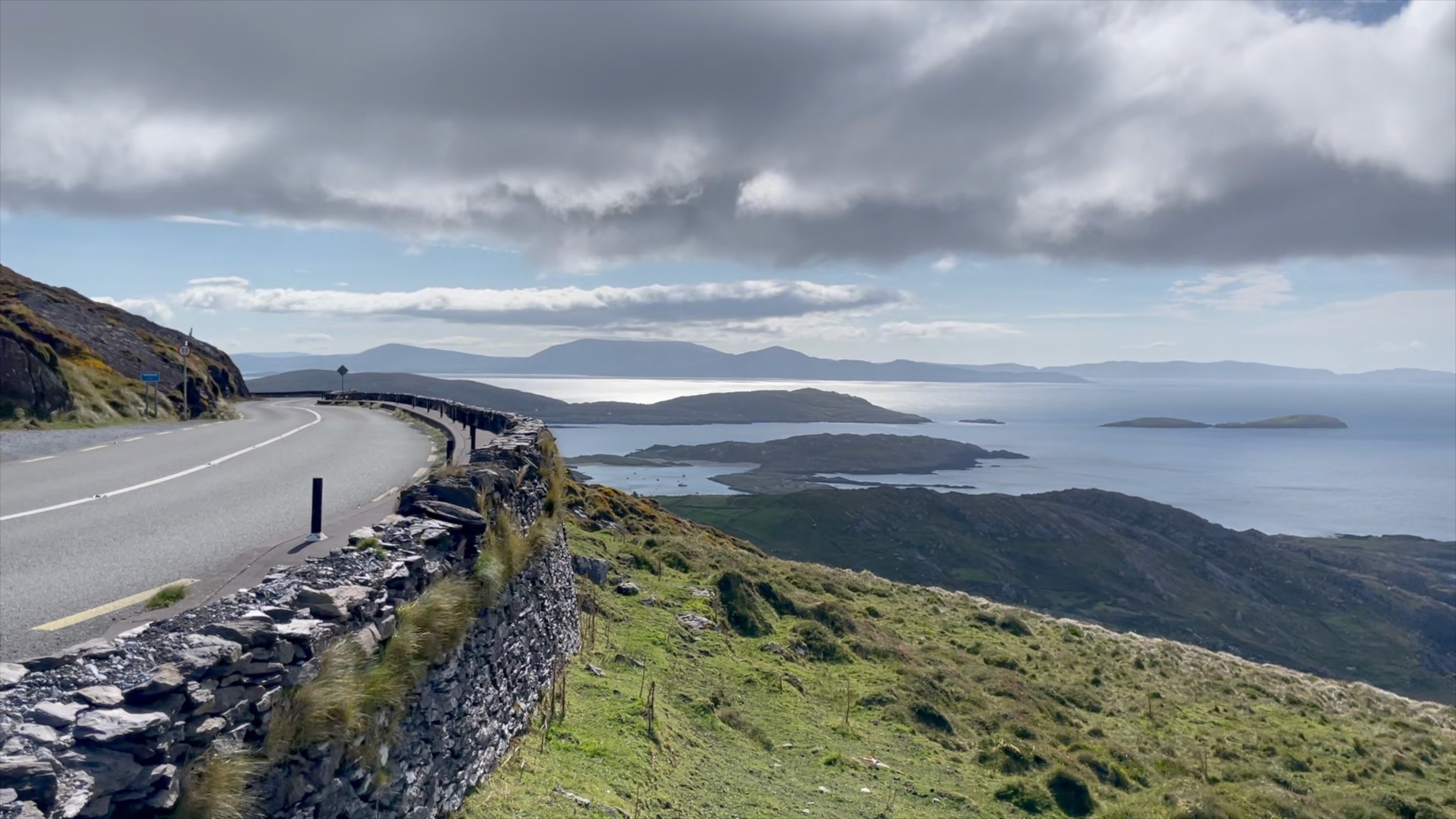
The view from the pass was spectacular.

We pulled off for photos. It was tough to just hold the bike up. Small price to pay though, for the favor of the wind gods. We coasted into Caherdaniel ahead of schedule.

I had reserved a room for us months earlier at the Travellers Rest Tourist Hostel. The proprietress Olivia had 3 hard and fast rules:

1. Cash only 

2. Reconfirm 48 hours prior to arrival

3. €3 extra if you want a towel.

No problem, and we went for the towels.

A charming place. A small house with a library complete with portraits of Beckett and Yeats. Curiously each and every of inns we stayed in, had libraries for guests. Major respect for the written word. 

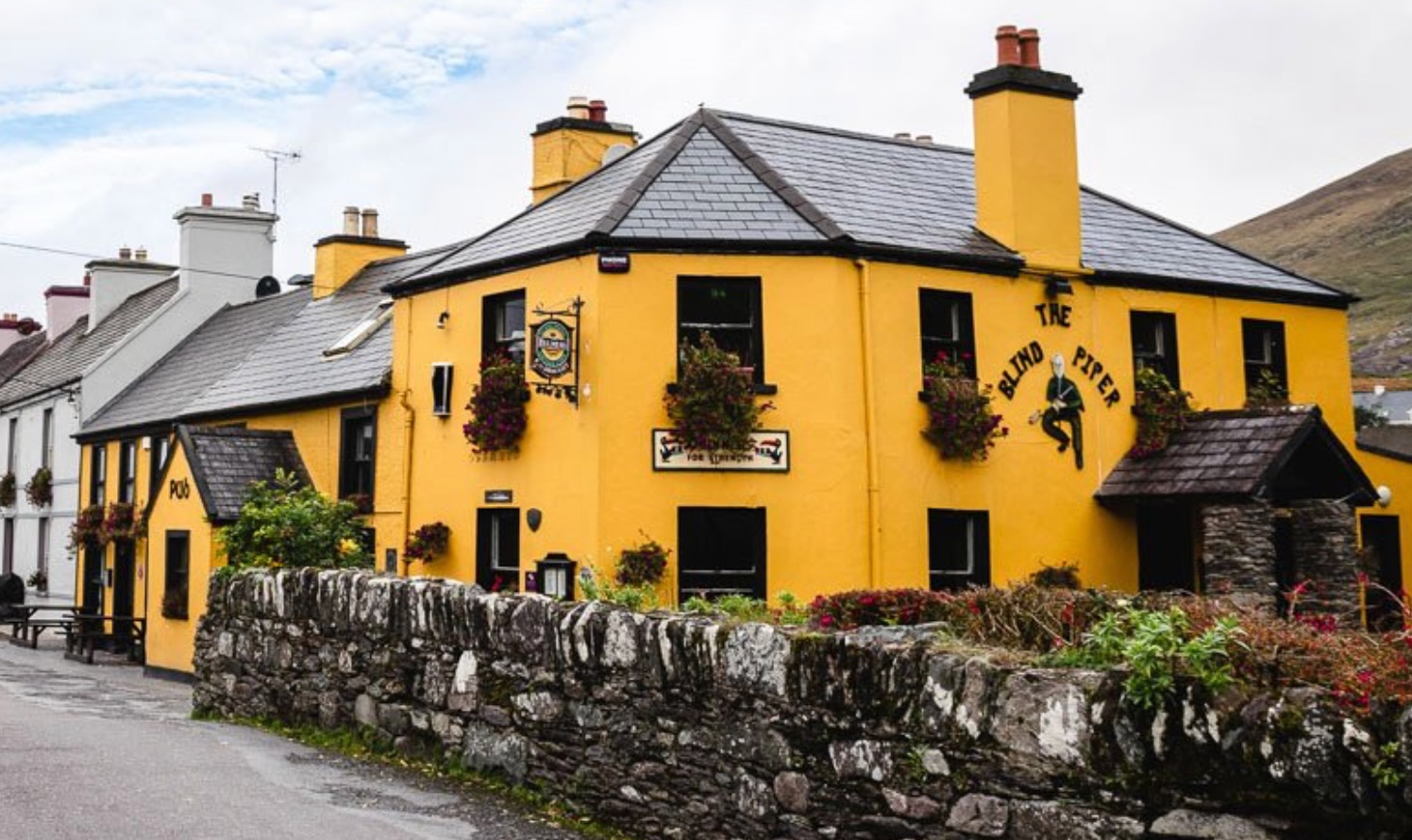
As this was a hostel, no meals were served. For dinner we walked over to the the Blind Piper, the only pub in town. 

The Blind Piper. Courtesy of the Blind Piper

The pub was named after Mici Cumba O’Sullivan born about 1835 in Castlecove, Co, Kerry. He emigrated to Massachusetts early in life, where he lost most of his sight. Later in life he returned to Kerry, a whiz on the pipes. 

We walked in a bit after 5, the bar and environs were full. We were directed to the empty dining room. Shortly thereafter we were joined by an American couple. Perhaps late 60s. They wanted hamburgers. 

They looked right out of a John Denver sound track. Thought to myself ,

“Sheesh”

We struck up a conversation. First impressions can be misleading. They were long distance hikers, doing it on their own, their way. We laughed about friends and family who’d be far more comfortable with us all lazing around a nice safe resort pool.

We get it. So do the actuaries. 

I tried to find insurance for our bike before this trip. Turns out we have aged out. Bicycling overseas is considered an extreme sport. Insurance is not available for the mid 70’s demographic. Extreme sports and senior citizens,

What could go wrong?

The photo below pretty much sums up The Blind Piper. I can identify.

Captioned from the Kerry News:

“Tiz your round Dan!… In Kerry an animal can be a man’s best friend and local Kerry farmer Dan Curran loves nothing better than to share a pint of plain with his horse following a hard days work in The Blind Piper Bar in Caherdaniel.”

Blind Piper Bar. Photo: Don MacMonagle 1994

No breakfast was available in Caherdaniel.  Olivia recommended a coffee shop in Sneem up the road. It didn’t disappoint.

Sneem Rolls

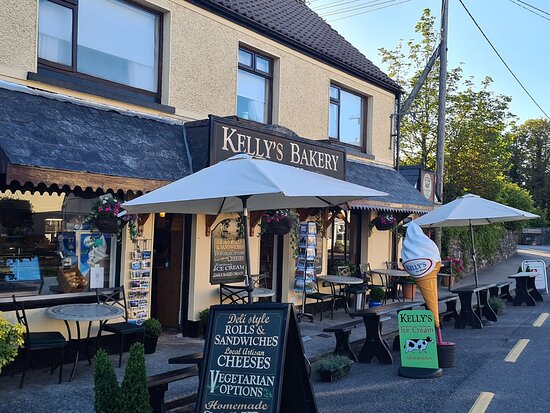
Kelly’s Bakery in Sneem is about as good as it gets. Run by the same family since 1955. 

Third generation Donal behind the counter, tipped us off that there were still a couple of Sneem rolls left, if we were interested. That would be a Yes.

Turns out a Sneem roll is homemade blood sausage mixed with Pork in a flake pastry roll. Served with red onion chutney. 5 star.

Second generation, Pauline brought our order out. I’d  guess 60s-ish. We hit it off.

“I was born in this bakery. Worked here my whole life. Next week I ‘m shutting down. Going to spend 4 months on the beach in the sun.”

We asked where she was headed.

“Mauritania, Azores, and Argentina.”

“It’s good to get [far] away, you know.”

Yep.

First generation Dan wasn’t around. Now in his 90s and purportedly still going strong. Bit of a temper though. Known to throw people out of the bakery if they rubbed him the wrong way.

“If you don’t like it, just get the [blank] out.”

To make it into your 90’s, a bit of an attitude seems to help.

The Fuchsia Coast and the Aos sí

I was vaguely aware that the Ireland’s climate was relatively mild, thanks to the Gulf Stream. 

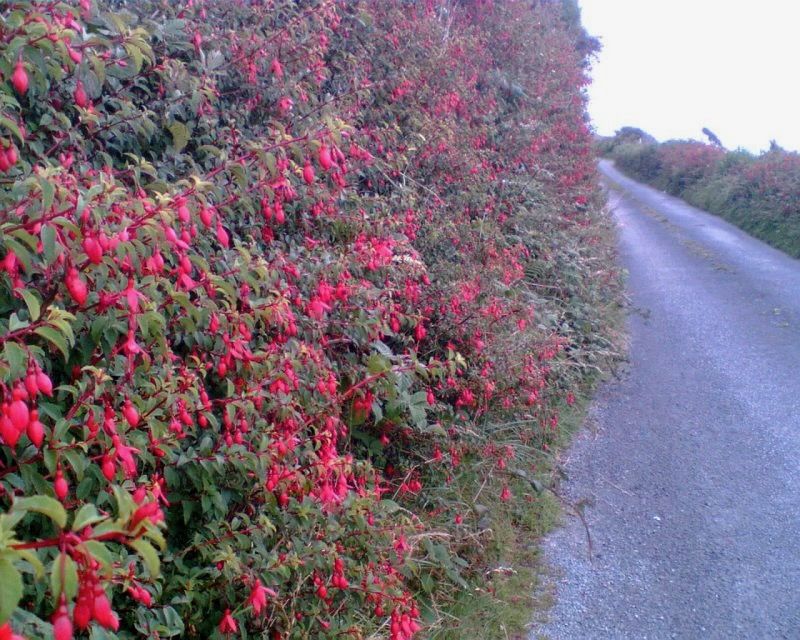
But the palm trees and hedgerows of fuchsia were definitely a surprise. A pleasant surprise.

Fuchsia Hedgerows. Courtesy of Deborah Barlow

Thanks to that same Gulf Stream, Ireland is also wet. The not always so pleasant side of a warm maritime climate.

We pulled into Kenmare, just ahead of the rain. Our hotel was the Brooklane, big, pretty new and well respected. 

The woman cleaning the windows directed us the the front desk. 

The front desk tipped us off, that the window washer was Una, one of the owners of the hotel.

Una also worked as a server. Covered the front desk, and the bar at times. She never let on she owned the place. Preferring to see how her enterprise was running from the ground up.

Una runs the hotel while her husband Dermot works the farm, about a mile down the road. Dermot makes his own pork sausages. Best I’ve ever tasted. “Champion of Ireland” good. 

Confirmed by the Fins Goustiers European Championships Certificate hanging in the hall.

After the win, Dermot explained, “We are situated two kilometres from the Atlantic, which gives our pork its unique flavour from the salt coming in off Kenmare Bay. The high salt levels and iodine-rich content of these plants and grasses that our pigs feed on make the muscle cells in the flesh retain more moisture so the meat is juicier and melt-in-the-mouth tender, a taste that has been largely forgotten in today’s mass produced pork.”

We looked for his sausages on the breakfast menu. They were there, but hidden away. 

We learned that all you had to do was ask for them. Were they that good?

Yes.

Our second night at dinner at the Brooklane Hotel, we noticed Olivia from our hostel in Caherdaniel, dining off in a corner with a friend. We let her be.

Another couple were enjoying themselves at an adjacent table. About our age or a bit older. Clearly still into each other. On vacation from the middle of Ireland.  

Yukking it up with their server. They wanted to change their sides around.

“No problem”

We added,

“Sometimes you just have to ask”

Laughter, And we got their story. 

He’s English. She Irish. He moved to Ireland many moons ago for her. No regrets. They loved that we were bicycling. 

“The best way to see this country.”

Down on holiday from Tullamore in central Ireland. Sharon piped up,

“Ah, the town were Tullamore DEW is made.”. 

Tullamore is a small town of perhaps 13,000 folks. DEW is an Irish whiskey with a long and storied past.

How Sharon knew about Tullamore and the whiskey, I have no idea. But I’ve long since ceased being surprised.

****

There were a couple of ceramic lighthouse-like towers in the stairwell. They were talking to me. I asked Uma about them.

“If you like them, Make me an offer” Completely in character. 

The artist was showing in a gallery in town.

The next day we walked over. Good Stuff.

Good but not great. And besides the crating and shipping would be more than the cost of the towers themselves, and no shipping guarantees.

Curiously a seed was planted for a trip to London next year. More on that Tower of Babel escapade later, if we go. 

Our next stop was Kenmare’s stone circle. One of the largest Stone Circles in South West Ireland built during the Bronze Age (2,200 – 500 B.C).

Truth-be-told, we were underwhelmed. Compared to what we had seen in England last year, this stone circle felt under-energized and domesticated.

Like Vermont when you’re used to the Rocky Mountains.

It wasn’t the stones fault. The site had been tourist-ified. Once they stood on a knoll with a view. 

Today views are blocked by a screen of trees and the stones sit on the flat. Grade has been raised for easier access from the adjacent parking lot.

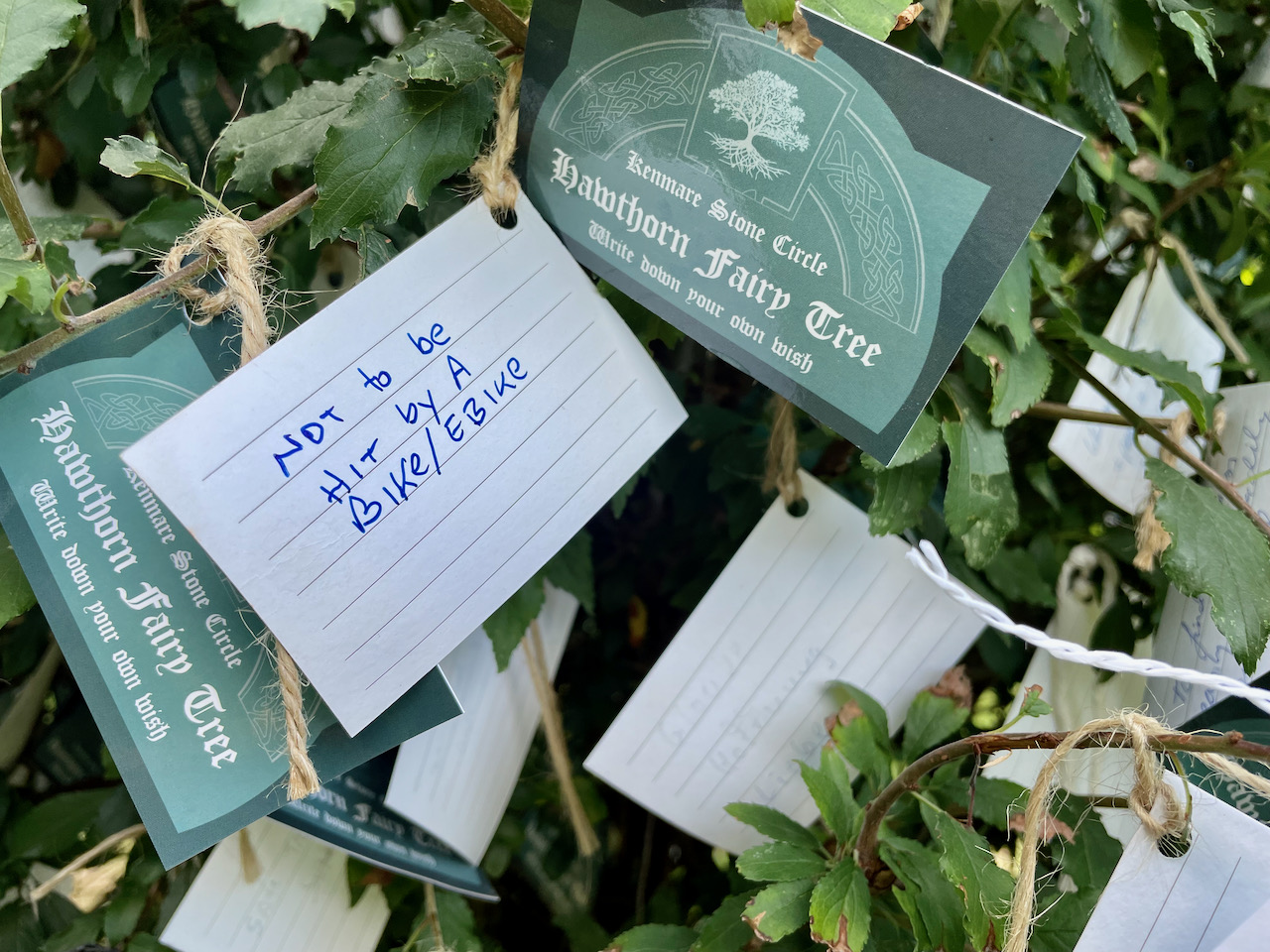
A Hawthorne Faerie tree has been added. You can buy pre-printed wish tags for €2.50. I couldn’t bring myself to buy one and besides I didn’t have a pen. On hindsight, suspect I missed an opportunity, to amuse the Faeries. 

My favorite tag:

Suspect this tree is going to be here for a long time. 

“Nobody cuts down a Hawthorn tree as it is believed that the tree represents a meeting place between worlds for mortals and that of the faeries in the other world. Indeed, many roads in Ireland have been diverted to avoid cutting one down.”

If I were to guess, I’d say the faeries, or more respectfully the Aos sí, find this 21st century dance of desires amusing. 

Irish faeries ≠ Disney fairies. They are old Celtic Gods from way, way back. To be respected and feared. Aos sí are fierce guardians of their abodes. Hawthorne trees are their favorites.

The  Aos sí are not to be messed around with. When crossed, they have been known to kidnap children, replacing them with changelings, and so forth. Dark, dark stuff. 

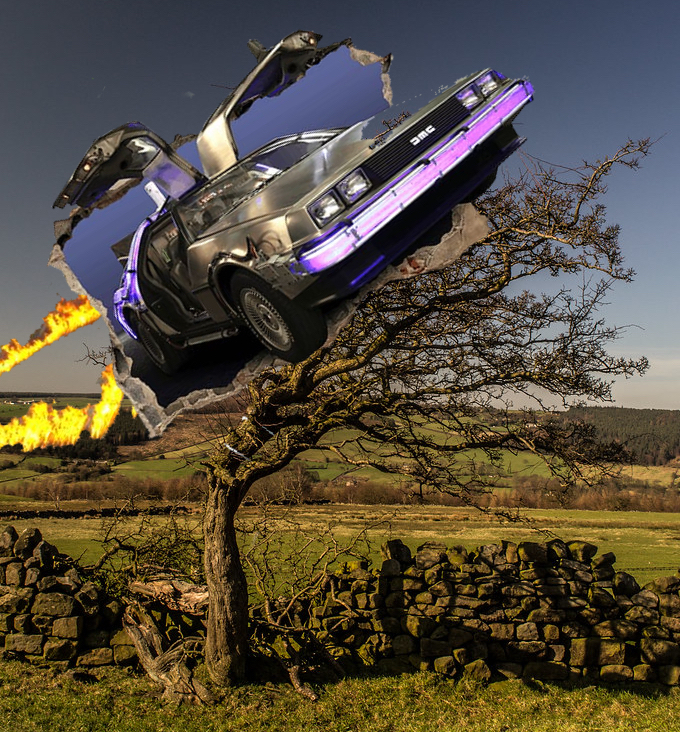
Back to the Future, An Aos sí Hawthorne Tree Story

Collage Courtesy of Blackthorn & Stone

Once upon a time, in the early 1980s, there was a flamboyant self-absorbed American who dreamed of fame and fortune. His name was John De Lorean. He came to Ireland to build his dream car.

He raised the money, found a site for his car plant, and lined up contractors. Time came to break ground, but a fairie tree stood in the way. No Irishman would touch it and risk the faeries’ wrath.

Mr. Pompous-ass De Lorean, was not to be deterred and personally drove the bulldozer which took out the Aos sí’s tree. 

Bad idea.

Shortly thereafter, his company went bankrupt. And he was busted in a $24 million drug deal gone bad. 

Just to twist the knife, his car went on to be a movie star. Mr. De Lorean went on to ruin. 

Don’t mess with old magic.

****

It was time to pack up the bike and head home. Our friends at the front desk said we could use the breakfast area once the space was free at 11:00 AM. It was a 2 Guinness job.

Yes, it all fits into the two cases. But barely.

To make our flight home. We needed to leave before breakfast. We asked if we could have breakfast early. But of course. With sausages? But of course.

All we had to do was ask.

Sharon and I chatted about our friends from Tullamore. They were headed to Helen’s Bar in Tuosist on the adjoining Beara Peninsula. They were most enthusiastic and encouraging.

We could do another trip starting in Kenmare, cycling along the southernmost Fuchsia Coast to Cork. Our first nights stay would be in Helen’s Bar. We could track down some Ogham stones. Easy Peasy. We know the drill now.

But the world is a big place and we aren’t getting any younger. Next up will be London and Kyoto in 2025. Then likely San Gimignano in Tuscany and a Sharon Sicilian roots trip. Prince Edward’s Island is calling too.

Vamos a Ver. We shall see.
2024 In Search of the Manatees

I’ve been been getting acquainted with Tampa for going on 50 years. It’s Sharon’s Home Town. She gets another 25+ .

Between us, you’d think we’d have seen it all. Au contraire.

Only scratching the surface. It’s all in the perspective and framing of the experience. Little did I know of the Mayan connection, Circus Freaks, or Confabulated Pirates.

Sharon’s Mom lived just north of Little Havana. Ybor City was on the family circuit. We’ve been to uptown, and downtown Tampa.

We’ve been South to Sanibel and the Everglades. Inland East to Winter Haven and Orlando, North inland for kayaking on the Hillsborough River and bicycling on the Withlacoochee State Bike Trail.

But we’d never simply gone due West to the Gulf, nor had we explored up the Gulf Coast. Which is what this trip was about. 

Neither of us had ever even seen a Manatee.

If not now, When?

Manatees are curious beasts. Been around for something like 50 million years. Somehow they’ve made it to 21st century Florida. Strip malls, speed boats, coal-fired power plants and all. 

The time to see Manatees is in the winter, when temperatures dip into the 50s. The perfect time to escape Boston is in January, when temperatures drop below freezing.

We chose three hotels, and explored out and around from each: 

  • Safety Harbor Resort and Spa put us across the bay from Tampa and within striking distance of St. Petersburg and Clearwater. Manatees sometimes are seen from the docks.
  • The Hacienda Hotel in New Port Richey is up the coast from Safety Harbor and close to ground zero for Manatees
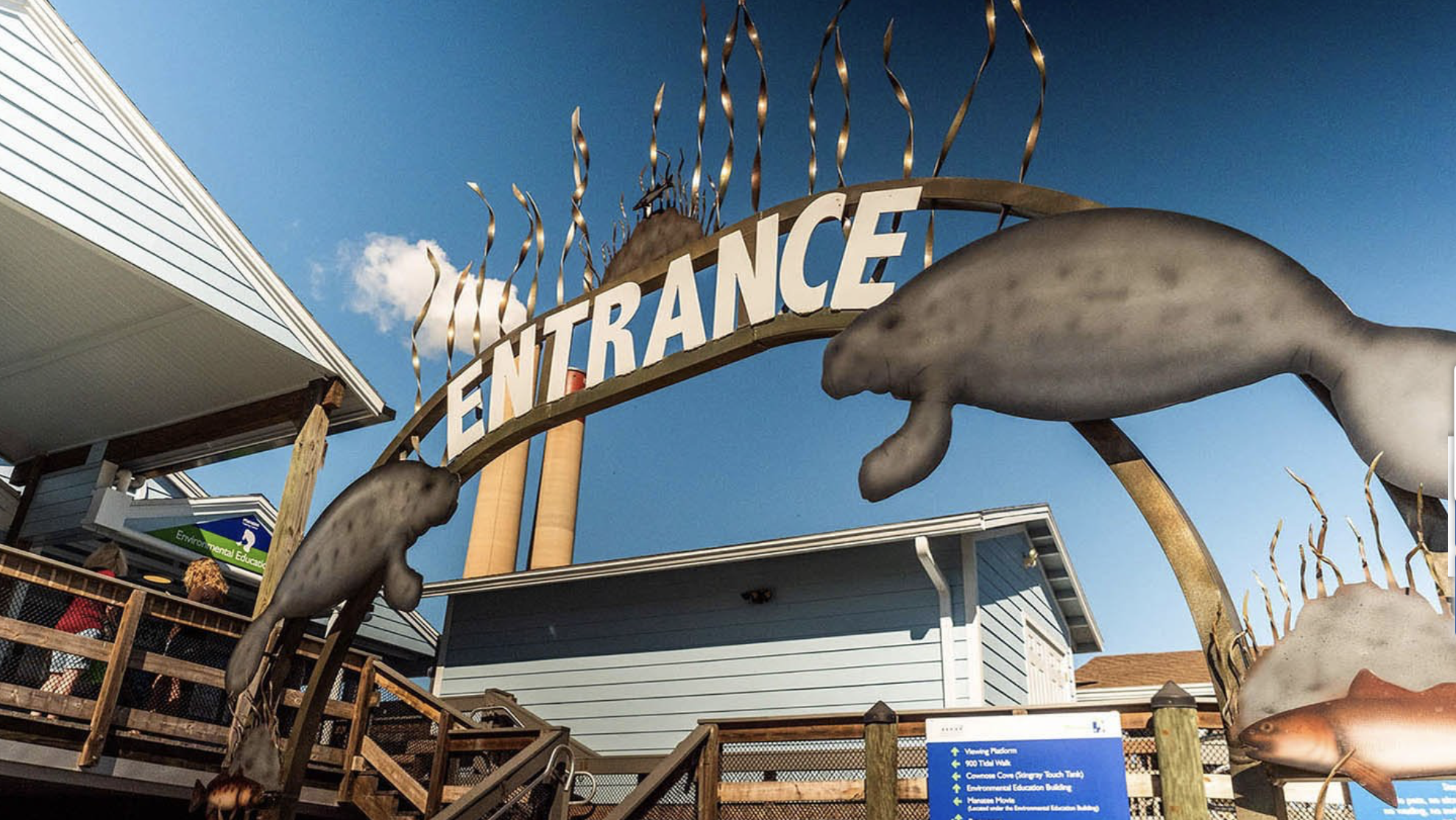
  • The Epicurean Hotel in Tampa, a favorite of ours. A foodie hotel in an artsy Tampa neighborhood. From the Epicurean, we could revisit old haunts and visit the TECO Manatee Viewing Center. 

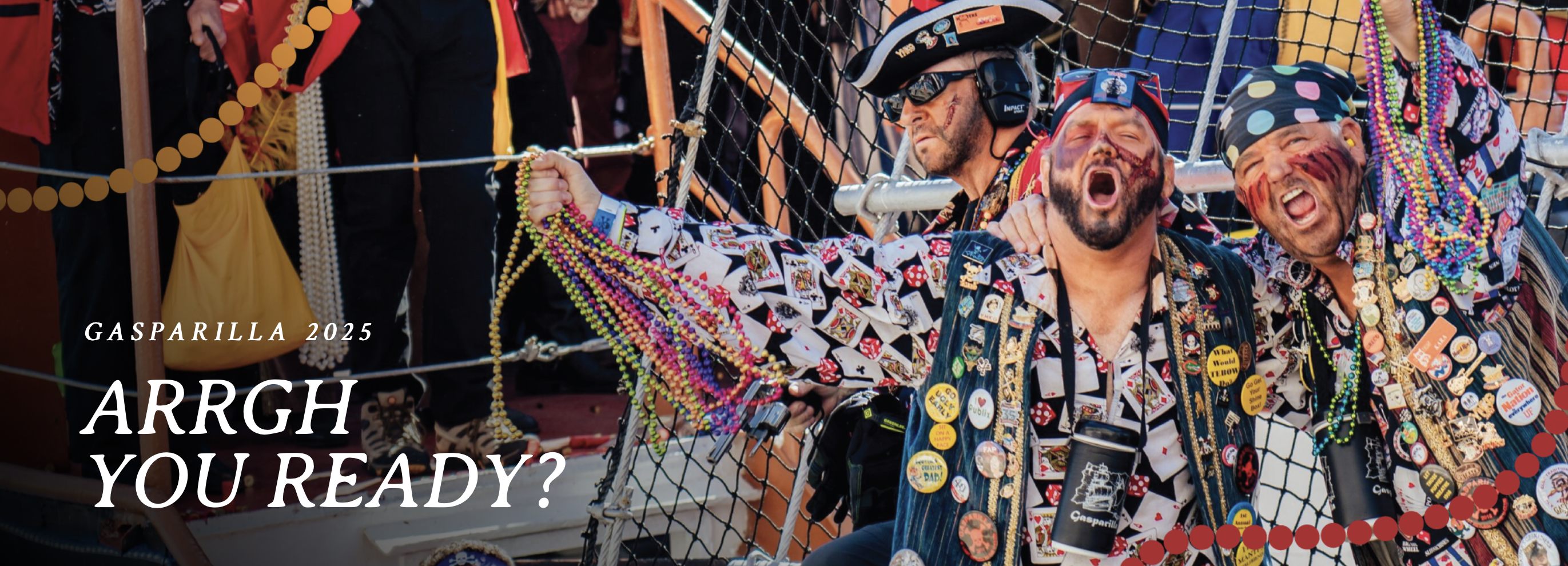
And as an added bonus at the Epicurian, we would be in the middle of Tampa’s Gasparilla Day. Tampa’s answer to New Orlean’s Mardi Gras. 

Safety Harbor Resort and Spa

When we landed in Tampa, we knew the drill. We’d done it enough times.

Sharon stayed with the suitcases outside of the baggage claim, while I headed for the car rental, only a short shuttle train ride away. I looped back and we loaded up. 20 minutes later we were pulling up at Safety Harbor Resort and Spa.

I had discovered Safety Harbor bicycling the previous Spring. A semi-moneyed enclave nestled up against the Bay just across the Courtney Campbell Causeway. Known affectionately locally as the Red Neck Riviera:

The Florida Heritage Landmark Sign out front of the Safety Harbor Resort caught my eye.  The Espiritu Santo Springs here were named by the Spanish explorer Hernando de Soto in 1539. He believed he  “had found the legendary Fountain of Youth, somehow missed by Ponce de Leon.” 

Too good to be true? Well, Yes.

For starters, Ponce de Leon wasn’t looking for the fountain of youth. He just wanted $$$. 

The whole fountain of youth thing was made up by a Spanish historian back in the day, who hated Ponce. He figured that such a goofy story would discredit the guy.

In a curious karmic twist, the historian’s machinations cemented Ponce’s name in the history books.

While Hernando de Soto did indeed visit Tampa Bay in 1539, his 900 men + war dogs didn’t wipe out the local Tocobaga people in Safety Harbor. They wiped out their cousins across the bay.

We checked in and headed for our room. I had tried to reserve in the historic wing, but had waited too long. As luck would have it, we ended up there anyway.

We were on the second floor. Tiny elevator. We looked at each other. Would the tandem – once assembled – fit? As it turned out, Yes, with the front wheel off and the bike vertical. Not the first time.

We woke to sunrise over Tampa Bay. 

Bike assembly day. But breakfast first. 

On the way to the coffee shop we hit the historic photos. Pretty great stuff.

The oldest were from the 1910s when the site was a classic Florida roadside attraction. 

Espiritu Santo Spring 1910s

“Famous Mineral Water. Cures Rheumatism, Diabetes, Bladder Troubles, Brights Disease, Digestive Disorders”

I particularly like the guy hanging out on the porch and the word “Cures” in extra big letters.

The “Waters” are still a big deal. The spa downstairs is sort-of world famous. 50,000 square feet. Which no doubt includes the swimming pools. All spring fed.

The couple next to us at breakfast in the coffee shop, wanted to know if the water on the table was from the spring.

“No, that would be extra”

We weren’t worried. The cooler outside our room was 100% Espiritu Springs water. It never ran dry. We drank a lot. And our bicycle water bottles just fit for filling. 

Today the Espiritu Springs water is filtered. They say back in the day it had much more character. Sulfur overtones. But it is still pretty great. Clean and clear. 

Did I feel younger? Healthier? Perhaps, for a moment here and there.

We got to know the head maintenance guy. Came from Chicago over 20 years ago. Has been working here ever since. Recently lost a good friend, still in Chicago.

His friend was a cop and was shot in the back of the head, sitting in his patrol car.

Our maintenance guy loves the resort. Knows all the stories and the workings of the place.

I asked him about the spring flow. 

“Millions of gallons/day”

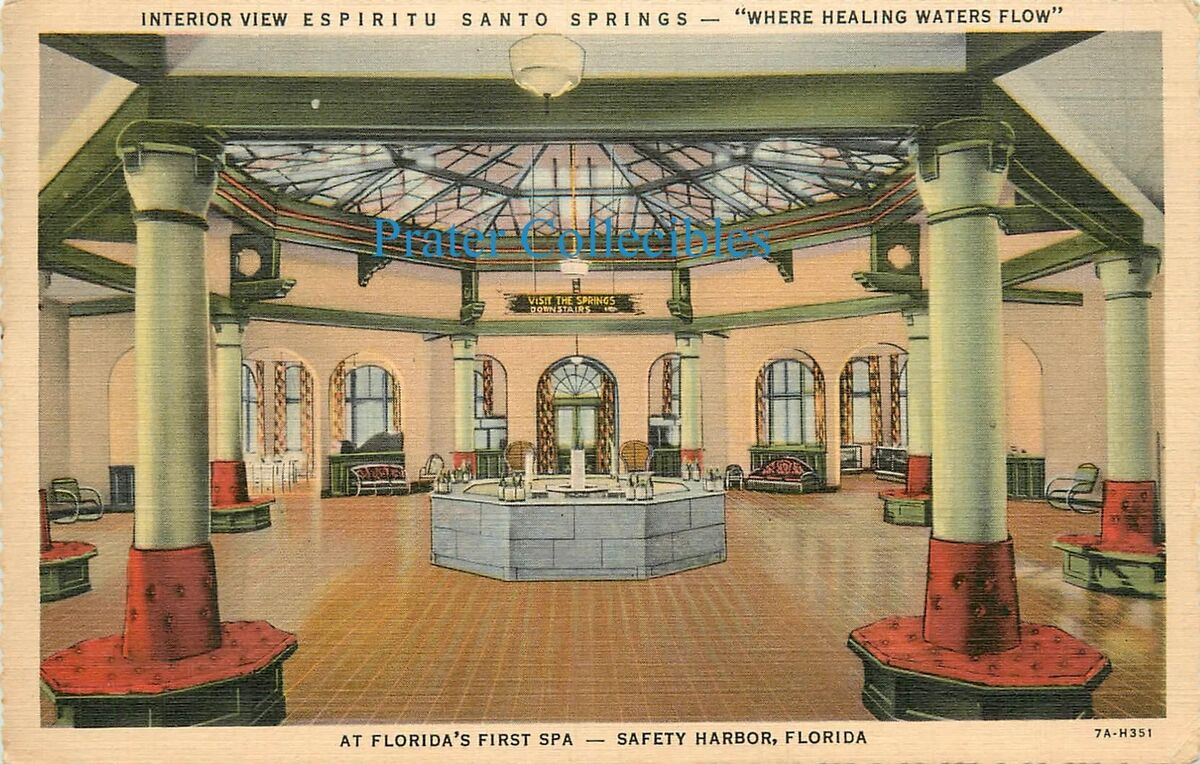
“The spring is artisanal. It just bubbled up. Back in the 1920s, You’d arrive and there was a spring-fed fountain in the middle of the room to greet you.” 

I figure this fountain was roughly where the domed ceiling mural is today, at the beginning of our St. Petersburg bicycle video below. 

Today the spring comes up to the side of the lower Spa entrance and is piped off from there. The featured spring fountain in the lobby is just pretend.

You’d never even know this real deal historic spring was here unless you had a maintenance buddy.

Standing there was a curious 21st century spiritual moment.

St Petersburg

We’d visited St. Pete before, but had never visited the Dali Museum. This was our opportunity. The museum is located on the downtown St Pete waterfront, a short drive south.

“With the exception of the Dali Theater- Museum created by Dalí himself in his hometown of Figueres in Spain, the St. Petersburg Dalí Museum has the world’s largest collections of Dalí’s works.” World class. New, big $$, fancy-pants building too.

The plan was to get a lift via private transport to the museum and then ride back to Safety Harbor via the Pinellas Rail Trail. Which is pretty much how it worked out.

We found our transport through the resort. An airport shuttle just for us. Mr. Tandem just fit. Our driver was from the British West Indies. Not surprisingly, his English was good. We chatted about politics, and fruit trees. 

He dropped us off at the Dali Museum. We locked up our bike and headed in. 

Exterior of the Dali Museum

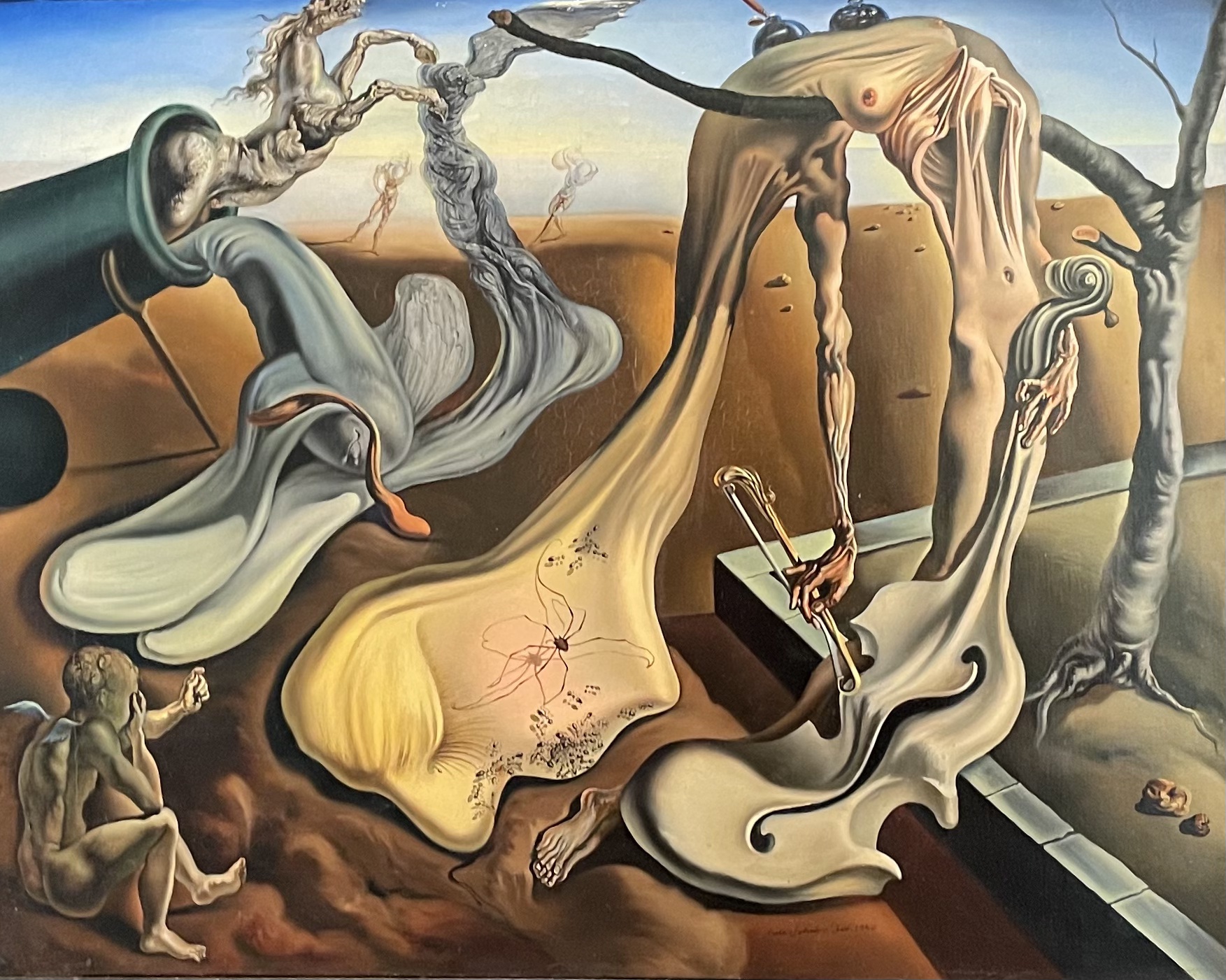
It took Sharon all of about 5 minutes to figure something wasn’t right with Dali. I can’t remember visiting a museum where she didn’t take a photo. On this visit she took none.

Zero. 

Her take on this famous painting, 

“Sick”. 

Probably true, but well done. Evocative and not derivative, like much of his later work.

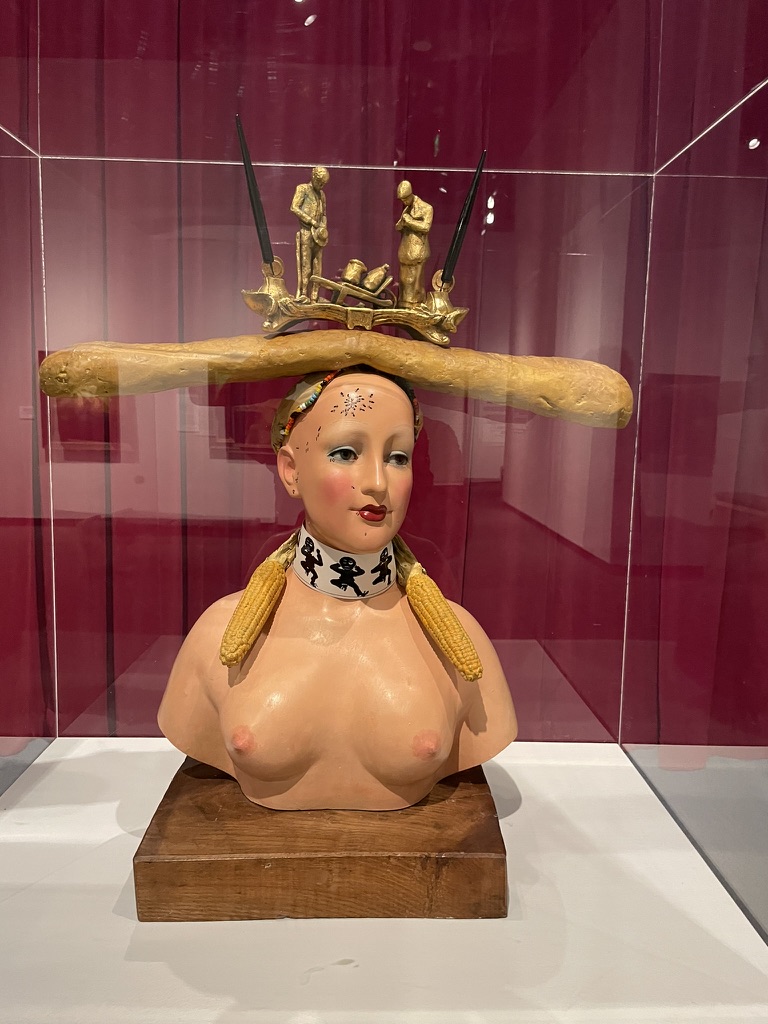
I took a lot of photos. My favorite piece, Retrospective Bust of a Woman 1933:

Pretty brilliant. 

On the way out we stopped at the Café Gala. “Light Fare with a Spanish Theme.” Named in honor of Salvador Dalí’s wife, Gala.

Had some good food and a fun conversation with the guy behind the counter. He has been wandering the world. Spent a year in Europe following the band Hiatus Kaiyote around. An Australian Jazz Funk Band. He was thinking of heading to Asian next. We talked about Japan and the Shikoku Pilgrimage. 

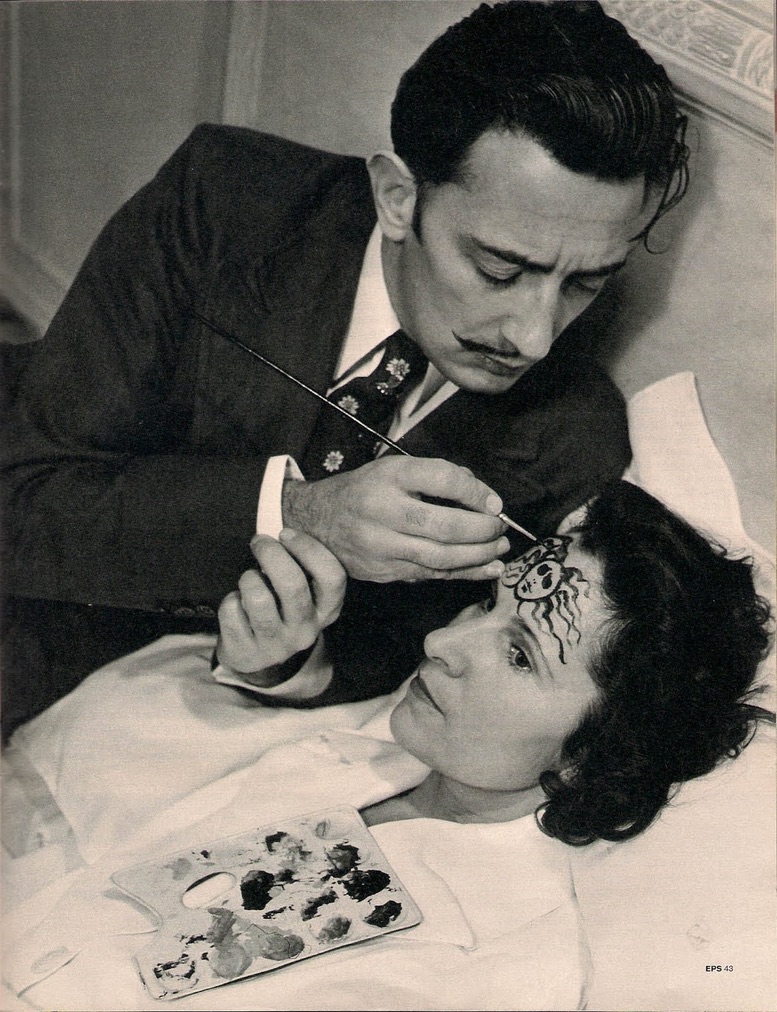
We didn’t talk about the Café’s namesake, Gala. Boy was she a piece of work. Given her proclivities and personality, it’s curious she has any café named after her.

In retrospect, it’s telling there were no photos of her on the walls.

No one ever referred to Dali’s wife Gala as sweet or light fare. 

A demonic dominatrix, Yes.

Could she have really been as bad as all that. In short, Yes.

As the Paris Review puts it,

“At her best, Gala was difficult and intense. At her worst, she was nothing short of monstrous. She had no friends and maintained a malevolent distance from her family. Described as “cruel, fierce and small” and having “eyes that pierced walls,” she collected stuffed toys but once cooked her own pet rabbit. Her “demonic temper” asserted itself often; if she didn’t like someone’s face, she spat at them, and if she wanted to silence someone, she would stub cigarettes out on their arm. Not surprisingly, she was hugely unpopular.”

The stories go on and on.

“Women particularly disliked her. Gala was sexually voracious and had no respect for other people’s relationships.” 

“The filmmaker Luis Buñuel, who, with Dalí, made the seminal short film “Un chien Andalou”, got so sick of Gala’s insults that he once tried to throttle her.”

A demonic dominatrix, Yes. But a lifelong Muse

Salvador and Gala had an open marriage. He was devoted to her his whole life. Yes, there were some kinks. See his paintings.

Stories have it that his thing was to watch. Worked for both of them. 

That said Gala was his life-long favorite subject. His muse.

At the end of their lives Salvador bought Gala a castle, but had to send a written request to visit. Gala had a harem of male lovers.

Back at the bike, no deflated watches, but we did have a flat tire. We pumped the tire back up and headed back to Safety Harbor via the Pinellas Rail Trail. Pressure held.

Click on this Video Link for our Ride. Don’t miss the weight lifters in slo-mo a short ways in. Very Florida.

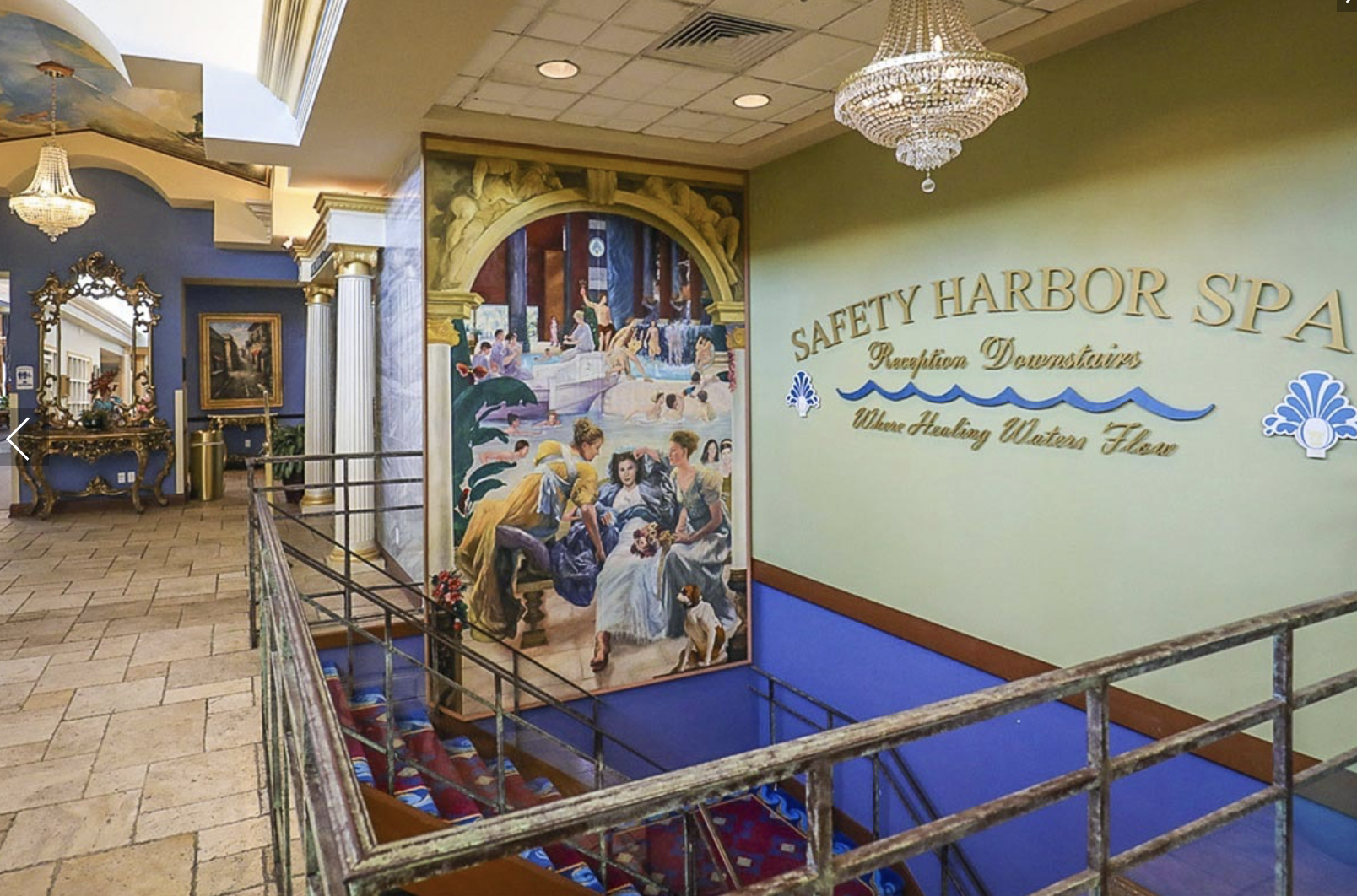
We had dinner at the Resort. We went with the Greek appetizers and entrees. Remarkably good. Our waiter explained that the current owners were Greek. Which explained both the quality of the food and the interior aesthetic of the hotel lobby.

Gold and Blue with shiny stone surfaces. Murals with half naked women. 

We knew this schtick. Many moons ago we had Greek neighbors. Same aesthetic. They had topped theirs off with a mirror on the ceiling over their bed. 

Today’s hotel dates back to the 1920s. Florida was booming. The first Florida real estate bubble. Big money and deep-pocketed tourists.

The story goes that folks from New York City moved down to the resort for the winter. They’d even bring their furniture. But didn’t always want to bring it all back home. The choicest still populate the common areas.

In those times Tampa Bay came right up behind the hotel. The waters were shallow and it took a half-mile long pier to get out to where the ferries from Tampa could dock.

Today these shallows have been filled. 

We walked across those wide flat lawns the next day in search of Manatees.

We made our way out onto today’s truncated pier. We had heard Manatees regularly visit. We checked both sides. To and fro. No Manatees.

Then we heading up shore to the Mangrove boardwalk. 

Mangroves

Just up the shore a bit we hit the Safety Harbor [Mangrove] Nature Walk. I never get tired of this stuff. The 2500 foot boardwalk runs through the mangroves and along the edge of Tampa Bay. 

Mangroves are salt tolerant shrubs and trees that are adapted to live in harsh coastal conditions. They contain a complex salt filtration system with wonderfully complex root systems.  

They thrive in the intertidal zones along marine coasts. Salt water/ fresh water mixes are their specialty.

They do not grow on land, and they don’t grow in the oceans. Mangroves only flourish in a narrow fringe of suitable in-between geomorphology, which is Florida’s specialty. Mangrove forests only grow at tropical and subtropical latitudes near the equator because they cannot withstand freezing temperatures.

I always forget that Tampa is the subtropics.

The Everglades is the largest mangrove forest in the Western hemisphere.
The Everglades are only a days’ drive south of Tampa.

50% of Tampa’s Mangroves have been lost, but that still leaves a whole lot. Survivors of days long gone.

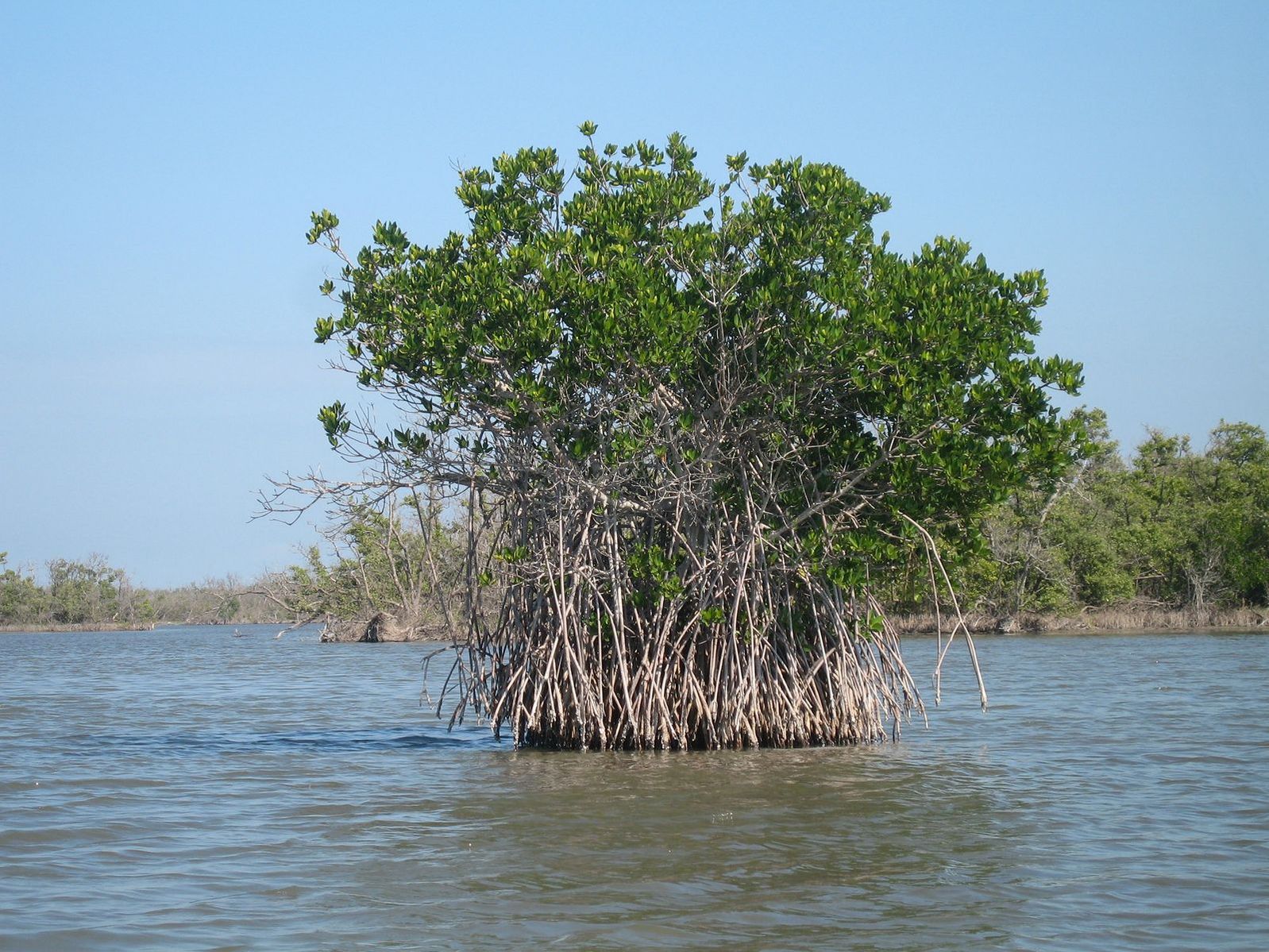
Red Mangrove in the Everglades. Could be Safety Harbor Boardwalk


Politics

One day last summer we were bicycling outside of Concord MA and struck up a conversation with a gentleman out walking his dog. He and his wife have a second home in Sanibel FL, a lovely town with shell beaches south of Tampa. Feels a bit like Berkeley CA, with hills swapped out for beaches and eucalyptus trees swapped out for mangroves.

“A great town we know well,”  we offered.

He agreed with one qualification, 

“The only thing wrong with Sanibel is that is in Florida.” 

We all laughed … knowingly.

So what’s wrong with Florida? 

You could start with the low-end strip malls which paper the state. Gun shops, pawn shops, strip clubs, churches. All mixed together. Same one story buildings. 

There was a billboard for a plastic surgeon, as you came out of Publix Market in Sharon’s Mom’s neighborhood: Two words with a picture. Not much left to the imagination: 

“Brazilian Butt”

And then there’s the politics. Florida  has become a poster-child for a “Red State.” To my mind, more stereotype than reality. But then again, Tampa is “Blue.” 

Sharon has always said that races mix more easily in Florida than Massachusetts. As a Latina, she should know. Her family came in all shades. A dash of Arab, a drab of Senegal, Benin and Togo. Voilà.

It took me 20 years to appreciate Old Florida. The Florida from before the malls. Usually hiding in plain site. The cigar rolling factory now self storage, or a restaurant from back in the day. 

And it’s taken another 20 years to get a feel for what the area might have been like pre-1800s. Before Westerners rolled over the local native cultures.

This was the world of Mangroves, Manatees and Native American Mounds.

Mangroves are easy and obvious, Manatees and Temple Mounds, not so much. They’re there, but you have to look.

On our way to New Port Richey we stopped by the Temple Mound just up the way a couple of miles from Safety Harbor at Phillipe Park, the largest remaining mound in the Tampa Bay Region.

Great Fung Shui. Views across Tampa Bay. This Temple Mound was built by the Tocobaga peoples. Abandoned in the 1500s after contact with Spanish. Days long gone. Lethal politics long gone.

New Port Richey

Our next stop was New Port Richey, an hour’s drive north.

We picked New Port Richey because it is close to the northern end of the Pinellas Rail Trail. We could bicycle south. It’s also within striking distance for ground zero for Manatees. Crystal Springs and Homosassa Springs Wildlife State Park.

Last but not least Sharon’s parents once owned property in New Port Richey, sold many moons ago, but I’ve always been curious. Sharon’s dad Joe grew his little nail long to deal from the bottom of the deck. Not a guy to be trusted. But perhaps a good guy underneath it all.

Joe’s father came from a small town in Sicily, Santo Stefano Quisquina. Sounds like a family roots trip. We shall see.
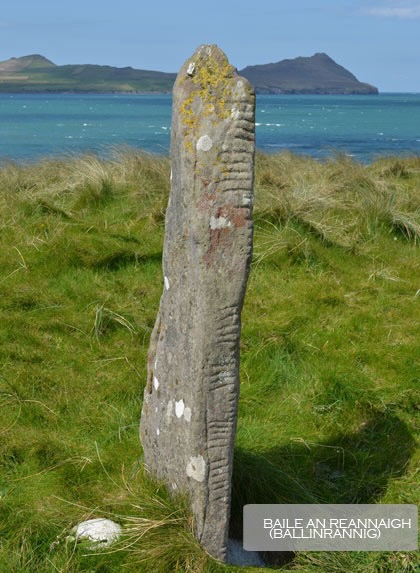
Our hotel in New Port Richey, The Hacienda, once again, dated from the 1920s. The wild west of Old Florida. Various promoters were pushing New Port Richey as the Hollywood of the East Coast. It didn’t come to pass, but not for want of trying.

Gloria Swanson had a place in town. Rumors of scandalous New Port Richie behavior still linger.  

Today Gloria has a parking lot named after her next to the Hacienda. The ripples are fading out. Kind of like old-time hardcore rock which has become today’s elevator music. 

Homosassa Springs Wildlife State Park

Homosassa was one of our slam dunks for Manatees. It didn’t disappoint. 

An hour + north of New Port Richey, today it is owned by the State of Florida and run as a wildlife refuge. Care is provided for Floridian wild critters large and small, who can no longer fend for themselves. 

There is even a Manatee ICU. 

This wildlife refuge had been a famous roadside attraction up to 1989 when the state took over.

Featured were exotic animals, including Hollywood stars. 

The most beloved, last-man-standing, was Lu the Hippo. Lu short for Lucifer was born in 1960, and was moved to Homosassa Springs to join the Ivan Tors Animal Actors. 

Lu starred in Hollywood films, including “Cowboy in Africa” and “Daktari” and the TV shows “Art Linkletter Show” and the “Herb Alpert Special.

In 1989 when the Florida Park Service took over the park, all non-native beasts were moved – out of state. Except for Lu.

The Governor made Lu an honorary Florida citizen. 

And so Lu today is the one and only Florida hippopotamus , and lives on at Homosassa Springs as the oldest hippo in North America.

During our visit, he looked bored and old. So it goes.

On a quick sweep around the boardwalk we saw black bears, red wolf, Key deer, flamingos, whooping cranes, and eagles. The rain was starting to beat down when we arrived at a manatee viewing spot. We had arrived.

Matatees all around. Water was on the murky side.  I looked down and someone was looking back up at me. 

Crystal River River Archeological Park

The next day was Crystal River day. Again, about an hour’s drive north on US Highway 19. Three Sisters’ Springs is famous for Manatees.

In scoping out the area, I noticed an “Archeological Park” nearby, featuring Native American mounds. Curious. We decided to make it our first stop. Easy peasy. Good choice.

Off the strip mall of Highway 19 we turned left just after the Crystal River Church of God next to the Denny’s, and just before the Ford dealership. 4 minutes later we arrived at the Archeological Park, a 61-acre, pre-Columbian site on the the shores of the Crystal River and overlooking an expansive coastal marsh.

Great Fung Shui. No doubt why it was chosen 2500 years ago as a special place. One of the longest continually occupied sites in Florida, believed to have been occupied for 1,600 years.

Perhaps it was this good karma that saved most of the main temple mound from the trailer park next door. In the 1960s, the temple mound ramp and about one half of the temple mound itself was grabbed for fill for trailer park expansion.

Round about then the site was donated to the Park Service. Probably a story there.

In any case a close, close call. 

We pulled into the mostly empty parking lot and headed into the museum, the only access to the site beyond. 

Modest place. Great exhibits. Not in the staging or the objects per se, but in the interpretation. 

Orthodoxy explains the sophistication of the finds here, pottery etc, as dribble down from eastern North America principally the Hopewell Culture located north in the Ohio River area. 

These exhibits hinted at another explanation: Seafaring Mayas. Referred to by some as “the Phoenicians of the New World.” Only now getting the respect they deserve. These Putun Maya of the Gulf lowlands got around.

Which explain the Mayan glyphs on pottery recovered from the mounds.

On Columbus’ fourth voyage, in 1502, journals describe a Mayan canoe measuring 8 ft wide and 50 ft long, propelled by 25 paddlers and carrying both passengers and cargo. 

Forgotten Voyagers. Re-creation.

The Caribbean isn’t all that big. For such a 50 foot long vessel, Cuba was no problem. Nor would Crystal River be.

Curiously Sharon’s Mom’s genome has traces of indigenous Cuban DNA and Central American (Mayan) DNA. Perhaps one her forbearers arrived on one of these oceangoing mega-canoes.

The view from the top of the main temple mound was outstanding. 

Click on this Video Link for Crystal River Archeological Site with the view.

I could see the the ghosts of the big Mayan canoes approaching. 

This is the year, I seem to be turning into something of a ghost myself. They say the average age at which invisibility begins occurring is 52 for women and 64 for men. Sounds about right. Apparently at 73, I can now achieve complete invisibility.  The shock seems to come when I uncloak or re-apparate. It’s an unconscious thing.

It started in the UK at the very end of  the Ridgeway. 

A couple were wild camping out of their van just off the road. I greeted them as we walked by, perhaps 10 feet away. The guy just about jumped out of his skin. I made a joke about how perhaps I was a barrow wight or some such, and had just appeared out of thin air. 

He did laugh, but with a tinge of nervousness as he pulled himself back together.

Then there was the Jamaican delivery guy. I saw him through our front door shades and went out to the front stoop to see if he had something for us. He was photographing a delivery to our next door neighbors. I stood there waiting until he was done. He turned and froze in shock.

In New Port Richey. I went across the street from our hotel for an early coffee. The sky was just lightening up. I opened the door and walked in. The young woman facing me at the counter was fiddling with something. She nearly fainted, when she looked up and found me waiting patiently. First customer of the day. 
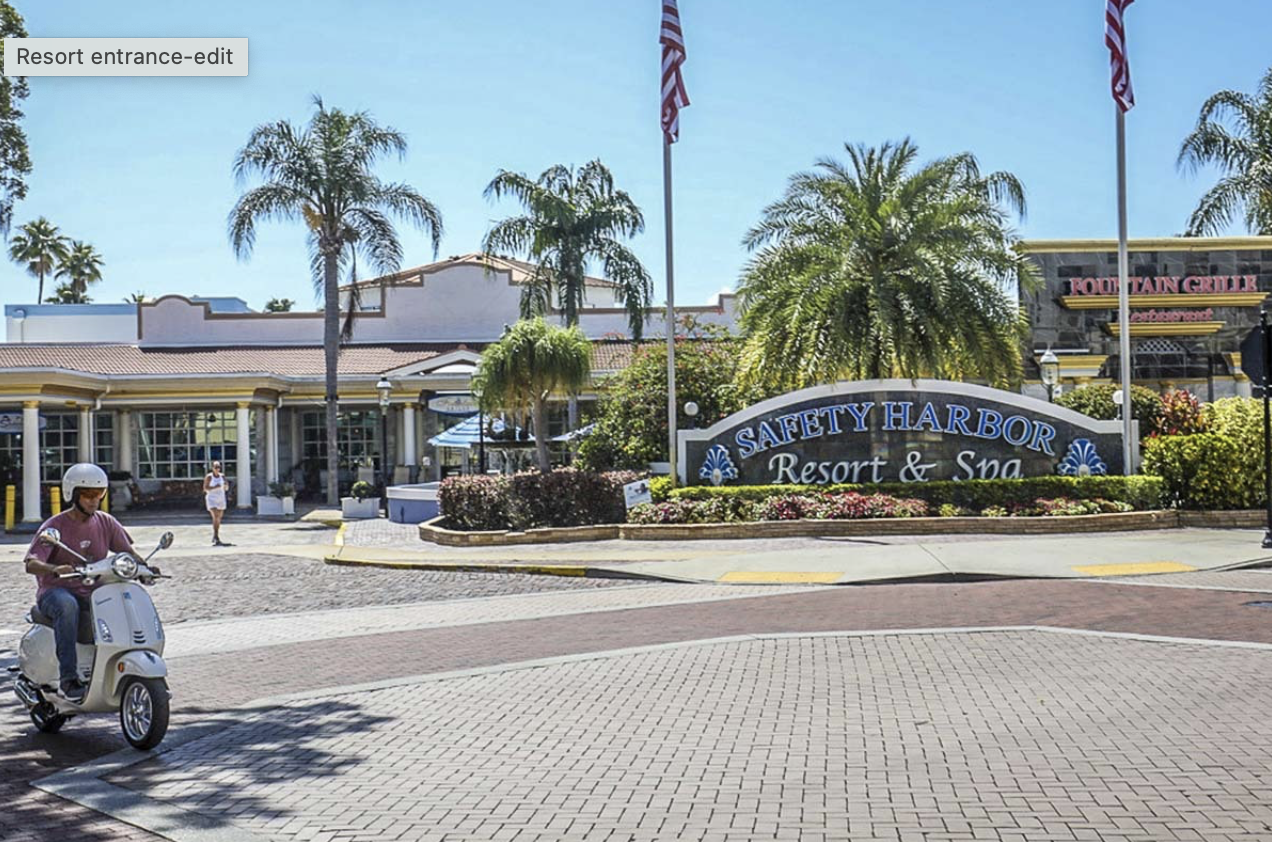
And here at the Crystal Archeological site, on our way out, Sharon and I walked up behind a couple of women studying an informational sign. She turned, saw me 2 feet behind her and went white. 

She stammered, “I heard you come up, but there was no shadow, so I figured no one was there” 

Sharon says it’s all my Japanese sneakers, but I’m not so sure. It doesn’t explain the missing shadow.

Eating Manatees

The Crystal River National Wildlife Refuge Visitor’s Center is a bit out of the way, we stumbled in trying to find the official parking lot for the Three Sister’s Springs. 

It was brand spanking new and filled with great Manatee exhibits. And staffed with volunteers.

An earnest, seemingly-sweet, elderly guy comes out from behind the desk and asks if any of us have any questions. So I ask him innocently enough,

“Did the indigenous people hereabouts eat Manatees?”

He blew a gasket. 

“Of course not. Manatees don’t hurt anyone. Why would people kill them? And the meat isn’t any good anyway, there’s no fat. And Manatees have thick skins, they’d be impossible to kill with arrows.”

He turns to his wife,

“Right Dear”

“Right.”  She says shrinking and edging away.

Not knowing when to stop, I add,

“Well I’ve heard that when times get tough indigenous peoples and locals have eaten Manatees to get by.”

“Not true. That’s simply not true. No one eats Manatees. They are sweet creatures.”

I decide it’s time to let this one slide, before he has a heart attack. In the pause, he growls

“I’m here to help the Manatees, not to encourage people to eat them!”

He and his wife wander off, and I make my way to the cash register to buy my Manatee stickers. The woman behind the desk, adds in a low voice,

“They did eat Manatees”

Manatees

Manatees are curious beasts. Their closest living relatives are elephants, and hyraxes. 

Best book on Manatees according to the woman behind the desk

50 million years ago their forebears walked on land. Today Manatees spend their whole lives in water, preferring calmer rivers, estuaries, bays and canals. Fresh, saltwater or brackish, no matter. 

They have two forelimbs, called flippers, with three to four nails on each flipper. 

The absence of hind limbs and streamlined bodies are the result of millions of years of adaptation to their watery environment.

Like elephants they have very thick skins and prehensile snouts, which like elephants, allows them to grab things. 

Hyraxes, found in Africa and the Mideast, look a bit like large rabbits but with sensory whiskers mixed with their fur all over. 

Manatees have no fur, but they do have the sensory whiskers – over their entire bodies. Basically they are covered in tiny antennae.

Manatees are big, gray, slow, vegetarian, and oddly have no natural predators. Which seems counterintuitive for a beast the size of a cow which has no way of defending itself. 

Swimming with the alligators, no problem. Apparently manatees are too big, and their hides too thick to bother with. Sharks aren’t an issue as manatees mostly keep to shallow waters 3 to 6 feet deep.

Like other mammals, manatees breathe air. They are champs at holding their breath. Up to 20 minutes.

They are warm-blooded, and as tropical animals, very sensitive to cold, showing signs of cold stress in waters less than 68°F. Florida is about as far north as they come and in winter why they can be found around warm springs and power plant warm water discharge. 

Manatees sleep a lot too. Like 50% of their lives. Manatees sleep underwater. As they sleep they rise to the surface every 2 to 20 minutes to take a breath –  without waking up. Or at least half of their brains don’t wake up. It’s called unihemispheric slow-wave sleep. Dolphins do it too.

They move like a dolphin in slow motion. They can swim upside down, vertically, and can do somersaults and barrel rolls, thanks to their tail fluke.

This round, flattened paddle-shaped tail, is rather mermaid like.

The top half, not so much. 

On January 9, 1493, Christopher Columbus, sailing near what is now the Dominican Republic, saw three manatees. He mistook them for mermaids. And added,

“Not half as beautiful as they are painted.” 

“Not everyone was quite so dismissive. A hundred years later, the English explorer John Smith reported seeing a mermaid, almost certainly a Manatee. It was “by no means unattractive”, he said, but I’m not so sure.
It’s just possible Mr. Smith needed to get out a little more.

Three Sisters Spring

We got our directions to the Spring proper. Not far. Just off US Highway 19. Ticketing was handled in a temporary pop-up space at the end of a dying strip mall.

A bit surprising given the Spring’s world class reputation. But this is Florida, and Manatees weren’t really fashionable until lately.

Three Sisters Spring had it’s own near death experience and not that long ago. 

In 2005 it was purchased by developers who were going to develop the 57-acre property for 300 homes and a water bottling plant. Permits had been pulled. 

Sometime soon thereafter, the lead developer rescued an injured manatee and had a change of heart, “This is not a Disneyland kind of place. It’s the real deal.” And sold to conservationists. 

Supporting infrastructure in still a work in progress, but the springs themselves are pretty much picture perfect. 

No Manatees at the Springs so we continued on. They had congregated at the entrance to the springs waiting for high tide to swim in.  

Click on this Video Link for the Three Sister’s Spring with Manatees.

Tarpon Springs

The town of Tarpon Springs is at the north end of the Pinellas Bike Trail, about 10 miles south of New Port Richey. We drove down, parked in Craig Park, unloaded the bike, waved to the Manatees and rode south on the Bike Trail towards Duneden. 

There’s a lot going on at Craig Park, in a very, very low key kind of way. A lot of history too. 

Today, above water, it’s a modest small community park with grass and a concrete walk at water’s edge around a stub of water off the Anclote River close to the Gulf of Mexico.

This stub of water is known as Spring Bayou. Bayou because it’s slow moving and off the main course of the river. Spring because there is big spring down there. Hence the Manatees. 

This is the Spring that Tarpon Springs was named after. Story goes that Mary Ormond, the daughter of one of the early settlers, named her tiny two-cabin settlement “Tarpon Springs “ after the giant Silver King-Tarpon that jumped and splashed in the bayou. The name stuck.

Today you’d never know the spring was even down there. But down there it is. And a good ways down. Like 125 feet down. I would have guessed depth at 10 to 20 feet, which it is in some parts before the drop off. Not a clue above water of the drama below. 

Except for the Manatees and Dolphins.

Nor clues of the drama of days gone by. First settlers settled here in the late 1800s. Log cabins gave way to mansions in short order. The neighborhood was known as the Golden Crescent. A neighborhood of Tycoons and Artists. 

Shallow-draft steamboats would tie up in Spring Bayou. 

Another mineral health springs/ health resort story:

“On the east shore of Spring Bayou, just below tide water, a mineral spring was discovered. It is not clear what the analysis of this spring was, but those who drank the water seemed to derive great benefits from it. The spring was curbed and housed with a pagoda and became a favorite loitering place for invalids and old veterans, who spent the time reminiscing, telling what they knew–and possible some things they didn’t know. At any rate, Tarpon began to acquire a reputation as a health resort; probably the change of climate and balmy air had much to do with the healing of weak lungs and overworked nerves of some who came from cold climates.” 

I suspect that the pagoda referenced above is the building behind the steamboat in the photo above.  Which is the lead in to my favorite Tarpon Springs story. With a joke and punchline for the ages.

From R. F. PENT’s  1964 “History of Tarpon Springs : In the late 1880s:

“A very tragic affair happened late one afternoon. Major Marks and Mr. Connolly got into an argument in the Tropical Hotel; hot words were exchanged and Connolly ran to get his revolver. Marks made his escape through the door, or window, before Connolly could return. When he did, he ran out on the front porch, looking up and down the street for Marks. It was twilight and visibility was poor. A man by the name of Cork was coming up the street and Connolly, thinking he was Marks, fired, killing him instantly.

My father was present at the inquest. Mr. Connolly, after spending some time in jail, was freed by the courts and given his liberty. Connolly bitterly repented this rash act and later became a minister of the Gospel. 

This is a very strange coincidence you say. Yes, indeed, but “with God all things are possible.” 

Stranger still, a very grim joke grew out of this affair. The saying became current that: 

Tarpon [Springs] was so healthful…, that …

“Someone had to be killed in order to start a cemetery”

In tragic context, black, black humor. The Tarpon leaps.

Duneden

Many say that the ride from Tarpon Springs to Duneden is the most scenic stretch on the Pinellas Bike Path. 

I’m not going to argue. Our Go Pro was acting up, so no video. Maybe next time.

Dunedin is a place I’d like to come back to. I’m not sure we are done with Tarpon Springs either. 

I routed us to Strahan’s Ice Shop in town. It didn’t disappoint.

Dunedin is a popular destination. World class beaches and deep pocketed Europeans will do that. 

We walked our bike back up Main Street to the Bike trail. Lots of tourists and slow traffic. The bike path crosses Main Street in the center of town. See photo below.

We walked the turn onto the Bike Path towards Tarpon Springs and we getting ready to take off, when we struck up a conversation with two guys sitting on a comfortable new bench. About our age. Had lived here forever. Local locals.

They had it figured out. Good town. The world comes to them. Sunshine. Music festivals, Farmer’s markets, Nice restaurants, Microbreweries, and Baseball. 

Dunedin is the Single-A affiliate of the Toronto Blue Jays.

Just don’t let you grass grow too long. The town fined one guy $30,000. He had been out of town. $500/day adds up.

Tampa

Our last stop was the Epicurean Hotel in Tampa. We’ve stayed here before. A Foodie hotel. Towards the high end but worth every penny.

We had hoped to visit Burns Steak House across the street. World famous and not easy to get reservations. We had solved that with a Epicurean special package. Unfortunately it wasn’t meant to be. 

We had followed up on a restaurant tip from a fellow we met while watching the Manatees in Spring Bayou. Food poisoning.

The Epicurean is in the Hyde Park neighborhood of Tampa. Only a few blocks from Bayshore Boulevard… and the annual Gasparilla Day festivities. 

Gasparilla Day is Tampa’s Mardi Gras. Curious in its own way. A big deal and a big, 300,000 + [people] draw for Tampa. We had no idea, we would be at ground Zero with front row seats.

Not our kind of thing. But here we were.

South Howard Street out front was closed down early. Our room was on the second floor. Late morning, we peered down as streams of folks headed over to Bayshore for the parade. 

Drinking had started early. The party was well underway. 

Early afternoon we headed over ourselves.

Gasparilla Day is named for the pirate José Gaspar. c. 1756 – 1821. The festival is a re-enactment of a battle between Gaspar and American forces that occurred in Tampa Bay in 1821. Gaspar won the day. And being a Robin Hood sort, spread the treasure. 

Or so it is said.

“Until about the late ’60s or maybe early ’70s, the press [and history books] still operated on the basis that this was a historical event,” says Charles Arnade, distinguished professor of international affairs and history at the University of South Florida.

But it was all a tall tale. Fakelore, if you will. But even Fakelore has a story. 

This one starts with Panther John. The alter ego of José Gaspar, or more properly put, vice versa.

Panther John lived in a shack with his wife on otherwise uninhabited Panther Key, a small spit of land, in the ten thousand islands south of what is Naples today. A nobody in long lost, old Florida world. 

Panther John Gomez

Panther John was an expert hunting and fishing guide. And he relished the tall tale. 

When the census folks could catch up with him, he’d spin one up. One time he was born in the USA in 1828, another time France in 1785, Portugal in 1776 or in Honduras in 1795. And there were supporting back stories.

Often involving his alter ego, Pirate José Gaspar. Sometimes he was the pirate’s cabin boy, another first mate, and closest to the truth, he sometimes dropped hints implying that he was José Gaspar himself living under a false name. Entirely true in confabulated kind of way.

In the early 1900s the Gasparilla Inn Resort in the town of Boca Grande needed a hook for tourists. They ran with one Panther John’s story of José Gaspar and printed it up a brochure.

Gasparilla Inn’s Brochure

The rest is history.

As the Boca Grande’s Historical Society puts it,

“Gaspar, the Pirate, an entirely fictional character created for tourists’ sales promotion purposes in the early 1900’s, overcame the best containment efforts of historical research and explication, and like Collodi’s “Pinocchio,” came to life.”

In 1904 officials in Tampa inspired by the brochure, added their tall tale of Jose Gaspar’s Pirate invasion of Tampa. The idea was to juice up their May Day festival. That they did with a new and improved storyline: 

José Gaspar, fought the USA navy in Tampa Bay, prevailed and turned Robin Hood distributing the wealth. 

“Pinocchio” José Gaspar took his first steps towards legitimacy, when history books picked up the story without double checking sources, and listed Gaspar alongside real Florida pirates like Robert Searles, Henry Jennings, and Francis Drake. 

In the meantime, the business elite in Tampa were partying it up. Play-acting the pirate invasion, receiving the key to the city and having an annual parade. Modeled after New Orleans’ Mardi Gras. Beads and all.

The May Day celebration had morphed into a white guys’ pirate themed dress-up frat party.

Some have rightly wondered: “What is it we’re celebrating exactly?”: 

 “Anyone familiar with the history of Tampa will tell you that the city’s story is riddled with its share of seedy, incorrigible characters: corrupt politicians, laughable law enforcement, rapacious businessmen and gangsters. In some cities, the mayor is allowed the small pleasure of giving away the key to the city as a gesture of friendship and appreciation. In Tampa, the elite demand it at gunpoint as a symbol of submission.”

And today the local business guys themselves no longer seem to be driving the bus. Slick Corporate Branding rules. Charm is the remaining rough edges.

It’s no longer simply the Gasparilla Parade, but the “Seminole Hard Rock Gasparilla Pirate Fest”

Title Sponsor: The Seminole Hard Rock Hotel and Casino, Tampa. Sponsors: Bud Light, Meridian Apartment Homes, Captain Morgan, City of Tampa, last and perhaps least Ye Mystic Krewe of Gasparilla, the original Frat. 

Kind-of like a Disney World Pirates of the Caribbean wanna-be – with lots and lots of alcohol. 

Standing at the chain-link fence entry to get close to the parade proper, we found a spot. It took a QR code to get by security. QR codes from one sponsor or another – at a price. $100 would get you 20 feet closer – where you could catch the beads thrown from the floats.

On one side were a group of college kids, on theme, dressed as pirates. They’d been drinking from early morning. We were adopted. Kind-of like family mascots to which all kinds of secrets could be told. Break-ups, sexual escapades, no matter. All in good cheer. 

They asked how long we’d been married. 

“46 years.”

And then they wanted to know how you know when you’ve met the right person.

“You’ll know it when it slaps you upside the head. Love at first sight is real deal. 

Crazy off the charts stuff. Buena Suerte. Good luck.”

On our other side was a middle aged guy, also dressed as a pirate, chatting with a pirate guy with a rolling cooler and younger pirate 30’s – ish woman. 

The guy with the cooler would spin a dial. If it went one way, the middle aged pirate would win shots from the cooler, if it went the other way, he’d do push-ups, never missing a beat in his patter with Miss Pirate.

As she made to leave, he pulled out his business card. She pulled out hers. Both Lawyers. 

I’ve wondered what the Godfather of Gasparilla, Panther John, would make of all these 21st Century shenanigans? 

Curiously I think he’d be most entertained. Pretend pirates to the left, pretend pirates to the right. Tall tales begetting tall tales. Right up his alley. What’s not to like. 

The spirit of José Gaspar lives on. 

The next day we drove south to the Manatee Viewing Center at Tampa Bay Electric’s Big Bend Power Station. Around 40 minutes south. TECO was our last slam dunk Manatee viewing site.  

On the way we passed through Gibsonton or Gibtown for those in the know.

Freaks

I doubt anyone who has ever seen the 1932 movie “Freaks” has ever forgotten it. I certainly haven’t. A remarkable film. Either the epitome of exploitation or a compassionate, daring piece of genre cinema. It’s been called both. Put me in the latter category.

Freaks, the Movie, Poster

Director Tod Browning somehow convinced MGM to make the movie. He himself had runaway from home to join the Circus, so he knew the real deal and cast accordingly.

The stars of the movie were actual working carnival sideshow, or freak show, performers, if you will: Dwarfs, Siamese-Twins, Pin-Heads, a legless and armless fellow, known as the caterpillar and so forth.

Needless to say when this cast of irregular characters showed up on set in Hollywood, the MGM staff were horrified , as were audiences and critics, when the movie was released. 

It took roughly 30 years, for the world to start to catch up with Browning’s vision. A screening at Cannes began the turn-around. Today the film is considered culturally, historically, and aesthetically significant. Rightly so.

The unsettling question posed by the film: Who were the real freaks? The odd looking folks on the outside or the pretty, regular people twisted inside?

So if you are one of the odd looking folks on the outside, where do you live off season, or where do you retire, where you can just be ordinary folks.

That would be Gibtown Florida. Today, just north of the Manatee Viewing Center of the Tampa Bay Electric Company. Quite a number of the Freaks cast ended up here.

Gibtown Band

The time to visit would have been the 1940s.  Gibtown had an 8 foot tall fire chief married to Jeanie, the postmistress, 2.5 feet tall. Both members in the band above. Jeanie is second over from the bottom right. No legs. Her husband Al is the big guy on the upper right.

Turned out they were a great match and very happy together.

The police chief was a midget. Then there were the  pinheads, tattooed men, bearded ladies, sword-swallowers and snake women. Living ordinary lives. 

Not wanting any attention, Gibtown laid low. Hiding in plain sight.

Today, the so-called odd ones have pretty much died off. 

When we drove through Gibtown, not a ripple flickered, of what it had been. 

The stealth shields are still operational. 

TECO

The crowds were out at TECO’s Manatee viewing center. Regular parking was full up.

We parked in the overflow parking lot and took the shuttle, a glorified articulated golf cart. 

Our driver was pushing 18. He was fast. The Latin Syntho Pop Rap Music was his. He cut the corners close.

In short order we arrived at the Manatee Viewing Center and all piled out. 

I’m not sure what I was expecting, but it wasn’t this.

The Center itself was a Cheerful Upbeat Disneyland. 

The view from the boardwalk was Mad Max or perhaps Bladerunner. A Dystopian landscape.

The word which sprang to mind: Post-Apocalyptic. 

No crystal clear spring-fed lagoon, edged with mangroves, for these Manatees. 

They bobbed like potatoes in the discharge canal’s warm water. Looming over all was Big Bend Power Station. An rusting coal-fired power plant. 

We didn’t linger. 

Desirée’s Story

My favorite Manatee story comes from Cambridge not Florida.

On hearing that we were going looking for Manatees , one of our favorite Trader Joe folks shared her Manatee story. 

When she was ten or so, Desirée visited St Pete’s on vacation with her family. One morning she wandered off by herself, down to the dock behind the hotel. All was quiet. Then right next to her up popped a Manatee. 

She had no idea what it was. But it was cute, like giant potato-head cute, and friendly. She sat there petting it, like something out of Sesame Street. 

Eventually Mom started calling from a distant balcony,

“Desirée what are you doing?”

“Petting a Sea Monster.”

“Well stop it and come back inside.”

2023 The Laurentians

In June 2023, we bicycled the P’Tit Train du Nord Rail Trail, North of Montreal Canada: 120 miles from Mont Laurier to St Jerome, through the heart of the Laurentians. Considered by many as one of the top 5 or 10 bicycle rides in Canada. 

We drove to St Jerome, parked in the lot next to the caboose, caught the bicycle shuttle to Mont Laurier and bicycled back. We lucked out on the rain and the wildfire smoke. 

Beautiful country, nice folks, good trail, great food, lots of history. No complaints. Highly recommended.

The Rail Trail is a work in progress. In 1994 the rail corridor was purchased from Canadian Pacific Railway. The rails were torn up, and the old stations turned into museums and cafes, and gradually the trail has been paved. 

As a rough guess, I’d say 75% is asphalt, with the remainder gravel/crushed stone. We swapped out our narrow road tires for wider mountain bike tires before the trip. A good call.

As a rail trail, this is easy riding. Nothing more than 4%. The longest climb was from the Red River watershed to the North River watershed. Close to 900 ft vertical, but over many miles.

Today the P’Tit Train du Nord Rail Trail is referred to as a Linear Park. Rightly so.

As this is Quebec, French is spoken here.

My solution, my swiss-army-knife-of-languages wife, who didn’t disappoint.

Inspiration

This trip was precipitated by a brilliant New York Times story from 2019: 

“Bad Health and Worse Luck?
Time for a Family Bike Trip

Three generations tempt fate on a four-day cycling trip through the Laurentian Mountains in Quebec.

By Jake Halpern

One-armed and and one-eyed grandmother Barbara crashes and one-legged Grandfather Mirek perseveres.” 

Although we are 16 tandem years older than Barbara and Mirek, we are in better health, more-or-less.

The less being Sharon’s 2 artificial hips and twisted ankle, and my sore ribs courtesy of an ill-advised new-mountain-bike-tire test run on our tandem down a dirt trail under the power lines in Conway NH.

“Mark, Mark, get off the bike”, our friend Greg shouted from below.

Mark to self, “We can do this.”

Which would have been true had it not rained the night before, which softened up the sandy stuff where I tried to make the turn.

As we were lying on our side,

Greg, “Don’t move!”

Sharon, “Good Fall”

Self, “My Ribs hurt.”

And then there were the Wildfires. 

Quebec was burning. Quebec smoke blocked out the sun in New York City. I contacted our Inn-who-answered,

“No problem, up here, prevailing winds are blowing our smoke down south to you.”

 Which was good enough for me. Sharon was not convinced. 

As it turned out smoke was not a problem, but that didn’t stop Sharon from worrying. Each day, she had her mask at the ready.

The key was rain, which scrubbed the air clean. 

And the fates were kind, it only rained at night and on our day off.

Crossing the Border

It was a very very, very, very close call at the border.

I was convinced our MA real ID chip driver’s licenses would suffice. After all with enhanced drivers licenses, no passports are required. I even called AAA. Yep, with an enhanced driver’s license, no passports required. 

In my mind real ID chip driver’s licenses = enhanced driver’s licenses. 

Wrong. 

The Canadian border guard, politely explained the distinction. One had a hologram on the backside and one does not. So he asked for our passports.

Which we didn’t have, because I was so sure we didn’t need them. Border guard: Dead eyes. He asked for our passports again.

We thought we were toast. He treated us as toast, and had us pull over next to the u-turn back to the USA.

Ultimately we were let through. Sharon asks, “What if someone asks for our passports”

New Border Guard at the pull over, “No one will, after all you are paying customers.” Big smile.

So I ask, “Will the USA let us back in?”

Big smile. “Of course they will. You are are US citizens.” 

Have you ever had a border guard smile?

Who knows the why they let us into Canada. They didn’t tell. We didn’t ask. The fates smiled.

The Laurentians

The Laurentian Mountains are fondly referred to as “Up Country” or “Up North” in Montreal. We’re not talking ragged peaks like the Sierras or Rocky Mountains. More really big rolling green hills.

The Laurentian Mountains. Borrowed from National Geographic

The Laurentians feel well worn, which makes eminent sense as they are really, really old. Like a billion years old. One of the oldest mountain ranges in the world. When they were formed, the Laurentian Mountains were estimated to have had an average height of 39,000 feet – 10,000 feet taller than Mount Everest today.

Those days are long gone. The highest “peak” we passed was Mont Treblant Elevation 2871 feet.The highest in the range is only 3280 feet.

Ground down glory. Time will do that.

But they are very, very green, at least in June. After all, this is part of the Boreal forest of Quebec: A bit on the rainy side: springs, streams, rivers and lakes; pine, fir, hemlock, aspen, lots of ferns, moss, and lichen.

Felt like Indian country, which it was: the ancestral territory of the Weskarini Algonquin.  

To Lac Nominingue

See video: https://youtu.be/ESNBA0MkSTY?si=bCA45XMBOjOLZw7x

The morning of our departure, it was pouring rain in St Jerome. We needed to be at the shuttle by 7:15, which wouldn’t have been a problem, if the hotel restaurant hadn’t been short staffed. We made it but not by much. And Sharon was definitely not happy. Someone dragged her out the door, before she could brush her teeth.

While Sharon dealt with the luggage transfer I paid for parking. A public lot with an old tech machine, in French, in the rain. What could go wrong? 

On the second time around, with a little help from the slightly-impatient guy behind me, the machine spit out my dash printout. I headed back to the car, fingers crossed. 

Lots of bikes were already on the trailer. Our tandem was just going on. I averted my eyes, as they zip-tied it to the frame. 

The trailer was full. The shuttle bus was full, and we were off. 

Our driver must have been a semi driver in a past life. He was fast and he was confident. We wove in and out of traffic. Trailer be damned.  Gradually the rain let up. 

And just like that we were in Mont Laurier. Skies were clearing. We packed our bike, waved to the shuttle driver, walked up the mini-hill, and rode south.

Once out of town, it got really quiet. Northern-Provinces-of-Quebec quiet. No road sounds, no people sounds. Just birds, wind, and rustling leaves.

Sharon called out, “Beaver Lodge,” as we rode along a meandering stream. A perfect photo op. Did I stop? 

No.

Do I regret it? Yes. It was the one and only beaver lodge we saw. 

A couple of hours of pretty great riding later we pulled into Auberge Chez Ignace, our lodgings for the night on the shores of Lake Nominingue. Our kind of place. Great food, nice folks, a bit of funk and a backstory.

Dinner was escargot gratinés, Salade d’été, Saumon fumé or Porc, creme, citron et romarin, with flan au sirop d’érable for desert.

Magnifique! 

Best dinner of the trip or for that matter, the best dinner I’ve had in years. Which seemed a bit unusual for Quebecois in the middle of nowhere. Then I remembered the NYT article. 

Tony and Cécile Canot, owners of Auberge Chez Ignace are French expats. They own vineyards in France. If I had been on my game I would have ordered one of their wines.

Next time.

To Mont Treblant

See video: https://youtu.be/s1d8ooZiUMo?si=OCkLIvbhGTNpUUAx

The next day’s ride to Mont Treblant was scenic, smooth and for the most part level.

In a quiet, lonely stretch a fox stepped onto the trail and gave us a long measured look. 

We were riding through the Rouge River watershed. Once the homeland of the Weskarini Algonquins. A nation that is no more. In 1653, the barely armed Weskarini made a last stand on the shores of their sacred lake, Nominingue, where all were massacred except an old man and a child.

Their traditional enemies the Iroquois, had settled things once and for all. The Iroquois were well organized and had guns courtesy of their allies, the English. The French, the allies of the Weskarini, had been reluctant to arm their friends. So it goes. Good intentions led the extinction of a nation.

While the Weskarini Nation may be gone, their place names live on: Both Nominingue and Mont Treblant, or “Trembling Mountain”, come from the Weskarini.

We pulled into the town of Mont Treblant early afternoon. Our rooms weren’t ready, so we hung out on the front porch, recuperating, and watched the trail traffic roll by. 

We were close to the historic Railway Station. Now a cultural center where local artists work and exhibit their works. Built in the late 1800s, the railway originally primarily hauled lumber, but transitioned in the early 1900s to tourists, as the forest reserves were exhausted.

Today Mont Treblant is a tourist magnet. Mostly from Montreal and Ottawa, but also from the USA and Europe. The real estate market is hot. High-end second homes are featured in the New York Times. Martin, the owner of our inn, had 12 condos, he was renting out. 

The Weskarini had a tale about how the great spirit Manitou was particularly present on Mont Treblant. The warning was that if people upset the natural order, Manitou would cause the mountain to tremble and shake. 

In the 1990s a category 5 earthquake hit the area. The cause of the earthquake is not well understood scientifically. Seismic activity in the area seems to be related to the regional stress fields as opposed to traditional fault lines. 

These are really really old mountains. 

To Sainte Adèle

See video: https://youtu.be/KxfKDbi9GQc?si=I_vJptF5y4UNvmZk

On the way up and out of the Rouge River Watershed we passed by the most brilliant bird house installation I have ever seen. The highest of Art.

On the side of the trail, in the middle of nowhere, was a collection of antique farm equipment on display. To one side were two poles. On top of one was a quaint church birdhouse. 

On top of the other was the the Pièce de Résistance, a carousal of birdhouses. The birdhouses were hung from a good-sized antique wooden spoked wheel. The airplane birdhouse was especially special. Kudos. 

We almost missed our Inn for the night. A faded sign and an overgrown single file footpath to led off to the left. On recounting this story to a friend, she started making haunted house sound effects. 

We parked our bike and opened the squeaky door. No one was around. We rang the bell, no one answered. We settled in on the porch. Paint was peeling and the grass could have used a mow.

After a bit, a tattooed woman appeared. She didn’t know we were coming. 

She showed us up to our room. Which as it turned out wasn’t our room. A gravelly voiced guy helped us move to the room we had reserved. 

Turns out, he was waiting to die. Metastasized cancer. He had three brothers. One shot himself and two hung themselves. His mother did herself in with prescription pills.

Truth-be-told, no haunting here, or at least no more than usual.  The new management were simply finding their legs.

The tattooed lady was most sweet. It was clear to me that she had a story, but don’t we all? 

I am guessing it was her children who served us dinner, all on their own, and in English-ish. They marched in. Plates held high. Most charming. We were the only guests.

The guy waiting to die was also great. Friendly, helpful, Seemingly at peace with his fate. Sharon’s bud. He didn’t share with me. 35 cents in his bank account. Literally.

To Sainte Jérôme 

See video: https://youtu.be/Dc-NV0w8H6U?si=9eLE1blDt2k9lhkh

The ride to Sainte Jérôme was easy peasy. It felt like cheating. We coasted and coasted. Pedaled a little, and coasted some more. 

We were riding along the North River now. Closing in rapidly on the end of our adventure. 

We passed through a long, high and wide tunnel covered in high-end graffiti. Beaver lodges, a distant past.

Around about noon, we pulled up to our car in the parking lot in Sainte Jérôme, unpacked and headed over to the caboose to check in. Sharon announced our return in her special way. Yuks all around. This trip was a wrap.

Theme Music

This rail trail has its own theme song. Kind of. At least the train did. Memorialized in 1951 by Félix Leclerc.

“The Train of the North”.

A cheerful, haunting, surreal song.

I had hoped to use various renditions of the song as sound tracks for the videos. But decided to let the Ronnie Earl stand. There’s always next time. 

Leclerc was an iconic figure in Québec music. Kind of like a Canadian Woody Guthrie with a dash of Stephen Sondheim. A French-Canadian singer-songwriter, poet, writer, actor and Québécois political activist.

He foresaw that there would come a day when the train line would be no more, 30 years before the fact, and used it as a metaphor for endings.

“The conductor and then the driver 
Have decided to disembark 
And the train alone continued

The train to St-Adèle 
Reached the end at Mont-Laurier. 
No one could stop it. 
Looks like we saw it spinning 
In the sky last night. 
Oh ! the North train”

What happens to the soul of a train, or a person, or a world for that matter, when it’s day is done? It spins (lives on) in the sky with no one aboard.  

I am particularly fond of this cover by Veranda, a Québécois duo.

Back to the USA, Crossing the Border (Part II)

So we pull up to USA customs. Hand our drivers licenses to the tough cookie in the booth, .

“No passports.” Scowl.

“They let you in without passports?” Scowl.

“Well, I didn’t understand the difference between enhanced driver’s licenses and real ID driver’s licenses. It really isn’t clear… blah, blah, blah…”

“You and a lot of other people.” Hint of a smile.

“You’re not the first and won’t be the last.” Rolls eyes

“That’s the government for you.” Stares off into the distance as she waves us through.

2023 Stonehenge

Our Neolithic Megalithic Tandem Adventure

Our plan was to sneak up on Stonehenge. We’d fly into Heathrow. Catch a ride to Goring on the Thames. Ride our tandem down the Ridgeway. Soak in the stones in Avebury.

And then make our way on back roads to Stonehenge, thus avoiding the tour buses. 

And finally kick back in historic Salisbury and relax.

A good plan, but it didn’t entirely account for the Artillery Range,

or the tanks for that matter.

As yet another tank blasted across the road in front of us in a cloud of dust, Sharon was not amused. Particularly not pleased that I had bungled the photo op:

“You had the camera on, Right?”

Me, “No. They’re fast and I’m slow.”

“Jeez”

Followed by a reflective,

“Other people get deer, why do we get tanks?”

Good question.

Inspiration

Lots of inspirations for this one. Stonehenge is kind-of-a-bucket list item, particularly if you’ve been reading lots of UK historical novels. 

Then there was that New York Times article many years ago about the Ridgeway from 2009: “Hiking History: England’s Ancient Ridgeway Trail.”  

It began with this memorable quote: “The Ridgeway is the oldest continuously used road in Europe, dating back to the Stone Age. Situated in southern England, built by our Neolithic ancestors…”

In my mind’s eye, I envisioned the smooth, groomed gravel drives of the BBC’s “Pride and Prejudice” rolling along for miles. We could bike it. Nice fantasy.

And our beloved Ponyhenge was also a nudge. Ponyhenge is a brilliant, ever-evolving, anonymous art installation in a field by the side of the road in Lincoln Massachusetts.

Ponyhenge is where rocking horses are put out to pasture. Many beloved steeds. Many signed, well worn and well loved. Deserves its own post. Maybe someday.

Heathrow

Sharon’s Mom passed this year @ 101. Lived in her house, on her own terms, to the end. A full life. We booked many, many miles to and fro. Cashed them in for our non-stop, overnight flight to Heathrow Airport in the UK.

After careful consideration we had booked our inns, and loaded our bicycle routes in our bicycle computer. We had arranged for luggage transfer and rides from and to Heathrow with Deep.

After flying all night we would arrive in Heathrow Airport early morning. Deep said he would pick us up personally.

A friend asked, “What if he doesn’t show?”. Hmmm. Best not to go there.

Deep did show. 20 minutes late. Just long enough for us to be really really glad to see him.

Deep has been moving folks and stuff around his whole life. A Pakistani and a total character.

A licensed London cabbie. Drives a big, fast BMW.

When our international wire transfer got dodgy, Deep emailed: “No matter, you can pay in cash, when I pick you up. That will save you enough for a couple of pints!”  For cash, he discounted, removing the credit card fee.

At the airport, we had our cash envelope. He counted it –  before taking us to his car.  A world-wise guy.

On our return leg, he had scheduled another of his drivers to pick us up. At the last minute his driver cancelled.

Deep picked us up personally in Salisbury at our hotel at 4 AM in the black of night, with a bum shoulder, in the rain, to drive us back to Heathrow for our flight back to the USA. That kind of guy. Thanks Deep.

Melrose Cottage

Curiously Goring was totally booked when I got serious about making hotel reservations. Except Melrose Cottage. So I grabbed it. Good call. 

Looked like a spare room in a modest house. Which is pretty much what it was. Nothing fancy. What was special was Rose. Truly a gem of a person. 

I emailed her that we would be arriving early and asked if that would be OK and whether there were any breakfast places around. 

She said, No problem and added that she could cook us breakfast if we liked. 

Deep dropped us off before 9 AM and we sat down to a full English breakfast. Rose is that kind of person. 

Rose is a widow. Suspect she had been happily married. No chips on the shoulder. Now a Mom to the world.

I put the bike together in her padded carpeted garage. Cushy.

Goring-on-Thames: Hobbits, George Michael and  Indian Food

We had a day to poke around, just generally hang out and recover from jet lag, So we walked into town. 

We passed the train station. The key to wealth in Goring today. Those who can afford to, can live in Goring and work in London. Only an hour away by train. 

Next up was the Miller of Mansfield Inn, in the center of town. Our first choice of accommodations in Goring. A charming 18th-century coaching inn.

Researching the place, I kept hitting references to George Michael Impersonator shows.

George Michael had been a somewhat infamous Pop Superstar in the 80s and 90s. But that was a long time ago. There had to be a backstory. 

I asked Rose. 

Turns out George lived in Goring. His house backed up to the Inn on the river side. Had his favorite table at the Inn where he ate every week. 

He died in his home in 2016 at age 53, on Christmas Day.

Rose said people came from all over the world to pay their respects. The piles of flowers were so deep  that you couldn’t get down the sidewalk. He was well-liked too. Accepted as a local.

We lingered on the bridge across the river Thames to Streatley. Quaint. Actually over-the-top quaint. Picturesque. 

We laughed about how this was the sort of place Hobbits would live. A small, beautiful and fruitful land, beloved by its inhabitants.

Turns out this is Hobbit country. Tolkien lived hereabouts, in Oxford, only 20 miles up the river. If you know your Tolkien, Goring was more Bree than Hobbiton.

We doubled back for a beer at the The Catherine Wheel, an 18th-century award-winning ale house. Complete with thatched roof. We ventured in. Low ceilings, great beer or should I say ale.

I walked up to the bar and explained to the charming young woman that I was an American.

A knowing laugh. 

I added, “You can tell by the accent. Right?”

A bigger laugh. I reused this line over and over during the trip. Always laughs. After all we do have a funny, most obvious accent.

So, I went on, “I have come all the way from the USA for an English Ale. I’ve never had one, what would you recommend? After some serious back bar discussion, I was handed a pint. 

Tasty, cool, not much head. 

It was great. Which I suppose is to be expected – after all they’ve been serving ales in this establishment for 350 years. 

A real ale like this, is a cask-conditioned artisanal beverage, and as such requires special handling and storage. 

The cask is stored in the cellar and served via tall, hand-pulled pumps. By definition, not a mass market product.

I was reluctant to leave the Catherine Wheel, but we were getting hungry. 

Outside we started chatting with some local folks, who were smoking and vaping. Turns out a couple were sheep farmers. London transplants. We were all in good humor. It turns out Sharon had recently read a book on sheep farming and thus was up to speed. 

News to me, but no shock. Deja Vu. I’ve been through this before with Medieval lit, advanced physics etc etc.

Once at our local liquor store, Sharon was chatting with an MIT post-doc about quarks.

Discovered in 1964, quarks are an elementary particle, and exceedingly weird.

Quarks can have six types of “flavors” or differences in mass and charge. She rattled off the list – “up, charm, down, bottom, top, and strange.” 

Why not the fine points of sheep farming? 

We were both in the mood for Indian Food. “Masooms” had caught Sharon’s eye on the places- to-eat-in-Goring sheet at Rose’s. It turned out to be really really good. As a couple told us on the way out. 

“You chose the right place.”

It’s true, Indian food in the UK is much better than in the USA. 

Our Test Ride

It’s always a good idea to check the bike out, after assembly, before hitting the adventure road. If something is amiss, better to find out sooner than later.

I had a plan. We’d ride over to the neighboring town of Aldworth for a visit to a famous, really-out-of-the-way pub, The Bell. It was only 5 miles away.

When I shared our plan with Rose, she smiled, her eyes twinkled, and said, “There is a bit of climb just out of town.” 

Our first taste of understated British humor. 

At the edge of town we stopped at a traffic light. Across the intersection our road continued straight. I thought it was an optical illusion. On our side a normal road. On the other side  It disappeared straight up into the trees. 

The light turned and we headed up, up and up. No illusion. The legs started burning. Perhaps a 15% grade. I asked myself, 

“How long could this go on?”

As we discovered, too long for us.

Thus we were introduced to Streatley Hill. Home of the 2020 British National Bicycle Hill Climb Championships. 1/2 mile. Average gradient 13% Max gradient 18%. When we got to the top, some hikers cheered. 

No comment from the second seat.

Suitably humbled we rolled into the Aldworth. The Bell wasn’t hard to find. It was the place with all the motorcycles parked out front.

In a curious kind of way, the vibe reminded me of the Westvleteren Brewery in Belgium. A beer destination in the middle of nowhere. No tour buses here though, but certainly a range of vehicles, from Jaguars to working trucks to serious motorcycles.

And all kinds of folks and their dogs, seemed to mix without a second thought. Show dogs or motorcycle leathers, no matter. Maybe it was the excellent beer or maybe the UK attitude towards pubs. Whatever. 

The Bell has been run by the same family for 250 years. It has been named the best in the country two times. It was built in the 15th century or possibly earlier. The ebony ale hand pumps were fitted in 1902.

My favorite Bell Inn Pub story is the Concorde trip of 1978. Concorde, like the plane.

One of the Pub regulars was a Concorde pilot. One thing, led to another and next thing you know the Bell had chartered a Concorde for a day for a whip round trip. All the pub regulars were on board. 

It was an inspired Mach 2 joyride. They buzzed the Bay of Biscay in Spain. Ale fueled. An old guy lost his false teeth. They fell down the side of his seat. He wasn’t worried in the least.

Ridgeway Day 1 – To the WhiteHorse

The time had come to hit the road. We waved goodbye to Rose. Rode past the train station, by the Miller of Mansfield, over the River Thames and took a right at the bottom of Streatley Hill. And from there, we worked our way out of town. To the gravel path where the Ridgeway got real.

Here is a link to the video of our ride to Woolstone (9:46).

Music is Bela Fleck and Edgar Meyer from the CD “Music for Two”

Perhaps my favorite part of the video is Sharon’s “Oh God” on seeing the incline of the gravel path where the Ridgeway for all intents and purposes begins. It goes by quickly. If I had the edit to do again, I’d boost the volume. Most expressive.

As we reached higher ground, we could see the backside of Aldworth off to the left about a mile away. We checked our bike computer. All seemed well. We checked our map/guidebook for points of interest. Mostly Farms and Stables. A large rabbit warren was noted. 

We had left Goring behind. 

The path was reasonable. We rode along. Albeit slowly.  I thought things were looking good for an early afternoon arrival in Woolstone. Which would be nice as rain was forecast 2-3 PM. 

Sharon wasn’t so optimistic, checked her rain gear and wondered whether our front light was charged. 

It wasn’t long before our nice smooth path was looking a bit worse for wear. 

The Ridgeway is multipurpose. A back road for farmers. A bridle path for the horsey set. A dog walk for the locals. And a favorite for off-road 4X4s and motorcycles out for kicks.

Sections had been chewed up pretty badly. Our pace slowed to a crawl.

This quote from the Guardian Newspaper puts it perfectly, 

“Britain’s most famous “green lane”, a track that was 4,000 years old when the Romans came to Britain, now resembles the kind of unpaved and potholed nightmare that travelers in rural Tanzania try to avoid.”

Might be a bit harsh, but then again, on second thought, maybe not. 

Pretty perfect for horses though. And this is horsey country. High end racehorse horsey.

At one point late morning a group of horse folks, moseying along, overtook us as we were taking a break. 

Totally gorgeous beasts. Perhaps 20 with trainers. Many of whom looked like foreign nationals. Perhaps India. 

Curious stirrup set-ups too. High.

After they had passed, we continued plodding along. Out of the corner of my eye, I saw them taking off 2 by 2. Racing up a hill. Full speed. High drama. 

I hadn’t understood what the “Gallup” tracks on our map were. I get it now. 

We rode where we could, but the deep ruts were a challenge. As a rule we never fall. This day was the exception. Thankfully we were going slow and the grass was soft, but it’s a shock to go down. 

Lying on our side, on the bike, we were both still clipped into the pedals:

Me, “Are you OK”

Sharon: “Yeah, are you OK?

Me: “Yeah” 

A curious conversation to have with someone, you can’t see,  2 feet behind you, in the middle of nowhere.

We weren’t done yet though. Our last such conversation was on a wide open straight stretch of wet chalk. It turns out that wet chalk is like black ice. Impossibly slick. And hard like concrete.

We were on our side with no warning. In the blink of an eye. 

No harm, no foul, but scary stuff. 

Suitably humbled, we pushed on.

Early afternoon was uneventful and gorgeous. This was why we came. Timeless vistas.

We were on the high ground. Where we could appreciate the panoramic views of the rolling chalk downland below. But the clock was ticking.

Mr. Sun came and went. We could see rain in the distance. The clouds closed in. Darker and darker. 

We could hear rolling thunder. Sharon was walking up ahead and started to count seconds for distance and launched into a mini-lecture, over her shoulder, on what to do on when on a trail in the open in a lighting storm. She’d been reading up. Something about crouching on your tip-toes.

Then the rain hit. We pulled out our jackets. Nothing to do but plod on. No chance of riding. I walked the tandem as best I could. The grass was wet and getting wetter and the ruts were filling with water.

I had thought beforehand about what to do if the Ridgeway was impassible for us. And had routes in the bike computer. We could catch a crossing road and ride on asphalt, down off the Ridgeway to another road paralleling our route. 

We came to the crossroads. Ate snacks in the wet gloom and talked things over.

We both voted Ridgeway. As Sharon put it, “In for a penny, in for a pound” A favorite saying of hers.

As we crossed the road, a murder of crows, perhaps 50 or so, took off from a tree where they had been watching us. Wheeled against the gray and were gone. 

An hour later we were on Whitehorse hill. Next to the Uffington “Castle”  a large Iron Age hill fort. 

Wind was blowing a light rain into swirls. Sheep were grazing and Red Kites (birds) were flying overhead. Absolutely no one around. No surprise there. Who in their right mind would be out here on a day like this? 

Sharon had had enough. My mood was picking up. An Iron Age fort with rain and sheep and Red Kites. Only us. No civilization in sight. Nice.

And I knew it was downhill from here. Not Streatley Hill steep, but close enough.

And we were close to the – paved- road to our Inn. 

Our wet disc brakes were singing, and brake levers bottoming out, as we pulled up to the White Horse Inn around 4:30.  We made our way into the pub. Sharon lit up on reading the blackboard menu. 

The Chef’s Special: Venison Bourgignon was most tasty! And Especially great, after the Thai Style Crab Cakes when washed down with English Ale in dry clothes after a hot soak.

Ridgeway Day 2 – To Avebury

We loved the White Horse Inn. Could have stayed a week. But after a rest/fun day it was time to push on. One more day on the Ridgeway would take us to Avebury.

Here is a link to the video of our ride to Avebury (9:59)

We were off early. Woolstone is charming. And Far more charming when the sun is out. We headed up back from where we’d come.

Once out of town, we stopped at an empty crossroads. I wanted to go left, the alternative being a very steep climb straight up on the opposite side.

We pull out our map. Just when this guy appears out of nowhere. Right behind us. 

“Excuse me. Are you Mark.” Totally upbeat in a heavy heavy British accent. Like a good friend of a friend you might bump into in the middle of day in a familiar haunt. 

Odd to a power of ten.

The follow-up was pretty good too.

“Are you going to Avebury? Ha, Ha. And after that the Dog +Gun” Ha, Ha, Ha, Ha

Odd to a power of a 100.

Ha, Ha, Ha, “I’m Norman.”

To this day, I’m not sure if he was real. Claimed to be delivering our luggage. Have no idea what he was doing hanging out there, then. 

Could have been a barrow wight or some such other. He seemed plenty friendly, a good thing if you’re going meet the mystical at an empty crossroads. 

As we told our story, he kept saying over, “Good for you. Well done.” Ha, Ha, Ha

We asked about Norman at our Inn in Avebury. A local, well-liked. We were sure to leave a nice tip for him in an origami envelop folded by Sharon. An offering of sorts. To a local spirit.

As we parted, Norman pointed up the hill. “That’s the way for you.”

And up we went. First stop the White Horse or more specifically, the Uffington White Horse, the Grandaddy of them all. Just below the Iron Age Uffington Hill Fort and just above Dragon Hill. 

Dragon Hill is where St. George fought the dragon, and the inspiration for Tolkien’s Weathertop where Gandolf fought the Nazgul. Lots of mojo in these parts.

We didn’t linger. Back on the Ridgeway, we picked up where we left off, and shortly arrived, on tandem, at the Wayland’s Smithy, a Neolithic chambered long barrow, 3590 BC. It was believed to have been the home of Wayland, the Saxon god of metal working. 

It was a beautiful day in the neighborhood. Sun was shining. Air was fresh. No sign of Wayland though.  Unless he was one of the two tiny tots teetering on the edge of the entrance to the tomb.

Late morning we hit blessed asphalt and flew as the miles peeled away and then flew right by our unmarked turn adding a few extra miles to the day. Not a problem, I don’t think we are gravel /dirt people.

Back on the dirt we heard what sounded like gun shots. I tried turning the sounds into construction sounds, but couldn’t keep up the illusion. They were gunshots and they were getting louder. 

Nothing like a gun club in the middle of nowhere to set a mood. We wound our way around 10 foot ponds in the dirt road. Still no Ridgeway signs. 

We stopped a bicyclist coming the other way. Thankfully we were OK. We were on the Ridgeway route for vehicles or something like that. 

Soon we arrived at the far side of Barbury Castle, yet another Iron Age Fort. Barbury is thought to have come from the Old English name Bera, after the Saxon chief who controlled the castle around AD 550.

We once again had our Ridgeway signs and we on route without a doubt. Time for sandwiches. Score on for the old man. He passed the test in the AM, when our waitress asked, “would you like sandwiches for the road?”

As we stood munching away. A fellow sauntered up with his bull dog, Boris. Sharon picked up on the joke immediately,

“Far better looking than Boris Johnson” An ex prime minister.

The fellow laughed. Boris drooled.

We chatted about our trip whereupon, he added, 

“As you are headed for Avebury, you’re in luck, it’s all downhill from here” 

True enough, but not all rideable downhill miles, on a road tandem, even with wider tires. An hour or so later I could see what I thought was Avebury off in the distance to the right. 

Sharon was not convinced. There were signs, but they were illegible. I decided I could see “Avebury” with an arrow. And off we went. 

Sometimes even a blind squirrel can find a nut. 

After making our way carefully  around a 50’ lake of a pothole, we rode into town, with Sharon singing,

“Keep your eyes on your driving 

and your hands on the wheel. 

Keep your filthy eyes on the road ahead”

Her point being that I was distracted and riding on the right. Not good in the UK. All -in-all, I did OK, most of the time.  

We passed our first Avebury Circle Sarsen stones. 

The charm of Avebury is that the stone circle is really big, like well over 4 football fields in diameter. Big enough to enclose a post office, gift shops, a pub, and our B&B. The best I can figure is that the two major thoroughfares which divide the circle in quarters, enter and exit where the original way-back-when gates were located.

I’m sure many historical types have spent many hours trying to scheme how to control the site. No luck yet. Anarchy rules. Sheep, cars, tourists, through traffic, all mixed up. A free for all, in a good way.

We pulled up to our B&B or at least I thought so. No signs. Opened the iron gate and pushed our tandem up to the front door. Sharon rang the doorbell and then rang it again. At which point I suggested she ring the doorbell. My suggestion was not appreciated. 

Then we heard a voice. Susan was working in the garden, behind a clump of plants.

“Be with you in a moment.” 

Me, “I think we are arriving.”

We were.

Avebury Lodge was great. It also has a story. There was a great manor in town and this was the hunting lodge. A boys club for drinking, carrying on and I suppose, now and then, a base camp for hunting. 

Located at the crossroads in the center of the Avebury Circle, my first thought was that there was a sensitive Lord who liked to look out over the stones. Wrong, it was located at the crossroads, so the guys could see who was coming.

Avebury

In its day, day 5000 years ago, Avebury Circle must have been quite the spectacle. Largest Stone Circle in Europe at about 1312 feet in diameter. Nearly 100 giant stones in the outer circle, surrounded by a circular earth bank immediately dropping down into a deep ditch. 

Did I mention that this scene was brilliant white. Thanks to the chalk.

Well, the stones weren’t white as they are sarsens, silicified sandstone blocks found fully formed in Southern England on the Salisbury Plain. What makes the sarsens so great is that they are incredibly hard, several times harder than granite, and filled with character. 

Tons of character. Literally. Each a scholars rock. Special rocks prized for uniqueness. 

Here is video of our walk around Avebury Circle (4:05)

Avebury is part of  a huge Neolithic Ritual Landscape with literally hundreds of prehistoric sites within a short walking distance.  Highlights include Avebury Circle, West Kennet Avenue, The Sanctuary, West Kennet Long barrow, and last but not least Silbury Hill.

And then there are other henges, barrows, passage tombs, random stones, avenues, and ritual pits and more scattered about.

And the Stonehenge sites are just down the road. Our next stop. 

No one knows how these sites were used or why they were built. Dating back almost 5000 ± years, we’re talking the dawn of western civilization. And no one left notes. 

Avebury Circle was connected to The Sanctuary 1.5 ± miles away by an avenue marked by 2 parallel rows of towering stones.  Today only a half mile remains.

The Sanctuary was originally the site of a circular wooden building, eventually replaced by two stone circles. Nothing left today but small concrete markers. Often described as “not one of the more memorable relics in the Avebury area”, it’s magic worked for/ and on us. 

First the place itself stopped the mind, then the fung shui kicked in, with views to West Kennet Long barrow, and Silbury Hill. And then I lost my glasses after a wrong turn. 

On retracing my steps I found them. I could hear “The Twilight Zone” music in the back of my mind.

West Kennet Long barrow is on a ridge about a mile from Silbury Hill. It’s one of the largest Neolithic burial mounds in the UK. 1000 years older than Wayland Smithy. And again you can just walk-in. Just bring a flashlight. It’s black dark.

And finally there’s Silbury Hill, the largest artificial hill in Europe. Similar in size and angle to pyramids in Egypt. The base of the hill is circular 548 ft in diameter. The summit is flat-topped and 98 ft in diameter. 

Silbury Hill was originally entirely white due to a chalk exterior, and surrounded by a pool fed from underground springs.

As a green hill today, it’s modest, but as a gleaming white faceted cone in its time. It must have been a showstopper. And a lot of work too. It’s estimated that it took about 4 million man hours and half a million tonnes of material, mostly chalk, to create it.

Avebury is one of those down the rabbit hole places. A wonderland world, you just couldn’t make up. Or if you could, no one would believe you. At least it was for us. 

What’s always curious are the unpredictable and unexpected twists. Both places and people. I suppose they always go together. 

Like our B&B host Andrew, who appeared had in “Red Dwarf,” One of our favorite BBC shows of days gone by. He made his appearance in Season 7 Episode 1 Tikka to Ride. We suspect as one of the policemen in this time traveling yarn about the JFK assassination. 

Or Renata, a douser/healer/producer etc, and Reece, the actor, whom we first saw hugging rocks in West Kennet Avenue. Then met again in Avebury Circle proper. They were carrying their shoes and walking tenderly – Earthing”, Renata told us. 

The last time we saw them was in the Red Lion Pub, two doors down from our abode in center of Avebury Circle.  We shared drinks and a very entertaining conversation, while next to us an elderly couple were just getting up from the Florrie’s well table.

So called because this glass topped table looks down into Florrie’s well. Purportedly 86 feet deep, I’d say you can only see 30 feet down today.

Story goes that Florrie was a bad girl and cheated on her husband. He threw her down the well and she has haunted the Pub ever since. This Red Lion Pub regularly makes the top-ten lists of most-haunted pubs in England. 

And then there was the Czech woman we met in the pitch black in West Kennet Long Barrow. We had brought our bike headlight so we could see in a focussed spotlight. After the first 5 burial niches, we hit the wall closing off the rest of Barrow. Here people left offerings. A dollar bill stuck between rocks. An amulet. We left a piece of Trader Joe’s jerky, when we saw her feet.

Michaela liked ancient, quiet places, as she explained several days later over coffee in Salisbury. 

To the Dog + Gun

Don’t you just love that name? Perfect name for a pub. Pretty perfect pub too. The local pub for Netheravon. Covid wiped out the owner, who was forced to sell. A major supermarket chain made a not-to-be-topped offer, and then a small group of young folks stepped in with a lower counter offer which won the day, but that’s jumping ahead. First we had to get there.

I was worried about the ride. Paranoia I suppose. 100% back on asphalt was a total plus, but what about traffic? On our last morning at Avebury Lodge, Andrew reassured me we were in for a nice ride.

Not only was our ride for the day by and large downhill, but traffic would be light on the backroads where we would be heading.

We saluted the Avebury Stones, and West Kennet Avenue on our way out of town. Passed The Sanctuary, and turned right. We crossed the West Kennet River, rode through West Kennet in the blink of an eye. A very small town.

Sun was shining and the miles were melting away. Out in the fields there was a parking lot on our right so we pulled over. What was this? Parking for Pewsey Downs Nature Preserve, Adams Grave, yet another Neolithic long barrow and The Alton Barnes White Horse. 

We pulled in. Time for a break anyway. 

A couple and their dogs were just arriving. 

“Nice Bike”

“Nice Dogs.”

A familiar conversation. From what we could tell, historic sites, and pathways are very popular in the UK – for walking dogs. And folks hereabouts like bikes. 

This White Horse is relatively new. Dates back to 1812. Designed by one John Thorne, also known as Jack the Painter, who was eventually hung. He took off with the money before the work was completed.

Soon we were down on the flats, riding along the River Avon on the edge of the Salisbury Plain. 

With the rural landscape behind us, clusters of suburban-like houses were appearing. The River Avon was more like a picturesque large stream, complete with swans and fly fishermen.

The Salisbury Plain lurked, but that would be tomorrow.

We arrived early at the Dog + Gun. All was well. Nice room, friendly folks, good ale, good food.

Stonehenge

One of our running jokes leading up to this trip was Salisbury Plain and the artillery range.

It’s always good to have a good paper map. We ordered official ordinance surveys. This stretch was covered by Map 130, Salisbury & Stonehenge which was stunning in detail. 

On review, I noticed that the route google maps liked to Stonehenge, wove in and out of a “Danger Area” in the Salisbury Plain. On closer inspection you could see why. The machine gun practice areas sounded especially real, but first and foremost on the worry list, were large areas marked artillery range. I made up an alternative route.

At breakfast we asked our waiter about the Danger Area. He reassured us that it was plenty safe, as long as the red flags weren’t flying and besides there would be lots of folks around to warn us off if something was up.

So off we went to Salisbury Plain. It was a pleasant sunny day. Though the gravel road left something to be desired. 

Here will be the link to our Stonehenge ride, if and when I edit the footage.

It wasn’t long before we hit this sign. 

A favorite of mine. We laughed and continued on. Next up was a flag pole. No red flag. No problem. Sign said, “If red flag flying, do not enter”

A couple of miles later, there was a red flag. Hmmm. Perhaps they left it up by mistake? The empty landscape was eerily quiet. We talked it over. We could turn around, but that meant many more miles on the day. We forged ahead.

Then another red flag. We convinced ourselves that we weren’t actually entering the artillery range, merely riding along side it. And on we went.

Next up were the military safety police. Nice guys. From Ireland. Big smiles. Happy to have company. Kind of lonely our there.

“You don’t need to worry until this afternoon”

He pointed us down the road to our next turn. Shortly thereafter we passed this tank enclosure topped by razor wire and soon were back on asphalt in the regular neighborhoods of the town of Larkhill. 

At the main backroad to Stonehenge, we made a wrong turn. Perhaps the signed bike-path was too good to pass up. In any case soon we hit a rotary, which are the worst for me. Everyone is going the wrong way around. 

Our bike computer was taking a coffee break so we headed off, “Intuitively.” We were soon pulling up to Woodhenge. A wonderful place. Out of the way. Ambulance drivers hung out there. Waiting for calls from the big brother, Stonehenge up the road or across the field.

In it’s day, Woodhenge must have been splendid. But wood doesn’t last millennia. Today only concrete markers tell the story. Reminded us of The Sanctuary back in Avebury. 

The place had soul. For want of a better word. We struck up a conversation with a woman heading out. She had lived in the area many moons ago and was back paying her respects. She passed along that she was here when the Beatles filmed scenes for their movie “Help” just up the road, on the Salisbury Plain, just passed the tanks with the tall fence and the razor wire on top. 

Now how to get to Stonehenge?

We asked some locals out for a stroll. Well, you could go this way, or you could go that way or you could just cut across this field, by the Cuckoo Stone, out through the gate, and follow the dirt path behind the officers’ barracks and eventually you’ll be there. 

It was the Cuckoo Stone for us. And a good choice too.  

Today the Cuckoo Stone is a modest stone in a field. Doesn’t even rate its own sign.

In days gone by, it could have been a star. Archeologists are working on it. In any case today, it makes a nice seat.

We headed on towards Stonehenge. Closing the gate behind us, the dirt path, aside from some unrideable sections, worked out perfectly. And unrideable wasn’t a problem, after the Ridgeway, we were used to that. 

We emerged from the underbrush to be greeted by a sweeping view to Stonehenge in the distance. It turned out the we at the top of the Stonehenge Cursus, perhaps used as a traditional processional approach to Stonehenge, back in the day.

But that may be backwards as the Stonehenge Cursus predates Stonehenge by hundreds of years. Cursus being a wide path with parallel earthworks. This Stonehenge Cursus is 330 wide and almost 2 miles long, and a nice ride.

Off we went playing tag with a family on mountain bikes. Mr. Dad would hold the gates for us and then off they’d zoom. Kids were 9-10, and far faster than us. Then again we were on grass, and still feeling the cold hard wet chalk when we went down on the Ridgeway.

We came out on a dirt road. Looking back Sharon pointed out a no-bikes-allowed sign. No harm. No foul.

This dirt road wasn’t any dirt road, it was the Drove. A Gravel Byway that runs past Stonehenge. It is a Vehicular right of way and an unofficial wild camping spot with a magnificent view of Stonehenge itself.

The Drove was entertaining. One part Mad Max. One part Hippy Caravan. With a filling of run-of-the mill-camper-vans.

We wove our way around the mega-potholes and shortly arrived at the entrance to Stonehenge. Our English Heritage 7 day pass did it’s magic and we were waved through. This was no Avebury. Huge crowds, paved walk-ways, Closely monitored. One way circulation.

Not a druid in sight. Curiously druids have become associated with Stonehenge, but Stonehenge is far older. Stonehenge as we know it today dates from the late Neolithic period, around 4500 years ago. Then came the Beaker people. And then the Celts with their druids, probably 2500 years ago. 

Then came the Romans, then King Arthur and the Anglo-Saxons, then the Vikings and finally the England of today. 

I was having a good time. Sharon was distracted by all the languages surrounding us. She struck up a conversation with an elderly German fellow, happy to have someone to talk to, in his native language.

In a curious kind-of-way, Stonehenge has become a caricature of itself. It looks, well, exactly like Stonehenge. You can’t walk up and touch the stones, but the path is optimized for selfies, all the way around. Looks a bit like a stage set. Which I suppose it is today.

One of the big differences between Avebury and Stonehenge is that the Avebury stones are natural, silicified sandstone blocks, or sarsens. Found rocks, filled with character.

Stonehenge stones are sarsens as well, but dressed sarsens. All the rough surfaces have been smoothed and shaped. Impressive work, but something lost as well. 

Our next door neighbor back home had warned us that Stonehenge was not all that impressive. In itself, perhaps not up to its reputation. 

As part of a ritual landscape though, it’s totally the real deal. 

A sundial in a ritual garden. 

After a quick stop at the museum complex up the road we headed back to the Dog + Gun. No Salisbury Plain, just fast, smooth asphalt. No shortcuts. No magic. No artillery range. We’d had enough for one day.

To Salisbury

We had a leisurely breakfast the next morning, packed up, and pulled our bike out onto the parking lot, where we had a short chat with a couple of French women, we had met at breakfast. 

We mentioned that we now had a Youtube channel. They asked how many subscribers we had.

“Three”

We all laughed. And then they added, 

“If you send us a link you’ll be up to five.”

Somehow we got to talking about Switzerland, trading anecdotes.

I shared that a back in college, a platinum blond from Phoenix I knew, married Swiss. She dumped me for a good friend in the next room over. I ran into her on the internet decades and decades later.

She told me, that she had named her Swiss son after me. 

Not to be outdone, one of the French women shared that when a good friend’s father was dying, he insisted on telling his daughter how he had lost his virginity. The daughter really didn’t want to hear the story, but Dad was’t hearing “No.”

He had been hiking in Switzerland as a teenager and met a Swiss woman. 

“She was all business, very skilled, very workman-like.” And clearly very memorable.

With that we were off to Salisbury.

With a couple of turns we were once again on back roads, when a tank flashed across the road up ahead. Then another and then another. 

Exciting, but a bit unnerving. Sharon really really wanted a tank video, but someone was out of synch.

We read later that Prince William, Prince of Wales, had visited the Salisbury Plain in our timeframe and taken a spin.

”He said it was his first time in a Warrior and they are always good fun – it’s like a 20-odd tonnes go-kart.” 

He’s right, they’re really fast. 

Maybe it was Prince William on the crossing. Could have been. But sadly, no video.

Hedges along the way were spectacular.

Before Salisbury, we had a stop at Old Sarum.

I was expecting another grassy knoll with defensive berms, a sign or two with pics showing what had once been there.

Old Sarum is so much more and has been for 5000 years. First used by Neolithic builders of Stonehenge and Avebury Circle, then the Celts, followed by the Romans, Anglo-Saxons, and finally the Normans. The remains today are of the Royal Castle of William the Conqueror, the first Norman King of England. 

Approaching Old Sarum was a climb. We were approaching from the backside. We had to ride up and around counterclockwise. 3/4 the way up our road started down. We had missed our turn. No wonder. It was a cowpath with a gate. After a short walk we were back on asphalt and heading up again.

Old Sarum is big and high. 

We rode through the outer berm, got off in the parking lot and pushed the bike up and across the drawbridge through the remains of the gatehouse into the inner Bailey of the the Castle. 

A model of Old Sarum in the 12th century above. The model is housed in the Salisbury Cathedral.

We flashed our English Heritage pass, bought some ice cream, and then some more ice cream and went for a stroll: through ruined shell of the keep, or great tower, the remains of the courtyard house, the kitchen tower, and chapel.

We could see marked out, the Old Sarum Cathedral in the outer keep below. Sun was shining. It was a good day. The freshly inked, Magna Carta had once been stored right there in the old Cathedral.

Then it was up onto the ramparts where we could see Salisbury Cathedral in the distance. 

By the mid-1200s, the church had had enough of Old Sarum. Something about poor relations between priests and castle guards, and taxes. They built themselves a spanking new world class cathedral, and moved.

My Grandmother always claimed that we were descendants of William the Conqueror, and she paid for a family tree to prove it. 

Perhaps. Then again perhaps not. There was one dodgy link, Humphrey Warren, who many thought died in the West Indies in about 1680. But maybe that was another Humphrey Warren, and our Humphrey Warren made it to the USA.

This was important for my grandmother. Say what you will, but she cared most about her family. If we were descended from royalty, so much the better. Here’s to you Cordelia.  

The ride down to Salisbury was a bit of an adventure. We didn’t have far to go, so I never doublechecked the route our bike computer had set up for us. Not that it would have made any difference. 

Something didn’t look right, so we asked a local, it turned out she was from Australia. We missed a turn and ended up in a mobile home park. Then it was along a narrow path through a park and into a tract of suburban homes. 

We walked alongside one of the houses and emerged on a bike path. From there we wove back and forth across the River Avon until we were close to downtown Salisbury. The bike path was blocked and we were kicked back off route. 

We trundled along with homeless guy and soon hit major construction, which is where we met Dan-Dan the gate man directing traffic. We shared our story, and he shared his, along with the story behind the construction.

River Avon was getting a makeover and a little respect. He thought our little adventure was great:

“You’re doing it right.”

Shortly thereafter we were pulling up to our Inn, the Red Lion. Dan-Dan the gate man thought highly of place. He was going to spend 5 days here over Xmas there with his girlfriend. Dan was perhaps early 30s. He was back in school, inspired by English History and respect for the environment. 

The Red Lion

The Red Lion was old old. Perhaps the oldest hotel in England. The original building dates from the late 1200s. Started life as the White Bear Inn to house the draughtsman working on the new Salisbury Cathedral. 

The running joke, probably also many centuries old:

“When the people of Old Sarum realized that there was an excellent hotel in the valley, they moved the Cathedral to be nearer it.” 

In the early 1700s the name was changed to the ‘Red Lion and Cross Keys’ and from there shortened to simply the Red Lion. 

The Red Lion served as the town post office during the 18th and 19th centuries, and was a regular stopping point for coaches traveling to and from London.

You could almost hear the hooves on pavement, cries of the coachmen, and rush of the passengers to get the good seats by the stage coach windows.

On our first night, a large group had booked the whole dining room. Luckily I had dinner reservations in hand and couldn’t be turned away. We were seated in the lounge in a nook table next to a gorgeous medieval (1600±) carved fireplace. Kind of perfect.

Curiously the Red Lion is owned and run today by Best Western. No more local artisanal English Ales in the bar. It’s Corona and Stella Artois all the way down. 

But, it’s probably safe to say that this is the only Best Western with a skeleton clock with case carvings by prisoners of war from the Spanish Armada. 

The skeletons purportedly came out dancing to hurdy gurdy organ music. 

 I asked if it still worked. Expected a flat “no” or a disinterested shrug, but instead, got an enthusiastic, 

“Let’s Try”

We did, but no music. No dancing skeletons.

Salisbury Cathedral

The next morning was Cathedral Day. I figured we’d wander over, check out the big guy, the Magna Carta and an associated museum.

Sharon was far more excited than I.

It was only a ten minute walk away – go up to the corner, take a left on Exeter Street and I figured we’d see the Cathedral across grassy lawns.

Well not exactly.

What I didn’t understand was the concept of a “close.” The entire area surrounding the cathedral is closed off by a wall built in the 15th century. This close is big. The biggest in the UK. 

We missed St. Anne’s gate and then the Bishops gate.

We asked a postman at the Royal Mail Postbox for directions. Friendly enough fellow, but barely understandable. Irish by birth. He’d been in Salisbury for 27 years. A mix of heavy accents. It would have been nice to have subtitles.  

He had had enough.

“Garble, garble… The only thing that changes here are the clothes in the windows… garble, garble, garble…” 

He pointed out the Bishop’s gate, nowadays the entrance to the Cathedral School, which looked to me like an arched opening in the side of  a stone house, and through the wall we passed with a passel of young folks in uniforms.

A short walk later, we had our grassy lawns and cathedral views. We decided to go to the museum first. But where was it? After a short bicker, a kindly soul directed us around to the other side of the cathedral. We were both right. Or at least that’s my story.

The Salisbury Museum was pretty great. World class collections on Stonehenge and Old Sarum. We had our own docent, who must have been a retired professor.  He knew far too much. No regular guy, he. Sharon was most happy. 

As is said, 

“Happy Wife, Happy Life.”

The museum also had stuffed Great Bustards. At 30 lbs, with wings that stretched to 7 feet, the Great Bustard is the heaviest flying bird in the world. Once native to the Salisbury Plain. 

They were too tasty for their own good. A staple of Medieval dinners. 

Here in the USA, we have the Turducken – a chicken stuffed into duck, stuffed into a turkey. That’s three birds. At a Great Bustards’ feast, they could do 15 birds – one inside another and so forth. Like Russian Dolls and baked for a day.

Eaten into extinction in England 170 years ago. Today Bustards, from Russia and Spain, have been reintroduced to the Salisbury Plain.

As a protected species, they no longer need fear the fork, but they are sharing their habitat with artillery, tanks, and long barrows. Fingers crossed.

Next up was the Cathedral. Pretty fantastic too, but it’s hard to top the Great Bustards.

The Cathedral’s main body was completed in 38 years, from 1220 to 1258. The spire was built in 1320. Eventually reaching 404 feet which made it the second tallest spire in England. Only St. Pauls in London was higher.

Then in 1561, Salisbury took over the number one ranking, when lighting hit St. Pauls. The spire caught fire, and crashed through the nave roof. 

Eventually St Pauls was redesigned and rebuilt, though not quite so high. The task fell to Sir Christopher Wren, perhaps the second most important Englishman after Shakespeare.

Wren made a survey of Salisbury Cathedral in 1669 for his friend Seth Ward, Bishop of Salisbury. In his report he noted that the Spire had tilted slightly. To fix it, he recommended adding iron bands to the inside of the Spire. So far so good.

Somewhere along the way, Sir Christopher Wren also left his mark on Stonehenge, carving his name into one of the Stones. Historic graffiti by famous folks. What’s not to like?

Salisbury Cathedral is filled with treasures: The oldest working clock in the world from 1386.

Also plenty of impressive tombs and medieval strong boxes where the church kept its money, and so forth, but most impressive was the Magna Carta.

Yes. The real deal Magna Carta, not a reproduction. Written in cursive Latin, in tiny letters, with closely spaced lines, so all 3500 ± words would fit on one sheepskin. No fancy flourishes. A working document and it looks it.

From then on, even Kings had to play by the rules, or at least some rules.

Some time later, Sharon and I were talking about document. In her inimitable way she volunteered that the scribes had used iron gall ink made from growths on oak trees caused by parasitic wasps. Who has that in their short term memory. Yikes.

Back at the Red Lion, it was time to pack Mr Tandem back into his suitcases. The luggage room was just off the courtyard as would be expected in a stage coach inn.  I pulled everything out and set to work. Pretty much an ideal set-up. Complete with a table to rest my beer.

The courtyard serves as an extended lounge and in good weather like that day, it fills up.

There was a birthday celebration a couple of tables over. Either a member of the staff or a spouse. Lots of folks sidled up and wished well. Sharon commented on the frightening orange color of their drinks.  

Then there was this elderly Irish guy in a sports coat with medals pinned to his chest. Clearly a regular and likely a regular for a long, long time. We chatted in an oblique way. He kept telling me how he’d given up drinking years ago, when clearly he hadn’t. 

His character would have been right at home in back in the 17th century. Outside the hotel ran one of the main watercourses of Salisbury, where there was a “Cage and Ducking Stool” for punishment and public humiliation. 

Story has it that after an entertaining dunking folks would return to the Inn for refreshment.

With the bike packed up, we packed up ourselves. And it was early to bed. 

Deep was picking us up at 4 AM for our 8:30 flight back to Boston out of Heathrow.

At 3:45 AM we headed down to the front desk. It was raining and it was dark, dark, in the courtyard. We stepped outside and were greeted by a black cat who appeared out of nowhere. We gave him a couple of pats and he disappeared. Felt like a local spirit, seeing us off.

We hauled our bags across the courtyard to the high arched covered entrance off the street. There were two giant ancient doors with a bar across both. Then on the left I noticed a door within the door which opened. A bit like time travel.

Outside Deep was waiting in the 21st century..