Our hiking plans started out innocently enough. We were going to Boulder to see our son’s thesis performance. We had 3 full days with only one show. Some hiking seemed in order. Would keep the near-elderly out of trouble.
We knew Boulder well, but that was decades ago. As I recalled, there were some nice trails that started within the Boulder city limits. A bit out of town, the drama increased with the elevation.
At breakfast on our first morning in Boulder, I had my “insight.” We should just go for it.
Rocky Mountain National Park (RMNP) was less than an hours drive. We could just mosey on up and take it from there.
The drive was great. I think I enjoyed every minute. Sharon was wondering what was wrong with me. As I recall she said something rather dry and a bit sarcastic about me and scenic drives.
The ranger at the RMNP visitor’s center was encouraging and helpful. Said we should head off to Bear Lake, hike up to Mill’s Lake, cut over to Lake Haiyaha and then loop back to Bear Lake- 4 to 5 hours on the trail. As it was “only” 11:00 AM there was “plenty of time.”
Sounded like a plan. He gave us a nice map and off we went.
On the trail, our first stop was Alberta Falls. I seem to have lost the pic of Sharon smiling next to the sign.
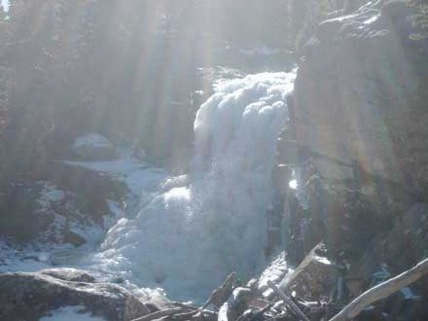
She is amused because the falls looked like falls, they just weren’t falling– they were frozen solid.
That day, the temperature was unseasonably warm for October- 50 ° F. A few days earlier it had been 20 ° F.
A woman at our Boulder B&B said she had been snowed out a couple of days earlier at Bear Lake, our trailhead.
We liked our B&B. Somewhat unique in that it is owned and run by a Zen Monk. As he put it, “In a monastery, you cook, clean and try to be nice to people. This is the kind of the same thing.” with the added bonus of a young female staff.
Kind of a perfect fit. At least for him.
We felt right at home. As lapsed Buddhists, the zendo tugged, but that will have to wait for another time.
Back on the trail, It only took us about an hour to reach Mills Lake at 9,940 feet above sea level.
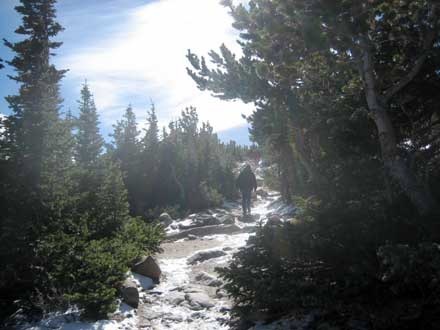
The 2 1/2 miles wound through spruce and fir woodlands with granite outcroppings. The 1000 foot climb was just enough to break a sweat.
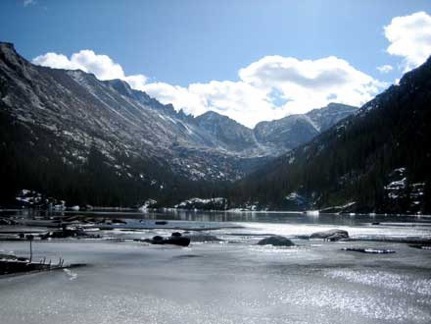
Mills Lake is a real charmer. Considered by many to be one of the prettiest lakes in the park. The setting is indeed most picturesque- at least on sunny warm days in late October.
The trail continued by Mill’s Lake and on to Black Lake. That one was going to have to wait. We had other fish to fry. After a short backtrack, we headed over to Lake Haiyaha. The trail was “unmaintained” and in many stretches we would have lost our way if others hadn’t been through recently, and left footprints in the snow.
Can’t speak for Sharon, but I was dragging when we finally reached Lake Haiyaha. The adrenaline rush was long gone. Almost 3 hours of hiking at almost 10,000 feet had taken its toll. Maybe its true that I’m not as young as I used to be.
Nah.
Once back at the trailhead, energy returned. On the way out the park, we stopped once again at the Visitor’s Center. Knocked one off. Might be time to up the ante for the next day.
Perhaps not the most prudent strategy., but who was I to see that.
Staff at the desk had rolled over. A nice retired couple held the fort. Originally from Virginia, these Park volunteers now lived in Estes Park, the town right outside the National Park. Really nice folks.
I explained our interests and our abilities. Their recommendation was Chasm Lake.
I can still hear him, “Don’t forget the last few hundred feet are a boulder scramble. Its worth the effort.” Then he turned around and pointed to this old-time original oil painting. “That will be your reward.” As I recall- a picture of pretty, little, innocent-looking lake.
Our second day of hiking started out pleasantly enough.
The trail began at an elevation of 9400 feet. There was sign-in and sign-out book at the trailhead. We signed in. Winds had picked up ominously. There was more ice and snow. And there was a warning sign:
“Pay attention. On This Trail Lightning Kills Hikers — Just like You — and with Some Regularity.”
No families or kids shared the trail. A much harder and younger crowd made up our fellowship.
I pretty much ignored all this. After all we weren’t going all the way to Long’s Peak. Our climb was “only” 2400 feet.
Sharon was really edgy. She’s smarter than I am.
After about 45 minutes of hiking, a couple of guys- late 20s/ early 30s- passed us.
Commenting on their gear- ice axes, crampons etc- Sharon made nice with, “So you guys going climbing?”
Her reward was a curt and sarcastic, “Why would you think that?”
Curiously shortly thereafter, we passed them taking a trail-side break. Conversation warmed up a tad.
Soon they steamed on by us. Thought this would be the last time we’d see them.
Not so. Next time we passed them on another break, they were friendlier. We exchanged jokes.
After a few minutes they once again powered by. Trees got smaller and more gnarled as Sharon and I approached timberline and the winds picked up another notch. After about 3 miles in, no more trees. Above tree line, we found ourselves in a broad rock-strewn basin.
Wind was becoming a real issue here. Would guess gusts were hitting 80+ mph. At times it was hard to simply stand. Now Sharon’s anxiety had given way to sheer orneriness. When gusts were just too much, we would crouch down or lean on the back side of boulders.. When the wind would let up we’d put our heads down and toil upwards.
Guess who we met in this wind-gusted boulder field – coming back down? Our technical climbing gear buddies. As they passed us in full retreat, they muttered sheepishly, “We got tired of fighting this wind.”
Yeah, tell me about it.
At this stage, I was thinking in several hundred foot increments. No need to turn back yet. If we can just get to “there,” then we could turn back. When we’d get “there,” I’d re-calibrate and pick out a new goal.
I suppose I neglected to share this internal monologue with Sharon, who was really getting blown around. At 165 lbs, I had 50+ lbs on her and I was having troubles. A couple of times when gusts hit us, I grabbed a bunch of Sharon’s jacket in the middle of her back, and pulled her down with me, so she wouldn’t simply be blown away.
A solo hiker heading back down, gave us hope. He said that if we could just reach the saddle up ahead, the winds would die down. He was right. After a well deserved snack break, we looked around and as our guide book put it, “the view … is literally almost too beautiful to describe.” Yep.
Next stop was the Park service hut used to house rescue supplies.
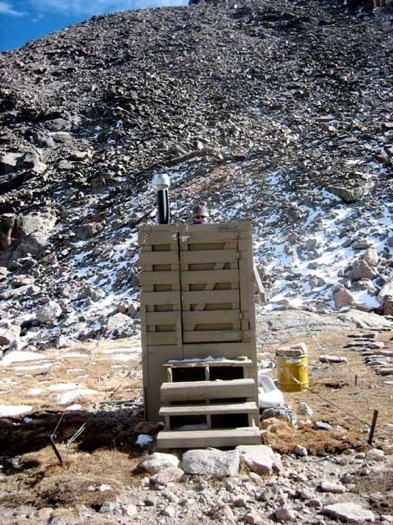
The adjacent outhouse offers a 360° view as it is topless; and privacy, as it is raised.
There were a dozen or so steel stakes and guy wires to keep it upright.
And yes that’s Sharon’s head above the door.
Now all that was left was the few hundred feet of boulder scramble.
The scene bore no resemblance to that picturesque painting in the Visitor’s Center nor to the image I saw in my mind’s eye as the ranger waxed poetic.
I left Sharon about a third of the way up the boulder scramble, on a small rock outcropping in the middle of a steep slope surrounded by solid ice, and loose rocks. Technical climbing gear would have been in order, if we had any.
Against my better judgement, I worked my way on up. Heck after what we’d been through, I at least, “Wanted to see Chasm Lake.”
Potentially classic famous last thoughts.
On the most dicey move, I remember calculating that I would only slide 5 feet into a rock wall, which limited the downside, so at least I wouldn’t die. Now there’s some 6th grade logic. The handhold held true, which was a very very good thing.
In the last stretch before the lake, I met two brothers who had made the climb, and had been looking for an alternate way down. No luck. They were forced back down the route I had just come up. I asked them to tell Sharon I was OK and that I thought it prudent for her to simply retreat to safer ground, which they did and which she did.
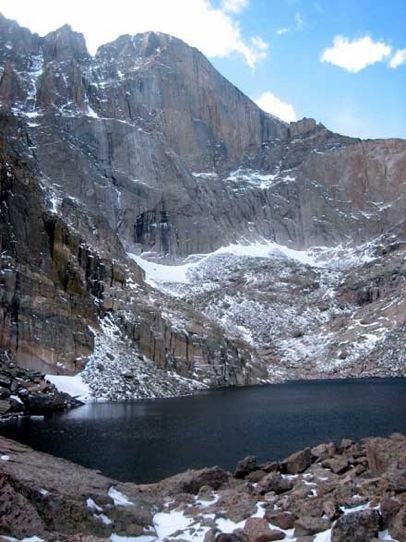
When I reached Chasm Lake at 11,760 feet, it looked like a very little lake in a very big and powerful place. I felt far far smaller yet.
Probably the moral of this story.
Back below the boulder field , we ran into a Korean guy:
“This place is just like the base camp for Mt. Everest.”
Light was intense. Winds were whipping. Ice crystals blown off cliff faces above refracted colors. A bit of the edge of the world- as we know it.
What really got me was the potato chip bag. We bought chips in Boulder which is about a mile above sea level. When I pulled them out of the pack at almost twice that elevation, the bag looked ready to explode. It was blown-up like a balloon ready to burst.
I felt OK-ish. Sharon felt OK-ish. But if the potato chip bag was doing that, how were our bodies coping? In hindsight I still wonder.
And then it occurred to me, we not only had to get back before dark, but that tonight was our son’s thesis performance.
The running joke on the way back down was my optimism. I was sure we were only minutes away from the trailhead for the last 40 minutes before we signed out.
When we walked into the kitchen at the B&B a bit after 6:00 PM, I found my Mom and B&B staff getting ready to put out an all-bulletins alert.
Apparently I had neglected to share the details of our day planning.
Mom was most gracious in being happy to see us.
With a few minutes to spare we all arrived at the performance.
As we were settling into our seats, Sharon, muttered underneath her breath:
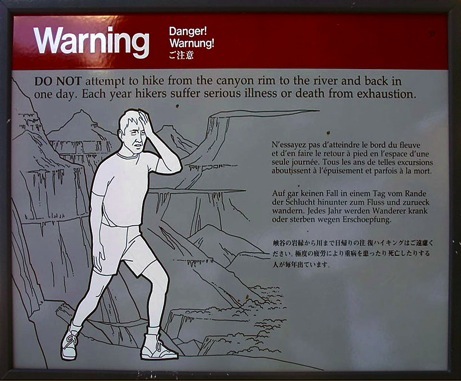
Everything we read said, “Don’t try to hike from the rim of the Grand Canyon to the Colorado River and back in one day.” Looking at the trail guides though, it seemed possible. Challenging, but feasible in the Spring or Fall when the weather was cooler and the trails free from ice.
Sharon and I knew we wanted to hike down inside the Canyon, the further down the better. The river sounded pretty tempting. If we could get there, we could take another trail out, and we could mail our postcards from Phantom Ranch.
We found our rationalization/ inspiration on the internet. Some folks were doing our contemplated route. Not that many age 55 and up, but figured our orneriness would compensate (somewhat) for lack of spring in the knees, which is kind of how it all worked out.
Once we had our hotel reservations in October 2006, the next step was to pick up the pace on our exercise program. I continued walking 3-4 miles a day during the week and on Fridays and Saturdays Sharon would join me. On Sundays we pushed it up to over 4 hours. This was the most we could fit in, given our schedules and New England’s winter weather. Would it be enough?
We were confident that we could keep moving for a long time. The 17+ miles seemed within our reach. The big unknown was whether our legs and lungs could handle the descent (4780’) and the ascent (4380’). Another wrinkle was altitude. The South Rim was over 6000’ higher than Cambridge. Our contemplated hike promised to be a significant cardio-vascular challenge.
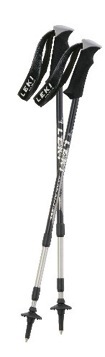
I figured our mini expedition was the perfect excuse for getting new cool hiking gear. We picked up new GoLite lightweight day packs, new lightweight trail shoes, new Leki Ultralight trekking (telescoping) poles and LED headlamps, should it get dark. At the time, thought the trekking poles and lamps a bit goofy. Was I wrong. As it worked out, the poles saved our knees and the lamps saved the day.
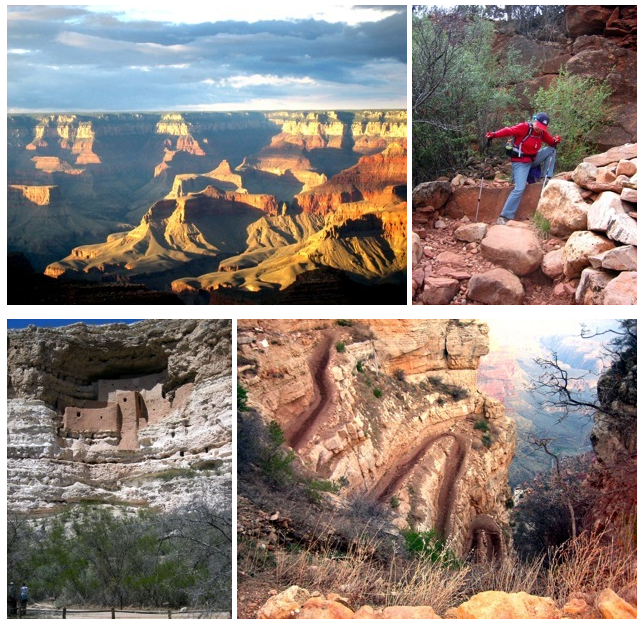
On March 23, 2007, we flew into Phoenix and drove up to Flagstaff. The next day we took our time on the way up to the Grand Canyon stopping at Wupatki National Monument. The Pueblos there dated from around 1100. Very interesting and wonderful country. We lingered.
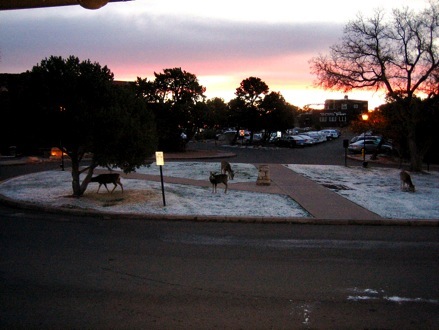
By the time we arrived at our Hotel, the historic El Tovar, we were still a bit jet-lagged. The pending question was when should we try for the big trek? Sooner was decided to be better as our legs would be fresh and there would be less time to worry and obsess.
Our wake-up call the next morning found us lying wide awake at 5:00 AM. By 5:35 we were walking through an empty lobby with our packs and poles.
By 5:50 we were on the shuttle bus to the S. Kaibab Trailhead. The crowd on the bus was a curious mix of sleepy park employees heading to work, tourists heading to overlooks for sunrise, and apprehensive hikers like ourselves who weren’t quite sure what they were in for.
By 6:30 AM Sharon and I were on the trail. We chose the S. Kaibab trail for our descent as it is one of the few trails which follows open ridge lines and therefore offers spectacular panoramic views of the main gorge. It is also steep with no shade or water and has 400’ more in elevation change than Bright Angel Trail, our selected return route. Since it would be down one and up the other, a descent of S. Kaibab in the cool of morning seemed preferable to an ascent in the heat of the afternoon. Think we made the right choice.
There were four of us starting down the trail together heading to the river and back. Our companions from Santa Fe promptly left us behind. A pattern which would repeat throughout our canyon stay. We never passed another hiker on the trails. Many passed us. Can live with that. Our day might come. If not, that’s OK too.
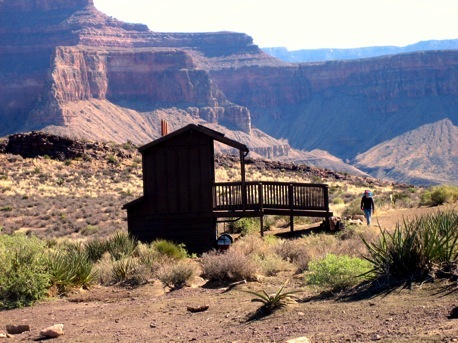
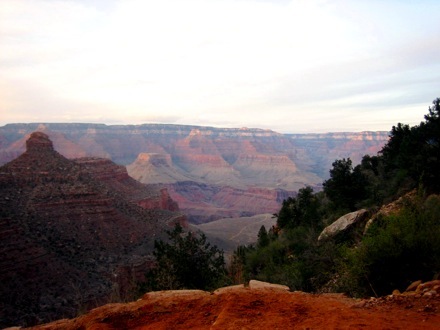
In any case, we must have hiked for about an hour before our first break. The panoramic views were indeed stunning and the sunrise was wonderful. The trail was steep with many mule steps which required full attention. No guard rails here. A slip or a trip in the wrong place and it is a long way down. Passed a Condor perched about 30’ above the trail. One big bird. The size of a medium-sized dog, but with feathers.
A bit later passed two ravens. Cool customers. Much character.
In the first hour we descended over 900 feet in a mile and a half. Lots and lots of tight switchbacks on these upper cliffs. Temperature was warming up. It was in the 30°s at the trailhead. By our first break our jackets were off. Would guess we were already into the mid 40°s. By the time we would reach the river, it would be over 80°.
While we were sitting munching our energy bars, three runners swept past. This was the extreme crowd. Am guessing they were on a r2r, rim-to-rim, run. Some are even able to fit a r2r2r run into one day, though they don’t get much sleep.
After another hour or so about 1/4 the way down the switchbacks following Skeleton point, we stopped to chat with one of the guys from Santa Fe, with whom we had started off.
He was about our age ± and was turning back. Said he had bladder leakage and showed us his wet pants. Thought to myself, “This guy is remarkably comfortable talking about such a sensitive subject.” Then he added that he was worried about having enough water. Was this a real medical emergency?
Debated with myself whether to offer him one of my 4 bottles. Knew I could refill at the river, but wasn’t sure if water would be available at Indian Gardens half way up Bright Angel Trail. If not, figured I would need all four bottles. On the other hand, if this guy was really in trouble, felt I should probably risk it.
After a few more delicately probing questions it became clear he was not experiencing a medical emergency, but simply an equipment malfunction. It was the water bladder in his pack which was leaking and he still had two full water bottles. I told him my worries about his seeming urinary condition. He laughed and said something like, “No leakage there yet. Hopefully not for a long long time.”
For the next hour we continued with our descent to the Tonto Platform, the broad shelf between the upper canyon walls and the inner gorge. Another half dozen or so rim-river-rim day hikers passed us checking their watches as they hurried along. This was the late-start crowd and mostly novices like us. They were young though (under 30) and seemed to bounce down those mule steps. Made me envious.
By 10:00 AM we had crossed the Tonto Platform and were about to descend the final 1200’+ of the inner gorge to the Colorado River. It was probably only around 70° but with the exercise and the sun beating down on us, it was starting to feel really hot. Sharon took the bandana from around her neck and put it over her head under her baseball-style hat so that it would act as a shade for the back and sides of her neck. In another couple of hours I would do the same thing.
We crossed the Kaibab suspension bridge over the Colorado River about 11:00 AM. We had made it down. The bridge itself is very cool and only used by hikers and mules. It was finished in 1928 and is over 400‘ long and hangs about 60’ above the river. The floor is wood, hung by galvanized cables clamped to the main cables above which in turn are anchored into the canyon walls 80 feet above. A little tunnel leads through the cliff to the bridge.
After a break at the bridge, there was still another very very long 3/4+ mile to Phantom Ranch. Along the way we passed the outlines of pueblo occupied by Ancestral Puebloans around 1100. These people used to be called Anasazi. No longer. Turns out Anasazi is a Navajo term which translates roughly as “enemy ancestors” or “ancient people who are not us.” Many modern Puebloans of direct descent, including the Hopi, took offense. So now it is “Ancestral Puebloans.”
We dragged ourselves into Phantom Ranch around noon. Phantom Ranch is a little oasis at the bottom of the Grand Canyon, complete with running water and cottonwood trees, a miniature resort village run by the Park Service, accessible only by foot trails, the Colorado River and helicopter. We mailed our postcards getting the coveted “Mailed by Mule at the bottom of the Grand Canyon, Phantom Ranch” postmark. Not surprisingly Sharon had written hers already. Buena idea.
Sitting at the picnic table next to us was this old guy fiddling with his stove, brewing tea. He had nice gear and it was well used. It looked like he did a lot of hiking/camping.
Turns out he does. His name is Laurent “Maverick” Gaudreau and last year for his 80th birthday he decided to do 80 rim-to-rim hikes to celebrate. Ended up doing 106 R2Rs. Quite the character.
The rule of thumb is that it takes twice as long to hike up as it does to hike down in the canyon. Although neither Sharon nor I mentioned this to the other at Phantom Ranch, we both did the math in our heads: 4 1/2 hours down meant 9 hours to go: we would hit the rim at 10:00 PM. A bit depressing, but it would be what it would be.
Back at the river about 1:00, we stopped to chat briefly with a couple of big tough young women who had passed us on the way down. They were done for the day. Their final destination had been Bright Angel Campground next to Phantom Ranch. They asked where we were headed. When we said, “Back up to the rim” one looked at us with a poker face, and without a word just clapped twice, which I interpreted as, “way to go, old folks.” And we were off.
Back across the river. This time over Bright Angel suspension bridge. After a mile or so of paralleling the river we turned up a side canyon towards the Devil’s Corkscrew. Maverick had informed us that a hiker had died on this section of the trail last summer. “When they found him, the temperature was 120°.”
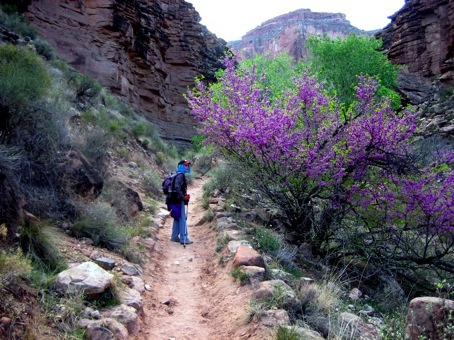
By the time we hit that stretch, thankfully, parts of the corkscrew were already in the shade. Up we plodded. We climbed out of the inner gorge and followed Garden Creek up to Indian Garden. Arriving around 3:30PM, Redbuds were blooming along the creek. We were making pretty good time considering. Only 4.5 miles and 3000’ to go.
While we were refilling our water bottles and snacking, we struck up a conversation with three young women also on a rim-river-rim hike following the same route we had chosen. They had left Phantom Ranch slightly ahead of us and had been lounging at Indian Garden for some time.
They had missed sunrise on the trail, because “Someone, wanted to eat breakfast in a restaurant.” Two rolled their eyes towards the third who was doing calisthenic-like stretches. Curiously they looked/sounded like they were just hanging out between college classes.
As they pranced off up the trail, they called back, “See you at the top.” I mumbled, “I doubt it.” Tinkling laughter drifted back and they were gone. No doubt they arrived at the rim hours ahead of us. Youth is a wonderful thing.
Although we were on the weary side, I was starting to feel more confident. We were going to make it, and well before 10:00. By sunset at about 6:30 we had passed Three Mile Rest House (and emergency telephone) and were into the last ascent.
We turned on our lights at 7:15 and were standing on the rim at 7:45 PM. Shudder to think, what the last stretch would have been like without the lights. Here’s to Petzl Headlamps and converted LED Mini-Maglites!
Now we just had to find our hotel. I hadn’t quite worked that one out. Sharon was not amused. After a couple of wrong turns, we finally made it to the veranda of the El Tovar where we found nice comfy wicker chairs and plunked ourselves down. It took at least 10 minutes for Sharon’s blood pressure to come down and for us to collect our energies for the final climb to our room on the third floor.
After couple of hot showers we collapsed into bed by 9:00, without dinner.
Predictably, the next day we could barely walk. After breakfast we hobbled back to the Bright Angel trailhead to see the section where we came up in the last stretch. Probably a good thing we hadn’t seen this before the hike. We took it very easy for the rest of the day.
The following morning we hiked 8-10 miles of the Rim Trail West of Grand Canyon Village. The trail winds through pinyon and juniper and in many parts runs right next to the edge into the canyon. Edge, as in slip sideways 3-4 feet, and you land a couple of thousand feet below. Again, no guard rails or other barriers, except at the shuttle bus stops. Made for fantastic views though. Nice level walk, even an old stagecoach road thrown in. Our favorite at the front desk, runs it at night on full moon days with her friends. Sheesh.
We took a day off to cruise Desert View Drive. Loved the vistas, but the crowds can be a bit much. Time after time we saw folks goofing off right on the edge of the canyon beyond the guard rails. Prime candidates for the Darwin Awards. After a while we just had to avert our eyes. Tourists fall to their deaths just about every year here. A fascinating read: “Over the Edge, Death in the Grand Canyon” .
On our last full day at the canyon, we hiked 2.5 miles, 1760’, down to Santa Maria Spring from Hermit’s Rest. A bit off the beaten track. Nice intimate trail with only glimpses of the main canyon. Someday would like to go all the way down this route to the river.
After climbing back to the rim at Hermit’s Rest in reasonably good humor, we met a sweet elderly couple from the UK sitting quietly gazing out over the canyon. They had just started their own 13 week tour of the American West having just flown in from Australia.
We exchanged a few travel stories and ended up encouraging them to visit Jerusalem. They were hesitant because of the perceived danger. Then after a pause, the woman looked up at us and said with twinkling eyes, “Maybe. After all, our motto is : Advencha before Dementia”
It all started out innocently enough. Taavo suggested we taste some Belgian beers. One thing led to another and before we knew it, we were dusting off our passports.
Physically Belgium is small- about the size of Massachusetts. Beer-wise Belgium is really big- 120 breweries, over 800 different beers and more than 500 specialist beer cafes.
Belgium and beer go way back. By the time the Romans came west, beer was already being brewed by the Belgae. Brewery ruins date back to the 3rd and 4th centuries AD. Today those bloodlines live on. For diversity of beer styles, Belgium is it.
There is a lot more to beer than Budweiser, Coors or Heineken for that matter. Beer can be every bit as diverse and sophisticated as wine and Belgium has the goods.
For our tastings, we tried to keep an open mind. We had our list of must try’s, but typically we’d ask our waitperson for recommendations- and Sharon (the obvious, unanimous and the most sober choice) kept a log. By the end of our trip, we had tried at least 75 different beers.
Michael Jackson (not that MJ- the famous beer guy) divided Belgiums’s beers up in his classic “Great Beers of Belgium” into the following categories: Wild Beers, Fruit Beers, Bieres Brut, White Beers, Brown Beers, Red Beers, Saisons, Belgian Ales, Trappist Beers, Abbey Beers, Wicked Beers, Passionate Pints, and Pils.
I found it nearly impossible to pick favorites. It always seemed to come back to the best fit at the time- the mood, the food, the time of day and so forth.
That said, the most intriguing generally fell into two categories- Wild Beers and Religious Beers (Trappist & Abbey).
Wild Beers mean wild yeast. For the first few thousand years beers were brewed, all beers were brewed with wild air-borne yeast. Today there are something like 6000 breweries worldwide. Less than ten depend on wild air-borne yeast. These are the Belgian Lambics.
As MJ puts it, these are the most challenging and exciting of beers. I would also add they are the strangest- an acquired taste- which I acquired on this trip.
On the other hand, to me, the Belgian Religious Beers have always been- Tasty, Tasty, Tasty.
I’ve always liked the idea of monks brewing beer as one small step towards salvation.
And the beers monks brew are really, really good. Experts have voted a particular as Best in the World, several times running.
This favorite is brewed by Sint Sixtus monks in a very remote area of Belgium, near the hop-producing town of Poperinge.
This Westvleteren beer is almost impossible to buy, even in Belgium. The only commercial establishment serving the stuff is a beer cafe across from the monastery. The only non-black market alternative is to buy direct and in person, which involves dealing by phone with the Trappiste monks and showing up at their monastery at the appointed hour.
Tom Allewaert, our hotel manager at the Erasmus Hotel in Bruges, said, “You can try to call them, but all you’ll get is a message that there are 200 people ahead of you on hold.” We gave up on that then and there. But we did make it to Sint Sixtus, and did drink our fill of Westvleteren, but am getting ahead of myself in this story. Probably best to start at the beginning.
We organized our travel in three chapters: Brussels, Brugge and Watou. All in West Flanders.
Brussels is not only the capital of Belgium, but the capital of the European Union. Big, sophisticated, old and urban for 800 years.
Brugge is picturesque, medieval, laced with canals and wonderful.
Watou is so far off the beaten track that even Belgians say “where?” Take a wrong turn and you are in France. Great food though, and great beer. Curious cows and ground zero for beer.
While Belgium is a bit on the expensive side, it turned out that drinking Belgian beers in Belgium is most economical. A silver lining indeed.
Brussels
Sharon and I flew overnight from Boston to Brussels, arriving at BRU mid morning. We caught the train into town and then walked (somewhat circuitously and I take the blame) to our hotel. Happily our room was available and we were able to relax, recharge, and then explore the neighborhood a bit before Taavo and his girlfriend Meredith arrived from London.
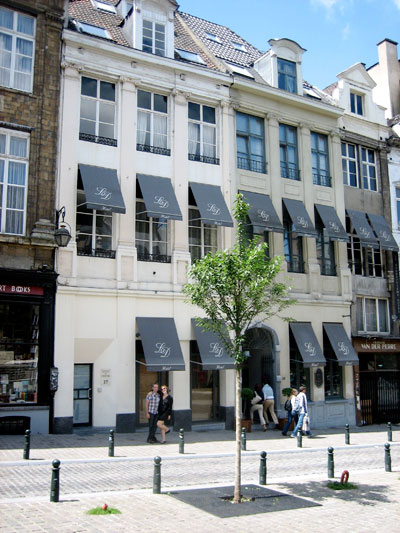
Hotel discounts in Brussels are a weekend event. We planned accordingly and scored a deal on the Le Dixseptieme Hotel in the historical heart of Brussels, around the corner from the Grande Place. Parts of the hotel go back to the 14th Century. In the 17th century, Le Dixseptième was the residence of the Spanish Ambassador. Our kind of place.
Taavo and Meredith arrived on schedule early in the evening. After they dropped their bags off in their rooms, we headed out to see a bit of the town.
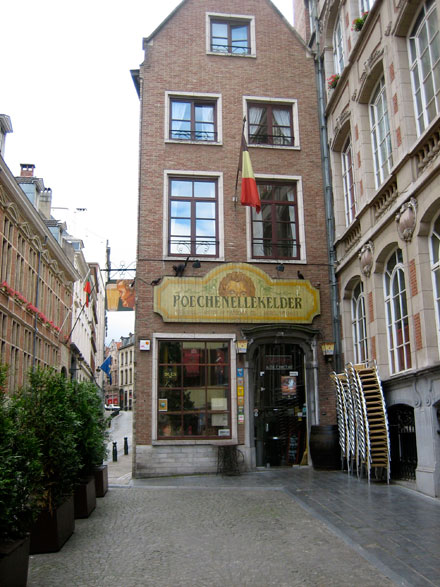
We ended up at the Poechenellekelder for food and drink. Great location opposite the Manneken-Pis (little pissing man) with a wonderful beer selection. Nice atmosphere and good people watching. And yes, I can pronounce it now. The trick is not think about all the letters- all at once.
The next day we were sitting at the Poechenellekelder mid-day and struck up a conversation with a couple at the next table. They were English, he worked at the BBC and they were big fans of The Sopranos & other HBO shows. We countered that we were big fans of all types of Masterpiece Theatre.
We explained our plans and quest. When we got to the part about Watou, they paused and looked us over for a second time and added with a note of envy, “You guys are really doing this right.”
We enjoyed the young folks at the front desk of the Le Dixseptieme. Not surprisingly the young Islamic woman wasn’t as enthusiastic as we were about beer, but she was fun and articulate.
The young Belgian guy was friendly and candid. He was surprised that we were from the USA. He said we weren’t anything like the Americans he was used to from TV. His wife was addicted to Miami Vice. They were soon heading to South Miami Beach for their USA experience.
We tried to explain that there was more to the USA than Miami Beach, but he said that not so far as his wife was concerned. He also volunteered that, in his experience, the American hotel guests were much more polite & grateful than the French ones. The Flemings don’t much care for French (speakers) even when they are Belgian.
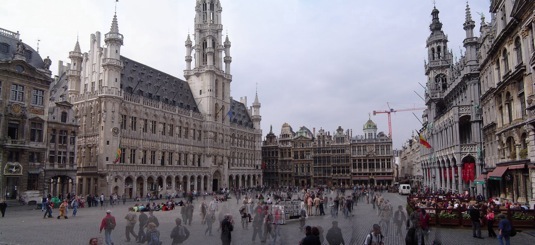
The aptly-named Grand-Place was pretty much right around the corner from our hotel. My pics are in the slide show. I borrowed the image below. It captures the feel of the space really well, though the colors are a bit washed out. There is a fourth side to this quadrangle- just behind the photographer- which includes the headquarters of the brewer’s guild.
When we’d wander through, there were many more folks out and about.
Lots more going on too. My guess is that this was shot early in the morning.
There is a lot more to be said about our time in Brussels, but I’m going to have to keep it short.
The Brussels’ museums are remarkable with the likes of Hieronymus Bosch, van Eyck, David, Magritte and Delvaux. Personally I’m partial to the surrealists. The really odd is often found embedded in the most normal. One can look at Belgium as something of a Bourgeois Paradise, but with a surreal and subversive twist.
The Cantillon Brewery was another Brussels’ highlight. Cantillon is a working family brewery, which, as one of the last breweries in the world using ultra-traditional methods and wild yeast, has become a place of pilgrimage for beer enthusiasts. Curiously it looks like a garage from the outside. Inside its musty and alive.
After three nights at the Le Dixseptieme Hotel we all checked out and headed back to the train station. As it turned out, we did get on the right train and an hour later we were in Brugge.
Brugge
As we stepped out of the train station we looked out over an expansive parking lot filled with thousands and thousands – of bicycles. Purportedly our hotel was about a mile’s walk, so off we went. After just a couple of wrong turns we arrived at the Erasmus.
Hotel Erasmus has been described as designer-modern, very beernut-friendly, with a great location close to the historic city center. All true.
From the outside it looked like the 1300’s. Inside it was like stepping into 21st century Helsinki. A bit disorienting, but not a problem. My favorite space was the patio out back. A few dining tables on the canal- Ridiculously picturesque, and a great spot for dinner and a great beer, which we took advantage on our first night and all the nights thereafter.
Lots of great things have been written about Brugge. After visiting I‘d have to say they’re all true. Even all the over the top stuff. Then again you have to be in the right mood. We were, or at least I was.
Here is what one of our guidebooks, Insight Guides Belgium, has to say about Brugge:
“The capital of West Flanders is one of Europe’s best-preserved medieval cities, with a turbulent history that is concealed by the serenity of its present-day appearance.
Those who speak of Bruges as the ‘Venice of the North’ or ‘Belgium’s Amsterdam’ do little service to a city that is simply unique and happy to be itself. This city is not some pale imitation of another, and needs no such false comparisons to illuminate it. Bruges is the pride and joy of Flanders, and beneath the smoothly cosmopolitan surface with which it greets its legions of foreign admirers, it is Flemish through and through.
In attempting to describe this canal-fretted ensemble of medieval architecture, it is hard to avoid the word “picturesque”. As Arnold Bennett said as long ago as 1896: ‘The difference between Bruges and other cities is that in the latter, you look about for the picturesque, and don’t find it easily, while in Bruges, assailed on every side by the picturesque, you look curiously for the unpicturesque, and don’t find it easily’”
This historic center of Bruges (French) or Brugge (Flemish) is a Unesco World Heritage Site- Rightly So.
Most of the tourists were European. Brugge is a favorite short-hop destination. I understand why. I’d go back in a second.
The acoustics were remarkable- bells, horses-hooves on cobblestones, and water.
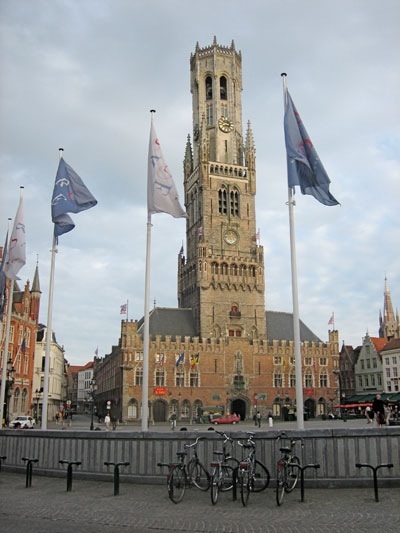
Just like Brussels we spent our days in Brugge walking, visiting museums, and seeing the sights. And yes we climbed the 366 steps to the top of the tower- Great view. Very medieval too on the way up with slots for archers and tight spaces.
For added entertainment, Sharon took up reading the Gideon Bible in our room- in Flemish. To check on her pronunciation, she’d go downstairs and read out loud to Tom Allewaert, the idiosyncratic manager of the Erasmus. He seemed to find Sharon’s readings most entertaining. One day, one of Tom’s buds was there. He ran a neighboring store.
After the reading, he offered Sharon a job.
Watou
The last leg of our trip took us to rural Belgium. We rented a car in Brugge and drove first up to the North Sea and then back down to Watou, where we had reservations at a most special B&B adjoining the Sint Bernardus Brewery.
At the 11th hour in our trip planning, I found this B&B. I emailed them, but no response. I also had a phone number. I suspected the key would be language, not my strong suit, so I leaned on Sharon.
She was none too happy about the challenge. As she put it, bluntly, “I don’t speak Flemish.”
I pleaded and whined until she said OK. She grabbed some books and after a half hour’s quick study, she called Watou and made our reservation in Flemish. They were full up, but if Taavo and Meredith could share our bathroom, there was space. This was not a problem and the reservation was made.
Sharon scares me sometimes.
The last stop on our drive to our Watou B&B was Café In De Vrede, the brewery tap for Westvletern beer from the St. Sixtus Trappist Abbey- next door.
To say Café In De Vrede is off the beaten track is an understatement. Its off the beaten track, off the beaten track, off the beaten track, which after all is where one expects to find monks living a life of seclusion.
I think I saw a monk driving by on tractor. But to tell you the truth, I was more interested in the Westvleteren beer at hand.
Yes, it is really really good. How good?
“Best in the world?”
Sitting on the patio out back at the In De Vrede with Sharon, Taavo, and Meredith with smiles all around, it was hard to argue that it wasn’t really special.
This was a neighborhood of special beers though, as we found out a few miles down the road at our B&B, t Brouwershuis.
Not only is t Brouwershuis next to the grounds of the St. Bernardus Brewery, it once was the master brewer’s home. Now run as a B&B by his daughter Bernadette.
Bernadette was charming, sensitive, and hands down, the the most gracious, charming, sophisticated B&B host I’ve ever run into. The Belgians staying there agreed, adding, “You know, she doesn’t have to do this. She sold the brewery and now has all the money she’ll ever need.”
Sharon was named after one her mother’s dolls.
We suspect Bernadette was named after her father’s beers. If true, Bernadette lived up to her name.
St Bernardus beer is world class.
We had ample opportunity to contemplate its subtleties and sophistication.
t Brouwershuis is the only B&B I’ve ever run into which had an open beer policy- at no charge. A mini refrigerator off the living room was always stocked with St Bernardus beer.
One of the Belgian guests informed me of the unstated rule- Have all you want. Just don’t be a jerk.
Not a bad rule. One that, indeed, goes a long way in many situations.
Sitting in the t Brouwershuis’s living room sipping from a glass of St Bernardus, I thought back to the Westvleteren we had recently tasted. St Bernardus measured up. And in many respects was remarkably similar.
As I sorted out later, this was not happenstance. Bernadette’s father, Evariste Deconinck, did some deals with the monks of St. Sixtus Abbey. Probably in that very living room.
As far as which beer was better? There’s a rule in baseball, “Tie goes to the runner.”
The runner in this case, to my mind, is Bernadette and Sint Bernardus.
There is probably only one way to confirm this call though,
Go back, for another round.
Beer list in order of consumption: Popperingr Hommelbier,Vielle Orval, Gouden Carolus Tripel, Hercule Stout, Lindemann’s Faro, Taras Boulba, Affligen Dubbel, Orval, Stouterik, La Chouffe, Chimay Tripel, Cantillion Geuze, Cantillon Lambic, Cantillon Faro, Cantillion Rosede Gambrinus, Oude Goede Tyd, Vieuxtemps, Hoegarden, Bourgogne des Flandres, La Rulles Tripel, Duvel, Delerium Tremens, Malheur 12, Rodenback, Westmalle Dubbel, Oer Bier, Duchess de Bourgogne, Kriek Girardin, Malheur 6, Vicaris Generaal, Dertig, Abbaye des Rocs, Westmalle Dubbel, Moinette, Abdis Bruin, Bush/Dubuisson, Vicaris Tripel, Duivelsbier, St. Feuillien Bruin, Abbay des Rocs, Liefmarrs Kriek (Erasmus Special), Pannepot 2006 Old Monk’s Ale, Rochefort 10, Stout Bie, Moinette, Vicaris General, Vicaris Tripel, Westvleteren Blond, Westvleteren Bruin 8, Westvleteren Bruin 12, St Bernardus Tripel, Watou Tripel, St Bernardus 6, St Bernardus 8, St Bernardus 12, Popperings Hommelbier, Gulden Draak, Ois de Geuze, XX Bitter, Duchesse de Bourgogne, Gueze Girardin, Marriage Parfuit, Hercule StoutPageBlock
Tensions in Israel were grabbing headlines with the Intifada and the Israel-Hezbollah War.
From our perspective, it seemed like as good a time as any to make the trip.
Its not like the last 4000 years have been all that calm in the region.
Finances played their part in our decision. Way out on the risk curve, we got lucky with an Israeli company’s stock (calls). Bought into a crisis. Sold into an acquisition. Sometimes things just work out.
We decided to take some of our profits and head off on a semi-indulgent jaunt to visit Jerusalem & the company, meet some Israelis, and soak up some history.
I had wanted to fly El Al, because of their remarkable track record in the face of terrorism.
El Al doesn’t fly Saturdays because of the Jewish Sabbath, which ultimately meant that we booked on American Airlines.
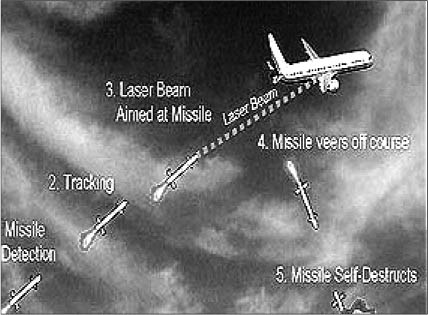
El Al Israel Airlines has installed anti-missile systems on all its planes. Somehow I doubted that American Airlines took those same precautions.
Food for thought at 5,000 feet and descending on the approach to Ben Gurion Airport.
We landed safely, picked up our bags, passed through customs, and walked outside into the bright sunshine.
Hmmm, how do we get from Ben Gurion Airport outside Tel Aviv to Jerusalem, about 30 miles away.
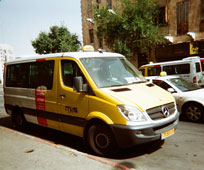
This Arab-looking guy says “Jerusalem” and points to his mini-van, we climb aboard.
Although we didn’t realize it, we were sitting in a sherut or shared taxi, the easiest and most cost effective means getting to Jerusalem.
Entertaining too.
Our fellow passengers were an interesting mix. About a third were Scandinavian.
One young Swede was a travel agent. His business partner, a Palestinian. Our clothes passed muster.
“Patagonia! Good company. Not the usual USA Bull Shit.”
Patagonia prides itself on excellent products that are made in an environmentally and morally sound way. No sweat shop labor and very, very Green.
Not cheap either.
Our son rolls his eyes on seeing Patagonia tags. The Patagonia thing can be a bit over the top. Nice clothes though.
A woman a bit younger than us struck up a conversation. We told her we were going to be staying at the American Colony Hotel. She said that she had eaten lunch in the courtyard, and added, with what I detected as a very light touch of envy,
“You’re going to like it.”
Yep.
The American Colony Hotel
The American Colony Hotel has had a long, curious, and colorful past- from Pasha’s palace to Christian utopian commune- to 5-star, Swiss-managed, boutique hotel.
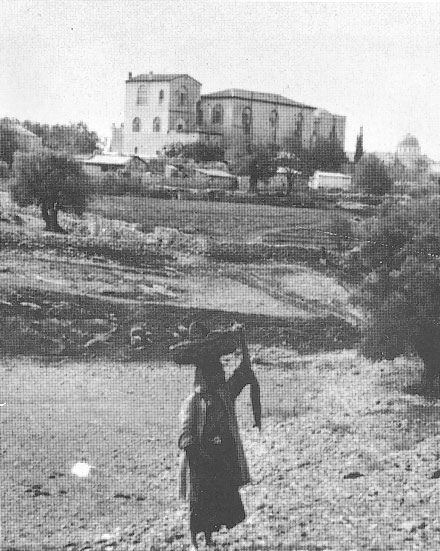
The story begins in the mid 19th century, when the area was still part of the Ottoman Empire.
The original building was built by the patriarch of one of Jerusalem’s most prominent and formidable families.
Rabbah Effendi al-Husaini was a pioneer in building his new luxurious home outside the walls of Jerusalem.
Rabbah Effendi al-Husaini was rich and powerful. He had good taste in architecture. His four wives had many daughters- but no sons.
And hence his mansion went up for sale in 1890s.
It was purchased in 1895, by the “American Colony”, a non-denominational utopian Christian community. A curious mix of Americans and Swedes who had moved to Jerusalem to await the Messiah’s imminent arrival.
Part commune, part Christian cult, the American Colony was a resilient and enterprising lot.
Renting out rooms as a tourist hostel, brought in welcome cash.
Those at the American Colony were on friendly terms with the Ottoman-Turkish governors of Jerusalem, the British Consul, and curiously, the rich and famous. The first of the famous guests arrived in 1902, the grandfather of the British actor Peter Ustinov.
Seasonal tourist hostel gradually morphed into today’s 5 star hotel.
Other famous guests along the way have included Lawrence of Arabia, Ingrid Bergman, Philip Roth, John le Carré, Mikhail Gorbachev, Tony Blair, Bob Dylan, Robert De Niro and Uma Thurman.
The photo to the right is of Winston Churchill’s visit to the American Colony in March 1921.
The American Colony, in one form or another, has remained a Jerusalem fixture under four regimes: Turkish, British, Jordanian, and Israeli.And through the heat of numerous wars and other conflicts, they always refused to take part in or facilitate any hostile acts, nor were they ever interned, evacuated or forced to close.
When the retreating Turkish governor snatched a bedsheet to use as a white flag, signalling to British troops that the four centuries of Ottoman control of Jerusalem was over, he was standing in the American Colony.
Today the American Colony Hotel calls itself an oasis of neutrality in the Palestinian-Israeli conflict. It is said to be located on the “seamline” between east and west Jerusalem, and as such is the preferred hotel of many diplomats, politicians and foreign correspondents.
Truth be told, it’s very much in East Jerusalem.
We didn’t really know what that meant.
We do now.
The sherut dropped us off at the American Colony in the late afternoon.
We checked in and were shown to our room.
We were on the second floor of the old building in one of Rabbah’s wives’ winter rooms with an entrance off the gallery.
First door on the left in the photo to the left.
The decorated blue-wooden gallery ceiling is original.
Quite exotic. We had come a long way.
We threw our bags in a corner and settled down for a well deserved nap.
I awoke with a start.
It was night. A man had just entered our room.
On seeing us, he was gone in a blink.
A bit unnerving. Maybe the front desk should know.
First I had to find it.
I wandered out into the darkened hotel.
Several wrong turns later, I found myself in the middle of a most-lively Saturday-night bar scene.
Even in my bleary state, I could recognize that this was an event with players.
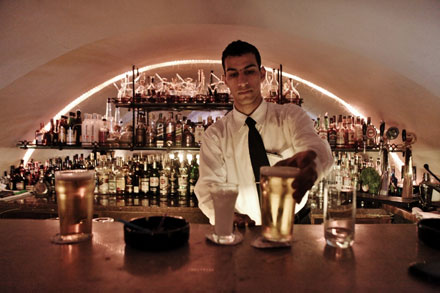
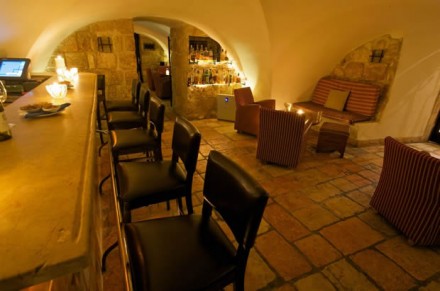
I had stumbled into the Cellar Bar, a favored smokey waterhole for foreign correspondents, Palestinians and left wing Israelis. Jerusalem’s version of Casablanca’s mythical Rick’s Café, complete with a 130-year-old pink stone floor.
I looked up. A middle-eastern-looking-guy in an expensive suit with drink in hand, nodded towards me. Maybe I was somebody. I nodded back. Maybe I was.
But where was the front desk?
One storey up and a few twists and turns later, I arrived.
The guy in our room was the turn-down service.
Welcome to Jerusalem and the American Colony.
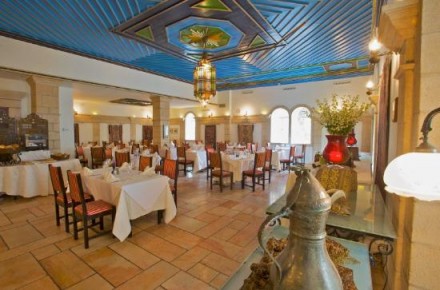
The next morning we awoke famished. Breakfast was a revelation and a metaphor of sorts.
The buffet had two areas: British and Middle Eastern.
Eggs or Baba Ganoush? Or both together with Turkish coffee to die for?
Lowell Thomas, the famous 20th century American writer, broadcaster, and traveller, once noted that Bertha Vester, daughter of the founders of the American Colony, was one of the few people in the world that he envied.
Not only did Bertha live in, “the most dramatic of the cities,” as he put it, but at the American Colony, she had a front row seat “both as an observer and a participant in events, under the Turkish sultans, through World War I, the period of the Mandate, a second world war, and finally the period of the return of the Children of Israel.”
It’s not Bertha that I envy, but her far more modest daughter-in-law, Valentine Vester.
2005 Photo to right- @ 93 in the American Colony.
Valentine married into the Vester family. Her husband, Horatio, was Bertha’s only child.
In 1963, Horatio and Valentine were living in England.
Horatio was a lawyer, and Valentine- a 51-year-old Yorkshire Homemaker- when the fates intervened.
Bertha’s American Colony had collapsed. Horatio and Valentine moved to Jerusalem, took over the failing enterprise and turned it into a commercial success.
Horatio was the CEO and Valentine the chief executive of the kitchen.
Horatio retired in 1980, and died shortly thereafter.
Gauer Hotels of Switzerland stepped in.
Valentine’s part of the deal was a private apartment and privileges- for life- in this 5 star hotel.
One night at dinner, I noticed a table being specially set-up. A reading light was brought in, special condiments appeared.
A most-elderly woman walked in, sat down, and pulled out a book- like she owned the place. Dinner appeared. Staff hovered.
Valentine.
I love this Valentine quote from the New York Times in 2005:
“I’m quite well in myself,” she says. “Nothing wrong with me. I can’t see very well, I can’t hear very well, and I can’t walk very well, but I’m perfectly well.”
The best of perspectives.
I choose to think that with such an attitude, we can all have our own American Colony.
The Old City of Jerusalem
So that first morning, Sharon and I took off on foot down Salah ed-Din Street. Jet-lagged and disoriented, I had decided we should wander about. Probably not the best of ideas.
In less than 15 minutes I had wandered us through Herod’s Gate into the heart of the Muslim residential quarter of the Old City of Jerusalem.
After about 300 feet, a few not so friendly whistles, and a short conversation with an alcoholic local offering to be our guide, I decided it prudent to retreat. Sharon was rolling her eyes.
So after we’re out. Sharon turns to me and says,
“Nice job! Did you see that Arab guy in pajamas?”
Next stop was the armed checkpoint for the Rockefeller Museum. I picked the side entrance off Sultan Suleiman St, complete with barricades, Uzis, metal detectors, passport check and a brief interview.
I might have found the least tourist-friendly experience in all Jerusalem.
All in a days work.
The museum was great. A taste of things to come. It was all downhill- in a good way- from here.
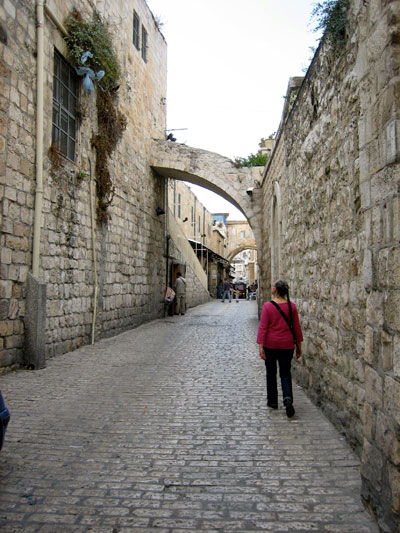
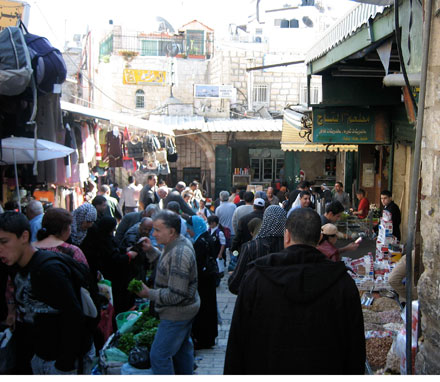
We spent the rest of the day, and most of the trip for that matter, wandering the narrow streets of the Old City, gradually relaxing.
After a few days, the street vendors started ignoring us.
A most positive sign.
The Old City is the oldest part of the Jerusalem, enclosed by stone walls built in the 16th century and accessed through seven gates.
Eight if you include the Golden Gate, but that one was sealed up centuries ago by Muslims hoping to keep the Jewish Messiah from entering the city.
East Jerusalem is Arab/Palestinian Jerusalem. It was part of Jordan as recently as 1967. A bit third world. When the dumpsters in the street fill up, they light them on fire.
We had no problems even though we walked everywhere. I didn’t wear my American flag t-shirt though. (joke)
Curiously, until I opened my mouth, most folks thought we were French. Sharon says it’s because of my nose.
I prefer to think it was our snappy style.
Figure we walked 10+ miles every day and thus earned that afternoon beer or two.
The courtyard of the American Colony was just about the perfect spot to contemplate the question of Israeli vs Palestinian – beers.
The courtyard was 70 degrees F, with flowers, birds, a gurgling fountain, and fruit on the trees- in early November.
Israeli Maccabee beer vs Palestinian Taybeh beer.
A tie to my palate.
Our favorite waiter was Jihad, a soft spoken Arab. He explained that “Jihad” was a nickname bestowed on him by other staff. So “Jihad” he was. Name tag and all.
Jihad and Sharon talked Middle Eastern music and the conclusion was we should get some George Wassouf- one early, one current.
For the earlier recording- Live Recording vol. 2 (Oum Kolthoum). For the current recording- Hoewa el ajam.
“Right inside the Damascus Gate, there’s a store.”
Since by then we knew our way around the neighborhood, this was not a problem.
Jihad asked how we did and what we paid.
“Got them both and 10 Shekels.”
He nodded approvingly.
“You did OK.”
And yes, both without a doubt, are black market, not that they were labeled as such.
One of the highlights of our trip promised to be our visit to M-Systems, an Israeli high tech company. I had neglected to bring a back-up camera battery.
So I ask the concierge at the American Colony, where I could buy one.
“About a block down Salah ed-Din Street, on the left, there’s a travel agent. Nassar can get whatever you need.”
So we saunter over.
Nassar was glad to see us.
He would have been glad to see just about anyone.
An Intifada is bad for the tourist business.
Yes Nassar could get us the battery.
Off went the runner. We settled back.
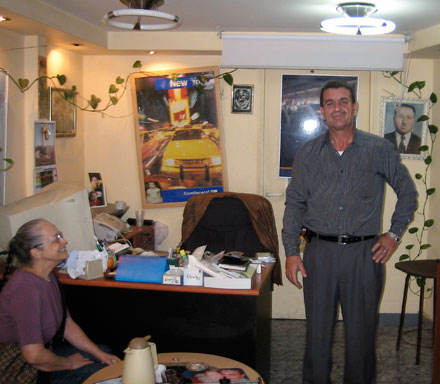
Nassar poured the coffee, showed us pictures of his family, and held forth.
Did we want to visit Bethlehem?
“I’d be happy to show you around. I have a white Mercedes. I’ll drive. Less than $200 for the day.”
I was tempted. For a millisecond.
Bethlehem is only 5 miles south of Jerusalem, but it is in the Palestinian-controlled West Bank.
Before this trip we had put our wills in order.
As Americans, it seemed pushing it to go on a jaunt to West Bank, during an Intifada, with Nassar- in his white Mercedes.
As far as I knew no hostages were currently being held. No need to cut to the front of the line.
M-Systems
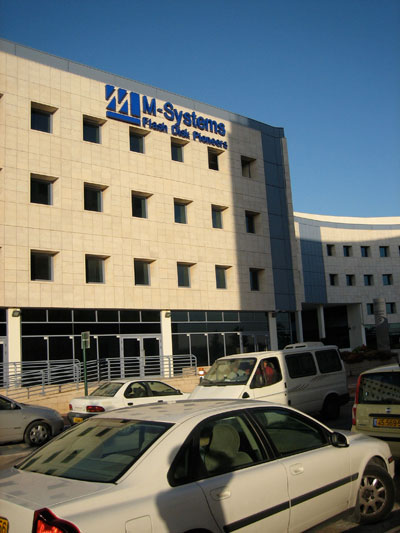
Back in 1997, I had discovered an Israeli company by the name of M-Systems. We bought stock on the premise that solid state memory technology was poised to break through into mainstream consumer electronics.
A good decision.
In 2006, M-Systems was acquired by SanDisk. Our winnings bankrolled this trip.
I wanted to visit the company, before the signs were changed. I especially wanted to meet the CEO, Dov Moran, in person. It looked like he would be leaving before the year was out.
An Israeli journalist friend, Shlomi Cohen, was able to arrange a meeting and was kind enough to drive to Kfar Saba where msystems is located.
Over the years I’d posted quite a bit on stock message boards about M-Systems, under the name Savolainen, my Finnish middle name.
So Dov walks in and Shlomi introduces me, “Mr. Smith”. Dov looks blankly at me.
Then Shlomi says “Solovian,” and Dov says “Solovian!”
Apparently “Savolainen” translates as “Solovian” through an Israeli filter.
My guess is Finns are far scarcer than Eastern Europeans in Israel and hence Savolainen, which is a bit of a linguistic mindful, comes out Solovian.
In any case, Dov was enthusiastic, once he knew I was Solovian,
“I’ve wanted to meet you. How do you know so much about our company?”
Apparently M-Systems had been following my rather obsessively-detailed postings.
Dov explained that given the info I appeared to have access to, they figured I had to be an insider or a relative of an employee. He said they had tried to figure out the connections, but hadn’t had any luck.
Given that Dov had a background in military intelligence, I took his curiosity as a high compliment.
While Shlomi and I were chatting with Dov and trying piece together company secrets, Sharon and Shlomi’s wife Dvorah were combing through the archaeological exhibits of the Israel Museum.
Dvorah was in Jerusalem that day doing consulting work with the Israeli government. Earlier while we were waiting for her meeting to finish, Shlomi drove me around West Jerusalem.
When we were driving by the new Supreme Court building, Shlomi says, “You want to go in?” So I say “Sure.” And he says, “I think I can talk my way by these guys.” As we pull up to the armed checkpoint, he pulls out his wounded veteran sign and puts it on the dash board.
The guy with the Uzi slung over his shoulder, walks over, and lots of Hebrew and laughing later, waves us to turn around.
Shlomi says, “It didn’t work. This is the same car that all the important government people drive, so I figured he might just wave us through, but he wanted to know who we were. So I told him and he said,
“Come back when you’re a judge!”
We picked up Dvorah and headed back to the American Colony for dinner.
We were sitting in the Cellar Bar in that corner with the arm chairs, when Dvorah looked around knowingly.
“You know we had this place bugged”
Dvorah had worked with Israeli intelligence. The American Colony was Arafat’s favorite hotel. Palestinian and Israeli officials met “covertly” in Room 16 to draft the 1993 Oslo Accords.
Of course everyone would be listening.
14 Stations of the Cross and the Church of the Holy Sepulchre
The next day Sharon and I walked the 14 stations of the Cross in the Old City, the fabled path Jesus is said to have taken to his fate on the cross, starting at the Lion’s Gate and ending in the Church of the Holy Sepulchre.
The Church of the Holy Sepulchre, also called the Church of the Resurrection by Eastern Christians, is a church within the walled Old City of Jerusalem. The site is venerated as the Hill of Calvary, where Jesus was crucified, and is said also to contain the place where Jesus was buried (the sepulchre).
The church has been an important Christian pilgrimage destination since at least the 4th century, as the purported site of the resurrection of Jesus.
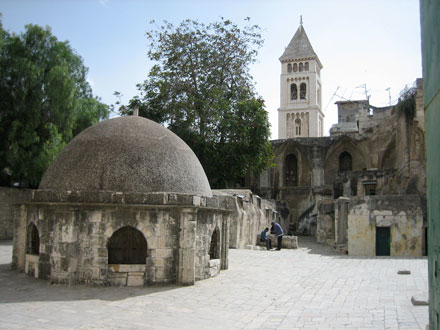
My favorite part was the Ethiopian Monastery on the roof of the Church.
There was no indication we were on a roof at all. The climb up the hill, on the backside, delivered us to this courtyard. It seemed like just another courtyard. An African village courtyard, but a courtyard nonetheless.
Off to one side, one African guy was shaving another guy’s head. In another corner a tour guide was holding forth. Typical Jerusalem moment.
We weren’t sure where to go next, but the the guy with the razor pointed to a low dark unmarked door. It led through a series of small, dark, candle-lit, Santeria-like spaces.
At the end, we emerged out of a corner of the large stone courtyard in front of the Church of the Holy Sepulchre. Nice sequence.
Bizarre too.
Once inside, we sat listening, just inside the door of the Church. We heard 10 languages in 10 minutes.
Back at the hotel they asked,
“You didn’t have a guide?”
The next day, we were sitting above a security checkpoint overlooking the Western Wall when I hear something like, “No, moniko sinun sedistäsi on tehnyt itsemurhan tänä vuonna?”
Helsinki deja vu.
So the Finns wander on down to to the Western Wall check point and this young Jewish woman walks up, “My husband and I live on the street, could you help us out, … ?”
Deja Vu of a sort.
Sharon and I have heard the same equivalent pitch, same rhythms, same inflections, many, many times, nearly every day in Harvard Square for the last 26 years. Curiously the moment made me feel right at home.
The Western Wall has Cecil B. DeMille dimensions, rising 65’ above grade and descending another 40’ below to bedrock. It is one section of one of the retaining walls creating the Temple Mount.
The Temple Mount itself is a 35 acre raised plaza with the Dome of the Rock as it’s focal point. The Rock inside, is the peak of Mount Moriah of the scriptures. Although it’s no longer visible, Mount Moriah is still there, just embedded in the box created by the enormous retaining walls.
The mountain’s peak had been so important for so long, that to accommodate the crowds, the raised plaza was created around the peak, which in turn buried the mountain.
Intriguing conceptually.
And this was done over two thousand years ago.
On our last day, I walk out of the hotel and Sharon is standing there with the taxi drivers, hotel security and a couple of guys from the gift shop. All are Arabs except Sharon.
Everyone, including Sharon, is laughing and smiling.
There is a wooden bird cage, with bird, hanging off a tree limb, swaying back and forth. Sharon tells me that one of the local cats had been watching the bird ever so closely.
Surprising everyone, it made it’s move, jumping vertically the 4 to 5 feet up up to the cage.
In an instant the cat pulled the cage open, freeing the bird, which then flew 10 to 15 feet straight by one of the cab drivers who nonchalantly reached out and caught it bare-handed.
The bird was returned to its cage. It was fine, the cat was fine, the taxi driver was fine.


















 Advencha before Dementia