When you find an old college friend on the internet, and it turns out she’s living in Europe right outside a medieval city dating back to the 12th century, and she says come visit,
You say Yes.
And Yes again, when that medieval city sits on the edge of the Alps and some of the best hiking in the world.
You don’t know the language. No problem, when your wife is a polyglot.
A couple of semesters of night school should be be enough- for the wife to get up to speed.
Yes, Yes and Yes.
We flew into Zurich. With our Swisscom SIM in our phone and our train passes in our pockets, we hopped onto a train headed for Bern.
I recognized another near-elderly American couple seated opposite us from our all-night flight. They had been flying first class.
We struck up a conversation. They were headed for Zermatt, where they spend a month, every summer.
Their conversation alternated between the weather and how close the train would come to departing on time. It was decided that the weather was irrelevant because when they got to Zermatt, they would be above the clouds.
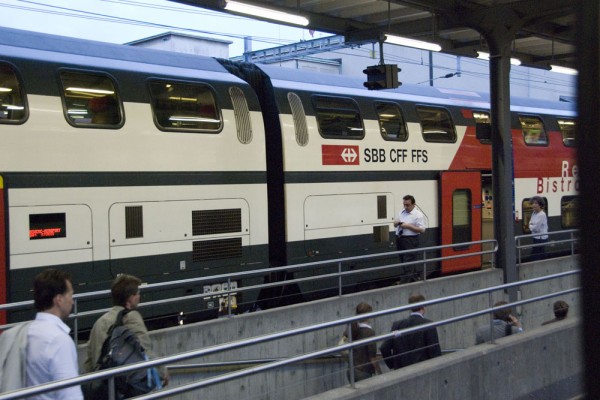
The train was scheduled to depart at 12:02. 12:01 clicked past. Nada.
The Mr. smiled ever so slightly when at precisely 12:02 the train pulled out.
Welcome to Switzerland.
The last time I saw Linda was 1971- 40 years ago. For many years, I wondered what had become of her.
Turns out Linda married Swiss and went native.
An interesting choice and journey for a girl from Phoenix, Arizona.
So how much does one change from twenty to sixty. I was about to find out.
Although Linda was no longer a platinum blond, and I no longer quite the kid, we recognized each other immediately, on the train platform in Bern.
Both of us had changed a lot, and not much at all.
As one of my Spanish sayings goes:
La vida es así.
Life is like that.
Over the last few years Linda has sent several young Swiss adults our way.
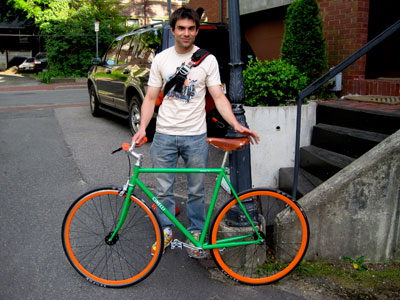
The last was Stefan, one of Linda’s son’s best friends. Stefan came to Cambridge to work on research for his master’s thesis (computer visualization for MRI) and needed a place to stay while he looked for more permanent lodgings.
Sharon and I are empty nesters with a spare bedroom, so we had plenty of room.
Having Stefan around was quite entertaining. Fun to have youthful energy back in the household.
Sharon took to calling Stefan our foster son. It felt like that- in a good way. Very relaxed.
When Stefan’s parents heard we were coming to Switzerland, they offered to host us for a stretch. We took Ueli and Ursi up on their kind offer, for the last third of our trip. We didn’t want to overstay our welcome with Linda, and the timing looked right.
The Plan
This trip had three distinct chapters.
Chapter 1 – Orientation and Exploration: Sharon and I explore Bern and its environs. Stay with Linda and her family in Uettligen for 5 days. This post.
Chapter 2 – Via Alpina: Sharon and I hike for 5 days from Mountain Inn to Mountain Inn in the Berner Oberland (Swiss Alps). The Bernese Oberland post.
Chapter 3 – Recover and Relax: For 4 days, Sharon and I pull ourselves back together and get out and around a bit more. Stay with the Ueli and Ursi in Uettligen. Post not written yet.
Sharon’s German
I must admit, I was really curious how Sharon would do with her German. Usually on our trips, Sharon picks up the language on the fly: Flemish in Belgium. Finnish in Finland, and so forth.
For this trip, she had a head start- two semesters at Harvard Extension School.
Sharon’s Harvard Extension School experience is worth a post in itself.
Suffice it to say that it was the real deal.The same material at the same pace as the undergraduate Harvard course. Kind of like trying to drink from a fire hose. Sharon was the oldest in the class by far.
Next oldest was a Russian scientist at Harvard, studying meteorites. She was in her 40s. She became one of Sharon’s buds.
Our first morning in Switzerland, Sharon bought us bus passes. We walked up to the window at the post office in Uettligen, the small village outside Bern, where Linda lived.
I handed Sharon some cash, mumbling something about a 6 ride pass.
The guy behind the window greeted Sharon – in German. She greeted him – in German. After a pleasant back and forth- in German. He went off and came back with the right transportation card. Sharon handed him some cash. Some more pleasant back and forth – in German, and we had our bus pass.
Never once did he ask her to repeat herself. Never once did he switch to English.
Later that day we were sitting in a café in Bern’s old town. Picturesque setting. Our gruff Swiss waitress had some English, but clearly preferred German.
Sharon ordered for us – in German.
A good start.
Gradually during the course of our meal, our waitress lightened up. Sharon was sociable- in German, and clearly had a sense of humor – in German.
By the end of the meal our waitress was humoring us with little English, and went so far as to give me a pat on the back. Though this gesture probably had more to do with my tip, than Sharon’s German.
Linda explained that night over dinner that the Swiss don’t tip as we do in the USA. Meal prices are (mostly) tip inclusive. I had left our waitress 15% on the table.
Bern’s Old Town (Altstadt)
The Old Town of Bern is a UNESCO World Heritage site. Rightly so.
The map below is from 1638. The Old City is the peninsula. Built on a narrow hill surrounded on three sides by the Aare river, it is essentially unchanged since its construction during the 12th to 15th century.
Today at the far right across the river where a tower is shown, is the bear park. At the far left where fortifications are shown is the train/bus station with underground parking.
Typically as time allowed, Sharon and I would arrive on the left wander down to the far right and then back, zigzagging or just walking the main street on the spine.

We never tired of the cycle. Remarkable layerings of history. Good people watching too.
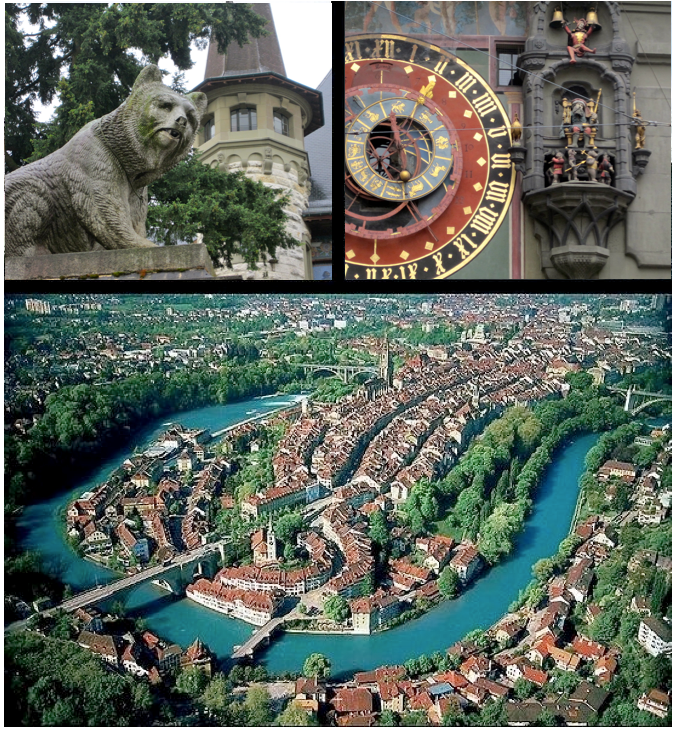
Bern is one of the most extraordinary and best preserved examples of medieval town planning in Europe. Wonderful scale and variety of buildings. Miles of pedestrian arcades. Sculptural fountains.
A hillside town wrapped by a river running turquoise.

The centerpiece, an elaborate medieval clock tower from the 11th century- with moving puppets, and once used as a prison for women convicted of sexual relations with clerics (photo to left).
Not surprisingly, Bern has great museums. We visited three in the days before our big hike.
First up was the Swiss Alpine Museum. The room-sized terrain model of the Bernese Oberland scared me. It is one of the largest models of the Swiss Alps ever built.
It’s remarkable detail spelled out exactly what terrain our hiking would cover. A closeup of the model showing the end of our hike – (Lake) Oeschinensee- below.

Yep, in hindsight, in reality, it really looked like that. Every bit as steep.
The historical museum of Bern is the second largest historical museum in Switzerland and contains collections related to the history of Bern, from prehistory to the present.
Standing at the bottom of the main stair, I glanced up and noticed a soulful, super-sized, wooden carving of a man’s face looking down at me. The angle looked good for a photo. I pulled out my camera.

On the third shot, a woman from the museum appeared. Although I couldn’t understand a word of her German, the drift was pretty obvious- no pictures in the museum. I nodded sheepishly and put my camera away.
As the woman disappeared around the corner, Sharon confirmed my intuition.
No photos!
Sharon added that the woman had pointed out that the feet were his too.
I glanced down and sure enough there were two super-sized wooden feet, on the floor on either side of me- curiously it was as if the rest of his body had been there, but was gone now.
Which in fact, was exactly the case.
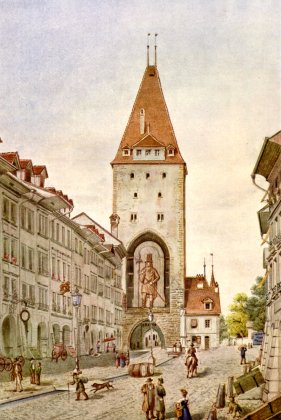
This guy had begun his life, whole, some 655 years ago as St. Christopher. He had been nearly 30 feet tall,. He had looked down from the side of a tower on those entering Bern through an arched gateway just below his feet.
Some hundred years later, when the Protestant Reformation swept through Switzerland, the child Jesus in his arms was removed and his name changed to “Goliath.”
In the 1860s his tower was knocked down to make way for progress.
Today in the 21st century, only his head and feet live on at the bottom of a stairwell in a historical museum. He looks down on little old American guys with digital cameras, who shouldn’t be taking pictures. So it goes.
La vida es así.
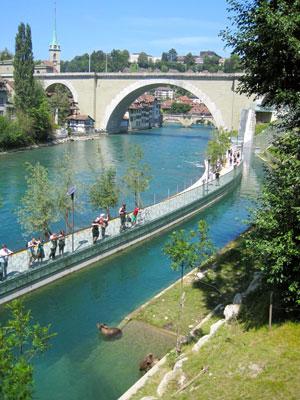
The old city of Bern is defined on three sides by the river Aare.
The Aare is no Charles River. The Charles here in Cambridge is technically a river, though in reality it is really more of a slow flowing artificial lake.
The Aare is a real river. Clear with a turquoise tint from glacial runoff, it rolls right along.
The photo to the left shows both the Aare and Bern’s new bear park.
The new bear park is great. It officially opened in October 2009.
The bears have lots of space and their own swimming lagoon.
The old bear pit is there too- for context. High on the hill. Not a nice place. Built in 1857, when bear-baiting was in vogue.
While these bears, looked contented, it was really nice to have them on the other side of the fence. Our Glacier National Park adventures were still fresh in our minds.
Sharon and I laughed and joked, as we ate our most-tasty Swiss ice cream.
Sometimes it’s really nice to have a fence.
Driving back from Bern to Uettligen with Ursi and Linda, we would cross high over the River Aare on a concrete bridge/ exit ramp. Looking back and down Sharon and I noticed a covered bridge, a remnant from a bygone era.
A Walk along the River Aare
We asked Linda and Ursi about the bridge and if there were hiking trails along the river itself.
The bridge was the so-called New Bridge. First built in 1466 to replace a ferry, and then rebuilt in 1535.
The next day Ursi gave us map showing the river trail. If we took the bus from Bern to the village of Bremgarten instead of Uettligen, we could walk along the river Aare, under the New Bridge, down a ways, and then cut back up and over to Uettligen. Time: 2+ hours of hiking.
Sounded like a plan.
After a morning at the remarkable Paul Klee Museum, and a couple more hours in the old city, Sharon and I caught the bus to Bremgarten and found our way to the river path.
This path along the river Aare was special. No tourists, just locals. And local flavor.
The closest USA equivalents that come to mind are the San Francisco and Berkeley urban walking paths. Public ways for pedestrians. No roads. Intimate scale. With a bit of voyeuristic tension thrown in.

In this case, the Aare River was on one side and on the other a steep bank with a jumble of vegetable and flower gardens, animals of all varieties, and funky along-the-river retreats mixed in with more substantial homes.
It was Saturday afternoon.
Folks were out and about. All ages. Little old men with wheelbarrows, runners, families.
When we’d pass. We’d usually get “Grüezi.” Or Hello in Swiss German, as Sharon explained to me. In German it would have been “Guten Tag”, but we weren’t in Germany.
Swiss German is considerably different from German. Both are used in Switzerland.
German is used primarily for writing. Swiss German mostly for speaking. Complicating matters further, Swiss German changes from Canton to Canton, or even town to town.
If there is any confusion, the conversation reverts to German.
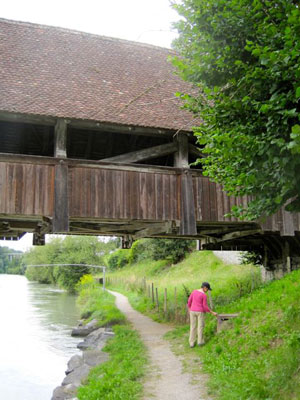
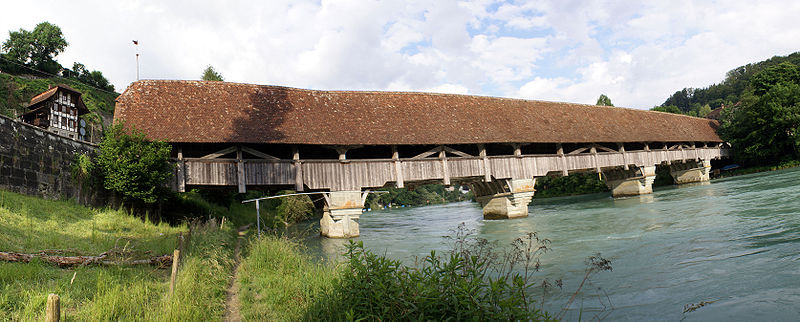
We crossed under the New Bridge. It was everything we had hoped for. A really, really old wooden covered bridge with a trussed frame- still working too.
Though today, its cars instead of horses and knights in armor.
With its dips and twists, some would say the bridge was a bit worse for wear. We thought- better for it.
Boats tied up along the river caught our eye. They looked like a cross between Venetian gondolas and English punts. Flat bottomed and about 30 feet long.
Archetypal. Think Charon and and the River Styx. This boat is said to be at least 5000 years old.
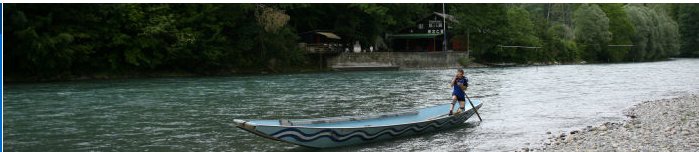
The Swiss use use these Pontonier-fahrverein for fun and sport on the river Aare. In shallow waters these boats can be maneuvered long poles, in deeper water- with standing oars.
As we wandered along, after about an hour and half ± , I started to get a bit worried that we’d somehow missed our cutoff to Uettligen.
Soon though, we arrived at what looked like the right sign marking our trail, Sharon confirmed with locals. This was indeed our 90 degree turn. Again an all-German conversion.
They suggested that rather than walk up into the apartment complex where the sign curiously pointed, we would be better off walking around and picking up the trail on the backside.
Good advice.
As we huffed and puffed up the steep slope away from the river, I wondered whether we would be in for more of this in the Alps- the day after tomorrow.
Yep. In spades.
 Advencha before Dementia