Curiously the seeds for this trip were planted in Ireland. I kind of fell for an artist’s porcelain lighthouse-ish tower. But it wasn’t meant to be. One thing led to another and I found another porcelain tower even better.
This porcelain tower had been an art installation at the Victoria and Albert Museum in London called the Tower of Babel.

The tower was almost 20 feet high, and built of 3000 bone china miniatures, each depicting a real London Shop, and each for sale, as part of the concept.

I contacted the artist, Barnaby Barford, to see if any shops were still available. I wasn’t so sure, as the installation had been way back in 2015. But there were a few orphans left. The unloved.
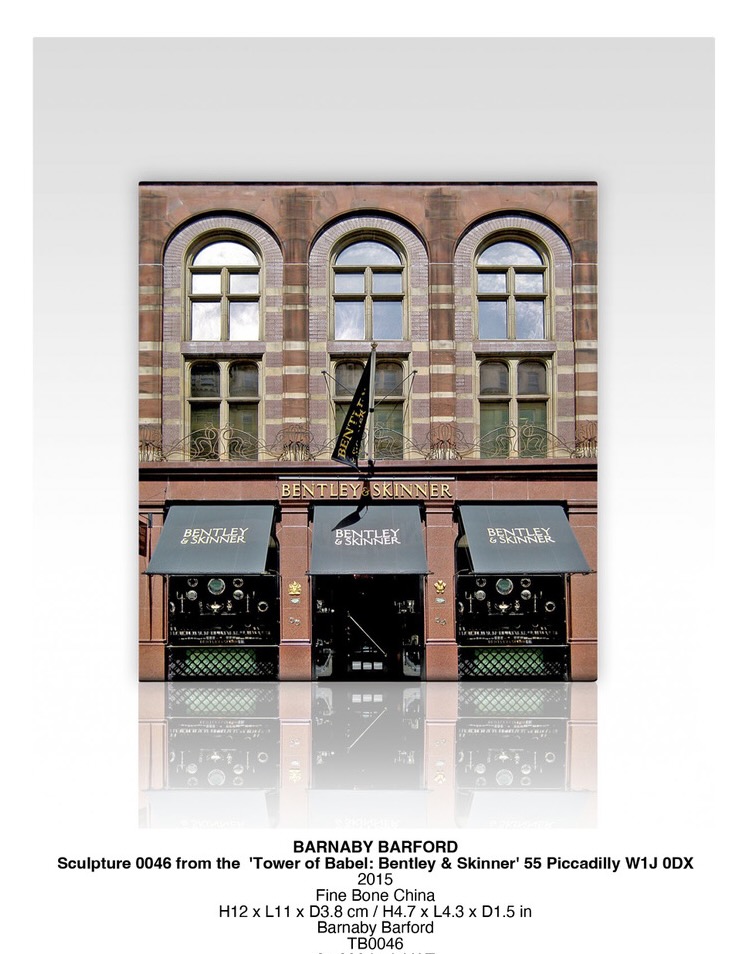
We purchased 6. Bentley & Skinner Below. This miniature porcelain shop is just a tad bigger than the pic below : about 4″ x 5″. Fantastic detail. The front is flat. The flag, the awnings, window displays and shadows, are all just graphics.
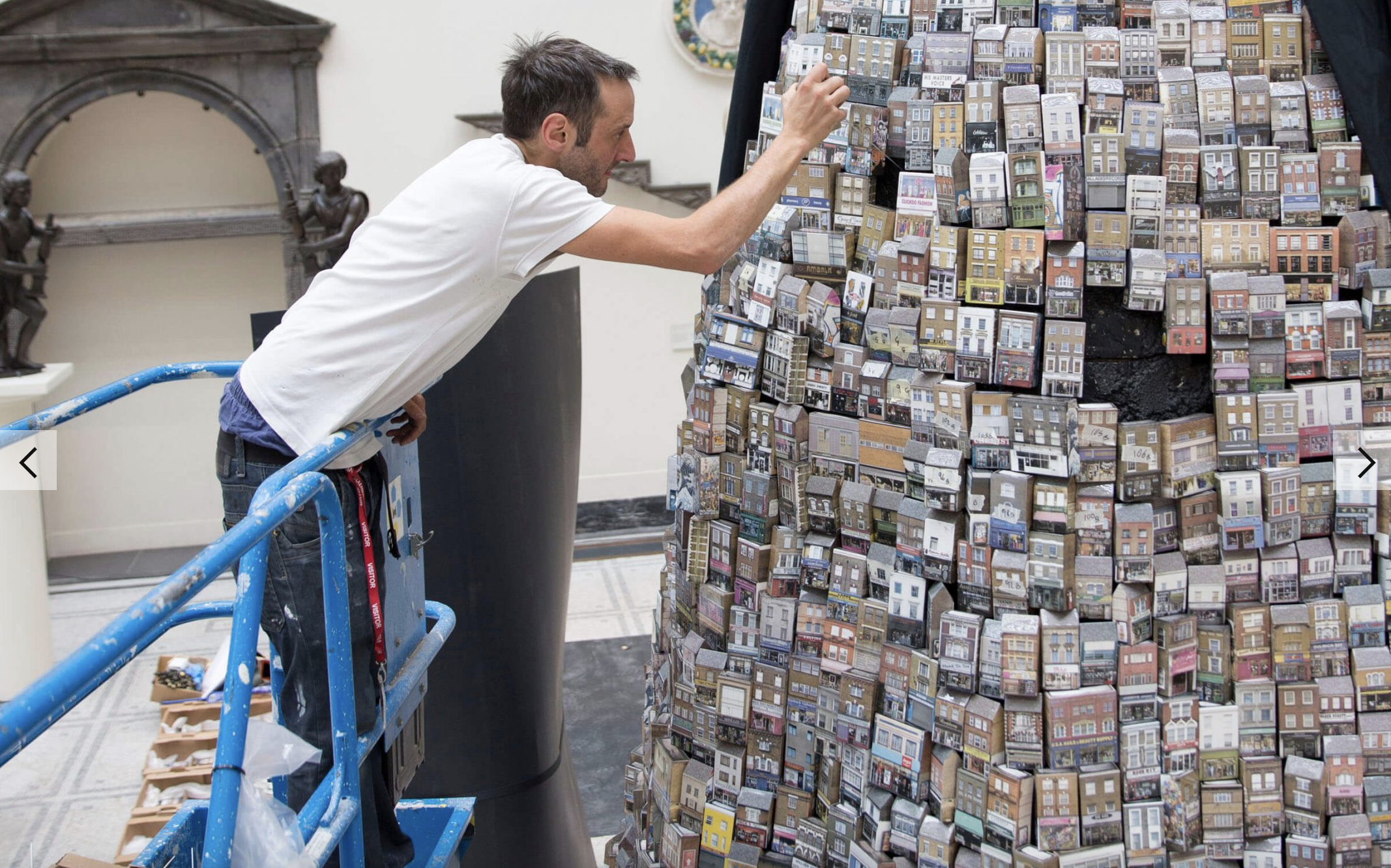
To construct the Tower, Barnaby used a foam base into which he stuck the shops using custom skewers off a lift.
Barnaby bicycled over 1000 miles, visiting every post code in London, photographing shops. The Tower’s 3000 were the ones that made the cut.
Our porcelain shops came with addresses. So we could find them, if we were to go to London.
Which on further thought seemed like a great idea. We could even bicycle to them, just like Barnaby had, if we brought our tandem.
We had a plan. Closing the circle, as it were. We went for it. Our personalized great London Scavenger Hunt.
And besides we had never been to London. Sights to see, museums to visit and so forth. The big surprise were the Rivers of London.
The Drive into Town
Deep, our Pakistani friend/driver picked us up at Heathrow Airport 7:30-ish AM. We had flown all night, and were bleary. Nonetheless, Deep took us into London via the slower scenic route, through the heart of the city. He thought it would be good for us. And he was right.
If you are ever in London and need private transportation or need bags moved from here to there. Deep is your guy. https://www.movemybags.com
As we approached Piccadilly Circus on Brompton Road, it was slow going. The rush hour squeeze. A few brave souls on bicycles wove their way through as best they could.
One bicycle guy in front of us was thinking about trying to slip his way through between a double decker bus and a van next to it.
Bad idea. He backed off. He might have fit, if he squinched his shoulders, but his handlebars, No. Sharon and I looked at each other. We would be bicycling through here ourselves in a few days.
Deep was giving us a running commentary. Pointing to the side streets:
“See those buildings. Modest on the outside, but another world altogether beyond the front door. Middle Eastern Big Money.”
The adjoining Mayfair district has a number of nicknames. “Little Doha”, “The Qatari quarter” and my favorite, “Qataropolis.” The Al-Thani family, the ruling family of Qatar,and their relatives and associates owned a quarter Mayfair in 2006. No doubt more now.
We passed Harrods Department Store.
“Famous for being an iconic luxury department store offering an unparalleled shopping experience, a grand and historic Egyptian-style architecture, an extensive selection of high-end and designer goods, and its famous, albeit expensive, Food Halls. Its fame also stems from its reputation for impeccable service, being a global tourist destination, and its symbolic value as a testament to British luxury and exclusivity.”
And who owns this testament to British luxury and exclusivity today? You guessed it, The Qataris.
Moving on ever so slowly, we reached Piccadilly Circus, which as Deep proclaimed, is the center of London.

Why is this square considered the center of London?
Well, it’s a central crossroads where 4 roads meet and the location of a key Underground Station. It’s also in the heart of the city’s entertainment and shopping district and a popular tourist and meeting point.
And as such was a place to acquire heroin, and was notorious in the 1960s as the center of London’s illegal drug trade.
We inched our way through. Not a drug dealer in sight.
In the blink of an eye we passed through Chinatown.
Deep then swung through a number of back streets like the back of his hand and we were out front of our hotel, the Hoxton Holburn.
We ended up here though the recommendation of our friend, now manager at the Hoxton Williamsburg, our favorite hotel in NYC, who had passed along a discount code and moral support.
It was a great location for our purposes. A ten minute walk to Covent Gardens and great Indian food. Only a few blocks to the British Museum and a couple of blocks to the John Soane Museum.
We could walk to the Thames River, although it was a bit of a hike, And we could bicycle north to the Regents Canal and the River Lee.
And besides, it looked like our kind of place. An ex-telephone exchange building repurposed as a hotel with big friendly, street level public spaces.
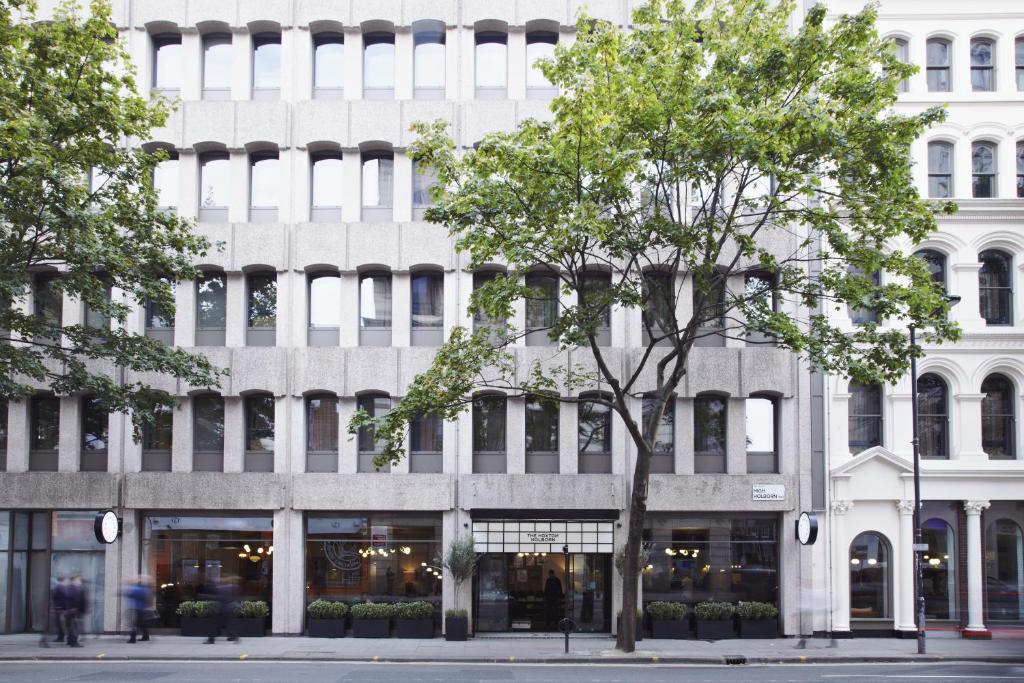
Deep dropped us off and took off, and we wandered in. The front desk was most friendly, but their computer didn’t show us checking in until the afternoon. Someone had missed something. I got to talking and the manager wandered over, checked her computer and sent us on up to the back side of the 5th floor.
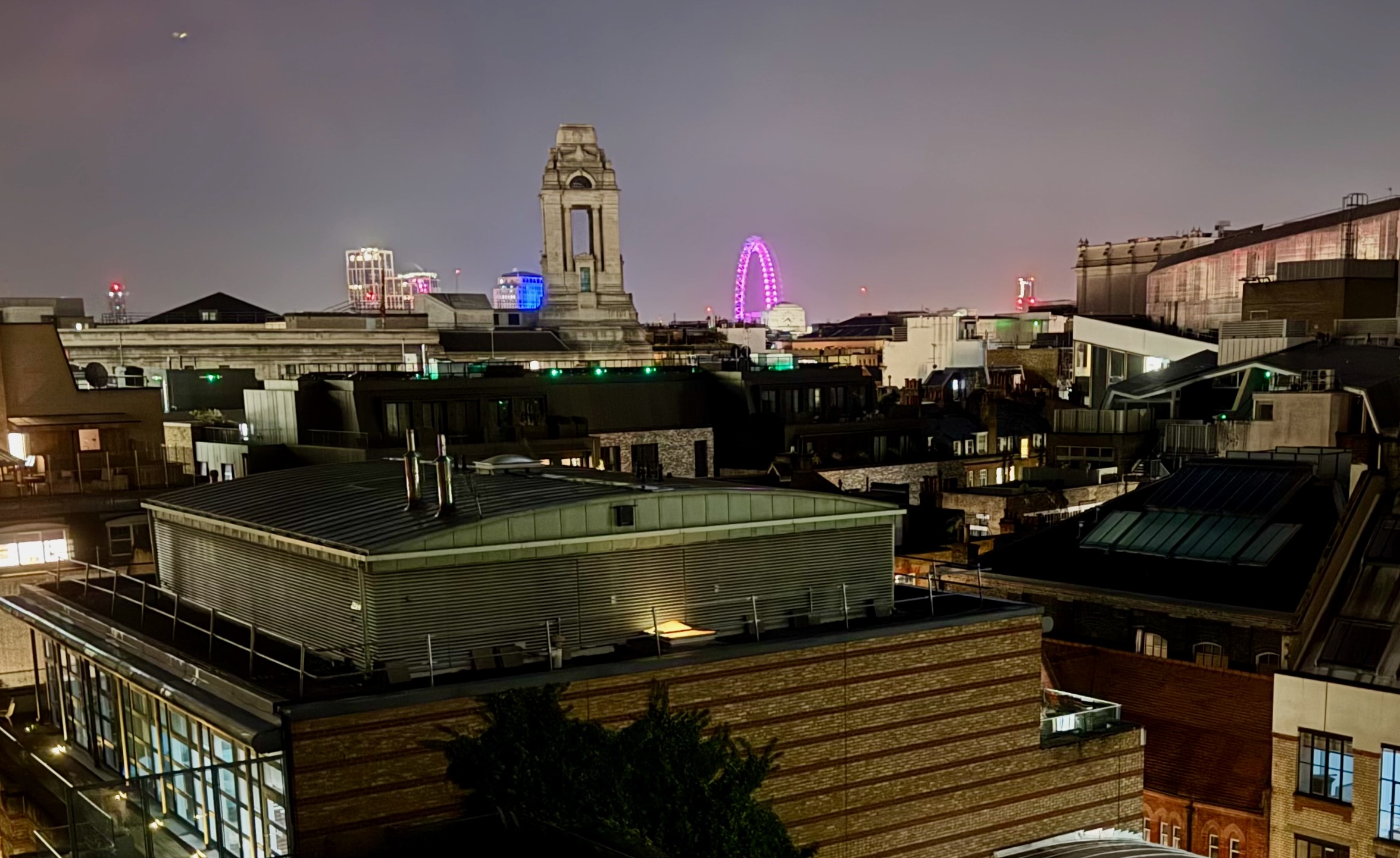
Where we were very happy, for the next 10 days. It was incredibly quiet and where we had perhaps the best view in the hotel. Out across the rooftops of London to the London Eye in the distance.
The British Museum and Shakespeare
It rained and then rained some more. Which wasn’t a problem as the British Museum was only a couple of blocks away and I had a bike to assemble.
We had a plan. We both headed off to to the British Museum.
The British Museum is big. Like big, big. Half again as big as the Met in NYC. And it is beautiful and it is free. Though it is advised to schedule admittance online, which we had done a couple of months before.
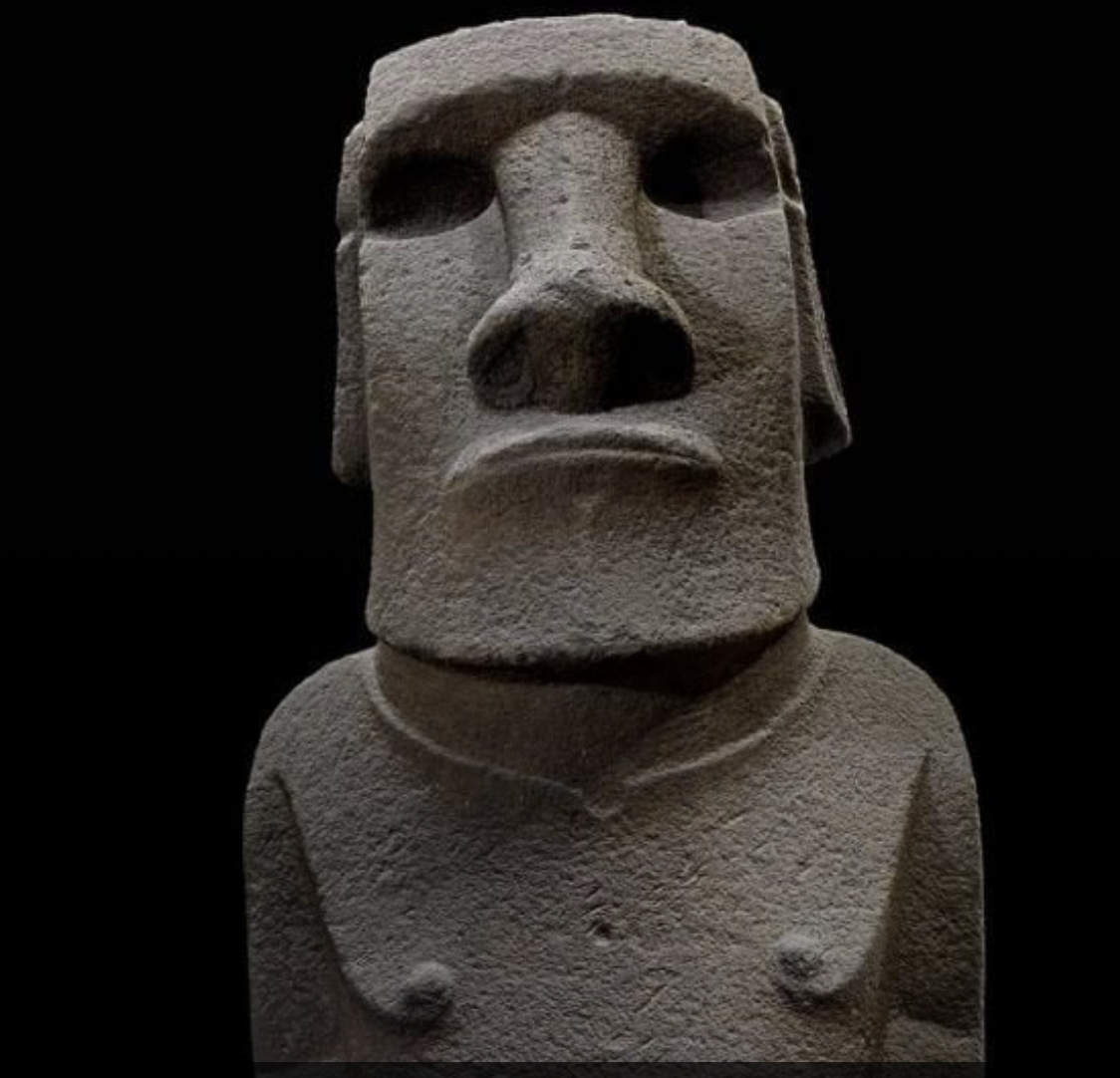
We saw the Hoa Hakananai’a, a colossal ancestor figure from Papa Nui/ Easter Island, and a whole lot more.
After an hour I headed back to assemble the bike. And Sharon took her time and museumed-to her heart’s content.
She brought me back a BLT, dropped into a book and in short order the bike was fully reconstituted.
We kept Mr. Bike in our room for the whole trip, as no one seemed to care. We could have locked it up off the loading dock. We had management’s permission. But all up, it was easier and more comforting to have it in our room.
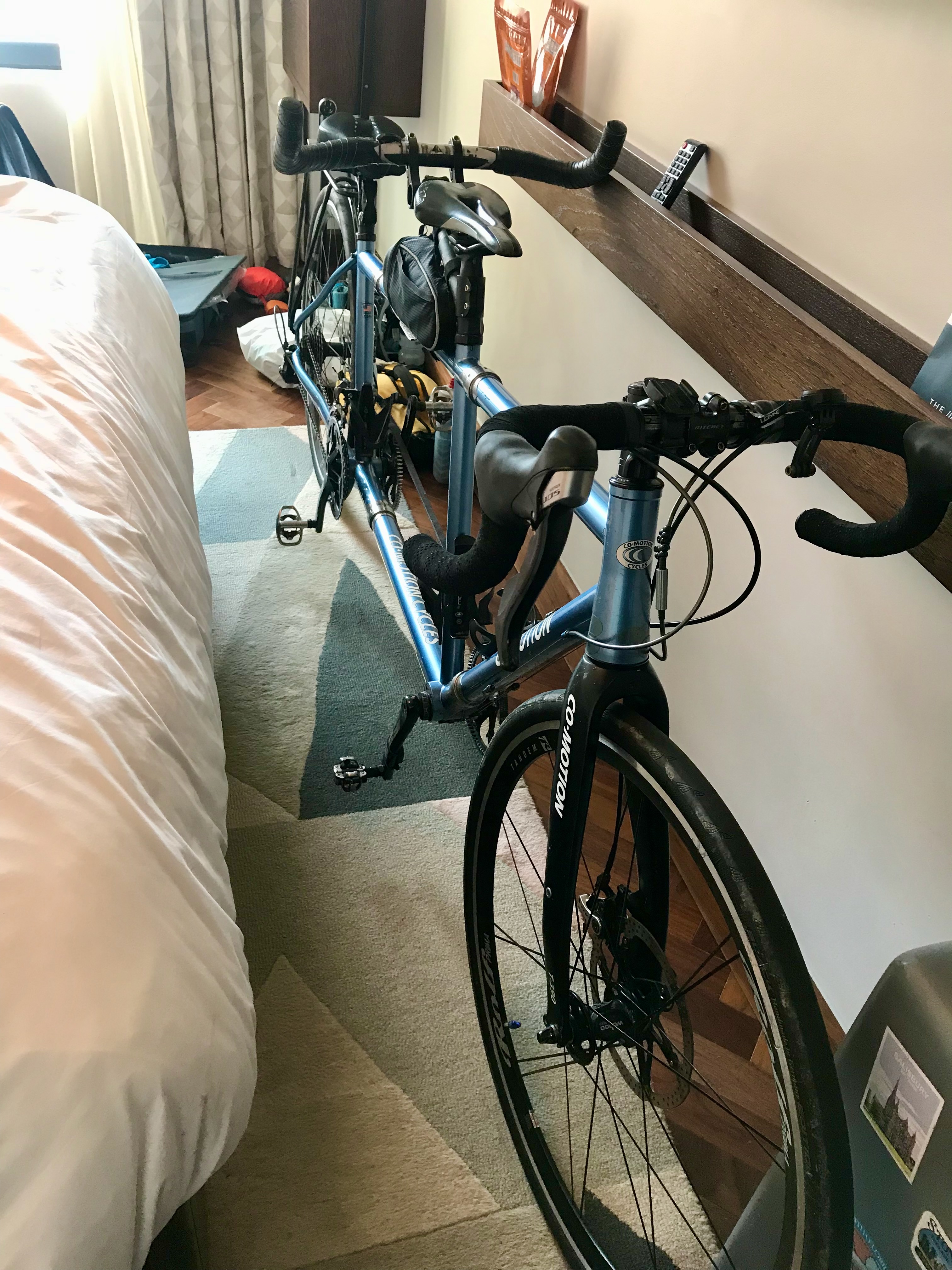
It wasn’t that hard for me to get by on the way to the bathroom. Mantra was butt to the bed. That way I could lean back and neither handlebars or pedals would catch.
The next day we had scheduled our visit to Shakespeare Globe Theatre and the Tate Modern Museum. Sharon wanted to ride in a London Black cab and this was as good a time as any.
The front desk called in our request. 5 minutes.
15 minutes came and went. I went back in. The front desk laughed,
“Someone else must have grabbed it. There’s another one out front. Why don’t you take that one?”
And we did. Whoever it was for, well they can take someone else’s.
First up was the Tate Modern Art Museum. Remarkable place. A converted Power plant. Very well done. Turns out in the right hands, a sympathetic aesthetic. Monumental spaces with industrial materials and a totally wonderful site on the Thames.
We had lunch on the top floor of the Tate with quite the view over London. St. Paul’s Cathedral and the Millennium Bridge across the Thames River.
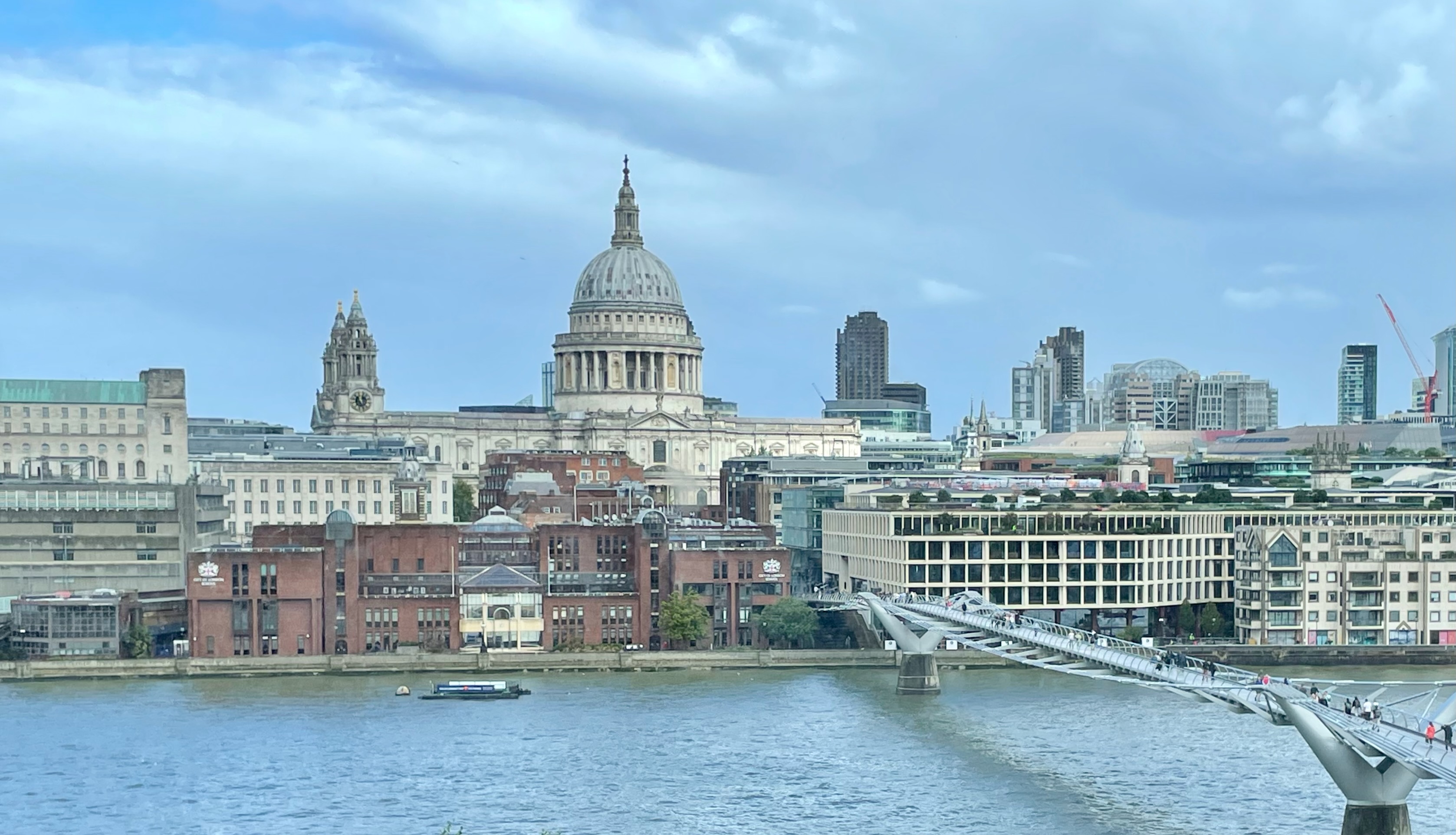
Pretty much right next door to the Tate is today’s Shakespeare Globe Theatre. We wandered over for our show.
This Theatre is the third generation. 4th if you include The Theatre, which was the first successful permanent theatre built exclusively for the showing of theatrical productions in England.
The Theatre was built in 1576 and stood in Shoreditch not too far from our hotel, in what was then, as today, an entertainment district. In 2025 it’s pubs, bars and nightclubs. In the late 1500s it was bear-baiting, taverns and Shakespeare.
Shakespeare wasn’t considered highfaluntin then. Perhaps the opposite. The highbrow were welcome and had special seating, but they kind-of had to make their way to the theatre on the sly. Shakespearian theatre wasn’t socially-accepted entertainment for the upper crust. More guilty pleasures.
When the Shoreditch lease was up in 1599, the owners of the land on which the theatre stood refused to renew the player’s lease, thinking they would end up with the theatre, and its very valuable oak timbers.
Wrong. While the landowners were out of town celebrating Christmas, the players and their cohorts took the Theatre apart and moved it close to this site on the Thames.
The Theatre was reconstructed the following year and renamed the Globe. First show: Shakespeare’s Julius Caesar. Not a bad way to get up and running.
This Globe Theatre burned down in 1613, but was rebuilt the next year on the same foundation with same name. This Globe Theatre had a good run, until it was closed by the Puritans in 1642. Two years later it was demolished to make way for housing.
The current Globe Theatre opened in 1997. A faithful reconstruction of the original. Open air, intimate, with remarkable acoustics. We had seats where the upper crust would have been seated, complete with rented , most-welcome cushions. That would be on the first gallery up.

Our show was Twelfth Night. A gender bender to start with. No problem there. Shakespeare knew folks. Our problem was with the current troupe’s improvements, which in this case meant more gender-bending on top of Shakespeare’s. Made it a bit hard to follow. At least for me.
Why try to re-invent a brilliant original? Maybe I’m just getting old. Then again, maybe I need to re-read Shakespeare.
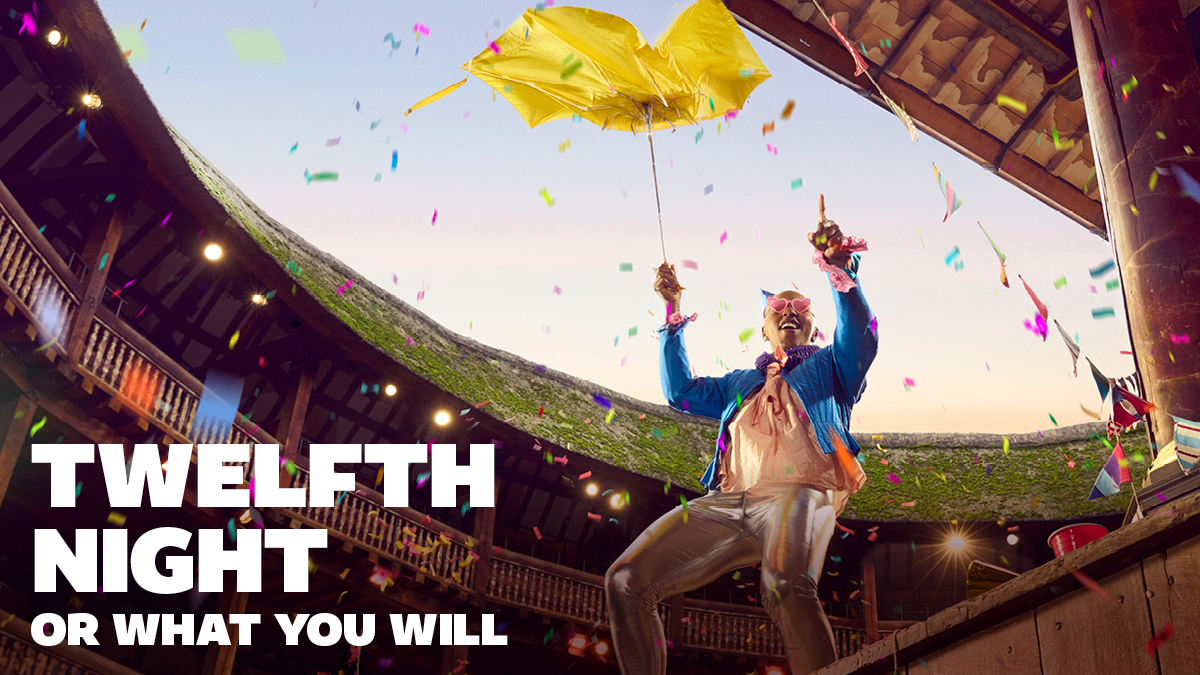
Most fun, in any case.
After the show we wandered out after returning our cushions. And made our way across the Millennium Foot bridge, by St. Pauls Cathedral and back to our hotel.
Rivers of London and a visit to Barnaby’s Studio
We had an invite to Barnaby Barford’s art studio. And in the spirit of the trip, we were going to bicycle there. And back.
This first London bicycle ride looked straightforward enough on paper. We’d cut up to the Regent’s Canal and then ride east, take a sharp left and head north on the river Lee. First we had to get to the canal.
But before that we had to get out of the hotel and on the road.
What could go wrong?
We were on the 5th floor, and pretty sure that our-now-assembled tandem would fit in the elevator, if we took the front wheel off and stood it up. Which it did with perhaps a 1/2” to spare. The front desk was amused when we rolled out on the first floor. Perhaps a first in their world.
We rolled Mr. Tandem through the extended lobby, full of folks. Remarkably nary a sideways glance.
Outside we loaded the bike up. I went to bring up our route on our bike computer, but the route wasn’t there. I headed back up to our room for a re-install, while Sharon stayed with the bike out front. Internet in our room was dodgy, so I wandered out into the hall for a better connection. I hit gold near the elevators and we had our route.
Back at the bike, I decided to top up our tire pressures. Probably not necessary, but why not? On removing the pump hose, the rear wheel valve stem came out too. Pressure promptly dropped to zero.
After re-installing the valve stem and after 3 minutes of high-cardio hand pumping tire pressure held. Thankfully.
We headed off walking the bike. Lots of traffic and best to be careful. After all, traffic is backwards, and we had two roads to cross. We found a safe launch spot. Got on the bike and waited for an opening in traffic.
Something was wrong. I looked down. I had Sharon’s pedals, and she had mine. Neither of us were happy, but it would work, we could swap later.
3-2-1 and we were off.
We had waited for rush hour to clear. Traffic wasn’t Piccadilly Circus bad, and lanes were full, but we soon discovered the saving grace. The left lane was reserved for Buses, Black Cabs and us (bicycles). We ride fast enough to keep up with traffic.
After a bit we turned hard left and headed north for the Regent’s Canal.
Or more accurately the tow paths along the Regent’s Canal. The Regent’s Canal was built in the early 1800s. At that time, horses towed boats on paths alongside the canal. Today these paths have been paved and are used by walkers and bicyclists. They are most scenic and much in demand, as we were soon to find out.
A tight right turn later we were on the Canal. I hadn’t really thought about what to expect. I had been focused on simply getting to Barnaby’s Studio. He had recommended this route.
The first thing that hit us were the narrow boats tied up along the path. A bustling world unto itself. The tow path was manageable as long as we ducked under the low bridges, were careful to give all the folks with headphones space and watched the water’s edge.
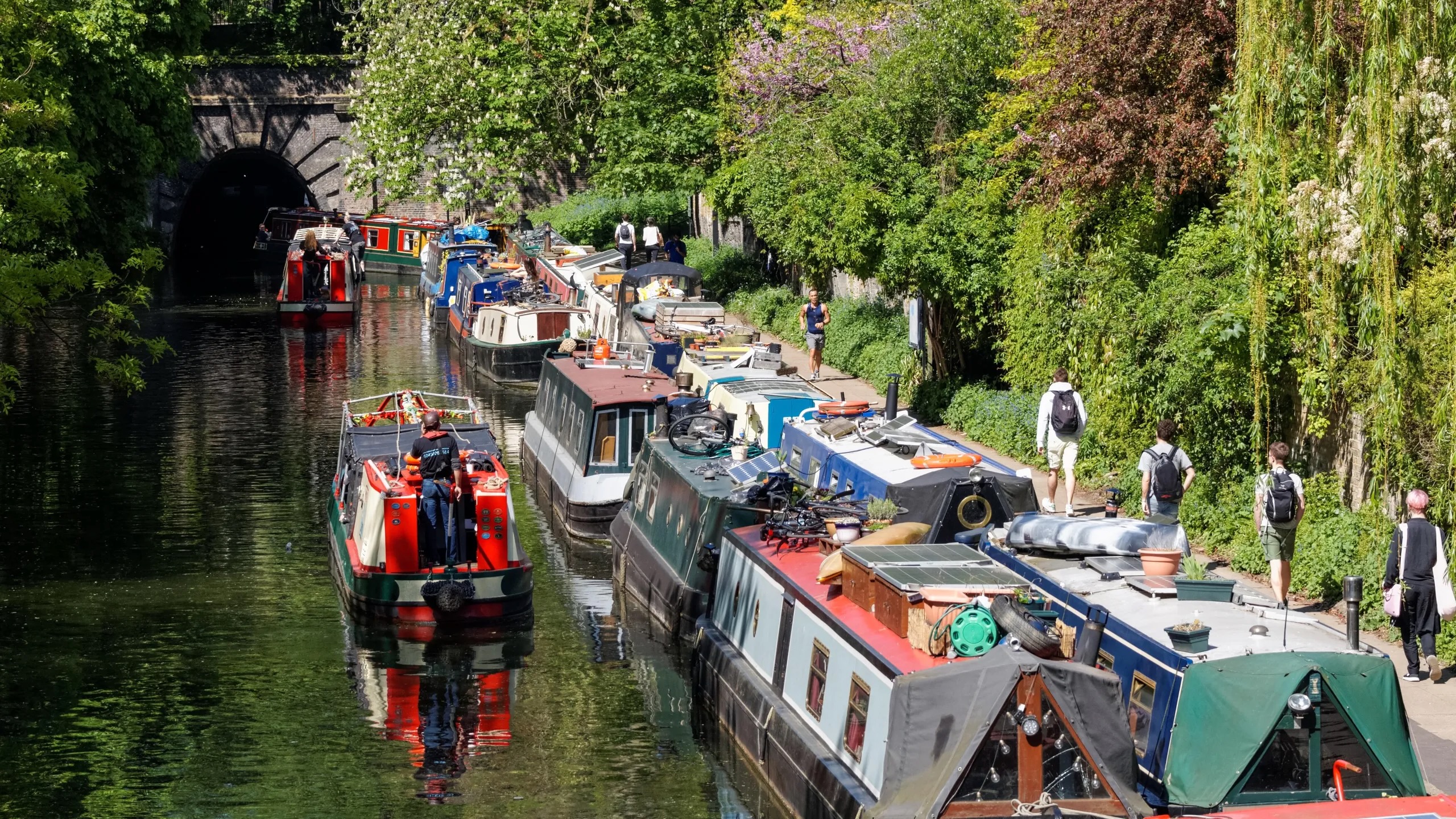
No guard rails. We were often riding 16” from the drop-off into the water.
We came up on a guy engrossed in his music. As this was the UK we passed on his right.
“On your right,” I called out. He jumped right. We hit shoulders. Our mass was greater that his and he bounced off.
Perhaps the diciest moment was when the path dropped hard right under a bridge. There was a tight hard left at the bottom. I hit the brakes as Sharon emphatically suggested we stop. Which we did. On the slope. And a good thing too as we were pointed into a lock filling with churning water. And no guard rails. Sharon:
“My handlebar is scraping the wall. Can I get off now?”
Not surprisingly, given how things were going, we missed our turn north on the River Lee. Our bike computer had given up and we were making do with my phone.
We eventually tried it the old fashioned way, we asked a local. He was sitting on his woebegone narrow boat. The saddest on the stretch. He was missing a tooth or three.
He shared that after he had moved here, he had missed the turn himself a few times. He gave us excellent directions and sent us off with a wave. Good guy. Wish him well.
The last 1/4 mile to Barnaby’s was more of the same. We were navigating by phone, now on low battery. We knew we were close, but my phone didn’t know we could have just slipped between guardrails and virtually been there. 20 minutes later we arrived at Barnaby’s studio. Unit C-1 in Hastingwood Trading Estate, an industrial park.
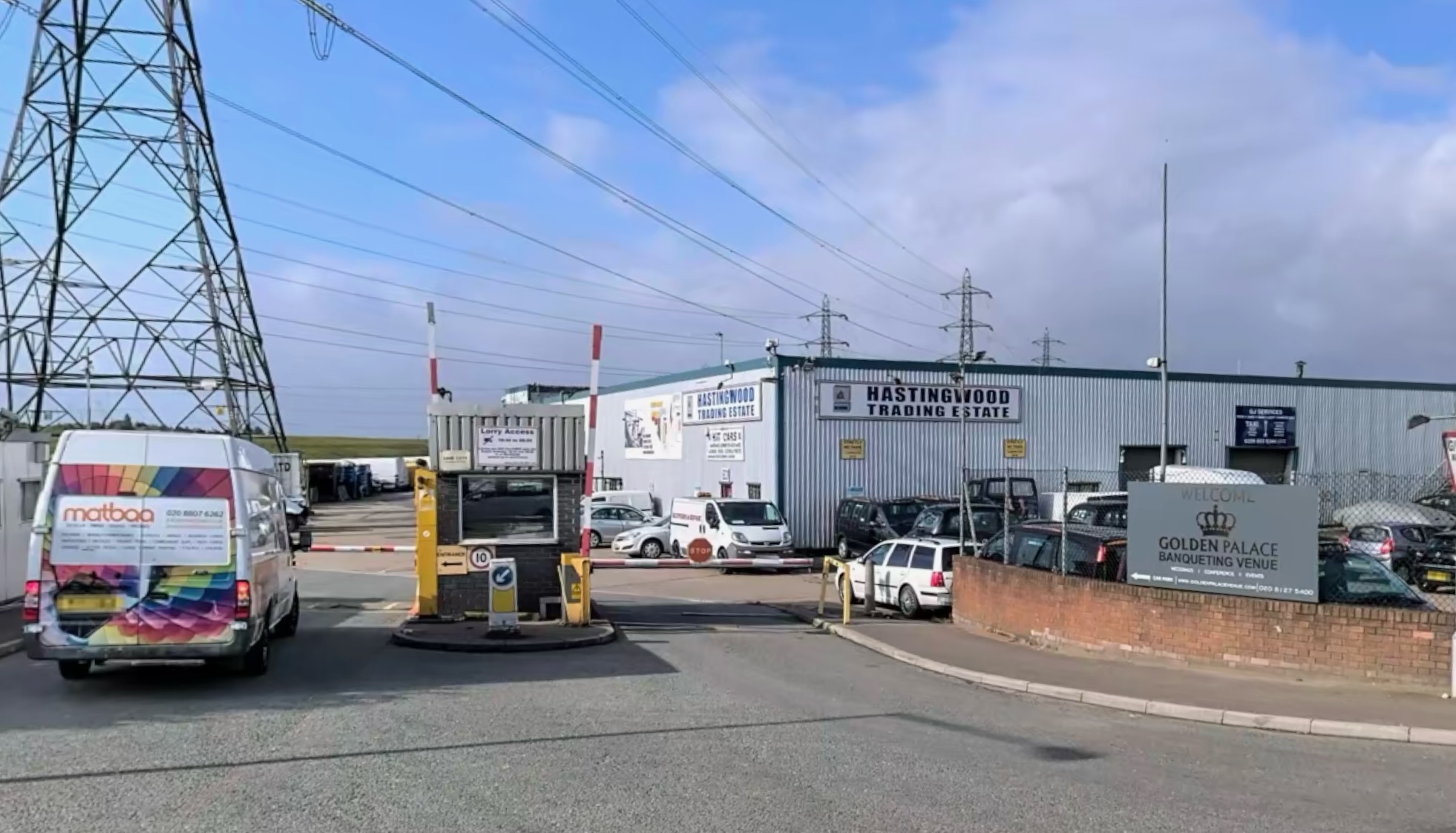
Nothing fancy on the outside. But great stuff inside.
From our pieces and the Victoria and Albert Museum’s Tower of Babel, we knew Barnaby had a love of porcelain. Here we could appreciate, what happens behind the curtain.
Give Barnaby credit, he is a laid back guy. As we stumbled in, I nearly smashed into the centerpiece of an upcoming show with my bike helmet.
A wonderful 2 + foot diameter hanging globe built up lovingly of innumerable porcelain shards and figurines with a dash of this and that.
Barnaby quietly suggested that I should be careful.
Later as I was shooting a video of his studio centered on the globe, Barnaby noted,
“I don’t mind that you take pics, just don’t share them.” Of course, a big upcoming show, no premature unveilings.
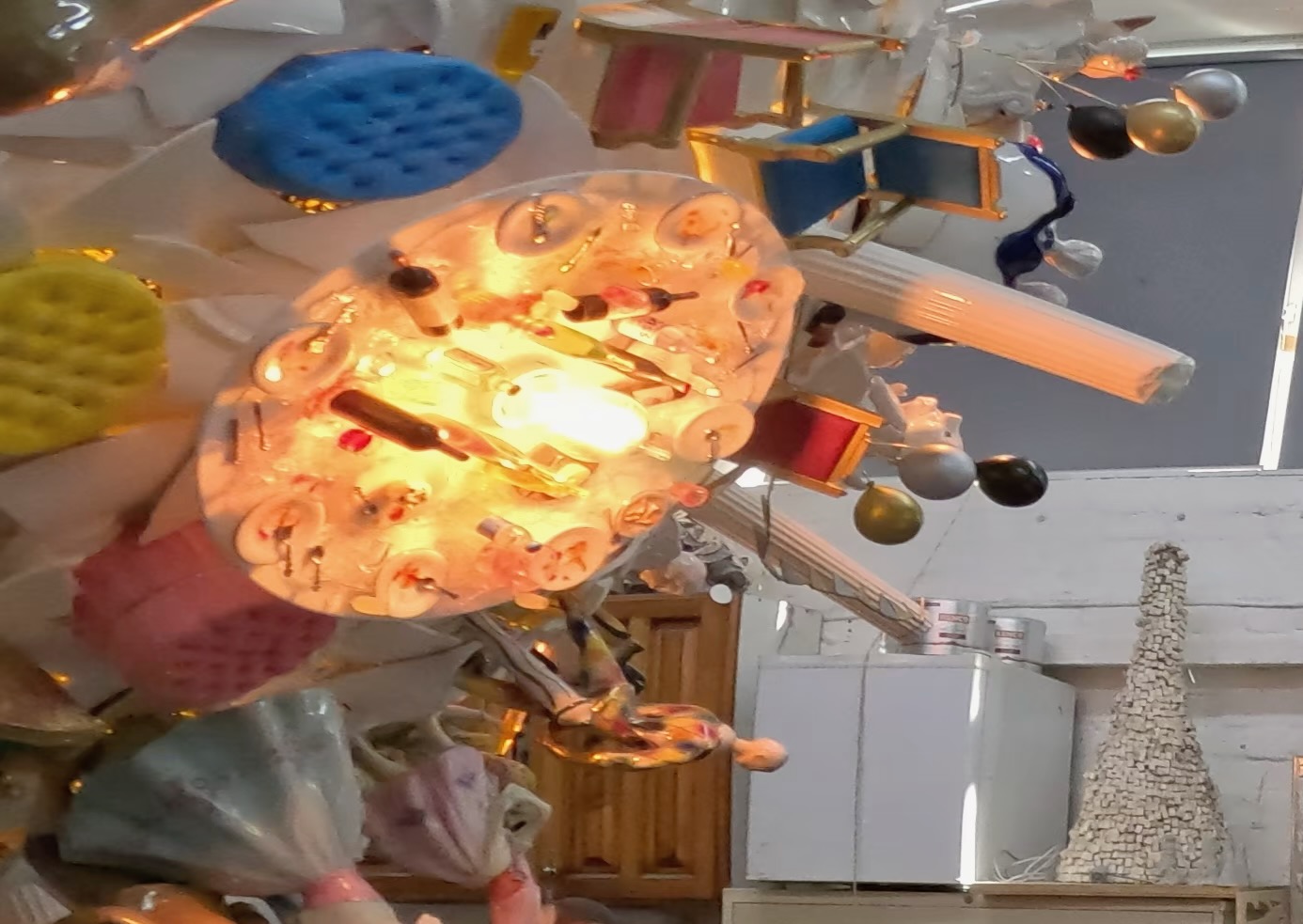
A couple of things to note in the above tease pic. In the left foreground is a small detail of the globe, I just about crashed into. Note the table and the exquisite detail of the used place settings and the tipped over wine bottles. In the background right is an early clay mock-up of the Tower of Babel.
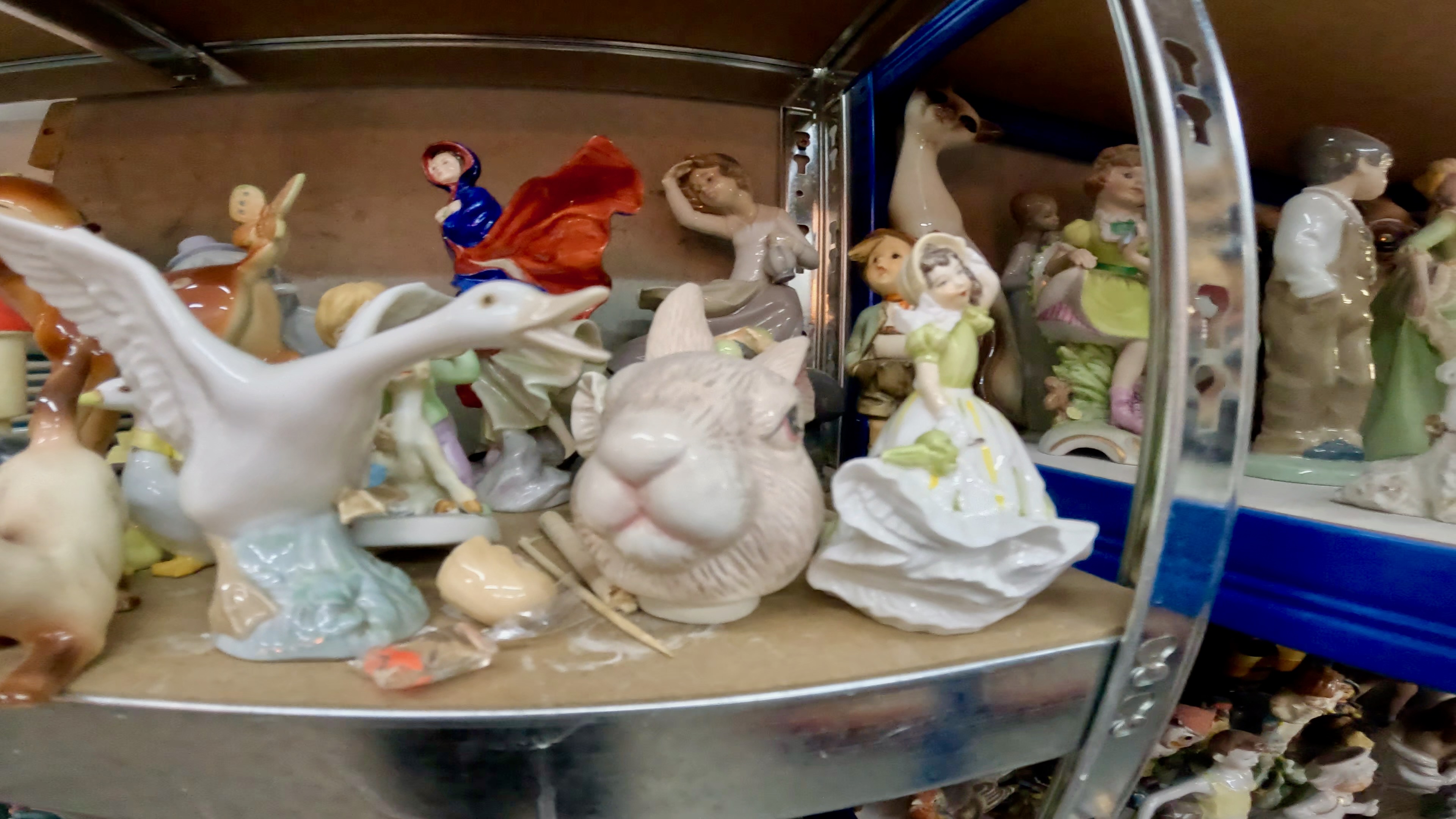
Barnaby’s studio was loaded with porcelain figurines. See above. Most come off the internet. Used, and full of life and full of character.
Below is Barnaby and his studio. With assistant Zach building some sort of wonderful 3D printed spiral base. Probably the show’s co-centerpiece once it’s populated with figurines and so forth.

We would love to be at the gallery opening for this next show. Another closing of another circle. Vamos a Ver. We shall see. Not out of the realm of possibility. April 2026.
Here is a short video of our ride to Barnaby’s studio and back:
Link to: Rivers of London
John Soane’s Cabinet of Curiosities
The John Soane Museum was only a few blocks east of our hotel. Soane was a most famous English Architect. Some say the greatest. The museum is his home kept as it was at the time of his death in 1837.
Which itself is a bit curious and has a backstory. Sir John did not see eye to eye with his eldest son, to put it mildly. In those days it was English law that the oldest son was to inherit.
To get around that, Sir John pulled some strings, and through a private act of Parliament, the museum was born, and his son George got nothing.
We wandered over. No tickets required and free like most London Museums. This is the smallest of the National Museums. Which makes sense as it is simply a house. Or more accurately three row houses made into one.
Much has been made of the facade, but it was tented on our visit. Restoration in progress. This is what it looks like without the scaffolding:

A lot revealed here of the Soane aesthetic. A curious combination of minimalism popped, with traditional classical elements pushed hard. Note the crazy floating surrealist column capitals. A hint of things to come inside.
There was a short line. When we arrived late morning, the Museum was already full up. Folks could only go in when others came out.
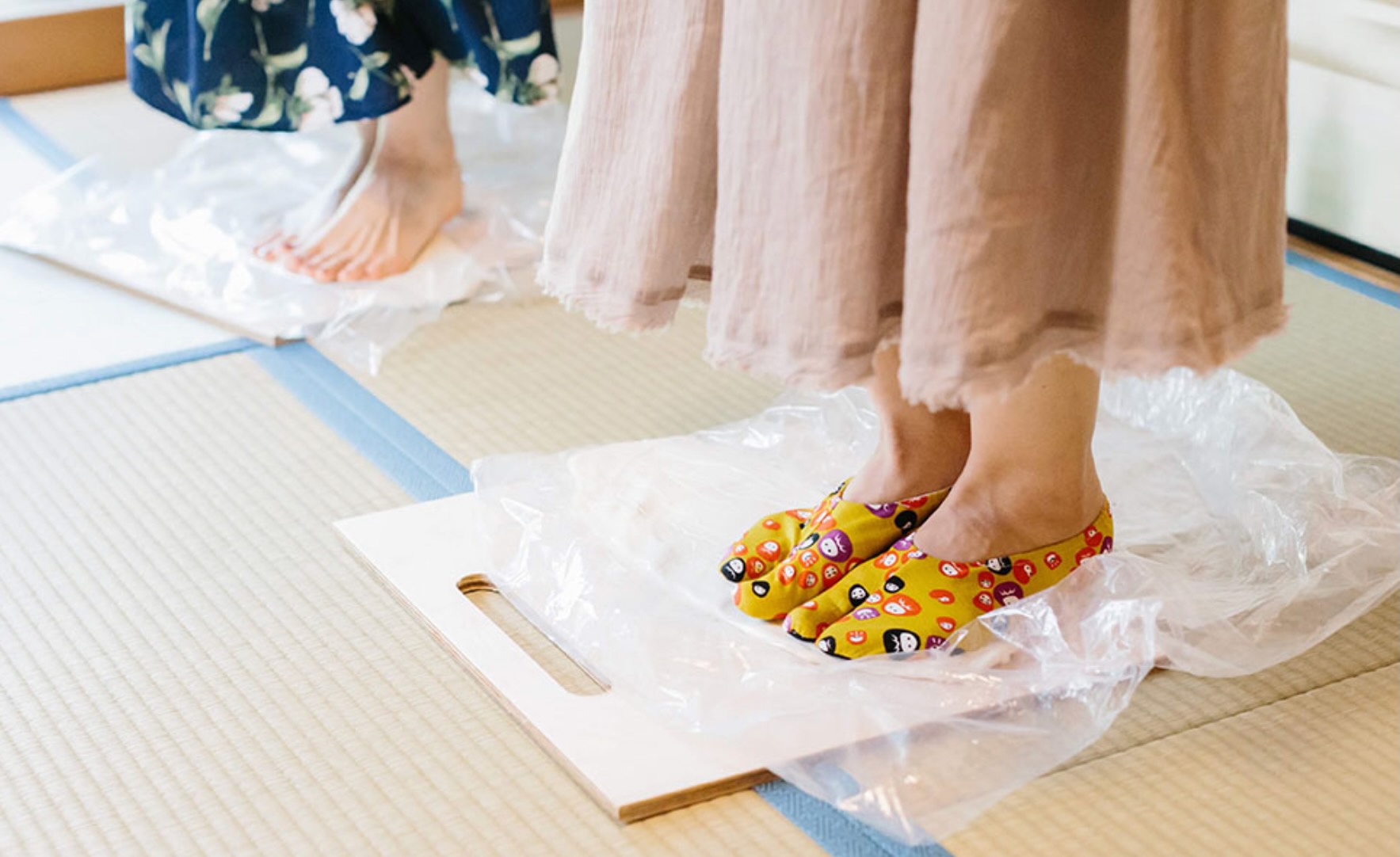
It’s probably safe to say that Sir John was a bit of a hoarder. His home was filled to brim with stuff. 40,000 objects or so they say. Great stuff, but stuff nonetheless. On entering everyone was given a plastic bag for extraneous stuff: camera’s, backpacks, purses and so forth.
We carried these smooth-surfaced bags full of our stuff through the museum so that nothing would catch on all of Soane’s stuff. The museum has tight spaces and narrow corridors.
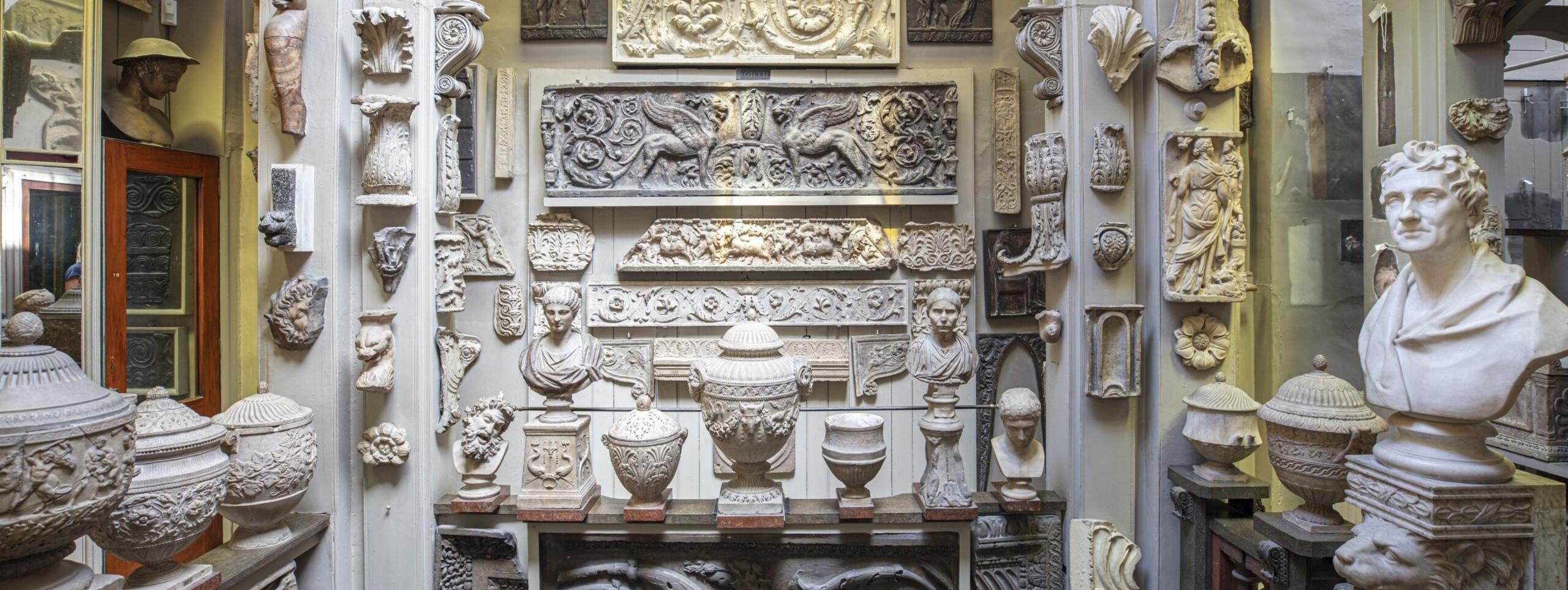
Soane owned a couple of Piranesi prints. Giovanni Battista Piranesi (1720–1778) was an influential Italian artist known primarily as a printmaker, architect and archaeologist. Soane was a fan.
He didn’t own the Piranesi print below, but this one perfectly captures the more-than-full interior aesthetic of Soane’s home/museum.
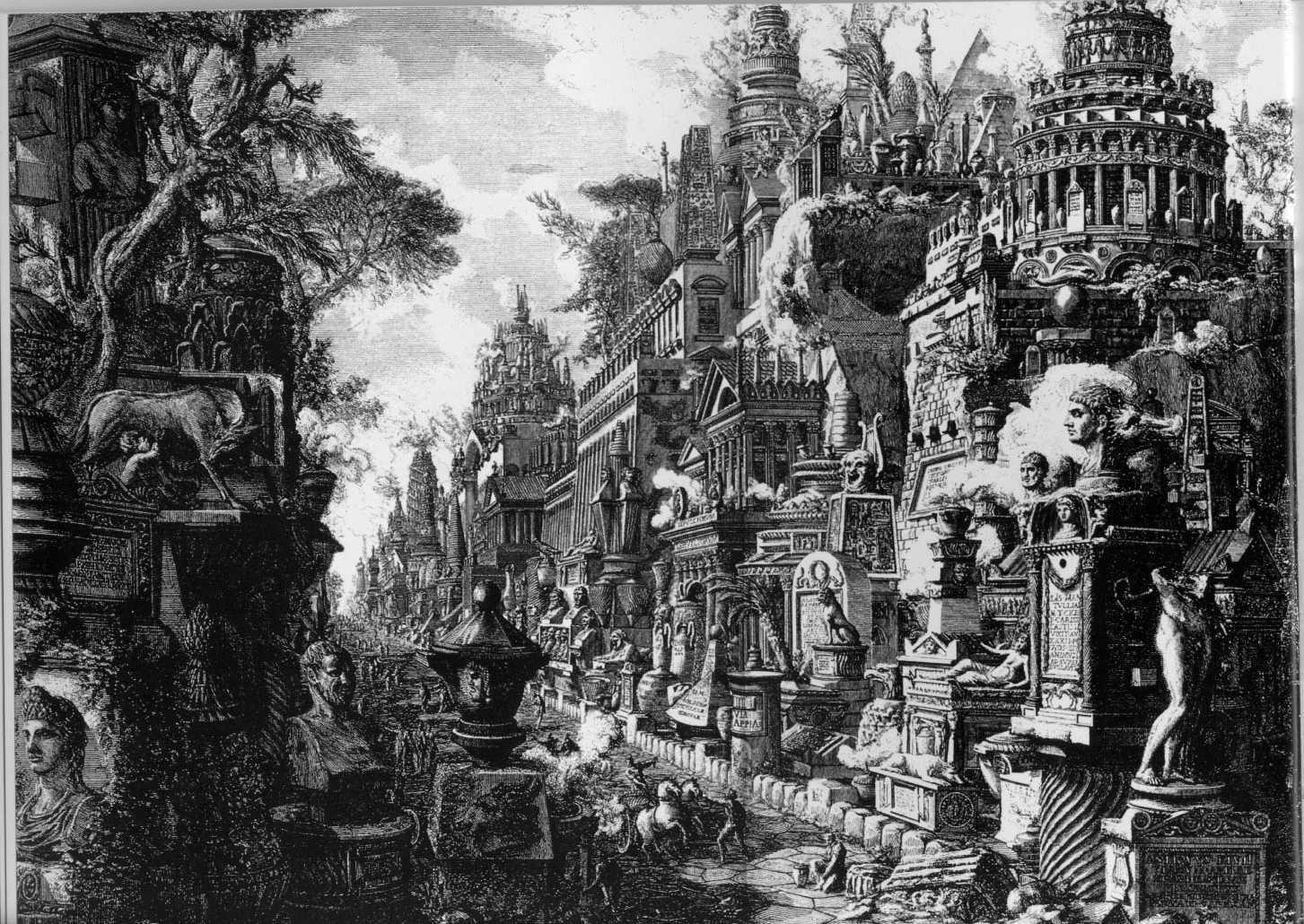
Sir John, along with many of his contemporaries were fascinated by ruins. Empires crumbling. Buildings crumbling. Past, present and future.
Soane’s biggest architectural project was the Bank of England. At the time of its grand opening, the below remarkable illustration of its ruin was done by one of Soane’s disciples. No doubt at Soane’s direction.
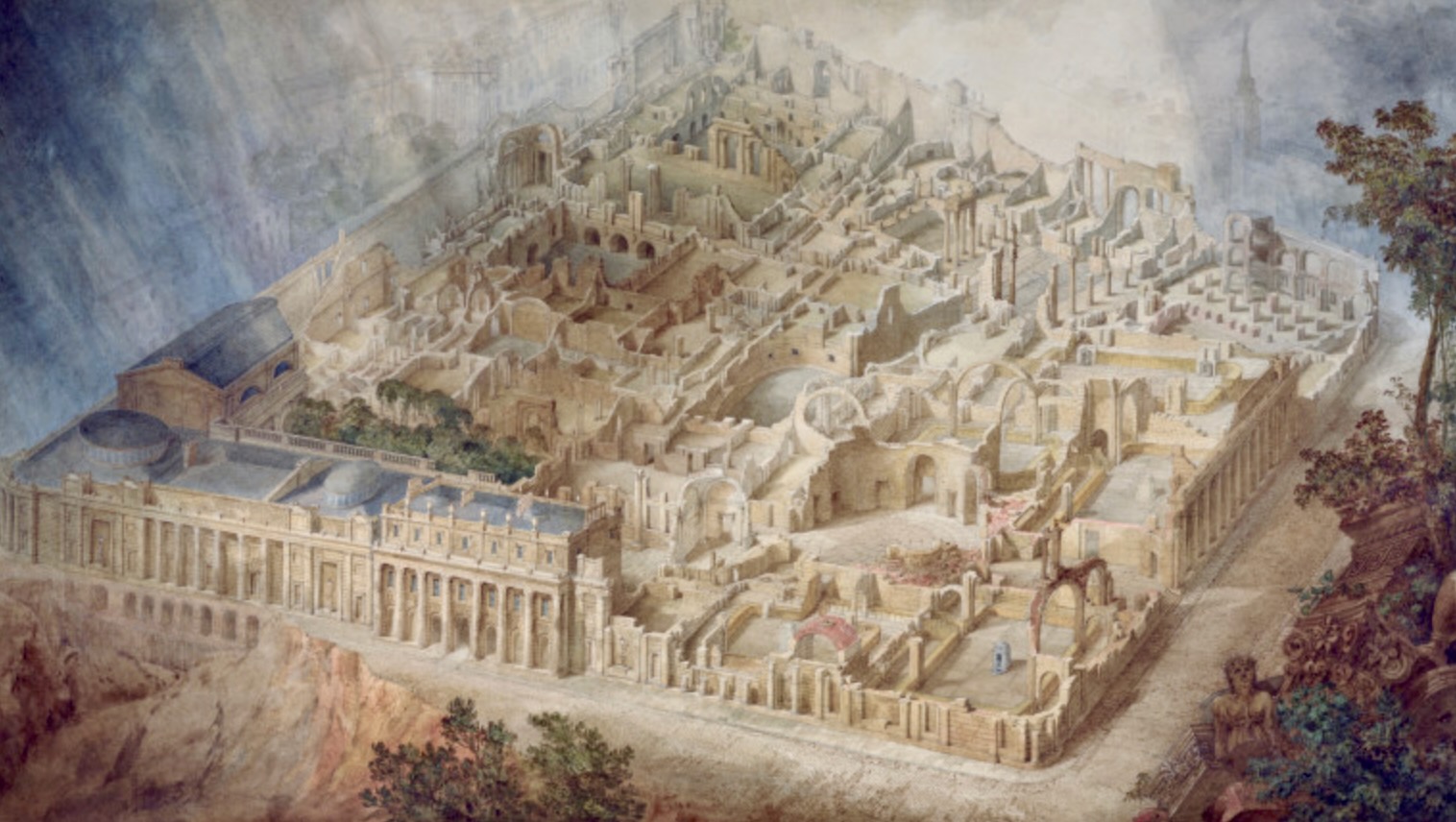
Perhaps this meditation on ruins was Soane’s anxiety over the future of his achievement or forebodings over its future, or simply contemplation of the passing of all things.
In any case, kudos to Sir John for this image. Perhaps more famous now than the actual building itself. Long gone now.
Barnaby had tipped us off about the not-to-be missed Hogarth paintings, hidden away in the picture room and only shown at certain times. While we were waiting, we asked if we would be able to see them.
“12:30.” Which was great news.
As it was only 11:30 we had plenty of time to poke around beforehand.
During his day Soane had amassed a vast collection of antiquities, furniture, sculptures, architectural models and paintings. Stuff filled every nook and cranny. The collection has accurately been described as a maze without a plan.
Which is part of it’s charm. If there is a method to the madness, it would be the architectural spaces. Below is a section through the museum from 1818.

These were the days of natural lighting. The lower you got, the darker it was. The basement, complete with an Egyptian sarcophagus, has been aptly described as:
“A gothic novel in miniature.”
We headed upstairs to the picture room for the Hogarth unveiling. We were characteristically early.
The picture room was yet another tight space only 13 by 12 feet, but Soane had managed to squeeze in 118 paintings.
His magic trick: picture planes. Only some pictures were visible at a time. The Hogarth’s were folded away.
We had time to kill and struck up a conversation with the local spirit. I say local spirit because the gallery attendant was a curious man. Middle aged, pretty much nondescript in every way except for the bright blue smooth high-topped leather shoes, which gave him away.
So I ask him, you’ve probably spent 1000’s of hours in this tiny windowless room:
“So which are your favorite paintings?”
I am thinking the big names, Hogarth, Fuseli Canaletto, Turner, Piranesi.
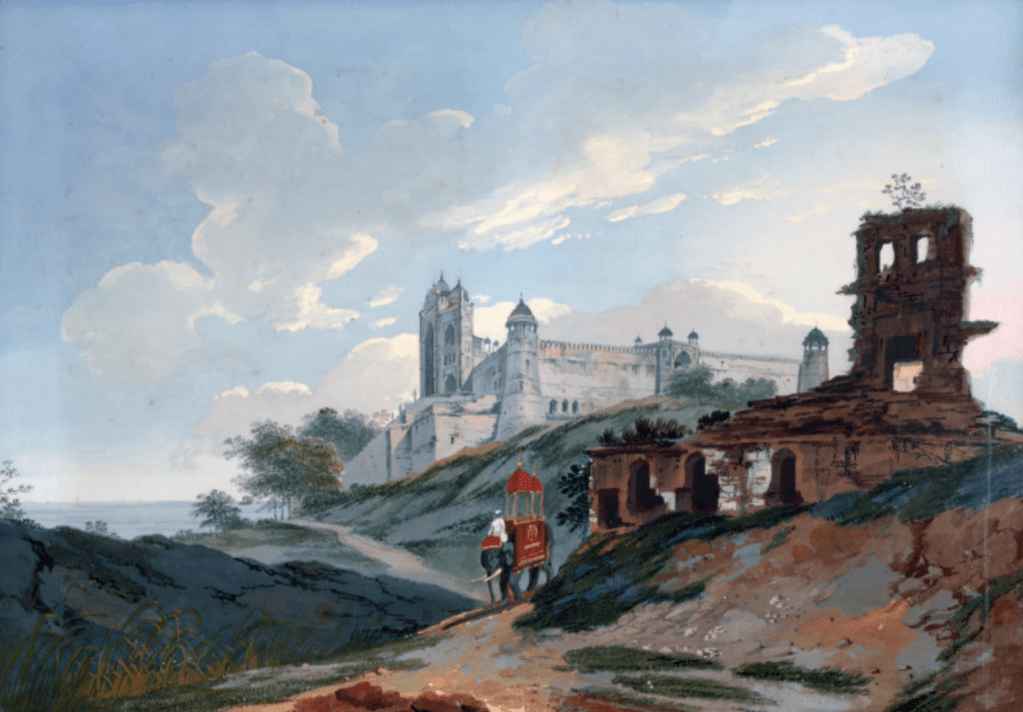
Au Contraire, his favorites were William Hodges’ 2 picturesque paintings of Indian landscapes, painted in the late 1700s, when traditional India was crumbling in the face of the British.
What our spirit found curious was that today, the wheel has turned again.
“This time its us. The British Empire has crumbled.”
Below, William Hodges’ Mosque at Fatehpur. More Ruins, though this time old time India.
And there were the magnificent Hogarth’s. Soane owned two series: Rake’s Progress, 8 paintings and The Election, 4 paintings. Below is The Humors of an Election I: An Election Entertainment.
So much detail. I’m going to put it in a slideshow below. First the full painting and then a few closeup vignettes to muse over. This painting is all about what it takes to get elected, and the corruption endemic in the electoral process. Same old, same old.
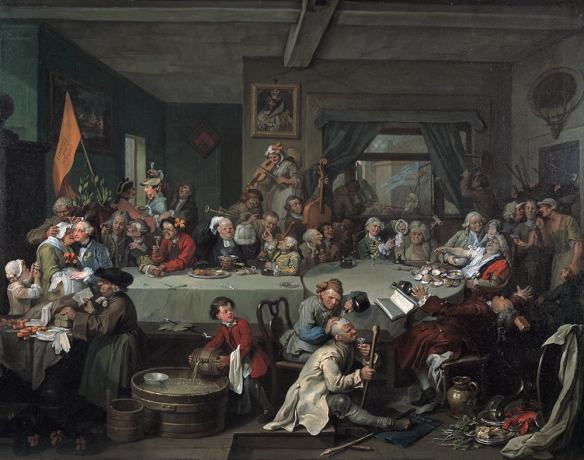
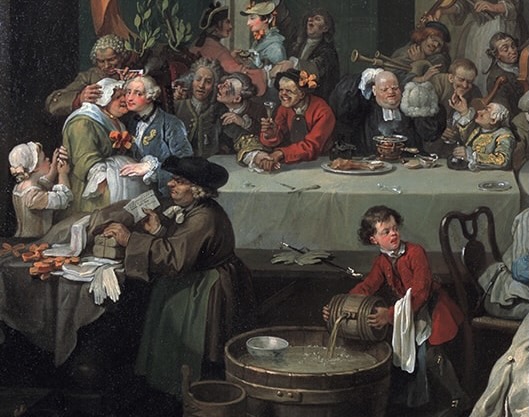
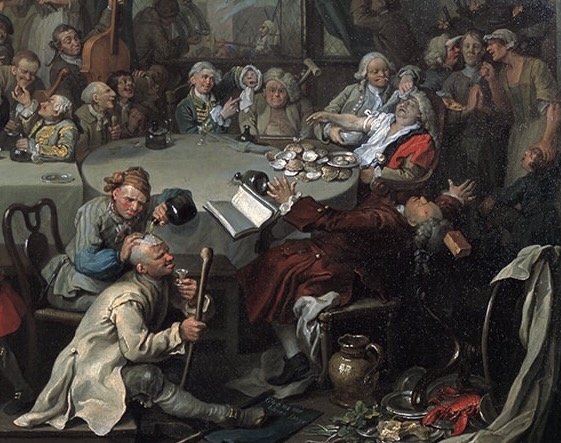
The composition of the overall painting shown on the first slide, parodies Leonardo da Vinci’s painting of the last supper.
On the second slide, note the little girl slipping the ring off the gentleman’s finger. On the third slide note the mayor collapsed from over indulgence in oysters. He’s being bled for his restoration.
I totally get Barnaby’s appreciation of the Hogarths. Hogarth’s scenes could easily be done with porcelain figurines.
Irani Cafes in London
Indian food in the UK is far far better than what is commonly served in the USA. Like another league entirely. Which makes sense considering the centuries of shared history.
Our son visited London earlier this year and gushed over Dishoom in Covent Garden only a short walk from our hotel.
Yes, it is that good. We went back for seconds.
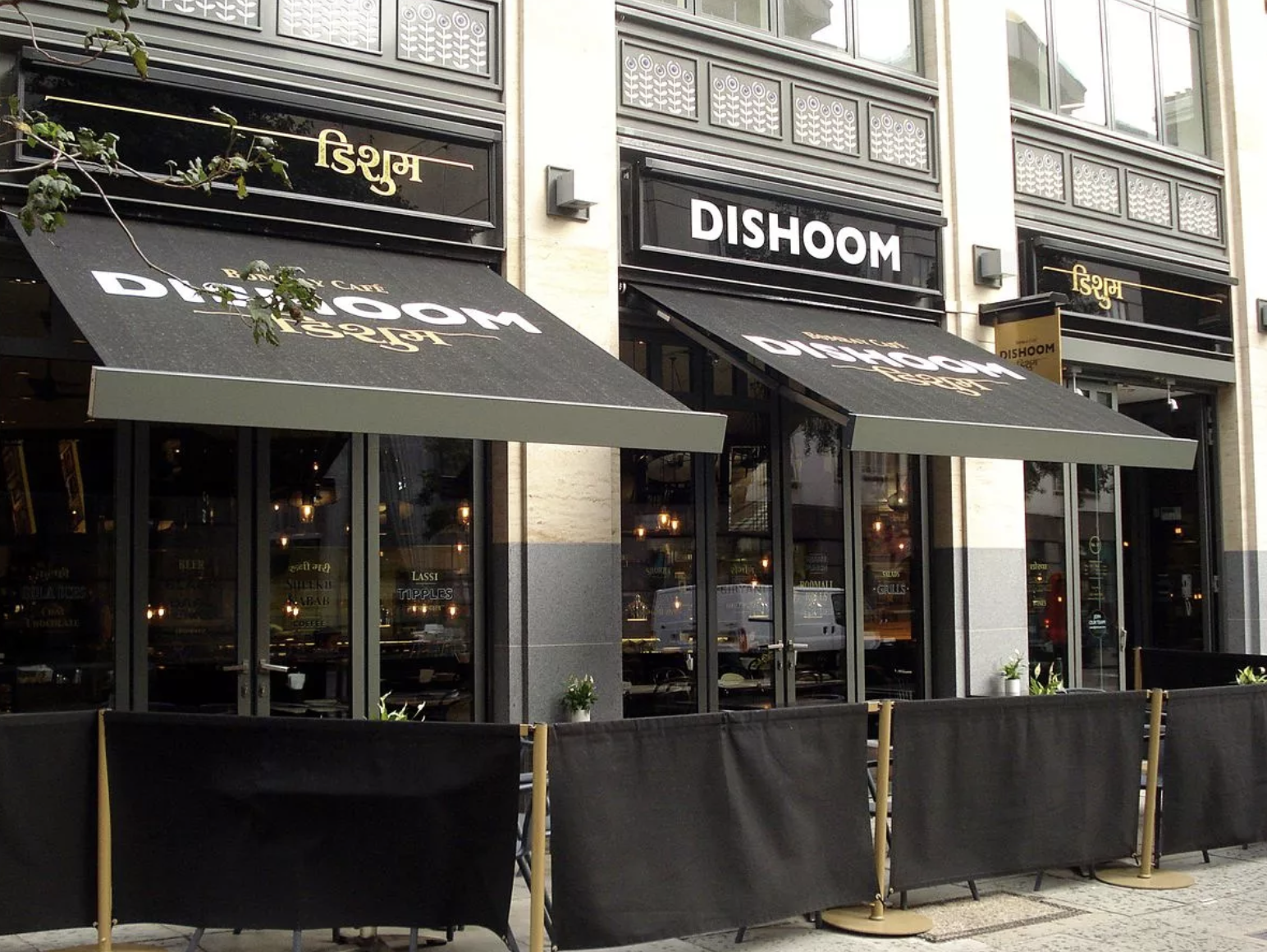
Dishoom isn’t just Indian, it’s Irani Cafe Indian. Wonderful food with a story. Persian influenced, Indian food tailored for British tastes.
Irani Cafes in Bombay were originally opened by Zoroastrian Irani immigrants to British India in the 19th century. The Qataris kicked them out of Iran.
Fading out now in Bombay, today known as Mumbai , the baton has been passed to London.
Dishoom has self-consciously leaned into the Irani Cafe tradition with 21st century ambitions. Founded in 2010 by Harvard Business School graduates. Now with five sites in London and one in Edinburgh. Soon to make the leap across the pond to the USA and NYC.
As one of Dishoom’s founder’s put it,
“You can eat an Irani breakfast, a Hindu Gujarati lunch and a Muslim dinner here and every single dish will be distinctly from Bombay.”
“Dishoom” is a well-known onomatopoeic sound effect from old Indian films, representing the impact of a punch or a flying bullet. The name is also used informally to describe having mojo.
The place has mojo. Enough to secure an investment deal with private equity valuing the company at approximately $400 million.
Our waitress told us that if she worked 5 years at Dishoom, she would get an all expenses paid vacation to Bombay. She was counting down.
Our son was right. The Black Daal is to die for.
We might have to go back to London, just for the Dishoom breakfast menu.
The Great London Scavenger Hunt
The big day had arrived, and we had a plan. We were riding Sunday morning at dawn. Up and at em early on the least-traffic day of the week.
Our six shops were our six destinations. 4 were in Quataroplis (Mayfair) or very close. These were the high end. Then we would do the outliers. Coco Kingdom in Kensington West beyond Hyde Park. And then back to our hotel and if all was going well, Northwest to Islington and the shop where Flight Centre had once lived.
Barnaby had designed his tower of Babel with the most exclusive shops at the top and the most so-called derelict at the bottom. All part of the concept of London’s hierarchy of consumption.
Curiously and totally by chance the route dictated by our shops was a spiral down Barnaby’s tower. From ultra high-end to work-a-day. Lots of life at the bottom of the tower.
This promised to be a most entertaining and educational ride.
****
Our pedals were swapped back, our bike route confirmed, our tires topped up for pressure. The day was dawning nice and we were off.
Everything that went wrong on our first ride, went right on this one. Bike computer was great. Traffic was good. The fates were with us.
Our first two shops were just outside Piccadilly Circus. Bentley and Skinner looked just like our porcelain miniature, with a couple of bays added.
We got turned around looking for Trickers.
We had most entertaining conversation with door man on cigarette break who got us back on route. And then another entertaining conversation with a garbageman, who was a smart foreigner, who found us amusing.
Trickers, again looked just like our miniature.

Two down and we were off to Quataroplis proper. Our shop Mathew Williamson had been replaced by IRO, the London flagship store for the French luxury fashion brand:
“Born in Paris, and inspired by the 70’s & 80’s American rock scene, IRO is driven by the desire to build a simple and strong wardrobe composed like a soundtrack.”
We then rode around Berkeley Square’s pleasant loop and peeled off on Davies Street, where we spotted a full-sized Tyranasaurus Rex headed to the park sans flesh.
We pulled up hard. This Dino was a show stopper. Very cool and impressive, and as is usually the case with such, there’s a backstory.
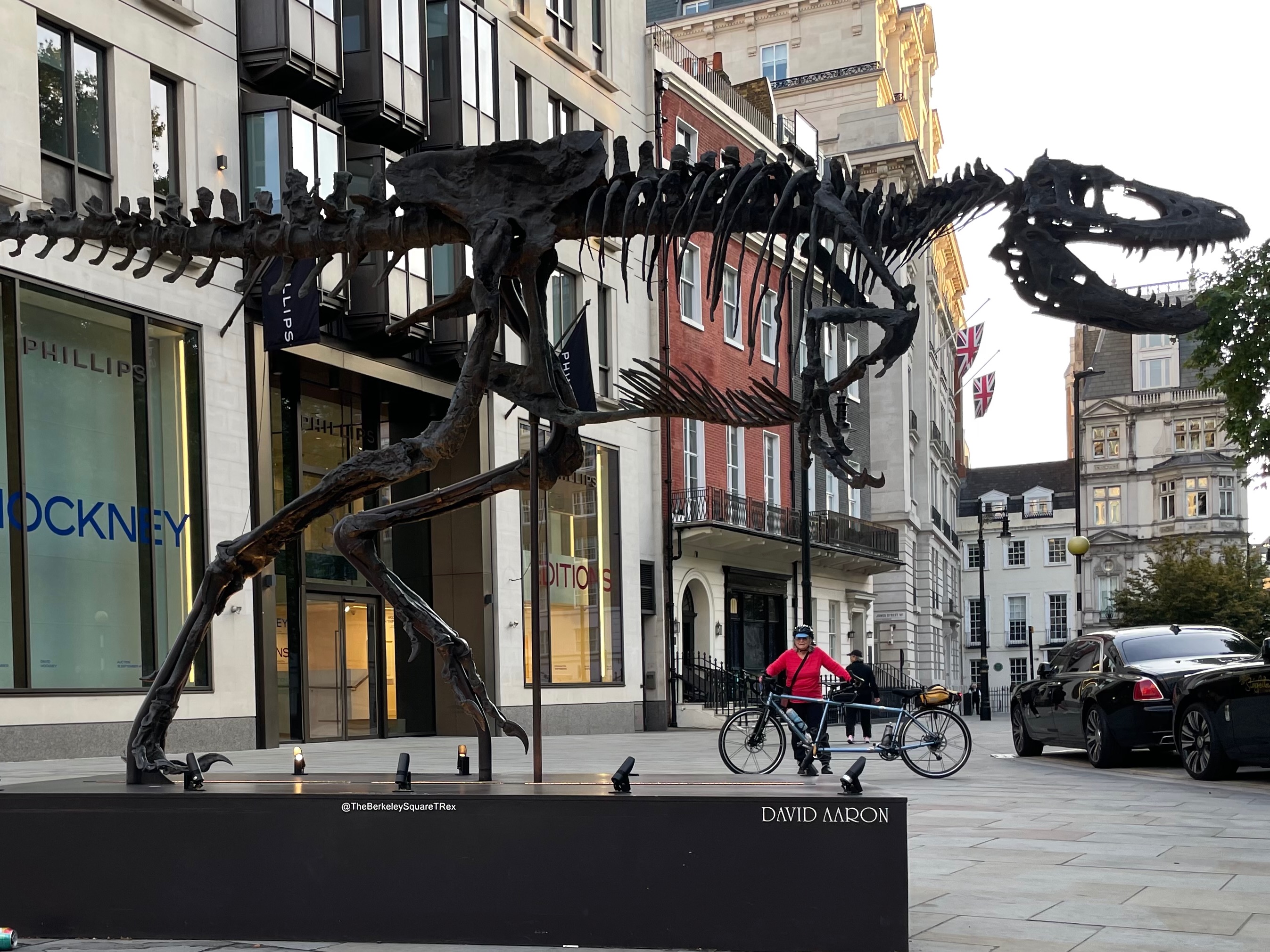
This guy is affectionately known as “Chomper” after the baby dinosaur in the 1988 cartoon, “The Land Before Time.” Unearthed by the third-generation cowboy Clayton Phipps in 2019 in Montana, the real bones once resided in the nearby David Aaron gallery. Real-bones Chomper went up for sale for $20+ million in 2023. After which the trail goes cold. Likely purchased below the event horizon.
Only a block hence we arrived at our next shop, Bluthner Piano Centre. Now doing business as Bacchanalia Mayfair.
With shop #4 checked off, we headed to Kensington via Hyde Park to look for Coco Kingdom in Notting Hill. Coco Kingdom is perhaps my favorite of our porcelain shops. Character in spades. Morning was still early and traffic was light.
Alas, Coco Kingdom Fashion Boutique is now just a memory. Living on as our miniature and the Alamy Stock Image below.

We headed back. Arriving at our hotel no worse for wear. It was still early-ish and we had the energy so we headed to Islington and our last shop: Flight Centre.
Flight Centre too had moved on, replaced by the Thai Therapy & Spa. Sharon made a couple of off-color jokes about what could actually be going on. And I’ll leave it at that.
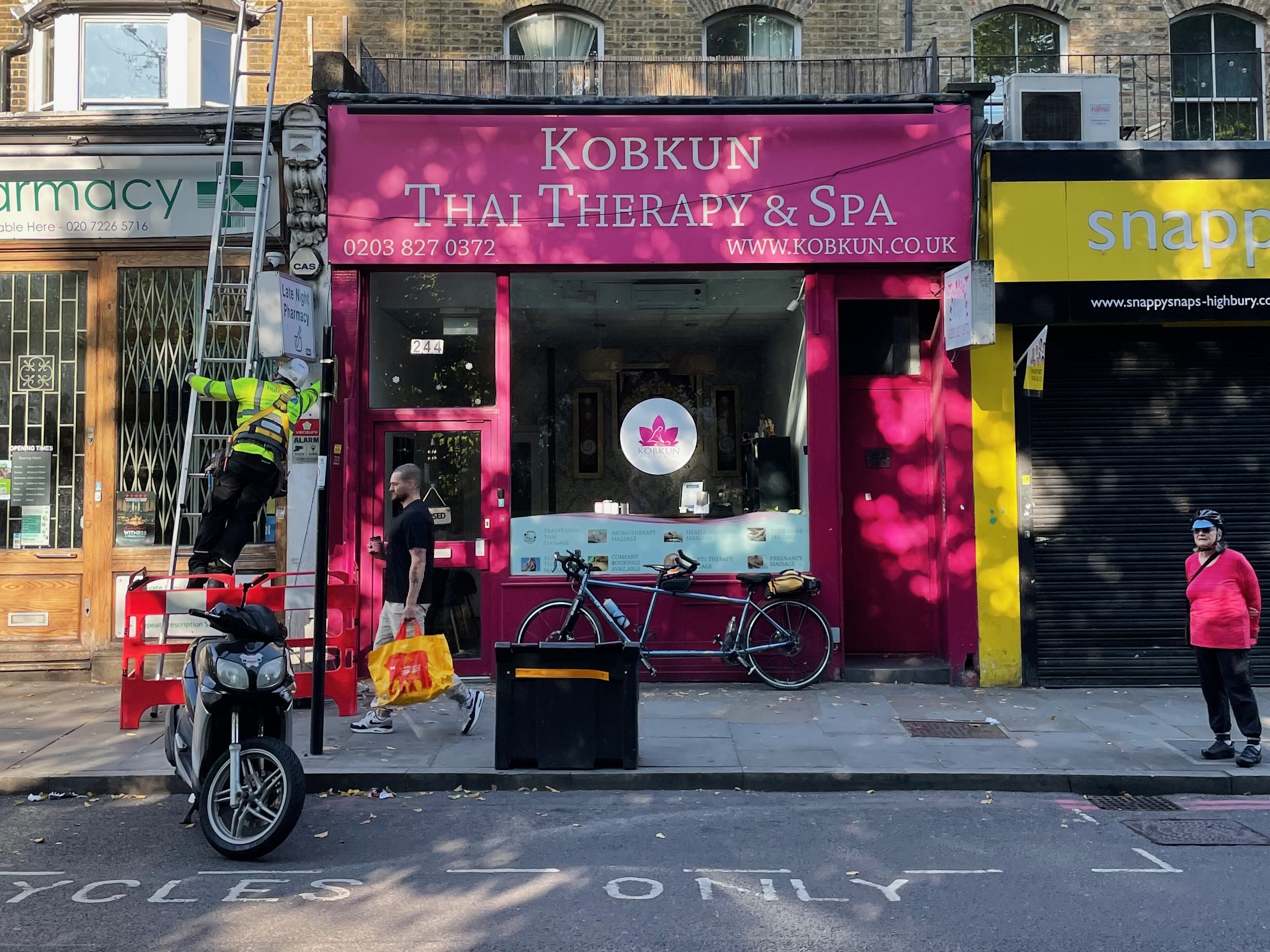
If you look carefully on the left, you’ll see a guy on a ladder replacing lights. After we got his OK on the bike photo-op placement, I say,
“Nice day, too bad you have to work on a Sunday”
He laughs,
“I’m just happy to have a job”
And that was that. Our great London Scavenger Hunt was complete @ 244 Upper Street @ 8:52 AM on Sunday September 7, 2025.
Here’s the video if you’re interested. One of my favorites. Music is Ry Cooder and Manuel Galban; Los Twangueros; 2003; from the CD- Mambo Sinuendo
The Great London Scavenger Hunt Video
****
Looking back, it seems so improbable that a porcelain lighthouse, tucked away on a ledge in a stair, in a hotel, in Kenmare, Ireland, would have precipitated this trip. But that’s the Goen of this one. Chance, fate and interconnectedness simultaneously at work.
So, if we leaned into it, what would be next?
Barnaby’s show is April, 2026. Perhaps if we ask nicely, we can snag an invite. And at the same time work a bit more on our London-to-do-list. Epping Forest might be calling too.
Vamos a ver. We shall see.






 Advencha before Dementia