In the fall of 2010, Sharon and I were sitting in our favorite Cambridge café down the hill, when the owner discretely asked if we could move a table over. No problem.
Another regular and his girlfriend needed our table. Both were blind and needed a bit more room for their service dogs.
We struck up a conversation. Curiously he was a kayaker/ fisherman and spent a big chunk of each year in the Tampa area. “As a computer programmer I can live where I want to.”
He knew Canoe Escapes, our favorite Tampa area Hillsborough river canoe/kayak rental company. I carry my Canoe Escapes VIP, “Very Important Paddler”, card every day in my wallet.
It humors me.
And besides with three more stamps, I’ll get a free rental.
Our friend noted that Canoe Escapes had recently changed ownership. He went boating regularly with a couple of Tampa Buccaneer pro-football players. The stories went on and on.
I started to get suspicious as each one-upped the one before.
His female companion was cute. 10:30 AM on a Saturday. Couples, the night after? Early in the relationship? Could be boasting time.
She was pretty, quiet, and a nice person.
Her dog was great too. She let us pet him. Not by the book for a service dog. We offered our bacon. She politely declined on behalf of Mr. Dog.
“Not healthy, though he loves it.”
You could tell by Mr. Dog’s body language that he was disappointed. He clearly understood the word “bacon” and the offer.
Sharon and I made it through our Everglades stories. Our human male companion at the next table had one better at every turn.
Then we got to our last visit to Sanibel.
He scowled, “You must have a lot more money than me.”
I pointed out that rooms could be had at reasonable rates with care. To no avail.
Clearly I had struck a nerve. “You’d be better off at Honeymoon Island near Brandenton or Anna Maria Island North of Sanibel.” Maybe he considered Sanibel elitist or a tourist trap or simply had been trying to impress his girlfriend. Maybe just different tastes. Sharon and I never figured it out.
I thought of our blind outdoorsman friend 6 weeks later at Sanibel.

After popping the champagne, I sat back and looked out over the Gulf of Mexico.
Above, the clouds were starting turn pink with the arrival of evening. Palms framed the scene.
No people in sight. No cars. No street lights. No hustle. No bustle. Velvety quiet.
Our kind of place.
I had checked out Honeymoon Island and Anna Maria Island. We probably could have saved $50 a night.
But at a cost- crowds, traffic, big developments, and night sky light pollution. To each their own I guess.
To my mind our extra $100 was well spent.
One of my favorite Spanish slogans goes:
“No sabía divertirme, pero estoy tratando a aprender.”
“I didn’t know how to have fun, but I’m trying to learn.”
Score one for the home team.
****
Our working plan for the 2010 New Year’s holiday had been to return to Everglades City and do an overnight kayak trip to the 10,000 islands- after visiting Sharon’s Mom, Rosita, in Tampa. We had hoped that Taavo and his girlfriend Meredith would be able to join us.
It just wasn’t meant to be.
Meredith ended up spending the Xmas holidays with her parents, and her sister and her husband in Naples Florida. Taavo received an invite.
Between the two families we worked out a plan whereby Taavo could visit his grandmother in Tampa and still join the Gliddens in Naples. And Sharon and I could get a Tampa break and time for ourselves on Sanibel.
The key was that Naples is just down the road from Sanibel and both are an easy 3 hour drive from Tampa.
The plan worked like a charm.
All had a great time.
Naples has more millionaires per capita than any other city in the USA. Snowmaking machines are set up in the palm trees downtown, for Xmas. Naples is that kind of place.

The Gliddens were staying in a beautiful condo tower at water’s edge.
This December 29 photo of Taavo and Meredith to the right, sums Naples up pretty well.
After a fun lunch with the Gliddens in the heart of Naples, Sharon and I said our goodbyes and an hour later were checking in at the Seaside Inn on Sanibel Island. This is the same resort Sharon, Taavo, Meredith and I stayed at in 2009.
I had tried to find somewhere new, but my other choices were all booked. As it turned out, I doubt we could have done better.
Our room felt a bit like a tree house. We were up a floor, one of two, looking out over the Gulf. Back a bit, with two walls of windows and priced right.
We had two nights and one full day to ourselves.
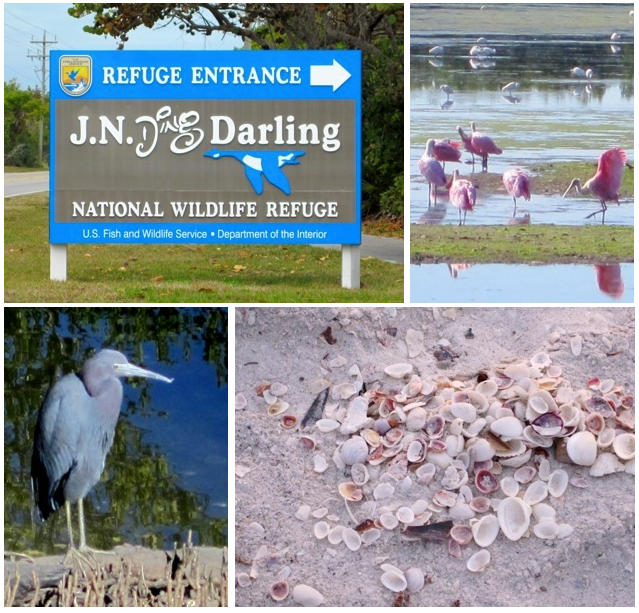
I knew exactly what I wanted to do, and Sharon humored me. I wanted to walk Wildlife Drive in Ding Darling National Wildlife Refuge.
Sanibel has many charms including miles of beaches, great restaurants and world class shelling. That said, it’s the Ding Darling Wildlife Refuge which does it for me.

Ding Darling takes up nearly half of Sanibel Island. At 6,354 acres of preserved subtropical barrier island habitat, it is part of the largest undeveloped mangrove ecosystem in the country.
Wildlife Drive runs right through the heart of the mangrove ecosystem and is a birder’s paradise.
Its almost too easy. An embarrassment of riches: white ibis, egrets, herons, pelicans, cormorants, ospreys, anhingas, roseate spoonbills, eagles. Check, check and check.
There are so many beautiful exotic birds, so exposed, that Fridays the Refuge is closed, just to give the birds a day off from people. Truth-be-told, the birds don’t seem to care one way or the other.
On our last visit in 2009, my rhythm had been off.
I drove right by the Visitor’s Center hitting Wildlife Drive before I was oriented. As we drove along, I kept wondering when we’d get there. Eventually, I did figure out my conceptual failure, though it took a while.
We were there already. A many-faceted moral.
This time, I figured that by parking at the Visitor’s Center and then walking Wildlife Drive we couldn’t miss. Mostly true.
Unfortunately I had neglected to share my walking plan with Sharon, so she didn’t dress accordingly.
After 8 miles on the hardest of the hard-paved of rocky roads in clogs, Sharon said that this was far worse than 15 miles at Glacier. Every joint from her waist down hurt.
And I didn’t bring my hiking shoes either. That road was tough! Sharp-edged rocks up to 2” set in a tarmac base. Next time its going to be bikes.
Still we had a great time. Great birds. Great weather. Great Landscape. Great people watching.
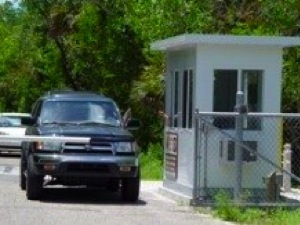
There is a toll booth at the beginning of Wildlife Drive. Entrance fees vary: car, bike or pedestrian.
This was our first opportunity to try out Sharon’s new senior pass for Federal Recreational Lands.
We walk up to the window. Sharon flashes her pass. The woman nods.
So far so good. But will it cover me? After all we weren’t together in a car. I pop the question.
“Only if she claims you.”
The woman then turns to Sharon with her best cold bureaucratic look.
Without missing a beat, Sharon responds in kind, after the slightest of pauses, “I claim him.”
Even in the briefest of fleeting moments, volumes can be written. This marriage thing has its twists and turns- even after decades.
We laughed all around. Knowingly.
I could pass without forking over a buck. And I am still claimed.
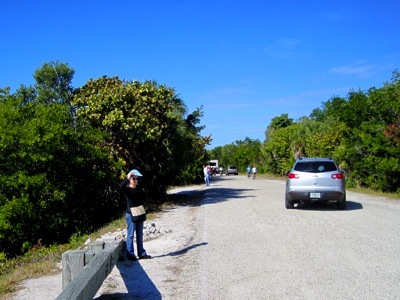
It was only on this trip that I caught on to the irony, or incongruity, of Wildlife Drive.
There’s nothing subtle about it.
It’s a freeway running through the heart of a pristine mangrove ecosystem.
Convenient? Yes.
Environmentally sensitive? No, No and No.
The road doesn’t appear to serve any purpose other than accommodating bird voyeurism.
It doesn’t go anywhere, other than loop back to main island artery. And it looks new.
If this weren’t enough, for much of its 5 miles, there was no there there, when it was built. Tons and tons of fill had to be trucked in to lift the road above the shallow tidal waters.
As it turns out, not surprisingly, it wasn’t about the birds at all. It was about the mosquitos.
Wildlife Drive is an upgraded service road built on top of a series of dikes constructed in the 1960s in an ill conceived and misguided effort at mosquito control. Today’s fantastic bird watching and paved eco-experience is just a happy twist of fate.
I think of the Drive as an extra-wide hiking/biking/driving path. Kind-of like the paved trails in National Parks, where there is so much traffic that paving is the right thing.
No harm, no foul. Nice when it works out.
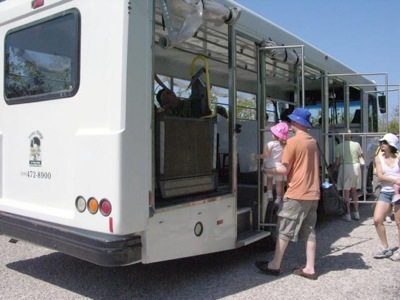
Sharon and I were a mile or so in when we caught up with the tram tour. Borrowed photo to the left.
The guide had lots of interesting things to say.
We were free to listen in as we walked along. The tram rolled slowly, windows were open and the guide was sensitively amplified.
The guide pointed out an Eagles’ nest in the distance, Anhingas drying their wings, and a solitary Ibis waiting patiently for lunch.
I was impressed. This guide really knew his stuff. Nice professional manner too. I thought- maybe a PhD in the natural sciences. He talked like a kindly knowledgeable professor.
The tram rolled up to the Mangrove Overlook Boardwalk. Everyone piled out, as the talk continued. We mixed in.
Mangrove trees are curious life forms.

The Red Mangrove, photo to the right, has tall arching roots called prop roots, that supply air to the underlying roots and provide support and stability.
They trap the mud and silt that flows with the tide, thus gradually increasing the soil around them.
Red Mangroves have a high salt tolerance and produce tons of leaf litter per year which benefit estuarine food chains.
The guide pointed out that there are three mangroves found in Florida: Red, Black and White.
The talk went on. I wandered off up the road as Sharon worked her way to the front of the group. I was soaking up some sun when Sharon caught up. Apparently she had been an active participant in the naturalist-led discussion. No surprise there.
As everyone was getting back on the tram, she had asked the guide where he was from. There was something about his accent. “Can you guess?”
I couldn’t.
“Brooklyn.”
Not to take anything away from Brooklyn, but a hotbed of naturalists it’s not.
The light went on.
This guide was likely a retiree living in the area picking up a few extra bucks: Nice guy and all, and masterful at the guide schtick, but probably no background in natural history- that had been my invention.
He was a grey-haired performance artist in khakis.
This was pretty much confirmed a short time later on the boardwalk through the shell mounds, when we came across a sign which read:
“There are four mangroves found in Florida: Red, Black, White and Buttonwood.”
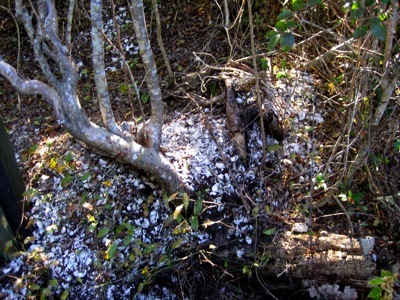
I found the shell mounds poignant. At one time the Calusa Indians controlled most of south Florida.
They were a fierce and war-like people. They traveled in dug out canoes, wreaking havoc far and wide.
Even the Spanish had to be careful, in not anchoring too close to shore.
The Calusa depended on the sea for their food and tools.
The Calusa were gone by the late 1700s. Victims of disease, warfare and changing times.
All that is left are their garbage dumps, known as shell mounds.
The mounds on Wildlife Drive don’t look like much: shells scattered on the ground. The rest of the mounds- all shells- aren’t visible. They’re embedded in the ground.
Interesting metaphor.
It was also on this boardwalk through the shell mounds that I finally noticed and came to appreciate the gumbo-limbo tree. It is fast growing, tolerant of salt and calcareous soils and has a shiny red exfoliating bark.
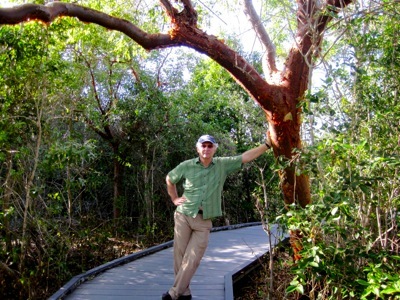
In South Florida, the gumbo-limbo is known as the tourist tree because of its red, flaking skin. Photo to the left with my new-found friend.
Haitians purportedly make drums from the trunk of the gumbo-limbo. A resin obtained from the trunk and bark is called chibou, cachibou or gomart in the West Indies, and is used to make glue, varnish, water repellent coatings and incense.
But it’s the name that I love most of all.
“Gumbo-Limbo.”
After the shell mounds, we turned around and headed back, walking against traffic. Wildlife Drive is one way for all but pedestrians. Traffic was light, but every now and then we’d hit an impatient and frustrated driver rolling his or her eyes at the slow pace on the Drive.
I recognized the look. It was me last time around. I repeated to myself, “Slow down. You’re there already.” I’d look out across the reserve. Shadows were getting long. The water was quiet. The birds were getting ready to call it a day.
Time to wrap this one up.
I’m going to skip the story about the coolest bird in Ding Darling. Suffice it to say that if you want to impress the birders, just mention the Mangrove Cuckoo.
I’m also going to skip the story about the birder with the biggest and lightest lens. Suffice it to say that cameras are a big deal on Wildlife Drive.
We were back at our car by 4:30 PM. Next stop dinner. I suggested stopping somewhere convenient on the way back to the Seaside Inn.
Sharon lobbied for the Lighthouse Cafe. Not as convenient, but our favorite from our last trip.
I resisted for a few minutes, but to my credit, I came around.
The food and service was as good as we had remembered. Quiet too. The evening crowd hadn’t arrived.
As I was paying our bill, I told the young woman about our day and how happy I was that we had driven the extra mile to get to this restaurant. Our classy take-home desserts were on the counter.
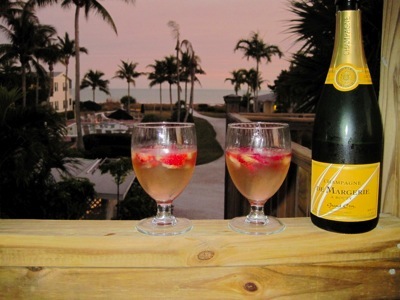
I explained that I had a special bottle of Champagne cooling which would be the perfect complement.
Sharon and I were going to watch the night roll-in from our deck and toast the end of the day in style.
“What you need are some strawberries for the Champagne. I can get you some from the kitchen.”
I started off with my usual response, “Nah, don’t bother.”
Then I slowed down and thought again. “Yeah, that’s a great idea.”
She laughed and headed off to the kitchen.
 Advencha before Dementia