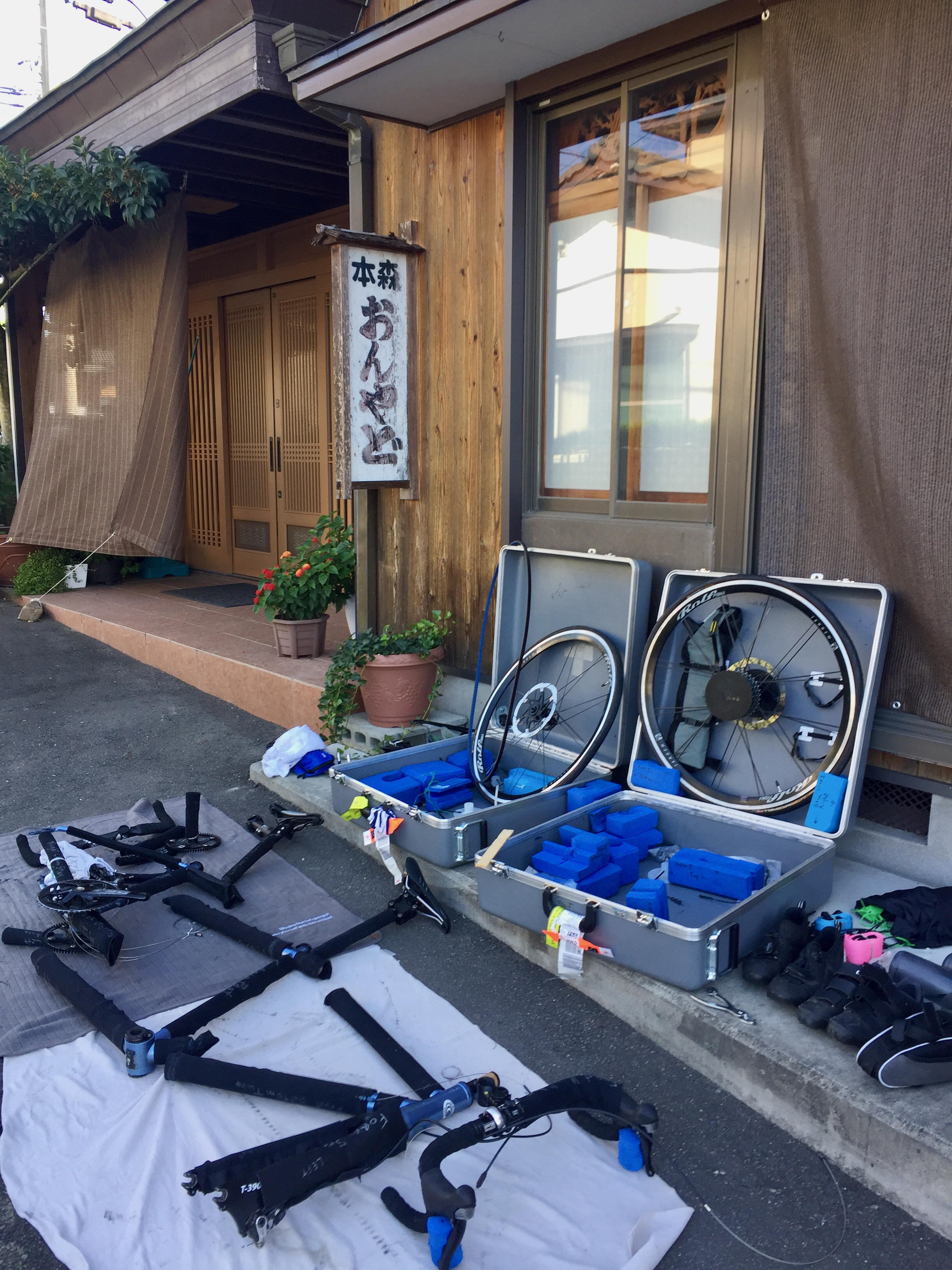
Our bike was assembled. Our test runs completed. Our GPS was up and running. We had our pilgrim gear. Our bike bags were packed.
Time to say goodbye to coziness and hit the Temple Road for real. If all went according to plan we’d be back in in a month, our 750 mile pilgrimage loop complete.
But, a typhoon was bearing down on Japan. A really big typhoon. Tokyo looked like a direct hit. But Tokyo was 300 miles away. Maybe we’d luck out.
Maybe not.
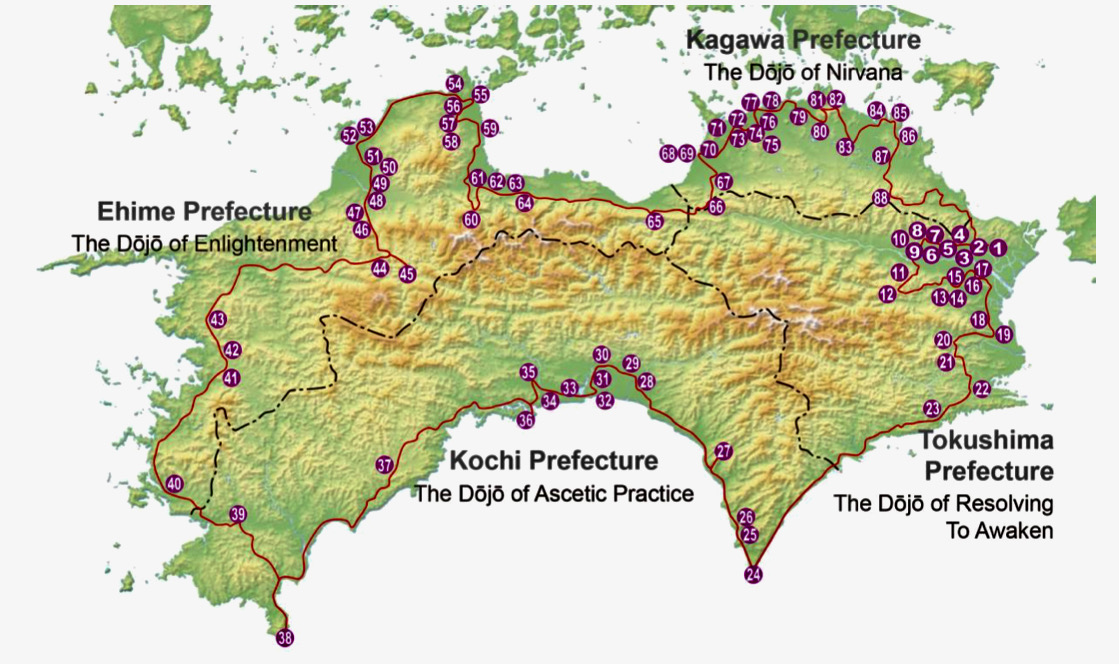
Day 5 October 12 Saturday; Departure & Temples 6 – 11
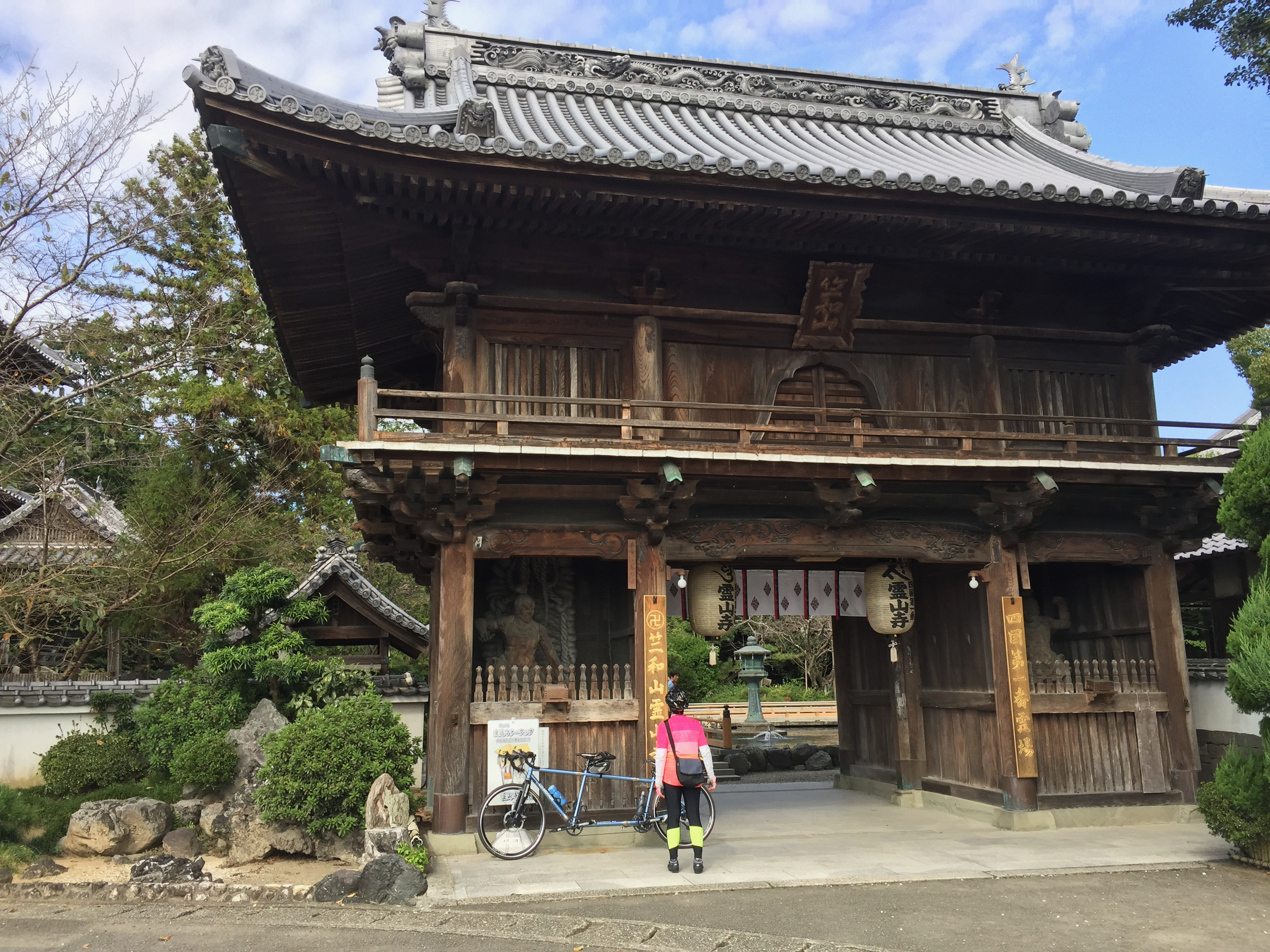
6 Anrakuji 安楽寺 Kamiita, Tokushima
7 Jūrakuji 十楽寺 Awa, Tokushima
8 Kumadaniji 熊谷寺 Awa, Tokushima
9 Hōrinji 法輪寺 Awa, Tokushima
10 Kirihataji 切幡寺 Awa, Tokushima
11 Fujiidera 藤井寺 Yoshinogawa , Tokushima
2:00 AM. No rain.
4:00 AM. No rain.
6:00 AM. Rain.
Sharon and I took turns checking the weather. Sharon would report on the devastation of Tokyo. I’d check my local weather app which showed rain clearing in the afternoon.
At breakfast we asked Mima-san who ran the inn what she thought about the weather. Shrug. Which I interpreted as: clearing in the afternoon, and Sharon as: we were headed to our doom.
We headed out at 8 AM or so in full rain gear. It was pouring. Mima-san took pics. She was laughing. Crazy Americans ride off on a crazy bike into a Typhoon. Great stuff for a new Morimoto-ya Japanese facebook post. Which indeed was how it turned out.
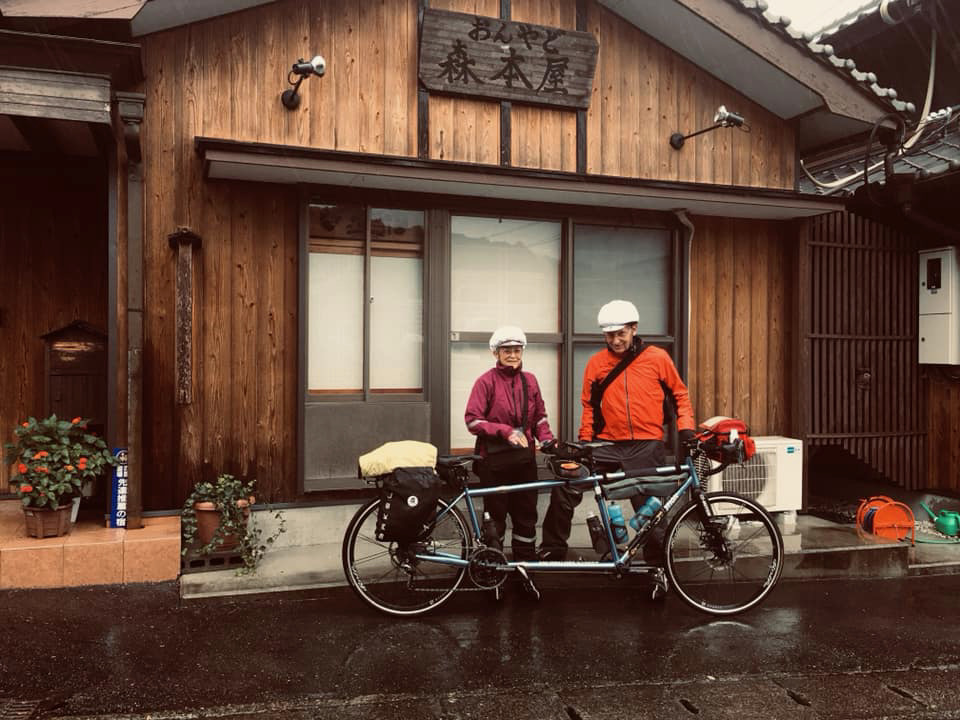
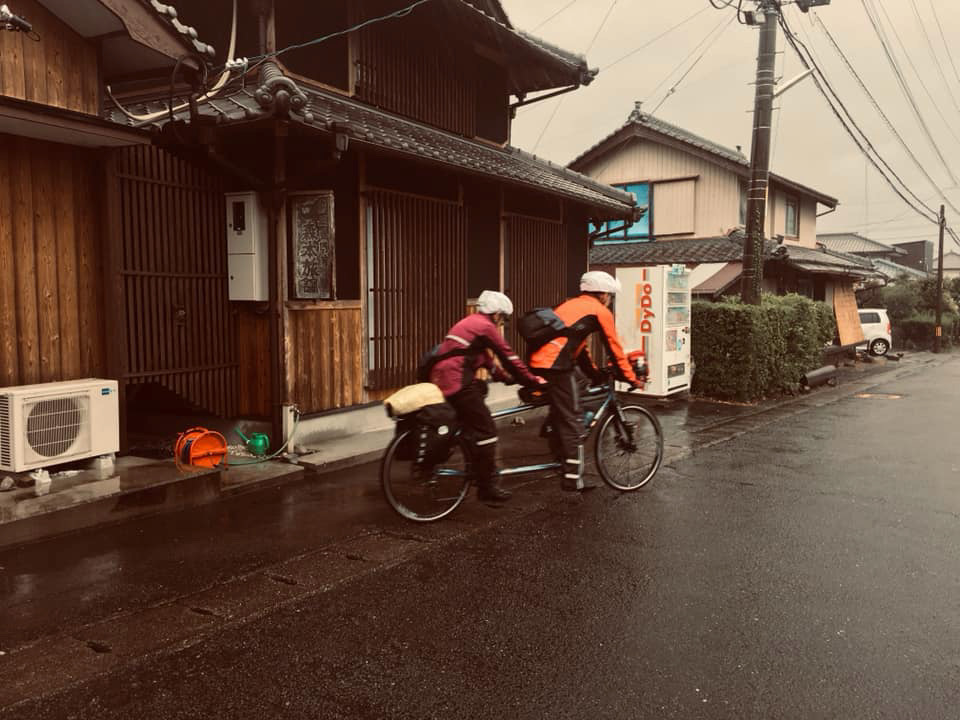
Temples 6 & 7 were cold, wet, and empty. No other pilgrims.
When we turned up the hill towards Kumadaniji – Temple #8, Bear Valley Temple- just before noon, the rain was still heavy.
The temple parking lot was deserted. I took refuge in the temple office while Sharon headed up towards the Temple proper. The Temple office was large and deserted. I stood there dripping while this young-ish woman added the temple calligraphy and stamps to my book.
She offered me a cup of instant coffee. The perfect antidote to my dreariness. It tasted, well, like the best coffee I’d ever had.
Sharon re-appeared, and a cup of instant and a stamped caligraphy later, she and the Temple office lady were chatting merrily, huddled over phone pics.
The lady did have very cute dogs.
From Temple 8 we headed down and out across the valley. The weather was breaking. Soon we pulled up at Temple 9. We did our temple thing and left some of our beloved-cat’s ashes in the temple cemetery.

Traditionally Japanese don’t feel like you need to buried in just one place, a little here and a little there works just as well. We feel the same. Yellowboy’s ashes have now been spread from Finland through Shikoku.
We look for a place where he would be at home. Temple 9 was one of those.
Although the clouds looked ominous, as we continued across the valley, the rest of the day was dry-ish We pulled into Temple 11, Fujiidera, mid afternoon.
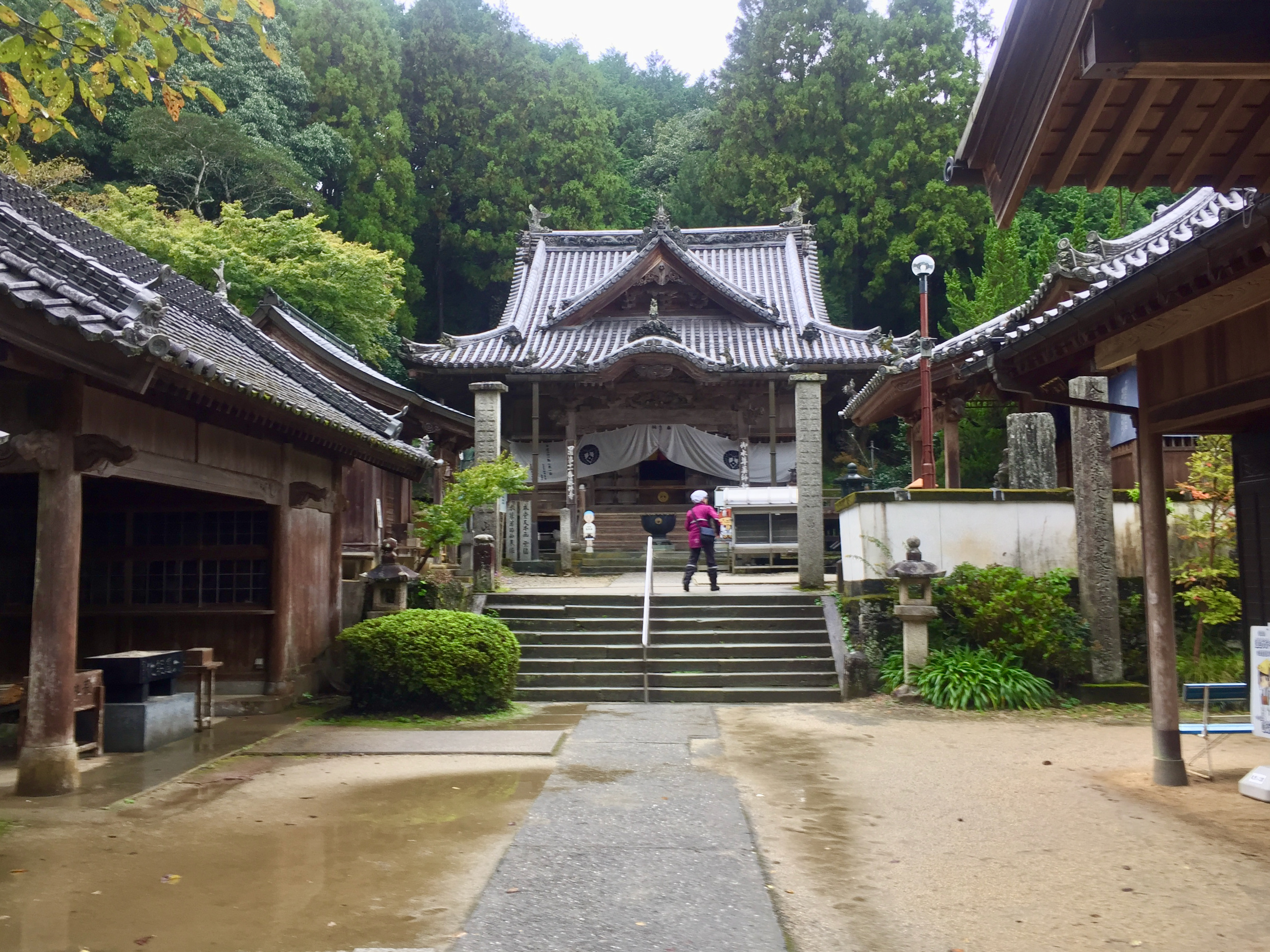
Temple 11 is the last stop of the easy first stretch. For walking pilgrims and for bicyclists. The mountains loom.
A Japanese pilgrim motioned around a corner of the Temple Hall. The beginning of the infamous hiking trail to Temple 12. He had a home-made convertible cart-backpack and knew what was coming. We’d meet him again in the days ahead, many times.
The walking pilgrims’ route was clear in our book. What wasn’t clear was how you get there from here, on asphalt, on a bike. I had decided in early planning that we would go the way less travelled. For better or worse.
Our route wasn’t the tour bus route, or as it turned out, just about anyone else’s route, but I had programmed it into our bike computer and thus, we had cast our lot.
At the very top of the long monster climb out of the valley, in the middle of absolutely nowhere – we hit our first dolls. And they were pilgrim dolls.
Doubt we had seen a car or anyone else for at least an hour. The road couldn’t have been more the ten feet across.
But here at the pass was a pilgrim shelter complete with a bed, a Coca Cola vending machine, and life-sized, fully-clothed pilgrim dolls. We knew what we were seeing and it was perfect. The real deal.
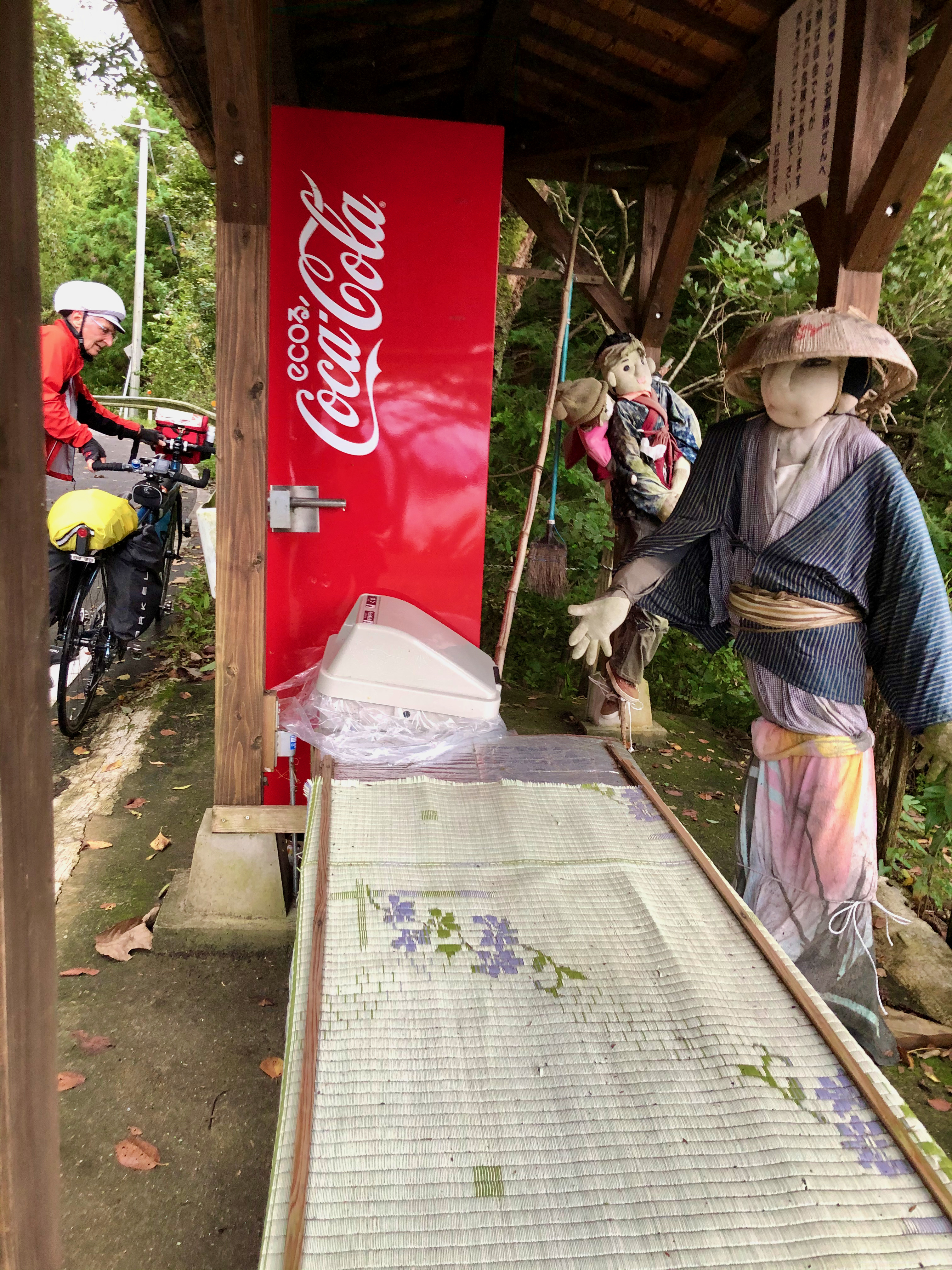
The backstory: Once upon a time, say 20 or so years ago, a Japanese woman, Tsukimi Ayano, moved back to her hometown Nagoro on Shikoku, to care for her father. Her hometown was dying – down to 30 some odd inhabitants, from over 300.
The town was still there. Buildings, schools, and homes had lasted. The people hadn’t.
Tsukimi had plenty of time on her hands. She decided to make herself a scarecrow or doll if you will. She made it in her father’s likeness, clothed it in his clothes, and put it out in his field.
Folks thought it was him.
I could relate. Way back in the day, say 1971, I had an organic garden, which I thought needed a scarecrow. So I took some of my old clothes and stuffed them. Those being the days, I put my scarecrow into the garden upside down, head-in-the-ground, which is kind of how I felt at the time. I thought the shoes waving in the air were a nice touch.
A couple of days later I was relaxing on the porch, when this woman comes screeching up the driveway. She jumps out of her car and runs up to me in a panic, shouting,
“There’s someone in your garden. And his head is stuck in the ground!” In her mind this was a life or death moment.
I smiled, and tried to explain it was just a regular scarecrow, but upside down.
She wasn’t having any. Livid, she started yelling and in no uncertain words, told me exactly what she thought of my “joke”, stormed back to her car, slammed the door and roared off.
Over the years, I have wondered about the intensity of that moment. A Scarecrow is just a Scarecrow except, when it’s much more.
In Nagoro, if Tsukimi had left it at one doll, it would have been simply a perfect local moment.
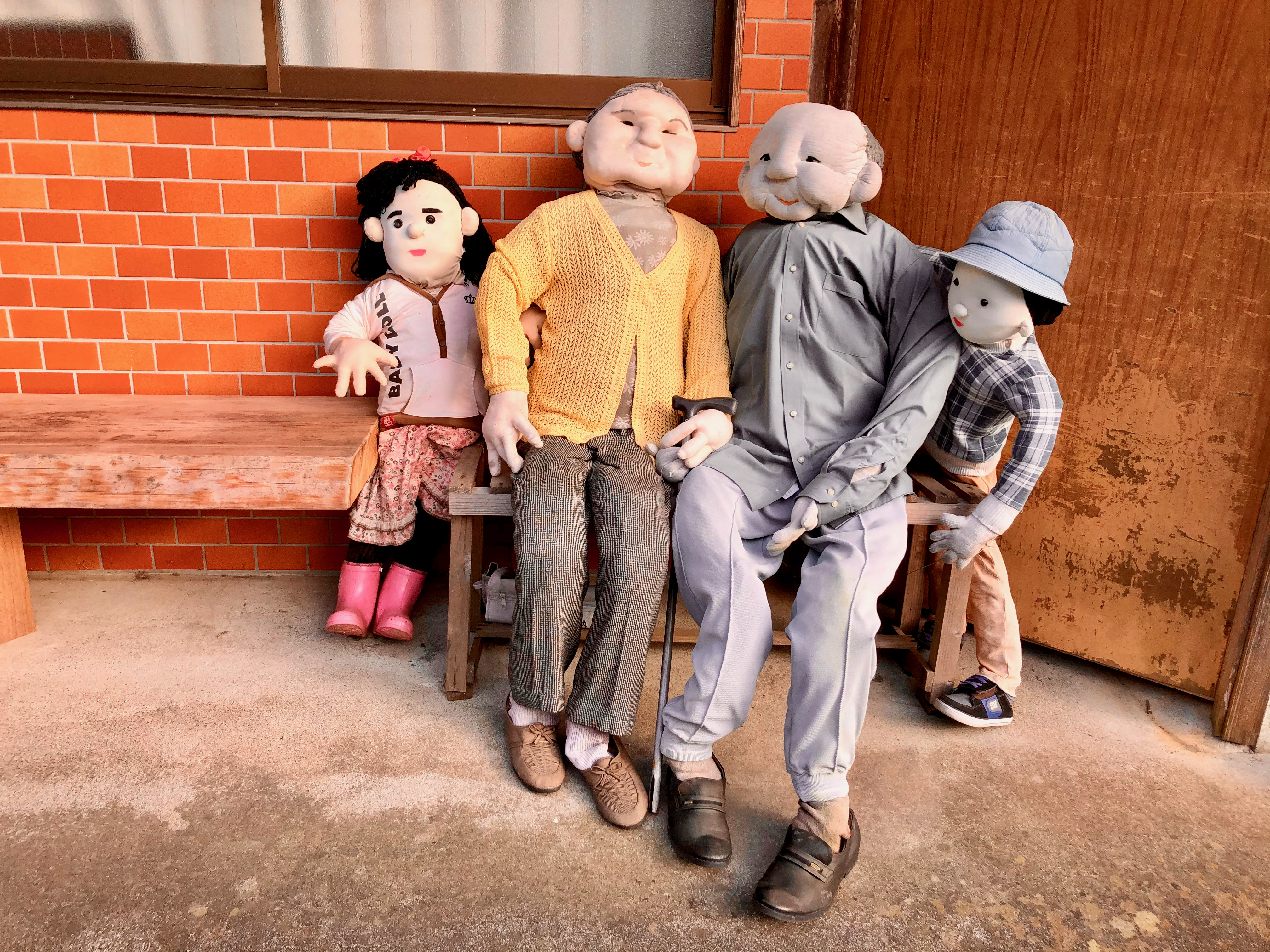
But she didn’t. One doll followed another and Nagoro slowly re-populated. Folks gone-by came back as dolls. In the places they lived, in the places they worked, in the places they just hung out.
Beyond brilliant, here we’re talking the truly remarkable. Genius if you will. The big leap. On her own, Tsukimi slowly created a real time, fully-scaled Art installation.
Nagoro, was perhaps fifty miles off our route. Too far to justify a visit.
As it turned out, fifty miles was close enough. The dolls had come to us.
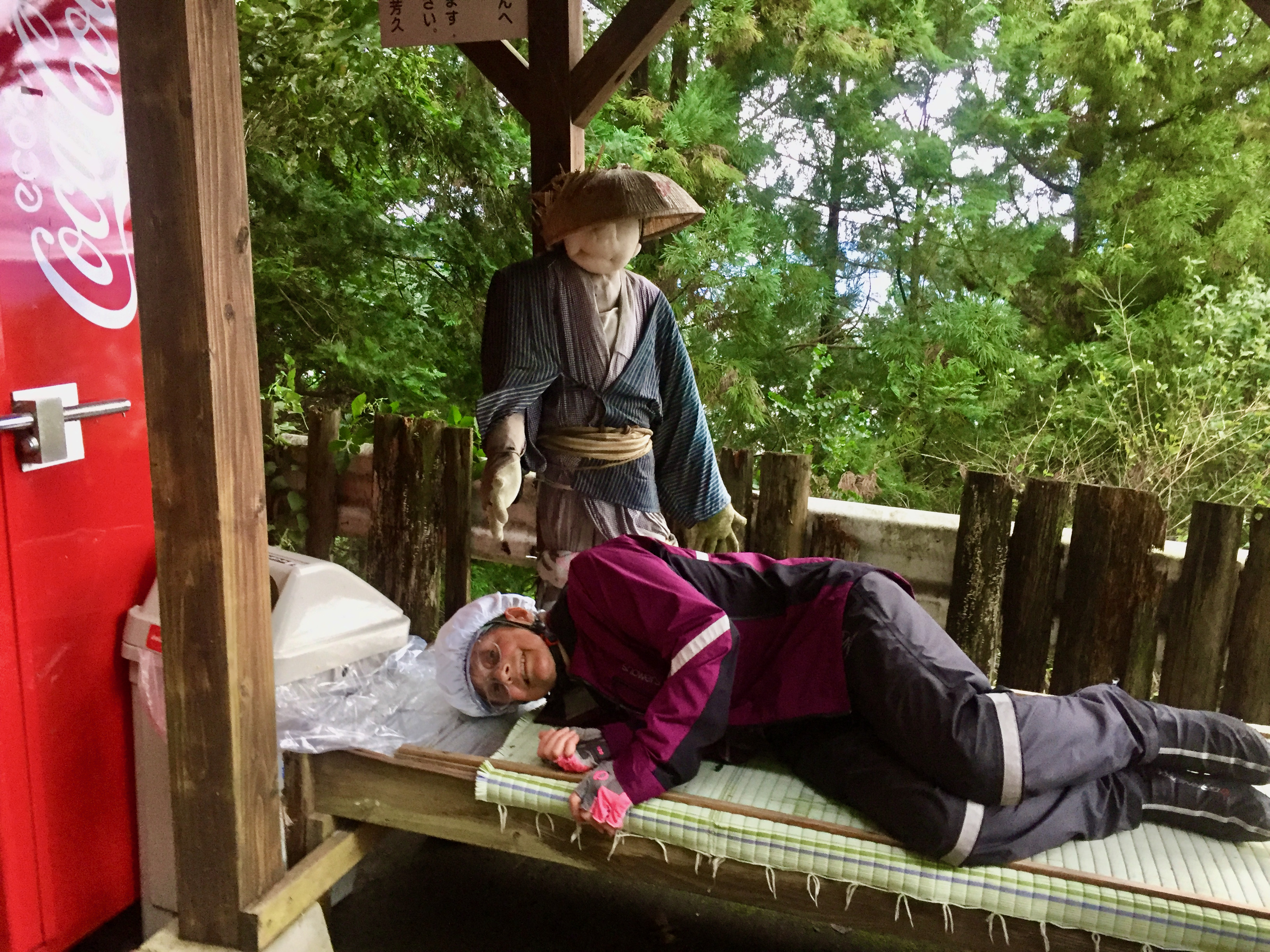
On the way down the backside of Temple 12, a day later, we hit Dollsville again just before our inn for the night.

But that’s jumping ahead.
Temple 12 is a mountain temple. And not just any mountain temple, it’s the first “Henro-Korogashi” mountain temple, which means it’s a really tough one. A route where “pilgrims fall down”, or in our case a route where pilgrims push their bikes up +20% grades.
We knew we weren’t going to get there on this first day.
Our plan was to do part of the climb, and then make the big push the next day.
On our descent from the pass, we almost missed our inn, Misato no Yu up and off to the right. Misato no Yu was a relaxed hot springs inn with dining. Their Japanese/French cuisine was pretty fabulous. We had western beds and even a hair dryer to dry our shoes.

I really don’t think the Inn owner thought we’d make it to Temple 12. He had this little smirk on his face when he pointed up the mountain and told us how far up we had to go.
I basically ignored him, easy enough to do when he’s using meters and you don’t want to ask your wife for the conversion. Besides one way or another I had no doubt we were going to get there. I’d long since gotten over the “too proud to walk” thing.
Day 6 October 13 Sunday; Temple 12
12 Shōzanji 焼山寺 Kamiyama, Tokushima
After leaving Misato no Yu, we rode the first stretch, up along a splashing stream and then we turned off, got off, and pushed. Our bike computer said the max grade was 32.7%, which probably is impossible.
But metaphorically about right.
There was virtually no traffic on the narrow road. Every now and then, a micro-pick-up truck would pass us. I had fantasies of one stopping and offering us a ride. We could wedge ourselves in the back with our bike. The rear wheels might stick out, but it would work.
No one stopped. Not surprising, as these were working folk with better things to do than save crazy foreigners from their own schemes.
In a somewhat ironic twist, we descended to Temple 12. For the other 99.999% of visitors it was the top.
There’s a moral here somewhere. I should probably add, this would not be the last time, we descended to a mountain temple.
We pulled into the Temple 12 parking lot just before noon, walked our bike up the carefully-graded, newly-engineered path to the base of the traditional stone stair. We locked our bike and headed up.

Temple 12 didn’t disappoint. Our first real-deal mountain temple. Sure, most visitors just drive up now. But past magic lingers.

Most easily detected on the Shinto side. An alien mindset, ebbing away in the 21st century. Photo below.

Buddhism and Shinto have co-existed in temple locations, side-by-side for centuries and centuries, taking turns in favor.
After the Second World War, Shinto fell on hard times. The Emperor and the Shinto establishment were held responsible for the crushing destruction of Japanese culture and society in second world war.
Rightly so.
So who should we run into? Our charming German friend Anika.
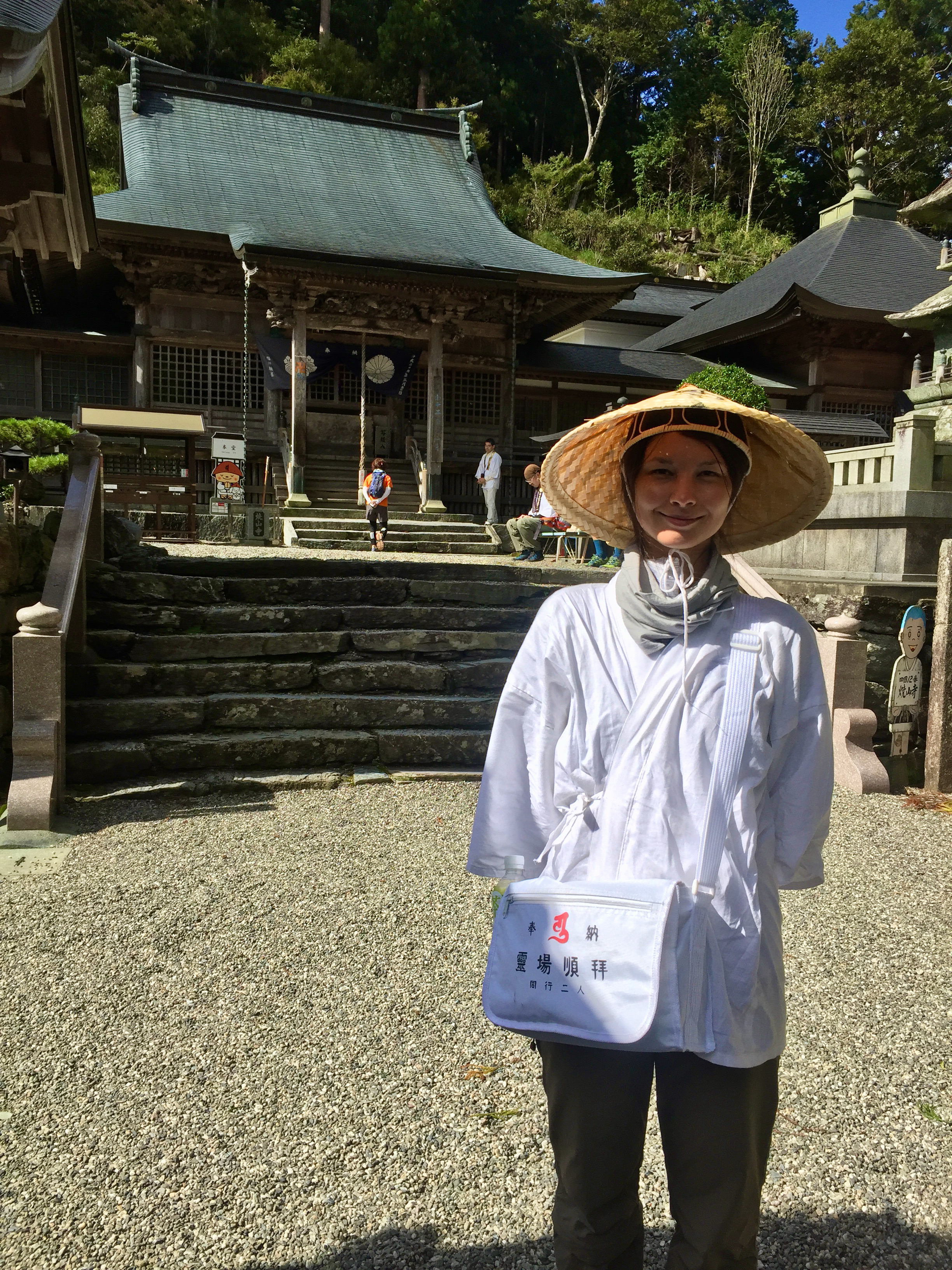
She had made the climb on foot from Temple 11. She was lingering, hoping to meet up with a hiking companion still back on the trail.
Back at the bike, ready for our descent, we had our own issues.
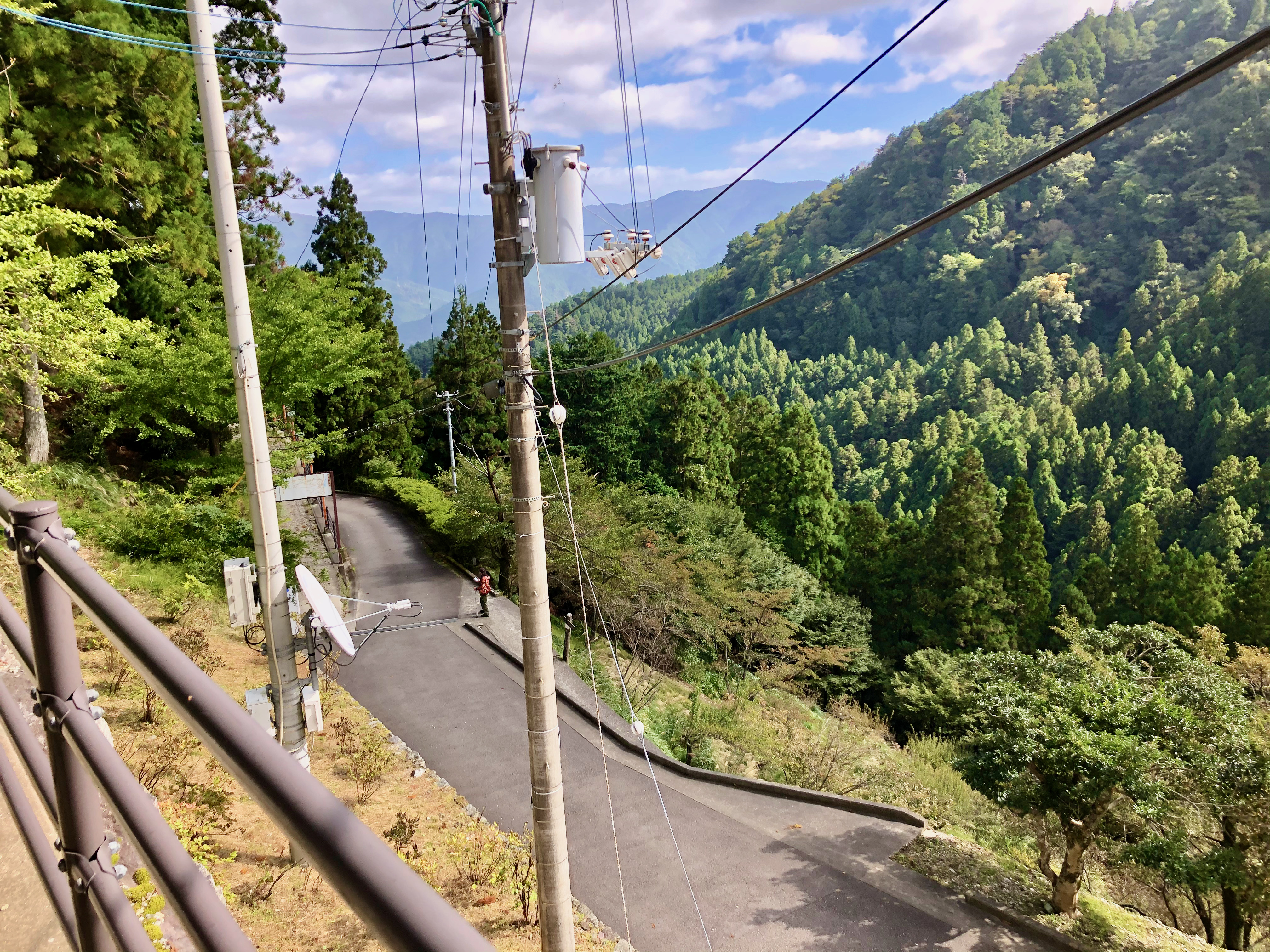
Our bike computer had gone on strike. No GPS connection. Our back-up in such situations was our phone, but Mr. Phone was dangerously low on charge. Breathe deeply.
Ah … the back-up battery, that came with our Japan Wireless pocket Wi-Fi gizmo. Yep, the cable fit and we were up and running again. Google Maps showed where we were, where we wanted to go and what turns we needed to make to get there.
The descent was smoke’n fast. In less than an hour, with no wrong turns, we were out front of what we thought was our inn for the night. No one was answering the door, but then Sharon noticed a guy puttering, doing something, a couple of doors down.
Yes, we were home. And soon a friendly face appeared and showed us to our room.
We had the place to ourselves. After a shower and soak, our young female host kind-of burst into our room, to get our laundry.
All I had on was my underwear. She couldn’t have cared less. Not an issue for her, well, not an issue for me.
After she left, I threw on my Yukata, kicked back and relaxed.
We had passed our first real test on the road. Temple 12 is infamous for its challenges, both physical and psychological. From here it was downhill for Temples 13 – 17, but next up was dinner and it was feast!
Day 7 October 14 Monday; Temples 13 – 17
13 Dainichiji 大日寺 Tokushima, Tokushima
14 Jōrakuji 常楽寺 Tokushima, Tokushima
15 Kokubunji 阿波国分寺 Tokushima, Tokushima
16 Kan’onji 観音寺 Tokushima, Tokushima
17 Idoji 井戸寺 Tokushima, Tokushima
We slept well and after a full Japanese breakfast, we headed out. Our bike computer was happy to be fully charged and our GPS signal was good. Weather was co-operating and we were off.
At less than 20 miles, this was a short day distance-wise, but with five temples, we knew it would be full.
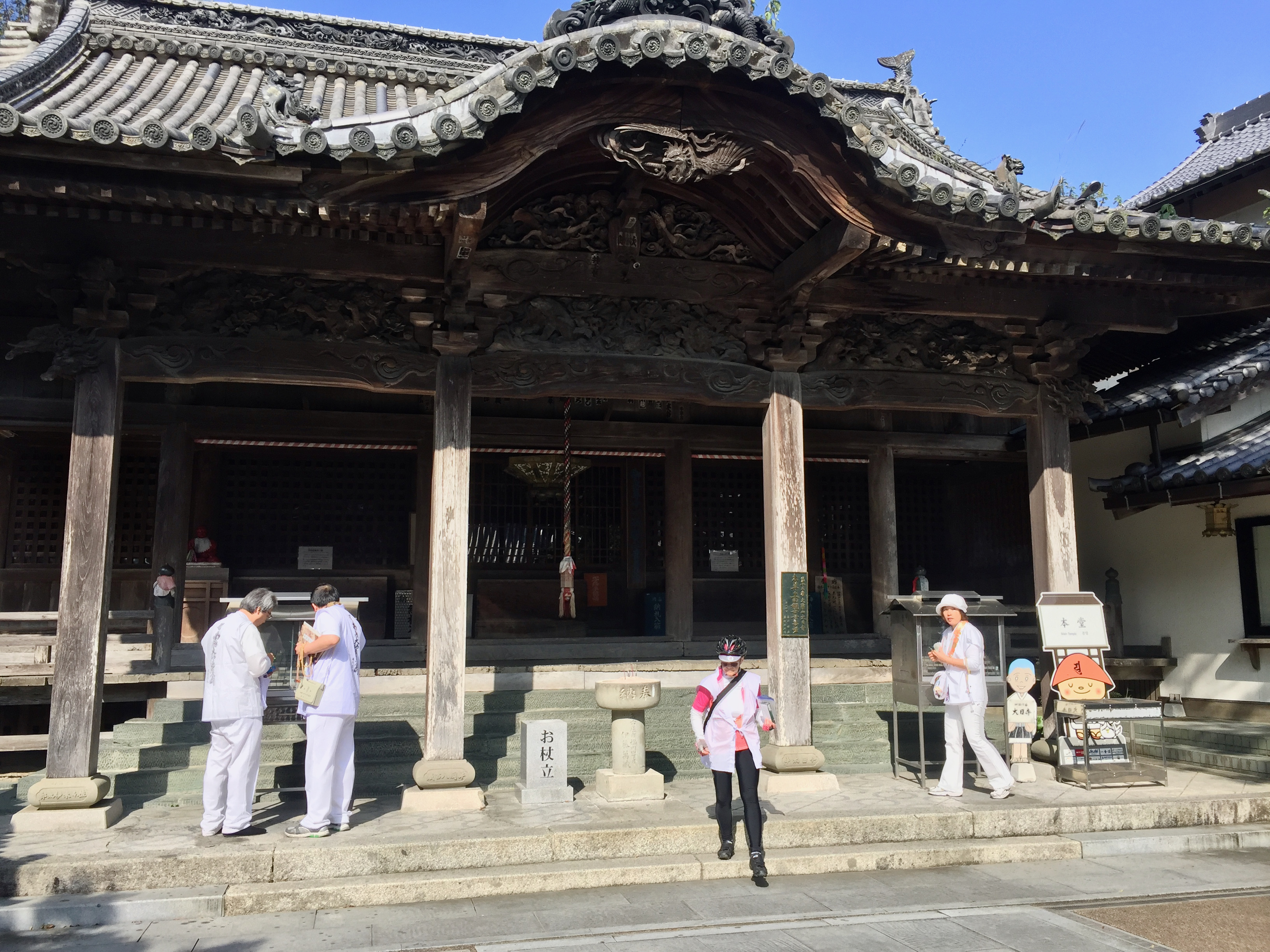
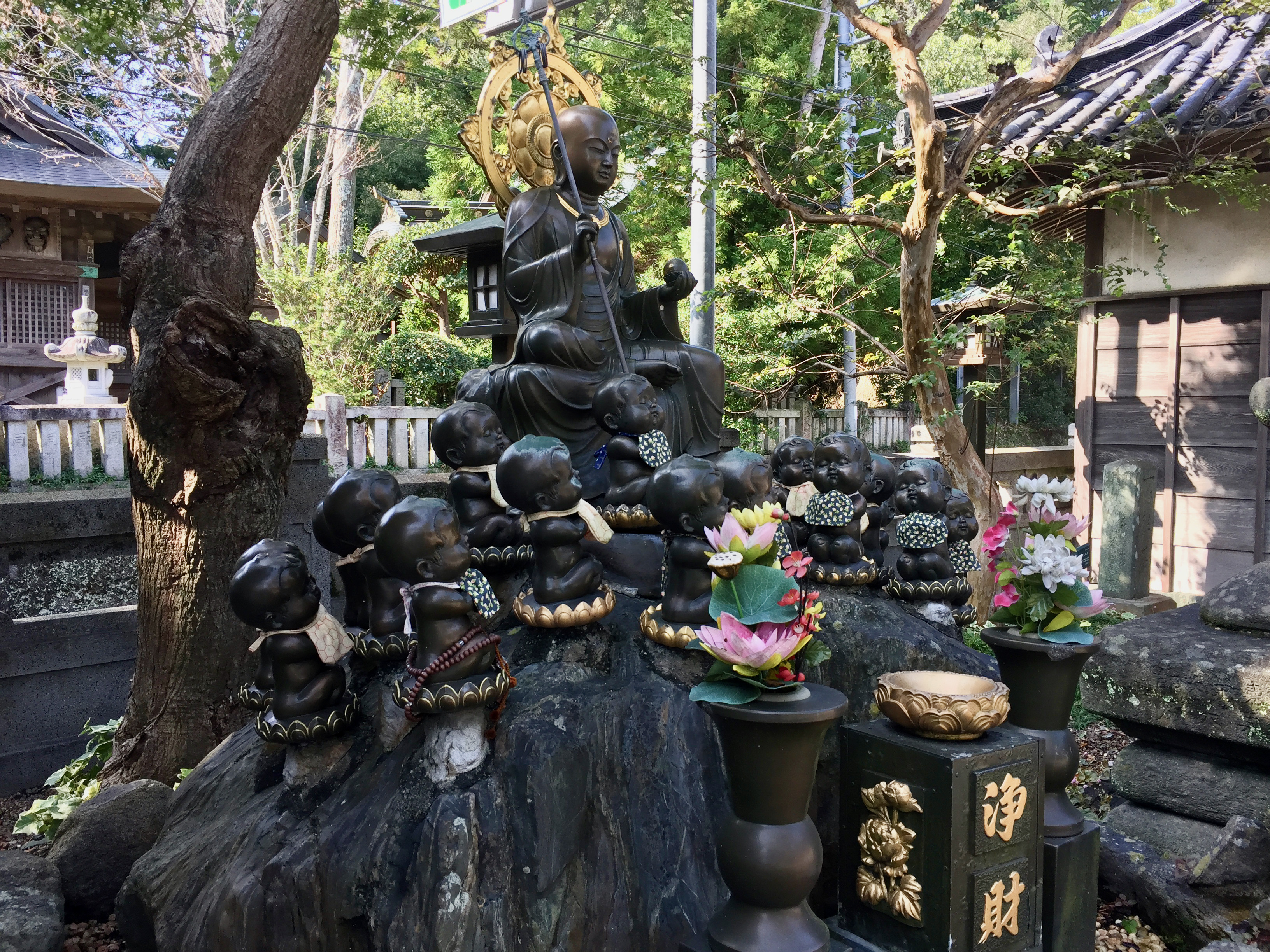

Late afternoon, right on schedule, we pulled up in front of our hotel in the heart of Tokushima.

The twist was that the lobby was on the fifth floor. I had known this was coming. After a most-pleasant email exchange, we had been cleared to bring our bike up in the elevator. It would be kept in a hall behind the front desk.
The hotel had done their homework. Our tandem was indeed too long to be accommodated in the underground bicycle parking nearby.
We wiped down our tires rolled across the pristine lobby and waited for an empty elevator. We rolled in, lifting our bike carefully, vertically. No problem, an inch or two to spare before hitting the ceiling.
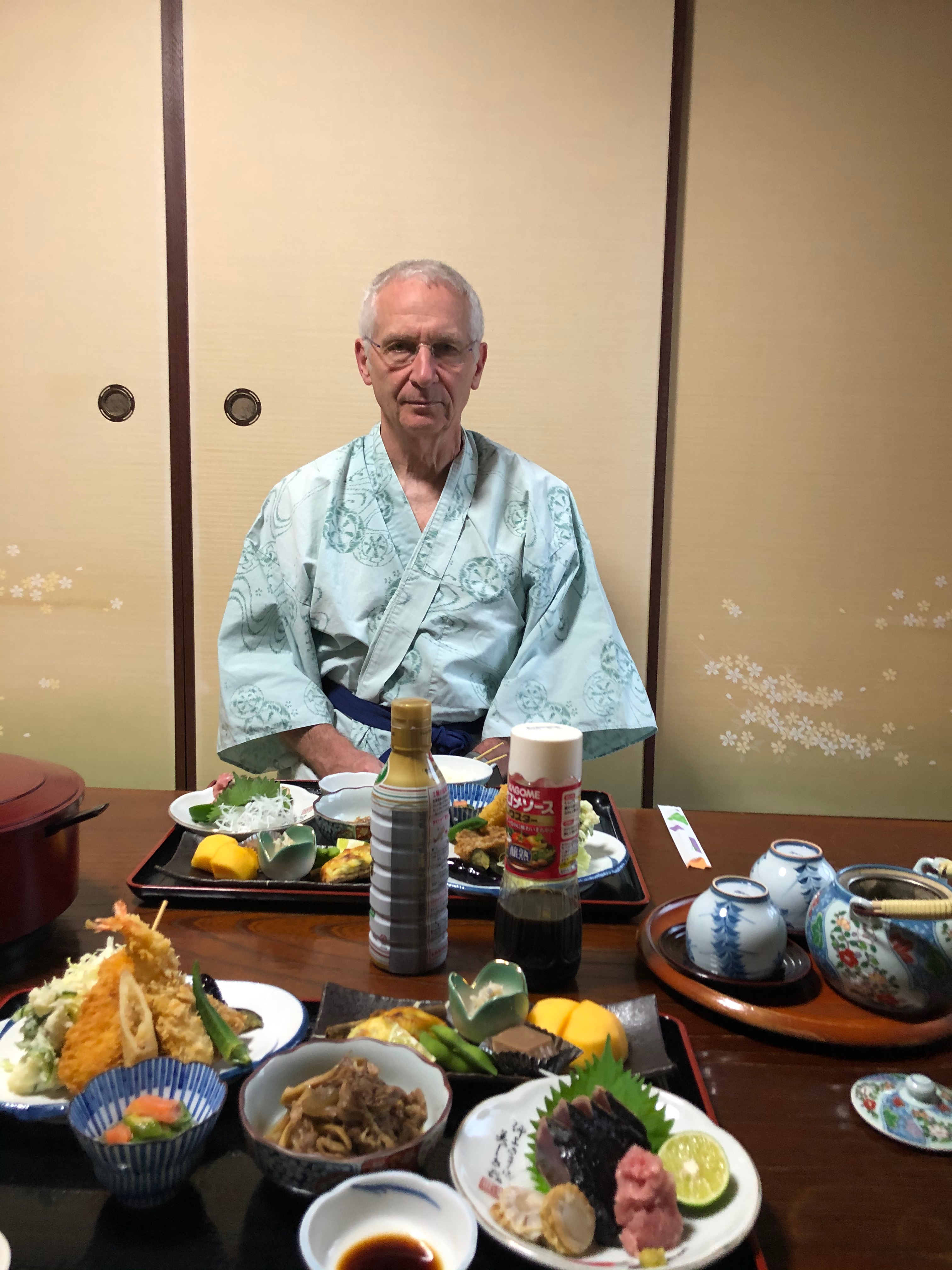
After checking in we found our room. No sleeping on the floor tonight. We had a western bed, and our bathroom was wonderful. Something right out of a space station.

This was most definitely 21st century Japan.
After showers and soaks, we ventured out for dinner. We didn’t have to go far. There was a 7 Eleven opening off the first floor lobby. Thus we were introduced to the wonders of Japanese convenience stores.
We loaded up, dinner, road snacks, the works, and headed back up to our room for a most-tasty picnic.
Day 8 October 15 Tuesday; Temples 18 – 20 Tokushima to Tano; [22 ± miles.]
18 Onzanji 恩山寺 Komatsushima, Tokushima
19 Tatsueji 立江寺 Komatsushima, Tokushima
20 Kakurinji 鶴林寺 Katsuura, Tokushima
We had signed up for breakfast when we made our room reservation. Good decision.
A far cry from our inn meals. Not better, just very different. Urban entertaining. We ate our buffet breakfast at a table – with chairs – on the second floor overlooking the central Tokushima subway entrance and, I think, the underground bicycle parking.
Outside below, folks were rushing to work and uniformed school children were rushing to school. A mass of humanity flowing this way and that. Inside, our breakfast compatriots were mostly business folk. Composed, but focussed. Rushing this way and that.
Sharon was having her own private food fest with everything exotic available. Which was a lot.
I was lingering over my coffee, wondering what the day would bring. At 22 miles, it wasn’t a particularly long day, but it promised to have its challenges. First we had to navigate out of Tokushima, then visit a couple of temples before #20, another Mountain Temple which looked pretty serious, then a descent and a river ride to our inn at the cable car base station for Temple 21.
On the ride out of Tokushima, we played a game of: Guess the Love Hotels.
Love Hotels are hotels catering to folks interested privacy for doing the deed. A somewhat Japanese institution. Makes sense in world of paper thin walls. Purportedly compete with anonymous check-in, double-blind pizza delivery, and in-room sex toy vending machines. And themed rooms which well, run the gamut.
You know you’re at a Love Hotel, if rooms are rented by the hour.
One might think that Love Hotels would be discreet and hard to identify. Au Contraire. The exterior aesthetic is look-at-me Disney.

And from what I’ve heard, interiors follow suit.
Later on our pilgrimage, we met a Female Canadian University Mathematics Prof. who couldn’t find a room, one night early on in her pilgrimage. Her only option was a Love Hotel.
Her Taxi driver didn’t want to take her there. But he relented. She said her room was very comfortable. The bed was really big and most comfy. The other stuff was entertaining, but kind of irrelevant as she was traveling alone.
If we ever make it back to Japan for another pilgrimage or whatever, and are on our game, a Love Hotel stay seems like a no brainer, for old folks’ entertainment.
Mid morning we arrived at Onsanji, Temple 18, and who should we run into but the same stout fellow we had met at Fujiidera, Temple 11 who had pointed out to us the hiker’s way up to Shosanji, Temple #12.
A good guy with an ingenious low-tech solution to the pilgrimage backpack. Wheels for the roads. Back straps for the trails.

He didn’t speak a word of English, but he made it pretty clear, that he didn’t think much of our chances for making it to Kakurinji, Temple 20, on our bike. Like it’s way up here and the unspoken – you are old folks, and foreign old folks at that.

Curiously over the days that followed, we became pretty good friends. He was a cheerful, hardcore pilgrim on his seventh time around. He was fast, but we were faster, and we’d stop and chat every time we passed him and his cart.
I’m not sure if its grudging respect we earned from him, but close enough.
On our way up to Temple 20, Kakurinji, our bike computer registered a max grade of 35%, an improbable reading, but it was wicked steep and for long stretches with no let up. Most likely mid-20s, perhaps a bit steeper on the insides of a few switchbacks.
We walked the steep stuff and rode where we could, arriving at the temple mid-day.
It’s said that it doesn’t matter how you do the pilgrimage: On foot, by car, buses, motorcycles, or tandem bicycles. It’s the state of mind that counts.

Kakurinji, Temple 20, was a gem. One, where we wished we had far more time to linger. Our second mountain temple. At 1804 feet in elevation, it’s the fifth highest temple on the pilgrimage.
Kakurinji translates as “Crane Forest Temple.” The crane being a very auspicious symbol, symbolizing longevity.
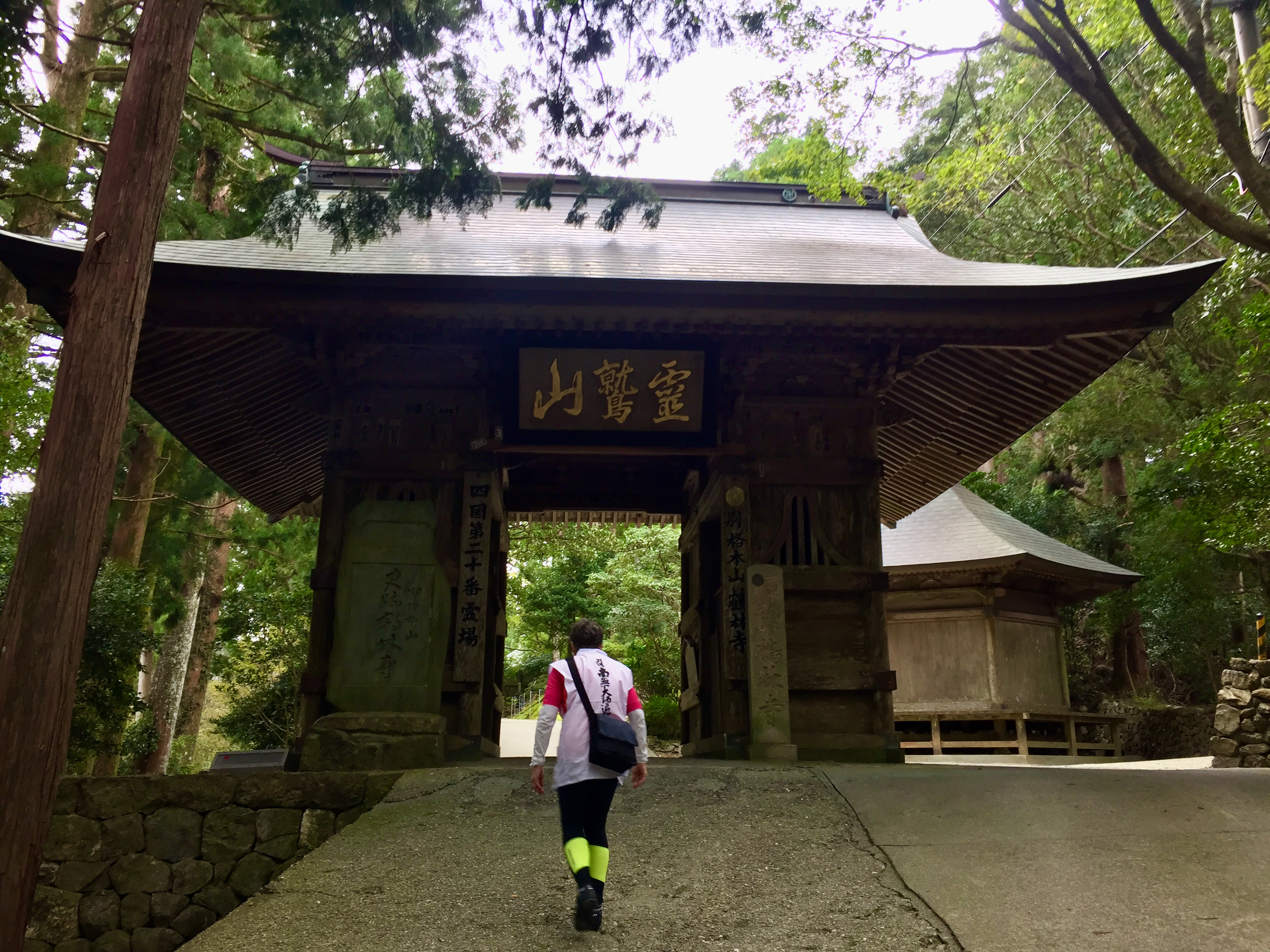

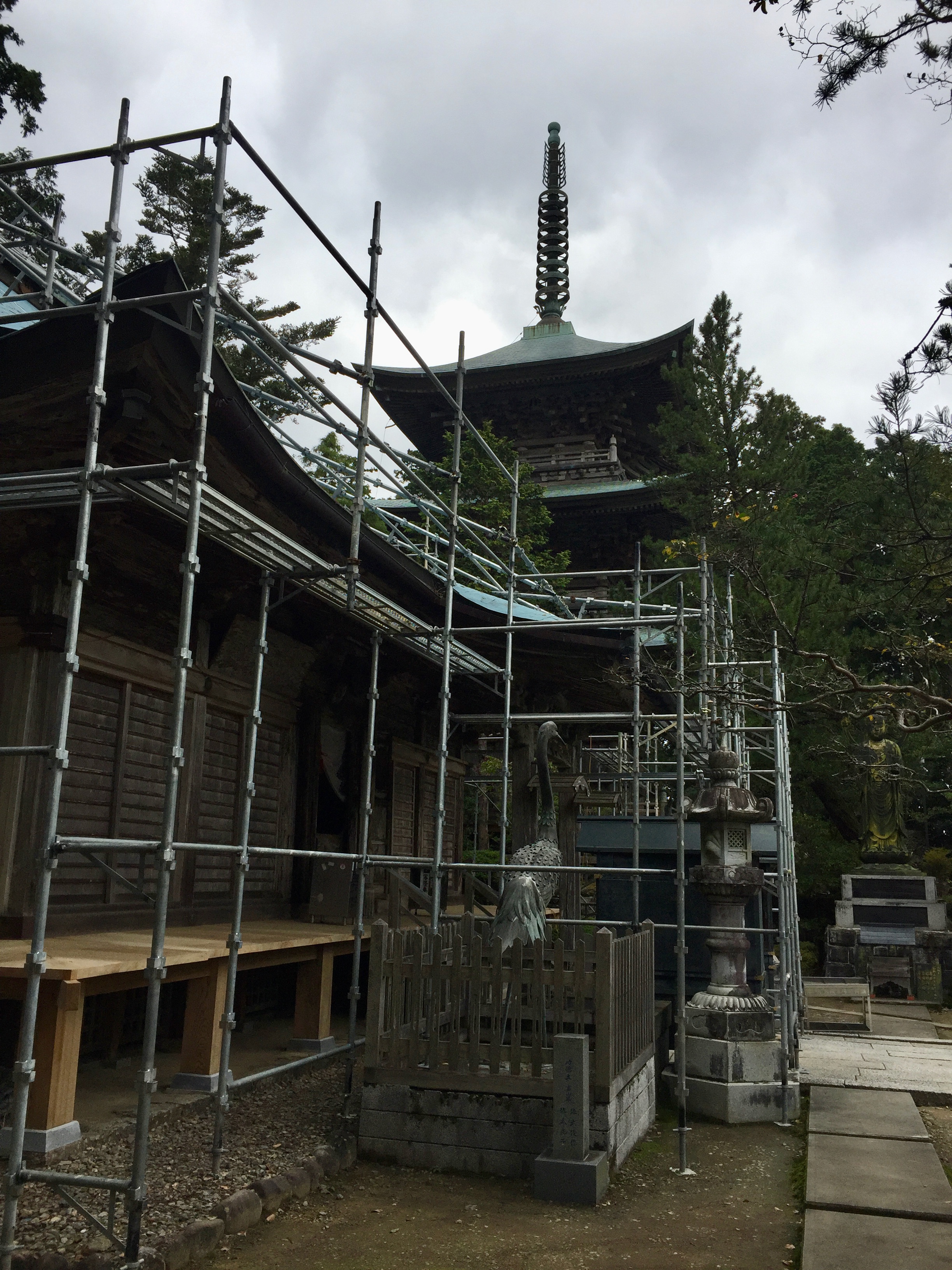
The descent down the other side of the mountain was steep. Like the steepest road, you’ve ever been on, steep. And it didn’t let up.
I braked and the brake grips bottomed out. And we didn’t stop. Not good news. I scanned for uphill spots to crash. The thought being better sooner and slower, than later and faster.
But thankfully we gradually started to slow and eventually came to a stop.
After more than a few deep breathes, I tightened up the brake cables, and we very, very slowly made our way down to the Naka River.
From there it was only a bit over 4 miles to our inn at the base of the Ropeway to Tairyuji, Temple 21.
And a beautiful 4 miles it was. 4 miles of some of the most beautiful riding I have ever experienced. Little or no traffic, turquoise river water, and late afternoon light.

We pulled into our inn, Sowaka, in Naka City, late afternoon, right on schedule.

Sowaka is located at the base of the ropeway, or cablecar if you will, to Temple 21, another mountain temple. We had decided early on, that the ropeway would be the right call for us.
Sowaka Inn had the reputation of being a bit too relaxed for some tastes. Their motto: “Cleanliness, laughter and gratitude.”
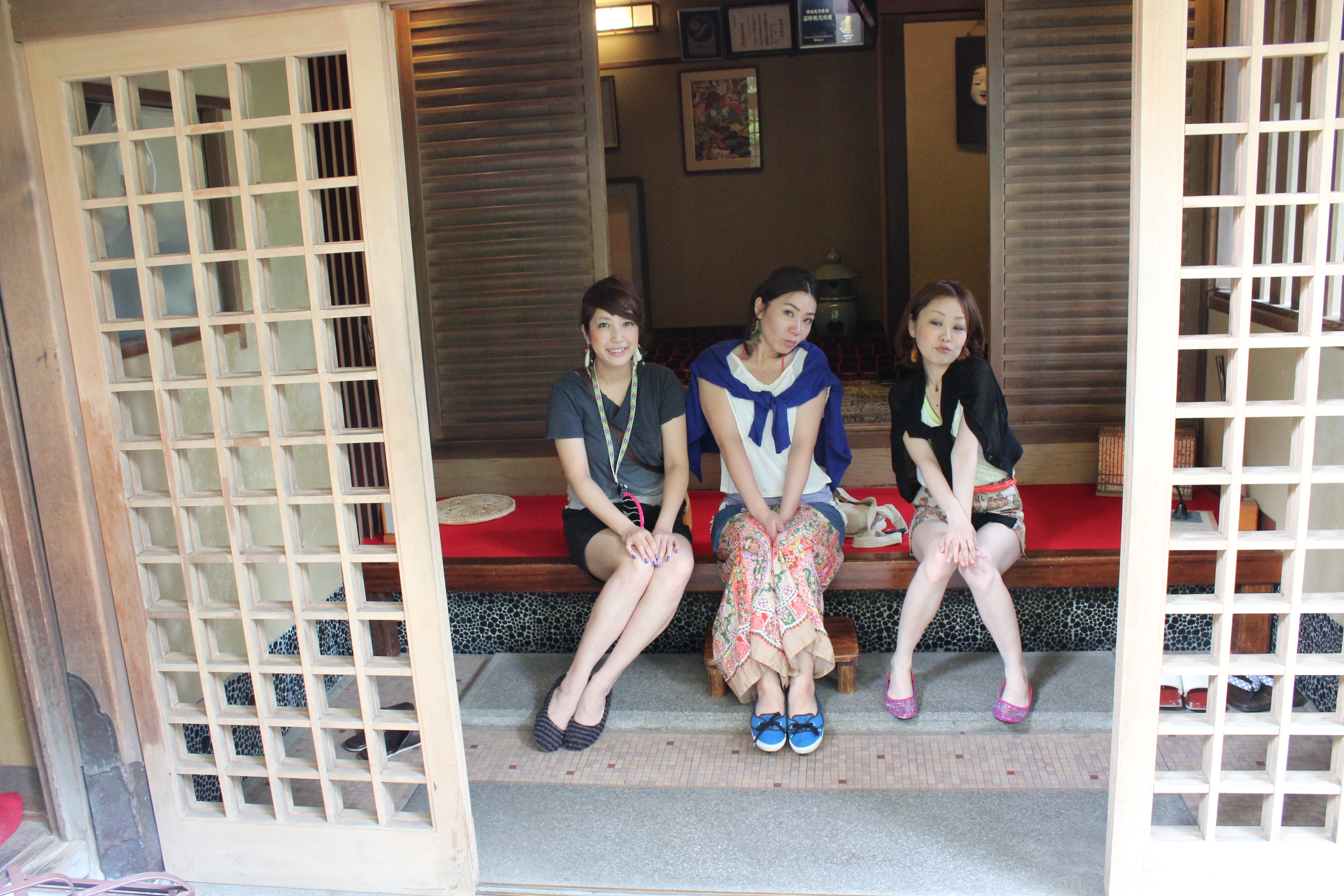
Whatever. We felt right at home.
One young women was kind-of at the front desk and another was puttering in the kitchen. We checked-in, parked and locked Mr. Bike in a side entrance, found our room, and unpacked.
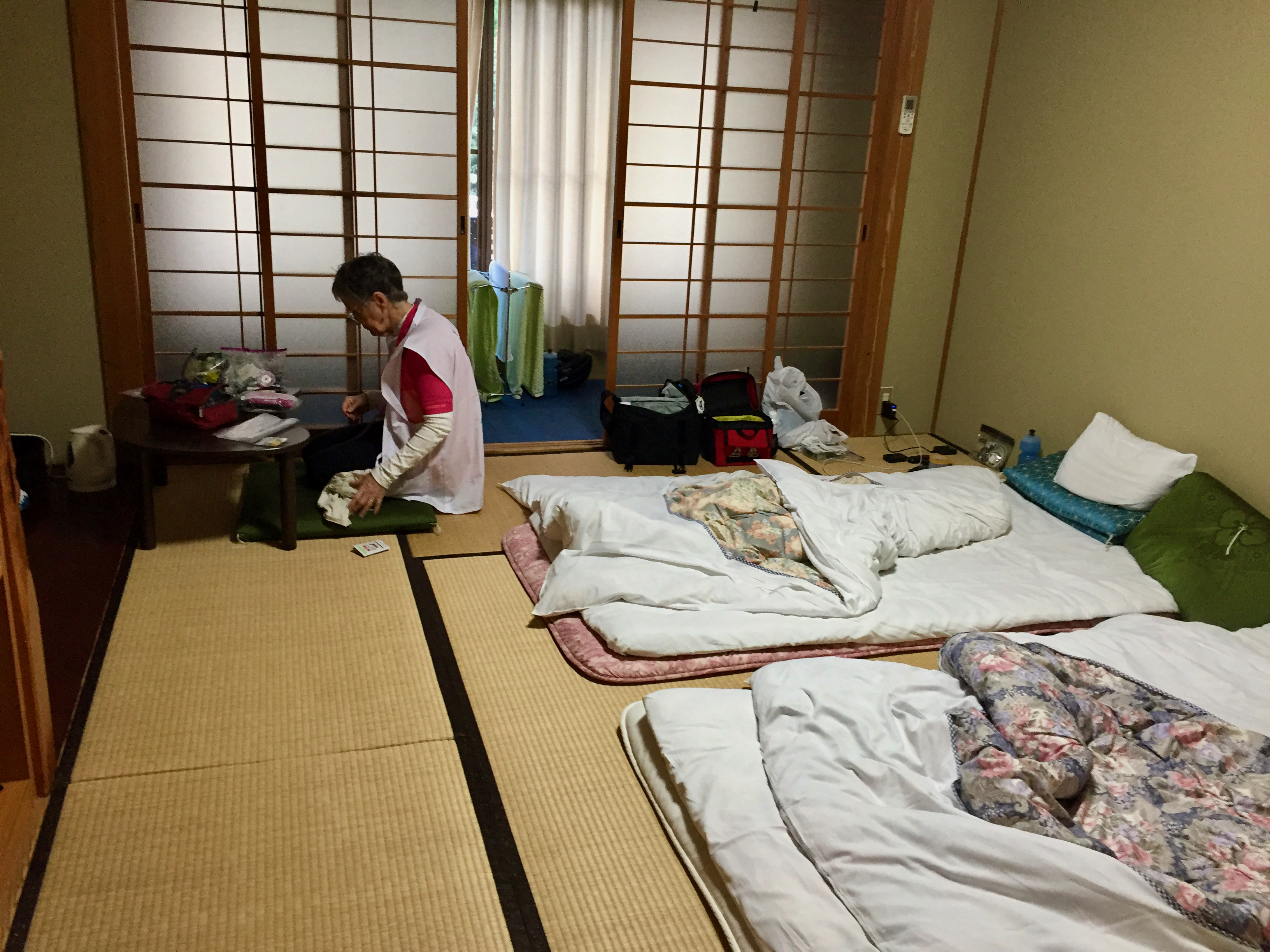
We had a toilet, but no shower. So it was off to the communal, sex-segregated baths in our bathrobe-like Yukatas.
I shared the Men’s bath with a half dozen Japanese men. This is a starker’s thing. Shower first and then it’s a really, really hot soak. Felt great.
At dinner over a couple of beers, mine, we talked about the next day. Up bright and early for a cablecar ride to Temple 21. Then a ride to the Pacific.
Day 9. October 16 Wednesday; Temples 21 to 23. Tano [Naka City] to Minami Town
21 Tairyūji 太龍寺 Anan, Tokushima Cable car
22 Byōdōji Anan Tokushima Another tough mountain temple
23 Yakuōji 薬王寺 Minami, Tokushima
I’m not sure what my problem was, but I was in a rush from the get go. I would get mine.

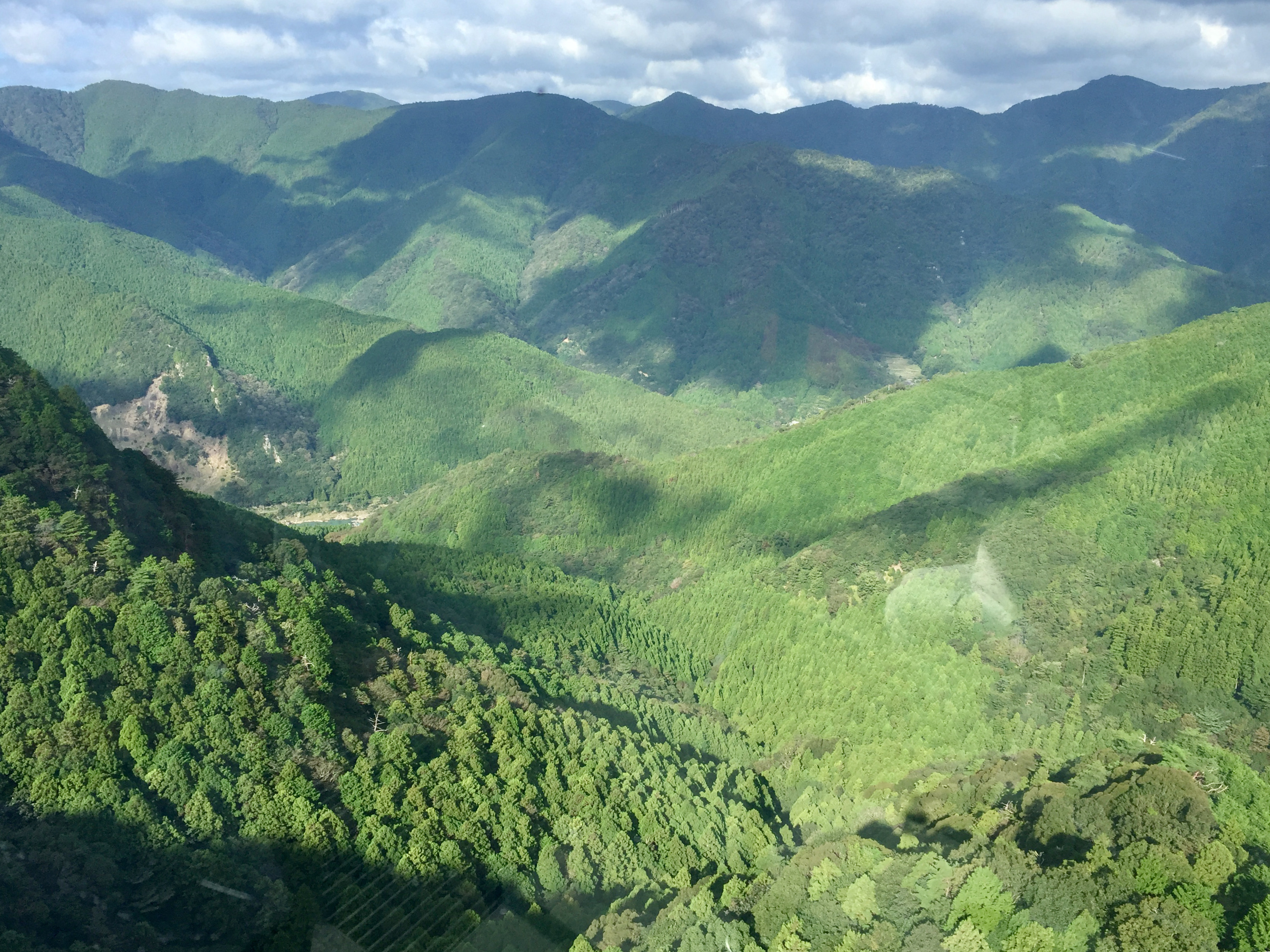
I kind-of relaxed in the cable car. A beautiful day with beautiful views of a gorgeous landscape. No sweat, just a gentle swaying. Only a couple of Japanese tourists in the car and us.

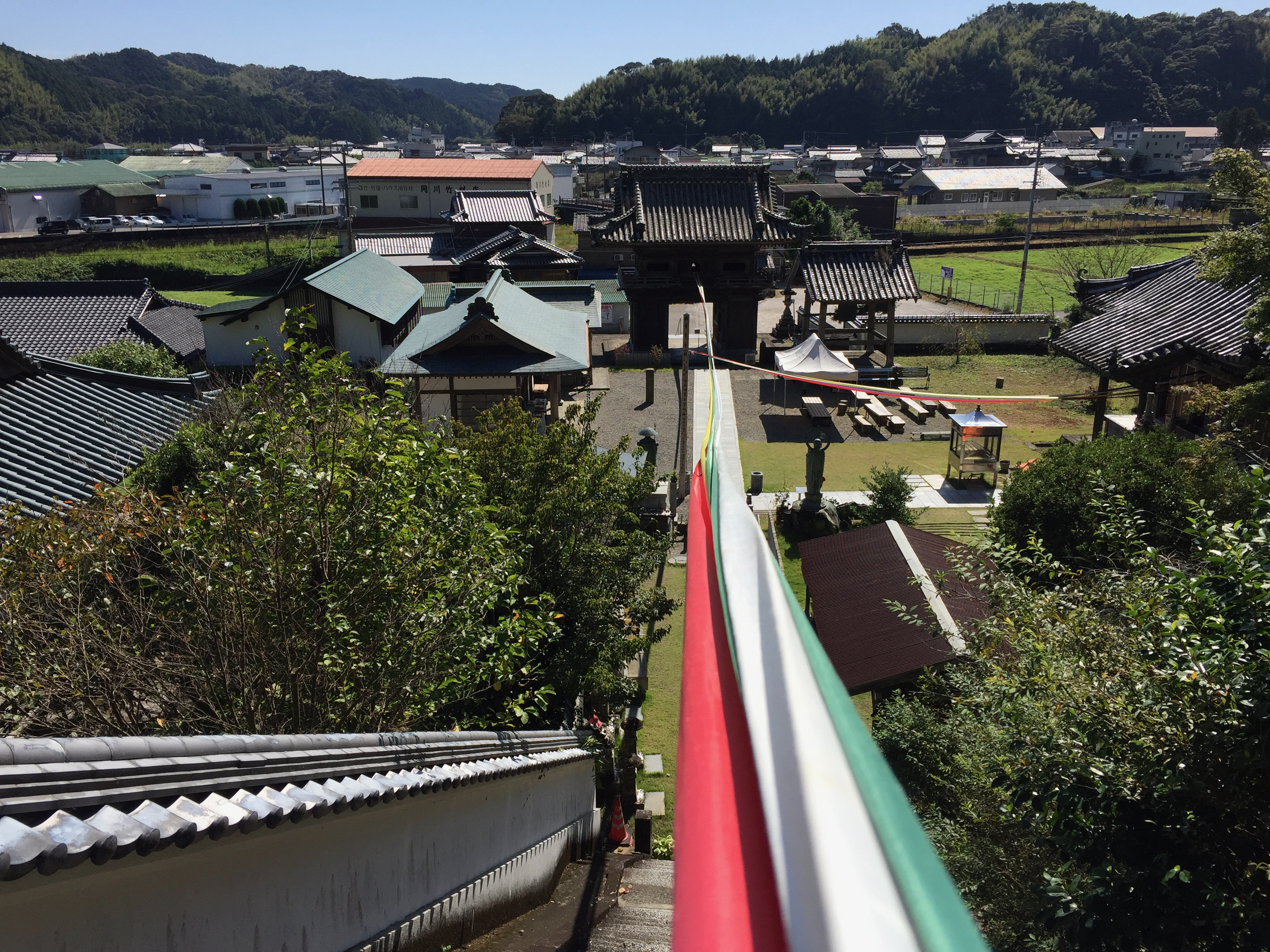
We could pick out where Temple 20 should be on the far ridge. Steep stuff. Photo below.
Temple 21 Tairyū-ji, or Dragon Temple, was pretty much perfect. Kobo Daishi himself wrote about practicing here. Wonderful architecture. Well-maintained, no one around. 1000 year old cedars. Mists were lifting.

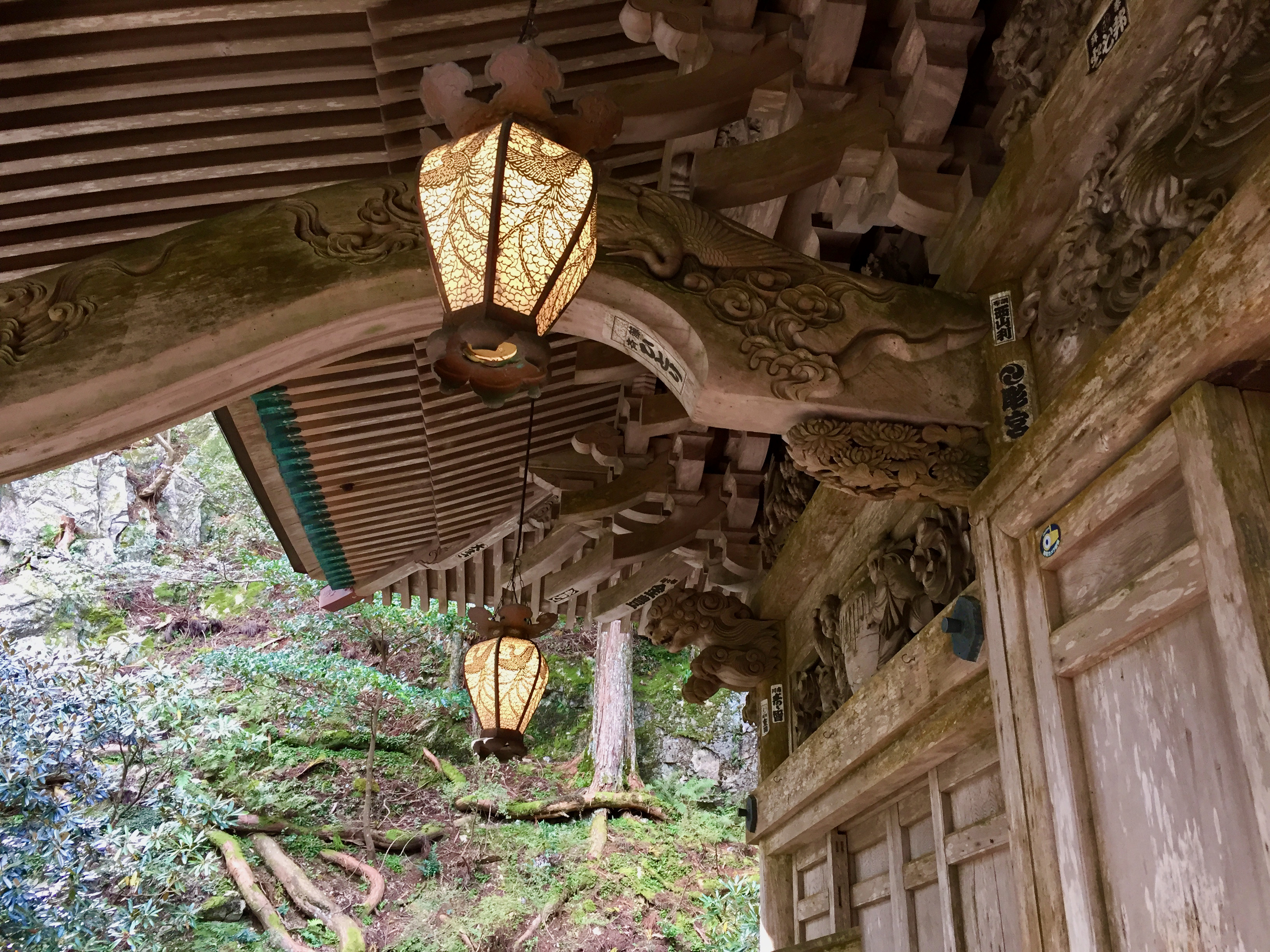

The epitome of Japanese mountain temple. Would have been a wonderful place to linger, but someone was in a rush. We paid our respects at the Main Hall and the Daishi Hall, with incense, candles, deposited name slips and token donations and headed back down.
I kept thinking, if we could only catch the next cablecar, we could save 20 minutes.
We arrived just as a car was about to pull out. We ran for it slipping in before the doors closed. I sat back congratulating myself, as we rode back down the mountain. We passed the super-sized Kobo Daishi and the super-sized wolf pack sculptures – scaled for cablecar views, when it hit me.
We hadn’t visited the Temple Office for our stamps in our pilgrimage books.
We were in agreement. Stamps ruled. So it was back up for book stamps and then back down. Probably lost at least an hour. There is a lesson here somewhere.
On the way out of the station, we stopped to contemplate this most-wanted sign.
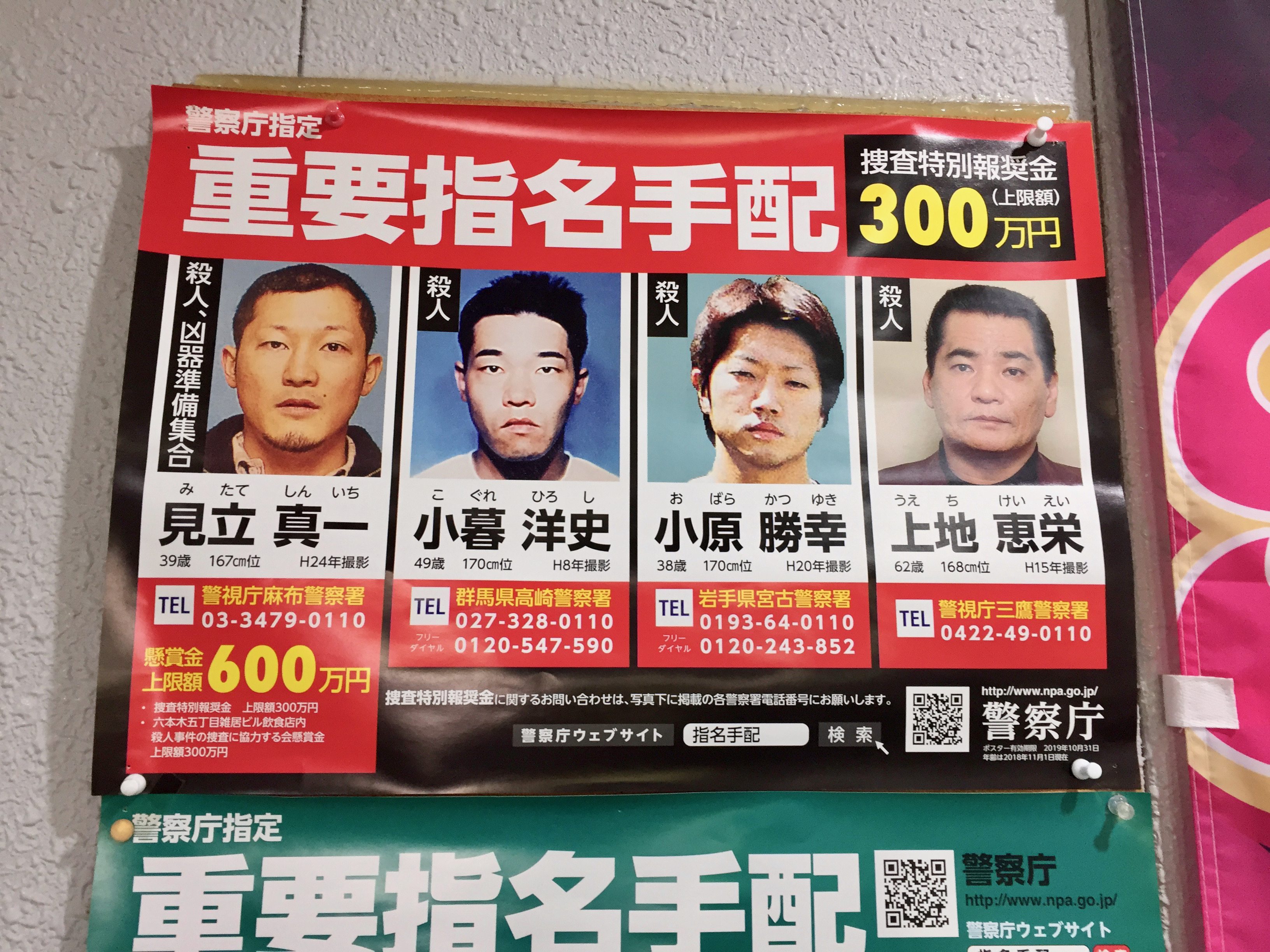
We had read many reports on crime-free Japan. Hmmm. These guys looked pretty much the real deal gangstas. Food for thought.
We retrieved our bike and headed for Temple 22.
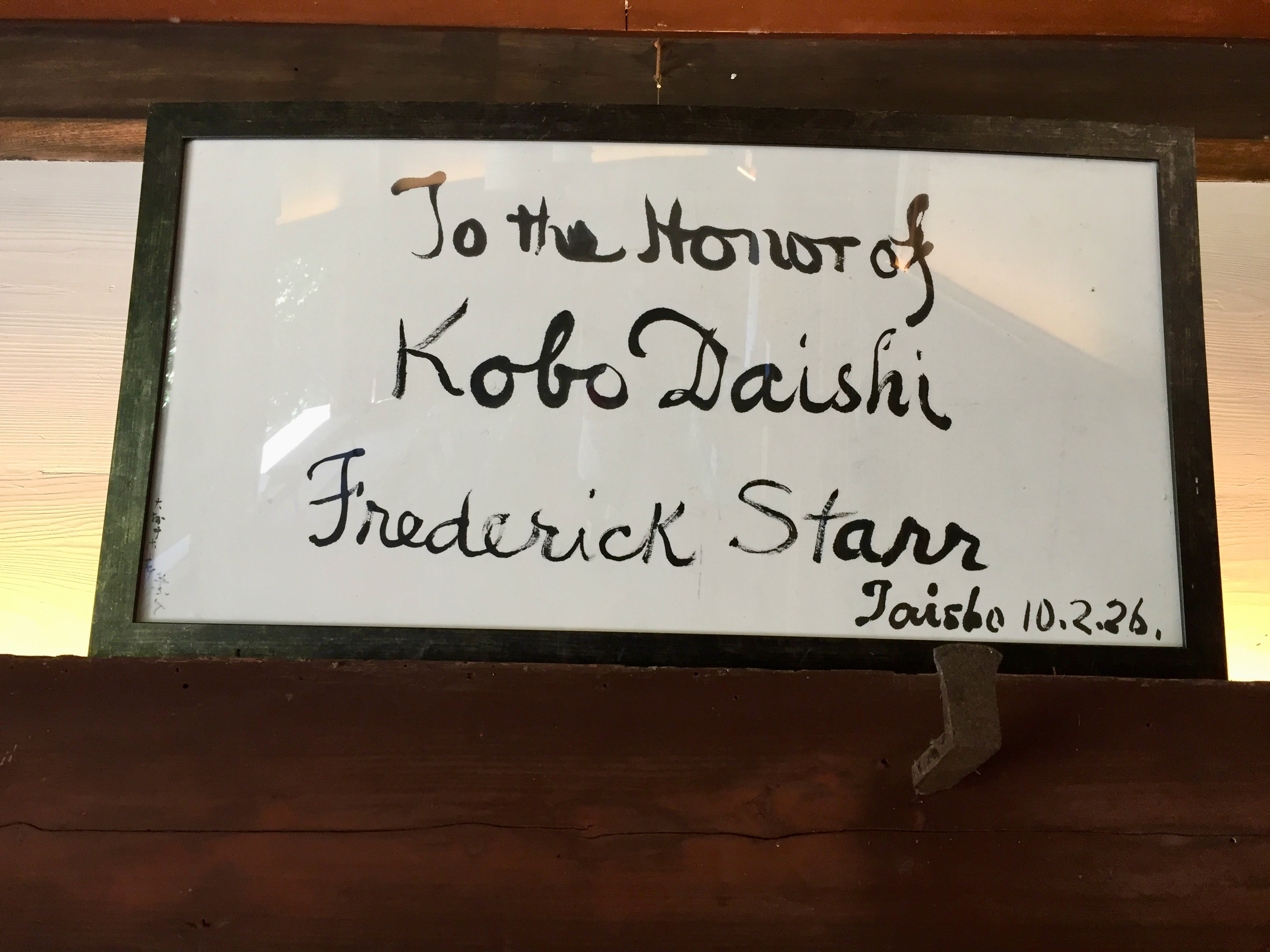
Temple 22, Byodoji, was a charmer. Colorful banners and a bit of western history.

Frederick Starr, an American anthropologist, visited in 1926 and left a calligraphy of sorts. Proudly displayed. Starr is purportedly the first westerner to complete the pilgrimage. Just about a 100 years before us. He walked some. And used rickshaws and trains. In 1926 he would have been 72, Sharon’s age.
And then it was off to Temple 23, Minami Town and the Pacific Ocean.
It wasn’t long, before we passed this cute, somewhat infamous warning sign of Mamushi snakes or Japanese Pit Vipers. Mamushi are the most venomous snakes on Shikoku. Every year ten people or so die from Mamushi bites.

I needed to take a leak. I stood well back on the pavement, shooting for the grass, watching for any sign of movement. All was quiet.
Next up were bamboo forests.

And our first of many, many tunnels. More on those later.

And before we knew it, we were in Minami Town at the base of Temple 23, Yakuoji.

The light had changed in the last stretch to a warm soft impressionistic ocean light.
We hiked up and paid our respects.
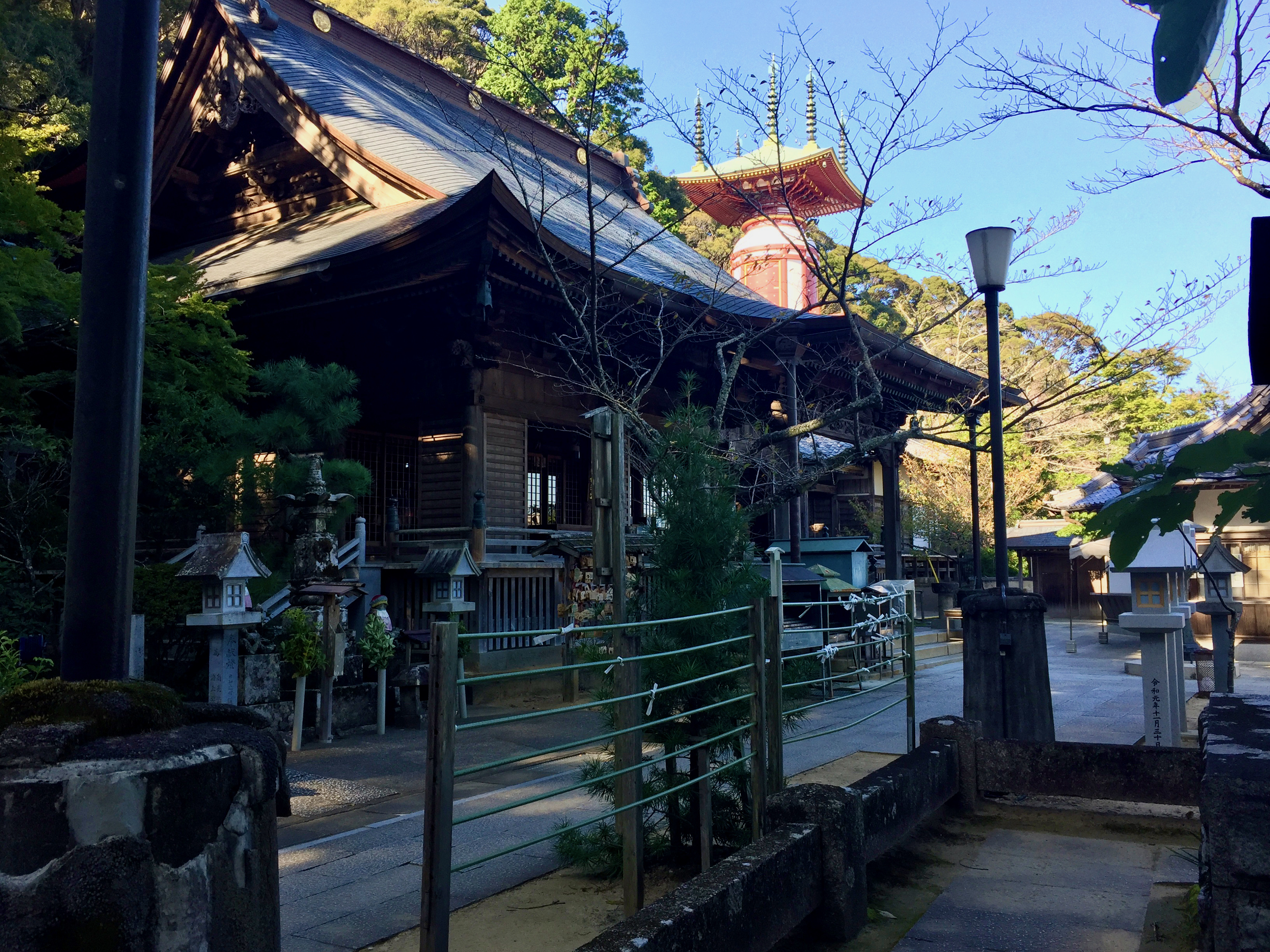
We gazed out over the town to the Pacific.

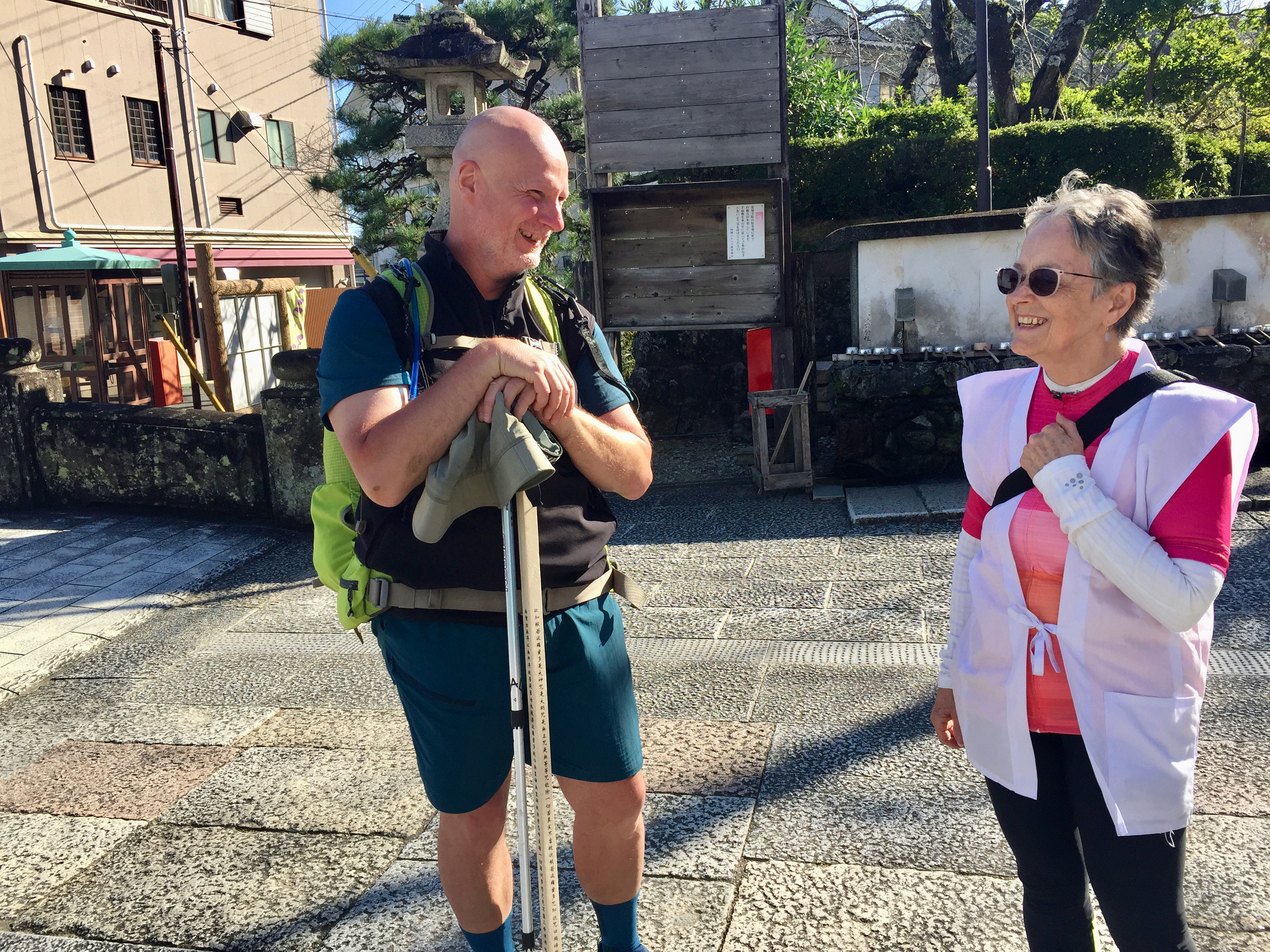
Back at our bike, Sharon struck up a conversation with a French Pilgrim. Conversation in French of course.
He would soon heading home. Limited time, but he said he would be back another year and would pick up his pilgrimage here, where he had left off.
We rode through town towards the ocean looking for our inn, Guest House Oyado Hiwasa. I suspected we were in for a treat. And we were.
We had a nineteenth century traditional Japanese fisherman’s house all to ourselves.
Kind-of too good to be true. Remarkable place.
We were in the heart of the fisherman’s district.
That’s Sharon in the turquoise shirt at our place. That path out front is considered a road. Scaled for carts.

Jean-Phillipe had bicycled over with us to to show us the ropes. Jean-Phillipe owns and runs the Guest House and this house known as the Annex, along with his Japanese wife.
Interesting guy. A French stone sculptor who wandered into Japan decades ago, went native and settled down in Minami Town. Respected by the locals. Shows internationally. Has a couple of cosmopolitan, arty, young-adult kids.
That’s Sharon and Jean-Phillipe in the kitchen

He showed us how to set up the mosquito netting in bedroom.
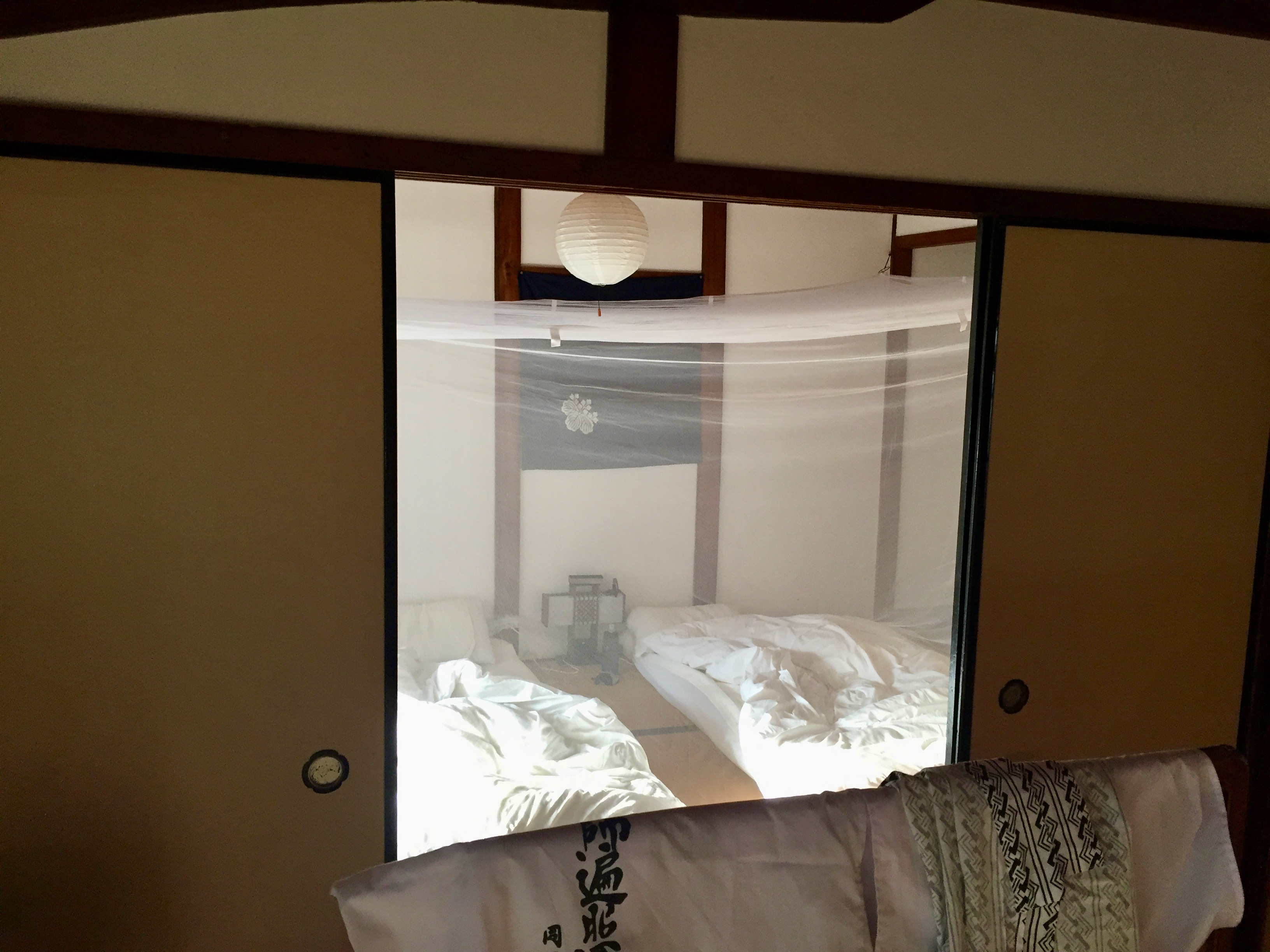
We talked about the ingenious post and beam, house construction. Good for earthquakes, good for heavy tile roofs and good for open plans. Beams with bends are a good thing if the camber is used to advantage.
The carpenters of 100+ years ago were proud of their work. They had carved their sign below a key post and beam joint.
“When selecting the lumber, it is not uniformity but rather individuality of trees that is important.”
Room dividers floated between structural posts.

After Jean Phillipe took off, we took showers, put on our Yukatas, and settled in for the eve.

Day 10. October 17 Thursday; Day off. Minami Town.
I woke up thinking about disc brake pads. I had a bad feeling and went out back to confirm.
Sure enough our pads were evaporating at an alarming rate. Would they last?
Unlikely.
I had brought one set as a back-up, but that only solved half of the problem.
And those were in our emergency box back at our first inn. They could be shipped ahead to meet us. That would be step one. That said, we’d still need another set.
The good news was that our brakes are Shimano, Japanese. The bad news was that we had hundreds of miles to go before we would be in a city likely to have what we needed.
We could order online : Amazon Japan? Or have them shipped from the USA expedited international? But we were a moving target. Logistics were an issue.
Ultimately we decided to simply to forge ahead. We had no problem stopping. For now.
In passing, Jean Phillipe said we shouldn’t try to ride up to Temple 27. Too steep. He tried it in his camper and the front wheels came off the ground. Hardly reassuring.
Next up Kochi and a long ride along the Pacific. I’ll add a link here when that post is done.





 Advencha before Dementia