The plan was to spend 5 days before our trek and one full day after, in Cuzco.
Good plan.
We needed every minute.
Beforehand to acclimatize to the altitude and explore.
Afterwards to regroup.
Altitude
On hearing that Sharon and I were going to spend my 61st birthday trekking over a 15,000 + foot pass in the Andes, a physician friend noted, only half in jest:
“Hypobaropathy (altitude sickness) is not a fun way to go!”
I didn’t ask for details, though I did hear him.
We contacted our health care provider and were scheduled for a group travel session.
A 70 year old retired librarian sat next to us. He was headed to Everest Base Camp at 17,598 ft.
I felt better immediately. Curious how the mind works.

Those of us headed to higher altitudes were told to acclimatize for several days, drink plenty of liquids and take Diamox.
We followed this advice with one refinement.
The liquid we drank by the gallon was coca tea- the Peruvian remedy for altitude sickness- and just about everything else.
Overall we did pretty well with the altitude, especially for 60-somethings.
Not everyone is so lucky.
Hotel Andenes al Cielo
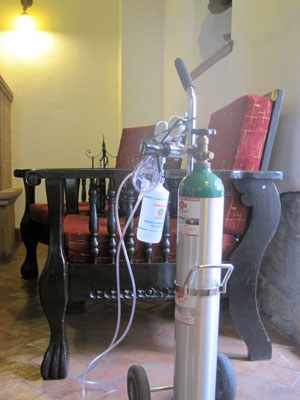
The morning we arrived at Hotel Andenes al Cielo in Cuzco, I spotted an oxygen tank in the lobby.
I made a mental note to ask whether it’s ever used.
The next pass through the lobby provided the answer.
A far younger guy than us was strapped in.
And he didn’t look happy.
We were happy enough, though we did totter and drag a bit the first couple of days.

Hotel Andenes was everything we had hoped: small (15 rooms), friendly, and located in the historic artisan’s district of San Blas. The hotel had been a private residence for the last couple of hundred years.
See Sharon on our balcony?
Five years ago it was rebuilt top to bottom and reborn as a hotel.
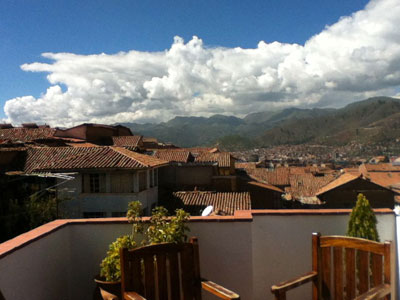
The photo to the right was taken from the rooftop terrace on our first day.
The hotel is organized around a central courtyard. All rooms, but two open only onto the courtyard.
Our room (207) was one of the two that also overlook the street. The good news was that we felt connected to the city. The bad news was that we felt connected to the city.
We also had our own balcony, which we soon discovered was the place to throw flowers onto passing processions.
Our Lady of Sorrows (Virgen de Dolores)
We arrived in Cuzco during Easter Week, or “Semana Santa.”
We had hoped to catch the great procession, featuring Taytacha Temblores, the Black Lord of Earthquakes, but we missed it by 3 days.

We weren’t shortchanged on processions though. We had the front row for the Virgen de Dolores.
We had just returned from dinner, and stepped out onto our balcony, when we noticed the senorita from the front desk, out in the street waving frantically at us- with both arms.
Did we mind some visitors?
Not at all.
Thus we met Emperatriz.
She had grown up in the home where Hotel Andenes now stood, as had her parents.
Her grandparents had purchased the property.
She had given birth to her daughter in our room.
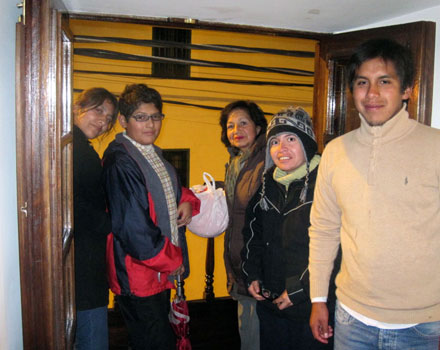
She had come back this night with her family to pay respects to the Virgen de Dolores as she passed by.
Emperatriz is holding the white bag filled with flowers in the photo to the right.
Sharon and Emperatriz hit off right away. Kind of like long lost Spanish family.
In short order the procession was approaching.
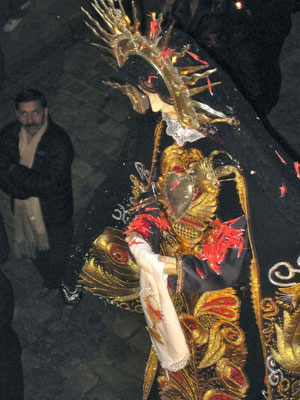
The Virgen stopped right under our balcony. Emperatriz was crying.
The band was playing.
I remember the soft cool feel of the flowers as I reached into the bag and how the red flowers floated down in the evening light towards the Virgen.
Then it was over.
The procession moved along down the street.
We asked Emperatriz about our room. How much was as she knew it?
The rawhide lashed natural treetrunk trusswork? The masonry fireplace? The the wood plank flooring?
She almost rolled her eyes. And then answered simply,
“The walls”
The street wall and wall to the courtyard are probably all that is left of her family home.
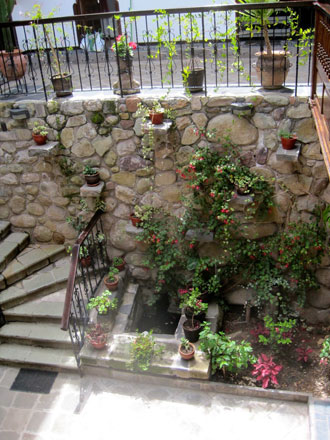
And substantial walls they are. Probably almost two feet thick.
Emperatriz added an interesting story about the little water pool in the courtyard. It’s not a recirculating ornamental feature, as I had thought.
When she lived here, the pool, and the opening into the hill, were bigger. One day her daughter swam back in- and found an original Incan canal.
Cuzco is like that. A 21st century veneer over a Spanish colonial past, which in turn overlays native Incan roots.
Literally and figuratively.
Walking Cuzco
Hotel Andenes al Cielo is only a few blocks from the Plaza de Armas, the center of Cusco today, and in Inca times. The plaza was a favorite destination. Typically our walks passed through the plaza and then off in ever-expanding circles.
We had two favorite routes to the Plaza de Armas.
The most straightforward was down a half block to Hatun Rumiyuc and then over to where this pedestrian way picks up Calle Triunfo into the plaza.
Hatun Rumiyuc is famous for the 12-angled stone in an original Incan wall.
Before our first pass, I wondered whether I’d be able to spot the stone.
Then the thought twinkled. There will probably be a crowd.
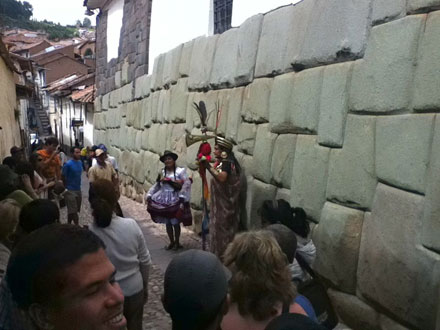
Sure enough, the stone was more than obvious.
It was right next to the guy dressed up like an Incan King, and right where all the cameras were focused, when we pushed our way though the other tourists.
Today these stones are all that remains of the palace of Inca Roca, the sixth ruler of the Incas. The Spanish knocked the rest of his palace down, before building a new palace- Spanish style- on top, for the first bishop of Cuzco.
Today this building, known as the Archbishop’s palace, is a museum of Catholic religious art. The image of the 12-angled stone has been adopted by Cusqueña Beer.
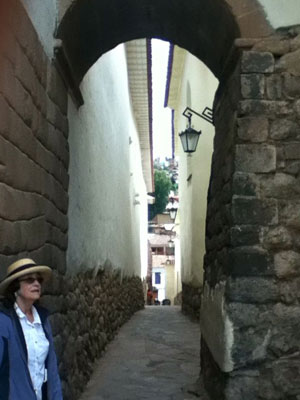
Our other route to Plaza de Armas is a bit less travelled: up a 1/4 block to Siete Culebras, through this narrow alleyway, across the Plaza of the Nazarenas and then down Cuesta del Almirante.
Siete Culebras to the right.
The alley was laid out by the Inca so that on the June Solstice, the sun shines directly through the alley.
“Siete Culebras” translates as “seven serpents.”
We wondered where were the snakes were. Next time through we paid closer attention.
Sure enough carved into the Incan walls were snakes, but there were a lot more than seven.

It turns out that these walls, were originally part of an Incan school, Yachaywasi or house of knowledge.
The Spanish knocked most of the school down and built a palace which in turn was eventually remodeled into a convent.
The convent is gone today. Soon the property will reopen as another very high-end Orient-Express hotel to be known as Palacio Nazarenas.
We’re not sure anyone today knows why the serpents were originally carved into the wall.
Siete Culebras opens onto the small Plaza of the Nazarenas, notable for the Pre-Columbian Museum and Hotel Monasterio.
Hotel Monasterio is Cusco’s finest, a former monastery dating from 1595. When Palacio Nazarenas opens, it will be the sister property to Hotel Monasterio.

The monastery for which the hotel is named, was built on the site of the palace of Inca Amaru Qhala.
Today Hotel Monasterio, is an international five-star hotel, complete with Michelin-starred chef and oxygen-enriched air in the rooms.
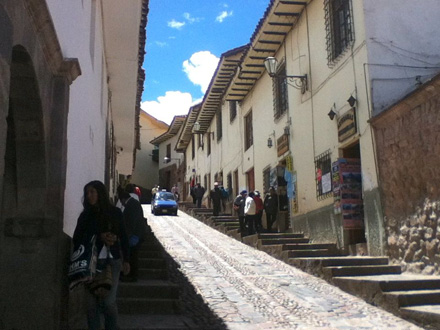
Cuesta del Almirante starts on the other side of the Plaza of the Nazarenas.
In 2 1/2 blocks it’s Plaza de Armas: center of Cuzco today, and in Incan times.
By-the-way, all our postcards came from the first store on the right.
We stumbled in on a quest to find two postcards: The Last Supper (painting in the Cuzco Cathedral) and an image featuring Taytacha Temblores, the Black Lord of Earthquakes (also in the Cuzco Cathedral).
The woman who ran this store had one and eventually tracked down the second.
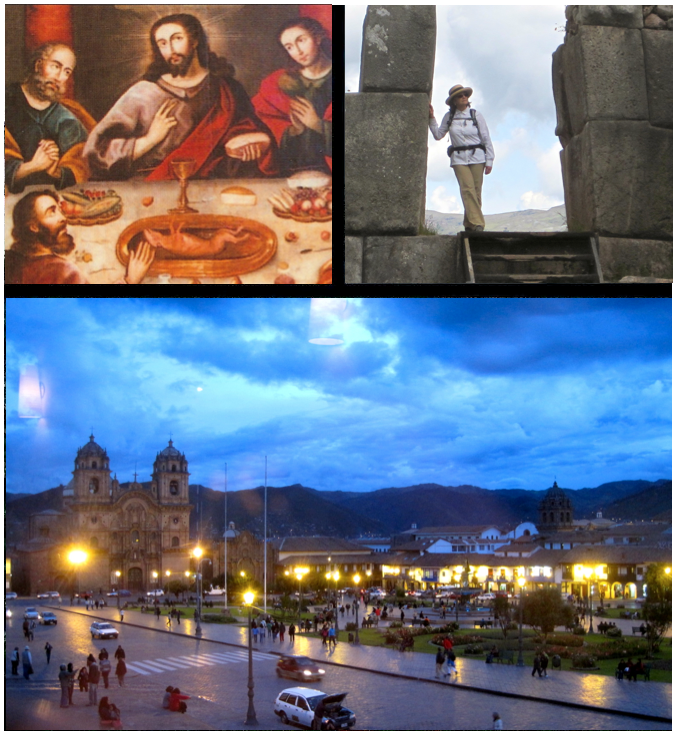
The Last Supper (1753), Ultima Cena, was painted by Marcos Zapata, a Peruvian Quechua painter born in Cuzco, he was taught by the Spanish to paint Catholic works.

Zapata introduced native elements from Peru into his paintings.
Such as Guinea Pig as the main course for the last supper.
Detail to the right from our prize postcard.
The Apostles are also shown drinking chicha.
The Inca used chicha for ritual purposes and consumed it in vast quantities during religious festivals.

Some say Zapata painted Judas (looking back over his shoulder with a money bag under the table) with the face of Francisco Pizarro, the Spanish conquistador who captured and murdered the Inca Emperor, Atahualpa.
I’m inclined to agree.
The portrait to the left of Pizarro, sure looks like Zapata’s Judas.
For Pizarro, it was all about the gold. Pizarro was a Judas-type character, conquering the Incas with a combination of superior weaponry, broken promises and treachery.
Kudos, Senor Zapata. We get it. Even 259 years later.
The Cathedral dominates the Plaza de Armas.
It’s actually so big that it’s hard to photograph.

The borrowed photo to the right does a good job of giving a sense of the place.
Entrance to the Cathedral is 25 soles, or roughly $8.00, unless you arrive before 10:00 AM, in which case it’s free.
We arrived at 8:00 AM along with many of the congregation.
I headed right for the “The Last Supper” in the back. Yep, it looks just like the postcard, and it’s a big painting. No mistaking the guinea pig.
Curiously there is no one big space inside the Cathedral. Instead it is broken up into many worship areas, each focused on particular religious figures. I suspect this is how the locals view the world.
The Cathedral is built on the foundations of the Inca palace of Viracocha. Most of the stones for the building were taken from Saqsaywaman, an Inca structure located in the hills above Cuzco.
Saqsaywaman, or “sexy woman”, itself is famous. Rightly so.
Perdido en Peru (Lost in Peru)
Our guidebook suggested a 5 mile hike that visited 5 Inca sites and culminated in Saqsaywaman, the most glamorous. On our fourth day in Cuzco, we gave it a shot.
The 5 miles is one way. One can choose up or down. We chose down.
We caught a taxi from our hotel to Tambomachay, the furthest site and hiked back.
Our cab driver, was Isaac, the same guy who had picked us up at the airport.
I expected him to take the main road up and out of Cuzco, but he had his own shortcut- back and forth up through local neighborhoods in the hills above Cuzco.
These neighborhoods reminded me of the Berkeley hills, but entirely third world.
We noticed a lot of blue tarps stretched out over the ground in the steep yards. Isaac explained that they are used to try to minimize land slides.

Isaac dropped us off in the parking lot for Tambomachay. We were on our own.
We had our tickets punched at the office and hiked on up.
Tambomachay is all about water. It consists of a spring leading to a series of aqueducts, canals and waterfalls or fountains that run through terraced rocks.
The stonework is high quality with four large outward-facing niches. Clues that this was an important shrine for the Incas.
Nice place with presence.
Sharon decided she wanted to explore a viewpoint. We were feeling the altitude at 12,450 feet as we slowly climbed. Benches for tourists were located every 30 feet or so.
Near the top of the long straight run, a bored young local girl was selling bottled water. We politely passed. No one else was in sight. We must have been between tour buses.
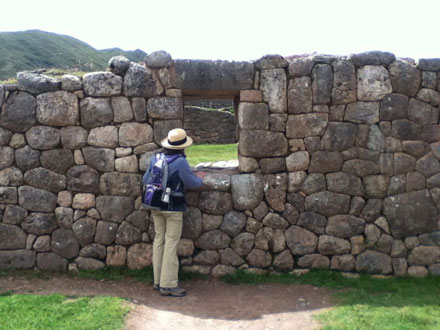
Our next site was Puca Pucara, or “Red Fort” in Quechua.
Puca Pucara wasn’t far from Tambomachay.
Just down and across the main road.
So far so good.
They said the trail signage was good, but signs were few and far between.
Peru is no Switzerland.
We left Puca Pucara walking down the main road per guidebook. After a suitable distance it seemed we should leave the road. No signs.
Some locals told Sharon, in Spanish, that we were more or less on the right track and that we could just follow the dirt road around the back of the village.

And the back of the village it was.
It was Easter Sunday and folks were out and around, working on fences and so forth.
We hit a fork in the trail. I thought we should follow the stream down to the left.
I was wrong. Another local pointed us in the right direction. Straight ahead. Along the beaten path.
In another half hour or so we caught up to a group of Europeans scratching their heads.
Which way to go?
I had learned my lesson. Or so I thought. Take the beaten path.
A local family passed us on the well worn route.
Sharon and I followed them. The Europeans followed us.
It soon became clear everyone was lost.
Sharon called out to the locals, “Perdido en Peru.” They laughed and nodded.
Thus we missed the Temple of the Moon, but did visit some obscure rock outcroppings.
After some rather steep cross country trekking Sharon and I were back on route for Salapunco, the next Inca archeological site. Salapunco is a giant limestone boulder.
From Salapunco we headed down to Quenko, another natural rock formation and one of the largest holy places in the Cusco area. It is believed to be a place where sacrifices and mummification took place.

Although smaller than Salapunco, there is a focus and density to Quenko missing from Salapunco.
“Quenko” translates as “zigzag” or “labyrinth.”
Inside is a tunnel leading through the rock complete with carved altars and seats.
As we approached, who should be there but the Europeans from our lost episode.
A woman looked up and smiled,
“What took you so long?”
I answered,
“We took another shortcut”
Laughs all around.
Next up was Saqsaywaman.
As Sharon and I wandered down the road, I was reminded of Tilden Park atop the Berkeley Hills.
Rolling hills with eucalyptus trees.
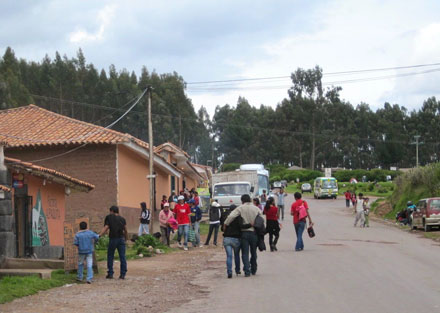
Once again, there were no trail signs, but I figured that given how big Saqsaywaman is, we couldn’t miss it.
I was right- this time.
As we got closer, lots of locals were out and around.
After all it was Easter Sunday.
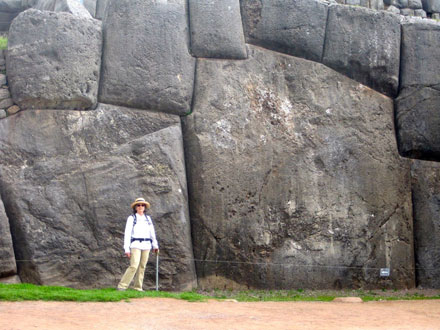
Our guidebook’s description of Saqsaywaman:
“The site itself is one of the most impressive stone monuments left standing in the world, and is awe-inspiring in its stature and form. Enormous stone blocks stand solemnly in three tiers of zigzag walls that stretch 360 metres (1181 feet)..”
Remarkable place. That stone next to Sharon is one of the largest, likely weighing in at upwards of 300 tons.
As much as we might have liked to linger, we didn’t. An afternoon thunderstorm was building. As the first drops started to fall followed by rolling thunder, we hightailed it down to Cuzco.
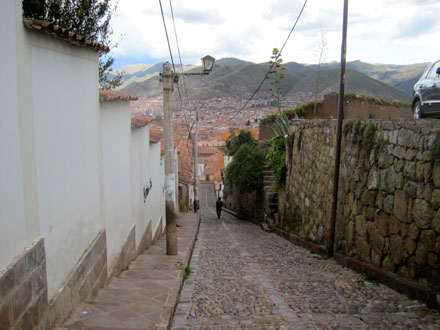
In 15 minutes or so we were back in the city.
Streets were steep as we worked our way down, but soon we were on familiar turf. In less than 30 minutes, we were knocking on the door of our hotel.
A quick wash and brief rest later, it was time for another most-tasty dinner.
Peruvian Food
Peruvian food may not be to everyone’s taste, but we loved it.
Traditional cooking practices and native ingredients are combined with influences from Spain, China, Italy, West Africa and Japan. For native ingredients, Peru pretty much has it all from fresh seafood to jungle fruit, with over 2,000 indigenous potatoes, native chili peppers and local meats such as alpaca and guinea pig.
Recently Peruvian food has become quite fashionable among the gastronomistas. Thanks in no small part to celebrity chefs.
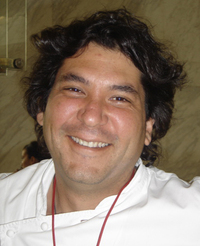
Probably the best known is Gastón Acurio Jaramillo, the only son of a career Peruvian politician. Gastón was expected to succeed his father into politics. Dutifully he headed to Europe to study.
As things turned out, he ended up at the Cordon Bleu instead of finishing law school. The rest is history.
Today he is probably the most famous Peruvian and considered by many to be one of the most visionary chefs in the world.
He and his German wife Astrid run a string of restaurants from Lima to New York City.
His Cuzco venue is known as Chi Cha. This restaurant is dedicated to Acurio’s reinterpretation of traditional Andean dishes.
Before we left we had a chance to look over the menu on the internet, we suspected the food would be fantastic.
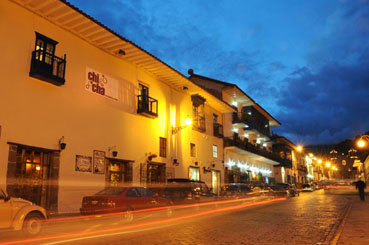
We were right.
“No solo es estupendo, es fantastico.”
“Not only was it stupendous, it was fantastic.”
As suspected, Chi Cha turned out to be our favorite restaurant.
Sharon and I have had a running joke for years about becoming little old people. We live close to Harvard University and as we walk the neighborhood, the kids just seem to get taller and taller. Same proportions, just sized up.
As we walk the river, we’ll see a young woman approaching. She looks normal enough until we pass.
We look up and realize that she seems well over 6 feet.
What’s going on? Could it be that we’re shrinking?
Walking the streets of Cusco, had the opposite effect. We’d look over the heads of many locals. We enjoyed feeling tall.
At our pre-trek meeting, we were struck by a couple things.
We were the oldest- as expected.
Just about everyone else was in their 50s- with the exception of a couple in their 30s.
Also by and large, this group of 10 other Norte Americanos was really tall.
As Sharon (5′-2″) put it:
“I felt like my shoulders only came up to their belts.”
Maybe we’re shrinking after all.
 Advencha before Dementia