
“You’re going to Israel… Now?,” a friend asked.
Tensions in Israel were grabbing headlines with the Intifada and the Israel-Hezbollah War.
From our perspective, it seemed like as good a time as any to make the trip.
Its not like the last 4000 years have been all that calm in the region.
Finances played their part in our decision. Way out on the risk curve, we got lucky with an Israeli company’s stock (calls). Bought into a crisis. Sold into an acquisition. Sometimes things just work out.
We decided to take some of our profits and head off on a semi-indulgent jaunt to visit Jerusalem & the company, meet some Israelis, and soak up some history.
I had wanted to fly El Al, because of their remarkable track record in the face of terrorism.
El Al doesn’t fly Saturdays because of the Jewish Sabbath, which ultimately meant that we booked on American Airlines.
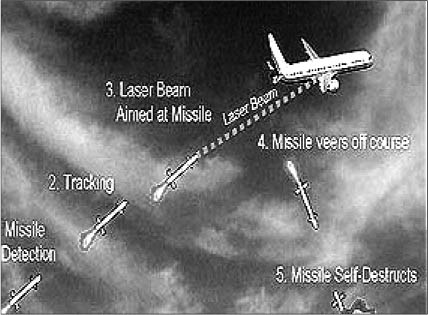 El Al Israel Airlines has installed anti-missile systems on all its planes. Somehow I doubted that American Airlines took those same precautions.
Food for thought at 5,000 feet and descending on the approach to Ben Gurion Airport.
We landed safely, picked up our bags, passed through customs, and walked outside into the bright sunshine.
Hmmm, how do we get from Ben Gurion Airport outside Tel Aviv to Jerusalem, about 30 miles away.
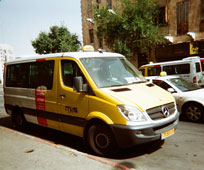 This Arab-looking guy says “Jerusalem” and points to his mini-van, we climb aboard.
Although we didn’t realize it, we were sitting in a sherut or shared taxi, the easiest and most cost effective means getting to Jerusalem.
Entertaining too.
Our fellow passengers were an interesting mix. About a third were Scandinavian.
One young Swede was a travel agent. His business partner, a Palestinian. Our clothes passed muster.
 “Patagonia! Good company. Not the usual USA Bull Shit.”
Patagonia prides itself on excellent products that are made in an environmentally and morally sound way. No sweat shop labor and very, very Green.
Not cheap either.
Our son rolls his eyes on seeing Patagonia tags. The Patagonia thing can be a bit over the top. Nice clothes though.
A woman a bit younger than us struck up a conversation. We told her we were going to be staying at the American Colony Hotel. She said that she had eaten lunch in the courtyard, and added, with what I detected as a very light touch of envy,
“You’re going to like it.”
Yep.
The American Colony Hotel
The American Colony Hotel has had a long, curious, and colorful past- from Pasha’s palace to Christian utopian commune- to 5-star, Swiss-managed, boutique hotel.
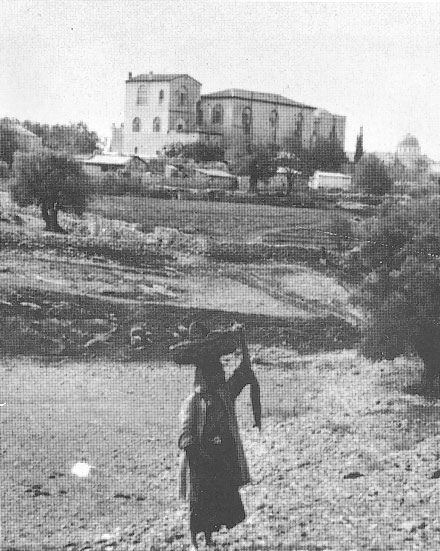 The story begins in the mid 19th century, when the area was still part of the Ottoman Empire.
The original building was built by the patriarch of one of Jerusalem’s most prominent and formidable families.
Rabbah Effendi al-Husaini was a pioneer in building his new luxurious home outside the walls of Jerusalem.
Rabbah Effendi al-Husaini was rich and powerful. He had good taste in architecture. His four wives had many daughters- but no sons.
And hence his mansion went up for sale in 1890s.
It was purchased in 1895, by the “American Colony”, a non-denominational utopian Christian community. A curious mix of Americans and Swedes who had moved to Jerusalem to await the Messiah’s imminent arrival.
 Part commune, part Christian cult, the American Colony was a resilient and enterprising lot.
Renting out rooms as a tourist hostel, brought in welcome cash.
Those at the American Colony were on friendly terms with the Ottoman-Turkish governors of Jerusalem, the British Consul, and curiously, the rich and famous. The first of the famous guests arrived in 1902, the grandfather of the British actor Peter Ustinov.
 Seasonal tourist hostel gradually morphed into today’s 5 star hotel.
Other famous guests along the way have included Lawrence of Arabia, Ingrid Bergman, Philip Roth, John le Carré, Mikhail Gorbachev, Tony Blair, Bob Dylan, Robert De Niro and Uma Thurman.
The photo to the right is of Winston Churchill’s visit to the American Colony in March 1921.
The American Colony, in one form or another, has remained a Jerusalem fixture under four regimes: Turkish, British, Jordanian, and Israeli. And through the heat of numerous wars and other conflicts, they always refused to take part in or facilitate any hostile acts, nor were they ever interned, evacuated or forced to close.
When the retreating Turkish governor snatched a bedsheet to use as a white flag, signalling to British troops that the four centuries of Ottoman control of Jerusalem was over, he was standing in the American Colony.
Today the American Colony Hotel calls itself an oasis of neutrality in the Palestinian-Israeli conflict. It is said to be located on the “seamline” between east and west Jerusalem, and as such is the preferred hotel of many diplomats, politicians and foreign correspondents.
Truth be told, it’s very much in East Jerusalem.
We didn’t really know what that meant.
We do now.
The sherut dropped us off at the American Colony in the late afternoon.
 We checked in and were shown to our room.
We were on the second floor of the old building in one of Rabbah’s wives’ winter rooms with an entrance off the gallery.
First door on the left in the photo to the left.
The decorated blue-wooden gallery ceiling is original.
Quite exotic. We had come a long way.
We threw our bags in a corner and settled down for a well deserved nap.
I awoke with a start.
It was night. A man had just entered our room.
On seeing us, he was gone in a blink.
A bit unnerving. Maybe the front desk should know.
First I had to find it.
I wandered out into the darkened hotel.
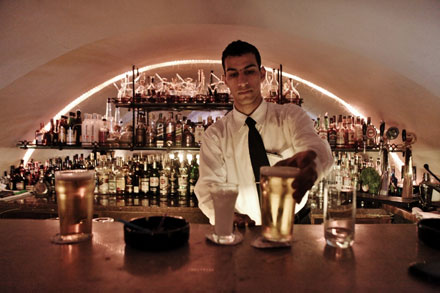 Several wrong turns later, I found myself in the middle of a most-lively Saturday-night bar scene.
Even in my bleary state, I could recognize that this was an event with players.
I had stumbled into the Cellar Bar, a favored smokey waterhole for foreign correspondents, Palestinians and left wing Israelis. Jerusalem’s version of Casablanca’s mythical Rick’s Café, complete with a 130-year-old pink stone floor.
I looked up. A middle-eastern-looking-guy in an expensive suit with drink in hand, nodded towards me. Maybe I was somebody. I nodded back. Maybe I was.
But where was the front desk?
One storey up and a few twists and turns later, I arrived.
The guy in our room was the turn-down service.
Welcome to Jerusalem and the American Colony.
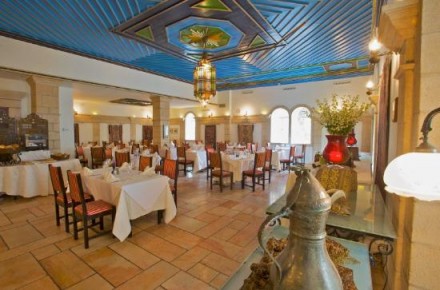 The next morning we awoke famished. Breakfast was a revelation and a metaphor of sorts.
The buffet had two areas: British and Middle Eastern.
Eggs or Baba Ganoush? Or both together with Turkish coffee to die for?
Lowell Thomas, the famous 20th century American writer, broadcaster, and traveller, once noted that Bertha Vester, daughter of the founders of the American Colony, was one of the few people in the world that he envied.
Not only did Bertha live in, “the most dramatic of the cities,” as he put it, but at the American Colony, she had a front row seat “both as an observer and a participant in events, under the Turkish sultans, through World War I, the period of the Mandate, a second world war, and finally the period of the return of the Children of Israel.”
 It’s not Bertha that I envy, but her far more modest daughter-in-law, Valentine Vester.
2005 Photo to right- @ 93 in the American Colony.
Valentine married into the Vester family. Her husband, Horatio, was Bertha’s only child.
In 1963, Horatio and Valentine were living in England.
Horatio was a lawyer, and Valentine- a 51-year-old Yorkshire Homemaker- when the fates intervened.
Bertha’s American Colony had collapsed. Horatio and Valentine moved to Jerusalem, took over the failing enterprise and turned it into a commercial success.
Horatio was the CEO and Valentine the chief executive of the kitchen.
Horatio retired in 1980, and died shortly thereafter.
Gauer Hotels of Switzerland stepped in.
Valentine’s part of the deal was a private apartment and privileges- for life- in this 5 star hotel.
One night at dinner, I noticed a table being specially set-up. A reading light was brought in, special condiments appeared.
A most-elderly woman walked in, sat down, and pulled out a book- like she owned the place. Dinner appeared. Staff hovered.
Valentine.
I love this Valentine quote from the New York Times in 2005:
“I’m quite well in myself,” she says. “Nothing wrong with me. I can’t see very well, I can’t hear very well, and I can’t walk very well, but I’m perfectly well.”
The best of perspectives.
I choose to think that with such an attitude, we can all have our own American Colony.
The Old City of Jerusalem
So that first morning, Sharon and I took off on foot down Salah ed-Din Street. Jet-lagged and disoriented, I had decided we should wander about. Probably not the best of ideas.
 In less than 15 minutes I had wandered us through Herod’s Gate into the heart of the Muslim residential quarter of the Old City of Jerusalem.
After about 300 feet, a few not so friendly whistles, and a short conversation with an alcoholic local offering to be our guide, I decided it prudent to retreat. Sharon was rolling her eyes.
So after we’re out. Sharon turns to me and says,
“Nice job! Did you see that Arab guy in pajamas?”
Next stop was the armed checkpoint for the Rockefeller Museum. I picked the side entrance off Sultan Suleiman St, complete with barricades, Uzis, metal detectors, passport check and a brief interview.
I might have found the least tourist-friendly experience in all Jerusalem.
All in a days work.
The museum was great. A taste of things to come. It was all downhill- in a good way- from here.
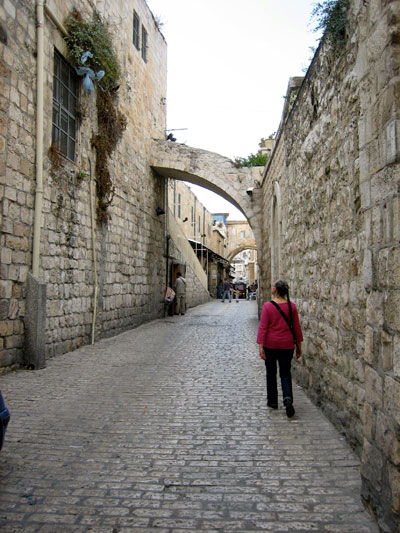 We spent the rest of the day, and most of the trip for that matter, wandering the narrow streets of the Old City, gradually relaxing.
After a few days, the street vendors started ignoring us.
A most positive sign.
The Old City is the oldest part of the Jerusalem, enclosed by stone walls built in the 16th century and accessed through seven gates.
Eight if you include the Golden Gate, but that one was sealed up centuries ago by Muslims hoping to keep the Jewish Messiah from entering the city.
East Jerusalem is Arab/Palestinian Jerusalem. It was part of Jordan as recently as 1967. A bit third world. When the dumpsters in the street fill up, they light them on fire.
We had no problems even though we walked everywhere. I didn’t wear my American flag t-shirt though. (joke)
Curiously, until I opened my mouth, most folks thought we were French. Sharon says it’s because of my nose.
I prefer to think it was our snappy style.
Figure we walked 10+ miles every day and thus earned that afternoon beer or two.
 The courtyard of the American Colony was just about the perfect spot to contemplate the question of Israeli vs Palestinian – beers.
The courtyard was 70 degrees F, with flowers, birds, a gurgling fountain, and fruit on the trees- in early November.
Israeli Maccabee beer vs Palestinian Taybeh beer.
A tie to my palate.
Our favorite waiter was Jihad, a soft spoken Arab. He explained that “Jihad” was a nickname bestowed on him by other staff. So “Jihad” he was. Name tag and all.
Jihad and Sharon talked Middle Eastern music and the conclusion was we should get some George Wassouf- one early, one current.
For the earlier recording- Live Recording vol. 2 (Oum Kolthoum). For the current recording- Hoewa el ajam.
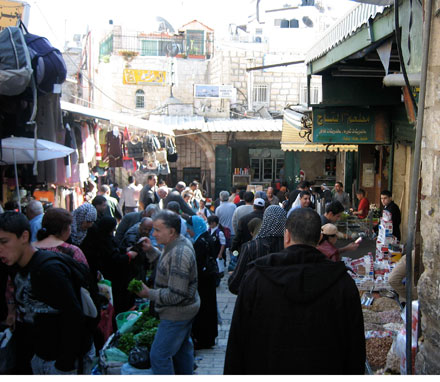 “Right inside the Damascus Gate, there’s a store.”
Since by then we knew our way around the neighborhood, this was not a problem.
Jihad asked how we did and what we paid.
“Got them both and 10 Shekels.”
He nodded approvingly.
“You did OK.”
And yes, both without a doubt, are black market, not that they were labeled as such.
One of the highlights of our trip promised to be our visit to M-Systems, an Israeli high tech company. I had neglected to bring a back-up camera battery.
So I ask the concierge at the American Colony, where I could buy one.
“About a block down Salah ed-Din Street, on the left, there’s a travel agent. Nassar can get whatever you need.”
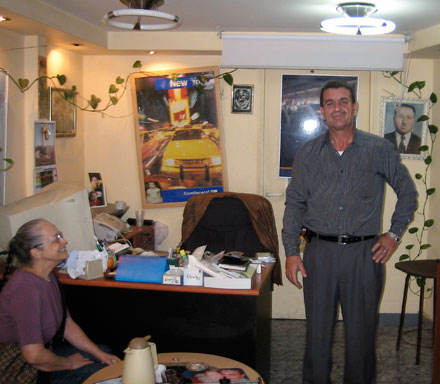 So we saunter over.
Nassar was glad to see us.
He would have been glad to see just about anyone.
An Intifada is bad for the tourist business.
Yes Nassar could get us the battery.
Off went the runner. We settled back.
Nassar poured the coffee, showed us pictures of his family, and held forth.
Did we want to visit Bethlehem?
“I’d be happy to show you around. I have a white Mercedes. I’ll drive. Less than $200 for the day.”
I was tempted. For a millisecond.
Bethlehem is only 5 miles south of Jerusalem, but it is in the Palestinian-controlled West Bank.
Before this trip we had put our wills in order.
As Americans, it seemed pushing it to go on a jaunt to West Bank, during an Intifada, with Nassar- in his white Mercedes.
As far as I knew no hostages were currently being held. No need to cut to the front of the line.
M-Systems
Back in 1997, I had discovered an Israeli company by the name of M-Systems. We bought stock on the premise that solid state memory technology was poised to break through into mainstream consumer electronics.
A good decision.
In 2006, M-Systems was acquired by SanDisk. Our winnings bankrolled this trip.
I wanted to visit the company, before the signs were changed. I especially wanted to meet the CEO, Dov Moran, in person. It looked like he would be leaving before the year was out.
An Israeli journalist friend, Shlomi Cohen, was able to arrange a meeting and was kind enough to drive to Kfar Saba where msystems is located.
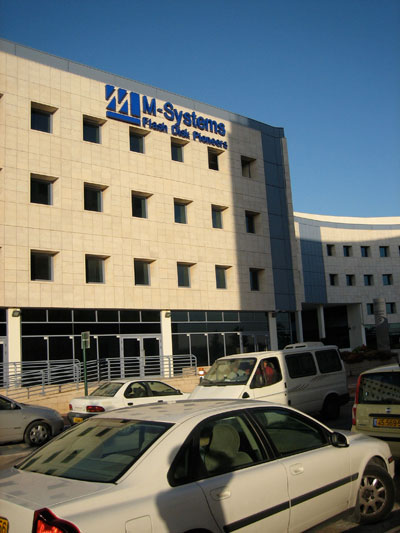 Over the years I’d posted quite a bit on stock message boards about M-Systems, under the name Savolainen, my Finnish middle name.
So Dov walks in and Shlomi introduces me, “Mr. Smith”. Dov looks blankly at me.
Then Shlomi says “Solovian,” and Dov says “Solovian!”
Apparently “Savolainen” translates as “Solovian” through an Israeli filter.
My guess is Finns are far scarcer than Eastern Europeans in Israel and hence Savolainen, which is a bit of a linguistic mindful, comes out Solovian.
In any case, Dov was enthusiastic, once he knew I was Solovian,
“I’ve wanted to meet you. How do you know so much about our company?”
Apparently M-Systems had been following my rather obsessively-detailed postings.
Dov explained that given the info I appeared to have access to, they figured I had to be an insider or a relative of an employee. He said they had tried to figure out the connections, but hadn’t had any luck.
Given that Dov had a background in military intelligence, I took his curiosity as a high compliment.
While Shlomi and I were chatting with Dov and trying piece together company secrets, Sharon and Shlomi’s wife Dvorah were combing through the archaeological exhibits of the Israel Museum.
Dvorah was in Jerusalem that day doing consulting work with the Israeli government. Earlier while we were waiting for her meeting to finish, Shlomi drove me around West Jerusalem.
When we were driving by the new Supreme Court building, Shlomi says, “You want to go in?” So I say “Sure.” And he says, “I think I can talk my way by these guys.” As we pull up to the armed checkpoint, he pulls out his wounded veteran sign and puts it on the dash board.
The guy with the Uzi slung over his shoulder, walks over, and lots of Hebrew and laughing later, waves us to turn around.
Shlomi says, “It didn’t work. This is the same car that all the important government people drive, so I figured he might just wave us through, but he wanted to know who we were. So I told him and he said,
“Come back when you’re a judge!”
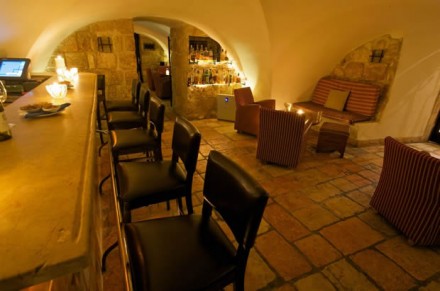 We picked up Dvorah and headed back to the American Colony for dinner.
We were sitting in the Cellar Bar in that corner with the arm chairs, when Dvorah looked around knowingly.
“You know we had this place bugged”
Dvorah had worked with Israeli intelligence. The American Colony was Arafat’s favorite hotel. Palestinian and Israeli officials met “covertly” in Room 16 to draft the 1993 Oslo Accords.
Of course everyone would be listening.
14 Stations of the Cross and the Church of the Holy Sepulchre
The next day Sharon and I walked the 14 stations of the Cross in the Old City, the fabled path Jesus is said to have taken to his fate on the cross, starting at the Lion’s Gate and ending in the Church of the Holy Sepulchre.
The Church of the Holy Sepulchre, also called the Church of the Resurrection by Eastern Christians, is a church within the walled Old City of Jerusalem. The site is venerated as the Hill of Calvary, where Jesus was crucified, and is said also to contain the place where Jesus was buried (the sepulchre).
The church has been an important Christian pilgrimage destination since at least the 4th century, as the purported site of the resurrection of Jesus.
My favorite part 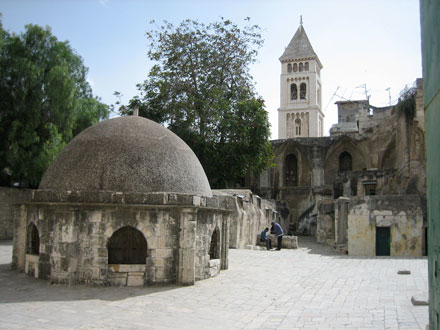 was the Ethiopian Monastery on the roof of the Church.
There was no indication we were on a roof at all. The climb up the hill, on the backside, delivered us to this courtyard. It seemed like just another courtyard. An African village courtyard, but a courtyard nonetheless.
Off to one side, one African guy was shaving another guy’s head. In another corner a tour guide was holding forth. Typical Jerusalem moment.
We weren’t sure where to go next, but the the guy with the razor pointed to a low dark unmarked door. It led through a series of small, dark, candle-lit, Santeria-like spaces.
 At the end, we emerged out of a corner of the large stone courtyard in front of the Church of the Holy Sepulchre. Nice sequence.
Bizarre too.
Once inside, we sat listening, just inside the door of the Church. We heard 10 languages in 10 minutes.
Back at the hotel they asked,
“You didn’t have a guide?”
 The next day, we were sitting above a security checkpoint overlooking the Western Wall when I hear something like, “No, moniko sinun sedistäsi on tehnyt itsemurhan tänä vuonna?”
Helsinki deja vu.
So the Finns wander on down to to the Western Wall check point and this young Jewish woman walks up, “My husband and I live on the street, could you help us out, … ?”
Deja Vu of a sort.
Sharon and I have heard the same equivalent pitch, same rhythms, same inflections, many, many times, nearly every day in Harvard Square for the last 26 years. Curiously the moment made me feel right at home.
The Western Wall has Cecil B. DeMille dimensions, rising 65’ above grade and descending another 40’ below to bedrock. It is one section of one of the retaining walls creating the Temple Mount.
The Temple Mount itself is a 35 acre raised plaza with the Dome of the Rock as it’s focal point. The Rock inside, is the peak of Mount Moriah of the scriptures. Although it’s no longer visible, Mount Moriah is still there, just embedded in the box created by the enormous retaining walls.
The mountain’s peak had been so important for so long, that to accommodate the crowds, the raised plaza was created around the peak, which in turn buried the mountain.
Intriguing conceptually.
And this was done over two thousand years ago.
On our last day, I walk out of the hotel and Sharon is standing there with the taxi drivers, hotel security and a couple of guys from the gift shop. All are Arabs except Sharon.
Everyone, including Sharon, is laughing and smiling.
There is a wooden bird cage, with bird, hanging off a tree limb, swaying back and forth. Sharon tells me that one of the local cats had been watching the bird ever so closely.
Surprising everyone, it made it’s move, jumping vertically the 4 to 5 feet up up to the cage.
In an instant the cat pulled the cage open, freeing the bird, which then flew 10 to 15 feet straight by one of the cab drivers who nonchalantly reached out and caught it bare-handed.
The bird was returned to its cage. It was fine, the cat was fine, the taxi driver was fine.
Everyone resumed their roles and on it goes.
 Advencha before Dementia