The Everglades 2010
Everglades City is a bit off the beaten track.
Naples it’s not. No glorious beaches. No high end restaurants. No valet parking.
With a population of 500±, “City” is a misnomer. Some have described the town as nothing more than a few marinas and boat ramps- and these were the good reviews.
Everglades City has been a commercial fishing village since the 1930s and bills itself as the “Stone Crab Capital of the World.”
When Meredith told one of her colleagues at NYU that she was going to Everglades City over the holidays for a vacation, the woman did a double take.
Her comment:
“My car broke down there once.”
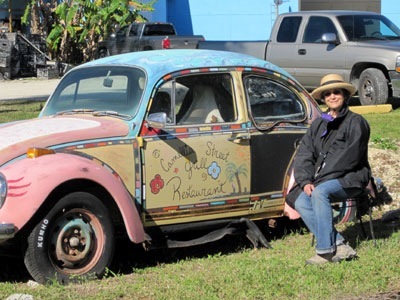 I took the photo to the left outside our favorite restaurant.
This is the Camellia Street Grill’s only sign.
On our last day, Taavo took another photo from a slightly different perspective- including the VW, but also 40+ Vultures picking over a dumpster- just out of frame here.
A charming hand painted VW bug sign with vultures snacking in a dumpster. Business as usual in Everglade’s City.
Check it out in the slideshow.
And just for the record, stone crabs are most tasty- a delicacy best eaten fresh and cold with mustard sauce.
Stone crabs in a restaurant means claws.
Stone crabs are not killed after being trapped. Fishermen clip the claws, and then throw the stone crabs back. The claws grow back in 6 months or so.
A curious cycle and a metaphor of sorts for Everglades City.
As our guide put it, “Every 10 years, the Feds swing through and haul off every male in Everglades City over 18.”
Drug smuggling.
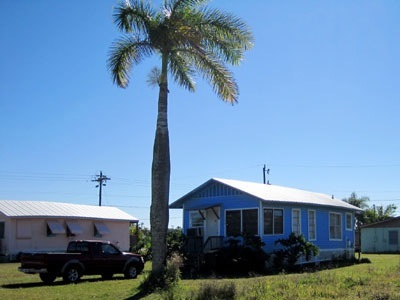 Sharon figures these guys do 5 years ± in prison. After another 5 years back home, they’re prime to be clipped again.
The running joke is- you know something’s up when you see a $10,000 house with a $50,000 pick-up truck parked out front.
On a recent overnight kayak outing from our Ivey House, the group was sitting silently in the dark, soaking up the mystery of the 10,000 islands, when right in front of them, out of the night, a water plane drops down, a boat slips up- and in a blink of an eye both are gone.
While Everglades City may be off the beaten track from a USA perspective, in a curious 21st century twist, its a destination for Europeans. Half the folks on our kayak trips were European, as were half the folks at breakfast at the Ivey House.
So what’s the draw for all these foreigners?
Everglades National Park and ecotourism. From one perspective Everglades City is the end of the road. From another its the northern, much less developed, gateway to Everglades National Park.
Everglades National Park at 1.5 million acres is the third largest national park in the lower 48 states, after Death Valley and Yellowstone. Its been designated a World Heritage Site, and an International Biosphere Reserve. Its the only subtropical preserve in North America, and the only ecosystem of its kind in the world.
In essence, the Everglades is a very wide, very shallow, very slow moving river. Its a sheet of water sliding slowly towards the Gulf of Mexico where it mixes with the salt water.
This mix, called brackish water, is where the magic takes place.
 Most all of the fish and a big portion of the wildlife, especially the saltwater birds, do most of their breeding and feeding in this brackish water.
Although I had read all about the Everglades, I really didn’t get it until we got there, and even then it took a couple of days.
I was pleasantly surprised to find the water in Everglades to be crystal clear. I could look down out of the kayak and see the bottom.
Also for the most part, the Everglades are open and flat, flat flat. The Everglades is not a jungle. Its more like the Great Plains, but with mangroves, exotic birds and alligators.
And there’s water everywhere. Really.
On our third day we had a bit of time on our hands. I thought it would be a good time for short hike. Our local map showed trails taking off from the Visitor Center at Big Cypress National Reserve, just down the road.
So I stroll up to the counter and ask the ranger which trail would be nice and dry for a short hike.
She gives me this look and starts telling me about the boardwalks. I say we’ve done those, we just want a dry trail.
She shakes her head slowly- “This is the Everglades. There are no dry trails.” Trails in the Everglades are wet- by definition- at least at this time of year.
And this is not a bad thing.
Back to the beginning of this story.
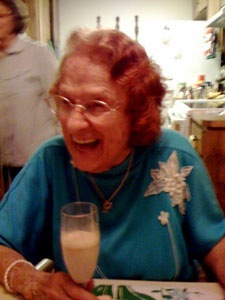 We celebrated New Year’s Eve with Sharon’s Mom, Rosita, in Tampa.
As it turned out, we all had a great time.
See photo to the left.
We started with Belgian beer, transitioned to champagne and capped the night off with eggnog. I probably should have called it a night at Belgian beer.
On New Year’s Day we rolled out of bed, a bit worse for wear- speaking for myself.
Fortified with grits and eggs courtesy of Taavo and Sharon, we hit the road.
Three hours later we were checking in at the Ivey House in Everglades City. It was unseasonably cold (40s°F) and rainy. Some Swede’s were splashing around in the outdoor pool.
 We ended up at the Ivey House, because it was the top rated Inn in Everglades City. It also didn’t hurt that they’ve been running their own eco-kayak tours for 30 years.
Given the weather, we decided to schedule our first kayak trip in the middle of the following day. Good decision. The rain cleared off.
The next day at 1:00 in the afternoon we were off for the Turner River. Our van held two Australians, three Germans, a couple from Fort Meyers, our guide and us.
We paddled for 3 hours or so, covering roughly 3 miles. First we headed up the gently winding river across some largish ponds through some sawgrass and into the edge of a bald cypress forest.
Gators were scarce, because of the cold temps, though we did pass one big guy up on the bank 40 feet ± away, mostly hidden.
Lots of birds though: anhingas, kingfishers, ospreys, moorhens and coots.
Woodstorks, Cigüeña Americanas, too. These birds are big. Rare, too.
We were all starting to get the hang of our tandem kayaks through trial and error.
 I aspire to kayak lessons someday, so I’ll be better prepared. There were times when paddling in tandem felt almost effortless.
Such synchronicity pays big dividends. A lesson there.
Then there were times when Sharon and I seemed to be working at cross purposes.
Another lesson.
After the cypress forest, it was back and under Hwy 41- Photo to right – and on to the red mangrove tunnels.
Our water route gradually began closing in as we approached. At about 8 feet wide our guide pulled up and showed us how to pull our kayak paddles apart.
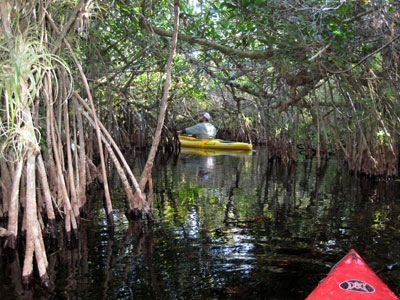 We stowed one half in our kayaks and used the other half to paddle canoe-style.
When things got really tight, we’d reach out and pull ourselves along using the mangrove branches.
Orchids and bromeliads were growing on the mangroves.
It would have been nice to see the orchids in bloom.
On the other hand, as our guide explained, if we wanted to come back in the right season for orchid flowers- summer- we’d have to wear a full body-bug suit with foam spacers.
No thanks.
Its pretty hard to tip a kayak over- especially the extra-wide models we were paddling. Hard, but not impossible.
On exiting the mangrove tunnels on the return leg, word filtered up that one of the Germans had taken the plunge. She was last in the single file. Nature was calling. She dropped back and apparently, all did not go according to plan.
To her credit, when she emerged from the tunnel- in boat- she was wet, but unbowed.
Our guide just shrugged, and muttered underneath his breath, “First of the year.”
There was something odd about the other American couple on our first day’s kayak trip.
They were nice enough. He was a classic Florida good old white boy around 50 – in good trim & over 6 feet, a hunter and fisherman; Owned his own air-boat; Drove a late model big American pickup truck. Am guessing though, not the sort typically found on an eco-kayaking trip.
She would be lucky to hit 5’- 4” in heels. 30s-ish; Darkish complexion; Short braided pigtails.
Privately Sharon and I referred to her as eco-girl.
The two were always holding hands. Even at trip orientation. Even in the shuttle van. That said, their banter could be peppery.
On the water they’d paddle like crazy in one direction and then another. Often disappearing for 5-10 minutes at a time.
The next morning on my second coffee, it hit me.
They were having an affair.
This was their private weekend. No one would know them in Everglades City.
I asked Sharon what she thought. Yep. I asked Taavo and Meredith. Yep & yep.
Taavo clinched it. He remembered the initial group orientation/ introductions where Doug was introduced as “William.”
“No. I’m Doug. William is only the name on the credit card.”
Moving on to alligators.
Taavo, Sharon and I had made our peace with Florida gators on the Hillsborough River, outside of Tampa.
The folks running our canoe trips said they have had no alligator problems- since they’ve been in business- decades.
Lots of gators on the Hillsborough too.
 To me the gators felt like big, uninterested lizards. As we paddled by- nary a response.
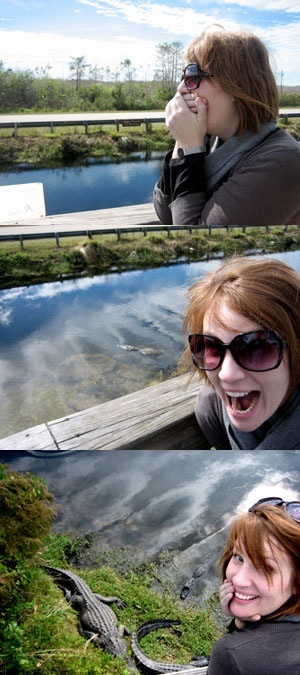
Meredith had her real introduction outside the Visitor Center at Big Cypress National Reserve.
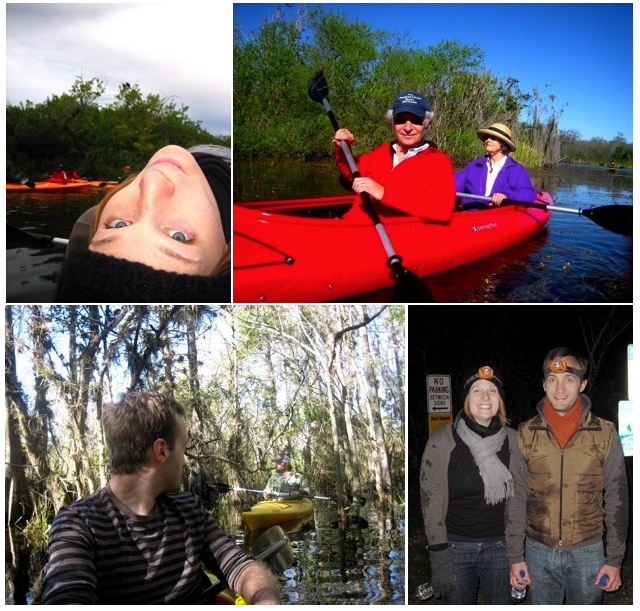
The three photos to the left tell the story.
As our guide book put it though, it’s still smart to play it safe:
“Do not, under any circumstances, feed the alligators, even if it is entertaining. It teaches them bad habits. You don’t want to see an alligator get up and beg.”
Our second kayak trip- down Halfway Creek- was our most ambitious. Paddling-wise it was about the same as Turner River- a shade over 3 hours. The twist was that half would be in the dark.
And dark it was. No moon and overcast. Cold, too- 40s°F. We were all comfortable-ish.
Paddling kept us warm.
 Meredith said she had on 6 shirts and two pairs of pants. She also borrowed a knit cap and gloves from Taavo.
The Photo to the right was just before dusk.
Dusk was the best. Birds were getting ready to settle down for the night.
First they had to have a wild rumpus. And a wild rumpus it was. Huge birds swarming like bats. Squawking up a storm.
In the fading light our guide passed out headlamps at the turn-around point. “Just don’t look anyone in the face. You’ll blind them.”
Five minutes later I looked around for our guide. I found- and blinded him. He just groaned a most-expressive groan. The trick for looking for someone is to look above them. I caught on eventually.
We had already tied glow-sticks to the front of our kayaks. And off we went back into the black.
For the first stretch, Sharon and I were right behind our guide who was setting a healthy pace.
This was a workout.
 Waterways broke off right and left. And it was pitch black.
Hard to stay oriented, apparently even for guides.
After a bit, our guide told us to hold up while he reconnoitered.
He never admitted it, but Sharon and I could tell that he was lost, albeit briefly.
As we paddled on furiously through the night, our guide would point out alligators. All we could see were their luminescent eyes- which seemed to glow as if lit up inside. Sharon says it was reflections off their retinas. In any case, a rather remarkable effect.
As we were checking out from the Ivey House the next morning. I asked about a fitting encore for the next trip, should there be a next time.
“An overnight kayak trip to the 10,000 islands.”
The Everglades proper is on the mainland. The 10,000 islands are uninhabited mangrove islands extending northward from the northwest corner of the Everglades. Close by to Everglades City and home to lots of birds, beautiful beaches, black starry nights, gorgeous sunsets and drug drops.
We can handle it.
I think.
 Advencha before Dementia
Pingback: Small Town Spotlight: Everglades City, Florida - Hopper Blog