We stumbled onto the Shikoku pilgrimage late 2018, researching a bicycle ride south from Kyoto.
It was love at first sight. That said, in hindsight, it had been waiting for us for a long time.
The first thing to know about the Shikoku Pilgrimage is that it is Buddhist. And not just any garden-variety Buddhist, but esoteric Shingon Buddhist.
The second thing to know is that the pilgrimage revolves around Kukai or Kobo Daishi, the father of Shingon. (774 – 835)
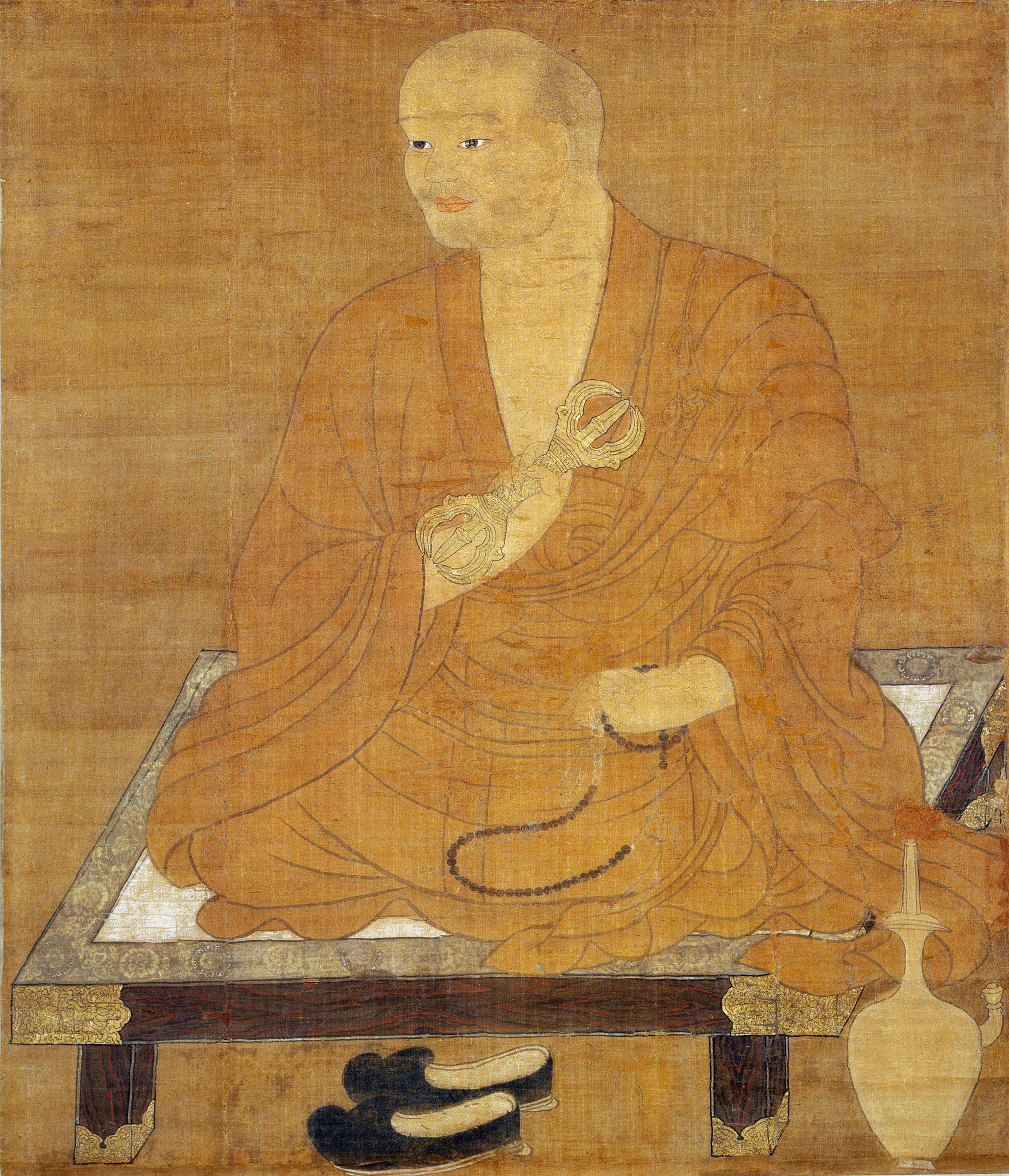
Kobo Daishi was born on the island of Shikoku. He practiced on this island – in these temple locations. It was here, he made his ultimate psychological breakthroughs.
The pilgrimage is an homage to the man.
There isn’t really a Western equivalent to Kobo Daishi. If you combined Leonardo da Vinci, Thomas Jefferson, and Moses into one man you might be getting close.
Kobo Daishi was a brilliant artist, linguist, diplomat, and engineer who brought sacred teachings and texts back to Japan from China. A champion of regular folk.
We already knew all about Kobo Daishi from our Buddhist journey. We had been married in a Buddhist Ceremony some 40 years ago, up to our eyeballs in Tibetan Vajrayana Buddhism, a close relative to Shingon.

At the time we were running a solitary retreat center just north of the New Mexican Border. Peyote Road Men, Vision Quests, Drop City Communes, Alan Ginsberg. That sort of place. That sort of time.
FWIW, Alan Ginsburg came down for an extended solitary retreat. After just a couple of days he drove off in cloud of dust in the early morning. Not a word to us.
Not the first time someone ran away, but a bit surprising given his Buddhist street cred.
This pilgrimage seemed to offer the opportunity pay our respects, see Japan, and contemplate the next chapter in our lives, whatever that may be. Which is kind of how it all worked out.
Not in the way we expected, but that’s kind of the point – in the world of Kobo Daishi.
Planning
The pilgrimage is a loop of about 750 miles clockwise around the island of Shikoku. With 88 temples, the route is pretty much defined – just connect the dots.
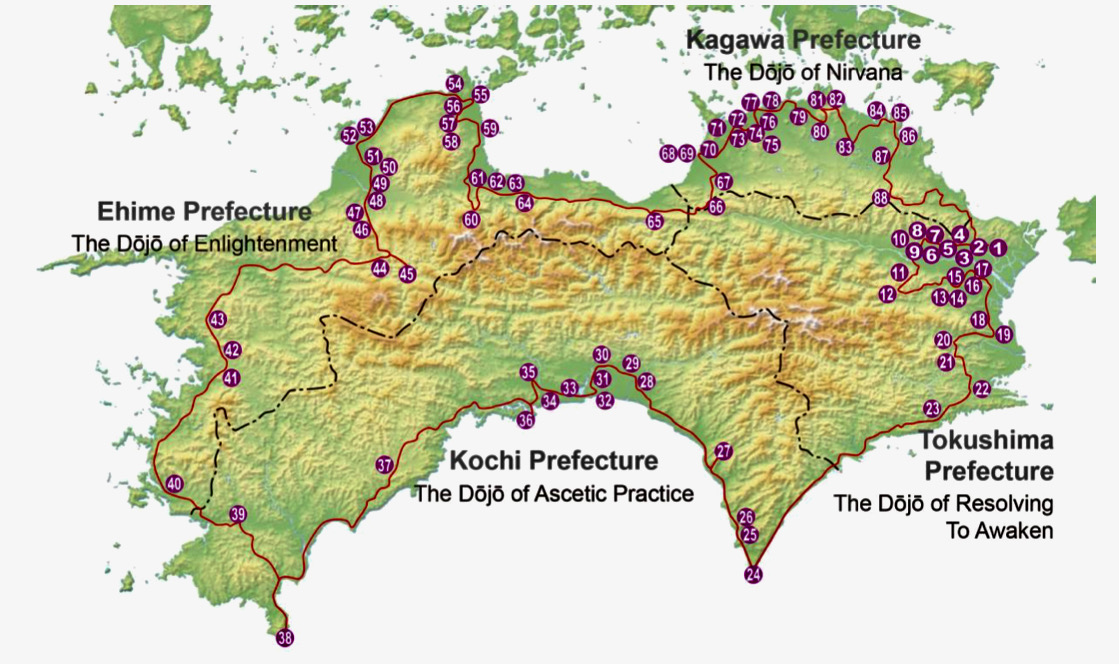
From other trips, we knew 30 to 50 miles a day would be about right, which would work out to roughly three weeks of riding – all things being equal – which of course they never are.
We needed to factor in climbing, accommodations, and temple specifics.
As our first step we ordered the “Shikoku Japan Route Guide” from Japan.
A most excellent decision. We now had our overview, complete with detailed maps, elevation profiles, inn locations and temple protocols – all in one tiny book.
Elevation profiles looked extreme. Long flat stretches and then incredibly steep climbs. We double and triple checked our route with Ride with GPS software. Add three days.
Inns not exactly where we needed them. Add a day.
Temple protocols. Only so many temples can be visited in a day if you are going to pay respects properly. Add a day.
We had a plan: 26 days of bicycling and another 9 for air travel, prep, rest and recuperation, packing and buffer. 35 days total.
We had a month window. 35 days seemed close enough. We bought our plane tickets. Arrive October 9 and depart November 12.
Now all we had to do was learn Japanese and get in shape.
Japanese
Sharon is one of those crazy gifted types. If you’ve seen the movie, “My Brilliant Friend” you kind of get the idea. She grew up dirt poor on wrong side of the tracks in a Spanish-speaking neighborhood in Florida. Went to college at 15. The truest of intellectuals, but on her own terms. An incorrigible iconoclast.
In the past 5 years or so, she has learned German, Italian, French, and Swedish. All I had to do was ask, buy the books, and sign her up for the language courses. 6 to 9 months later folks would be laughing at her jokes.
It’s oh so nice to have a travel companion who can speak the language.
When Japan started getting real, she told me point blank, “Don’t even think of asking me!” Fair enough. I’d do the studying.
I bought the books, found an app and started in. A few days later I had company. Someone couldn’t resist. I was shortly thereafter lapped several times over.
Was I surprised when folks laughed at Sharon’s jokes in Tokushima? Yes, and no. Yes, because there’s always a new twist, and no, because that’s just how she is.
When we were lost in the middle of nowhere, was I happy that Sharon repeatedly saved the day? You betcha.
After one memorable GPS hiccup, we pulled up having lost our signal and our way, when seemingly out of nowhere, this magical little old lady appeared, as though she had been waiting for us.
Sharon did her Japanese language thing.
The woman started nodding, laughing, and patting Sharon like a long lost best friend.
A somewhat regular occurrence, FWIW.
Training
We started bicycling three years ago in 2017. Sharon had a hip replaced the year before. Her rehab included a stationary bike. Bingo, inspiration.
That winter we ordered a tandem that could be broken down for travel. The following Spring we started riding. That summer we took it to Italy for a group tour. Last year we took it to Finland and rode across the Finnish Archipelago – on our own.
Each of the last two years, we logged about 1000 miles. This year we were just nudging another 1000 miles when we left for Japan. So I figure we’re no longer beginners –
More like advanced beginners.
Rationally this ride was way over the top, but realistically when you’re over 140, in tandem years, it’s best to get on with things while you’ve still got a shot.
This story will be told in 5 parts: This introduction and then 4 posts on the the 4 prefectures we circled through: Tokushima, Kochi, Ehime and Kagawa.
Day 1 , October 8 Tuesday; Fly to Tokushima City Japan (TKS)
We left our house in MA at 9 AM on October 8 arriving at Morimoto-ya Inn in Tokushima City at 9 PM the next day. We flew Boston to Toronto to Tokyo to Tokushima.
Day 2, October 9. Wednesday [Itano Town Japan] Arrival in Tokushima
Toshimitsu Mima, or Mima-san, from Morimoto-ya Inn picked us up at the airport and served us a much appreciated late dinner when we reached the inn. We had been on the road 23 hours or so.
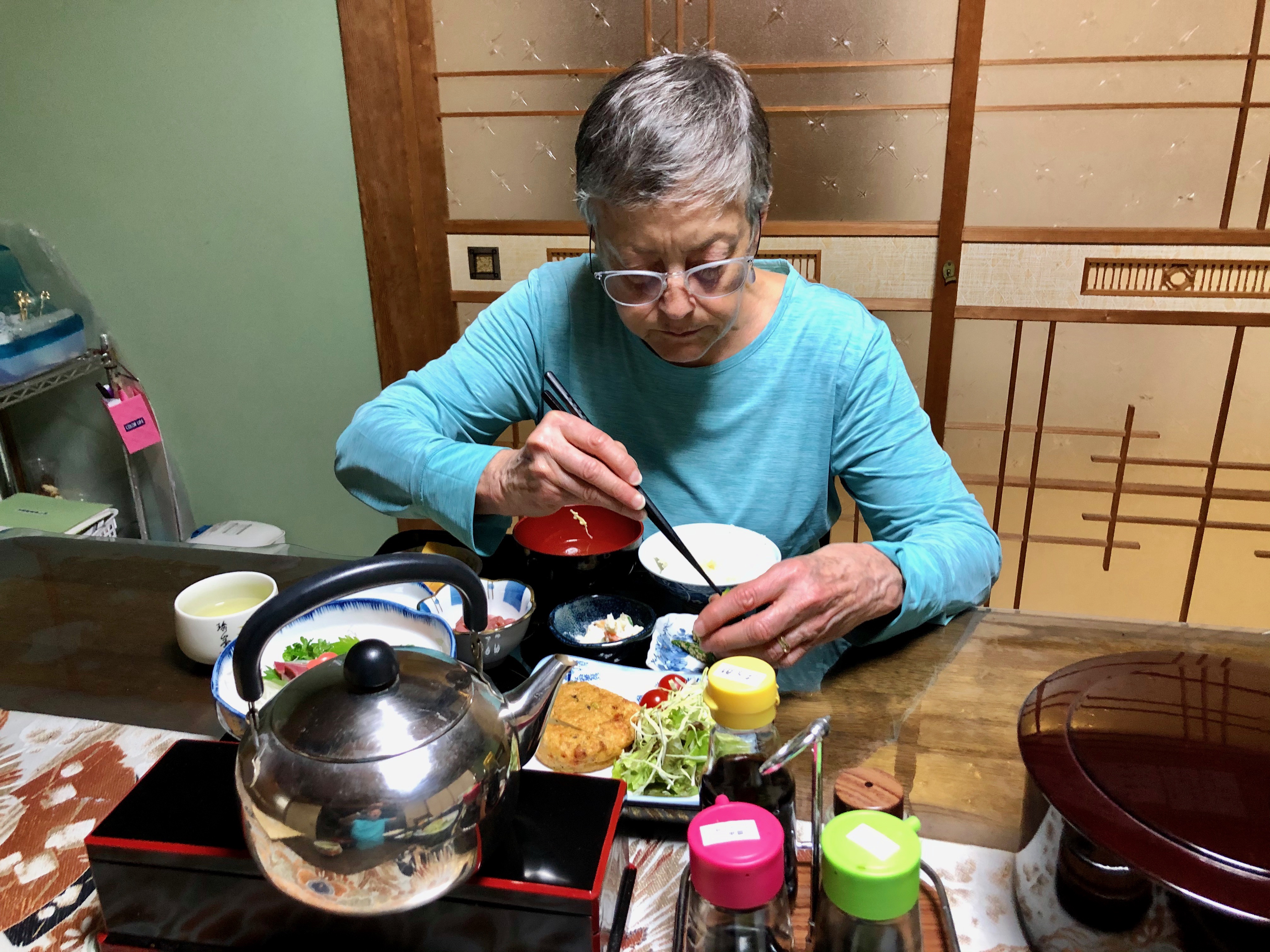
We slept Japanese style on futons on tatami mats on the floor.
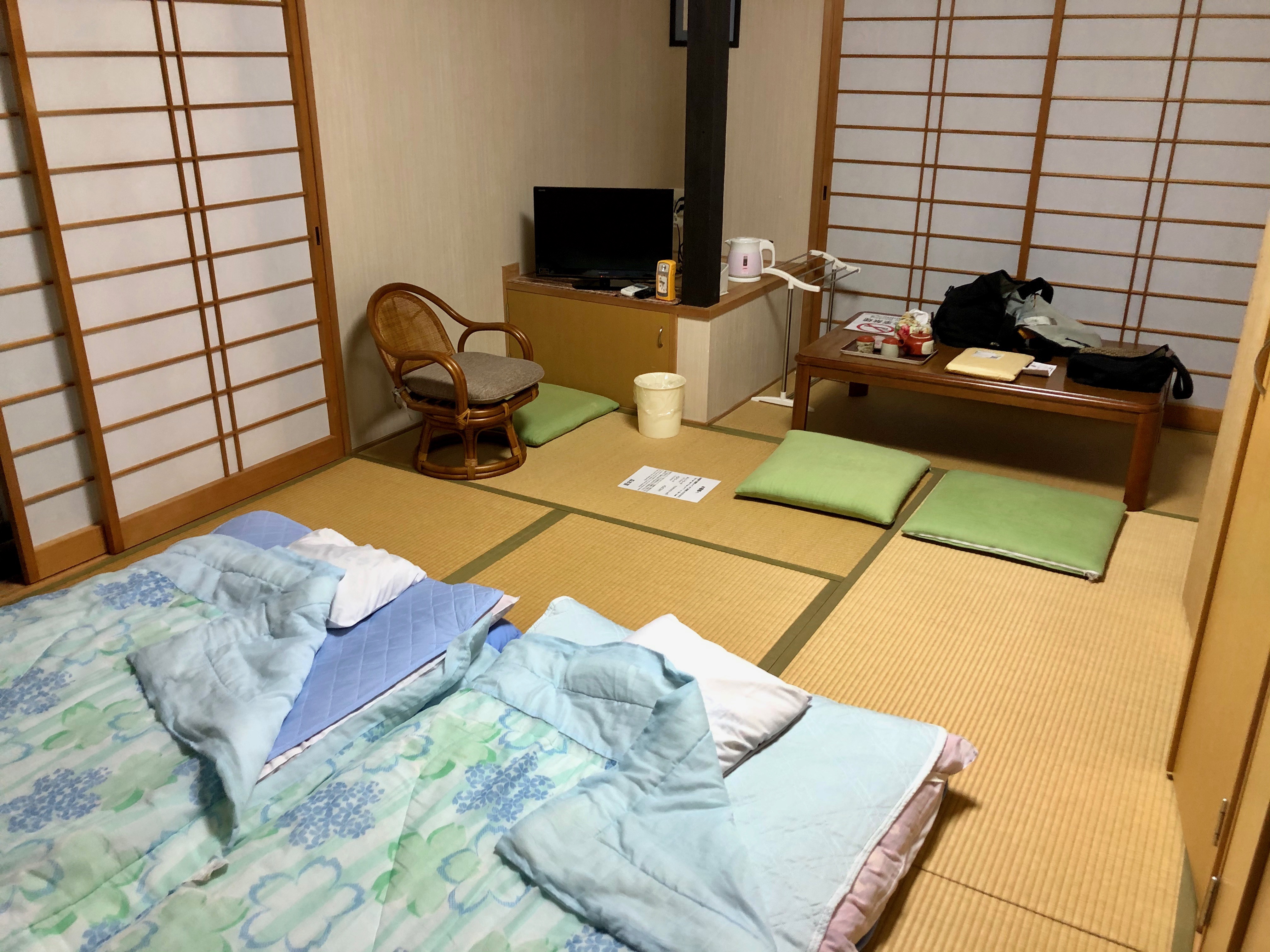
And were introduced to the world of Japanese Toilets.

Day 3 October 10 Thursday; Test Run & Temple #1, Ryozen-ji
Temple 1 Ryōzen-ji 霊山寺 Naruto, Tokushima
The next morning I put our bike together out front of the inn.
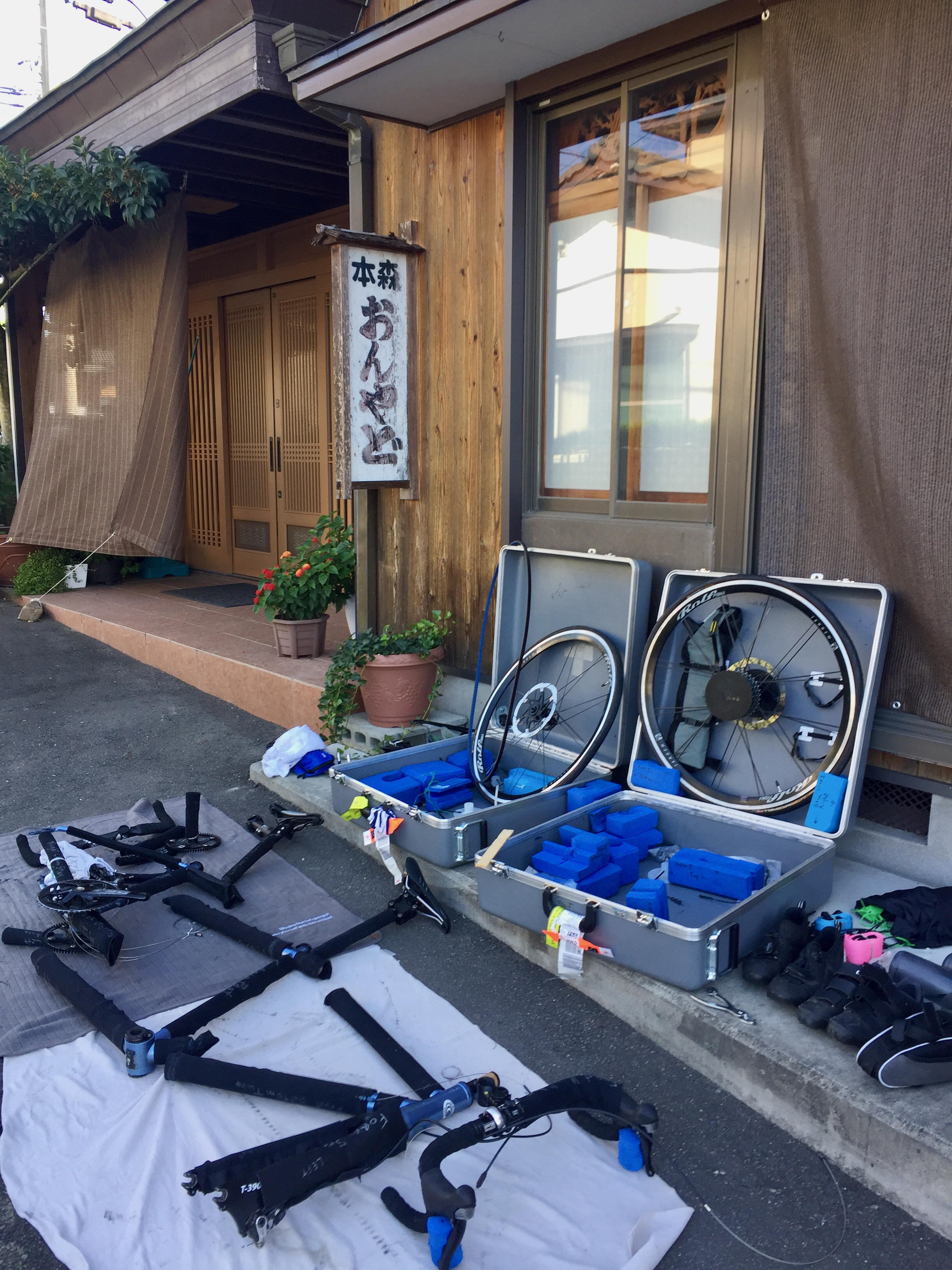
And we rode it on backstreets to Temple #1, Ryozen-ji. Both shifting and braking seemed fine. A good thing. And reassuring. It hasn’t always been so, after baggage handling did their thing on other trips.
We pulled up to the temple gate. Our first of 88.
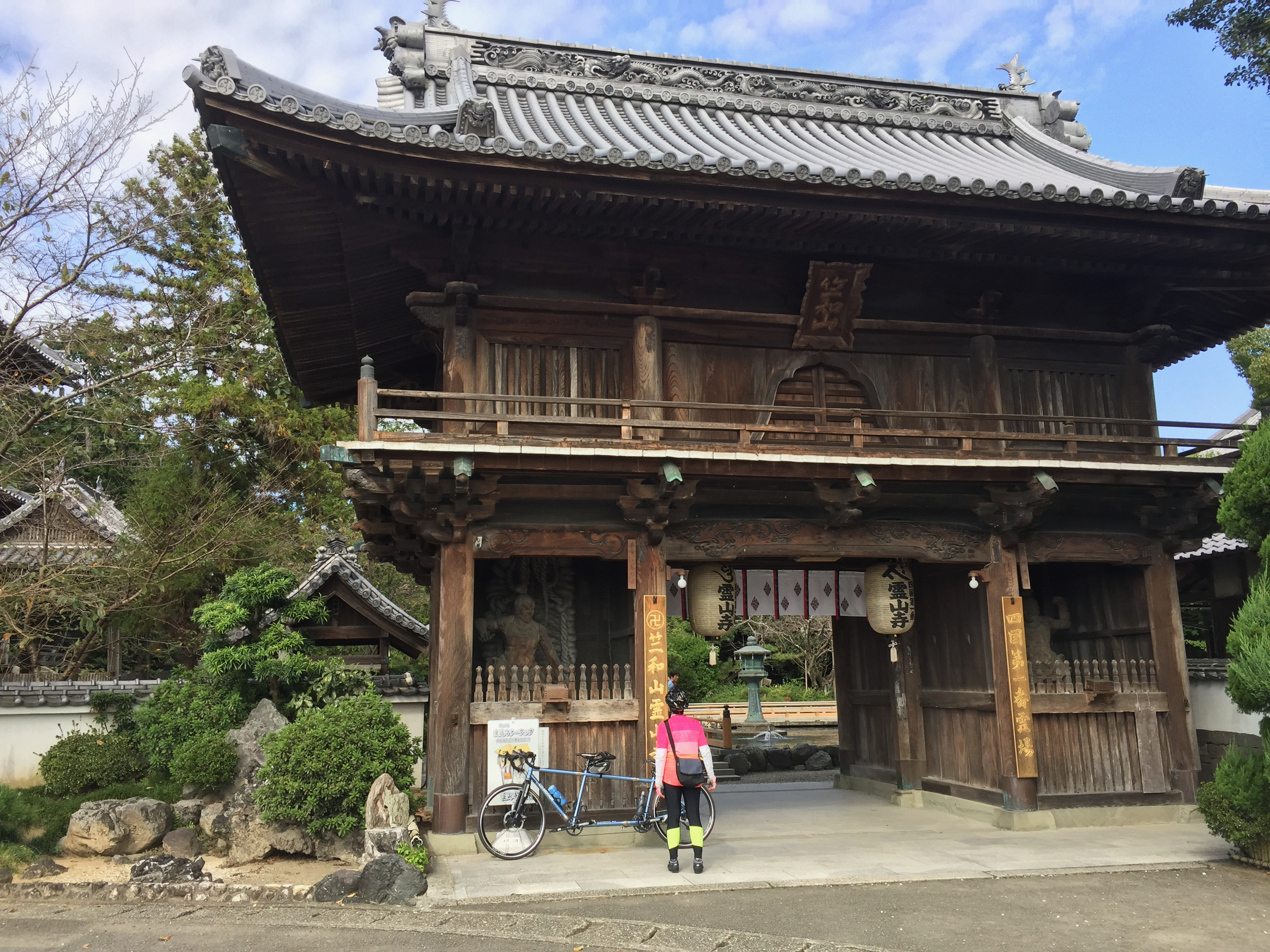
Mima-san had tipped us off that the place next door was cheaper than the temple store for pilgrim clothes and supplies. So we moseyed on over, and picked up white pilgrim vests, temple books, nameslips, candles, incense and a lighter.
Suitably equipped, we were ready for our first temple.
Back at the temple gate, we bowed and checked out the guardians. Always unique. Always no nonsense. Temples are considered sacred ground and the guardians are there to keep it that way.
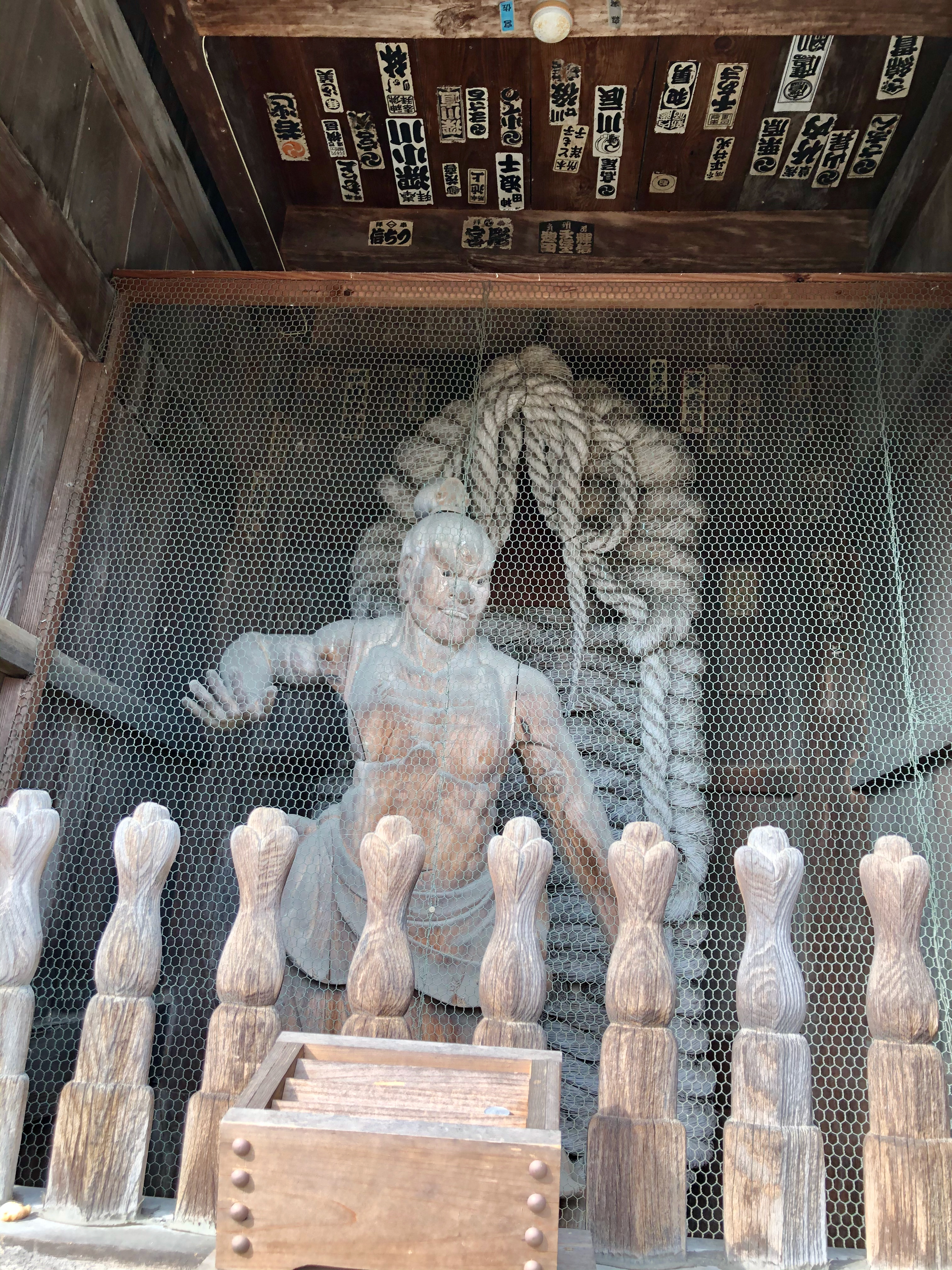
So where to park the bike? I rolled it through the gate and locked it up on the backside. Where to start? In a flash, Sharon was off to the wash basin. Suitably purified she rang the bell announcing our arrival.
I sat down on a bench next to another old guy and watched the Koi fish slowly swim around.
In Japan, Koi are a symbol of good fortune associated with perseverance in adversity and strength of purpose. I was feeling the 13 hours of jet lag. The lolling Koi were about my speed.

Wandering through the temple grounds we soon found the Main Temple Hall, where following protocol, we lit incense and candles and left nameslips in the nameslip box and a small donation in the offertory box.
Nameslips are something akin to a spiritual business card, including name, age, country of origin, and intent/wish. They are left at the Main and Daishi Halls, exchanged with other pilgrims and given to those from whom you receive gifts – osettai. More on osettai later.
Then we wandered into the Main Hall itself. The lanterns were quite atmospheric. And the shrine felt oh so familiar. Memories flooded back.

Back in the early 1970s, I did a month long group Buddhist meditation intensive. Perhaps the first ever in the USA. All of us had been practicing formless mediation intensely several times a day and for weekend stretches, but never all day long for a whole month. We wondered what would happen?
Bottomline: Nothing. Which is kind of the point. Lots of mini-drama though.
We’d be sitting there, eyes open trying to pay attention to our breathing and labelling thoughts thoughts, when out of nowhere now and then, someone would start laughing or crying. Internal monologues taking over. Nothing particularly new there.
One day a young woman next to me broke down sobbing. Later I asked her about it. Nothing to do with memories or fantasies.
She said that she had let a fly land on her face, and then walk across her open eyeball.
At which point she broke down. Way over all the lines, & in the present to the extreme. Kobo Daishi stuff.
And I’d always thought of her as pretty easy going.
****
After the Main Hall Sharon and I made our way back to the Daishi Hall, lit incense and candles and left our nameslips per protocol.
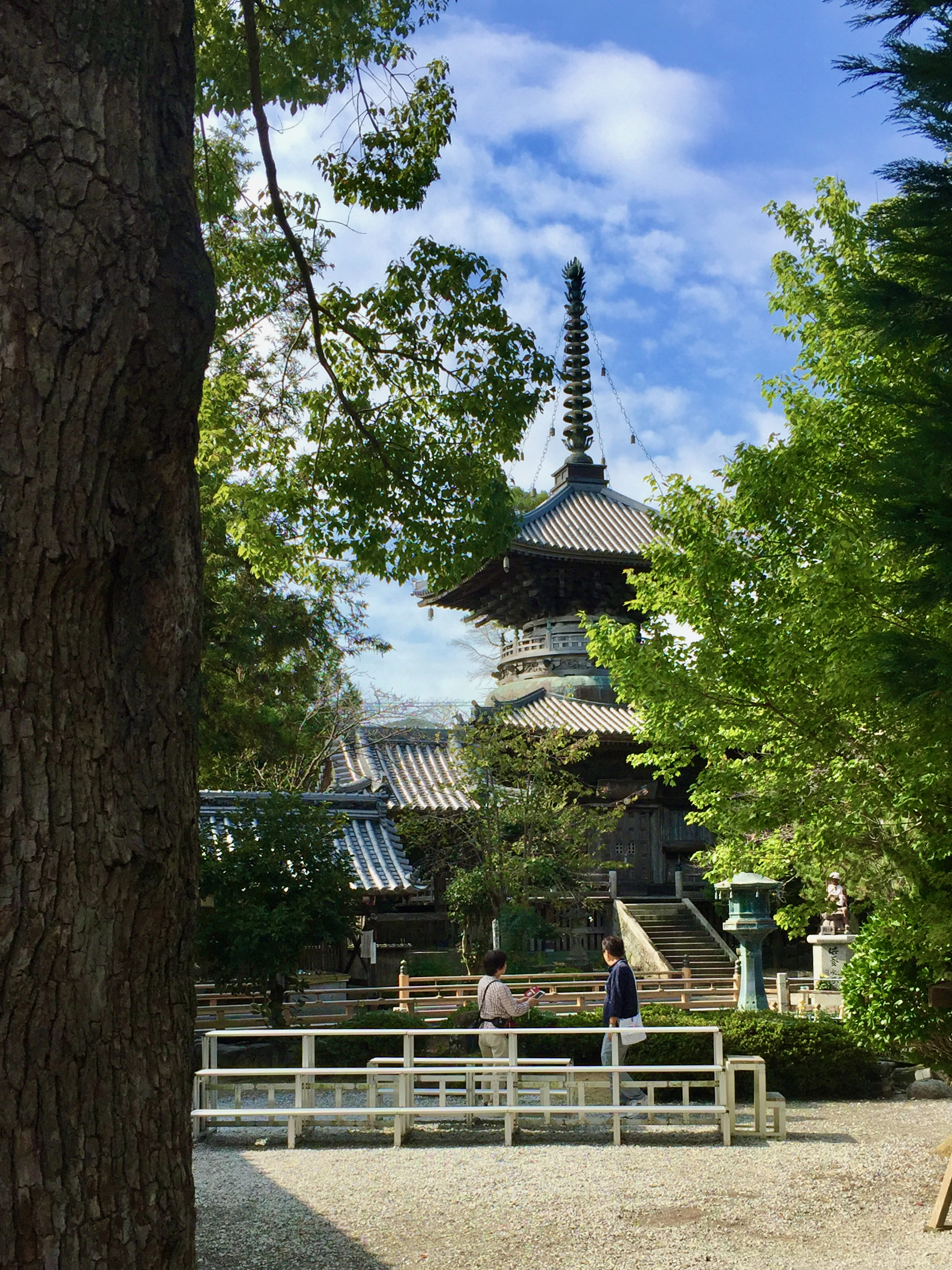
On the way to the Temple Office this was the pagoda view.
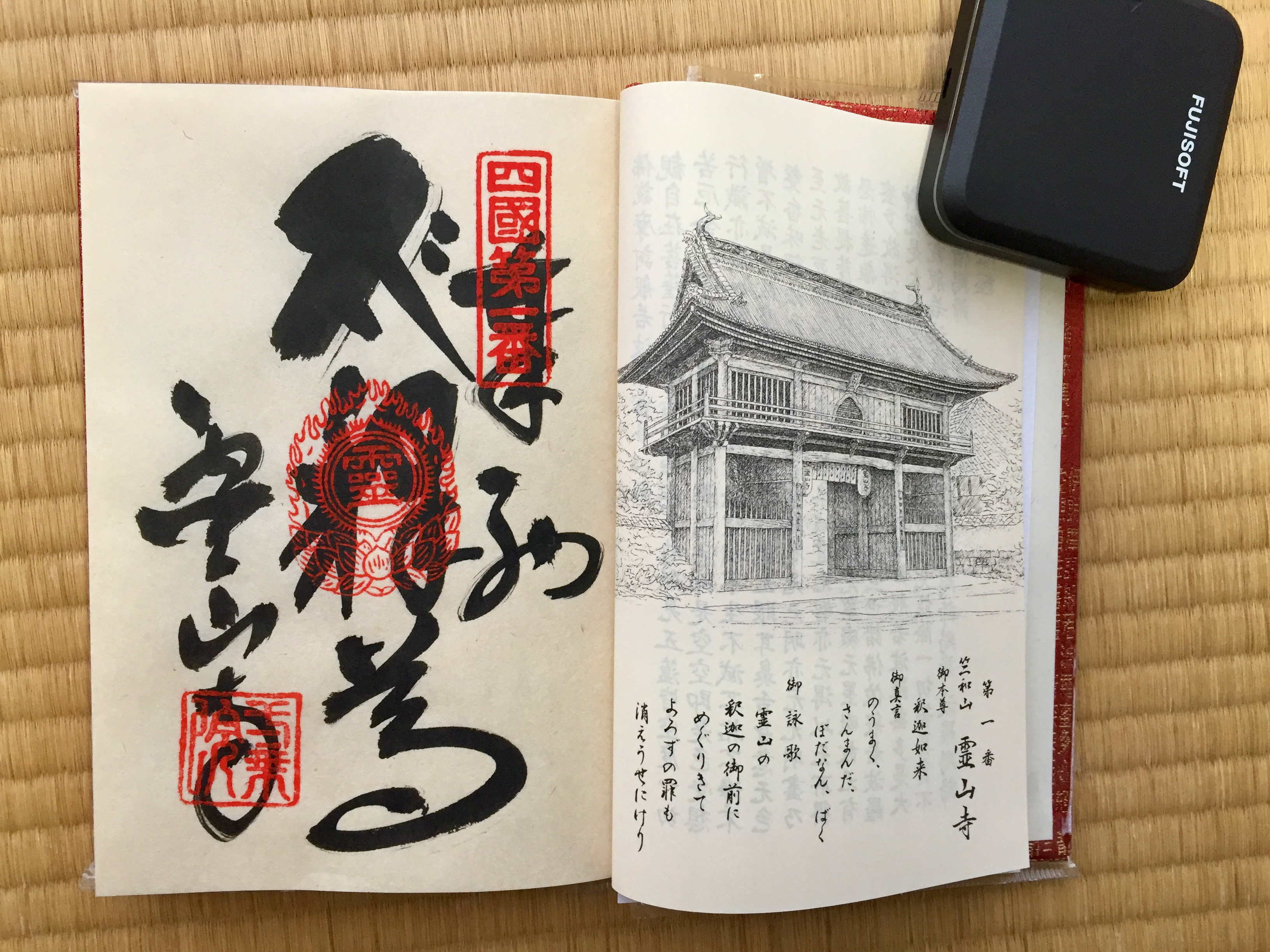
At the Temple Office we pulled out our virgin pilgrim books and received our first stamped calligraphies. 300 yen (about $3), well spent. 1 down 87 to go.
We rode back to Morimoto-ya Inn, the way we had come. Arriving in time for an early private couple tub soak. Grandma knocked on our door to let us know that the tub had reached just the right, really-hot-temperature. We walked down the hall, and went in, locking the door behind us.
We showered side by side, sitting on low stools with handheld sprays in the open room. Suitably clean, we slowly lowered ourselves into the steaming tub sized for two. Grandma had expected us to bathe together.
Welcome to Japan.
At dinner there were two Japanese, two Germans and us. The Japanese kept to themselves, as did the Germans until the meal had almost finished, & then the German woman broke into English.
It turned out that she was German/Japanese with excellent English and Japanese. Her German friend, she had met that day on the road.
In her late 20s, she had spent the last 6 months caring for her dying mother, grieving at a crossroads in her life. Her band had broken up, and her boyfriend had left.
She had decided to do some of the pilgrimage as a time of reflection in memory of her Mom. She said perhaps she would visit the first dozen or so temples. Or as far as her limited budget would go.
We saw Anika again at Temple 12, photo below.
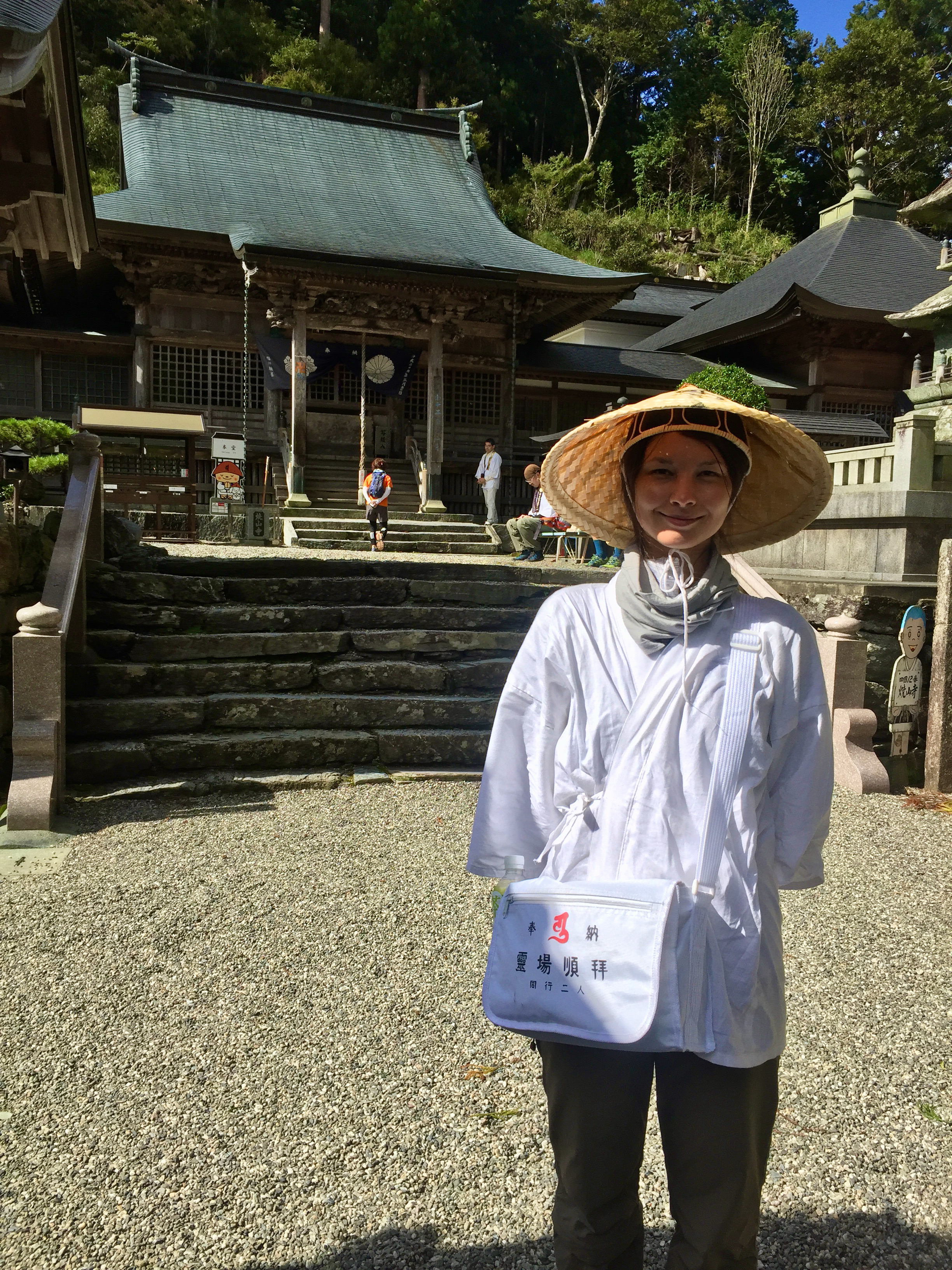
In late November, I checked the Shikoku Facebook page, and there she was. 88 temples. Kudos Chica.
People do the pilgrimage for many reasons: honoring loved ones, religious conviction, a break from daily routine, or simply as a challenge. All are welcome. All equally valid. Kind-of like formless mediation.
We had heard that the Shikoku pilgrimage was pretty much undiscovered by Westerners. True. In our month on the road we met perhaps a couple dozen Europeans and only two other Americans.
That said, the trend is fewer Japanese and more foreigners. Will this be an issue?
Yes, as Jean Phillipe explained a week later in Minami Town.
Day 4 October 11 Friday; Another Test Run, & Temples 2 – 5
2 Gokuraku-ji 極楽寺 Naruto, Tokushima
3 Konsenji 金泉寺 Naruto, Tokushima
4 Jizō-ji 大日寺 Itano, Tokushima
5 Dainichi-ji 地蔵寺 Itano, Tokushima
The next day was another test run. We looped back to catch Temples 2, 3, 4 and 5.
The first two temples were a piece of cake. Then we headed to temple 4 as dark clouds were gathering. One bad decision followed another as we raced to beat the weather.
We arrived at what we thought was Temple 4, but really was temple 5. Then headed off downhill to where we thought 5 should be. Our bike computer kept rerouting us in circles, down on the flats miles off route.
Rain started falling. We were tired, disoriented and getting our first lesson from the world of Kobo Daishi.
“Rushing won’t get you there faster.”
If we had just taken more time and paid proper attention, we’d have already been soaking in that tub at Morimoto-ya Inn. Instead we had to retrace our steps. Back at Temple 5 we faced a big climb to Temple 4 which we had barely missed when we went left instead of right.
The women in the Temple 5 office laughed knowingly at our story, glanced at each other, and then one offered to drive us up to Temple 4 in her car.
She walked us through the temple. At the wash basin, after washing each hand, I went to wash my mouth out, per book protocol. She made a nasty face and said,
“No. The water is dirty. Just watch and imitate.”
Which I did and from then on, after washing each hand, I simply let the water run back down the ladle’s handle and over my hand like 98+% of the other pilgrims. Cool, smooth, simple, symbolic and hygienic.
Sharon, the incorrigible one, continued with her mouth washings. As we worked our way around the island from temple to temple, I noticed that the really hardcore pilgrims did the same.
Traditionally the 4 prefectures: Tokushima, Kochi, Ehime and Kagawa are associated with 4 places of training. Each have personalized lessons. Tokushima was the first: The Hosshin dojo or Place of Spiritual Awakening.
We certainly weren’t shortchanged on lessons, or more accurately, I wasn’t.
Back in the day, a friend used to laugh about Jack Kerouac thinking he could reach enlightenment by going faster. Suppose anything is possible, but that’s kind of the wrong end of the stick.
You’d think that after all these years, now in my old dog days, I’d have figured that one out.
Nah.
“Rushing won’t get you there faster.” My personalized Tokushima lesson.

The next morning we would bid our comfy and cozy inn goodbye. We did a final packing and sorting, with one eye on the weather.
A typhoon was bearing down on Japan. A really big typhoon. Tokyo looked like a direct hit. But Tokyo was 300 miles away. Maybe we’d luck out.
Maybe not.
 Advencha before Dementia