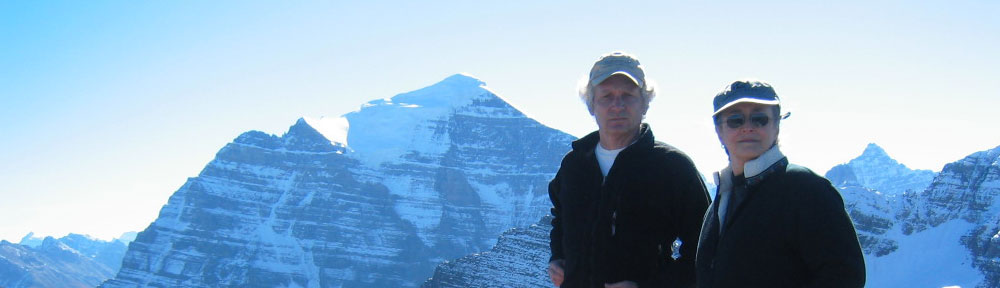
Our Neolithic Megalithic Tandem Adventure
Our plan was to sneak up on Stonehenge. We’d fly into Heathrow. Catch a ride to Goring on the Thames. Ride our tandem down the Ridgeway. Soak in the stones in Avebury.
And then make our way on back roads to Stonehenge, thus avoiding the tour buses.
And finally kick back in historic Salisbury and relax.
A good plan, but it didn’t entirely account for the Artillery Range,

or the tanks for that matter.
As yet another tank blasted across the road in front of us in a cloud of dust, Sharon was not amused. Particularly not pleased that I had bungled the photo op:
“You had the camera on, Right?”
Me, “No. They’re fast and I’m slow.”
“Jeez”
Followed by a reflective,
“Other people get deer, why do we get tanks?”
Good question.
Inspiration
Lots of inspirations for this one. Stonehenge is kind-of-a-bucket list item, particularly if you’ve been reading lots of UK historical novels.
Then there was that New York Times article many years ago about the Ridgeway from 2009: “Hiking History: England’s Ancient Ridgeway Trail.”
It began with this memorable quote: “The Ridgeway is the oldest continuously used road in Europe, dating back to the Stone Age. Situated in southern England, built by our Neolithic ancestors…”
In my mind’s eye, I envisioned the smooth, groomed gravel drives of the BBC’s “Pride and Prejudice” rolling along for miles. We could bike it. Nice fantasy.
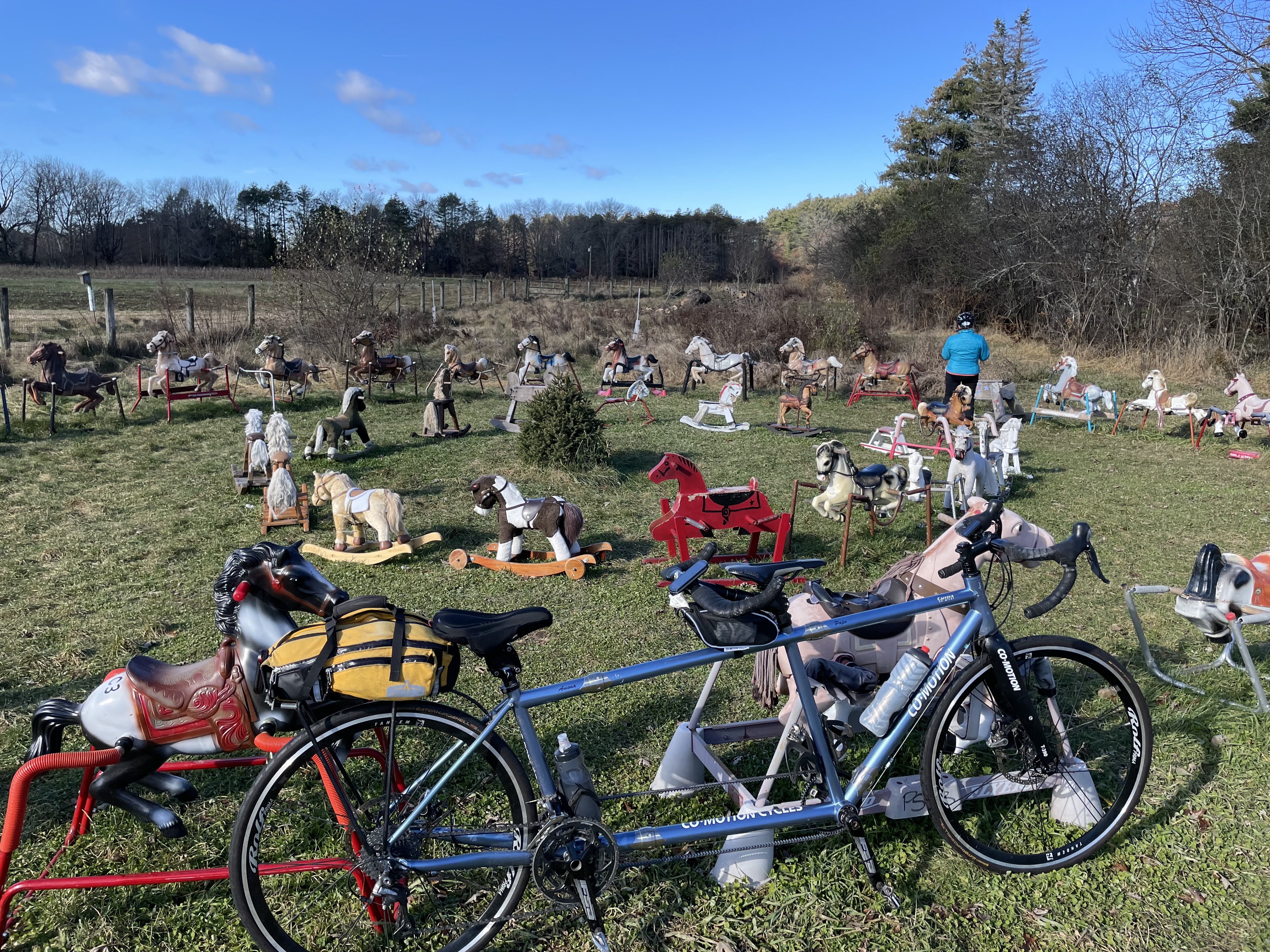
And our beloved Ponyhenge was also a nudge. Ponyhenge is a brilliant, ever-evolving, anonymous art installation in a field by the side of the road in Lincoln Massachusetts.
Ponyhenge is where rocking horses are put out to pasture. Many beloved steeds. Many signed, well worn and well loved. Deserves its own post. Maybe someday.
Heathrow
Sharon’s Mom passed this year @ 101. Lived in her house, on her own terms, to the end. A full life. We booked many, many miles to and fro. Cashed them in for our non-stop, overnight flight to Heathrow Airport in the UK.
After careful consideration we had booked our inns, and loaded our bicycle routes in our bicycle computer. We had arranged for luggage transfer and rides from and to Heathrow with Deep.
After flying all night we would arrive in Heathrow Airport early morning. Deep said he would pick us up personally.
A friend asked, “What if he doesn’t show?”. Hmmm. Best not to go there.
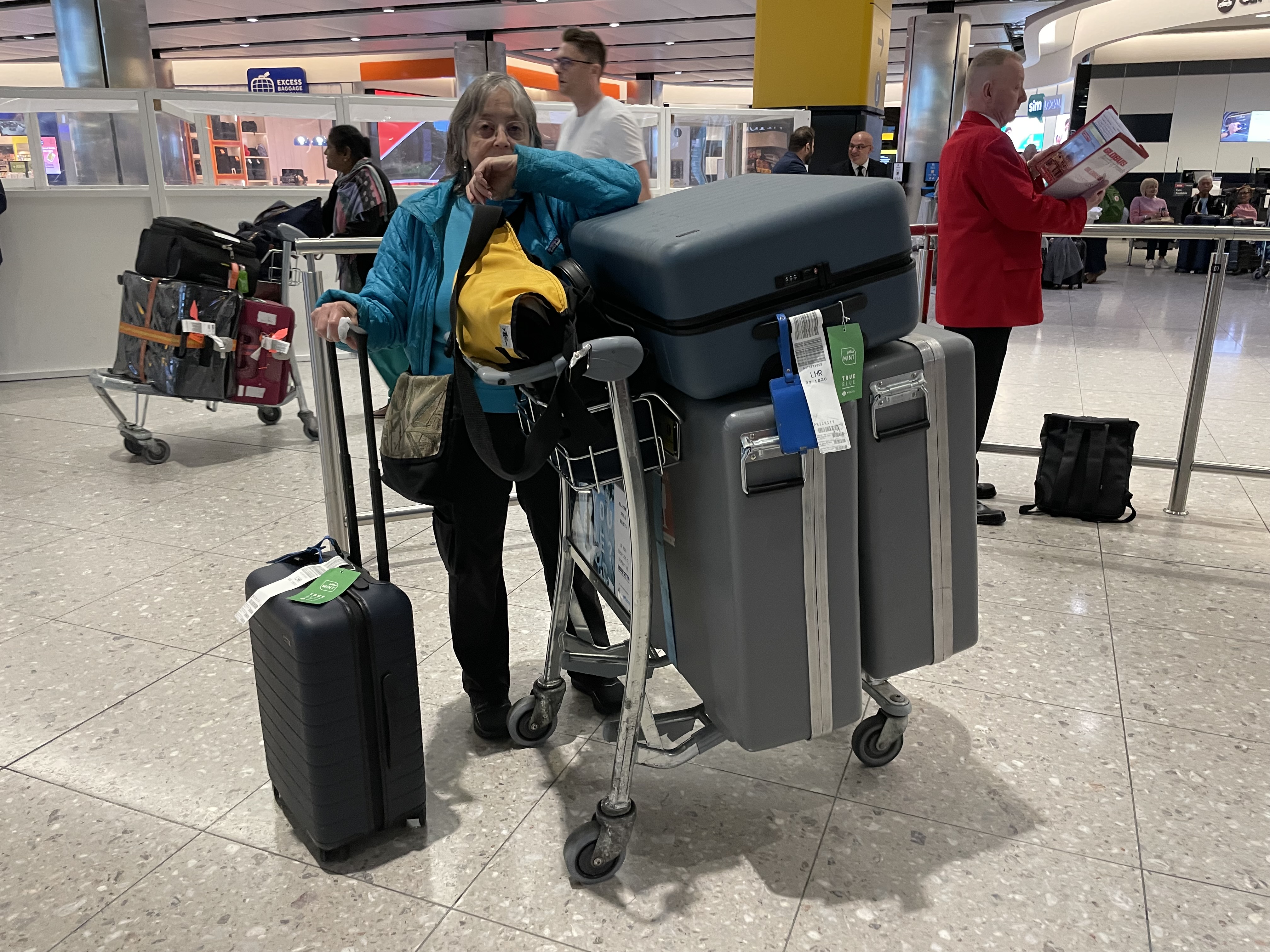
Deep did show. 20 minutes late. Just long enough for us to be really really glad to see him.
Deep has been moving folks and stuff around his whole life. A Pakistani and a total character.
A licensed London cabbie. Drives a big, fast BMW.
When our international wire transfer got dodgy, Deep emailed: “No matter, you can pay in cash, when I pick you up. That will save you enough for a couple of pints!” For cash, he discounted, removing the credit card fee.
At the airport, we had our cash envelope. He counted it – before taking us to his car. A world-wise guy.
On our return leg, he had scheduled another of his drivers to pick us up. At the last minute his driver cancelled.
Deep picked us up personally in Salisbury at our hotel at 4 AM in the black of night, with a bum shoulder, in the rain, to drive us back to Heathrow for our flight back to the USA. That kind of guy. Thanks Deep.
Melrose Cottage
Curiously Goring was totally booked when I got serious about making hotel reservations. Except Melrose Cottage. So I grabbed it. Good call.
Looked like a spare room in a modest house. Which is pretty much what it was. Nothing fancy. What was special was Rose. Truly a gem of a person.
I emailed her that we would be arriving early and asked if that would be OK and whether there were any breakfast places around.
She said, No problem and added that she could cook us breakfast if we liked.
Deep dropped us off before 9 AM and we sat down to a full English breakfast. Rose is that kind of person.
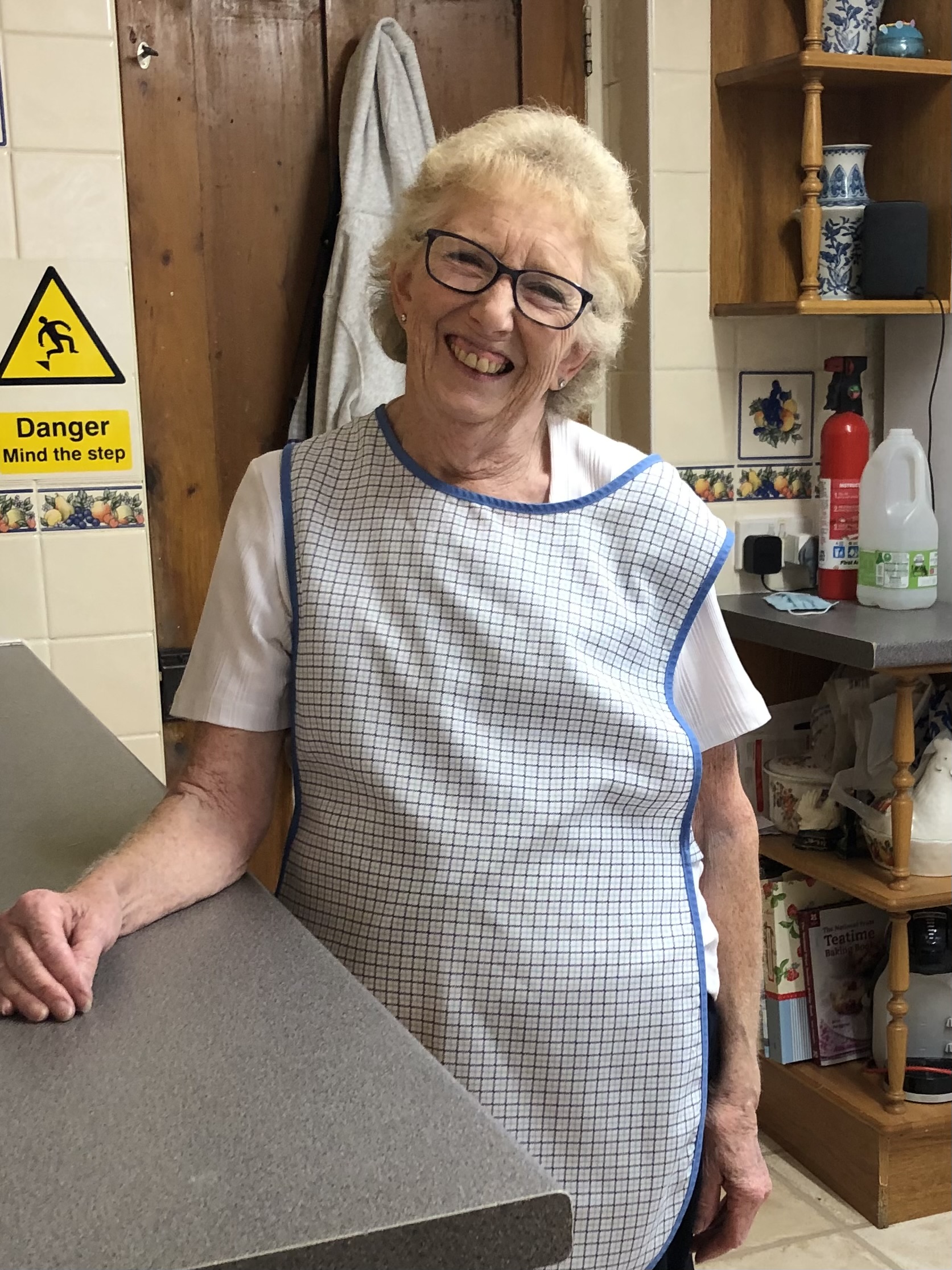
Rose is a widow. Suspect she had been happily married. No chips on the shoulder. Now a Mom to the world.
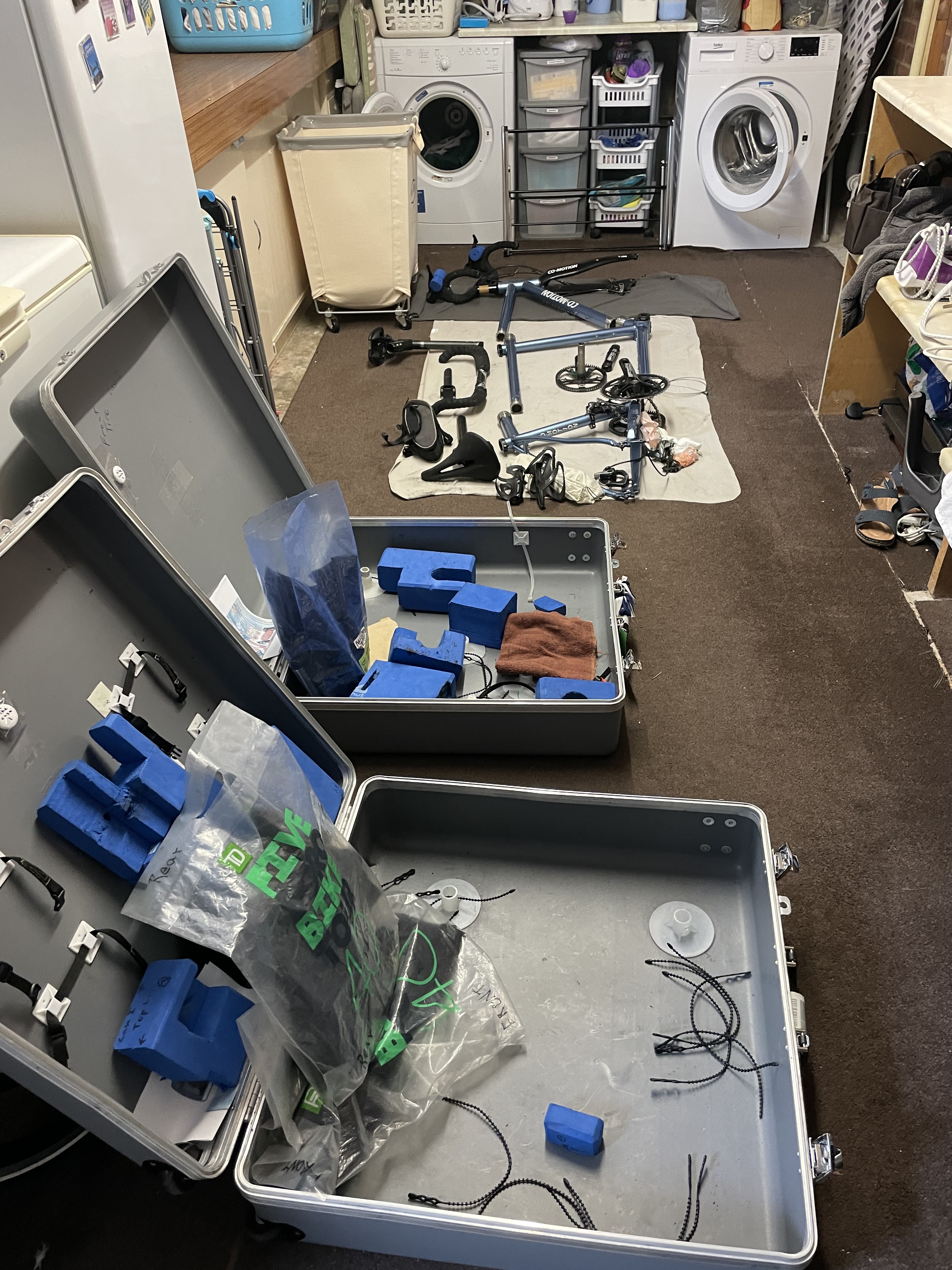
I put the bike together in her padded carpeted garage. Cushy.
Goring-on-Thames: Hobbits, George Michael and Indian Food
We had a day to poke around, just generally hang out and recover from jet lag, So we walked into town.
We passed the train station. The key to wealth in Goring today. Those who can afford to, can live in Goring and work in London. Only an hour away by train.
Next up was the Miller of Mansfield Inn, in the center of town. Our first choice of accommodations in Goring. A charming 18th-century coaching inn.
Researching the place, I kept hitting references to George Michael Impersonator shows.
George Michael had been a somewhat infamous Pop Superstar in the 80s and 90s. But that was a long time ago. There had to be a backstory.
I asked Rose.

Turns out George lived in Goring. His house backed up to the Inn on the river side. Had his favorite table at the Inn where he ate every week.
He died in his home in 2016 at age 53, on Christmas Day.

Rose said people came from all over the world to pay their respects. The piles of flowers were so deep that you couldn’t get down the sidewalk. He was well-liked too. Accepted as a local.
We lingered on the bridge across the river Thames to Streatley. Quaint. Actually over-the-top quaint. Picturesque.
We laughed about how this was the sort of place Hobbits would live. A small, beautiful and fruitful land, beloved by its inhabitants.
Turns out this is Hobbit country. Tolkien lived hereabouts, in Oxford, only 20 miles up the river. If you know your Tolkien, Goring was more Bree than Hobbiton.
We doubled back for a beer at the The Catherine Wheel, an 18th-century award-winning ale house. Complete with thatched roof. We ventured in. Low ceilings, great beer or should I say ale.
I walked up to the bar and explained to the charming young woman that I was an American.
A knowing laugh.
I added, “You can tell by the accent. Right?”
A bigger laugh. I reused this line over and over during the trip. Always laughs. After all we do have a funny, most obvious accent.
So, I went on, “I have come all the way from the USA for an English Ale. I’ve never had one, what would you recommend? After some serious back bar discussion, I was handed a pint.
Tasty, cool, not much head.
It was great. Which I suppose is to be expected – after all they’ve been serving ales in this establishment for 350 years.
A real ale like this, is a cask-conditioned artisanal beverage, and as such requires special handling and storage.
The cask is stored in the cellar and served via tall, hand-pulled pumps. By definition, not a mass market product.
I was reluctant to leave the Catherine Wheel, but we were getting hungry.
Outside we started chatting with some local folks, who were smoking and vaping. Turns out a couple were sheep farmers. London transplants. We were all in good humor. It turns out Sharon had recently read a book on sheep farming and thus was up to speed.
News to me, but no shock. Deja Vu. I’ve been through this before with Medieval lit, advanced physics etc etc.
Once at our local liquor store, Sharon was chatting with an MIT post-doc about quarks.
Discovered in 1964, quarks are an elementary particle, and exceedingly weird.
Quarks can have six types of “flavors” or differences in mass and charge. She rattled off the list – “up, charm, down, bottom, top, and strange.”
Why not the fine points of sheep farming?
We were both in the mood for Indian Food. “Masooms” had caught Sharon’s eye on the places- to-eat-in-Goring sheet at Rose’s. It turned out to be really really good. As a couple told us on the way out.
“You chose the right place.”
It’s true, Indian food in the UK is much better than in the USA.
Our Test Ride
It’s always a good idea to check the bike out, after assembly, before hitting the adventure road. If something is amiss, better to find out sooner than later.
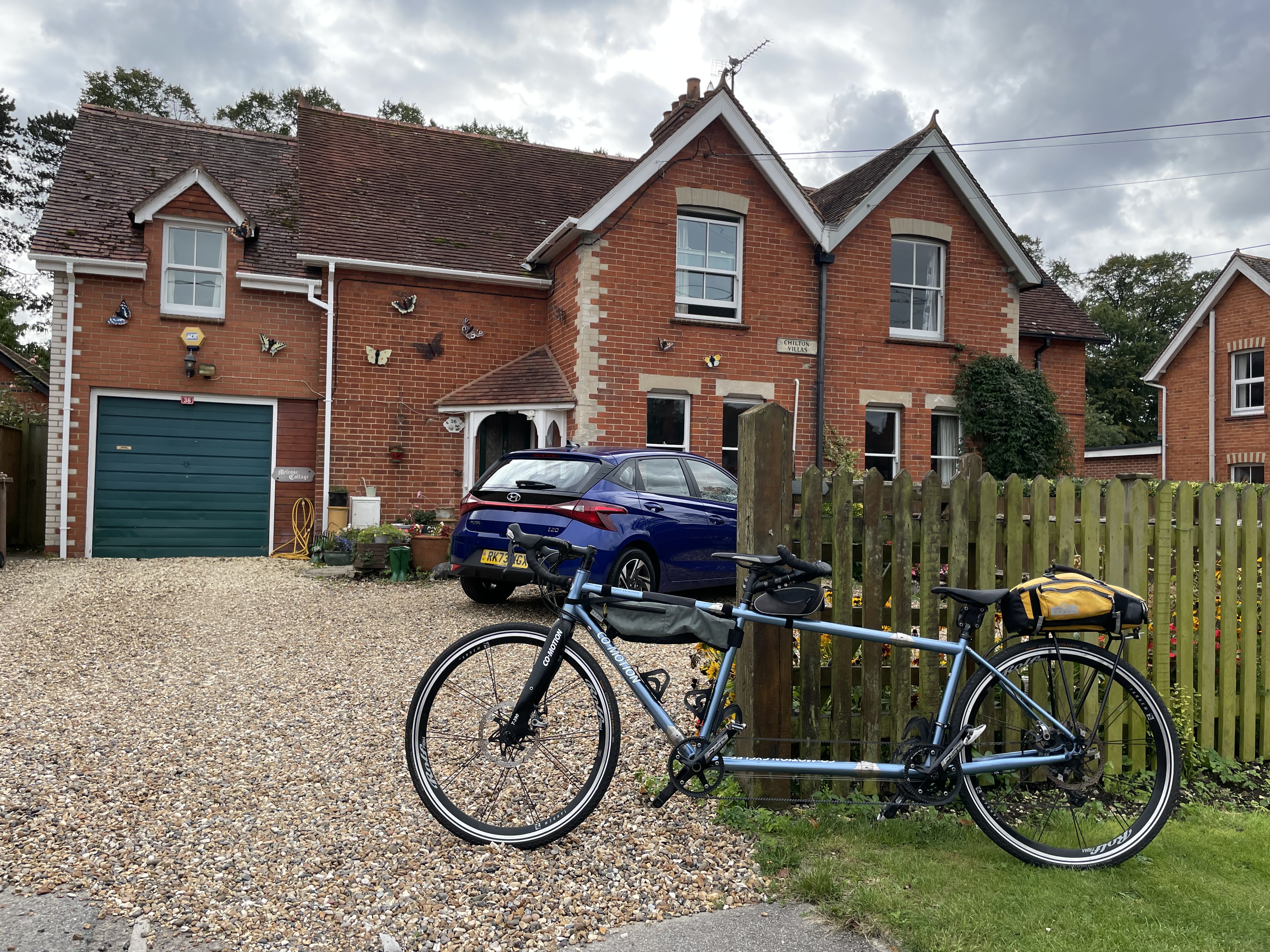
I had a plan. We’d ride over to the neighboring town of Aldworth for a visit to a famous, really-out-of-the-way pub, The Bell. It was only 5 miles away.
When I shared our plan with Rose, she smiled, her eyes twinkled, and said, “There is a bit of climb just out of town.”
Our first taste of understated British humor.
At the edge of town we stopped at a traffic light. Across the intersection our road continued straight. I thought it was an optical illusion. On our side a normal road. On the other side It disappeared straight up into the trees.
The light turned and we headed up, up and up. No illusion. The legs started burning. Perhaps a 15% grade. I asked myself,
“How long could this go on?”
As we discovered, too long for us.
Thus we were introduced to Streatley Hill. Home of the 2020 British National Bicycle Hill Climb Championships. 1/2 mile. Average gradient 13% Max gradient 18%. When we got to the top, some hikers cheered.
No comment from the second seat.
Suitably humbled we rolled into the Aldworth. The Bell wasn’t hard to find. It was the place with all the motorcycles parked out front.
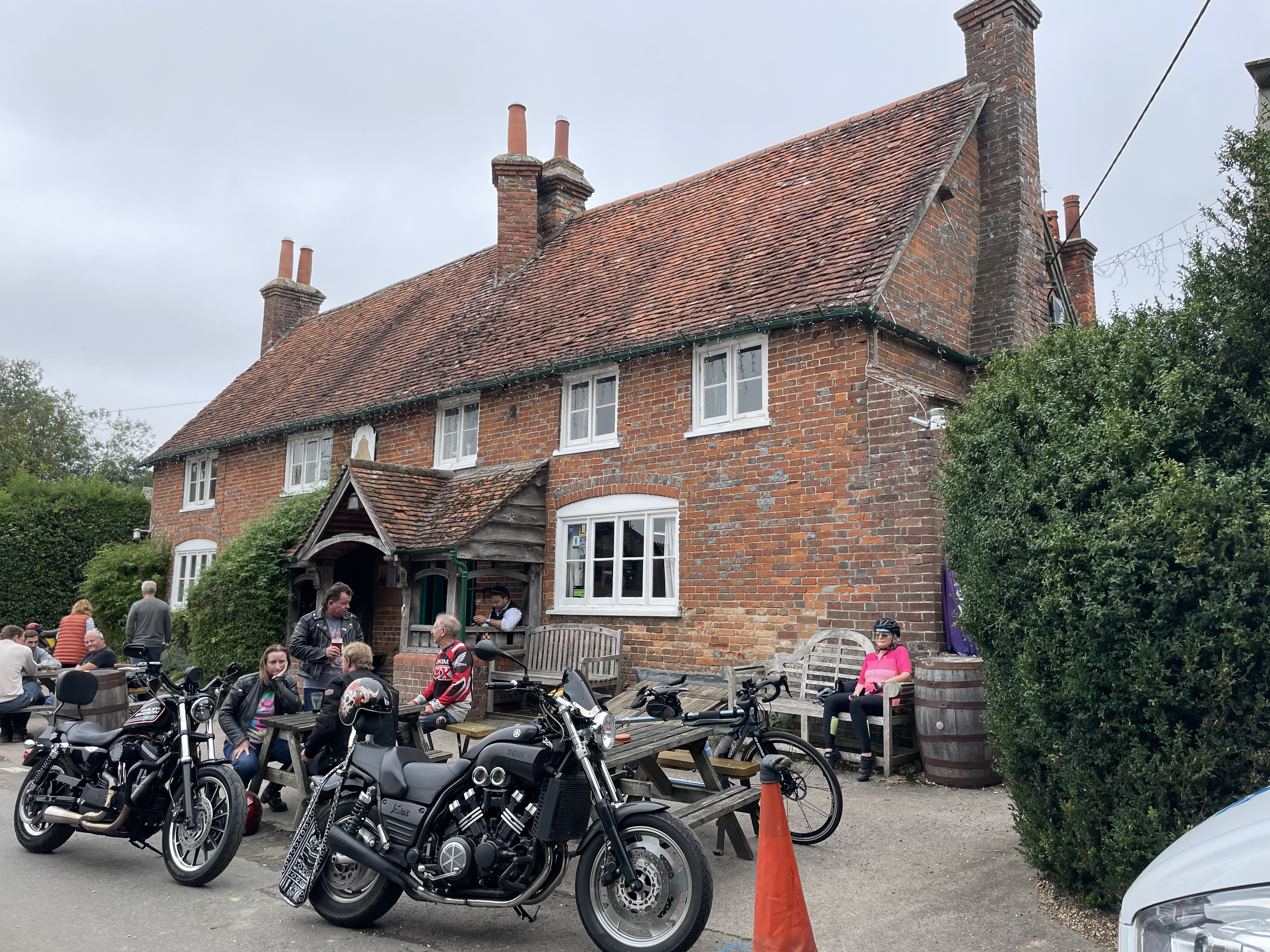
In a curious kind of way, the vibe reminded me of the Westvleteren Brewery in Belgium. A beer destination in the middle of nowhere. No tour buses here though, but certainly a range of vehicles, from Jaguars to working trucks to serious motorcycles.
And all kinds of folks and their dogs, seemed to mix without a second thought. Show dogs or motorcycle leathers, no matter. Maybe it was the excellent beer or maybe the UK attitude towards pubs. Whatever.

The Bell has been run by the same family for 250 years. It has been named the best in the country two times. It was built in the 15th century or possibly earlier. The ebony ale hand pumps were fitted in 1902.
My favorite Bell Inn Pub story is the Concorde trip of 1978. Concorde, like the plane.
One of the Pub regulars was a Concorde pilot. One thing, led to another and next thing you know the Bell had chartered a Concorde for a day for a whip round trip. All the regulars were on board.
It was an inspired Mach 2 joyride. They buzzed the Bay of Biscay in Spain. Ale fueled. An old guy lost his false teeth. They fell down the side of his seat. He wasn’t worried in the least.
Ridgeway Day 1 – To the WhiteHorse
The time had come to hit the road. We waved goodbye to Rose. Rode past the train station, by the Miller of Mansfield, over the River Thames and took a right at the bottom of Streatley Hill. And from there, we worked our way out of town. To the gravel path where the Ridgeway got real.
Here is a link to the video of our ride to Woolstone (9:46).
Music is Bela Fleck and Edgar Meyer from the CD “Music for Two”
Perhaps my favorite part of the video is Sharon’s “Oh God” on seeing the incline of the gravel path where the Ridgeway for all intents and purposes begins. It goes by quickly. If I had the edit to do again, I’d boost the volume. Most expressive.
As we reached higher ground, we could see the backside of Aldworth off to the left about a mile away. We checked our bike computer. All seemed well. We checked our map/guidebook for points of interest. Mostly Farms and Stables. A large rabbit warren was noted.
We had left Goring behind.
The path was reasonable. We rode along. Albeit slowly. I thought things were looking good for an early afternoon arrival in Woolstone. Which would be nice as rain was forecast 2-3 PM.
Sharon wasn’t so optimistic, checked her rain gear and wondered whether our front light was charged.
It wasn’t long before our nice smooth path was looking a bit worse for wear.
The Ridgeway is multipurpose. A back road for farmers. A bridle path for the horsey set. A dog walk for the locals. And a favorite for off-road 4X4s and motorcycles out for kicks.
Sections had been chewed up pretty badly. Our pace slowed to a crawl.
This quote from the Guardian Newspaper puts it perfectly,
“Britain’s most famous “green lane”, a track that was 4,000 years old when the Romans came to Britain, now resembles the kind of unpaved and potholed nightmare that travelers in rural Tanzania try to avoid.”
Might be a bit harsh, but then again, on second thought, maybe not.
Pretty perfect for horses though. And this is horsey country. High end racehorse horsey.
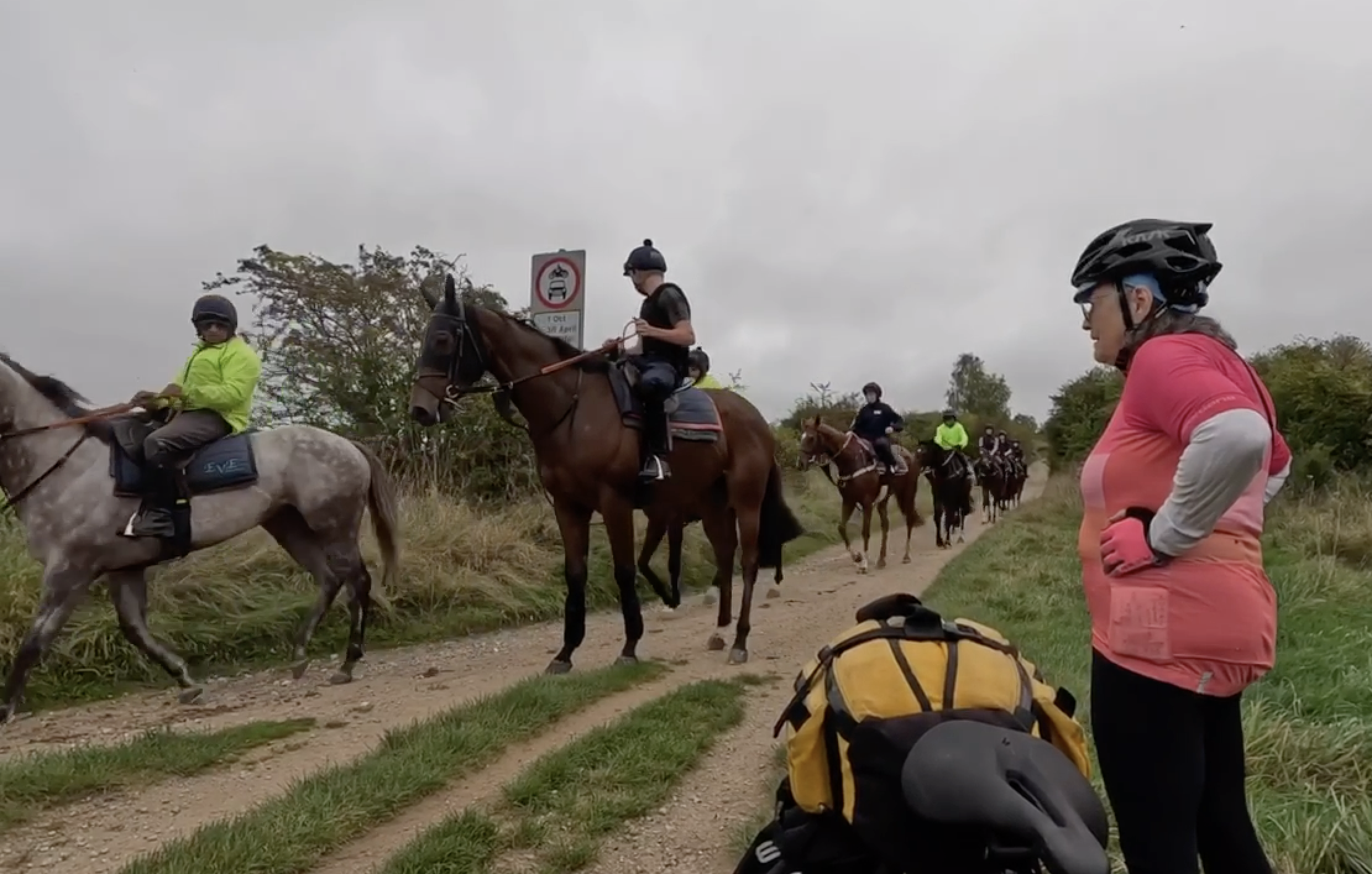
At one point late morning a group of horse folks, moseying along, overtook us as we were taking a break.
Totally gorgeous beasts. Perhaps 20 with trainers. Many of whom looked like foreign nationals. Perhaps India.
Curious stirrup set-ups too. High.
After they had passed, we continued plodding along. Out of the corner of my eye, I saw them taking off 2 by 2. Racing up a hill. Full speed. High drama.
I hadn’t understood what the “Gallup” tracks on our map were. I get it now.
We rode where we could, but the deep ruts were a challenge. As a rule we never fall. This day was the exception. Thankfully we were going slow and the grass was soft, but it’s a shock to go down.
Lying on our side, on the bike, we were both still clipped into the pedals:
Me, “Are you OK”
Sharon: “Yeah, are you OK?
Me: “Yeah”
A curious conversation to have with someone, you can’t see, 2 feet behind you, in the middle of nowhere.
We weren’t done yet though. Our last such conversation was on a wide open straight stretch of wet chalk. It turns out that wet chalk is like black ice. Impossibly slick. And hard like concrete.
We were on our side with no warning. In the blink of an eye.
No harm, no foul, but scary stuff.
Suitably humbled, we pushed on.
Early afternoon was uneventful and gorgeous. This was why we came. Timeless vistas.
We were on the high ground. Where we could appreciate the panoramic views of the rolling chalk downland below. But the clock was ticking.
Mr. Sun came and went. We could see rain in the distance. The clouds closed in. Darker and darker.
We could hear rolling thunder. Sharon was walking up ahead and started to count seconds for distance and launched into a mini-lecture, over her shoulder, on what to do on when on a trail in the open in a lighting storm. She’d been reading up. Something about crouching on your tip-toes.
Then the rain hit. We pulled out our jackets. Nothing to do but plod on. No chance of riding. I walked the tandem as best I could. The grass was wet and getting wetter and the ruts were filling with water.
I had thought beforehand about what to do if the Ridgeway was impassible for us. And had routes in the bike computer. We could catch a crossing road and ride on asphalt, down off the Ridgeway to another road paralleling our route.
We came to the crossroads. Ate snacks in the wet gloom and talked things over.
We both voted Ridgeway. As Sharon put it, “In for a penny, in for a pound” A favorite saying of hers.
As we crossed the road, a murder of crows, perhaps 50 or so, took off from a tree where they had been watching us. Wheeled against the gray and were gone.
An hour later we were on Whitehorse hill. Next to the Uffington “Castle” a large Iron Age hill fort.
Wind was blowing a light rain into swirls. Sheep were grazing and Red Kites (birds) were flying overhead. Absolutely no one around. No surprise there. Who in their right mind would be out here on a day like this?
Sharon had had enough. My mood was picking up. An Iron Age fort with rain and sheep and Red Kites. Only us. No civilization in sight. Nice.
And I knew it was downhill from here. Not Streatley Hill steep, but close enough.
And we were close to the – paved- road to our Inn.
Our wet disc brakes were singing, and brake levers bottoming out, as we pulled up to the White Horse Inn around 4:30. We made our way into the pub. Sharon lit up on reading the blackboard menu.

The Chef’s Special: Venison Bourgignon was most tasty! And Especially great, after the Thai Style Crab Cakes when washed down with English Ale in dry clothes after a hot soak.
Ridgeway Day 2 – To Avebury
We loved the White Horse Inn. Could have stayed a week. But after a rest/fun day it was time to push on. One more day on the Ridgeway would take us to Avebury.
Here is a link to the video of our ride to Avebury (9:59)
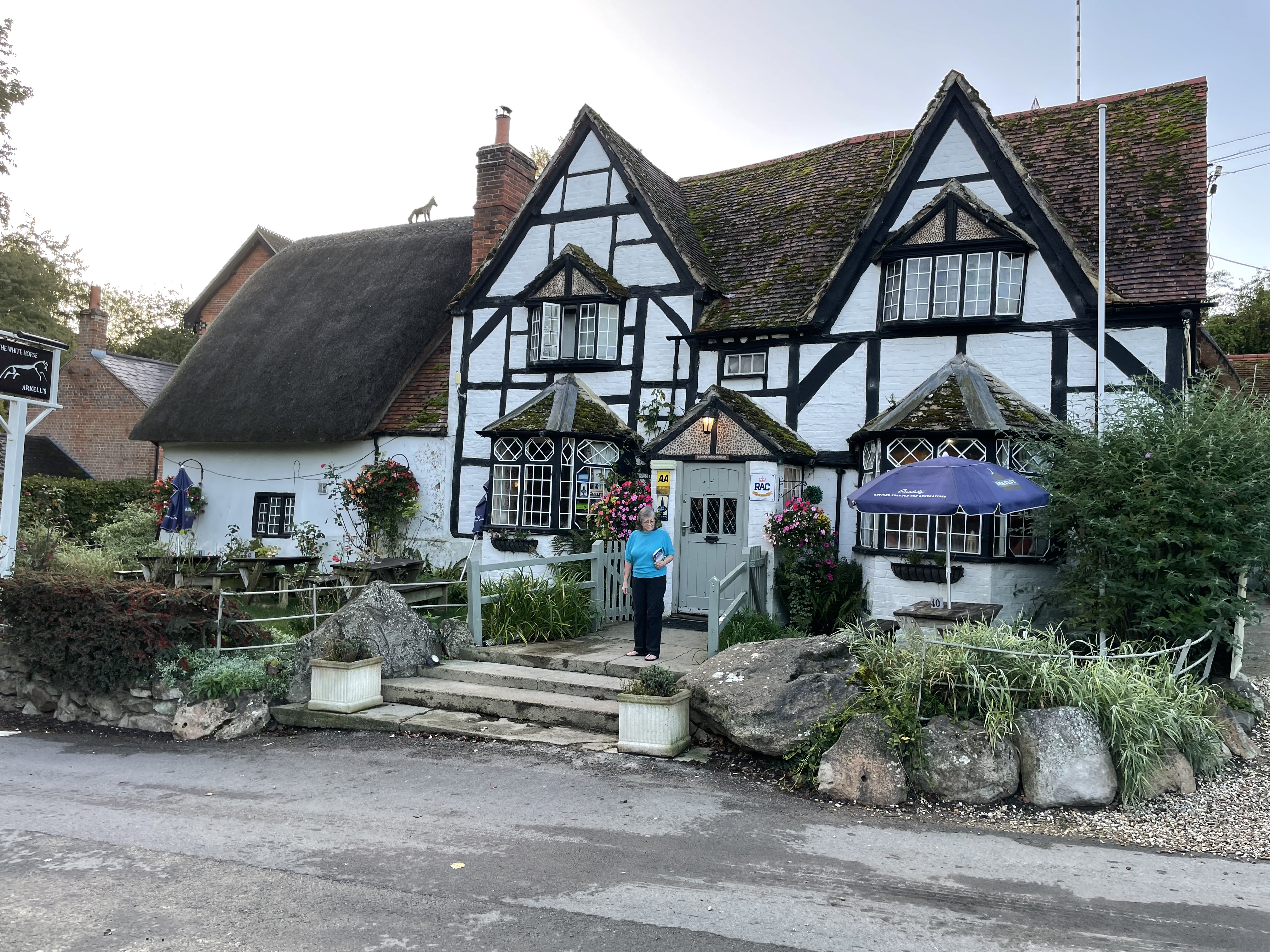
We were off early. Woolstone is charming. Far more charming when the sun is out. We headed up back from where we’d come.

Once out of town, we stopped at an empty crossroads. I wanted to go left, the alternative being a very steep climb straight up on the opposite side.
We pull out our map. Just when this guy appears out of nowhere. Right behind us.
“Excuse me. Are you Mark.” Totally upbeat in a heavy heavy British accent. Like a good friend of a friend you might bump into in the middle of day in a familiar haunt.
Odd to a power of ten.
The follow-up was pretty good too.
“Are you going to Avebury? Ha, Ha. And after that the Dog +Gun” Ha, Ha, Ha, Ha
Odd to a power of a 100.
Ha, Ha, Ha, “I’m Norman.”
To this day, I’m not sure if he was real. Claimed to be delivering our luggage. Have no idea what he was doing hanging out there, then.
Could have been a barrow wight or some such other. He seemed plenty friendly, a good thing if you’re going meet the mystical at an empty crossroads.
As we told our story, he kept saying over, “Good for you. Well done.” Ha, Ha, Ha
We asked about Norman at our Inn in Avebury. A local, well-liked. We were sure to leave a nice tip for him in an origami envelop folded by Sharon. An offering of sorts. To a local spirit.
As we parted, Norman pointed up the hill. “That’s the way for you.”
And up we went. First stop the White Horse or more specifically, the Uffington White Horse, the Grandaddy of them all. Just below the Iron Age Uffington Hill Fort and just above Dragon Hill.

Dragon Hill is where St. George fought the dragon, and the inspiration for Tolkien’s Weathertop where Gandolf fought the Nazgul. Lots of mojo in these parts.
We didn’t linger. Back on the Ridgeway, we picked up where we left off, and shortly arrived, on tandem, at the Wayland’s Smithy, a Neolithic chambered long barrow, 3590 BC. It was believed to have been the home of Wayland, the Saxon god of metal working.
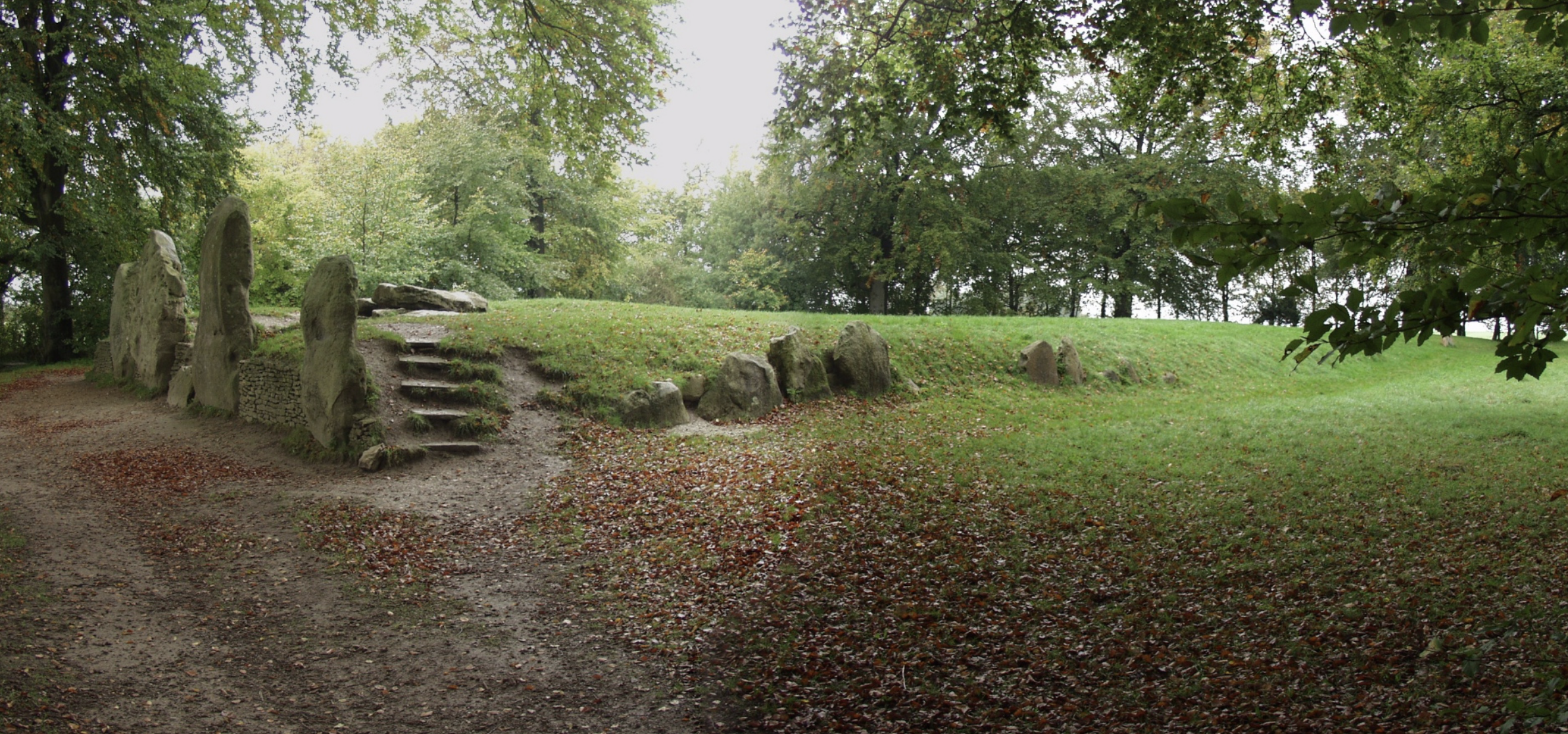
It was a beautiful day in the neighborhood. Sun was shining. Air was fresh. No sign of Wayland though. Unless he was one of the two tiny tots teetering on the edge of the entrance to the tomb.
Late morning we hit blessed asphalt and flew as the miles peeled away and then flew right by our unmarked turn adding a few extra miles to the day. Not a problem, I don’t think we are gravel /dirt people.
Back on the dirt we heard what sounded like gun shots. I tried turning the sounds into construction sounds, but couldn’t keep up the illusion. They were gunshots and they were getting louder.
Nothing like a gun club in the middle of nowhere to set a mood. We wound our way around 10 foot ponds in the dirt road. Still no Ridgeway signs.

We stopped a bicyclist coming the other way. Thankfully we were OK. We were on the Ridgeway route for vehicles or something like that.
Soon we arrived at the far side of Barbury Castle, yet another Iron Age Fort. Barbury is thought to have come from the Old English name Bera, after the Saxon chief who controlled the castle around AD 550.
We once again had our Ridgeway signs and we on route without a doubt. Time for sandwiches. Score on for the old man. He passed the test in the AM, when our waitress asked, “would you like sandwiches for the road?”
As we stood munching away. A fellow sauntered up with his bull dog, Boris. Sharon picked up on the joke immediately,
“Far better looking than Boris Johnson” An ex prime minister.
The fellow laughed. Boris drooled.
We chatted about our trip whereupon, he added,
“As you are headed for Avebury, you’re in luck, it’s all downhill from here”
True enough, but not all rideable downhill miles, on a road tandem, even with wider tires. An hour or so later I could see what I thought was Avebury off in the distance to the right.
Sharon was not convinced. There were signs, but they were illegible. I decided I could see “Avebury” with an arrow. And off we went.
Sometimes even a blind squirrel can find a nut.
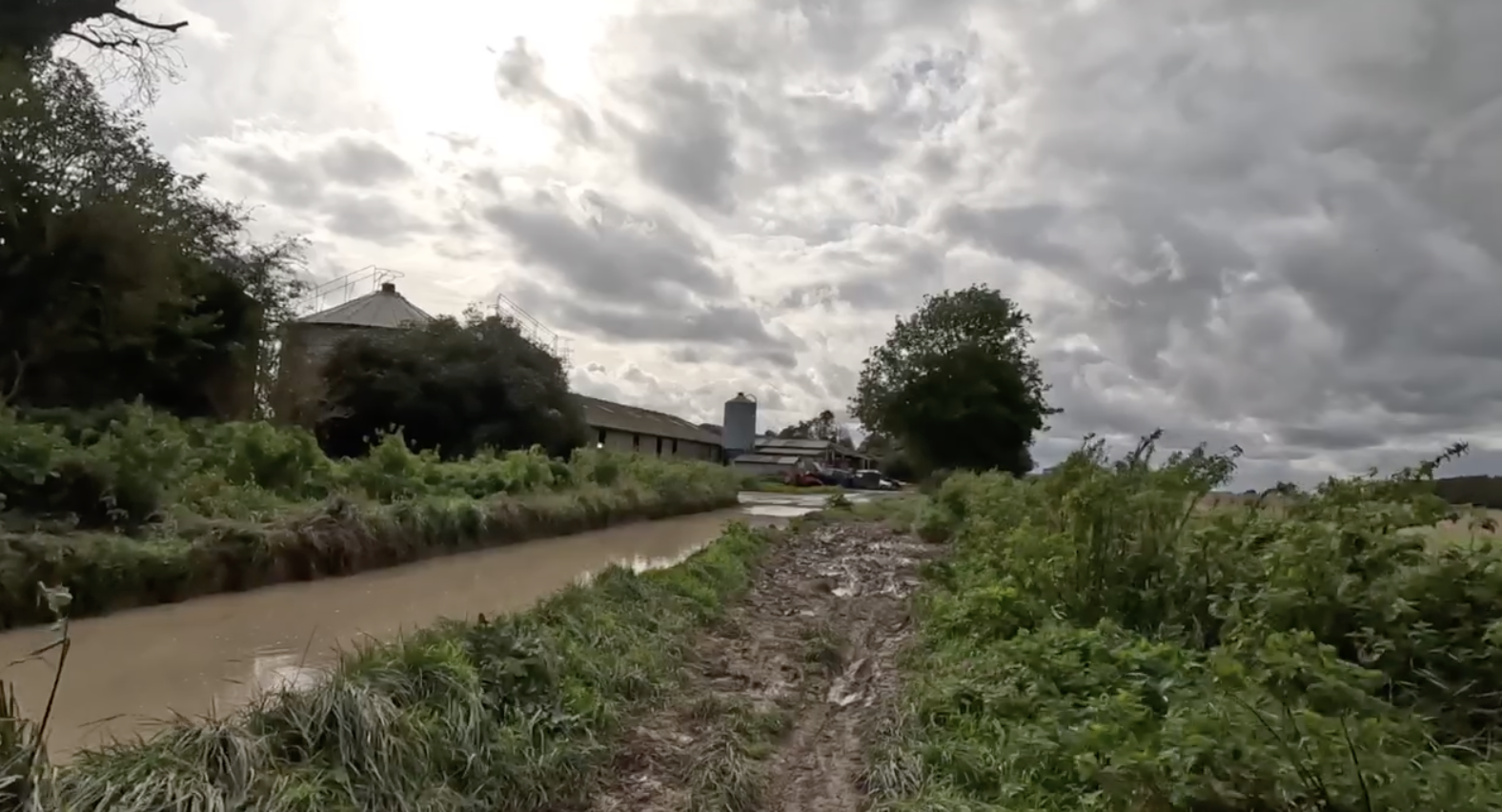
After making our way carefully around a 50’ lake of a pothole, we rode into town, with Sharon singing,
“Keep your eyes on your driving
and your hands on the wheel.
Keep your filthy eyes on the road ahead”
Her point being that I was distracted and riding on the right. Not good in the UK. All -in-all, I did OK, most of the time.
We passed our first Avebury Circle Sarsen stones.
The charm of Avebury is that the stone circle is really big, like well over 4 football fields in diameter. Big enough to enclose a post office, gift shops, a pub, and our B&B. The best I can figure is that the two major thoroughfares which divide the circle in quarters, enter and exit where the original way-back-when gates were located.
I’m sure many historical types have spent many hours trying to scheme how to control the site. No luck yet. Anarchy rules. Sheep, cars, tourists, through traffic, all mixed up. A free for all, in a good way.
We pulled up to our B&B or at least I thought so. No signs. Opened the iron gate and pushed our tandem up to the front door. Sharon rang the doorbell and then rang it again. At which point I suggested she ring the doorbell. My suggestion was not appreciated.
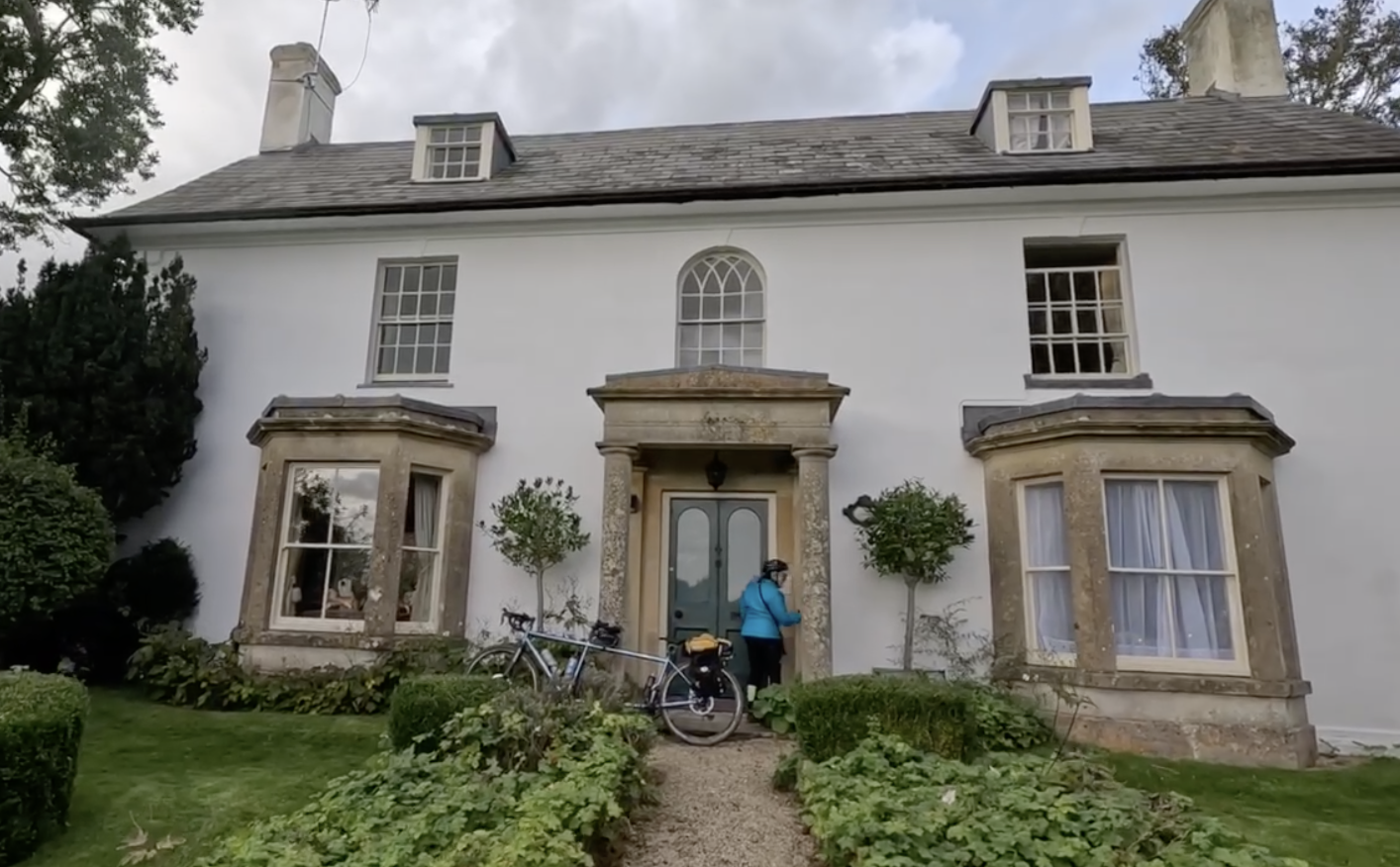
Then we heard a voice. Susan was working in the garden, behind a clump of plants.
“Be with you in a moment.”
Me, “I think we are arriving.”
We were.
Avebury Lodge was great. It also has a story. There was a great manor in town and this was the hunting lodge. A boys club for drinking, carrying on and I suppose, now and then, a base camp for hunting.
Located at the crossroads in the center of the Avebury Circle, my first thought was that there was a sensitive Lord who liked to look out over the stones. Wrong, it was located at the crossroads, so the guys could see who was coming.
Avebury
In its day, day 5000 years ago, Avebury Circle must have been quite the spectacle. Largest Stone Circle in Europe at about 1312 feet in diameter. Nearly 100 giant stones in the outer circle, surrounded by a circular earth bank immediately dropping down into a deep ditch.
Did I mention that this scene was brilliant white. Thanks to the chalk.
Well, the stones weren’t white as they are sarsens, silicified sandstone blocks found fully formed in Southern England on the Salisbury Plain. What makes the sarsens so great is that they are incredibly hard, several times harder than granite, and filled with character.

Tons of character. Literally. Each a scholars rock. Special rocks prized for uniqueness.
Here is video of our walk around Avebury Circle (4:05)
Avebury is part of a huge Neolithic Ritual Landscape with literally hundreds of prehistoric sites within a short walking distance. Highlights include Avebury Circle, West Kennet Avenue, The Sanctuary, West Kennet Long barrow, and last but not least Silbury Hill.
And then there are other henges, barrows, passage tombs, random stones, avenues, and ritual pits and more scattered about.
And the Stonehenge sites are just down the road. Our next stop.
No one knows how these sites were used or why they were built. Dating back almost 5000 ± years, we’re talking the dawn of western civilization. And no one left notes.
Avebury Circle was connected to The Sanctuary 1.5 ± miles away by an avenue marked by 2 parallel rows of towering stones. Today only a half mile remains.
The Sanctuary was originally the site of a circular wooden building, eventually replaced by two stone circles. Nothing left today but small concrete markers. Often described as “not one of the more memorable relics in the Avebury area”, it’s magic worked for/ and on us.
First the place itself stopped the mind, then the fung shui kicked in, with views to West Kennet Long barrow, and Silbury Hill. And then I lost my glasses after a wrong turn.
On retracing my steps I found them. I could hear “The Twilight Zone” music in the back of my mind.
West Kennet Long barrow is on a ridge about a mile from Silbury Hill. It’s one of the largest Neolithic burial mounds in the UK. 1000 years older than Wayland Smithy. And again you can just walk-in. Just bring a flashlight. It’s black dark.

And finally there’s Silbury Hill, the largest artificial hill in Europe. Similar in size and angle to pyramids in Egypt. The base of the hill is circular 548 ft in diameter. The summit is flat-topped and 98 ft in diameter.
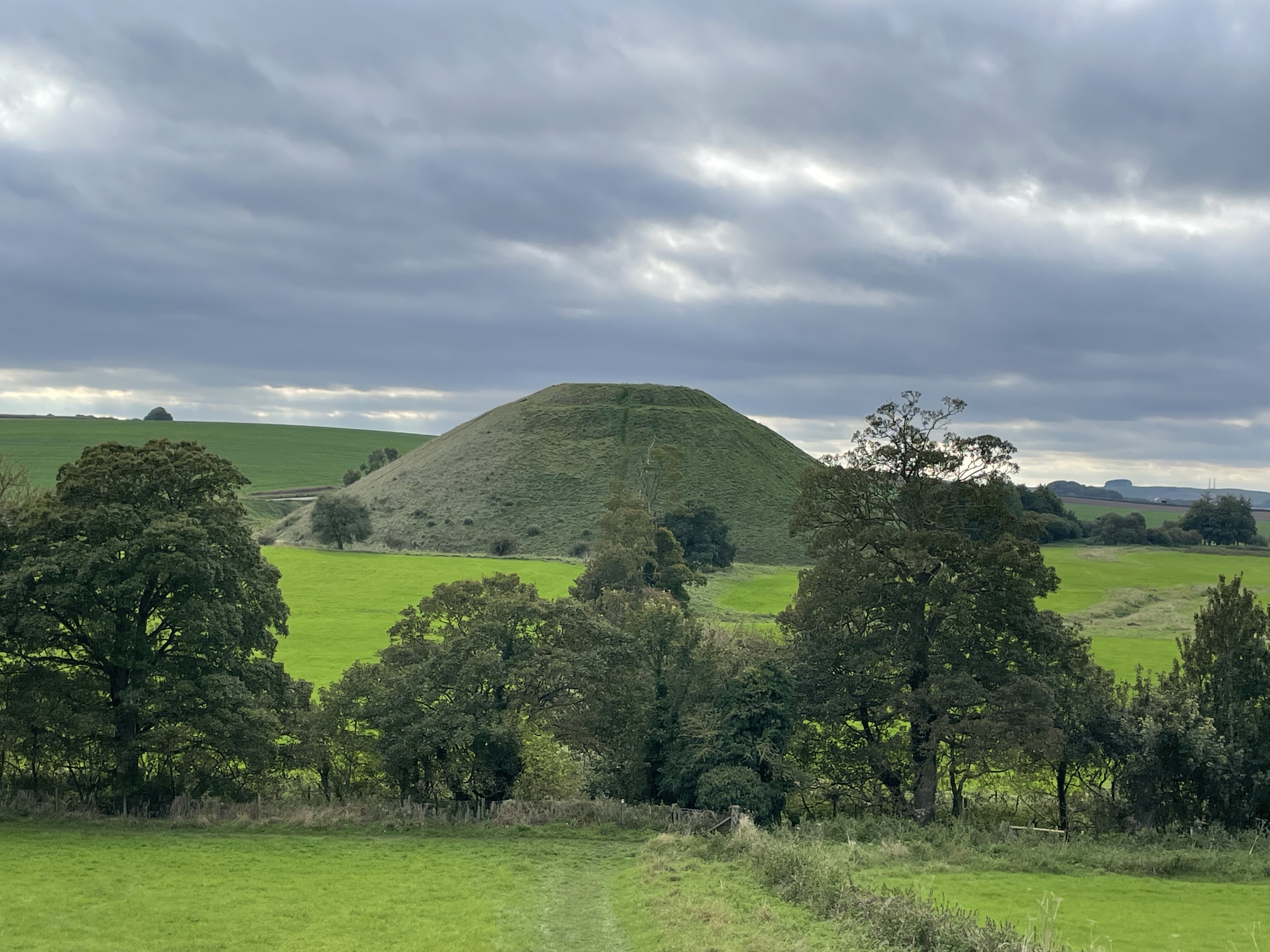
Silbury Hill was originally entirely white due to a chalk exterior, and surrounded by a pool fed from underground springs.
As a green hill today, it’s modest, but as a gleaming white faceted cone in its time. It must have been a showstopper. And a lot of work too. It’s estimated that it took about 4 million man hours and half a million tonnes of material, mostly chalk, to create it.

Avebury is one of those down the rabbit hole places. A wonderland world, you just couldn’t make up. Or if you could, no one would believe you. At least it was for us.
What’s always curious are the unpredictable and unexpected twists. Both places and people. I suppose they always go together.
Like our B&B host Andrew, who appeared had in “Red Dwarf,” One of our favorite BBC shows of days gone by. He made his appearance in Season 7 Episode 1 Tikka to Ride. We suspect as one of the policemen in this time traveling yarn about the JFK assassination.
Or Renata, a douser/healer/producer etc, and Reece, the actor, whom we first saw hugging rocks in West Kennet Avenue. Then met again in Avebury Circle proper. They were carrying their shoes and walking tenderly – Earthing”, Renata told us.
The last time we saw them was in the Red Lion Pub, two doors down from our abode in center of Avebury Circle. We shared drinks and a very entertaining conversation, while next to us an elderly couple were just getting up from the Florrie’s well table.

So called because this glass topped table looks down into Florrie’s well. Purportedly 86 feet deep, I’d say you can only see 30 feet down today.
Story goes that Florrie was a bad girl and cheated on her husband. He threw her down the well and she has haunted the Pub ever since. This Red Lion Pub regularly makes the top-ten lists of most-haunted pubs in England.
And then there was the Czech woman we met in the pitch black in West Kennet Long Barrow. We had brought our bike headlight so we could see in a focussed spotlight. After the first 5 burial niches, we hit the wall closing off the rest of Barrow. Here people left offerings. A dollar bill stuck between rocks. An amulet. We left a piece of Trader Joe’s jerky, when we saw her feet.
Michaela liked ancient, quiet places, as she explained several days later over coffee in Salisbury.
To the Dog + Gun
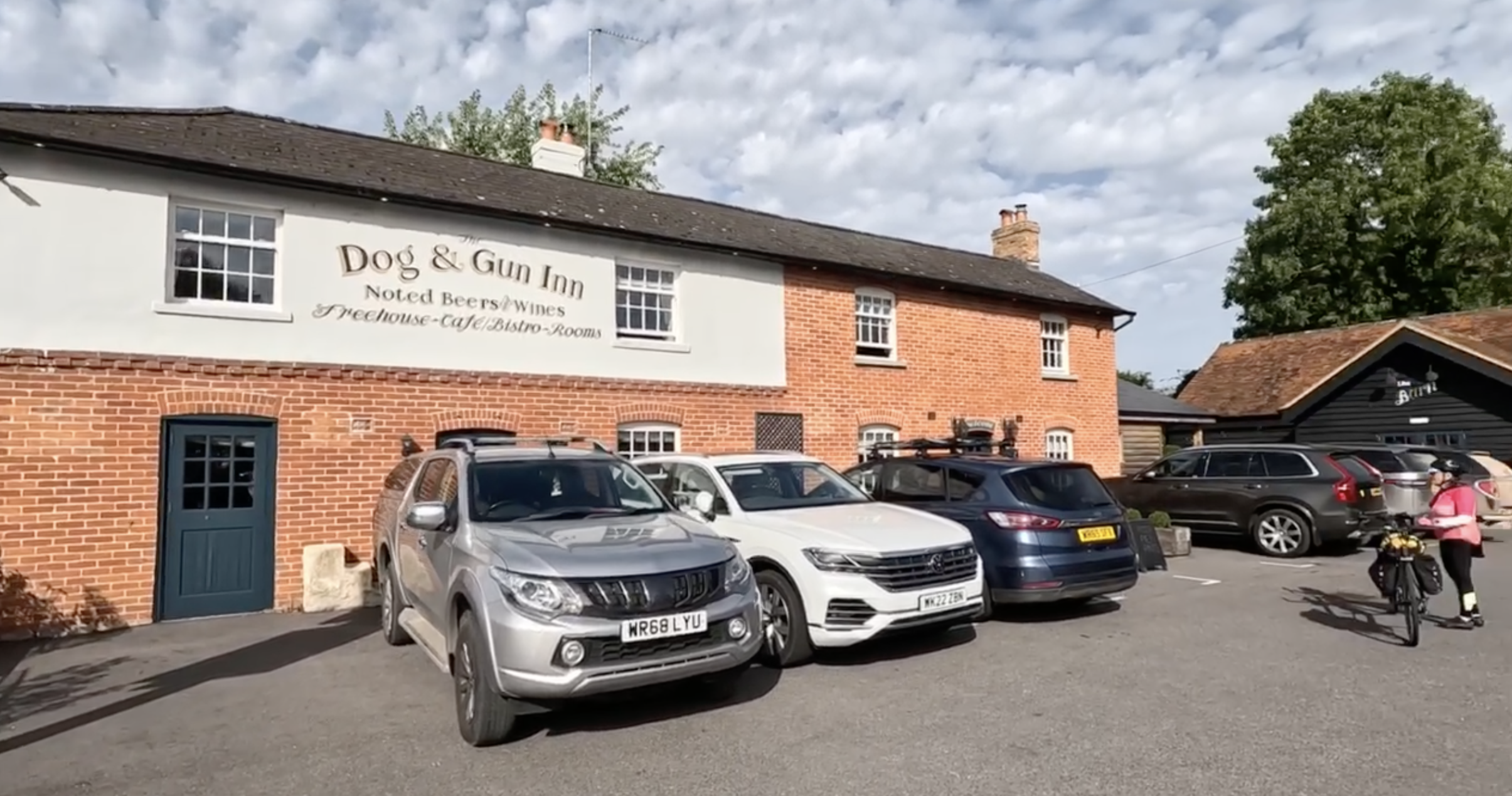
Don’t you just love that name? Perfect name for a pub. Pretty perfect pub too. The local pub for Netheravon. Covid wiped out the owner, who was forced to sell. A major supermarket chain made a not-to-be-topped offer, and then a small group of young folks stepped in with a lower counter offer which won the day, but that’s jumping ahead. First we had to get there.
I was worried about the ride. Paranoia I suppose. 100% back on asphalt was a total plus, but what about traffic? On our last morning at Avebury Lodge, Andrew reassured me we were in for a nice ride.
Not only was our ride for the day by and large downhill, but traffic would be light on the backroads where we would be heading.
We saluted the Avebury Stones, and West Kennet Avenue on our way out of town. Passed The Sanctuary, and turned right. We crossed the West Kennet River, rode through West Kennet in the blink of an eye. A very small town.
Sun was shining and the miles were melting away. Out in the fields there was a parking lot on our right so we pulled over. What was this? Parking for Pewsey Downs Nature Preserve, Adams Grave, yet another Neolithic long barrow and The Alton Barnes White Horse.
We pulled in. Time for a break anyway.
A couple and their dogs were just arriving.
“Nice Bike”
“Nice Dogs.”
A familiar conversation. From what we could tell, historic sites, and pathways are very popular in the UK – for walking dogs. And folks hereabouts like bikes.
This White Horse is relatively new. Dates back to 1812. Designed by one John Thorne, also known as Jack the Painter, who was eventually hung. He took off with the money before the work was completed.
Soon we were down on the flats, riding along the River Avon on the edge of the Salisbury Plain.
With the rural landscape behind us, clusters of suburban-like houses were appearing. The River Avon was more like a picturesque large stream, complete with swans and fly fishermen.
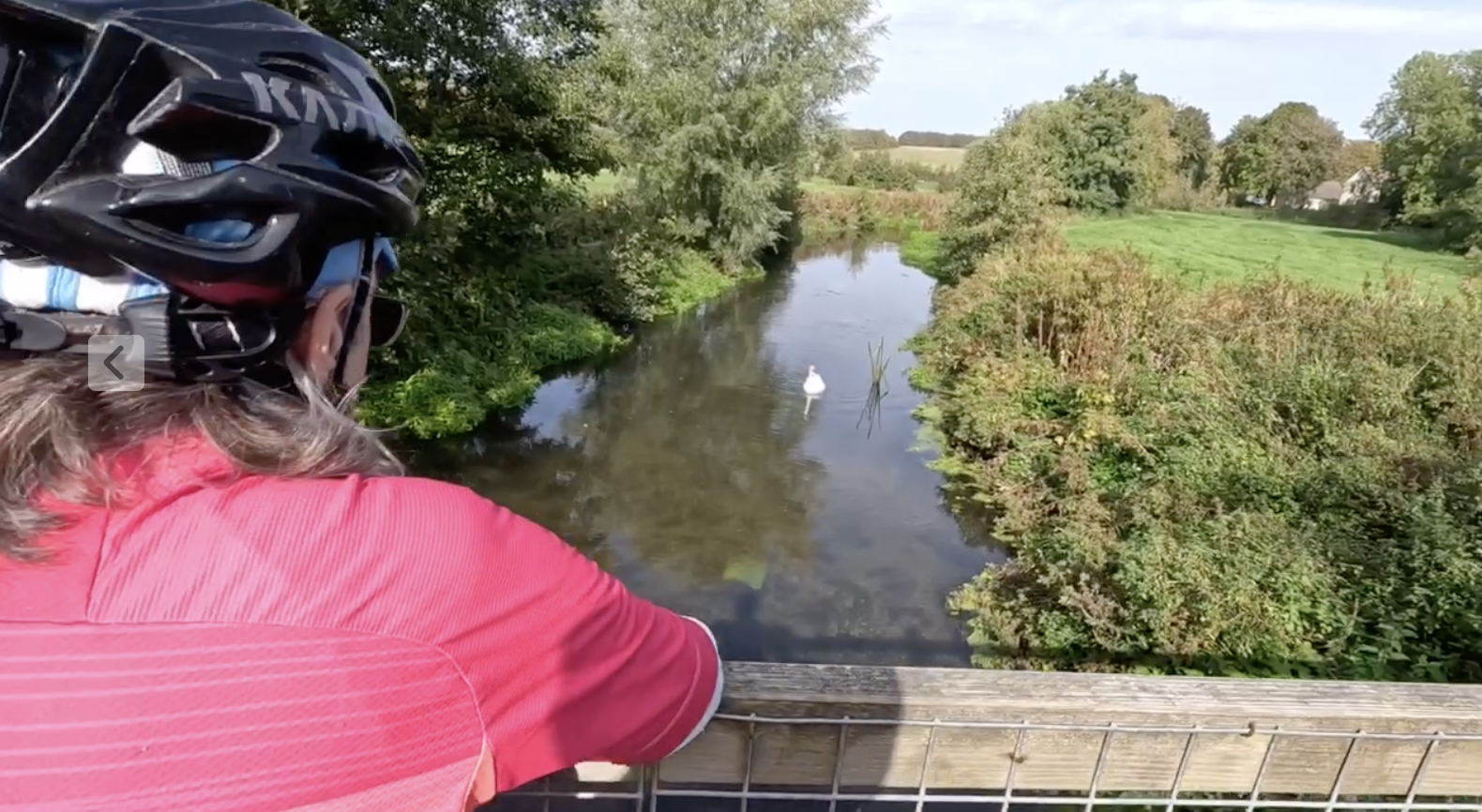
The Salisbury Plain lurked, but that’s another story.
We arrived early at the Dog + Gun. All was well. Nice room, friendly folks, good ale, good food.
Stonehenge
One of our running jokes leading up to this trip was Salisbury Plain and the artillery range.
It’s always good to have a good paper map. We ordered official ordinance surveys. This stretch was covered by Map 130, Salisbury & Stonehenge which was stunning in detail.
On review, I noticed that the route google maps liked to Stonehenge, wove in and out of a “Danger Area” in the Salisbury Plain. On closer inspection you could see why. The machine gun practice areas sounded especially real, but first and foremost on the worry list were large areas marked artillery range. I made up an alternative route.
At breakfast we asked our waiter about the Danger Area. He reassured us that it was plenty safe, as long as the red flags weren’t flying and besides there would be lots of folks around to warn us off if something was up.
So off we went to Salisbury Plain. It was a pleasant sunny day. Though the gravel road left something to be desired.
Here will be the link to our Stonehenge ride, if and when I edit the footage.
It wasn’t long before we hit this sign.

A favorite of mine. We laughed and continued on. Next up was a flag pole. No red flag. No problem. Sign said, “If red flag flying, do not enter”
A couple of miles later, there was a red flag. Hmmm. Perhaps they left it up by mistake? The empty landscape was eerily quiet. We talked it over. We could turn around, but that meant many more miles on the day. We forged ahead.
Then another red flag. We convinced ourselves that we weren’t actually entering the artillery range, merely riding along side it. And on we went.
Next up were the military safety police. Nice guys. From Ireland. Big smiles. Happy to have company. Kind of lonely our there.
“You don’t need to worry until this afternoon”
He pointed us down the road to our next turn. Shortly thereafter we passed this tank enclosure topped by razor wire and soon were back on asphalt in the regular neighborhoods of the town of Larkhill.
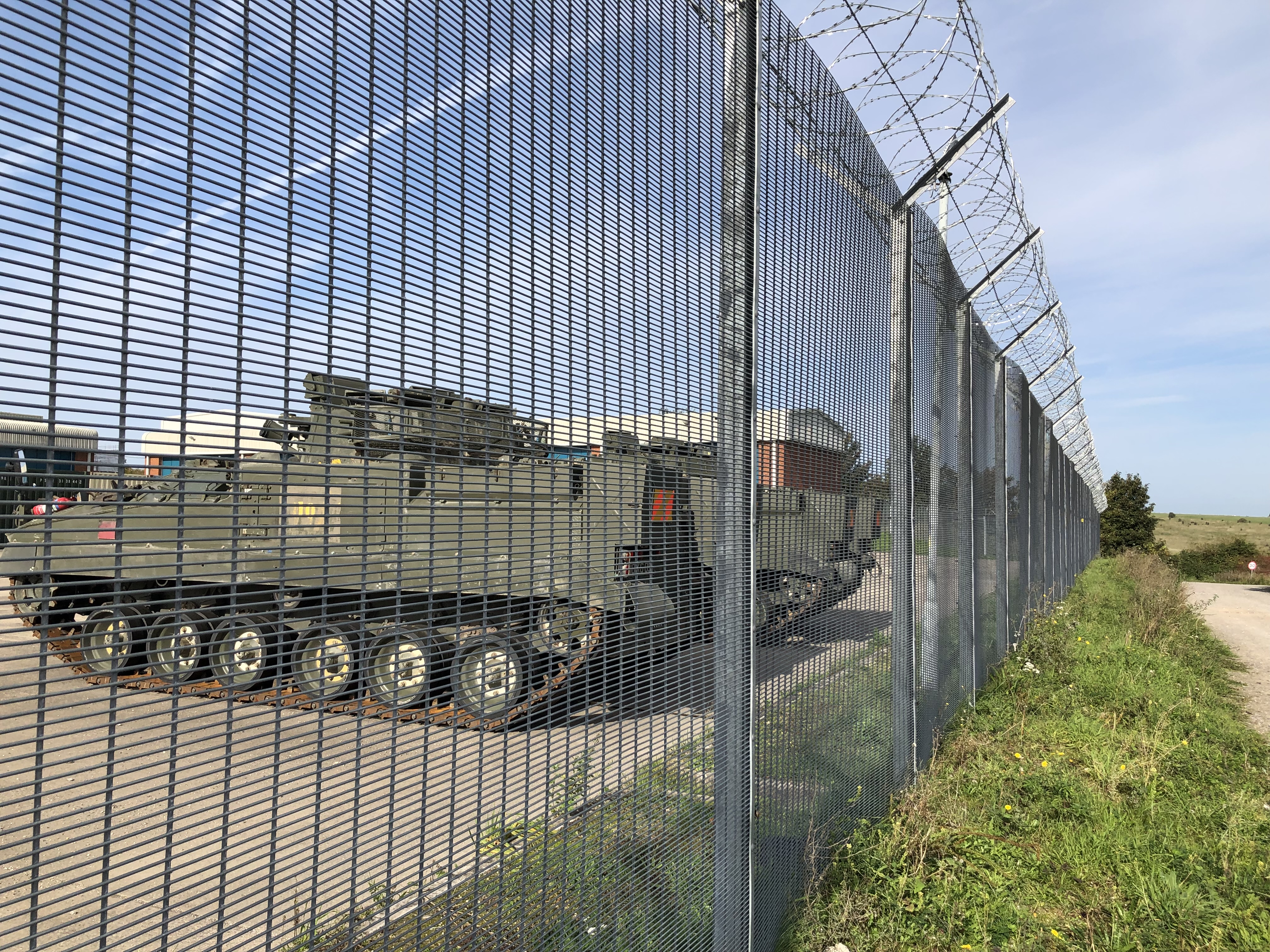
At the main backroad to Stonehenge, we made a wrong turn. Perhaps the signed bike-path was too good to pass up. In any case soon we hit a rotary, which are the worst for me. Everyone is going the wrong way around.
Our bike computer was taking a coffee break so we headed off, “Intuitively.” We were soon pulling up to Woodhenge. A wonderful place. Out of the way. Ambulance drivers hung out there. Waiting for calls from the big brother, Stonehenge up the road or across the field.
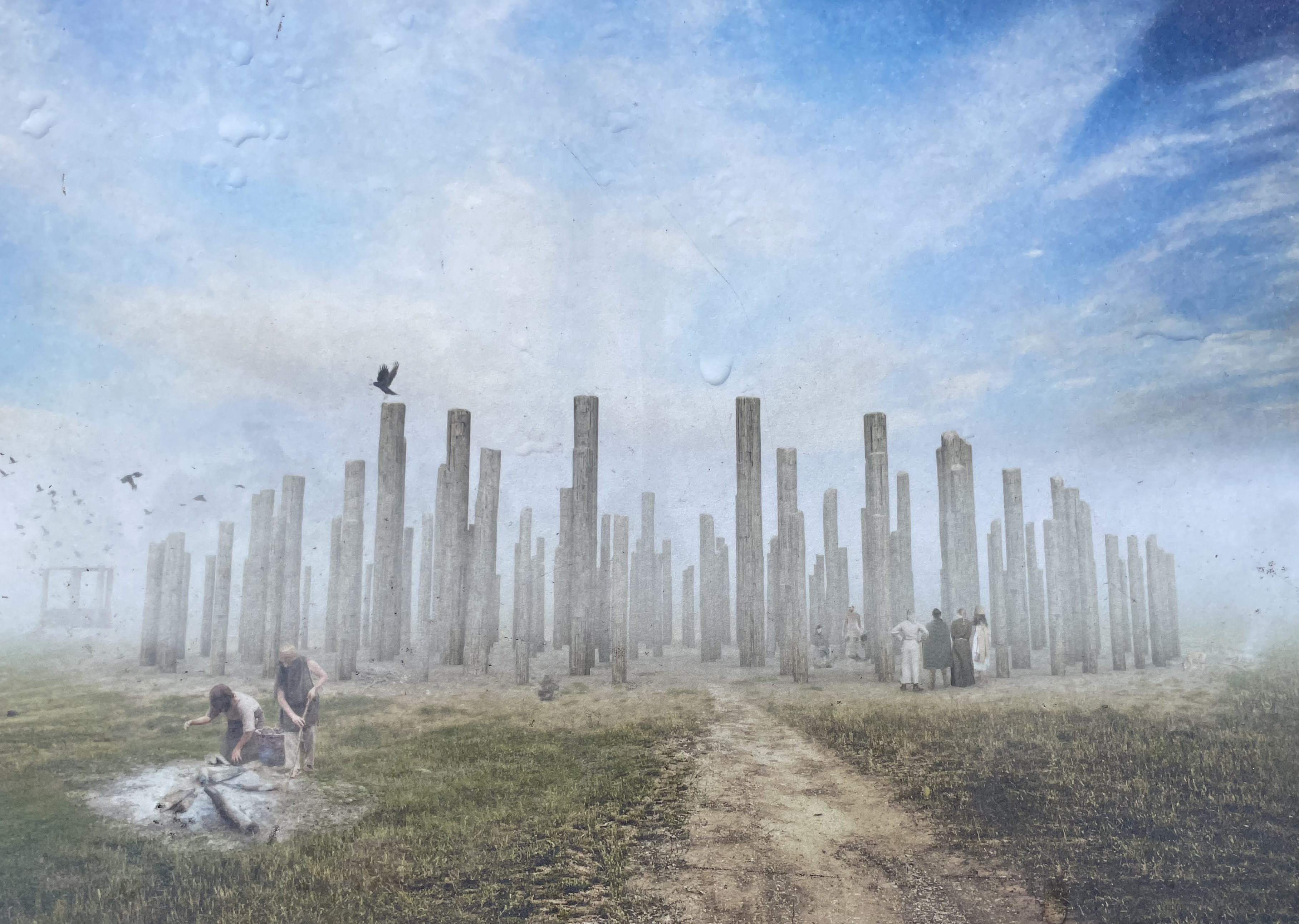
In it’s day, Woodhenge must have been splendid. But wood doesn’t last millennia. Today only concrete markers tell the story. Reminded us of The Sanctuary back in Avebury.
The place had soul. For want of a better word. We struck up a conversation with a woman heading out. She had lived in the area many moons ago and was back paying her respects. She passed along that she was here when the Beatles filmed scenes for their movie “Help” just up the road, on the Salisbury Plain, just passed the tanks with the tall fence and the razor wire on top.
Now how to get to Stonehenge?
We asked some locals out for a stroll. Well, you could go this way, or you could go that way or you could just cut across this field, by the Cuckoo Stone, out through the gate, and follow the dirt path behind the officers’ barracks and eventually you’ll be there.
It was the Cuckoo Stone for us. And a good choice too.
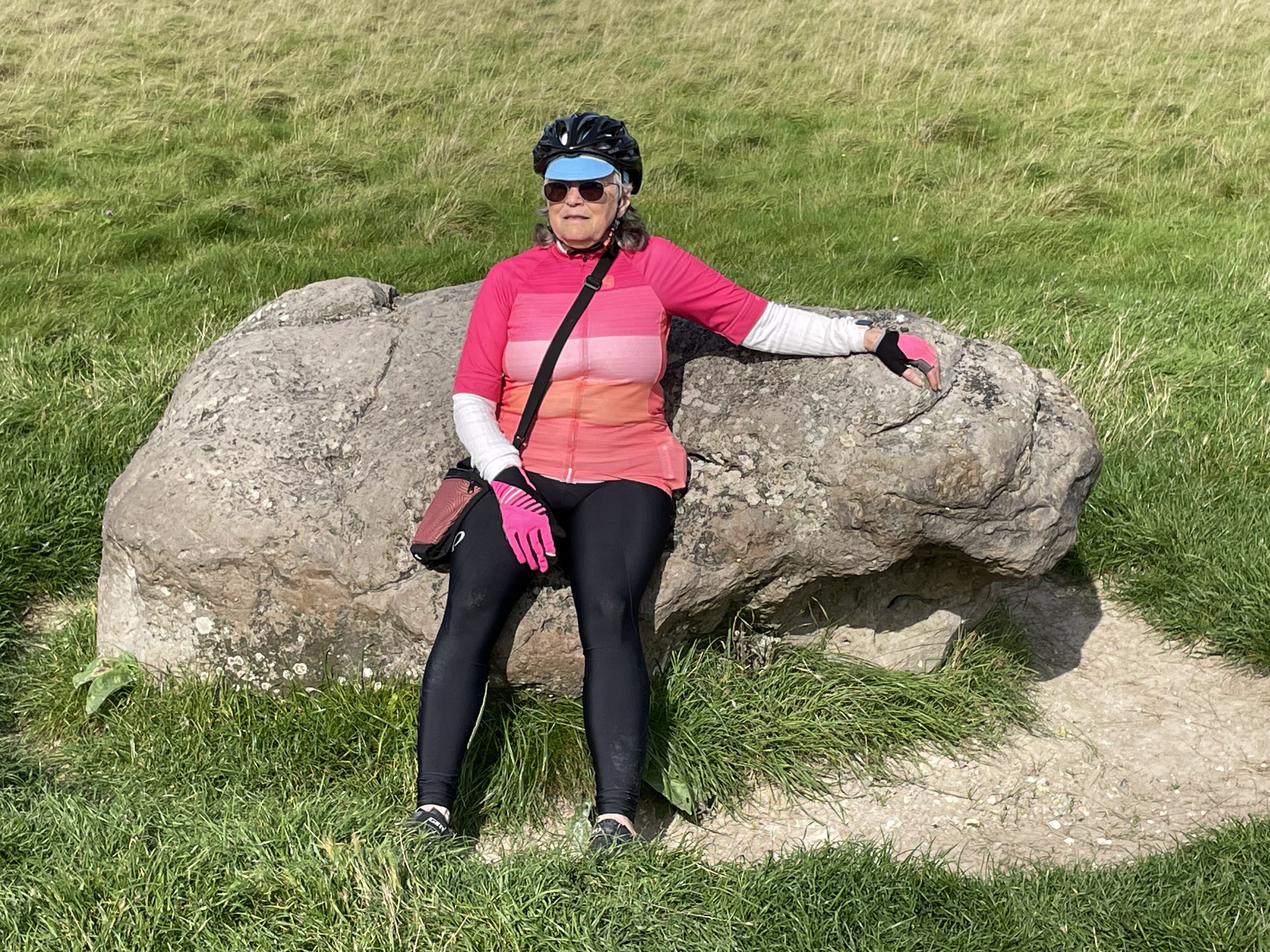
Today the Cuckoo Stone is a modest stone in a field. Doesn’t even rate its own sign.
In days gone by, it could have been a star. Archeologists are working on it. In any case today, it makes a nice seat.
We headed on towards Stonehenge. Closing the gate behind us, the dirt path, aside from some unrideable sections, worked out perfectly. And unrideable wasn’t a problem, after the Ridgeway, we were used to that.
We emerged from the underbrush to be greeted by a sweeping view to Stonehenge in the distance. It turned out the we at the top of the Stonehenge Cursus, perhaps used as a traditional processional approach to Stonehenge, back in the day.
But that may be backwards as the Stonehenge Cursus predates Stonehenge by hundreds of years. Cursus being a wide path with parallel earthworks. This Stonehenge Cursus is 330 wide and almost 2 miles long, and a nice ride.
Off we went playing tag with a family on mountain bikes. Mr. Dad would hold the gates for us and then off they’d zoom. Kids were 9-10, and far faster than us. Then again we were on grass, and still feeling the cold hard wet chalk when we went down on the Ridgeway.
We came out on a dirt road. Looking back Sharon pointed out a no-bikes-allowed sign. No harm. No foul.
This dirt road wasn’t any dirt road, it was the Drove. A Gravel Byway that runs past Stonehenge. It is a Vehicular right of way and an unofficial wild camping spot with a magnificent view of Stonehenge itself.

The Drove was entertaining. One part Mad Max. One part Hippy Caravan. With a filling of run-of-the mill-camper-vans.
We wove our way around the mega-potholes and shortly arrived at the entrance to Stonehenge. Our English Heritage 7 day pass did it’s magic and we were waved through. This was no Avebury. Huge crowds, paved walk-ways, Closely monitored. One way circulation.
Not a druid in sight. Curiously druids have become associated with Stonehenge, but Stonehenge is far older. Stonehenge as we know it today dates from the late Neolithic period, around 4500 years ago. Then came the Beaker people. And then the Celts with their druids, probably 2500 years ago.
Then came the Romans, then King Arthur and the Anglo-Saxons, then the Vikings and finally the England of today.
I was having a good time. Sharon was distracted by all the languages surrounding us. She struck up a conversation with an elderly German fellow, happy to have someone to talk to, in his native language.

In a curious kind-of-way, Stonehenge has become a caricature of itself. It looks, well, exactly like Stonehenge. You can’t walk up and touch the stones, but the path is optimized for selfies, all the way around. Looks a bit like a stage set. Which I suppose it is today.
One of the big differences between Avebury and Stonehenge is that the Avebury stones are natural, silicified sandstone blocks, or sarsens. Found rocks, filled with character.
Stonehenge stones are sarsens as well, but dressed sarsens. All the rough surfaces have been smoothed and shaped. Impressive work, but something lost as well.
Our next door neighbor back home had warned us that Stonehenge was not all that impressive. In itself, perhaps not up to its reputation.
As part of a ritual landscape though, it’s totally the real deal.
A sundial in a ritual garden.
After a quick stop at the museum complex up the road we headed back to the Dog + Gun. No Salisbury Plain, just fast, smooth asphalt. No shortcuts. No magic. No artillery range. We’d had enough for one day.
To Salisbury
We had a leisurely breakfast the next morning, packed up, and pulled our bike out onto the parking lot, where we had a short chat with a couple of French women, we had met at breakfast.
We mentioned that we now had a Youtube channel. They asked how many subscribers we had.
“Three”
We all laughed. And then they added,
“If you send us a link you’ll be up to five.”
Somehow we got to talking about Switzerland, trading anecdotes.
I shared that a back in college, a platinum blond from Phoenix I knew, married Swiss. She dumped me for a good friend in the next room over. I ran into her on the internet decades and decades later.
She told me, that she had named her Swiss son after me.
Not to be outdone, one of the French women shared that when a good friend’s father was dying, he insisted on telling his daughter how he had lost his virginity. The daughter really didn’t want to hear the story, but Dad was’t hearing “No.”
He had been hiking in Switzerland as a teenager and met a Swiss woman.
“She was all business, very skilled, very workman-like.” And clearly very memorable.
With that we were off to Salisbury.
With a couple of turns we were once again on back roads, when a tank flashed across the road up ahead. Then another and then another.
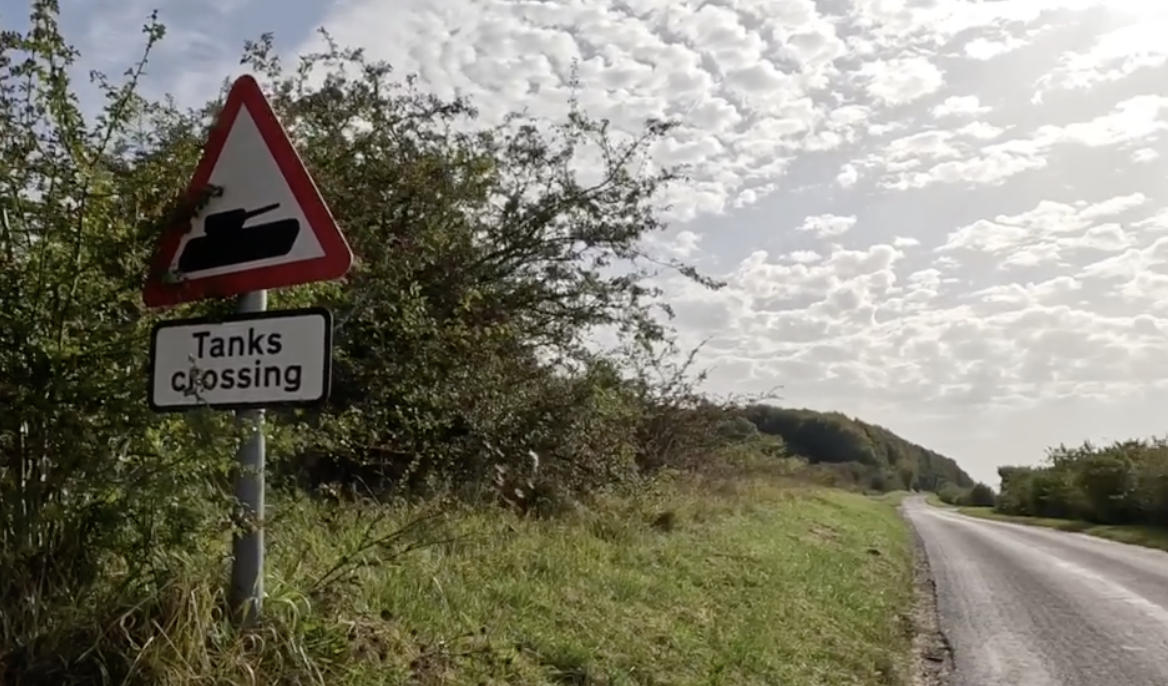
Exciting, but a bit unnerving. Sharon really really wanted a tank video, but someone was out of synch.
We read later that Prince William, Prince of Wales, had visited the Salisbury Plain in our timeframe and taken a spin.
”He said it was his first time in a Warrior and they are always good fun – it’s like a 20-odd tonnes go-kart.”
He’s right, they’re really fast.
Maybe it was Prince William on the crossing. Could have been. But sadly, no video.
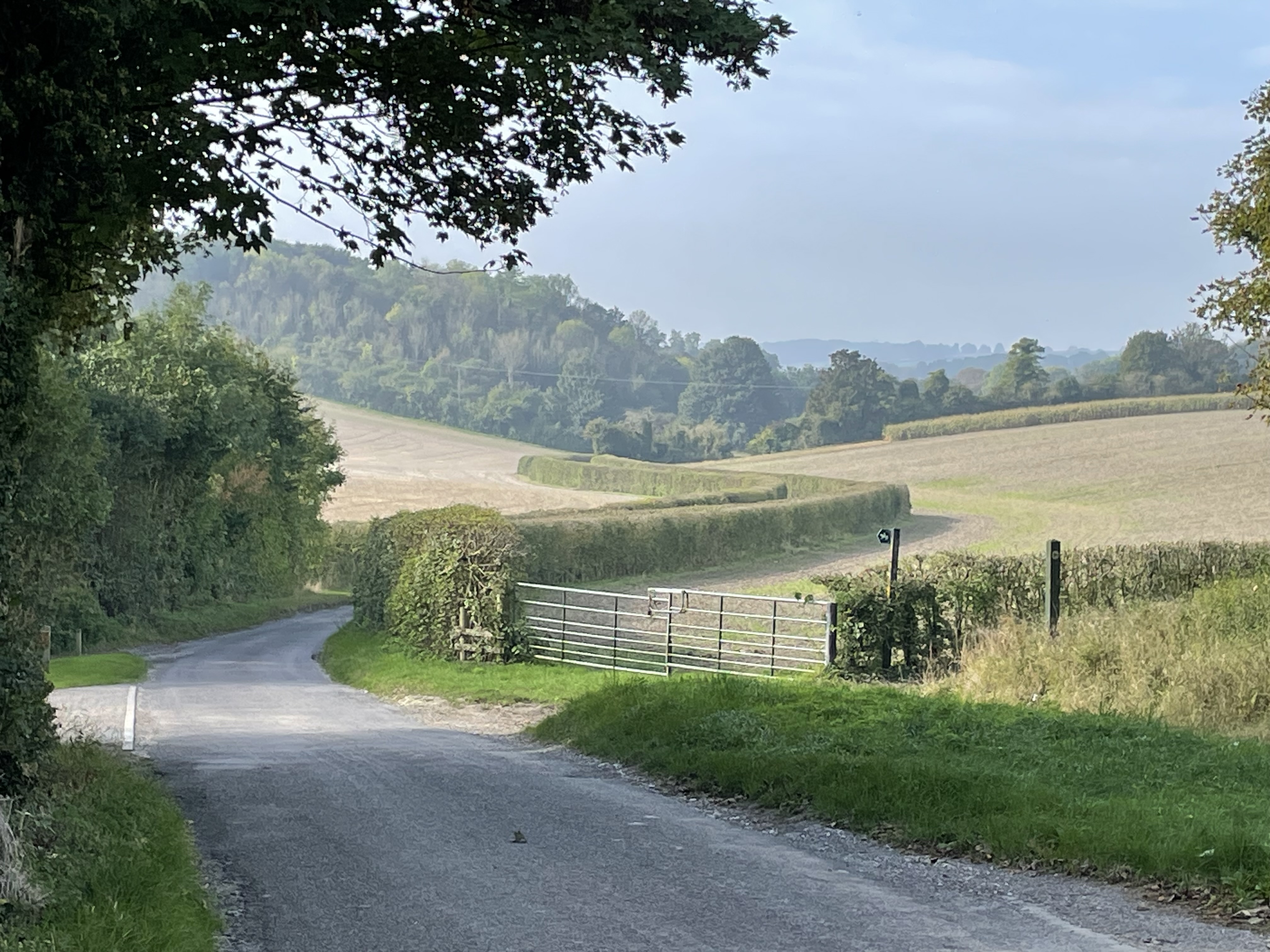
Hedges along the way were spectacular.
Before Salisbury, we had a stop at Old Sarum.
I was expecting another grassy knoll with defensive berms, a sign or two with pics showing what had once been there.
Old Sarum is so much more and has been for 5000 years. First used by Neolithic builders of Stonehenge and Avebury Circle, then the Celts, followed by the Romans, Anglo-Saxons, and finally the Normans. The remains today are of the Royal Castle of William the Conqueror, the first Norman King of England.
Approaching Old Sarum was a climb. We were approaching from the backside. We had to ride up and around counterclockwise. 3/4 the way up our road started down. We had missed our turn. No wonder. It was a cowpath with a gate. After a short walk we were back on asphalt and heading up again.
Old Sarum is big and high.
We rode through the outer berm, got off in the parking lot and pushed the bike up and across the drawbridge through the remains of the gatehouse into the inner Bailey of the the Castle.

A model of Old Sarum in the 12th century above. The model is housed in the Salisbury Cathedral.
We flashed our English Heritage pass, bought some ice cream, and then some more ice cream and went for a stroll: through ruined shell of the keep, or great tower, the remains of the courtyard house, the kitchen tower, and chapel.
We could see marked out, the Old Sarum Cathedral in the outer keep below. Sun was shining. It was a good day. The freshly inked, Magna Carta had once been stored right there in the old Cathedral.

Then it was up onto the ramparts where we could see Salisbury Cathedral in the distance.
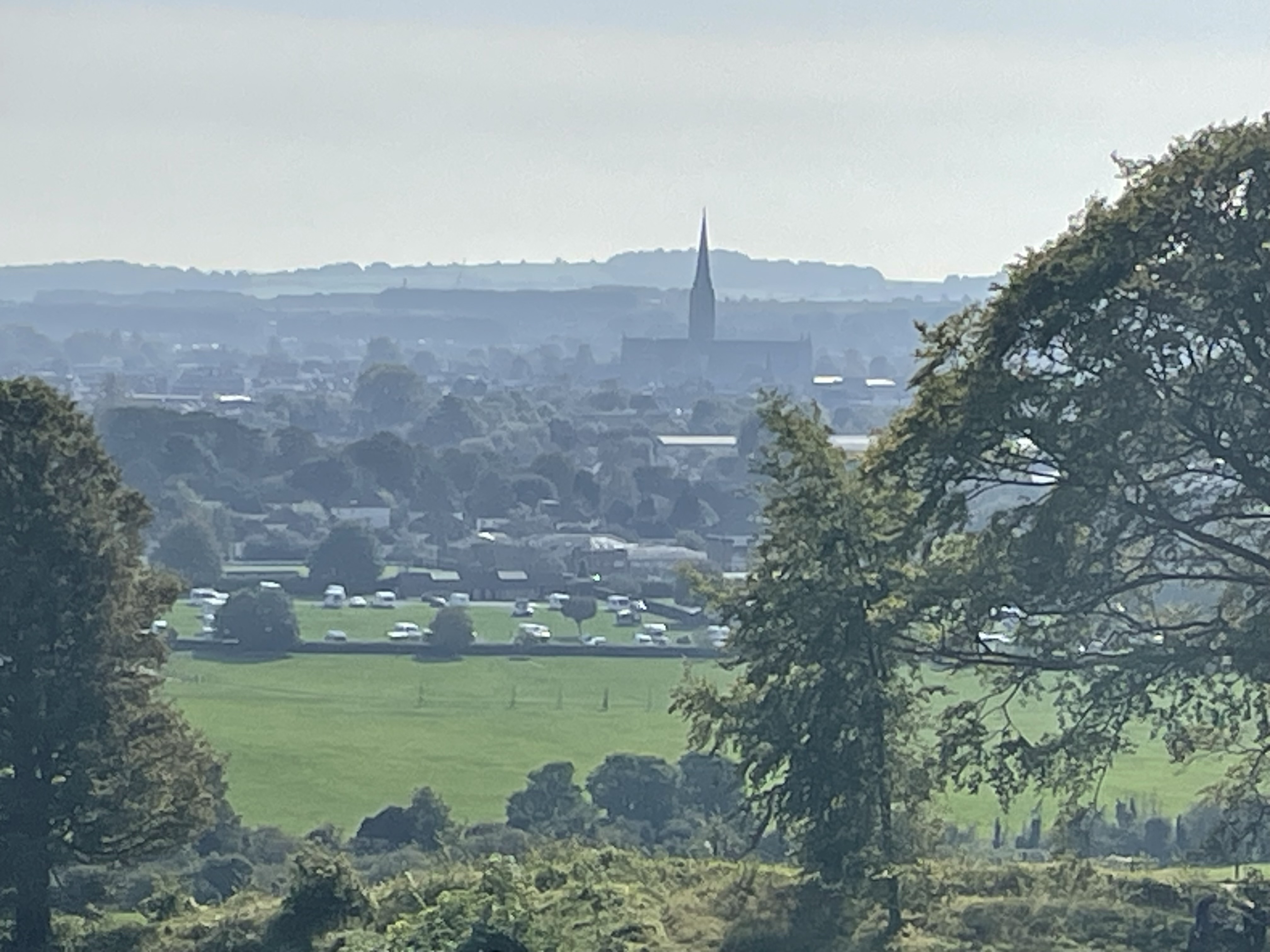
By the mid-1200s, the church had had enough of Old Sarum. Something about poor relations between priests and castle guards, and taxes. They built themselves a spanking new world class cathedral, and moved.
My Grandmother always claimed that we were descendants of William the Conqueror, and she paid for a family tree to prove it.
Perhaps. Then again perhaps not. There was one dodgy link, Humphrey Warren, who many thought died in the West Indies in about 1680. But maybe that was another Humphrey Warren, and our Humphrey Warren made it to the USA.
This was important for my grandmother. Say what you will, but she cared most about her family. If we were descended from royalty, so much the better. Here’s to you Cordelia.
The ride down to Salisbury was a bit of an adventure. We didn’t have far to go, so I never doublechecked the route our bike computer had set up for us. Not that it would have made any difference.
Something didn’t look right, so we asked a local, it turned out she was from Australia. We missed a turn and ended up in a mobile home park. Then it was along a narrow path through a park and into a tract of suburban homes.
We walked alongside one of the houses and emerged on a bike path. From there we wove back and forth across the River Avon until we were close to downtown Salisbury. The bike path was blocked and we were kicked back off route.
We trundled along with homeless guy and soon hit major construction, which is where we met Dan-Dan the gate man directing traffic. We shared our story, and he shared his, along with the story behind the construction.
River Avon was getting a makeover and a little respect. He thought our little adventure was great:
“You’re doing it right.”
Shortly thereafter we were pulling up to our Inn, the Red Lion. Dan-Dan the gate man thought highly of place. He was going to spend 5 days there over Xmas there with his girlfriend. Dan was perhaps early 30s. He was back in school, inspired by English History and respect for the environment.
The Red Lion
The Red Lion was old old. Perhaps the oldest hotel in England. The original building dates from the late 1200s. Started life as the White Bear Inn to house the draughtsman working on the new Salisbury Cathedral.
The running joke, probably also many centuries old:
“When the people of Old Sarum realized that there was an excellent hotel in the valley, they moved the Cathedral to be nearer it.”
In the early 1700s the name was changed to the ‘Red Lion and Cross Keys’ and from there shortened to simply the Red Lion.

The Red Lion served as the town post office during the 18th and 19th centuries, and was a regular stopping point for coaches traveling to and from London.
You could almost hear the hooves on pavement, cries of the coachmen, and rush of the passengers to get the good seats by the stage coach windows.
On our first night, a large group had booked the whole dining room. Luckily I had dinner reservations in hand and couldn’t be turned away. We were seated in the lounge in a nook table next to a gorgeous medieval (1600±) carved fireplace. Kind of perfect.

Curiously the Red Lion is owned and run today by Best Western. No more local artisanal English Ales in the bar. It’s Corona and Stella Artois all the way down.
But, it’s probably safe to say that this is the only Best Western with a skeleton clock with case carvings by prisoners of war from the Spanish Armada.
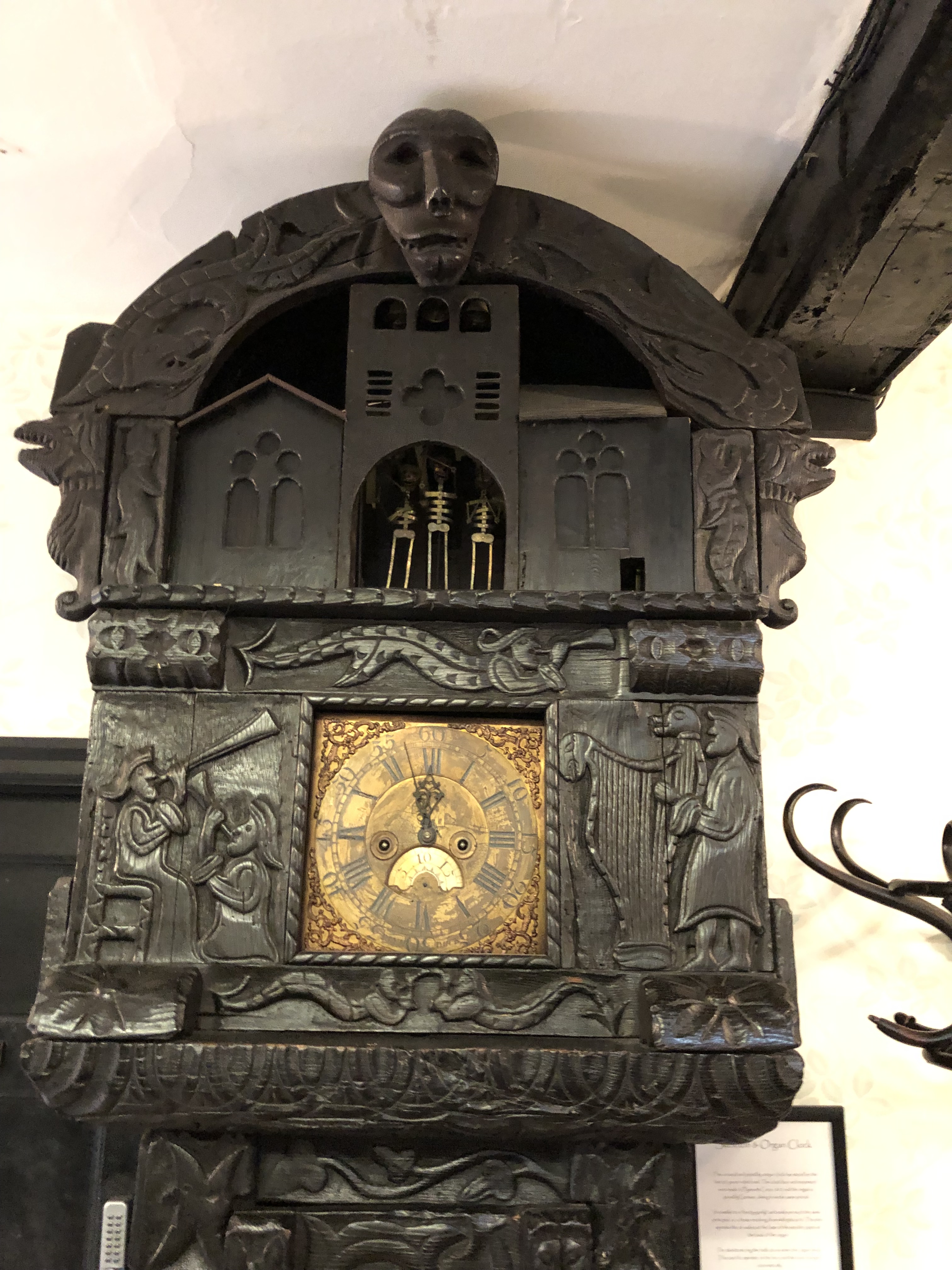
The skeletons purportedly came out dancing to hurdy gurdy organ music.
I asked if it still worked. Expected a flat “no” or a disinterested shrug, but instead, got an enthusiastic,
“Let’s Try”
We did, but no music. No dancing skeletons.
Salisbury Cathedral
The next morning was Cathedral Day. I figured we’d wander over, check out the big guy, the Magna Carta and an associated museum.
Sharon was far more excited than I.
It was only a ten minute walk away – go up to the corner, take a left on Exeter Street and I figured we’d see the Cathedral across grassy lawns.
Well not exactly.
What I didn’t understand was the concept of a “close.” The entire area surrounding the cathedral is closed off by a wall built in the 15th century. This close is big. The biggest in the UK.
We missed St. Anne’s gate and then the Bishops gate.
We asked a postman at the Royal Mail Postbox for directions. Friendly enough fellow, but barely understandable. Irish by birth. He’d been in Salisbury for 27 years. A mix of heavy accents. It would have been nice to have subtitles.
He had had enough.
“Garble, garble… The only thing that changes here are the clothes in the windows… garble, garble, garble…”
He pointed out the Bishop’s gate, nowadays the entrance to the Cathedral School, which looked to me like an arched opening in the side of a stone house, and through the wall we passed with a passel of young folks in uniforms.
A short walk later, we had our grassy lawns and cathedral views. We decided to go to the museum first. But where was it? After a short bicker, a kindly soul directed us around to the other side of the cathedral. We were both right. Or at least that’s my story.
The Salisbury Museum was pretty great. World class collections on Stonehenge and Old Sarum. We had our own docent, who must have been a retired professor. He knew far too much. No regular guy, he. Sharon was most happy.
As is said,
“Happy Wife, Happy Life.”
The museum also had stuffed Great Bustards. At 30 lbs, with wings that stretched to 7 feet, the Great Bustard is the heaviest flying bird in the world. Once native to the Salisbury Plain.

They were too tasty for their own good. A staple of Medieval dinners.
Here in the USA, we have the Turducken – a chicken stuffed into duck, stuffed into a turkey. That’s three birds. At a Great Bustards’ feast, they could do 15 birds – one inside another and so forth. Like Russian Dolls and baked for a day.
Eaten into extinction in England 170 years ago. Today Bustards have been reintroduced to the Salisbury Plain from Russia and Spain.
As a protected species, they no longer need fear the fork, but they are sharing their habitat with artillery, tanks, and long barrows. Fingers crossed.
Next up was the Cathedral. Pretty fantastic too, but it’s hard to top the Great Bustards.

The Cathedral’s main body was completed in 38 years, from 1220 to 1258. The spire was built in 1320. Eventually reaching 404 feet which made it the second tallest spire in England. Only St. Pauls in London was higher.
Then in 1561, Salisbury took over the number one ranking, when lighting hit St. Pauls. The spire caught fire, and crashed through the nave roof.
Eventually St Pauls was redesigned and rebuilt, though not quite so high. The task fell to Sir Christopher Wren, perhaps the second most important Englishman after Shakespeare.
Wren made a survey of Salisbury Cathedral in 1669 for his friend Seth Ward, Bishop of Salisbury. In his report he noted that the Spire had tilted slightly. To fix it, he recommended adding iron bands to the inside of the Spire. So far so good.
Somewhere along the way, Sir Christopher Wren also left his mark on Stonehenge, carving his name into one of the Stones. Historic graffiti by famous folks. What’s not to like?
Salisbury Cathedral is filled with treasures: The oldest working clock in the world from 1386.
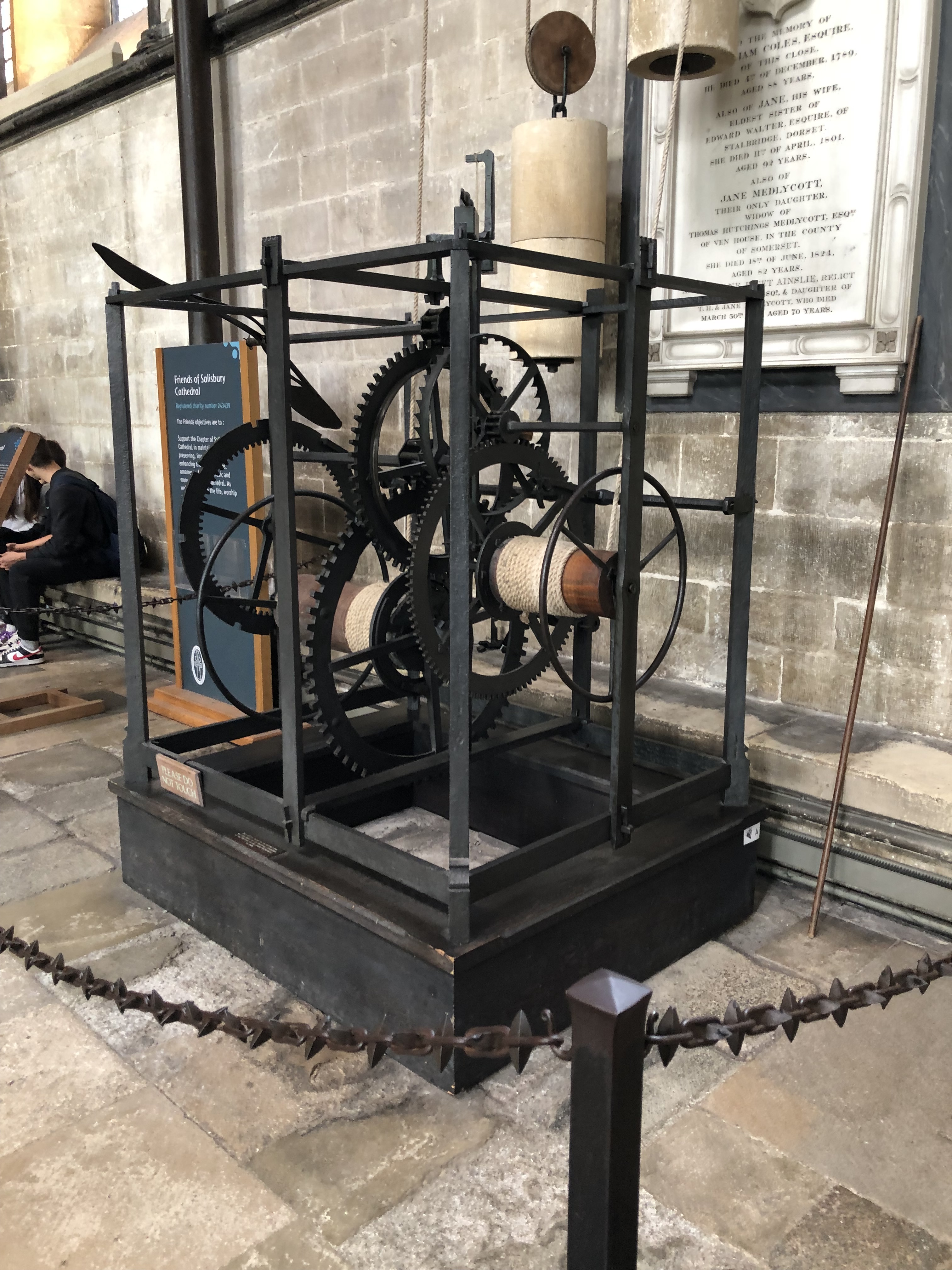
Also plenty of impressive tombs and medieval strong boxes where the church kept its money, and so forth, but most impressive was the Magna Carta.
Yes. The real deal Magna Carta, not a reproduction. Written in cursive Latin, in tiny letters, with closely spaced lines, so all 3500 ± words would fit on one sheepskin. No fancy flourishes. A working document and it looks it.

From then on, even Kings had to play by the rules, or at least some rules.
Some time later, Sharon and I were talking about document. In her inimitable way she volunteered that the scribes had used iron gall ink made from growths on oak trees caused by parasitic wasps. Who has that in their short term memory. Yikes.
Back at the Red Lion, it was time to pack Mr Tandem back into his suitcases. The luggage room was just off the courtyard as would be expected in a stage coach inn. I pulled everything out and set to work. Pretty much an ideal set-up. Complete with a table to rest my beer.
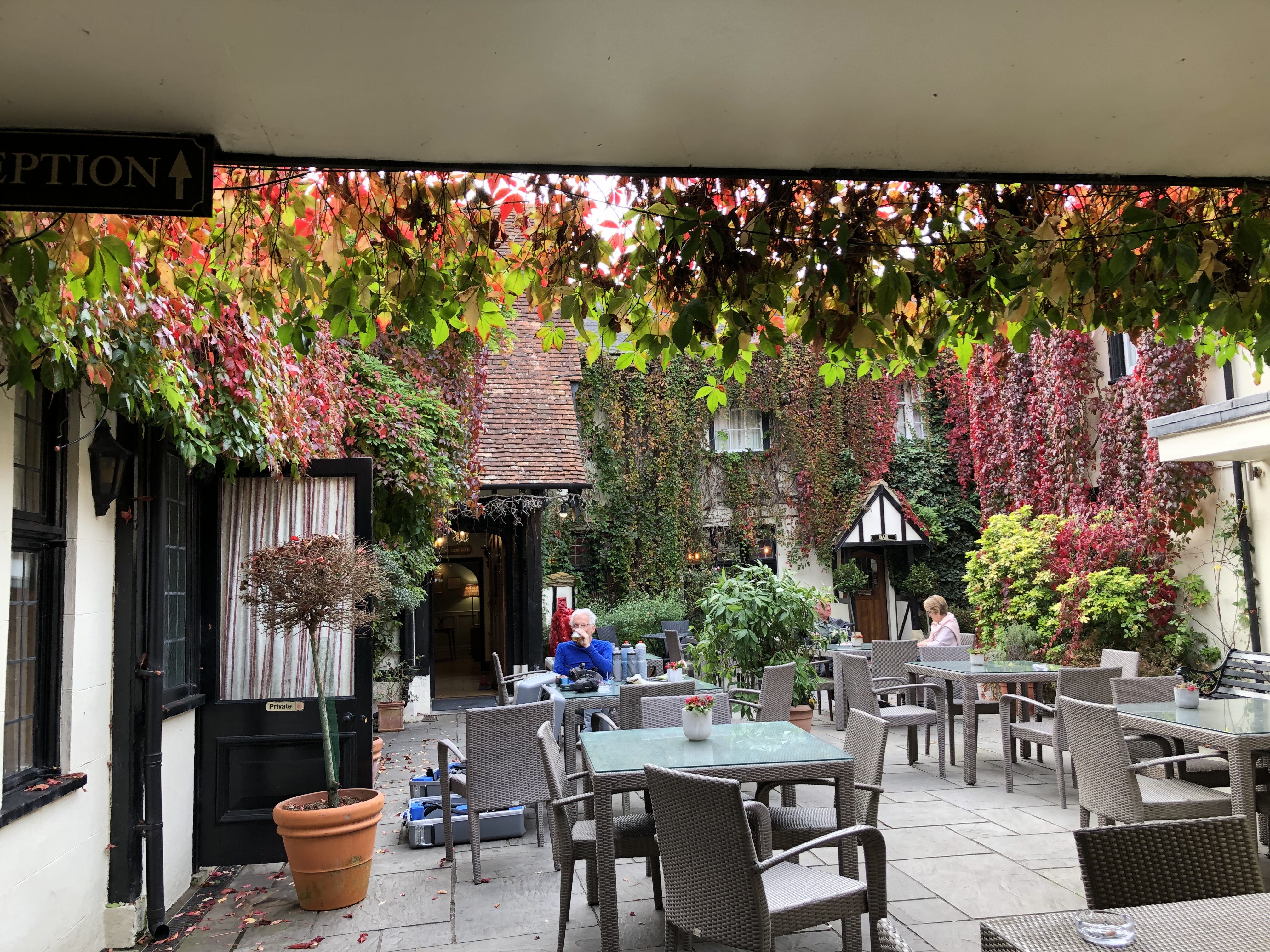
The courtyard serves as an extended lounge and in good weather like that day, it fills up.
There was a birthday celebration a couple of tables over. Either a member of the staff or a spouse. Lots of folks sidled up and wished well. Sharon commented on the frightening orange color of their drinks.
Then there was this elderly Irish guy in a sports coat with medals pinned to his chest. Clearly a regular and likely a regular for a long, long time. We chatted in an oblique way. He kept telling me how he’d given up drinking years ago, when clearly he hadn’t.
His character would have been right at home in back in the 17th century. Outside the hotel ran one of the main watercourses of Salisbury, where there was a “Cage and Ducking Stool” for punishment and public humiliation.
Story has it that after an entertaining dunking folks would return to the Inn for refreshment.
With the bike packed up, we packed up ourselves. And it was early to bed.
Deep was picking us up at 4 AM for our 8:30 flight back to Boston out of Heathrow.
At 3:45 AM we headed down to the front desk. It was raining and it was dark, dark in the courtyard. We stepped outside and were greeted by a black cat who appeared out of nowhere. We gave him a couple of pats and he disappeared. Felt like a local spirit, seeing us off.
We hauled our bags across the courtyard to the high arched covered entrance off the street. There were two giant ancient doors with a bar across both. Then on the left I noticed a door within the door which opened. A bit like time travel.
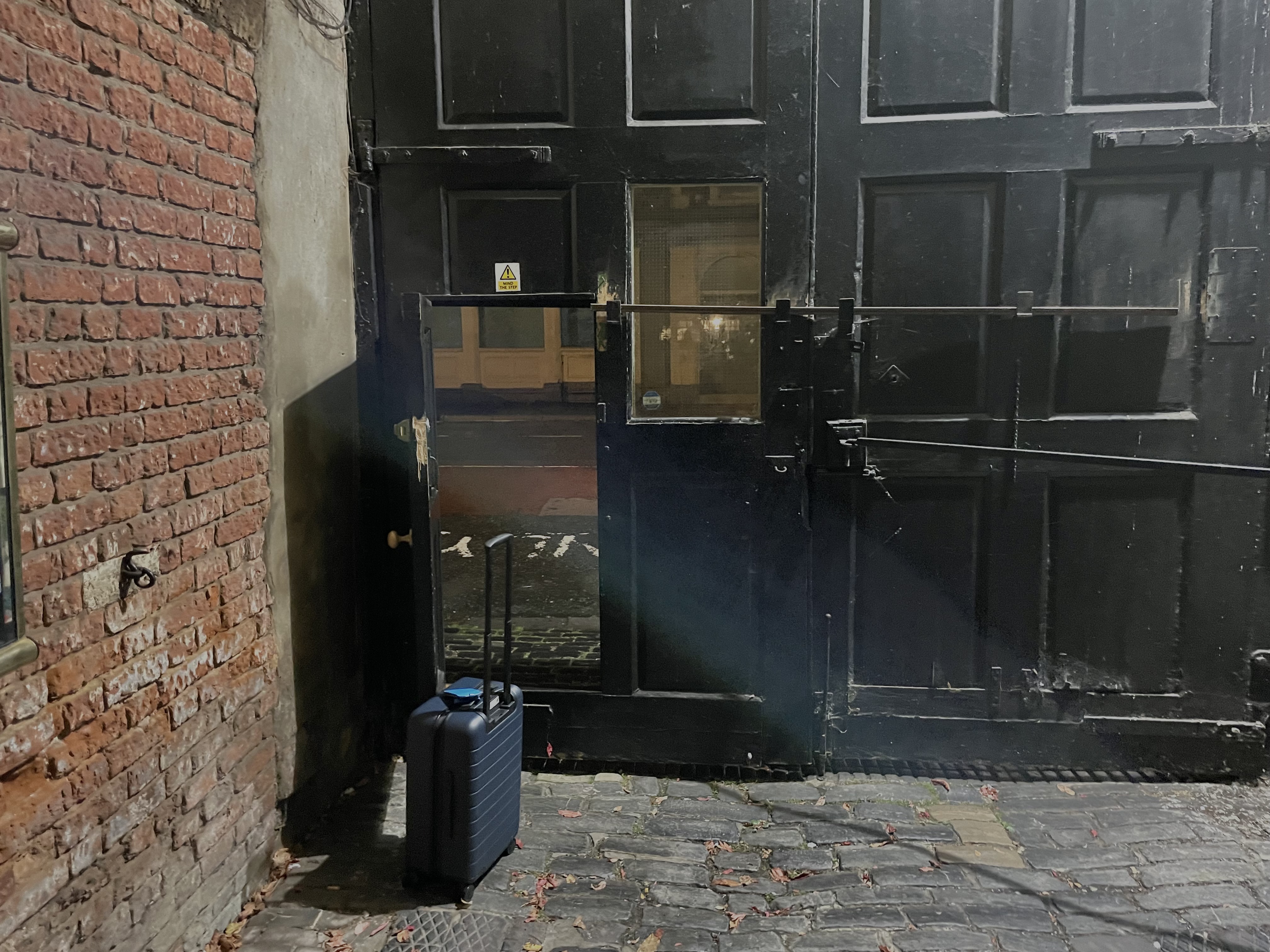
Outside Deep was waiting in the 21st century..
 Advencha before Dementia